Music Videos
Music and the moving image / Directed videos and adjacent collaborations
A song can find another life inside an image.
Some of these works begin with an invitation from another musician. Others join Lynch’s own music to his filmmaking, or carry an existing character into a live performance. Their shared territory is the relationship between a recording and an image—but their credits, purposes and histories are not all the same.
This dossier develops seven selected encounters, from Chris Isaak to Chrystabell, with a separate record for the difficult-to-collate Longing. It connects to Lynch’s recording and performance work, the short films and commercials. It is a substantial working guide, not a complete authenticated music-video filmography.
Whose song, whose film?
A song performed by David Lynch does not necessarily have a video directed by David Lynch. Arnold de Parscau’s own portfolio places Good Day Today among the clips he wrote and directed, while identifying Lynch as composer and performer. Director’s portfolio ↗ This distinction is basic, but it matters whenever an online playlist becomes someone’s filmography.
The same care is needed for a video assembled from feature-film footage. Directing those original scenes, directing a new performance shoot and editing the finished promotional video are different jobs. A musician’s appearance in Twin Peaks is another distinct form. The studies below identify the evidence behind each attribution and mark adjacent collaborations as such.
Directed video
A music video with a directing credit documented by its artist, label, contemporary reporting or institutional programme.
Adjacent collaboration
An animation, concert image, soundtrack contribution or performance can belong here without being relabelled as a conventional music video. Interpol’s own distinction is particularly revealing.
The best comparison starts with the relation between song and image. Does the image supply a performer, a story, a space or an independent event? Does it repeat the words, pull away from them or make their meaning uncertain? Those questions are more useful than simply counting recurrent red curtains and industrial textures.
Wicked Game: performance beside a feature film
Chris Isaak / 1990
The Lucca Film Festival’s 2014 programme credits Lynch’s Wicked Game and describes a band performance intercut with Wild at Heart material. Programme, pp. 80–81 ↗ A 1990 notice corroborates Lynch’s credit. Credit notice ↗
The juxtaposition asks a recording to occupy two spaces: the musician’s performance and an already existing fiction. A film excerpt carries memories, faces and dramatic associations into the song. The performance can, in turn, detach the music from a particular film scene and return attention to the artist. This is a useful starting hypothesis for the shot-by-shot comparison, not a report of a completed viewing.
Version identity is especially important for a song with multiple circulating videos. The Lynch record should be matched to an original label copy before technical details, awards or images from another version are attached to it. keeps that comparison open. The feature’s own production and reception remain in the Wild at Heart dossier.
Longing: preserve the uncertainty around the copy
X Japan / 1995 in the programme record
Lucca’s programme lists Longing as a five-minute Lynch work for X Japan and illustrates Yoshiki against an expansive landscape. The accompanying description discusses layered imagery. Programme, pp. 80–81 ↗ This establishes a specific institutional reference, not a complete release history.
The work’s history spans poetry, recorded music and promotional film. Each presentation gives the collaboration a different form, from a short advertisement to a completed video and later documentary extracts.
The useful next step is concrete: identify the precise version pictured and listed by the festival, then compare it with artist or label records. That preserves a valuable part of the catalogue without turning uncertainty into a confident story about an “unreleased” or “lost” film.
Shot in the Back of the Head: an invitation to draw
Moby / 2009
Moby’s original Wait for Me announcement explains that he sent Lynch the music with an open invitation. It describes the first video as animated and identifies the choice of an instrumental lead track as part of the album’s approach. Artist’s journal, 14 April 2009 ↗
In his interview with Liz Ohanesian, Moby gave the invitation a more particular shape: he had asked whether Lynch had footage available, and remembered receiving a fully animated video five days later. That is his account, rather than a verified production timetable. He connected the choice of an instrumental single and unconventional video to his greater independence from major-label expectations. LA Weekly interview ↗
The distinction between borrowing footage and receiving a new animation is the heart of this collaboration. A request for material becomes an act of making. With no singer to lip-sync on screen, the video need not organize itself around a visible vocal performance. Drawing can establish its own figures and spaces alongside the music.
This gives the work a natural route to Lynch’s animated shorts and his graphic work. Similarities of medium are grounds for comparison, not proof that the same process, tools or production team were used. Moby’s video archive
I Touch a Red Button Man: a collaboration that resists the category
Interpol / Coachella and online presentation, 2011
Interpol’s 2011 statement, reproduced by Exclaim!, gives an unusually useful correction to the usual music-video label. The band approached Lynch while developing its Coachella presentation. He offered a drawn character; they sent “Lights.” Their statement expressly distinguished his character animation from a music video made for the song. Band statement ↗
In a later interview, Daniel Kessler recalled the impact of turning around onstage to see Lynch’s image while the band played. NME interview ↗ This recollection restores something that a standalone online clip cannot: the work’s relationship to performers, projection and a live audience.
A concert image is encountered inside an event. It may compete with musicians for attention or enlarge the visual space around them. A later online combination fixes an image and a recording into a different viewing situation. Neither object automatically explains the other. The dossier therefore retains I Touch a Red Button Man as an adjacent collaboration and records its successive presentations in , rather than silently calling every version the official video for “Lights.”
Crazy Clown Time: the backyard as a stage
David Lynch / Video released 2012
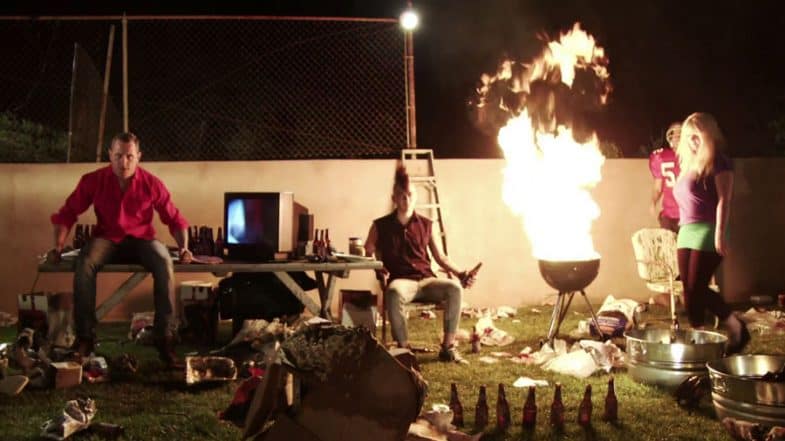
Before the video’s release, Lynch described the song’s world to W in terms of a backyard barbecue and beer. In the same interview, he discussed songs as individual stories and sound for film as an experimental search for the right relation between music and image. These are comments about his thinking, not a shot list for the eventual video. Interview, November 2011 ↗
The self-directed video appeared through Noisey in April 2012. Contemporary coverage also linked a making-of film. Official release · Premiere and production route ↗
Looking at the reproduced frame: a burning barbecue dominates a space cluttered with bottles, a small television, furniture and bodies. The ordinary objects are emphatically present, but the arrangement feels like a performance area: a boundary at the back, a bright light overhead and figures distributed across the width. It is an image of recreation made strange through staging and intensity.
The arrangement brings Lynch’s work as recording artist and image-maker into the same encounter: a song acquires a visual world, and the image establishes its own rhythm of attention.
Came Back Haunted: a long collaboration, a concentrated encounter
Nine Inch Nails / 2013
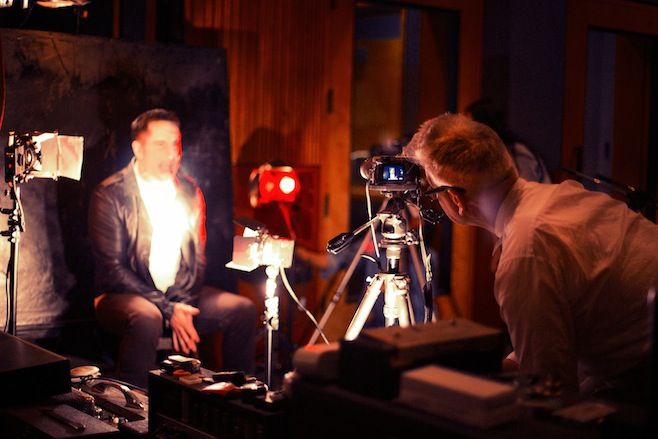
Came Back Haunted arrived in June 2013 ahead of Hesitation Marks. The contemporary release notice explicitly identifies Lynch as director and carries a photosensitivity warning. Release record ↗
Viewing note: the video contains intense flashing imagery that may trigger seizures. This page uses a static production photograph and does not autoplay it. Nine Inch Nails’ video page ↗
Reznor’s 2017 KEXP interview places the video between his work with Lynch on Lost Highway and Nine Inch Nails’ Roadhouse appearance in The Return. He remembered encouraging Lynch to return to moving-image work, while expressly declining to claim responsibility for the television revival. KEXP interview, closing exchange ↗
Looking at the production image: Reznor sits within a tightly organized field of lamps and equipment while Lynch works close to the camera. This is evidence of a physical performance being photographed, even when a finished video is discussed chiefly through its distortions and effects. It helps keep an actor, a camera and a working set inside the account.
I Am the Shaman: the recording story is not the video story
Donovan / Video circulation, 2021
Donovan’s official page gives a useful division of labour: Donovan wrote the song, sang and played his Ferrington acoustic guitar; Lynch produced, supplied guitar textures/effects and directed the video; Dean Hurley engineered and co-mixed the recording. Artist’s credits ↗
In his 2021 Recording Academy interview, Donovan recalled Lynch inviting him to bring an emerging song and develop it in front of the microphone, followed by further production work. This is testimony about the musical session. It does not mean that the video was shot at the same time, improvised in the same way, or made when the song was first recorded. Production interview ↗
A song can be recorded, released, revisited and given a new image at different moments. The video adds another chapter to that collaboration’s history. official artist page
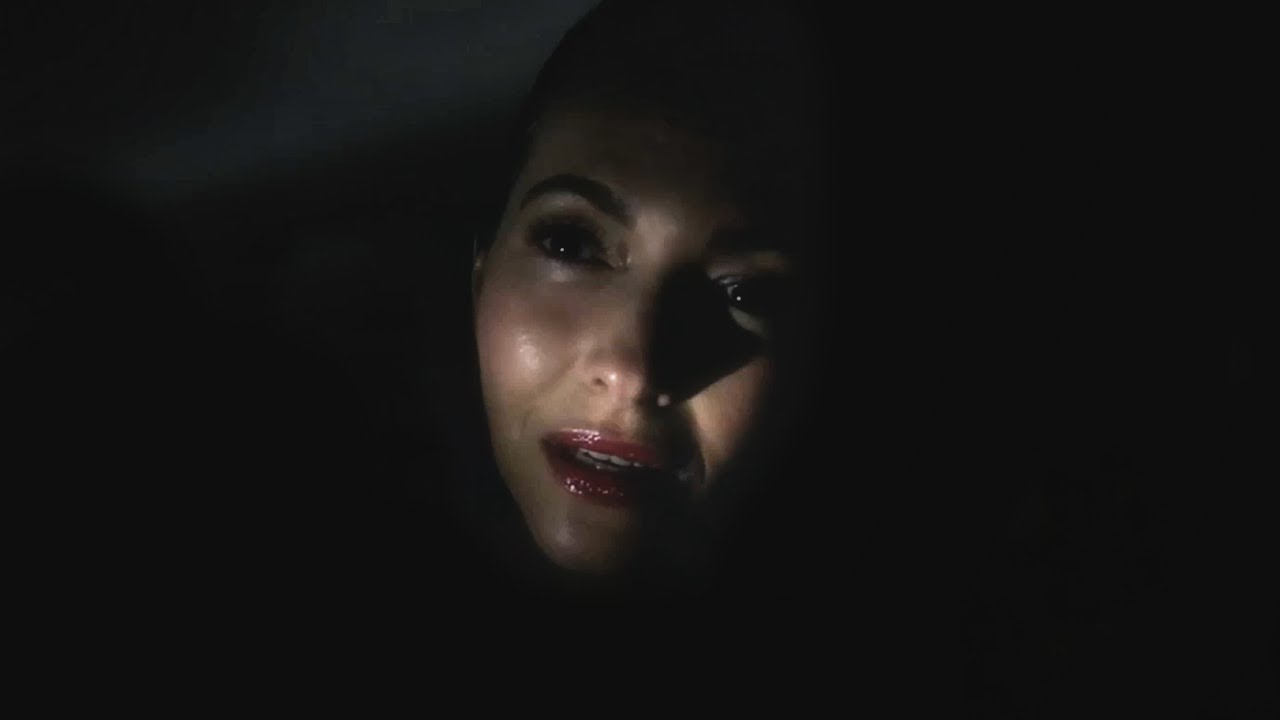
Sublime Eternal Love: a face held in the dark
Chrystabell & David Lynch / 2024
The official David Lynch Theater release identifies Sublime Eternal Love as a Chrystabell and Lynch video; the BFI interview identifies Lynch’s direction. Sacred Bones places the track on Cellophane Memories, originally released on 2 August 2024. Official video · Sight and Sound · Label record ↗
Chrystabell’s account of making the album describes multiple improvised vocal takes, Lynch’s assembly of those recordings and her increasing technical involvement. It is important evidence of collaborative authorship. It is not, by itself, an account of how every video effect was constructed. Recording interview ↗
Looking at the opening image: the lit face occupies only part of a field of darkness. Very little setting is provided; light gives the viewer a person to attend to. Compared with the crowded backyard of Crazy Clown Time, the visible means are spare. The emotional invitation comes from a face and its partial emergence, rather than a collection of props.
This comparison concerns the two reproduced images. A fuller reading of vocal layers, changing faces, pauses and image timing belongs to the audiovisual pass. Watch the official video ↗, or continue to the Music dossier for the recording partnership and album context.
From promotion to exhibition—and back to the source
Lucca’s 2014 catalogue placed four videos inside a project relating them to virtual architectural spaces. That is a concrete example of promotional work acquiring an exhibition context. It also gives a dated institutional list against which to check titles and credits. Lucca Virtual, pp. 80–83 ↗
Context changes the questions. A label release asks how a film introduces a song. A live projection asks how an image shares attention with performers. An exhibition asks how a work behaves in a space among other objects and screens. A present-day archive must preserve those differences rather than flatten all three into a playlist.
Access is part of the history. An official catalogue page can survive after its embedded player fails; a later repost can have a different soundtrack, crop or opening slate. The links here identify their source, and the page keeps its written research accessible without loading a wall of third-party players.
Follow the recording
Music follows albums, collaborators and performances beyond the video. A record’s engineering credit is not automatically a film’s sound credit.
Follow the image
Short films, commercials and visual art offer comparisons in animation, commissioned work and the material image.
Explore further
Follow the sources below, explore the museum collection, or continue through the Reading Room. New archival discoveries and contributions enrich the record of Lynch’s work.
Sources and further reading
Artist statements, production accounts, institutional collections and contemporary reporting trace the works and their collaborations. Explore the references below.
- Lucca Film Festival 2014 catalogue: Lucca Virtual ↗Printed pp. 80–83 (PDF pages 41–42) inspected; pp. 80–81 also visually checked. Programme entries and Luca Pacilio’s commentary identify Wicked Game, Longing, Shot in the Back of the Head and Came Back Haunted. Evidence of curatorial framing and exhibition plans, not a record of our viewing.
- Patrick Goldstein — Los Angeles Times, 19 August 1990 ↗Contemporary corroboration, inspected.
- Moby: Wait for Me — artist’s journal, 14 April 2009 ↗Artist’s original album announcement inspected.
- Liz Ohanesian interviews Moby — LA Weekly, 20 May 2009 ↗Question-and-answer account inspected, especially the initial Lynch and major-label exchanges. The five-day recollection is attributed to Moby, not converted into a verified production schedule.
- Shot in the Back of the Head — Moby’s video archive ↗Artist-hosted catalogue route inspected. Its embedded player currently lacks a video identifier in the retrieved page, so this is a reference link rather than a promise of working playback.
- Interpol’s 2011 statement, reproduced by Exclaim! ↗Josiah Hughes, 13 July 2011. Complete reproduced band statement inspected; the original HuffPost premiere is an outstanding source. Distinguishes a character animation shared for performance from a commissioned music video.
- Interpol interview — NME, 2022 ↗Coachella/Red Button Man interview exchange inspected. Participant recollection of the collaboration and onstage projection; not a reconstruction of every exhibition version.
- Michael Slenske: Five Minutes With David Lynch — W, 1 November 2011 ↗Interview inspected. Distinguishes Lynch’s comments about the album, backyard setting and sound/image experimentation from evidence about a later video shoot.
- Crazy Clown Time — official Noisey premiere ↗Official upload title and uploader verified through public metadata; contemporary release coverage identifies the self-directed video.
- Pieter Dom: Crazy Clown Time — Welcome to Twin Peaks, 2 April 2012 ↗Premiere article, authentic backyard frame and links to production material inspected. Embedded making-of remains a specific viewing lead.
- Evan Minsker: Came Back Haunted — Pitchfork, 28 June 2013 ↗Contemporary release notice, photosensitivity warning and production photographs inspected. Source of the reproduced Reznor/Lynch production image.
- Claire Lobenfeld: Came Back Haunted — Stereogum, 28 June 2013 ↗Contemporary production-photograph gallery, credited to Rob Sheridan.
- KEXP exclusive interview with Trent Reznor, 2 August 2017 ↗Closing Twin Peaks/Lynch exchange inspected. Reznor connects Lost Highway, the video and the Roadhouse performance; his encouragement is not claimed as the cause of The Return.
- I Am the Shaman — Donovan’s official record ↗Artist’s credits inspected: song, instruments, production, engineering/co-mix and video direction. A digital single listing does not establish the session date.
- Morgan Enos interviews Donovan — Recording Academy, 1 June 2021 ↗Opening production exchange inspected. Donovan describes a spontaneously developing song; the account concerns recording, not proof that the video was improvised.
- Chrystabell on Cellophane Memories — Sight and Sound, 2024 ↗Interview passages on takes, vocal assembly, Pro Tools and collaboration inspected; embeds the official Sublime Eternal Love video and identifies Lynch as director.
- Sublime Eternal Love — David Lynch Theater ↗Official video title, uploader and original 1280×720 thumbnail verified through public page/metadata.
- Cellophane Memories — Sacred Bones Records, SBR344 ↗Label’s track list and original 2 August 2024 release date inspected. Current merchandise/repress shipping dates are not substituted for the album’s original date.
- Arnold de Parscau: official directing portfolio ↗Clips section inspected. Identifies Good Day Today as written and directed by de Parscau, with music composed/performed by Lynch. Portfolio uses 2010; release chronology remains to be collated.
Another doorway
Continue exploring
Music
Music
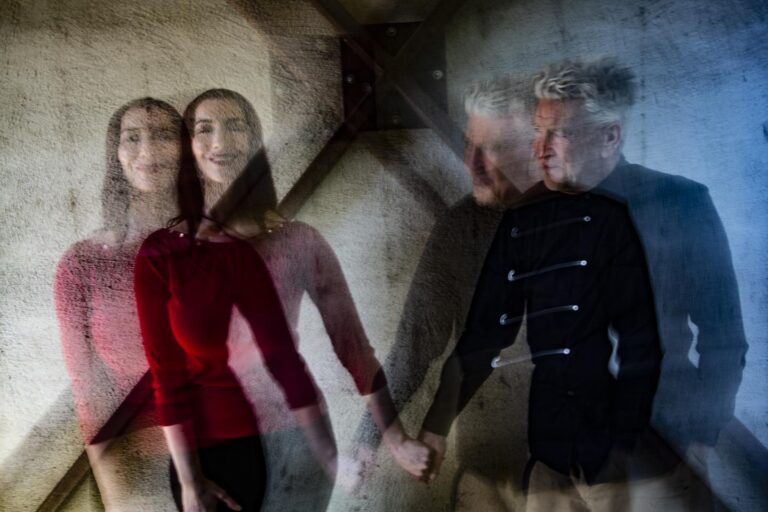
Explore David Lynch’s albums and collaborators, from Julee Cruise and Thought Gang to Chrystabell, with recording histories, edition notes and sources.
Commercials
Commercials
Explore David Lynch’s commercials, from Obsession and Barilla to PlayStation and Dior, through campaign histories, creative collaborations and striking imagery.
Short films
Short Films
Explore David Lynch’s short films, from The Alphabet to Rabbits and Fire, with production histories, collaborators, sound studies and viewing guides.
Image credits and sources accompany each linked guide.