Wild at Heart
The feature films / 1990 / Scenes & research
Two lovers. An open road. A world that keeps breaking into their dream.
Nicolas Cage’s Sailor and Laura Dern’s Lula travel through a threatening America, pursued by forces set in motion by Lula’s mother. The road promises escape, but freedom is never simply a matter of putting distance behind them. BFI film introduction ↗
By Lyncharium · Updated 13 November 2026
- Film year
- 1990
- Listed runtime
- 125 min
- Image
- Color
- Edition ratio
- 2.39:1
Sailor and Lula
Follow the film, image by image
From the opening fire to the reunion above the traffic: explore the lovers’ journey through 32 selected moments. Enlarge any still, move through the images with the arrows, or follow each study into the production and adaptation research.
The guide discusses the complete story and ending. Times locate the illustrated moments in the copy examined here.
Browse all 32 scene studies
Scene studies / 01
Fire, performance and flight
The lovers enter through violence, then invent an image of themselves through clothes, gestures and performance.
A world already burning
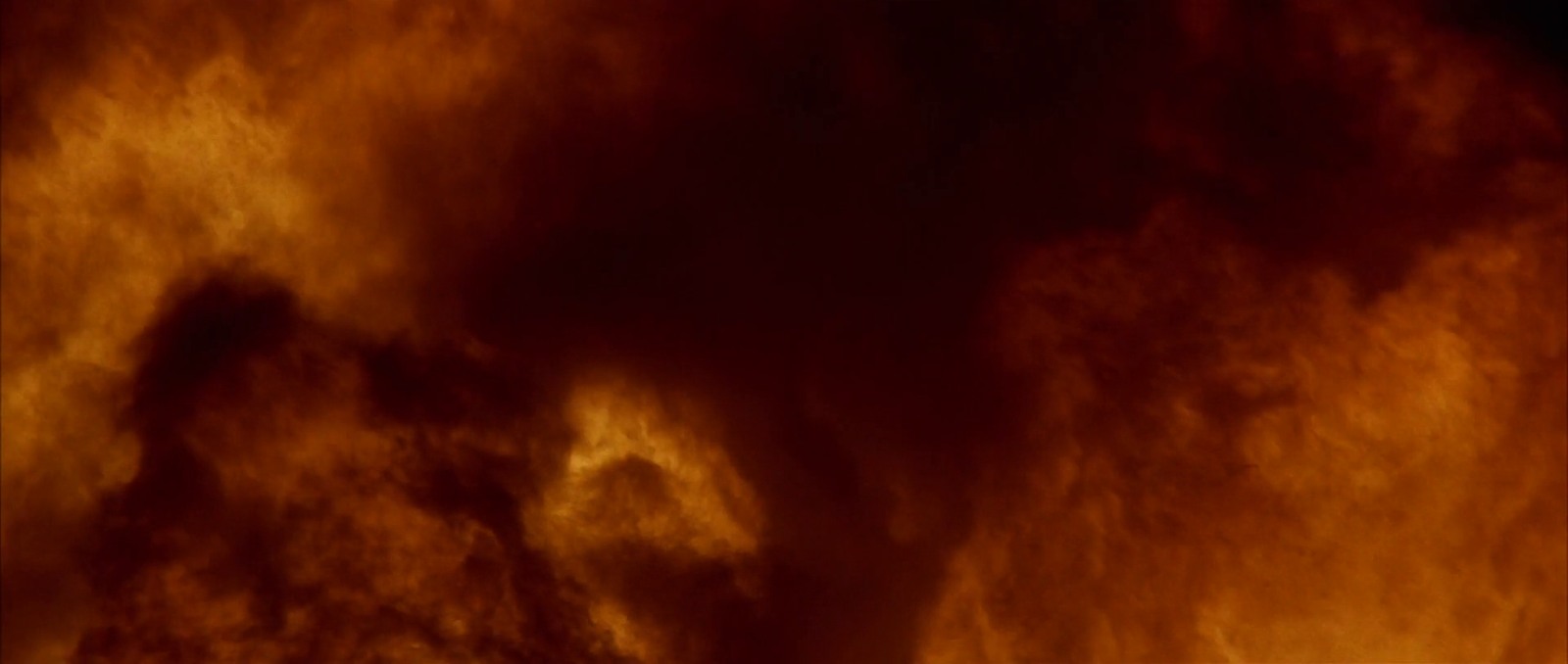
01:15Before there is a road to travel, fire occupies the entire image. Its lack of a visible boundary makes it a field of energy rather than a contained household object. The later appearances of flame can recall both this opening spectacle and the family history disclosed along the journey. Elmes’s account of building the title fire gives this apparently abstract image a concrete production history.
Romance enters a public space
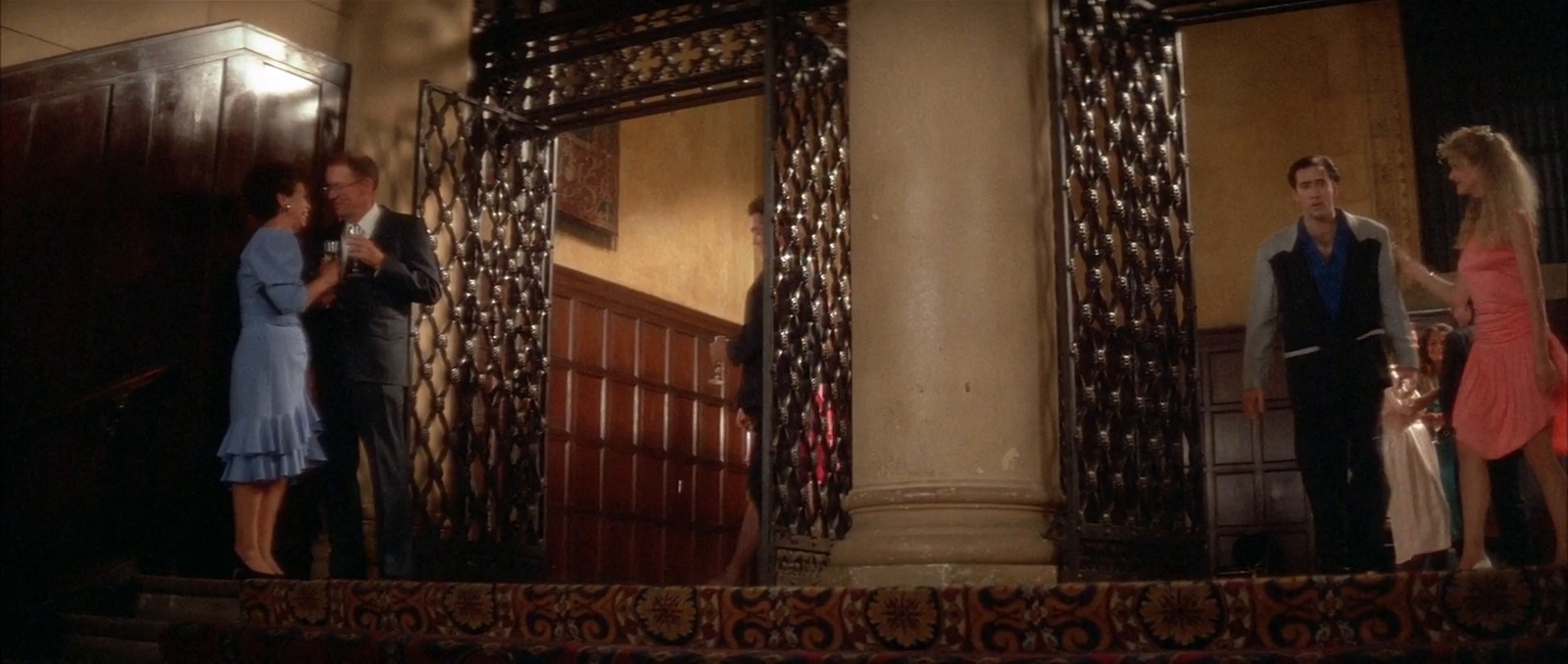
03:15The couple appear amid decorative columns, stairs and other people. The setting gives their entrance a theatrical form, but also leaves them exposed to confrontation. This is a different opening proposition from the unrelated eruptions in the online screenplay transcription: here, violence soon attaches itself to the man whose romance we are being asked to follow.
A pose after violence
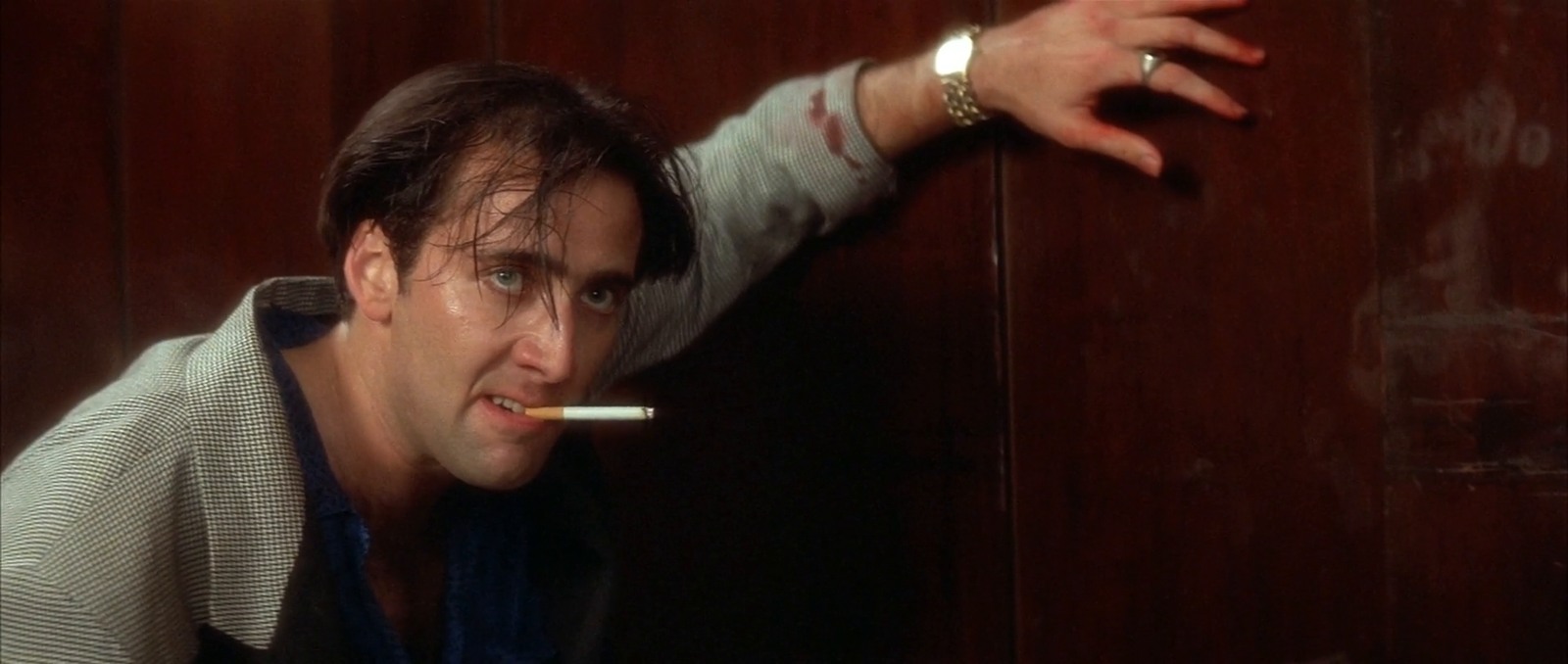
04:45The composed cigarette gesture follows the bodily chaos of the staircase fight. Sailor’s bearing remains part of his self-presentation even when blood makes the cost of that pose visible. The juxtaposition unsettles an easy division between charismatic romantic hero and dangerous man. It is a useful starting point for the dossier’s debate about whether the film’s excess deepens feeling or overwhelms it.
The car as a promise
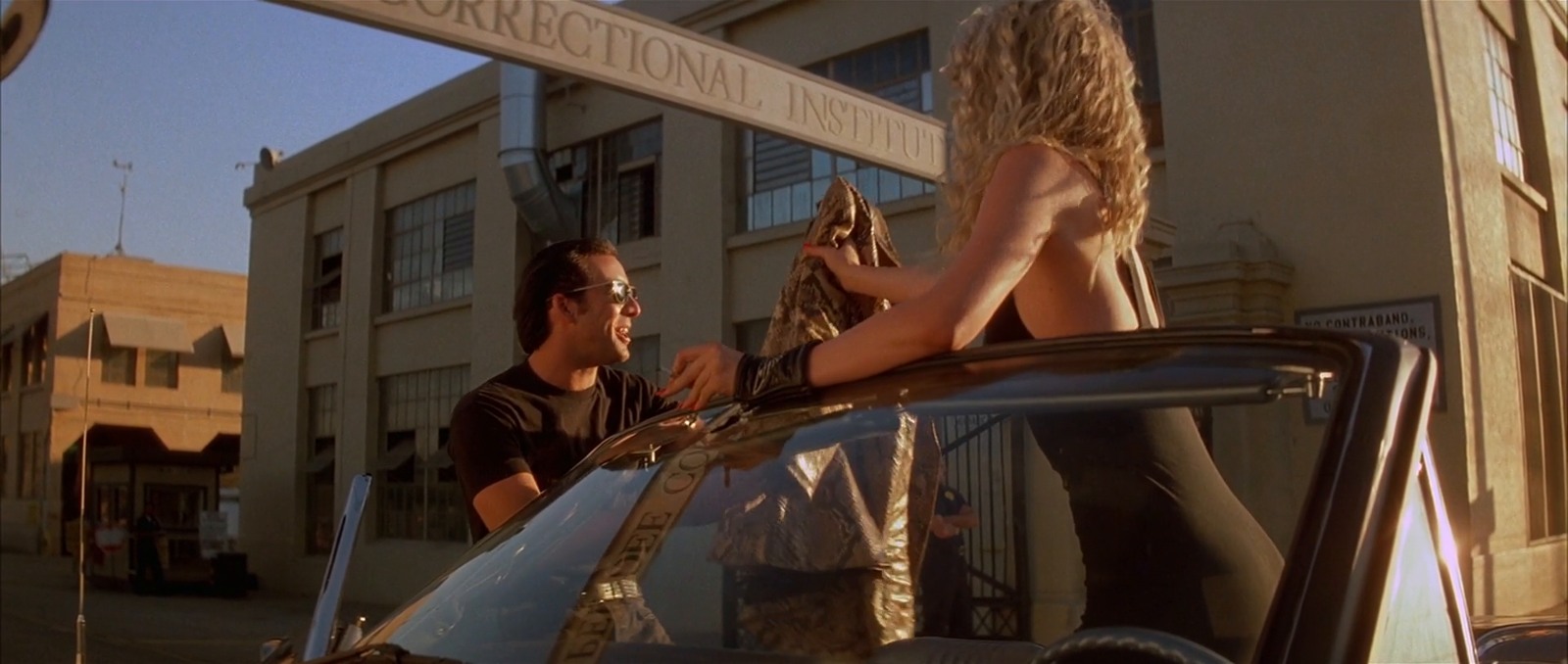
07:15Lula and Sailor meet beside the convertible. The car turns release from an institution into the possibility of movement together. Its open top promises exposure to the world as much as freedom from confinement. The reunion near the ending will revisit this arrangement with a child and years of separation added to the image.
The pursuit begins at home
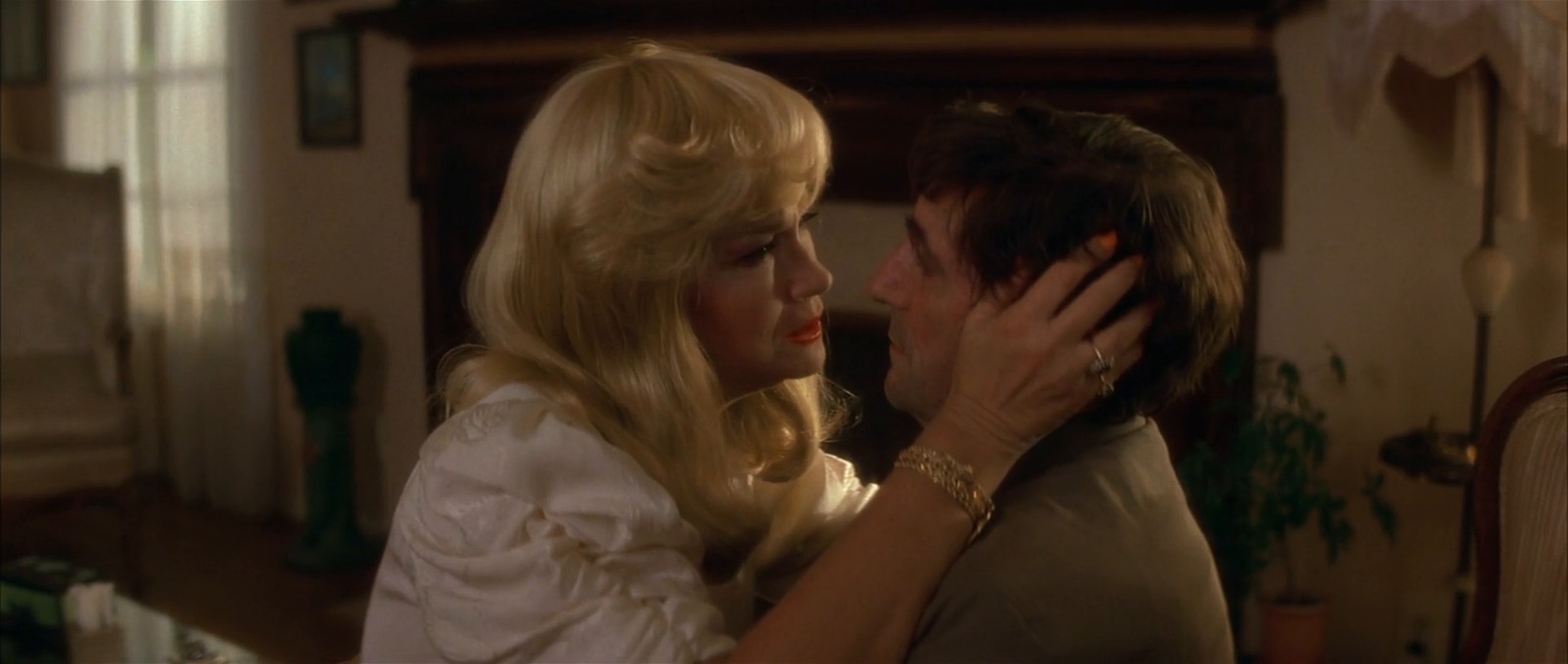
12:45Marietta’s hands make affection a forceful physical arrangement: Johnnie’s face is held between them. The close grouping gives their relationship a different texture from Sailor and Lula’s chosen flight. Ladd’s gestures can be extravagant without making the character merely decorative; her domestic determination helps organize the danger that follows the couple.
Practising their freedom
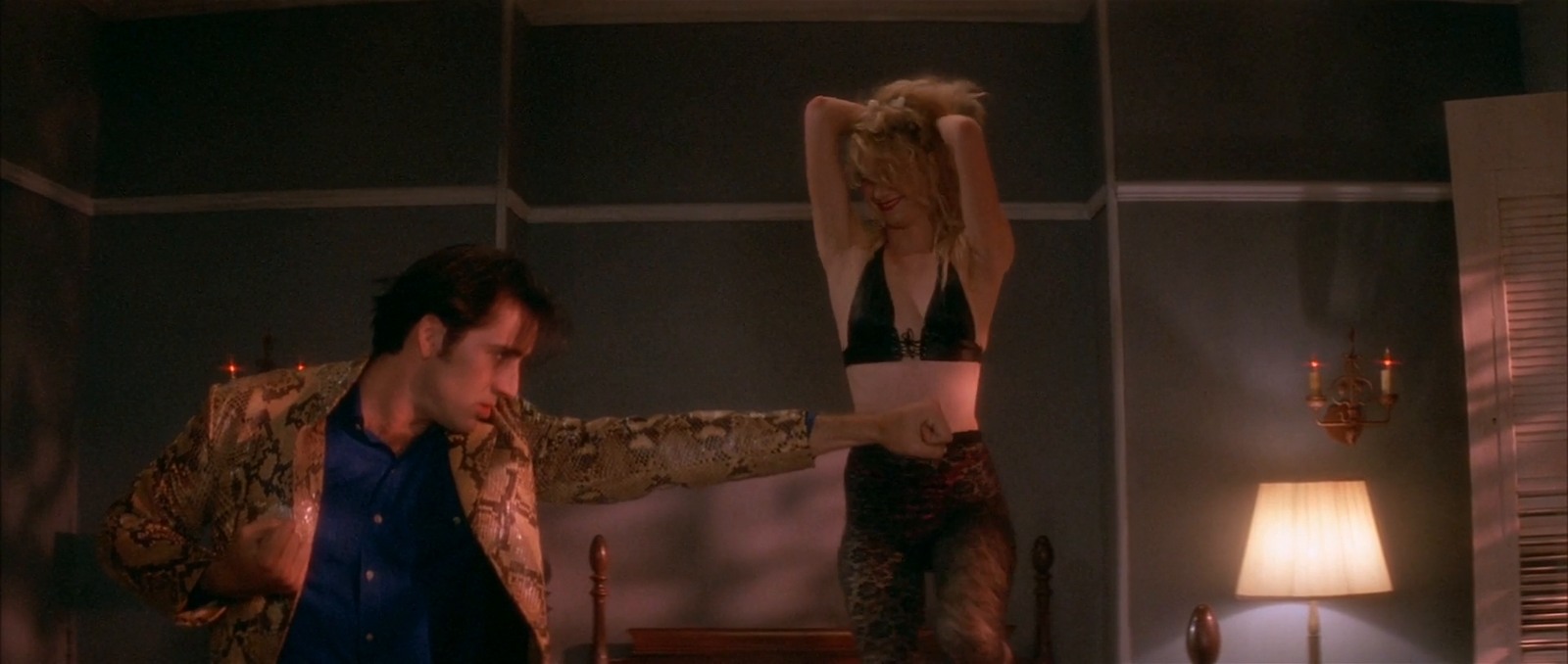
18:15In the room, Lula’s extended arms and Sailor’s snakeskin jacket turn an ordinary interior into a private stage. Clothing and posture carry the lovers’ exuberance before the public performance that follows. Their borrowed glamour is something they do together, rather than a stable identity the film simply grants them.
A declaration made public
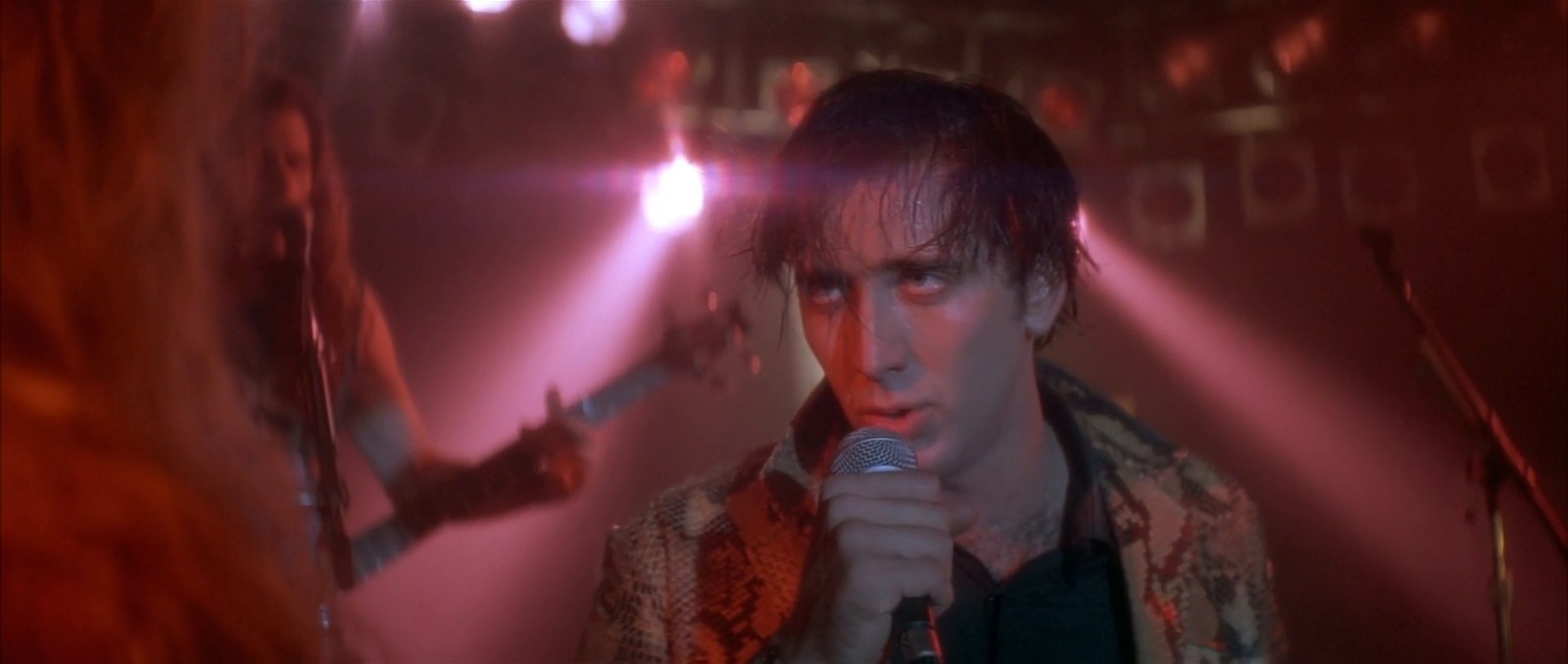
21:15A microphone and colored stage light give Sailor’s declaration the shape of a performance. The surrounding crowd makes the gesture public, while its address remains personal. Read beside Cage’s account of contributing the jacket, the scene shows how an actor’s repertoire of clothes, stance and pop-star manners can become a character’s language of attachment.
Two people behind one windscreen
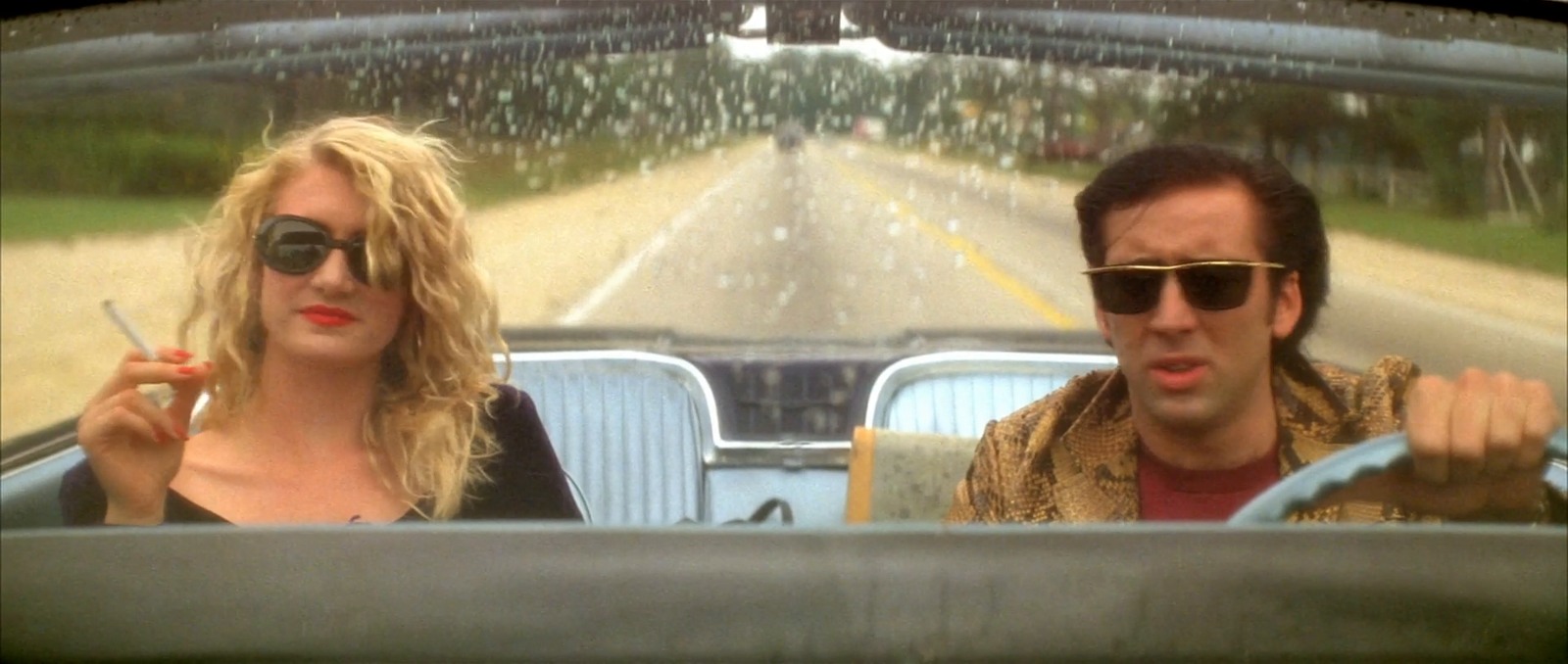
28:15The windscreen groups the lovers inside a moving rectangle. Sunglasses and the open convertible make the journey look self-consciously glamorous, but the enclosing frame also keeps them together against a world passing outside it. Later night driving and the stopped car will complicate this apparently easy image of escape.
Scene studies / 02
The road opens—and closes
Distance gives the couple a moment of freedom. Family memories, pursuit and a roadside death keep interrupting it.
Another journey is being arranged
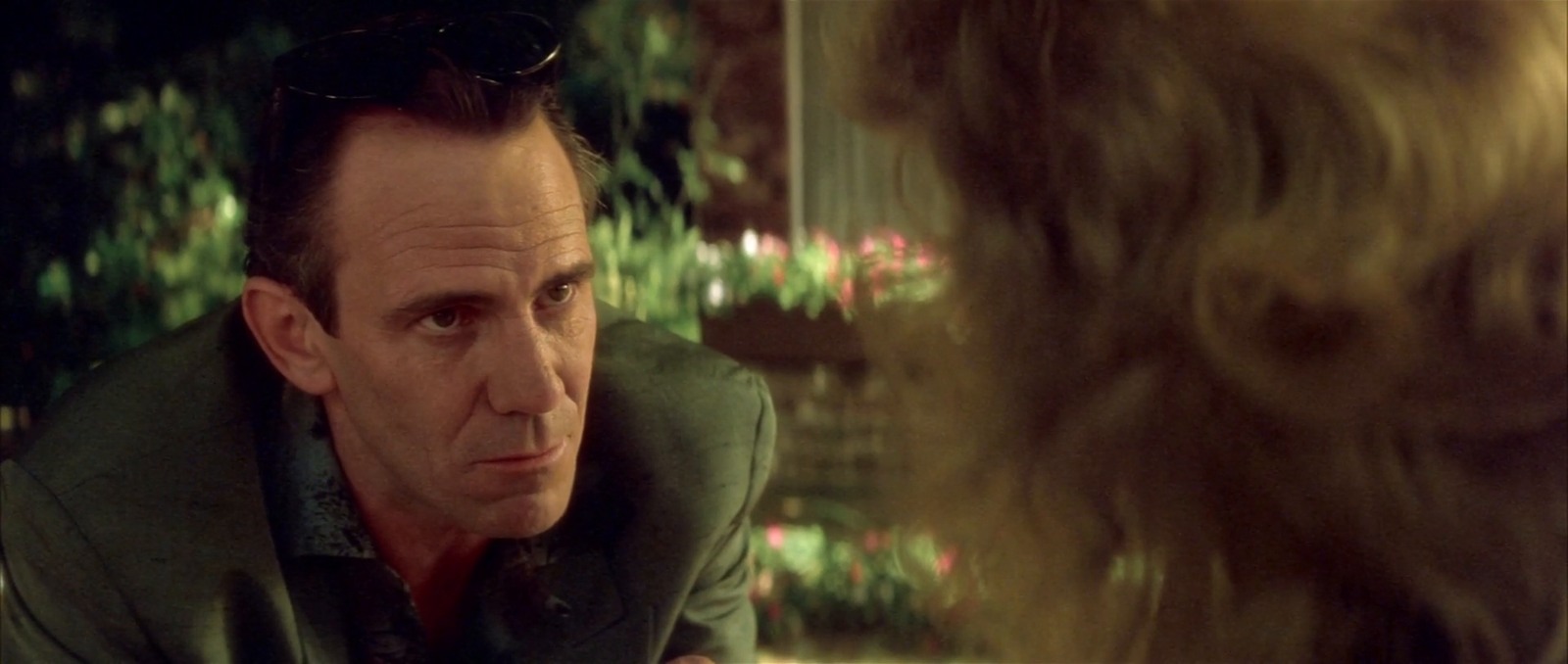
30:15While the lovers travel, the film returns to the people organizing pursuit. Santos’s calm, close presentation gives the threat an ordinary social surface. The alternation means that mileage cannot be read as safety: the couple’s freedom and the arrangements made elsewhere occupy the same unfolding story.
Memory makes room for an interruption
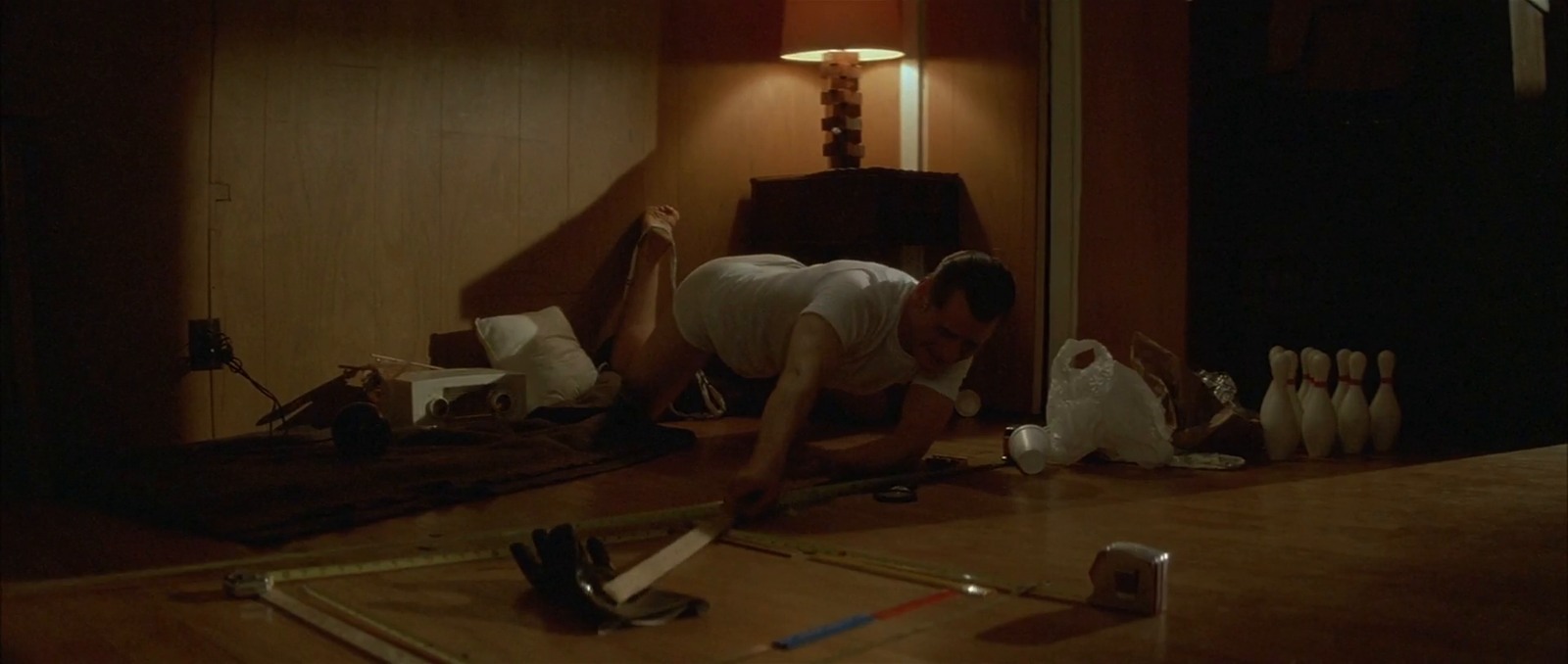
45:15Dell and the carefully visible pins form a self-contained tableau inside the film’s accumulating family stories. Its odd specificity interrupts the forward movement of the romance. Rather than explain every eccentric image as a clue to the plot, it is useful to notice how such episodes give the lovers a past crowded with other bodies, habits and private catastrophes.
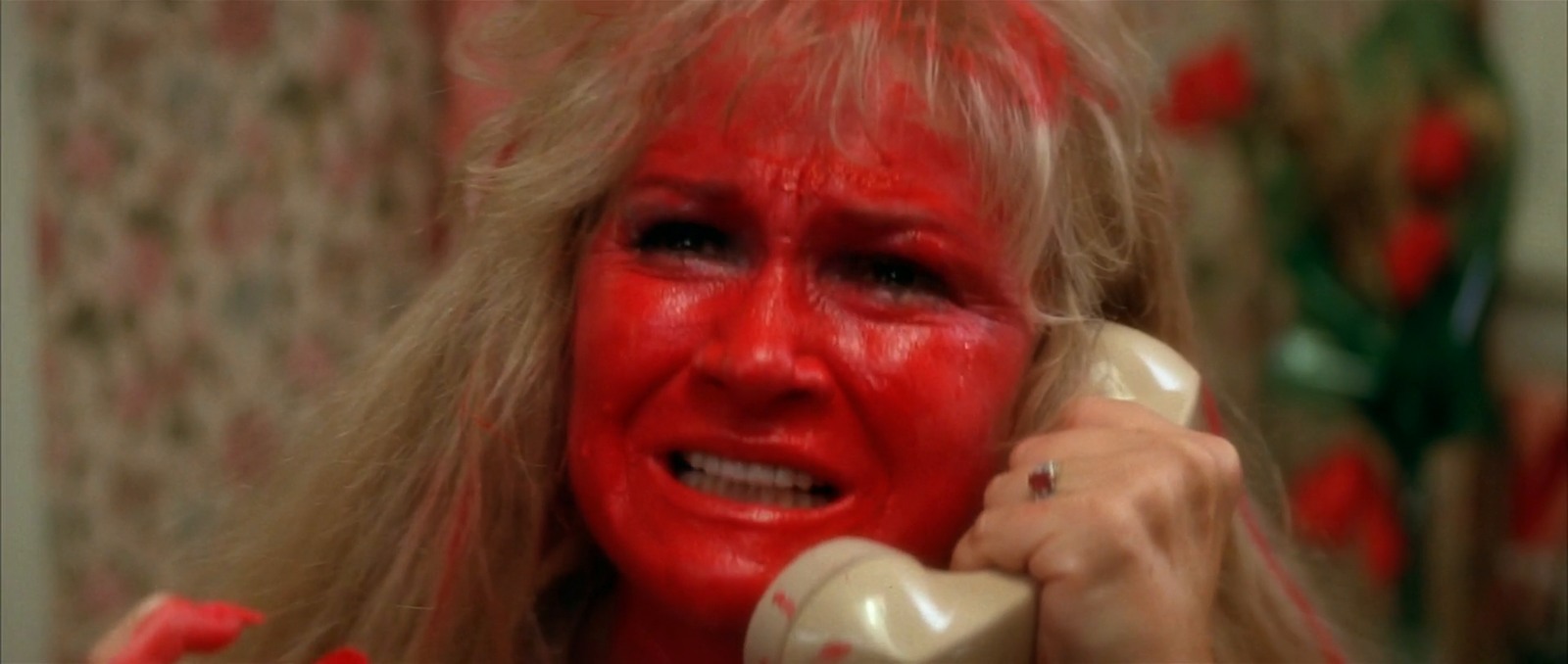
Makeup stops behaving like a mask
47:15Red extends beyond the lips and across Marietta’s face. An object associated with controlled self-presentation becomes an image of control breaking down. The effect depends on the recognizable face remaining visible beneath the color; it intensifies Ladd’s performance rather than replacing it with an anonymous monstrous disguise.
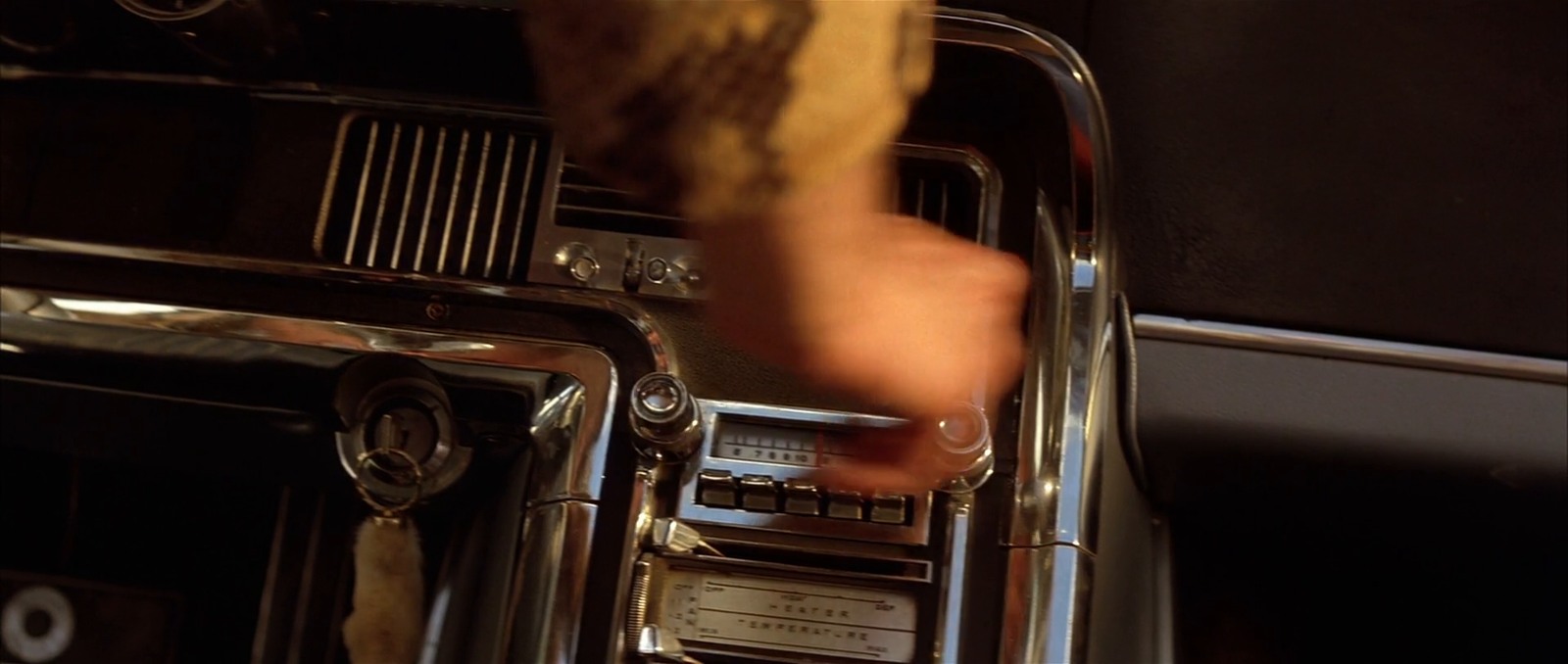
A hand reaches for the dial
51:15The close view of a hand and the radio interrupts the broader view of the couple driving. It makes the console an active part of their journey: the outside world can enter this supposedly private space through a small dashboard device. Elmes’s recollection connects this passage with the release into dance and the sunset compositions that follow.
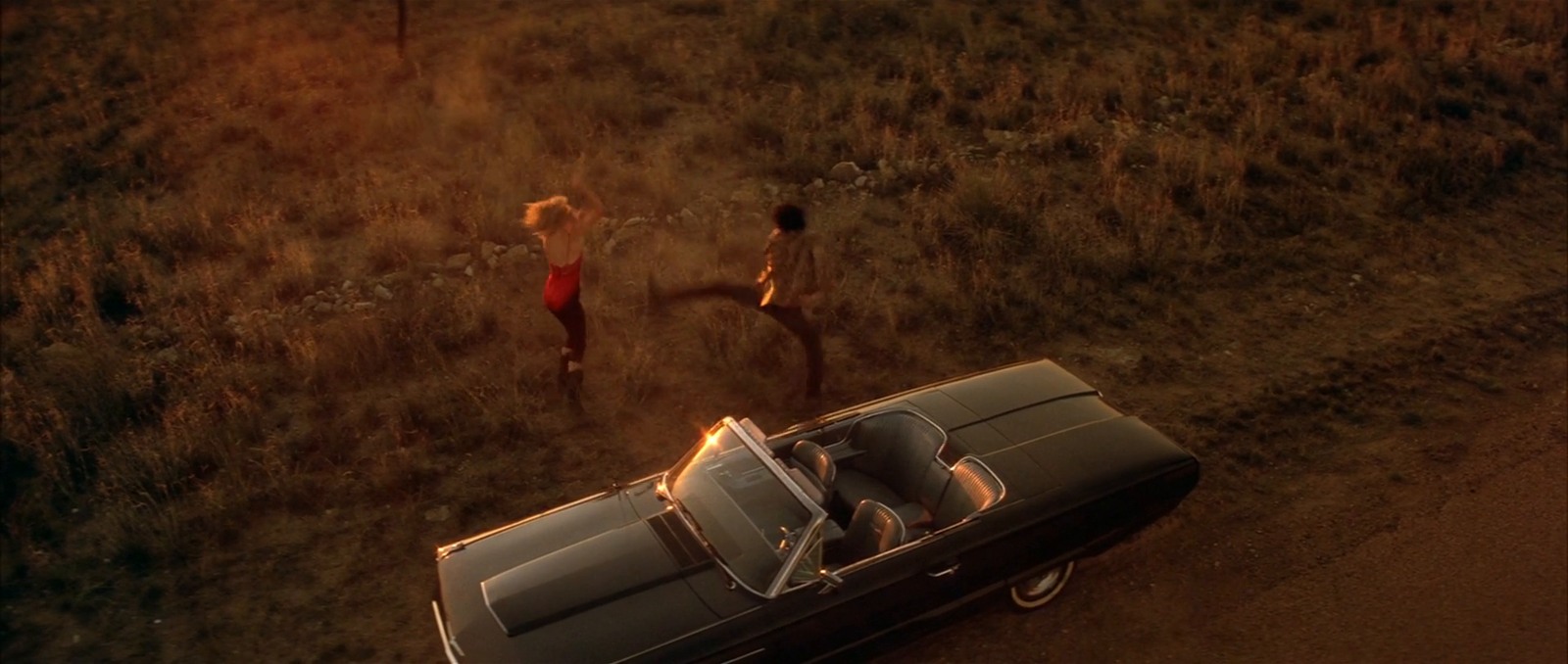
Bodies beyond the car
51:40Seen from above, Sailor and Lula are separate moving figures beside the long, open car. The vehicle is no longer carrying the action; their bodies claim a patch of roadside space. The wider composition lets their movement register against the ground, briefly replacing the direction of travel with a shared physical event.
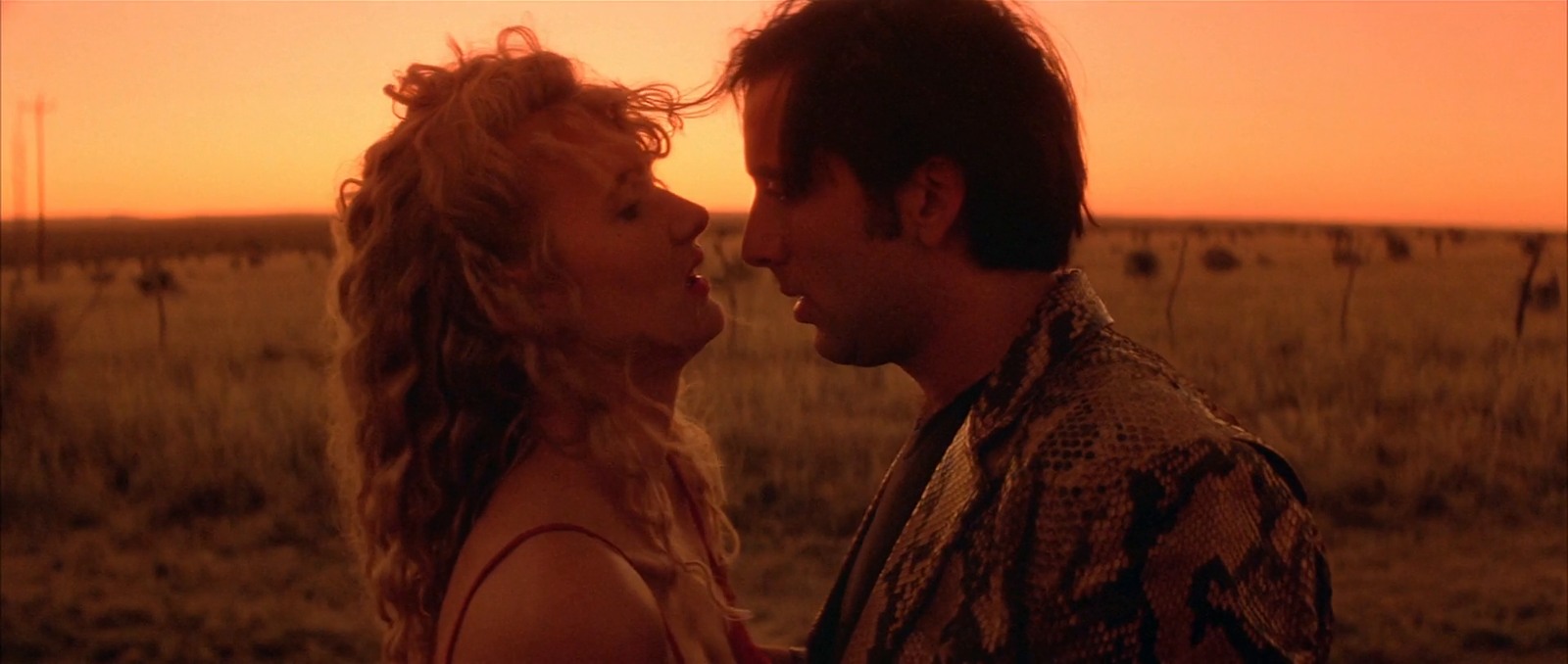
The landscape becomes intimate
52:00The orange horizon fills the space behind the lovers’ faces. After the high view of their dance, this closer image gathers the landscape into an embrace. Elmes’s account of limited equipment and rapidly disappearing light helps explain the practical stakes of making this apparently effortless release. It does not establish an exact location or a camera report for the selected frame.
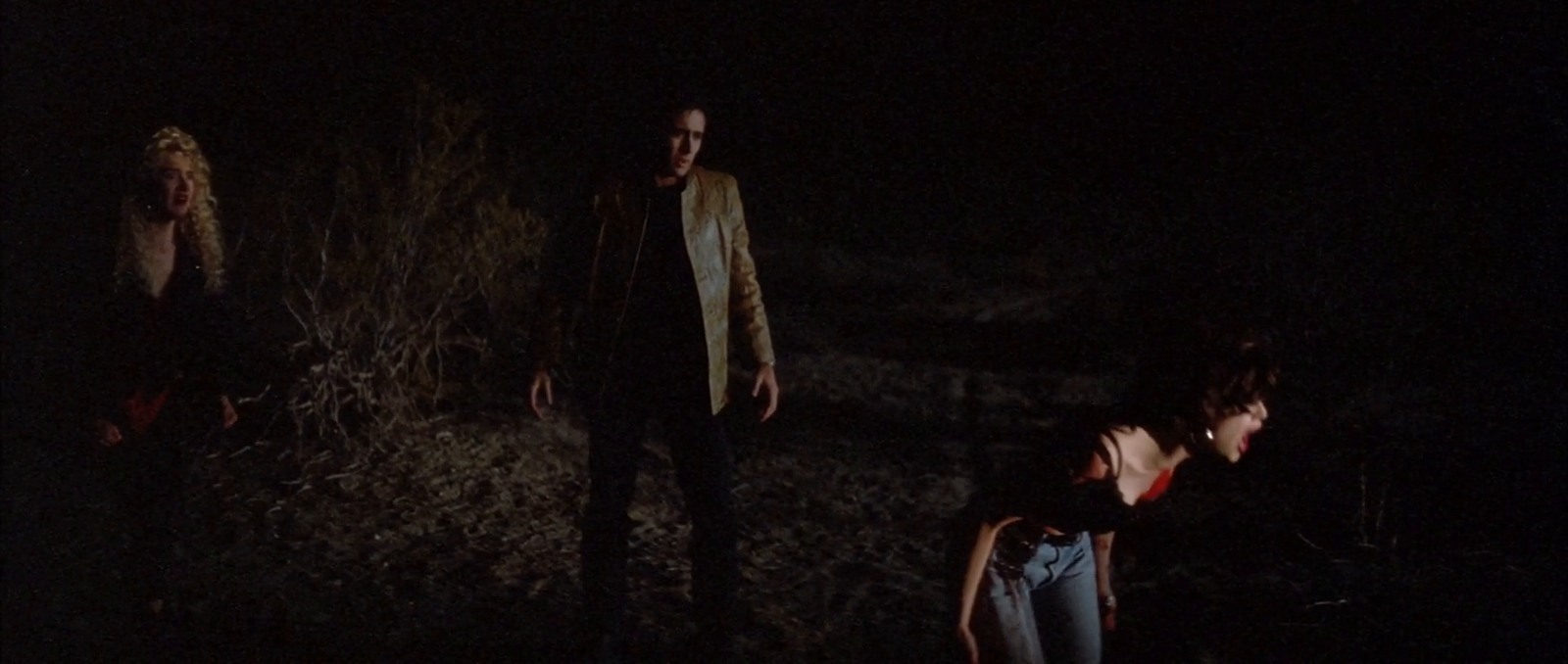
The road cannot protect them
1:01:40Darkness separates three people who have met beside the wreck. Unlike the sunset embrace, this space does not draw the lovers safely together; it makes them witnesses to someone else’s disorientation. The encounter interrupts the romance without resolving into an obstacle they can defeat. Its afterlife in Lula’s worries makes a brief stranger part of the couple’s continuing story.
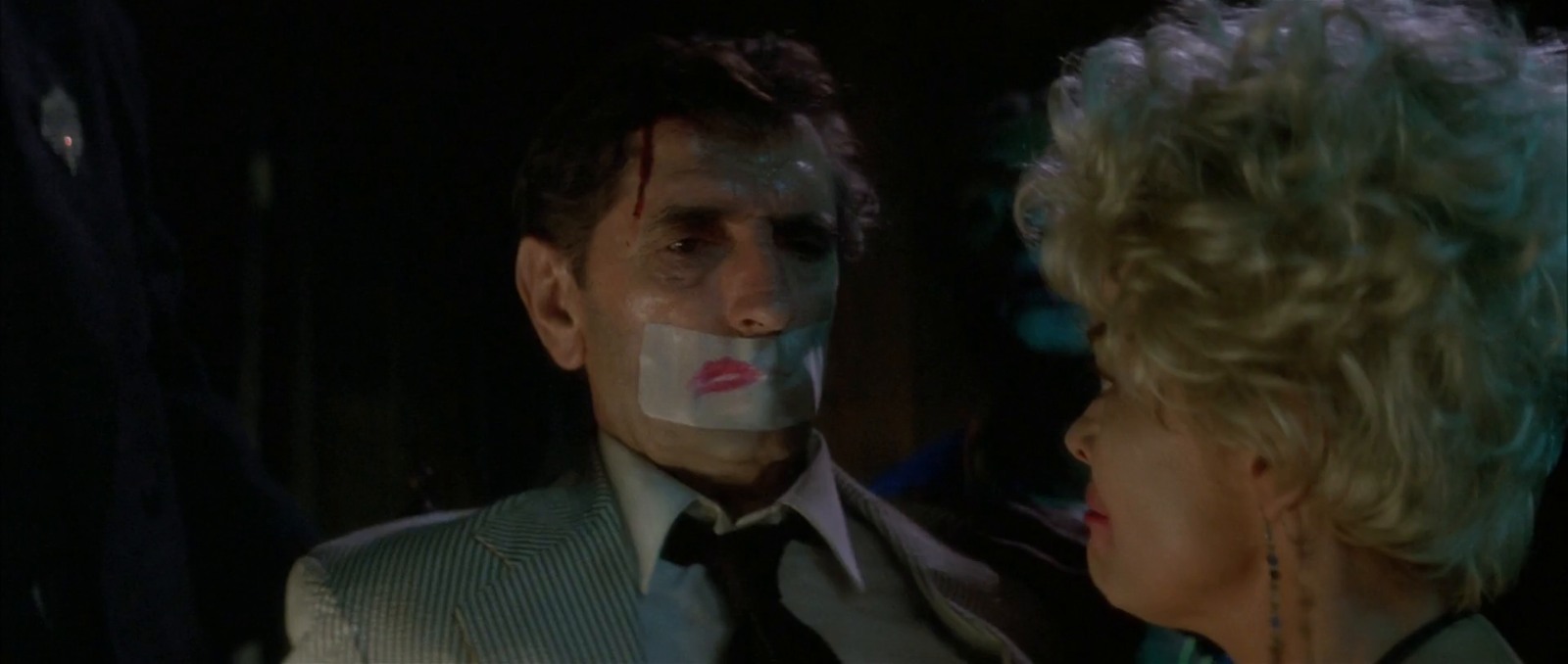
A second story reaches a trap
1:07:45Johnnie’s immobilized face contrasts with the lovers’ mobility. The pursuit has produced a victim within its own network of relationships. Moving between the two stories widens the film’s field of danger: Sailor and Lula do not see every consequence of the forces following them, but the viewer cannot leave those consequences outside the romance.
Scene studies / 03
Stranded in Big Tuna
The journey contracts into a motel room and a circle of strangers. Money, pregnancy and coercion make staying still dangerous.
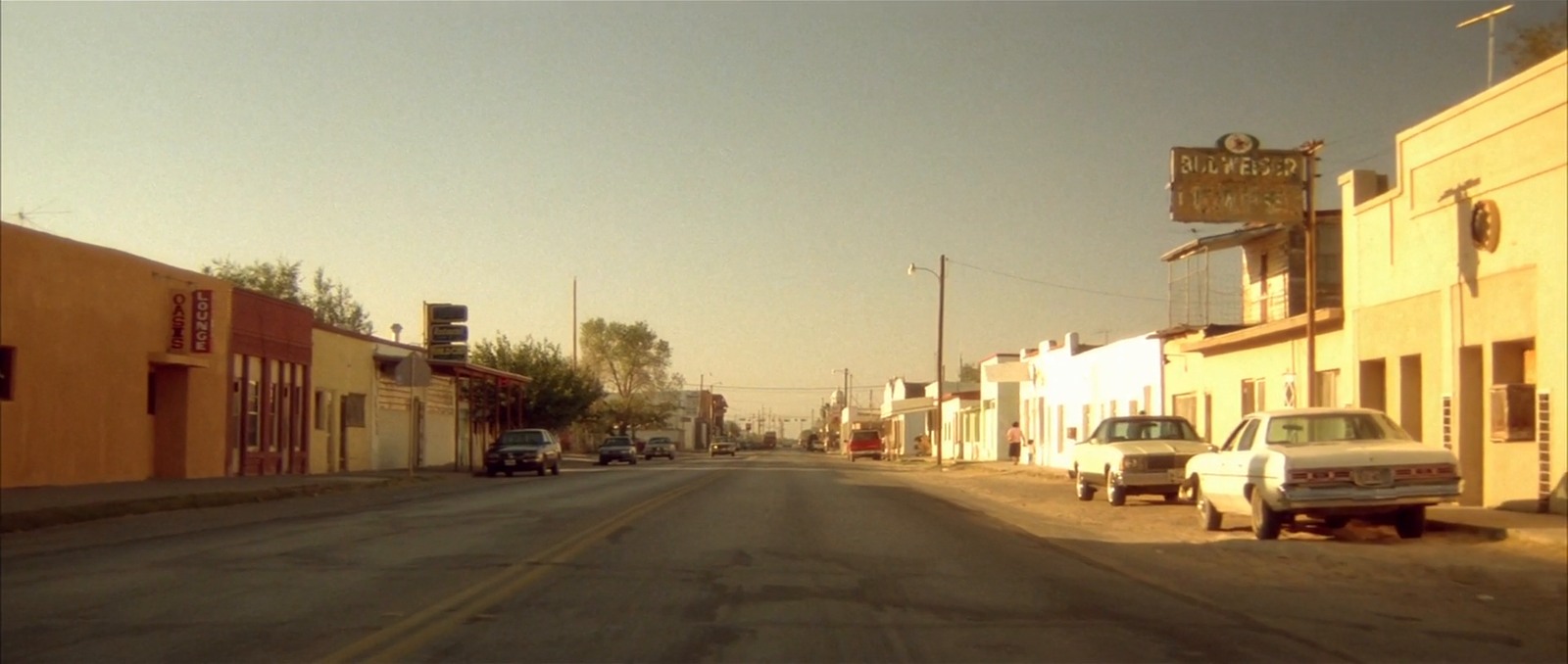
The destination looks emptied out
1:10:45The broad, sparsely occupied street is a change from the promise of the open highway. Arrival does not supply an obvious refuge or a thriving world to join. It introduces a place where the lovers’ options narrow even while the image remains wide. The contrast between open space and restricted choices shapes the motel passages.
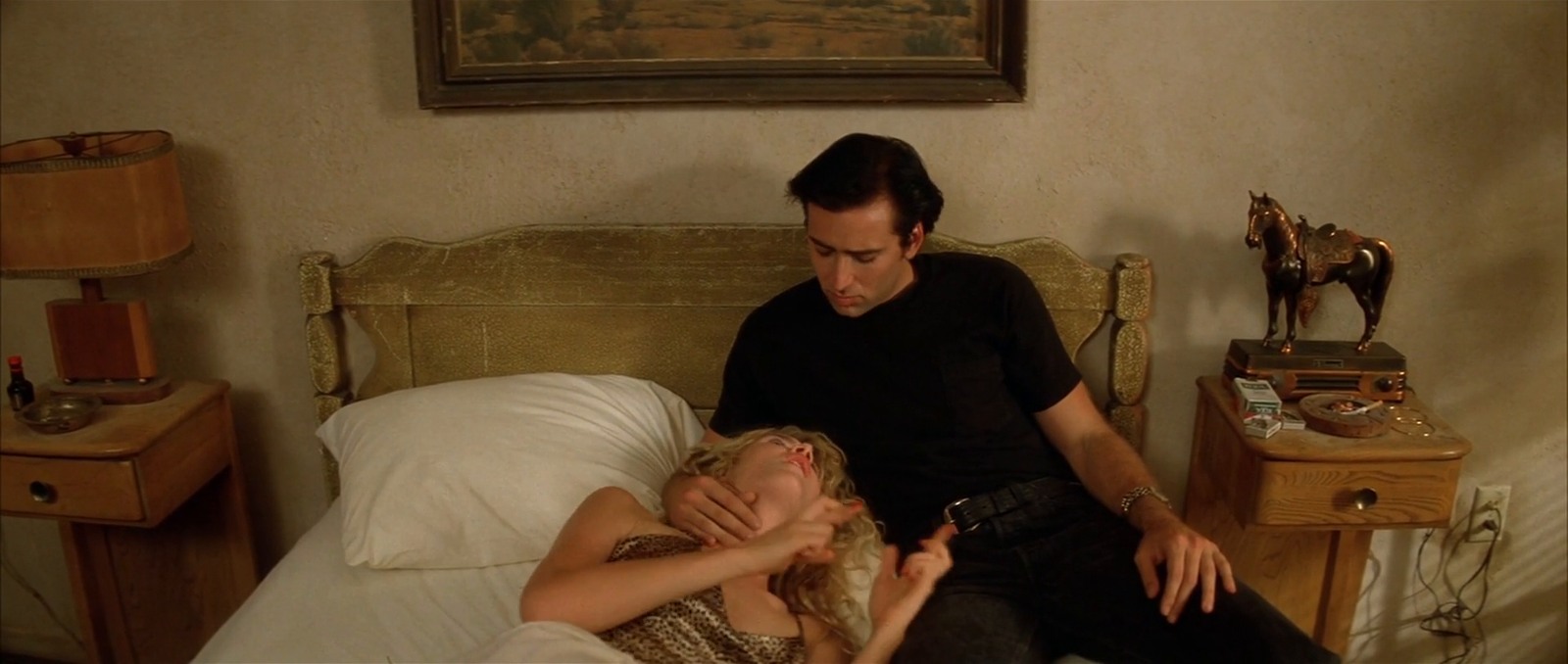
Rest is not reassurance
1:14:45The bed groups the couple together, but the plain room and Lula’s exhausted posture make the pause feel fragile. Their closeness has survived the roadside encounter; it has not erased its effects. Small acts of care matter here because the surrounding story increasingly turns their bodies into targets for other people’s plans.
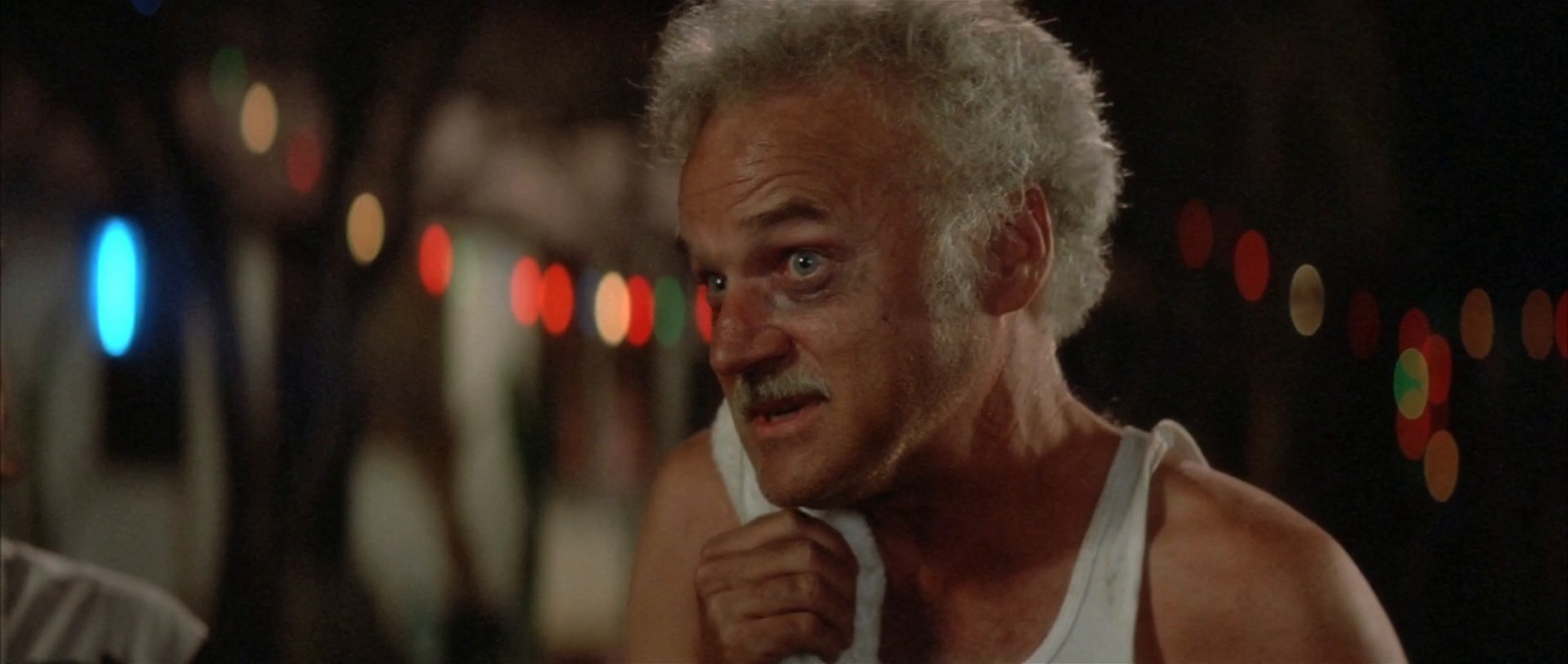
An audience for another stranger
1:17:15The string lights make this nighttime gathering look festive. Tight views of individual speakers and listeners, however, give each stranger a small stage of his own. The couple have entered a social circle whose stories and behavior they cannot readily interpret. The setting mixes hospitality with uncertainty before Bobby Peru takes command of the gathering.
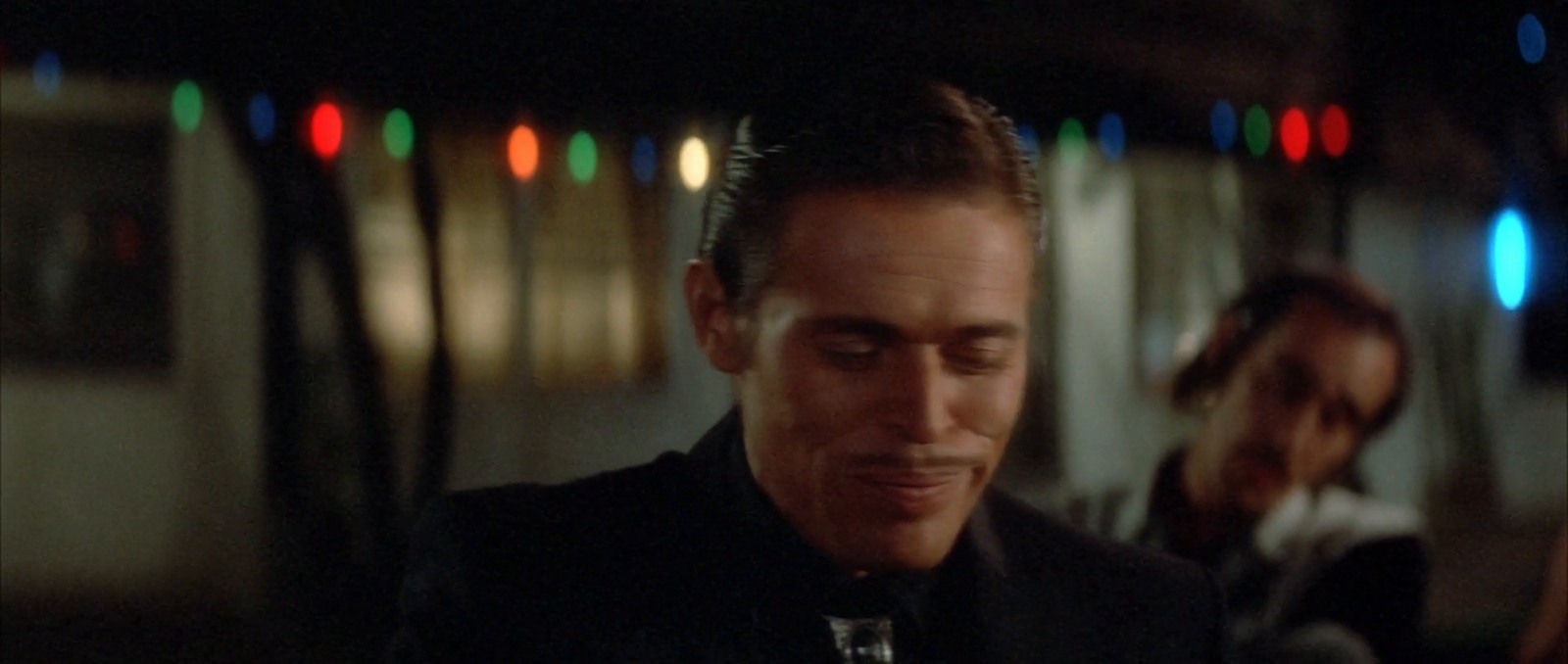
The smile becomes an intrusion
1:18:45Bobby’s close framing makes the mouth, gaze and forward-leaning presence difficult to ignore. Dafoe’s performance takes up space even in a social setting where everyone is ostensibly sitting together. The scene establishes an invasive manner before the later encounter in Lula’s room turns that manner into direct coercion.
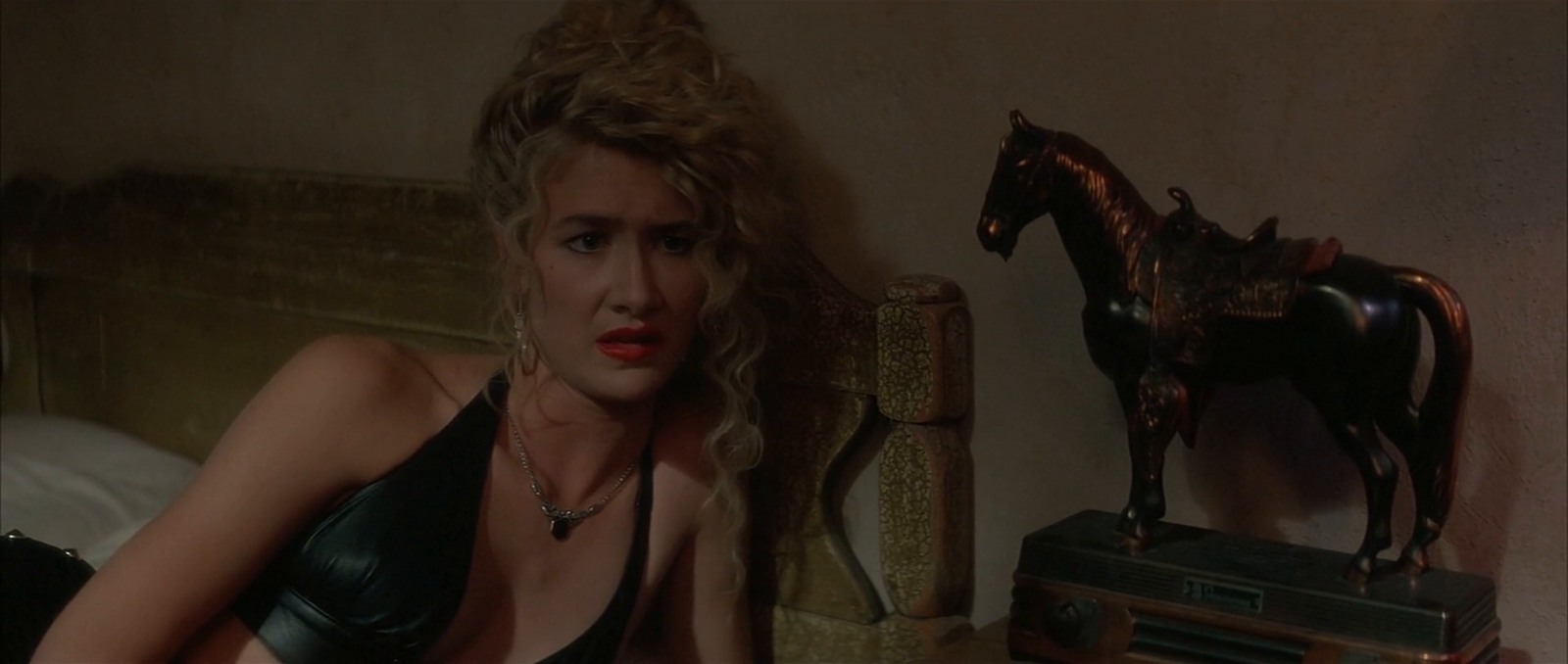
News changes the room
1:23:45The pregnancy conversation separates the lovers into individual views rather than a reassuring embrace. Lula’s look carries uncertainty about their circumstances alongside attachment to Sailor. The news changes what their freedom will have to include: another life and a future that cannot be settled by the next stretch of road.
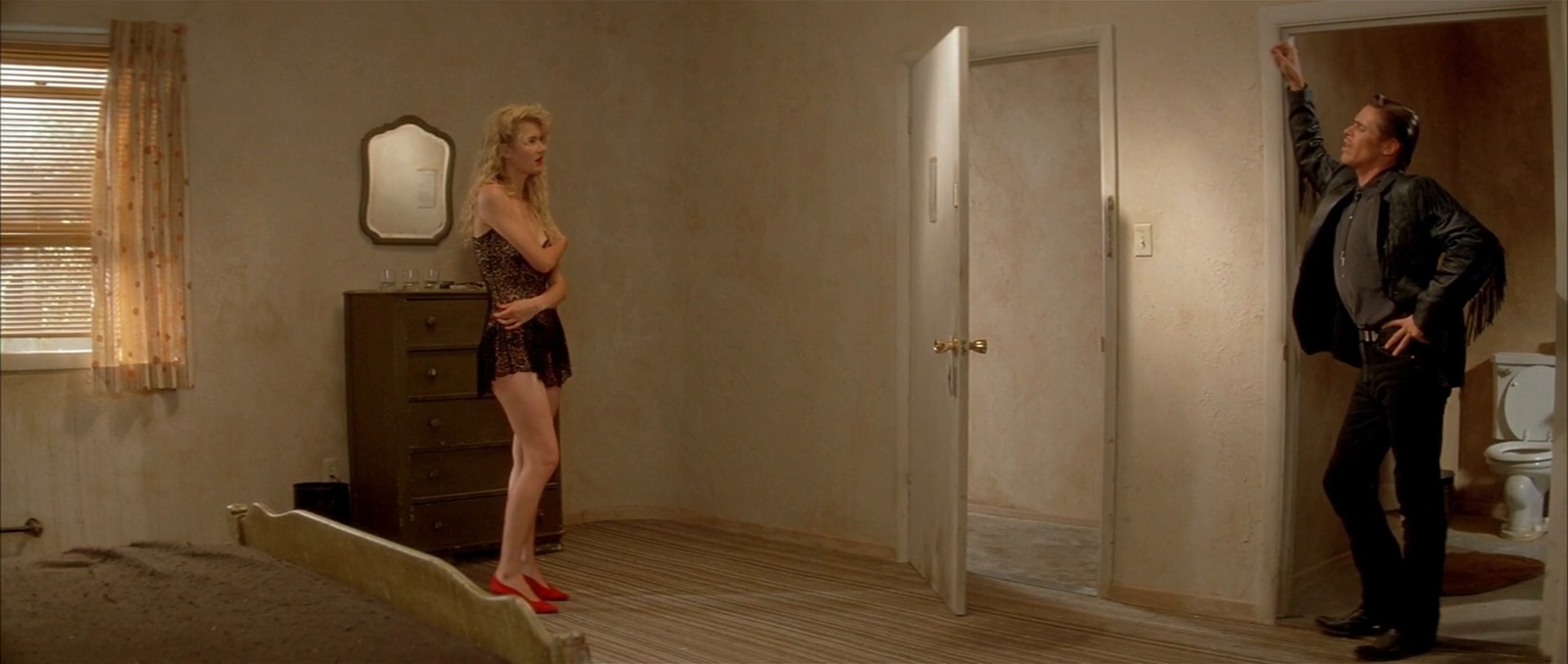
A room loses its privacy
1:26:15The wide view preserves the distance between Lula and Bobby and the doorway behind him. That spatial relationship matters as his intrusion develops: this is a room she occupies, not a meeting she has arranged. The subsequent intimidation should be read alongside Dern’s contemporary rejection of the idea that Lula’s refusal conceals consent.
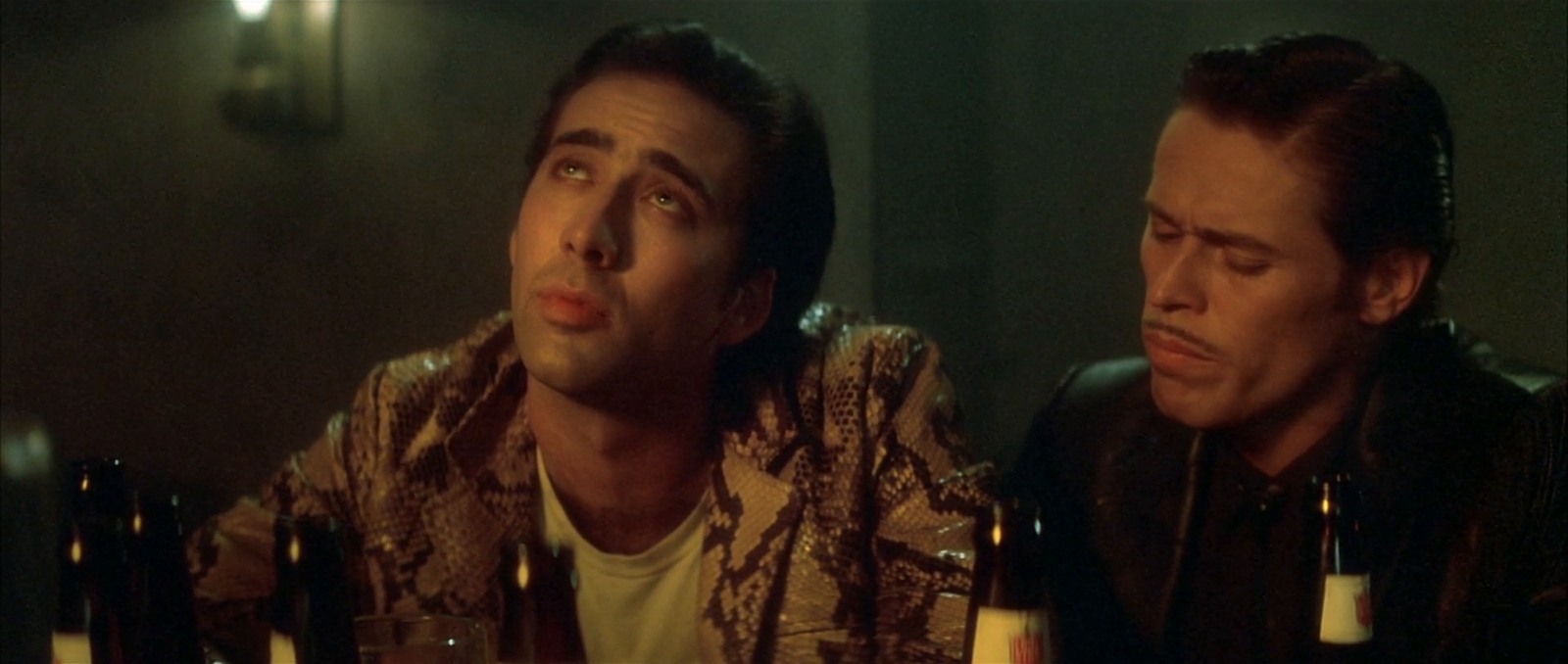
The offer closes in
1:32:15Bottles and the close pairing of the men compress the image. Bobby’s proposal of a robbery turns conversation into pressure on someone already short of options. Sailor’s participation is a decision with consequences, not simply another colorful detour. The scene draws the romance into a different genre of promise: quick money offered through a compromised alliance.
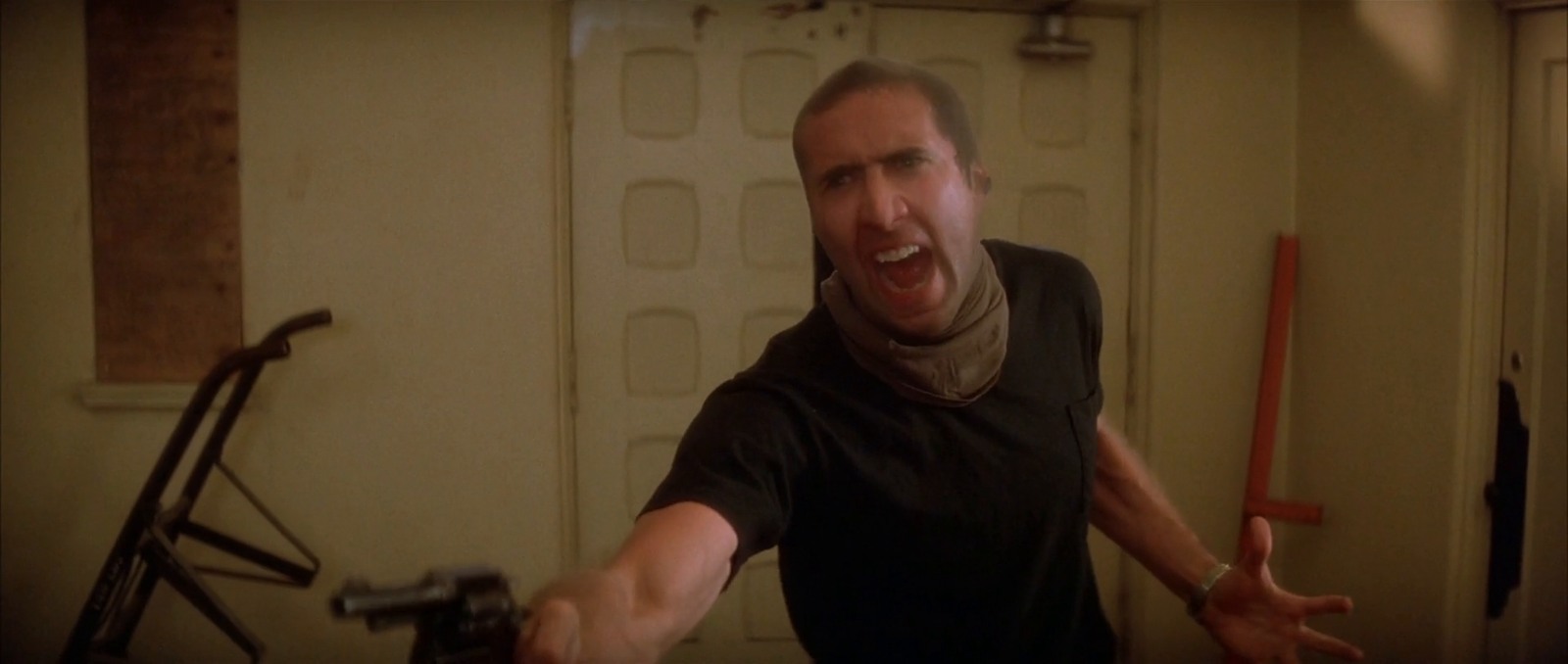
The alliance breaks in public
1:45:15The robbery moves the danger out of private conversation and into a workplace with other people at risk. Sailor’s tense, extended gesture replaces the earlier ease of his poses. The abrupt violence brings the supposed solution to the couple’s money problems back to the same problem established at the staircase: an act can be over quickly while its consequences reorganize years of life.
Scene studies / 04
Separation and return
Prison interrupts the romance. The ending asks Sailor to abandon his performance of independence and choose the family waiting for him.
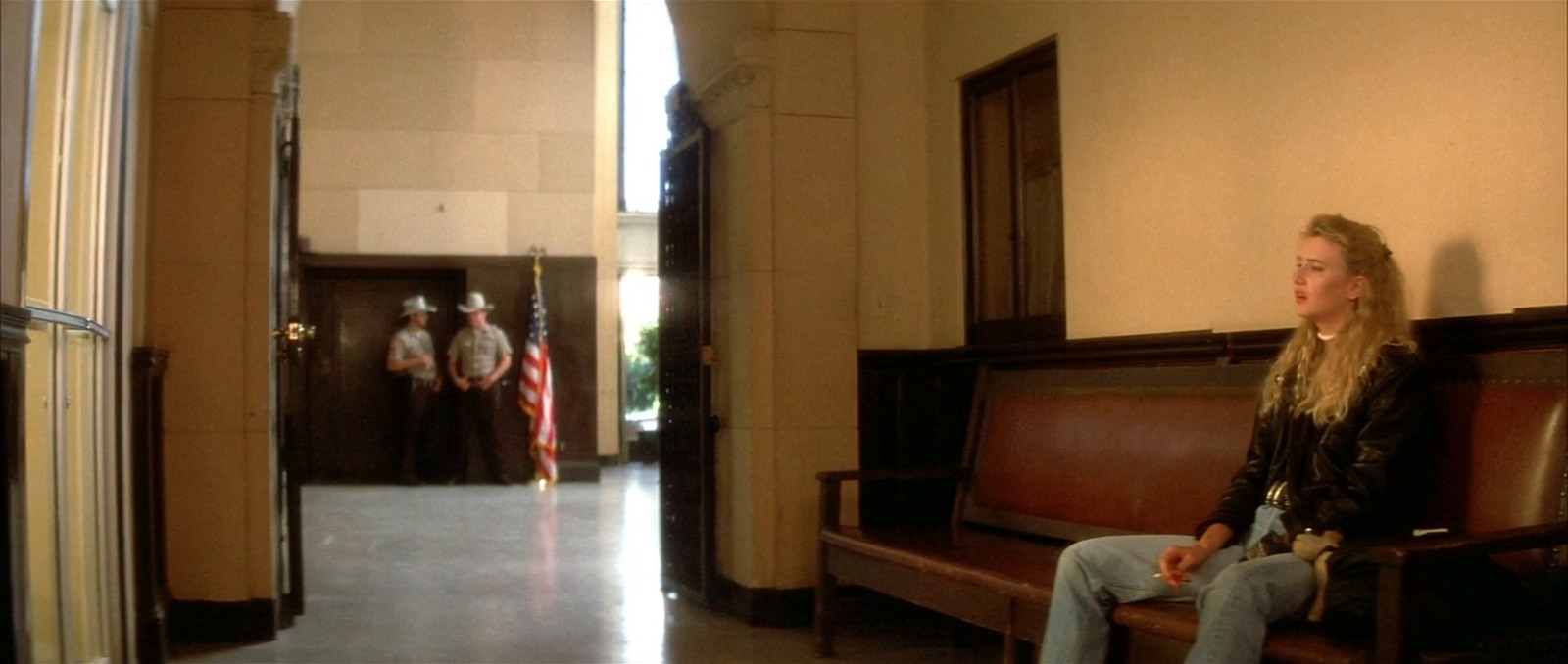
Lula waits outside the action
1:47:45The long bench and empty space around Lula register the aftermath through waiting. She is no longer held within the shared car or a two-person embrace. The composition gives her separation a physical duration, while the narrative brings her mother and Santos back into the space the couple had tried to leave.
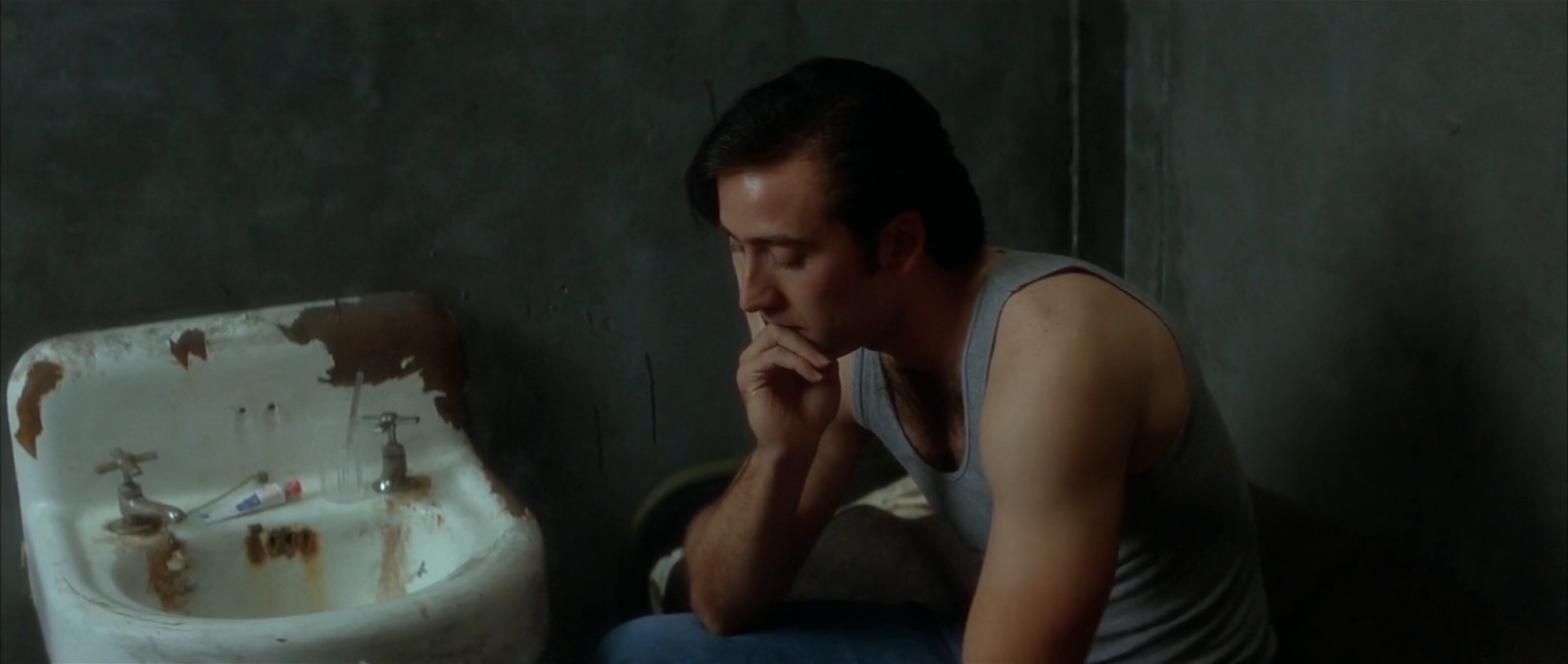
A future measured by absence
1:49:45The room is reduced to a seated body and worn fixtures. This return to imprisonment is not a repetition without change: the lovers now face the growth of a child during their separation. The image strips the performance of freedom down to stillness, making the later reunion answer a longer absence than the one near the beginning.
The household after the time jump
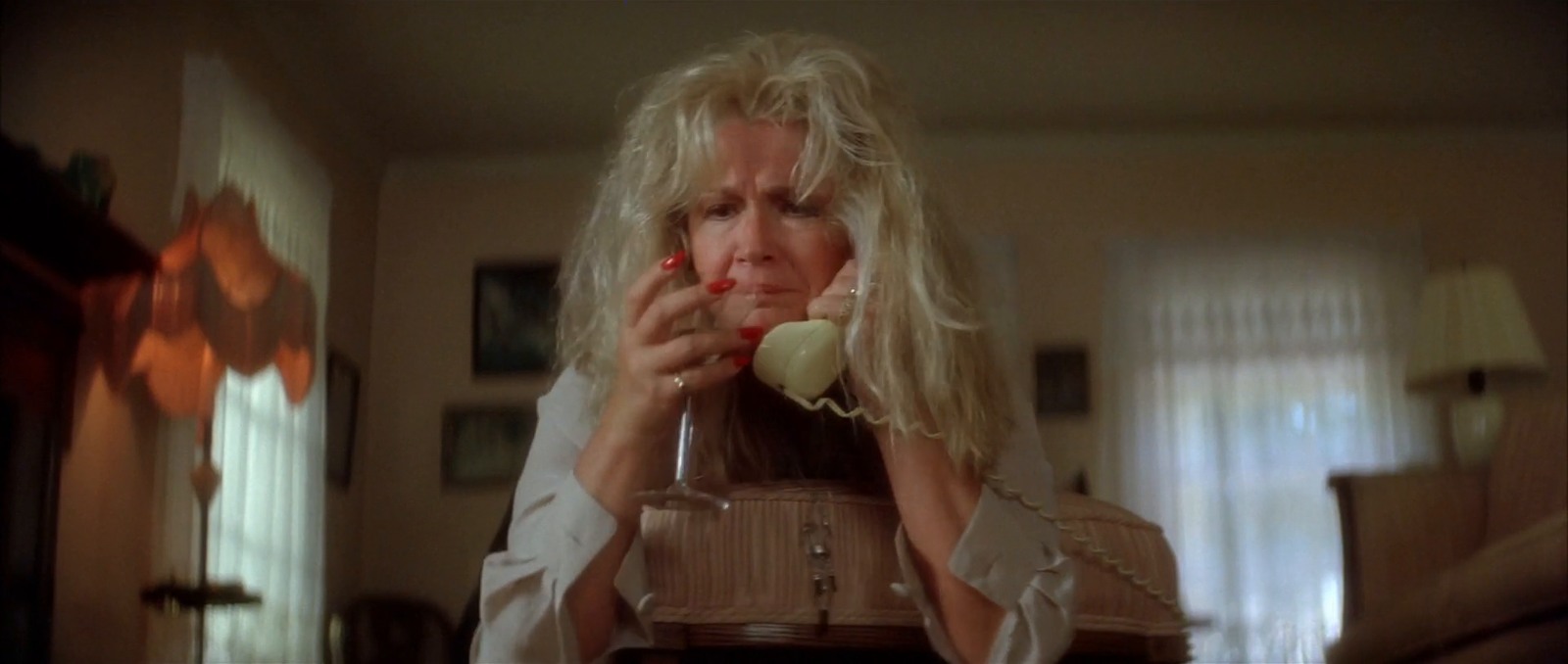
1:50:15Marietta’s changed appearance makes elapsed time visible inside the familiar domestic struggle. The telephone again connects her to arrangements beyond the room, but Lula is no longer simply the daughter leaving at the beginning. The scene gives the forthcoming reunion a second confrontation: the decision to go must first be asserted at home.
The reunion now contains three people
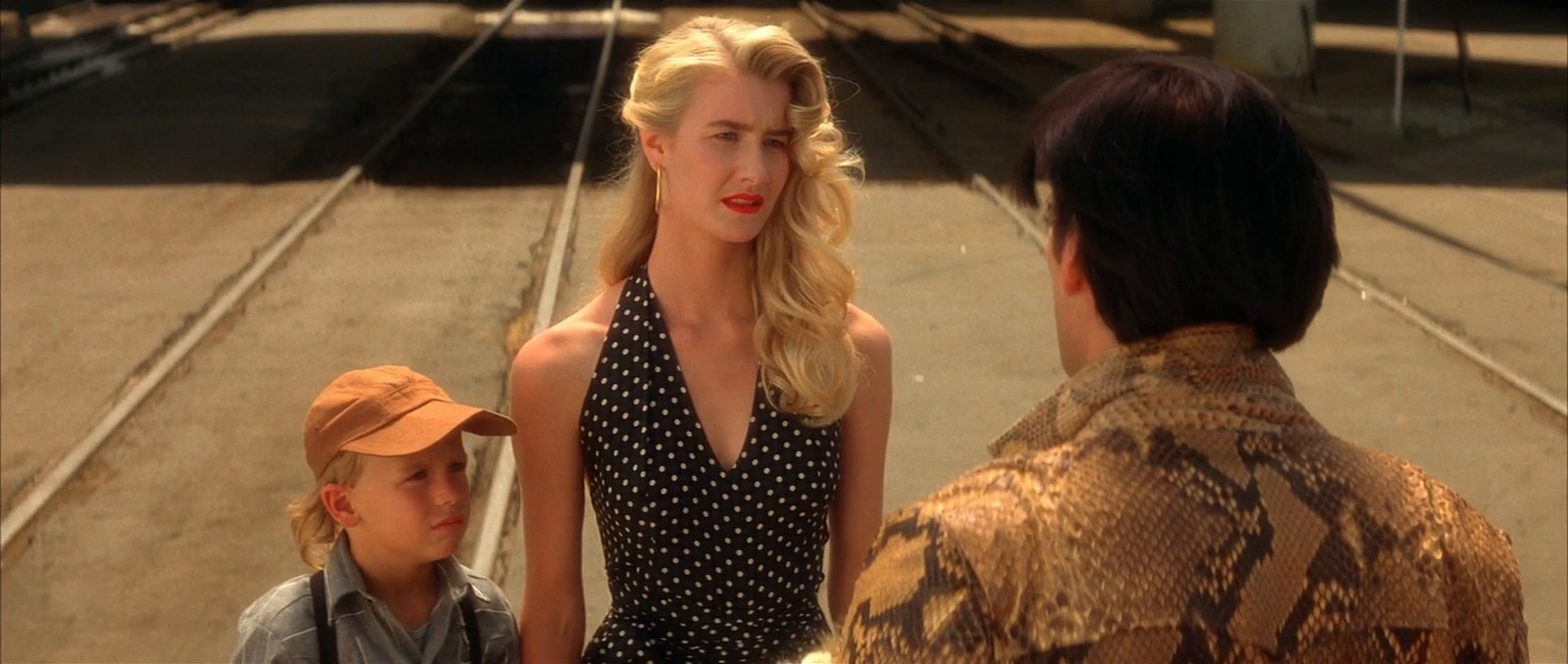
1:52:15The child changes the geometry of the reunion. Sailor faces both a lover he remembers and a son he has not known in everyday life. The snakeskin jacket remains recognizable, but its continuity does not cancel the missing years. The film asks whether the old image of Sailor can make room for a different responsibility.
Leaving becomes the problem
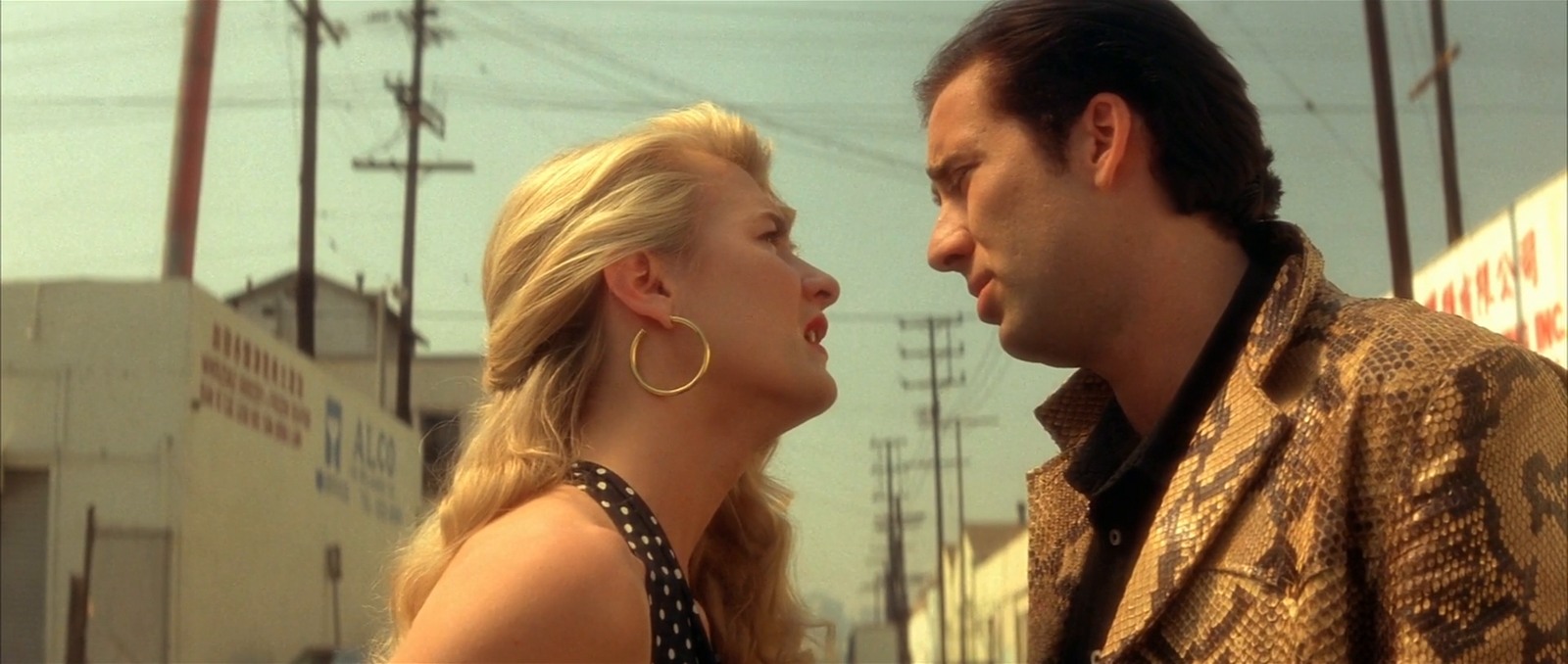
1:54:45The lovers face one another outside a car that had once promised escape. Sailor’s attempt to withdraw reverses the meaning of departure: movement away from the relationship now threatens the future they might share. The roadside setting lets the film revisit its central objects without granting them fixed meanings. A car can offer flight, shelter or abandonment.
A fairy tale interrupts the street
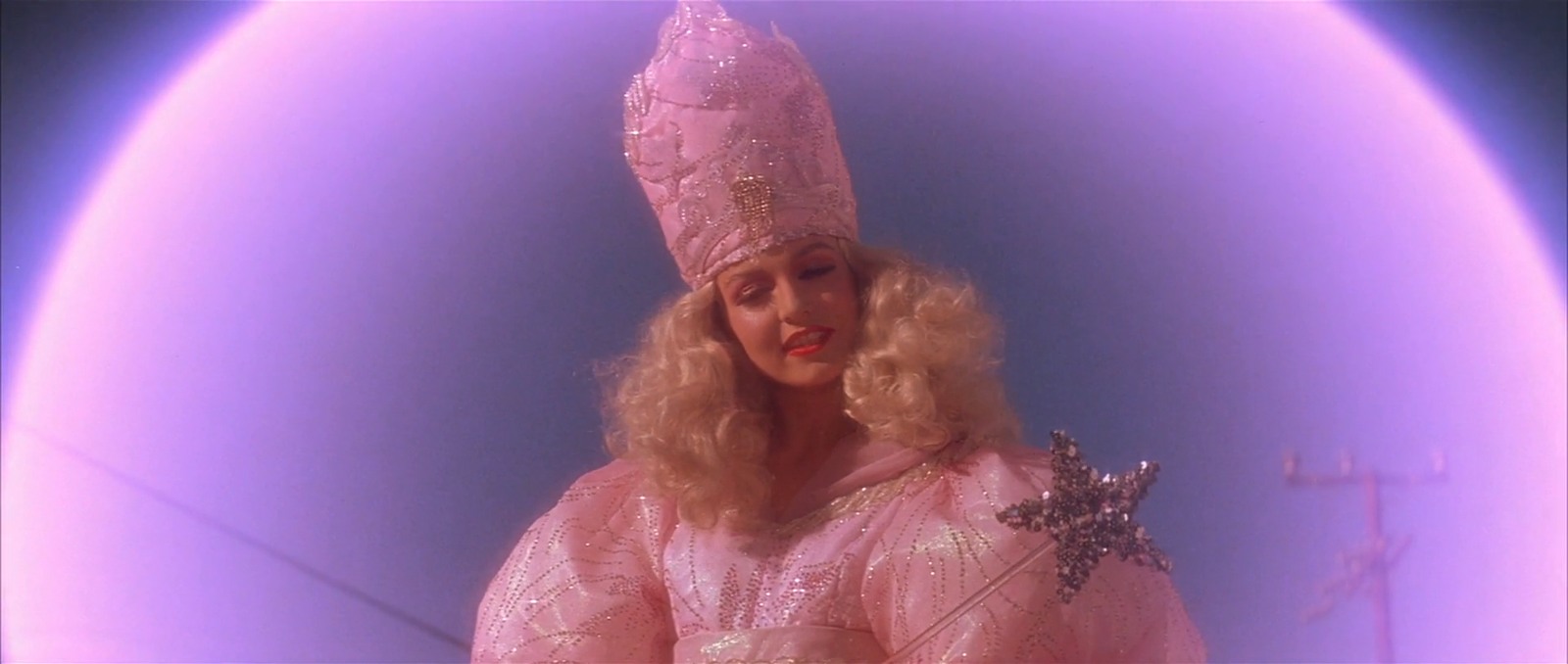
1:58:10The bright sphere appears against ordinary buildings and utility lines. Its openly artificial presence does not disguise the intervention as realism. The ending changes register to make an emotional command visible: Sailor can choose to return. The online screenplay includes this intervention, but its undated transcription cannot establish when the idea entered the writing.
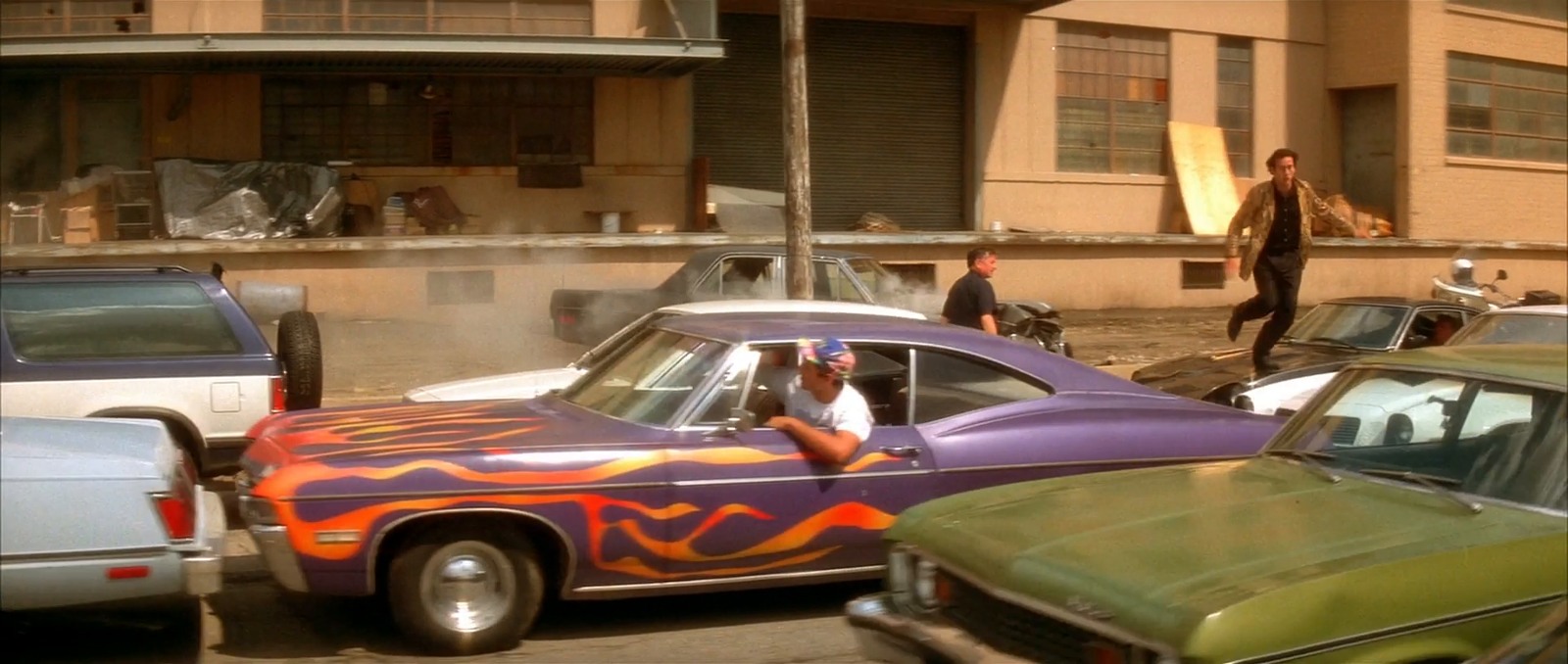
The obstacle is now the road itself
2:00:00The traffic that carries other people becomes the surface Sailor crosses on foot. A road previously used to escape is reorganized into an obstacle between him and Lula. His spectacular movement still belongs to the film’s theatrical vocabulary, but it now has a clear destination: reaching the people he was about to leave.
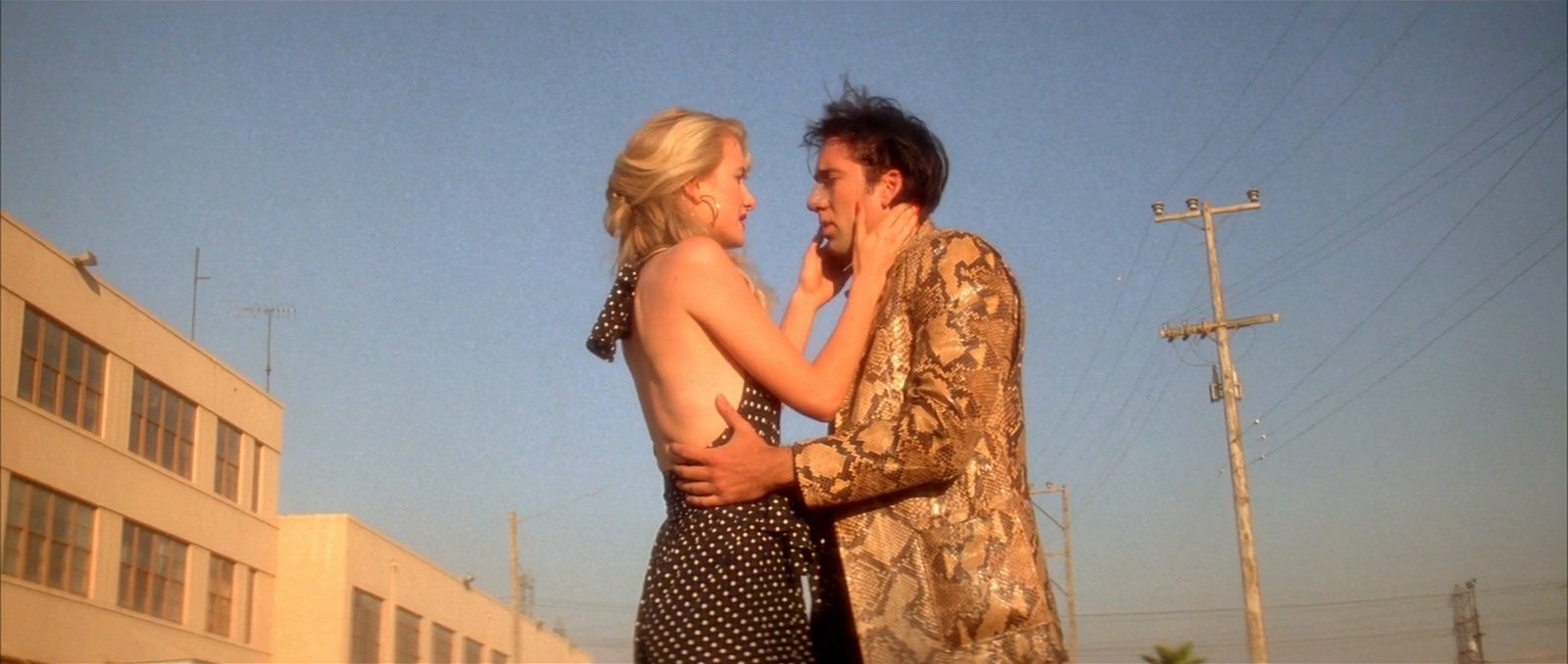
The performance chooses its audience
2:00:50The final embrace places the lovers against the daylight street rather than removing them into a separate dream landscape. The performance at the ending recalls the earlier public serenade, now after the refusal of an easier departure. Whether the fairy-tale rescue feels earned remains open to argument; the image makes its commitment to their reunion unmistakable.
Viewing this edition
The copy behind the scene guide
The illustrated moments come from a widescreen copy running 2 hours 5 minutes 1 second, including opening logos and closing credits. Its image is approximately 2.36:1. Times belong to this copy and may shift in other presentations.
Criterion’s forthcoming edition is separately described as the unrated international version. The version guide keeps the rating history, runtime records and announced restoration distinct.
About the scene studies and images
Selected frames were examined across the complete running time, with closer checks of the roadside dance, wreck and ending. These are scene readings, not an inventory of every cut. Embedded English subtitles support narrative identification. The dialogue studies add a complete-track recognition pass and selected cross-checks; direct listening and comparisons between sound mixes remain separate work.
Film images: Wild at Heart (1990). Captions describe each selected moment. The research below supplies production credits, collaborator testimony and documentary sources.
The lovers are the point of attachment
The central problem of Wild at Heart is how to believe in a romance when almost everything surrounding it seems designed to make belief ridiculous. Sailor and Lula travel through a threatening America while Lula’s mother tries to separate them. BFI introduction ↗ Their private language promises shelter. The road repeatedly exposes how fragile that shelter is.
At BAFTA in 2007, Lynch described their mutual respect and equality. He connected Dern’s casting to discovering her range after Blue Velvet and praised Cage’s readiness to try an idea. Lynch’s recollection ↗ Gifford likewise emphasized the lovers’ openness and the way they speak to one another when interviewed in 2016. Gifford on the relationship ↗ These accounts establish a shared emphasis; they do not require every viewer to find the film tender.
Sincerity and theatricality can occupy the same gesture. A declaration of love can borrow the manner of a pop idol and still matter to the person making it. The harder question is whether the spectacle lets us feel the lovers’ vulnerability, or keeps replacing that feeling with the pleasure of another outrageous image. That disagreement runs through the film’s reception.
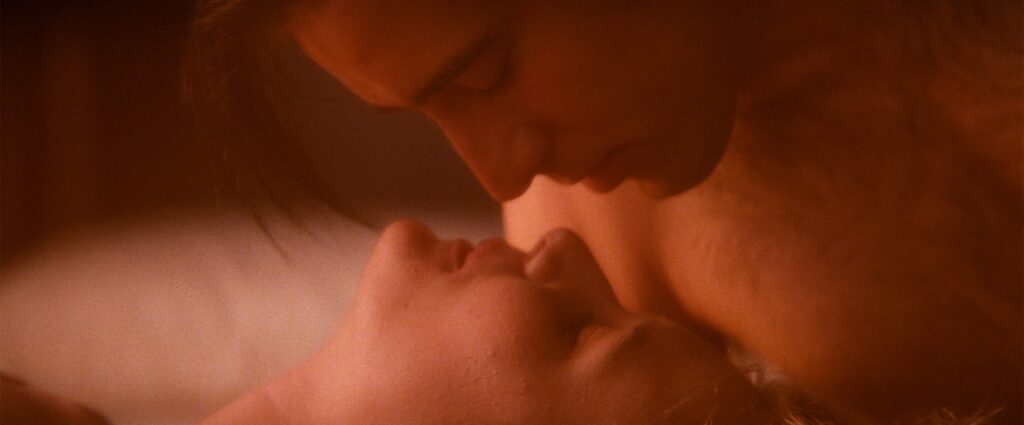
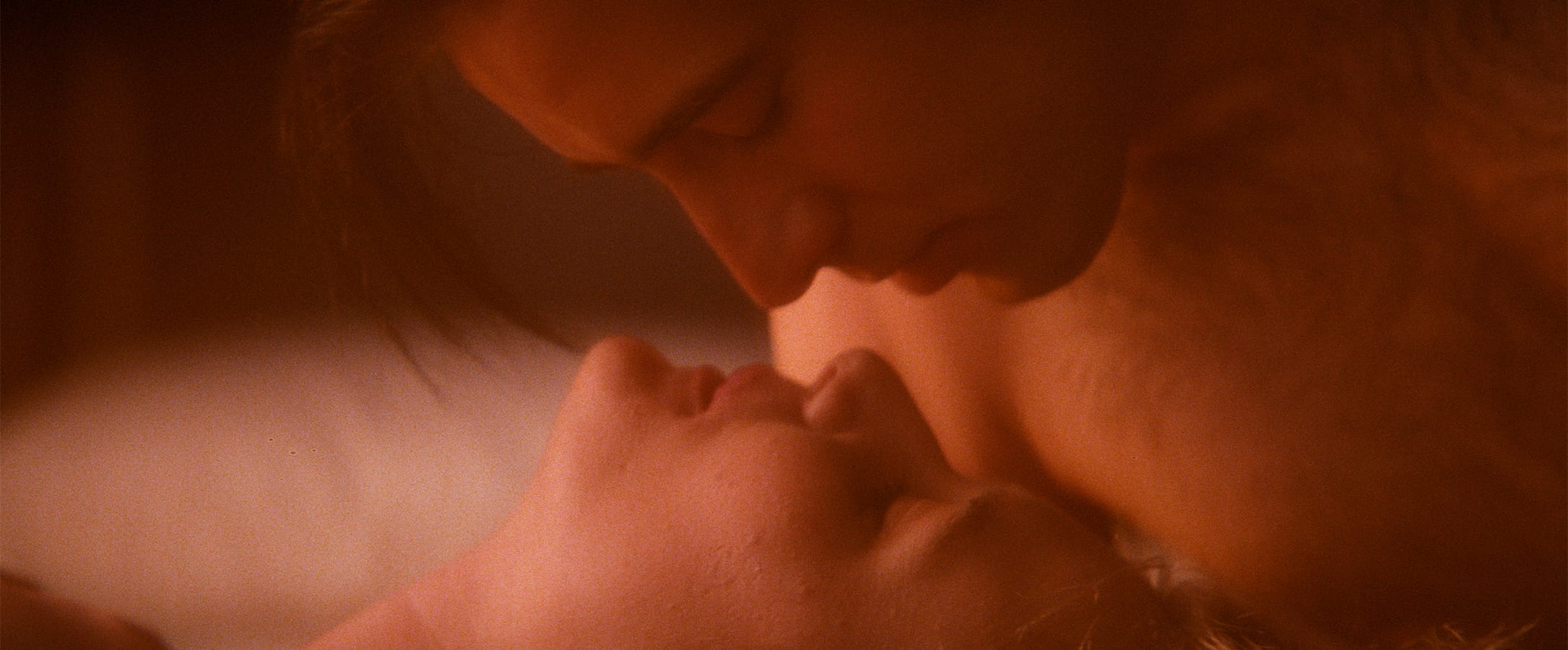
The opening still concentrates the question into two faces and warm light. The outside world almost disappears. Its intimacy suggests a refuge, but the story of flight makes that refuge precarious.
A sparse novel, an expansive screen world
Lynch recalled Gifford’s economical prose generating many possibilities and acknowledged that the script departed from it. Lynch on adaptation ↗ The distinction matters: a novel, a dated screenplay and a released film are separate objects. Changes to structure, emphasis or the ending need to be traced through those objects before they can become a reliable account of the rewriting.
The available online screenplay is a 136-page transcription, not a scan authenticated against a production copy. Its opening page supplies no draft date. Scenes 1–3 describe a motorcycle crash, followed on page 2 by further violence in everyday surroundings. PDF pp. 1–2 ↗ Sam Davies independently cites the crash’s sound instruction as belonging to a 1989 script. That correspondence helps identify a passage, but does not authenticate the whole transcription. Published script reference ↗
Beginning with unconnected eruptions would establish a hostile world before asking us to invest in a couple. The staircase study follows the released film’s different approach: Sailor and Lula are already present when the public setting becomes violent. Written material alone cannot establish that these opening episodes were shot.
The ending: what the inspected text establishes — spoilers
The transcription includes the Good Witch in scene 162A and Sailor’s return to Lula across traffic in scenes 163–164; the reunion culminates in a song. PDF pp. 134–135 ↗ At BAFTA, Lynch said Gifford accepted the happier conclusion. Printed pp. 7–8; PDF p. 4 ↗ The undated copy cannot tell us when the change entered the script. Nor does this pass claim a page-by-page comparison with Gifford’s novel.
The rescue turns freedom toward commitment. Returning to someone can become the courageous act, rather than another departure. Yet a fairy-tale intervention also raises a formal doubt: does it earn the reunion through the lovers’ experience, or openly announce the wish that the experience should end differently? Both possibilities deserve room.
A concrete archival lead: entries in Stanford’s current Gifford finding aid identify a first draft dated 1 June 1989, M0927, Series 2, Box 32, folders 9–11. They offer a specific future comparison, not retrospective authority for the web copy. Finding-aid lead ↗
A feature made alongside Twin Peaks
AFI’s production history places photography from 9 August to late October 1989, with work in Los Angeles, New Orleans and El Paso. Its account draws on trade reporting and production notes. Production record ↗ These are filming regions; a fictional place name is not automatically the address where its scene was made.
Dunham remembers editing Wild at Heart while sets were being prepared for Twin Peaks, then stepping away to direct the first regular episode. Separate cutting rooms followed. He recalls a first cut exceeding four hours. The editor’s account ↗ This describes an intertwined working schedule, rather than two neatly consecutive productions. It also gives the long first cut its proper status: an editorial stage, not proof of an authorized four-hour release.
The credited core includes Elmes on photography, Dunham on editing, Patricia Norris on production design and Johanna Ray on casting. Department credits ↗ AFI separately credits Amy Stofsky for costume design. Costume credit ↗ That distinction matters when discussing the look of a character. A production-design credit does not establish authorship of every garment, and a performer’s contribution can enter a department’s work.
Our synthesis: the interviews describe a production in which preparation and sudden invention coexisted. The quick opportunity, the trusted collaborator and the practical limit recur across departments. That is more informative than describing every excess as spontaneous: a photographed burst of freedom can depend on a carefully placed crane, a costume decision and an editor’s later selection.
Fire, distance and the making of a release
Elmes recalled testing close-ups of a match and a cigarette, then building a large outdoor fire for the opening titles. Fire was already in the script, he said. Elmes on the fire imagery ↗ The testimony connects a recurring image to experiments in scale and an actual production undertaking.
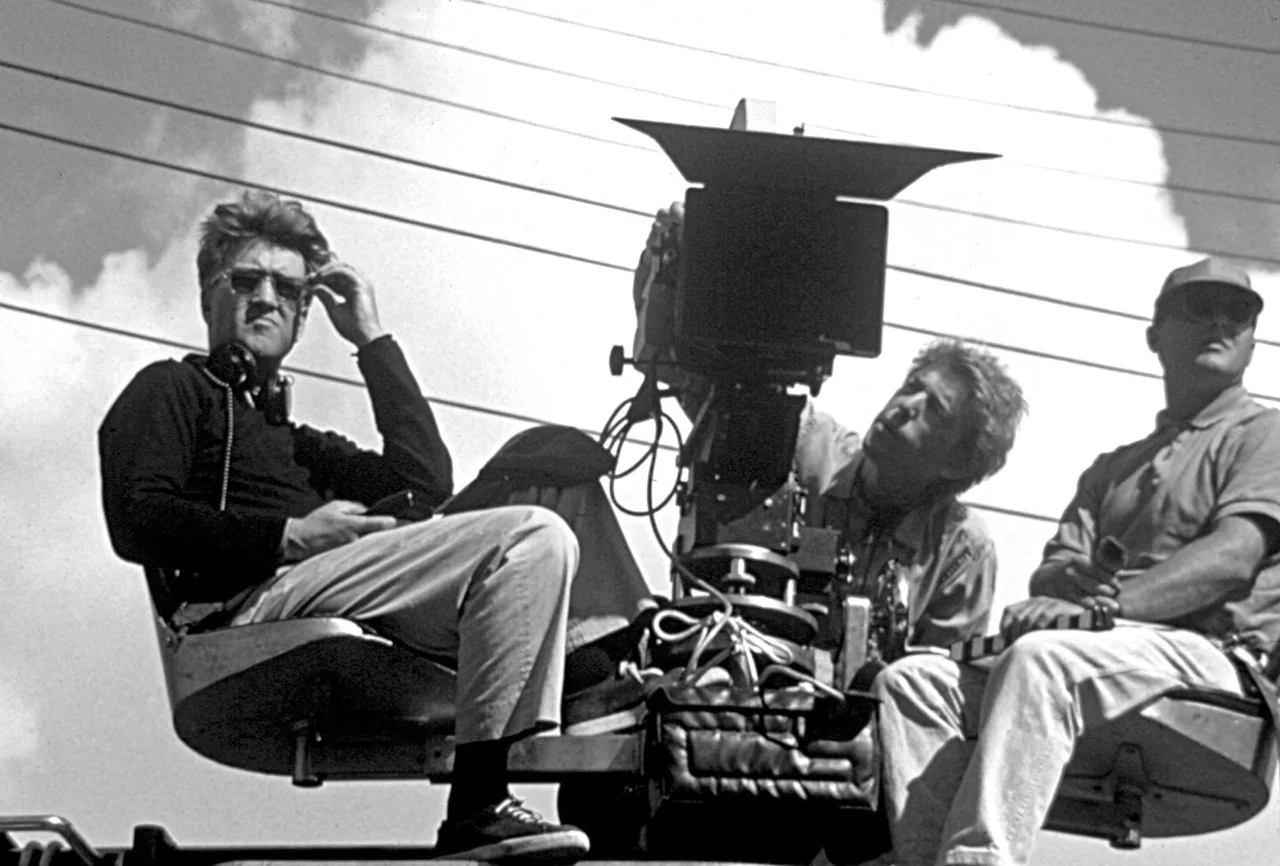
The roadside dance provides a particularly useful account of collaboration. In 2024, Elmes described choosing a place with the sunset in mind, positioning a small crane and racing there after filming at a gas station. He recalled limited equipment and little margin for unfavorable weather. He also connected Lula’s costume color with the brickwork behind the couple. The final interview exchange ↗ His earlier ASC recollection similarly emphasizes how quickly the sunset material had to be made. Earlier account ↗ These are two recollections by the same participant, not two independent witnesses.
The movement from a car into an open landscape can make escape temporarily bodily rather than geographic. The lovers have not solved the threats pursuing them, but the composition gives them room. Elmes’s practical details show how costume, location, camera height and the remaining light could converge on that sensation.
This is also why a location list is insufficient. A place can be chosen for what the sun will do there, rather than for the story’s map. Our later location record must distinguish the fictional journey, the shooting region and the documented position of an individual setup. Elmes’s recollection supplies an important lead without establishing a precise roadside address.
Borrowed identities, personal choices
In an interview published in October 1990, Cage described a playful set where scenes and lines could change. He recalled a preparatory road trip with Dern and said the snakeskin jacket was his own purchase; Lynch incorporated it into the writing. Contemporary Cage interview ↗ The jacket therefore has more than a symbolic life. It is an actor’s chosen possession entering a fictional declaration of identity.
BFI identifies Elvis and The Wizard of Oz among the film’s cultural references. Iconography ↗ Dern later described Lynch asking for more Marilyn Monroe as a compact direction she understood for Lula. Dern on direction ↗ These borrowed images are working materials for performers as well as references for viewers. An impersonation can become a vocabulary for feeling; it need not be only a joke at a character’s expense.
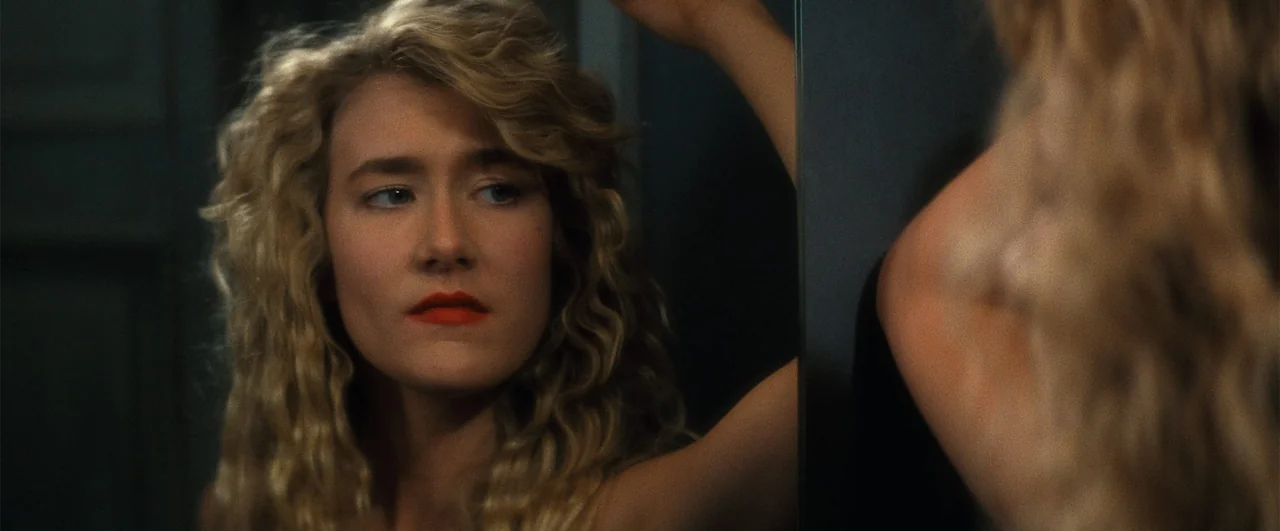
Lula, coercion and a contested performance
Dern’s September 1990 conversation with Gary Indiana is especially valuable because it preserves an argument happening at release. She rejected the idea that the Bobby Peru scene meant a woman’s refusal concealed agreement, and described Lula’s speech as arising from fear while discussing the character’s effort to retain control. She also recalled shared laughter when Ladd’s motherly gesture became recognizable during their first scene together. Contemporary Dern interview ↗ The real family relationship informed performance without making Marietta a portrait of Ladd.
An actor’s account of a character’s inner resistance and a viewer’s recognition of coercion are different kinds of evidence. They can coexist. Spoken compliance under intimidation does not establish consent. The scene should be examined through staging, proximity, pauses and the distribution of power, rather than treated as a puzzle in which one retrospective explanation settles Lula’s experience.
Diane Ladd’s Marietta, Harry Dean Stanton’s Johnnie Farragut and Willem Dafoe’s Bobby Peru change the pressure around Sailor and Lula. Their performances give attachment, pursuit and threat distinct faces and rhythms. Cast record ↗
Finding Lula in rehearsal
In her 2022 conversation with Kyle MacLachlan, Laura Dern recalls Lynch asking for a more youthful, buoyant Lula during rehearsals: the feeling of a teenager in love rather than a mature romantic heroine. She describes the direction as a series of vivid clues that let her find the person he imagined. The recollection gives the performance’s exuberance a practical history. Lula’s manner is something discovered and adjusted in rehearsal, not simply an unfiltered version of the actor. Dern and MacLachlan, 2022 conversation, 11:40–12:15
Excess has to be selected
Dunham’s account of the long first cut changes the question from how much strangeness was invented to how it was shaped. Editing recollection ↗ An assembly can contain alternatives, repetitions and passages that have not found their place. Its length says little about the rhythm or meaning of a finished version. Deleted scenes on a disc are another object again: selection and presentation can turn working material into a new retrospective experience.
A road narrative offers an unusually permissive structure for interruptions. New people can arrive, tell a story or become a threat, then disappear. But permissiveness creates a problem of proportion. Each detour can deepen the sense of a world pressing on the couple, or dissipate the urgency of their journey. The difference lies in duration, return and contrast—not simply the number of unusual characters.
A later comparison should therefore track where an encounter begins, whose knowledge governs it, how it changes the next scene and what sound bridges the cut. It should preserve the distinction between memory, a narrated anecdote and present action.
A romance built in the mix
Badalamenti is the credited composer and Randy Thom the sound designer. Music and sound credits ↗ Thom’s Cinesonic testimony describes Lynch declining advance premixing and experimenting with him on samplers during the final mix. He remembers the process as both exhilarating and exhausting. Final interview exchange ↗ This complicates the assumption that score and effects arrived as sealed packages. It is a participant’s recollection, not a quantified account of musical authorship.
The earlier script lead also matters here: Davies’s cited motorcycle passage imagines an impact in emotional, exaggerated terms. Script example ↗ Sound is part of the conception of an action. But neither that instruction nor Thom’s account establishes which individual sound survives in which release.
A compact music index
AFI’s music credits identify the following recordings and performances. This index distinguishes contributors; it is not a timed cue sheet. Music and song credits ↗
Swipe the table sideways to compare every column.
| Music | Credited performer | What to keep distinct |
|---|---|---|
| “Slaughter House” | Powermad | The recording, its on-screen context and the surrounding mix. |
| “Love Me”; “Love Me Tender” | Nicolas Cage | A character performing and an Elvis-associated repertoire. |
| “Up in Flames” | Koko Taylor | Performance and the Lynch–Badalamenti writing credit. |
| “Wicked Game” | Chris Isaak | The song, film use and separately produced music videos. |
| “Im Abendrot” | Jessye Norman; Gewandhausorchester | The pre-existing Strauss work and its placement in the film. |
Our listening framework: a source song can begin as something the characters hear and become the emotional scale of an entire landscape. A performance can make a declaration public. An effect can seem larger than the object producing it. The productive question is how those functions change across a cut. Album sequencing cannot resolve this, and a new surround mix can change the experience even if the images remain the same.
Thom’s wider argument is that sound should influence the construction of a film, rather than decorate completed pictures. Sound-design discussion ↗ Read beside Elmes’s account of the roadside sequence, this points to the film as a meeting of departments: movement, light, music and performance producing one event.
Sound collaborators in the closing credits
The closing roll of the copy examined here names the following collaborators. These credits identify responsibilities without assigning every individual sound to a particular person.
- Supervising sound editor
- Richard Hymns
- Dialogue editors
- Michael Silvers, John Nutt, Sara Bolder, John Verbeck and Robert Fruchtman
- Sound effects editors
- Ken Fischer and Luis Colina
- Music editor
- David Slusser
- Foley artists
- Gary Hecker and Catherine Rowe
- Foley recordist
- Scott Chandler
- Rerecording mixers
- Randy Thom and David Parker
- Music supervisor
- Mark Roswell
The roll also credits Skywalker Sound North with sound services. Read these names alongside Thom’s account of experimenting during the mix: the recollection describes a working process, while the credits make the larger collaboration visible.
More music named in the film’s credits
Beyond the compact index above, the closing credits identify these recordings and performers. This is a credit record, not a claim about exact cue positions.
- Streamline — John Ewing and the Allstars.
- Smoke Rings — Glenn Grey and the Casa Loma Orchestra, as spelled in the film’s credit.
- Baby Please Don’t Go — Them.
- Far Away Chant — African Head Charge.
- Kosmogonia — composed by Krzysztof Penderecki; performed by the Chorus and Symphony Orchestra of the National Philharmonic, Warsaw.
The credits also confirm Cage’s performance of Love Me Tender and Koko Taylor’s performance of Up in Flames, written by David Lynch and Angelo Badalamenti. The repeated request for Sailor’s song links a music credit to the lovers’ unfolding commitment.
Dialogue & song
Words that carry the journey
Sailor and Lula tell stories, make promises and borrow phrases from the movies. Around them, other people use conversation to conceal a crime, sell a betrayal or force a response. Fourteen studies follow those exchanges from the first declaration of freedom to the final serenade.
These readings follow the complete story. Times locate passages in the 2:05:01 copy; review scope and sources are below.
Choose a dialogue study
The jacket becomes a speech
Sailor introduces his snakeskin jacket as an emblem of individuality and freedom. Lula has heard the declaration so often that she can puncture its grandeur without rejecting him. When a stranger insults the jacket at the club, Sailor repeats the formula in a confrontation: a private joke becomes a public test of identity. His eventual apology to the men who beat him offers another response to humiliation. Read across the film, the repeated declaration raises a question the ending finally answers: can Sailor remain himself without proving himself through another fight?
Being known by another person
The lovers’ conversations move between jokes, sexual memories, childhood injury and parental absence. Their intimacy depends on a willingness to hear these changes of subject. Sailor already knows about the abuse Lula’s mother never knew; Lula listens when his story of childhood smoking becomes an account of bereavement. Later she joins in his recollection of a former lover rather than treating it as a test of fidelity. In her 1990 interview, Dern described this exchange as a key to Lula’s confidence in their relationship. The stories give the couple a shared history while the road keeps taking them away from home.
Laura Dern in conversation with Gary Indiana, September 1990 ↗
A laugh, a wind, an unseen dog
Lula identifies a woman’s laugh with the Wicked Witch; Sailor interprets it as someone enjoying herself. Later she connects the wind with the witch’s approach. The disagreement is already in their dialogue: the same stimulus can belong to ordinary life or to an imagined menace. Spool gives this process a miniature demonstration in Big Tuna. He mentions a barking dog, then points out that his listeners have pictured an animal he has never described, perhaps even Toto. Words summon images before evidence supplies them. The Oz references therefore concern perception as well as costume, quotation and the eventual appearance of the Good Witch.
Who gets to call it an agreement?
Marietta wants Sailor killed, but Santos makes Johnnie’s death a condition of his help. He elects to treat her silence as permission and persists through her objections. The transaction moves to Mr. Reindeer, whose language converts people into problems, payments and obligations. A silver dollar and a set of particulars stand in for a victim’s identity. This is a system for distributing violence while keeping its organizers at a conversational distance. Santos’s appropriation of another person’s response also anticipates Bobby Peru’s treatment of Lula: the aggressor claims the authority to decide what someone else has agreed to.
Two ways of keeping a secret
Marietta says she has done something terrible but postpones explaining it to Johnnie until they can meet. In person, she again turns toward their plans and denies involving Santos. The delay makes affection an obstacle to information. Sailor’s disclosure to Lula travels in the other direction. He admits driving for Santos and being outside her family home when it burned. He does not claim to have witnessed everything that happened inside. Lula must reconsider the account of her father’s death inherited from her mother. The confession changes their relationship by exposing a gap in Sailor’s story; it does not magically settle every fact about the fire.
Lula changes the station
The car radio assembles a world of illness, killing and grotesque news. Lula objects to what she is being made to take in and demands music. Her intervention gives the subsequent roadside dance a dramatic cause: the lovers actively seek another way of occupying the moment. The contrast can be followed through the broadcast words, her request and the visible change in their behavior. It also prepares a reversal. At the motel, a later bulletin turns the fatal accident they have witnessed into a brief report that other listeners mock. The radio can reduce a life to an item; the lovers’ encounter has already made that loss personal.
The things the dying girl still needs
The injured stranger keeps returning to a missing purse, cards, a bobby pin, her hair and her mother’s anticipated anger. Her concerns remain attached to the practical world she expects to rejoin, while Lula recognizes that she is dying. The scene’s distress comes partly from this mismatch between what the girl can name and what the witnesses understand. Her fear of her mother also catches against Lula’s own flight from maternal control, without making the two lives identical. Sailor wants to help but mentions his broken parole: even at this roadside emergency, their freedom has conditions. No speech gives them an explanation adequate to what they have seen.
A witness who conceals the danger
Sailor asks Perdita whether a contract has been placed on him. She claims firsthand knowledge that Marietta and Santos killed Lula’s father, yet denies hearing about the threat to Sailor. Her later conversation with Bobby makes that denial untenable. She is a source of information and part of the danger at the same time. The exchange matters because it prevents the fire story from arriving as one clean explanatory revelation. Sailor’s limited recollection, Lula’s inherited account and Perdita’s self-interested testimony carry different kinds of authority. What a character says must be read alongside what that character has reason to withhold.
What Lula cannot yet say
Lula writes down the news of her pregnancy when she cannot bring herself to speak it. Once Sailor knows, the conversation distinguishes her love for him from her uncertainty about the circumstances in which they would raise a child. She describes their journey through the broken promise of the Yellow Brick Road. Sailor answers with an assurance that things will not get worse. The dialogue exposes how little protection a sincere promise can provide when he has no plan to support it. Writing nevertheless gives Lula a way to choose what she communicates, a striking contrast with the speech Bobby soon demands from her.
Bobby Peru takes control of the words
Bobby begins by asking to use the bathroom, comments on Lula’s illness and moves into demands that disregard her repeated efforts to make him leave. He tries to redefine her retreat as desire, then dictates the words that will supposedly end the encounter. The sequence makes the production of an utterance part of the assault. Repeating a demanded phrase under intimidation does not establish consent. Dern’s contemporary account describes speech given out of fear while also asserting Lula’s effort to retain an inner sense of control. That actor’s interpretation belongs beside the scene’s visible and verbal coercion, rather than erasing it. The existing performance discussion explores the disagreement in greater detail.
Easy money and a warning unheard
Bobby’s robbery pitch turns Sailor’s lack of money and Lula’s pregnancy into arguments for accepting the job. His knowledge also betrays that he has visited her while Sailor was absent. Sailor notices this, questions him and still accepts reassurances about the robbery. Lula subsequently asks to leave and warns him about Bobby. Sailor acknowledges her concern but closes the conversation rather than acting on it. His insistence that nobody be hurt returns at the feed store just before Bobby destroys the bargain. The tragedy is organized through assurances that the audience has increasing reason to distrust, including Sailor’s own promise to keep Lula safe.
A family carried by letters
Lula’s letter names the child Pace, anticipates the age the child will be when Sailor leaves prison, and records what she misses about being together. The relationship has to continue through an addressed message while bodies and years remain apart. When Sailor meets Pace, he says that he has read a great deal about him. That small greeting gives the correspondence a consequence: a family history has reached Sailor before he can take his place in it. His later claim that the boy barely knows him threatens to dismiss precisely the connection that these messages have maintained.
An old explanation becomes a choice
Sailor first explains his lack of parental guidance as something his public defender said on his behalf. Near the end he presents that same explanation to the Good Witch alongside his criminal history. Her reply directs him toward what he can do now: return to Lula and fight for the relationship. The repetition moves from a story about causes to a decision about responsibility. Afterward Sailor apologizes to the men who attacked him. The fairy-tale encounter is followed by a concrete change in his language and conduct, before the run across the traffic makes the return visible.
The song he saves for his wife
After his first serenade, Lula asks why Sailor has not sung “Love Me Tender.” He says he reserves it for his wife. She asks for it again in Big Tuna, when his involvement with Bobby threatens their future. The final serenade therefore answers an unfinished conversation that has lasted across the film. The closing credits identify Nicolas Cage as the song’s performer. Its significance is more specific than a general Elvis reference: Sailor finally offers the commitment he had attached to the song, after nearly abandoning Lula and Pace. Performance completes a promise that ordinary reassurance had repeatedly failed to secure.
Review scope and sources
The complete English audio track was processed locally with speech recognition and checked against a reading of all embedded English subtitle cues. Fourteen selected passages received a second recognition pass using the centre channel. Recognition errors and repeated-word artifacts were excluded; the studies paraphrase the dialogue rather than present a transcript.
This is a machine-assisted dialogue review, not a continuous direct-listening assessment. Precise vocal delivery, the timing and spatial placement of effects, a complete music cue sheet and comparisons between sound mixes remain unverified. The song argument combines dialogue, the previously examined performance images and the film’s closing credits. Laura Dern’s contemporary interview and Randy Thom’s published testimony supply separately attributed production context.
A prize does not settle an argument
Cannes records Wild at Heart, also titled Sailor et Lula, as a 1990 competition film and Palme d’Or winner. Official French-language record ↗ The Academy records Diane Ladd’s supporting-actress nomination at the 1991 ceremony. Nomination record ↗ These are specific forms of recognition, not measures of unanimous approval.
Chris Hicks’s 17 August 1990 review finds the film unrewarding while acknowledging the fascination of Cage and Dern. Contemporary dissent ↗ Terrence Rafferty argues that the shocks and elaborate images lack resonance. The New Yorker ↗ Rainer instead finds energy in the collision of genres. 12 August 1990 review ↗
The disagreement concerns what formal excess accomplishes. Does a collision of tones enlarge feeling or evade it? Does an encounter make the world more dangerous or merely more decorated? It is useful to retain these objections beside the collaborators’ enthusiasm. An award cannot answer them, and later affection does not erase the experience of a viewer who found the film hollow.
Atkinson’s 2025 career essay places this highway fantasy in relation to Blue Velvet and Oz. Later critical reading ↗ That is a different historical perspective. The earlier film’s apparently settled environment and this film’s promise of movement offer a useful comparison, but a retrospective account should not be substituted for how a particular audience responded in 1990.
The sample here remains principally American. Terms such as “cult film” describe a later relationship with audiences; they should lead to evidence about circulation, revival and reuse rather than stand in for that history.
Name the version before comparing it
AFI records a dispute over the American rating and further editing for an R-rated release after Cannes. Its date fields distinguish a New York opening in the week of 17 August 1990 from an 18 August Los Angeles opening. Release history ↗ We retain those fields rather than silently turning them into one universal premiere date.
Three kinds of version evidence
Swipe the table sideways to compare every column.
| Record | What it documents | What remains unproved |
|---|---|---|
| 1990 Cannes | Competition and award. Festival ↗ | The exact content of an identified surviving festival print. |
| UK classifications | 6 August 1990 cinema: 124m 14s; 20 November 1990 video: 119m 19s; 16 June 2017 cinema: 125m 3s. BBFC entries ↗ | Why each length differs; the measurements alone do not identify removed scenes. |
| Criterion, announced for 17 November 2026 | Restored unrated international version, supervised by Elmes and approved by the Estate; 2.0 surround and a new alternate 5.1 mix by Dean Hurley. Publisher listing ↗ | Our own disc, image, audio and supplement inspection. |
Announcement rechecked 8 November 2026. The release remains forthcoming. The publisher identifies original 35 mm DME magnetic tracks as the source for the alternate mix.
Runtime is a clue, not a cut list. Playback speed, logos and other presentation differences must be checked alongside the actual sequence of images and sounds. The word “unrated” describes a release context; it does not authenticate every circulating file as the same version. A restoration, an alternate mix and a collection of deleted scenes need separate records.
Objects have their own history
The museum distinguishes a period theatrical poster, later artist edition and home-video package. For this film, useful additions would document territory, distributor, dimensions, printer or catalogue marks, front and back, and a traceable issue date. A reproduced sleeve image is not evidence that a particular physical copy was examined.
The existing menu and header use an authentic still sourced from Criterion. The production photograph in this dossier documents filmmaking rather than a moment inside the fictional world. Keeping those image types visible helps prevent publicity, film evidence and later interpretation from becoming interchangeable.
Explore further
Follow the sources below, explore the museum collection, or continue through the Reading Room. New archival discoveries and contributions enrich the record of Lynch’s work.
Sources and further reading
The records below distinguish catalogues, participant testimony, criticism and directly inspected text or images. A linked source does not imply that every object it describes was inspected.
- Wild at Heart: the copy examined for the scene guideDirect visual study of selected frames across the 2:05:01 widescreen copy, with denser checks of the roadside dance, wreck and ending. Embedded English subtitles consulted for narrative identification. A complete-track speech-recognition pass, full English-subtitle reading, selected centre-channel checks and on-screen sound-credit review inform the dialogue and song studies. This does not constitute a continuous direct-listening audit.
- Criterion Collection: Wild at Heart ↗Credits, specifications, still gallery and forthcoming edition listing checked; announcement rechecked 8 November 2026. No Criterion disc or complete supplements inspected. The separate local-copy visual study is identified above.
- BFI Player: Wild at Heart ↗Synopsis and introduction read; this is catalogue evidence, not a viewing record.
- David Lynch in conversation with Jason Barlow, BAFTA, 27 October 2007 ↗Wild at Heart discussion checked against the downloadable transcript, printed pp. 7–8 / PDF p. 4.
- AP Kryza interviews Barry Gifford, 22 March 2016 ↗Opening answers on the lovers and later discussion of a proposed continuation read. Aspirations do not establish a completed production.
- Wild at Heart: online screenplay transcription ↗136-page PDF downloaded. Opening and ending passages read; pp. 1, 134–135 visually checked. No draft date is visible on the opening page; the transcription has not been authenticated against a production copy.
- Guide to the Barry Gifford Papers, Stanford Special Collections M0927 ↗Current collection guide and printable HTML entries checked: Series 2, Box 32, folders 9–11, archival objects 263225–263227. Manuscripts themselves remain unseen.
- AFI Catalog: Wild at Heart, record 67067 ↗History, release fields, production and music credits checked.
- American Cinematographer: Artistry in Balance—Fred Elmes, ASC ↗Wild at Heart paragraphs and crane photograph inspected; page displays 4 February 2020. Participant recollection within a career profile, not a camera report.
- Frank Falisi interviews Frederick Elmes, 11 April 2024 ↗Final Wild at Heart exchange on the roadside sequence read. Later recollection; exact location and camera paperwork unverified.
- Erik Luers interviews Duwayne Dunham, Filmmaker ↗Wild at Heart / Twin Peaks scheduling and first-cut account read. No assembly, cutting notes or deleted-scene compilation inspected.
- Nicolas Cage interview: Porcupine-tufted King of the Kooks, 2 October 1990 ↗Contemporary published account of preparation, changing scenes and the jacket read; no wardrobe object inspected.
- Gary Indiana interviews Laura Dern, September 1990; Interview republication ↗Published exchanges on Bobby Peru, character interpretation and working with Diane Ladd read.
- Laura Dern on David Lynch, MovieMaker ↗Retrospective answers on directing style and playing Lula read. Inland Empire comments are kept separate from Wild at Heart.
- Randy Thom: Cinesonic, text © 2000, hosted by Philip Brophy ↗Final exchange on improvising the mix and the sound-design principles read. No recording, session files or cue sheets inspected.
- Sam Davies: Backwards through the backwoods, Sight and Sound, 10 June 2025 ↗Opening script reference checked. Most testimony concerns Twin Peaks; it is not reassigned to Wild at Heart. The headline reverses Eschler’s and Hurley’s surnames.
- Festival de Cannes: Wild at Heart / Sailor et Lula ↗French-language official entry read: 1990 competition, Palme d’Or and credits. The page does not identify a surviving screening print.
- Chris Hicks, Deseret News review, 17 August 1990 ↗Contemporary dissent read. A critic’s response, not a representative survey of viewers.
- Peter Rainer (1990) ↗Review consulted.
- Terrence Rafferty: End of the Road, The New Yorker ↗Opening Wild at Heart criticism read. Web date 20 August 1990; URL identifies the 27 August issue.
- Academy: 63rd Academy Awards, 1991 ↗Supporting-actress nominee entry checked.
- Michael Atkinson: David Lynch, the dream engine who altered our orbit, 21 January 2025 ↗Later critical comparison with Blue Velvet retained; retrospective interpretation, not 1990 reception evidence.
- BBFC: Wild at Heart release records ↗Cinema and home-video classification entries read. Listed lengths are not measured edition comparisons or proof of particular cuts.
Another doorway
Continue exploring
Films
Blue Velvet
Explore Blue Velvet with 29 illustrated scene studies, dialogue and song analysis, production interviews, screenplay evidence and a guide to its editions.
Music
Music
Explore David Lynch’s albums and collaborators, from Julee Cruise and Thought Gang to Chrystabell, with recording histories, edition notes and sources.
Films
The Straight Story
Explore David Lynch’s The Straight Story through Alvin’s journey, Richard Farnsworth, Freddie Francis’s photography, landscape, music and production sources.
Image credits and sources accompany each linked guide.