Lost Highway
The feature films / 1997 / Scenes & research
The recording knows what memory refuses.
A videotape arrives without an explanation. To watch it is to discover that the home has already been entered—and that someone else can make an image of your life. Lost Highway turns that intrusion into a struggle over identity, desire and the authority of a story.
This dossier follows the film from Lynch and Barry Gifford’s writing to the rooms, performances, handmade transformations and layers of sound that make its uncertainty tangible. Its central question is not simply who a character “really” is, but what happens when an image resists the account someone wants to give.
- Film year
- 1997
- Listed runtime
- 134 min
- Image
- Color
- Edition ratio
- 2.39:1
Reading note: contains plot spoilers and discussion of sexual coercion and violence without graphic description. The illustrated scene guide discusses the complete story and ending.
Choose a route: follow the writing and production, enter through rooms and darkness, or explore the construction of sound and the film’s recurring words and songs. Source notes distinguish documents, recollections and criticism.
Images, doubles and returns
Follow the film, image by image
Thirty-six selected moments trace the journey from the Madison house through Pete’s other life to the return of the highway. Enlarge the stills, compare the repeating objects, and follow each study into the production and critical research.
The guide discusses the complete story and ending. Times locate the selected frames in the copy examined here.
Browse all 36 scene studies
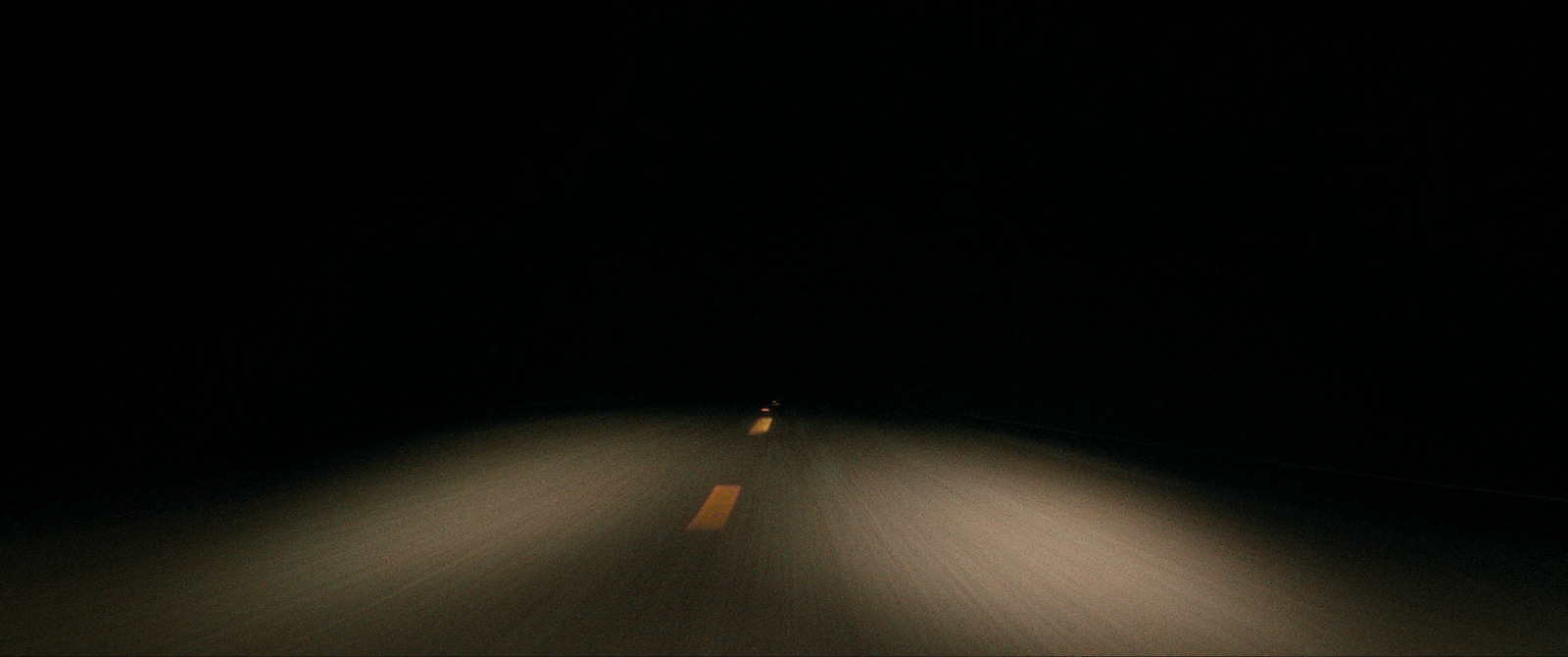
- 01:45 Movement without a destination
- 04:45 The first intrusion is a voice
- 08:03 A public performer, a private uncertainty
- 10:45 The threat arrives as an ordinary object
- 12:45 Their home becomes a screen image
- 21:45 Together in the room, apart in the frame
- 25:15 An official inquiry enters the bedroom
- 32:15 A face that breaks the party’s rules
- 38:15 The house stops giving directions
- 41:45 Looking becomes an accusation
- 43:15 The body enters an institution
- 45:45 Confinement made visible
- 50:20 The cell loses its stable appearance
- 50:50 A second body enters the sequence
- 53:45 The new man acquires a record
- 56:15 Daylight promises a different film
- 59:45 A new life begins at work
- 1:02:45 A passenger inside another man’s power
- 1:06:15 The road becomes a demonstration
- 1:14:45 Recognition arrives with a changed appearance
- 1:16:45 An invitation across the street
- 1:23:45 A familiar room changes register
- 1:25:45 A parent cannot complete the account
- 1:28:15 The friendly visit contains a weapon
- 1:35:15 The woman tells a story of coercion
- 1:40:15 The impossible caller reaches Pete
- 1:43:45 The mansion rearranges the encounter
- 1:46:40 Two appearances share one photograph
- 1:47:50 The corridor becomes a bodily crisis
- 1:51:45 An earlier image finds a place in the journey
- 1:53:15 A threshold before the separation
- 1:58:45 The face at the doorway is Fred’s
- 1:59:15 The observer carries his own camera
- 2:07:45 The photograph no longer holds the same group
- 2:09:15 The listener becomes the messenger
- 2:10:35 The road continues through the crisis
Scene studies / 01
The house under observation
A road, a voice and a succession of tapes put Fred and Renée inside a story whose observer they cannot locate.
Movement without a destination
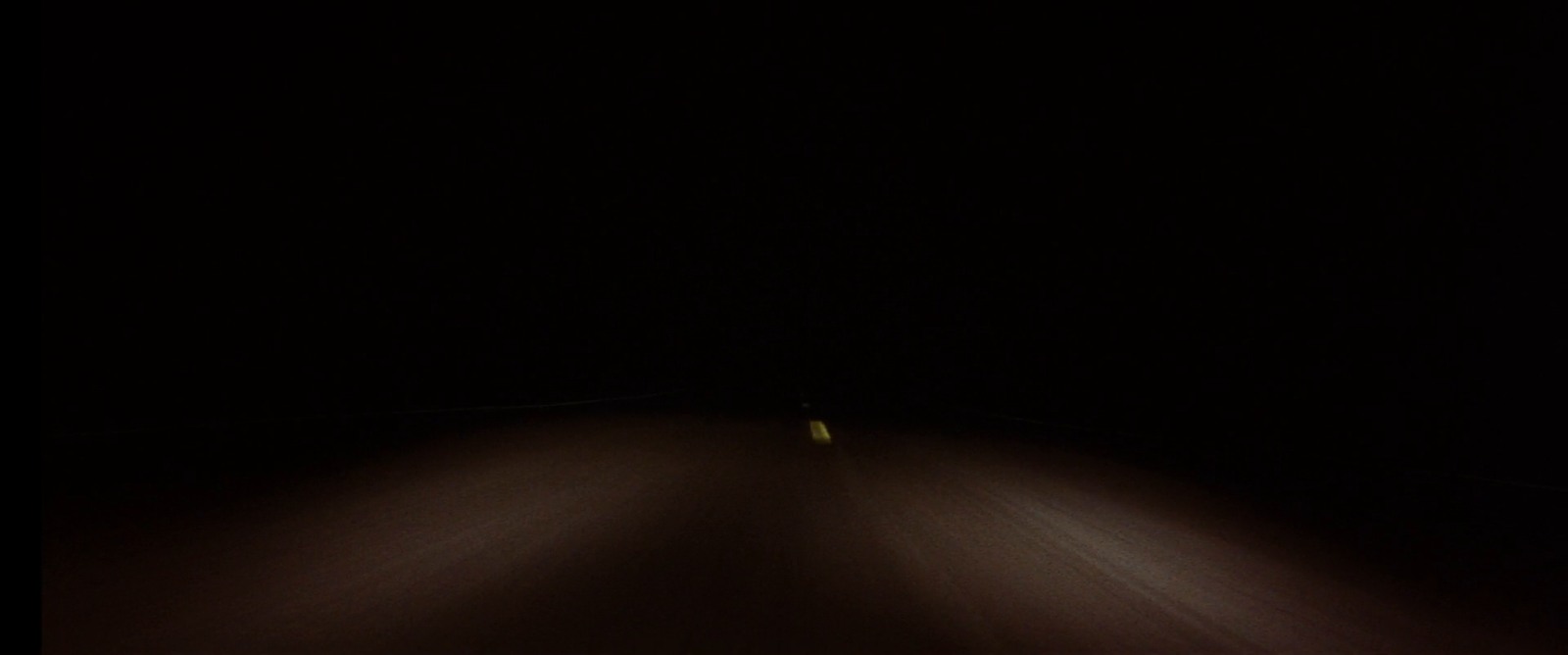
01:45The headlight beam gives the road a narrow, moving boundary. The yellow line pulls the eye forward while almost everything beyond it remains unavailable. Before a character appears, the film establishes a way of looking: compelled to advance, unable to see far ahead. The returning road at the ending makes this opening movement part of the film’s structure.
The first intrusion is a voice
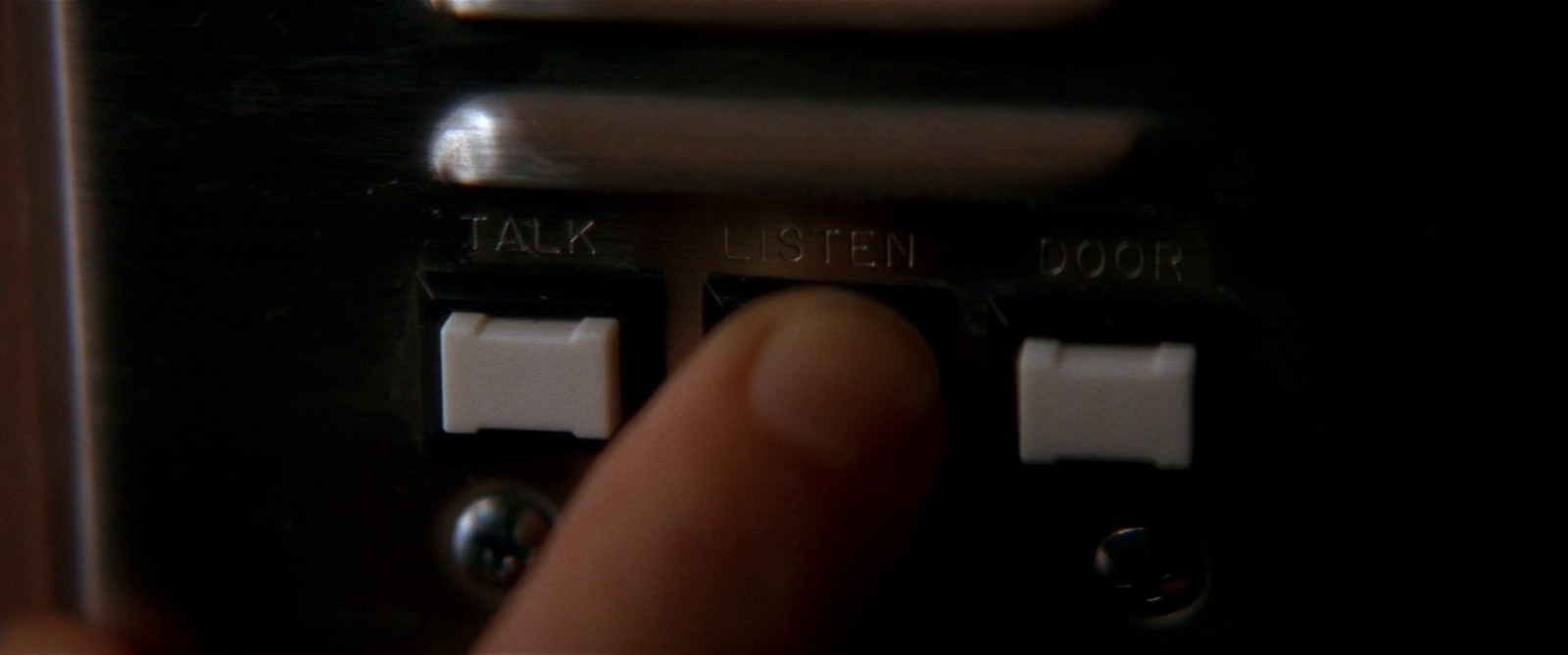
04:45The close view isolates the buttons and the hand operating them. A commonplace household device becomes a boundary between a visible listener and an unseen speaker. Near the ending, Fred occupies the other side of this arrangement. Following the object across the film is more useful than treating the opening message as information that can simply be filed away.
A public performer, a private uncertainty
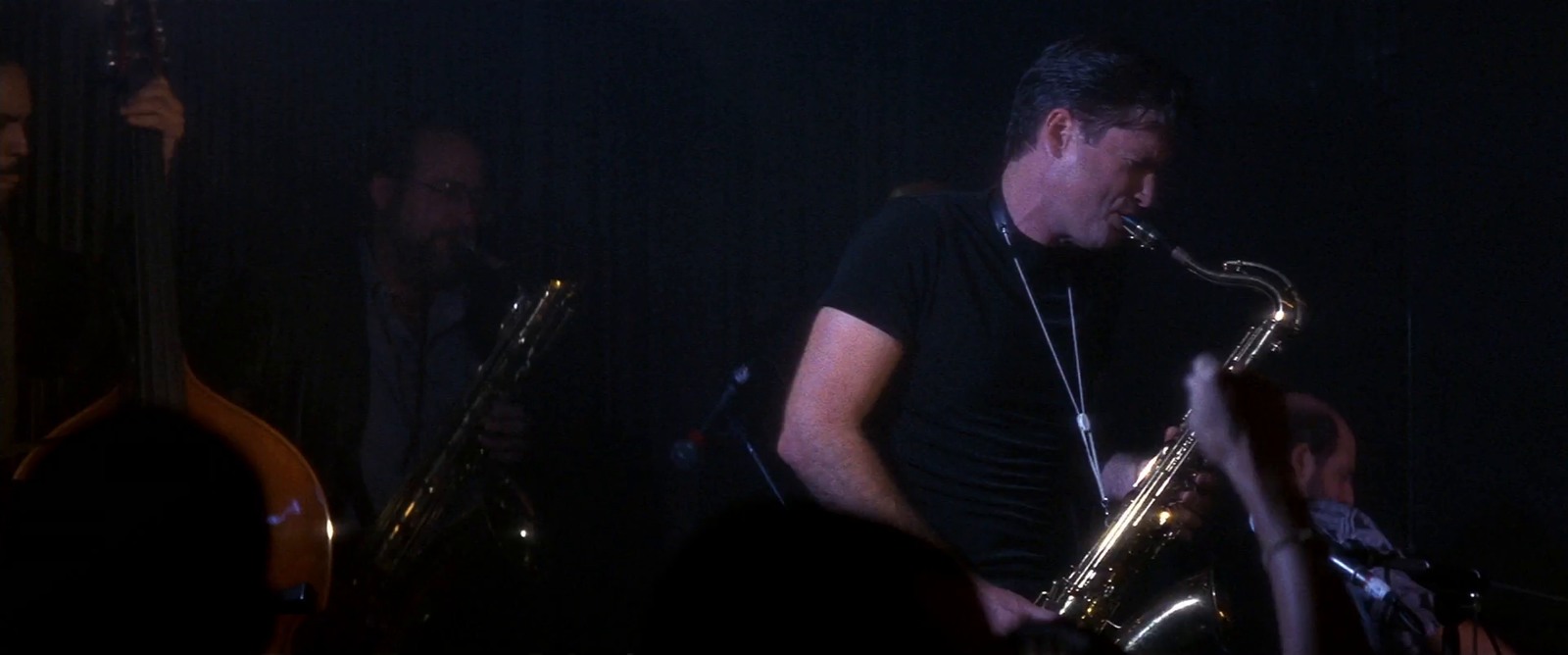
08:03The instrument and forward-leaning stance make Fred’s work physically forceful. Stage light distinguishes this space from the browns and shadows of his house. Yet public visibility does not settle what he knows about his private life. The performer presented to an audience and the man trying to account for Renée’s whereabouts remain different aspects of the same uneasy figure.
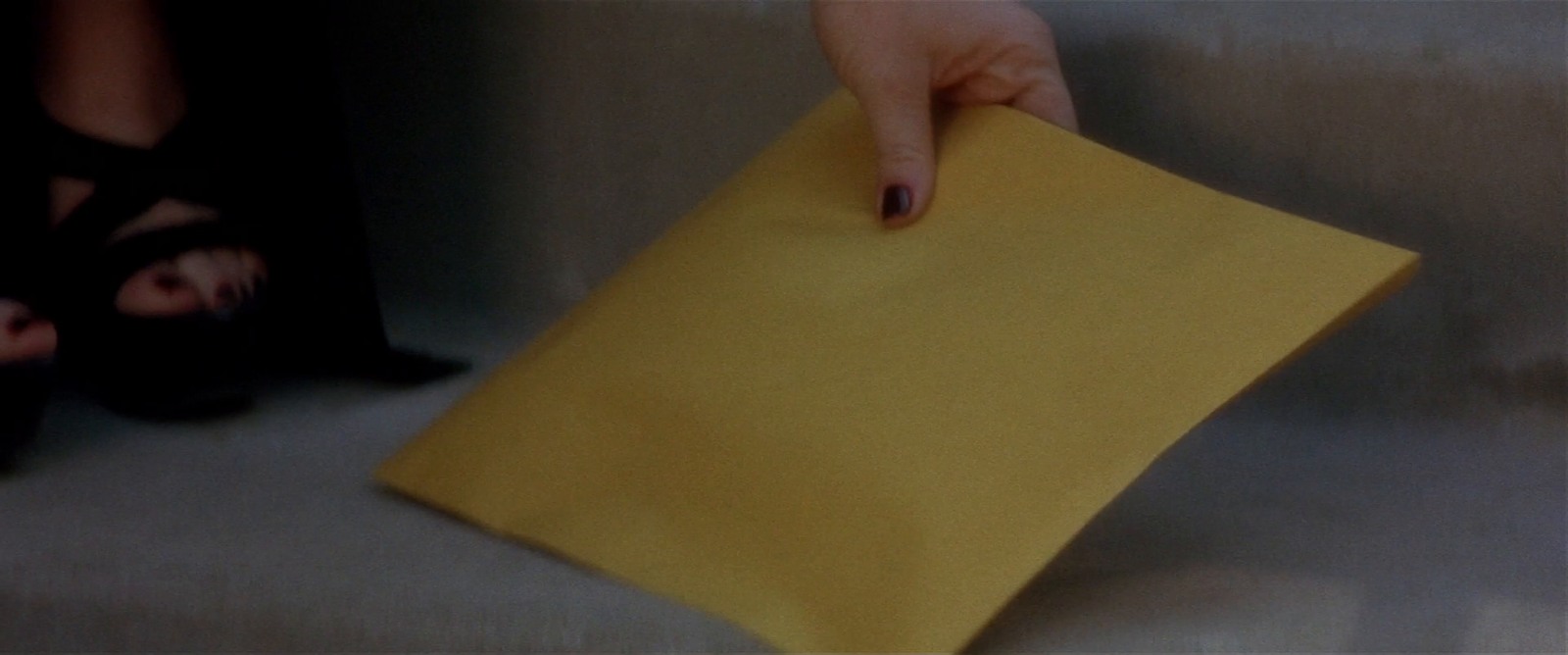
The threat arrives as an ordinary object
10:45The envelope offers neither an identifiable visitor nor an explanation. Its plain surface makes the intrusion deceptively manageable: an object can be picked up, opened and taken indoors. What it contains reverses that relationship. The house that seems to receive the delivery becomes the subject of someone else’s recording.
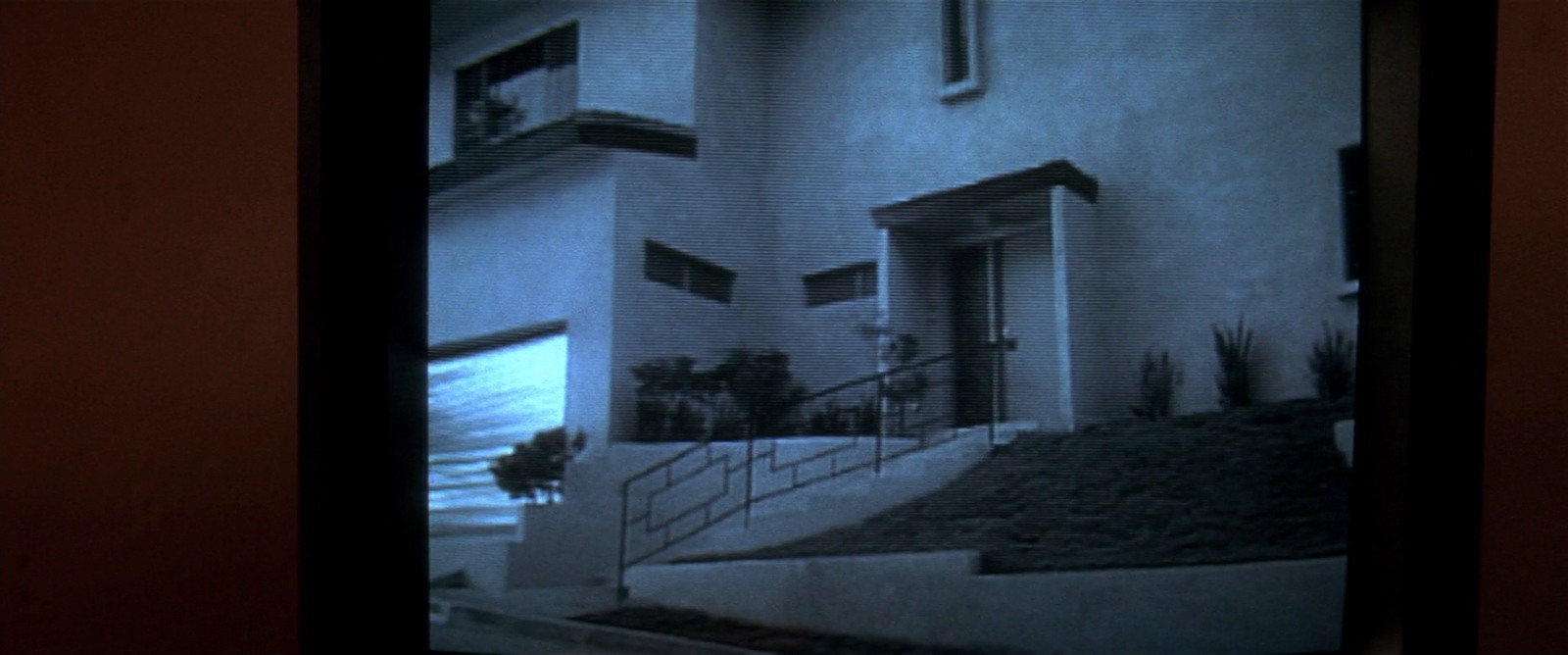
Their home becomes a screen image
12:45The monochrome recording changes the appearance of a house we have already encountered in color. The television frame makes the familiar exterior into something available for inspection. Its importance lies in that shift of position: Fred and Renée become viewers of their own home, while the person who made the recording remains outside their view.
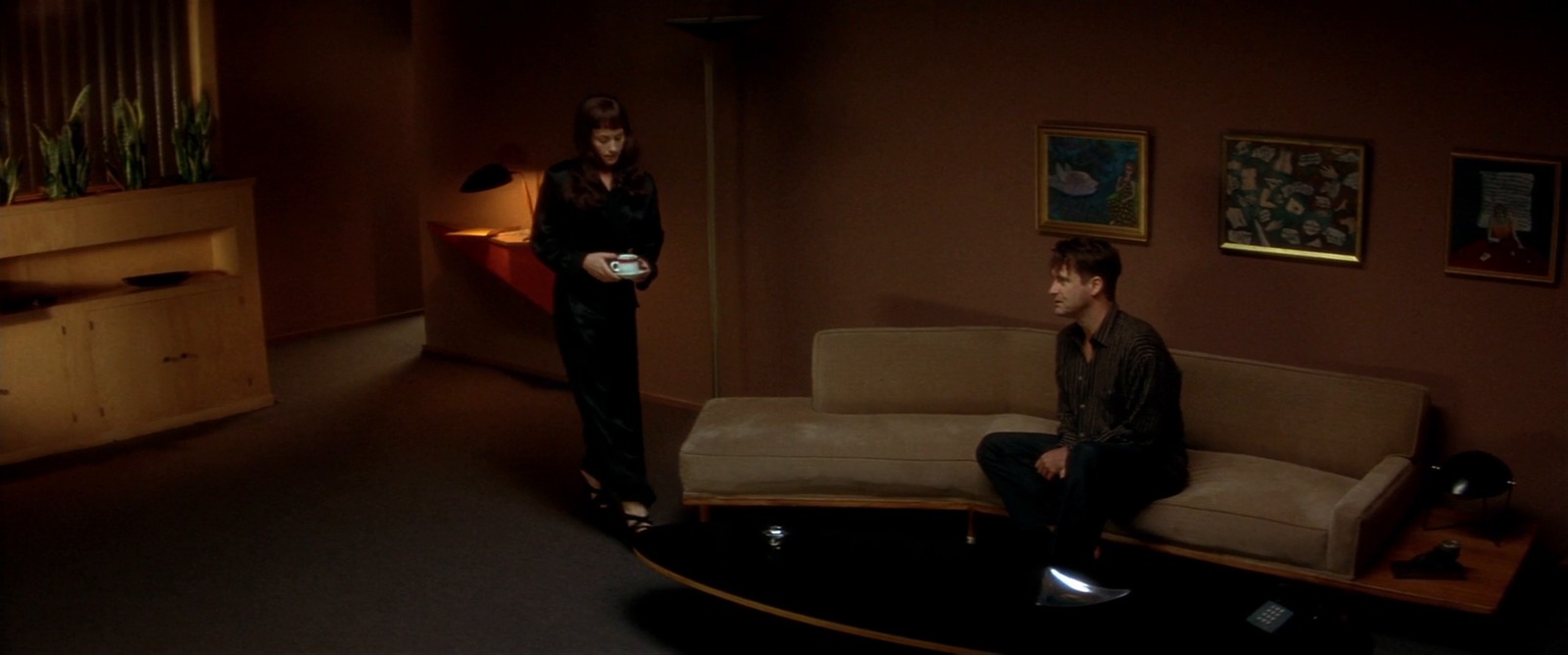
Together in the room, apart in the frame
21:45The wide room leaves a visible distance between the couple. The curved sofa and carefully placed objects give the interior an ordered surface, but the recording has made that order feel exposed. Neither a shared address nor a shared viewing position guarantees a shared account of what is happening. The room’s arrangement lets that separation register without an explanatory speech.
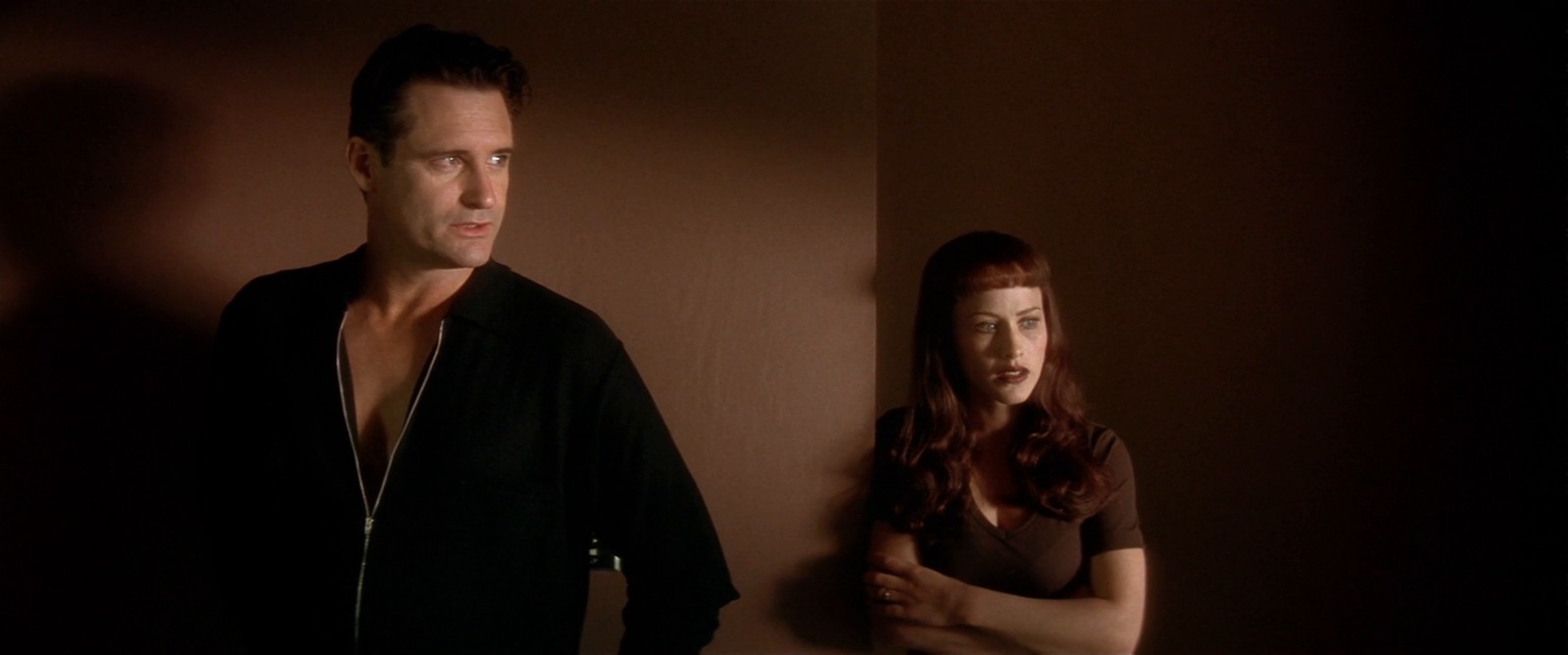
An official inquiry enters the bedroom
25:15The couple stand together under questioning, their bodies and shadows held against the warm wall. Bringing police into the house seems to offer a practical response to the tapes. It also makes the occupants explain a private space to more outside observers. Fred’s distrust of recorded memory belongs to this encounter, where an account of events and an image of them begin to compete.
A face that breaks the party’s rules
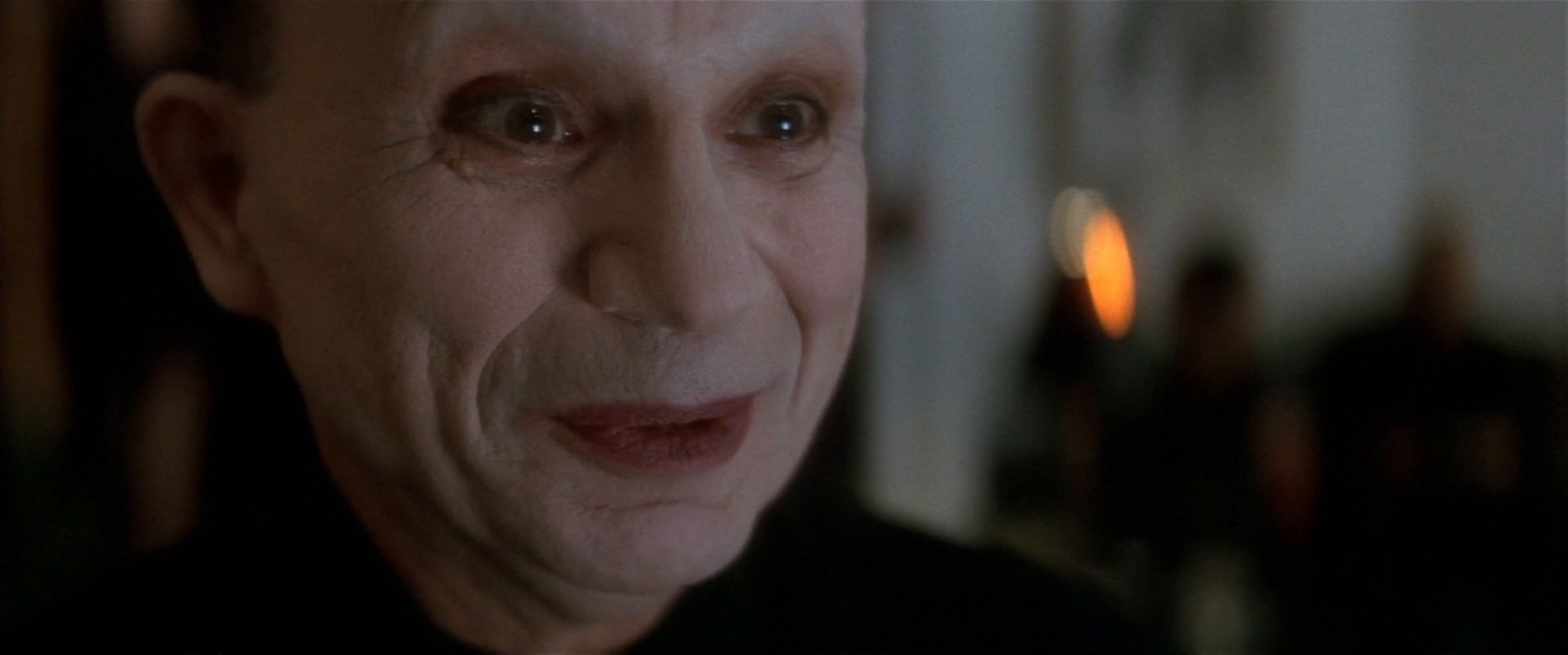
32:15The pale face and sustained frontal presentation separate the Mystery Man from the party’s social ease. His presence creates an encounter that is intimate without being familiar. The telephone exchange makes physical proximity unreliable: the person in front of Fred is connected with a place from which he appears to be absent. The film makes the contradiction playable before offering any explanation.
The house stops giving directions
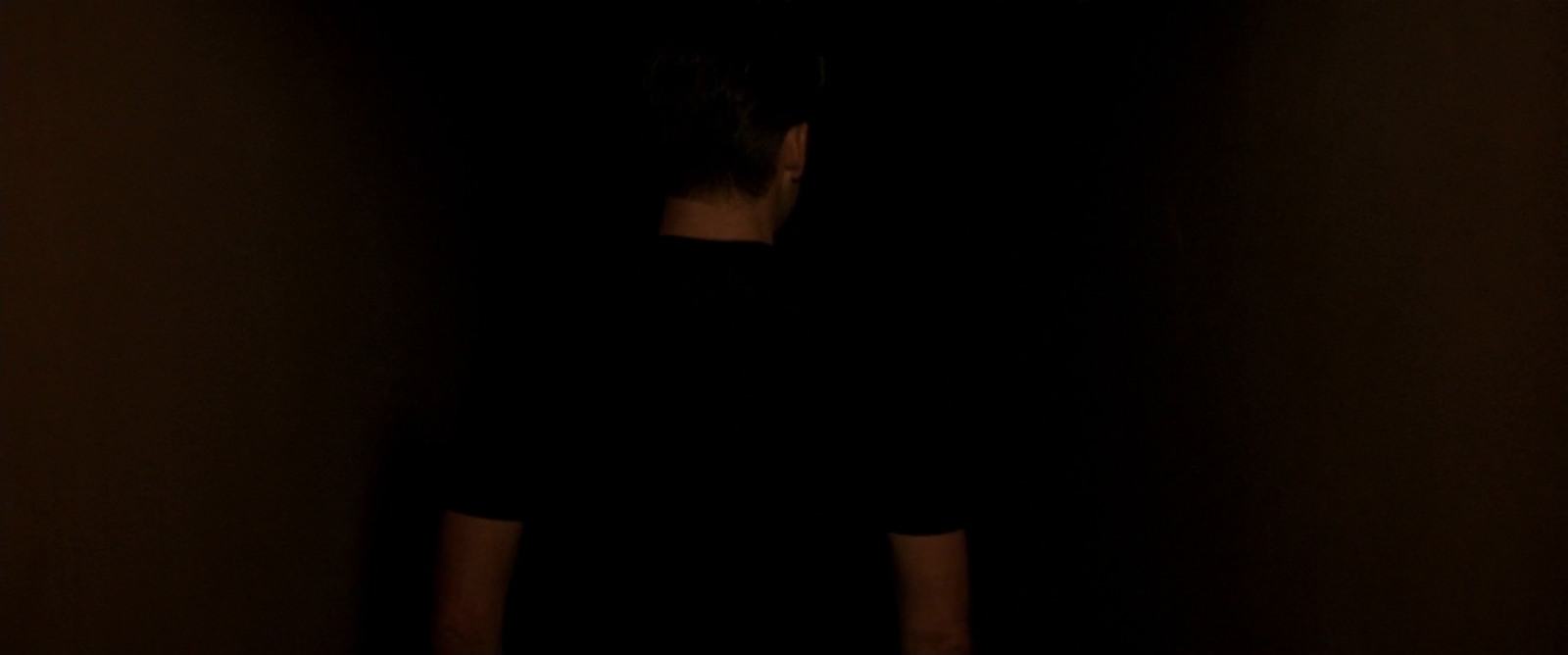
38:15The passage withholds the information that an open doorway normally promises. Familiar rooms do not guarantee a legible route between them. Read beside Deming’s account of controlling reflections and blocking light, this darkness becomes a designed space with an active dramatic function: Fred can enter it without our being able to follow him with confidence.
Scene studies / 02
A prisoner becomes someone else
The prison gives identity an official record. The images that interrupt Fred’s confinement undo that certainty.
Looking becomes an accusation
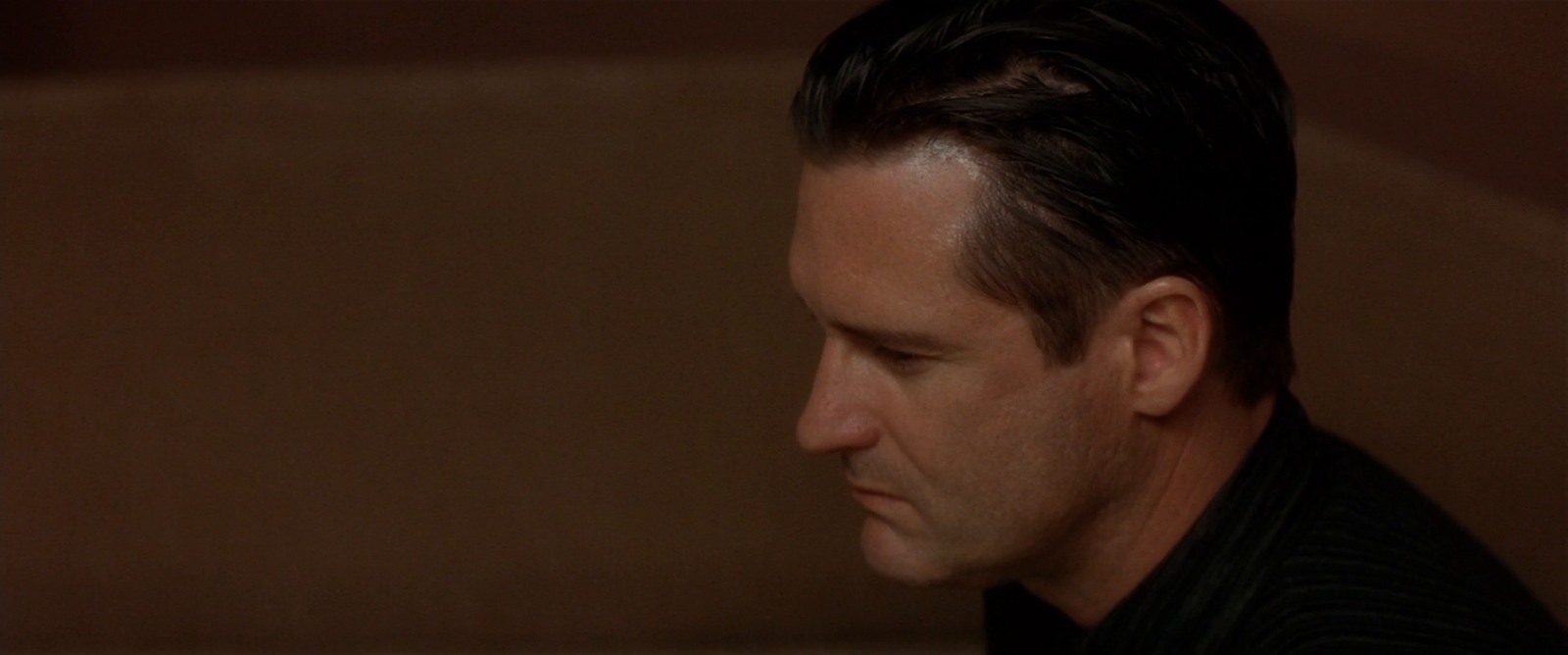
41:45Fred’s face is held in profile as the recording brings the intrusion to its most destructive point. The image does not restore a secure account of the night; it makes the distance between seeing and remembering unbearable. His position as a viewer can no longer be kept separate from his implication in the violence that the tape presents.
The body enters an institution
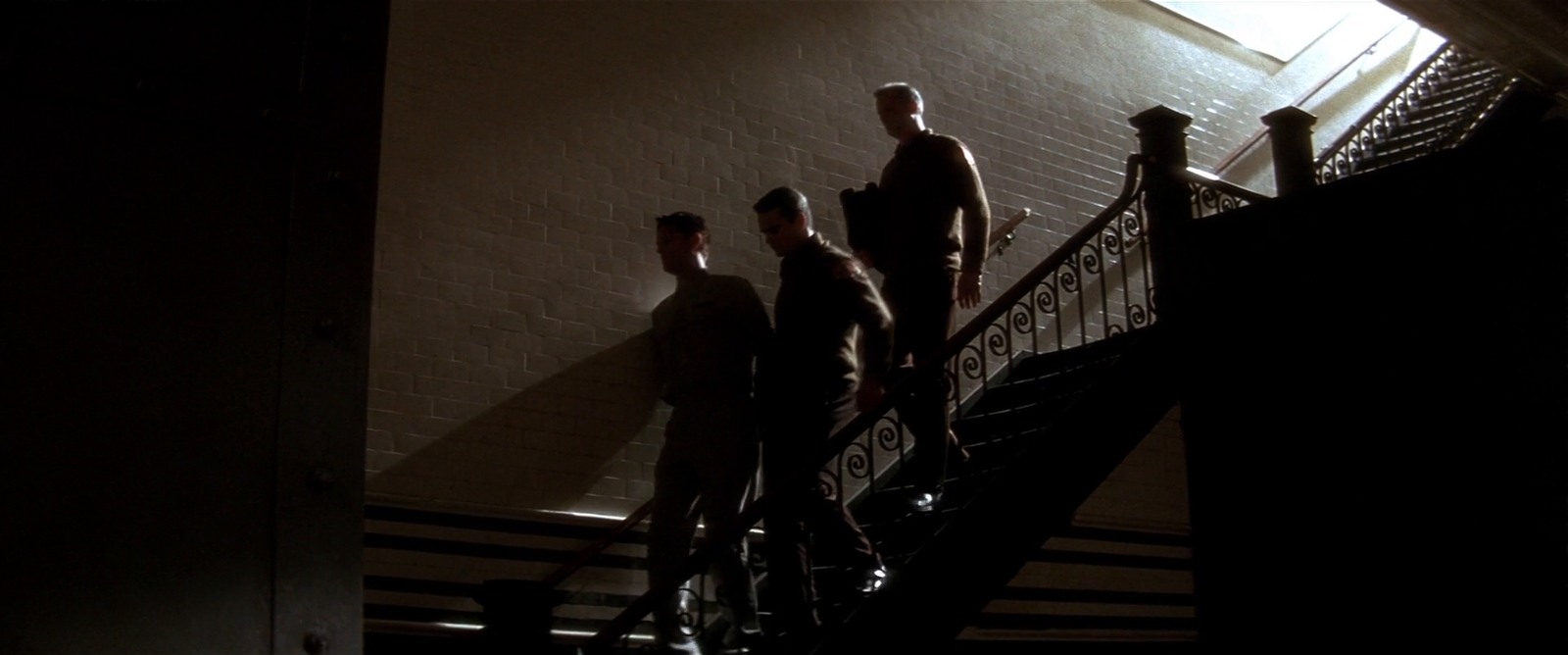
43:15The stair rail, overhead light and accompanying guards give Fred a prescribed route. After the uncertain interior of the house, the prison appears to make movement and identity definite. He is escorted, observed and assigned a place. That apparent certainty prepares the force of the transformation: the institution can hold a body without retaining the person it expects.
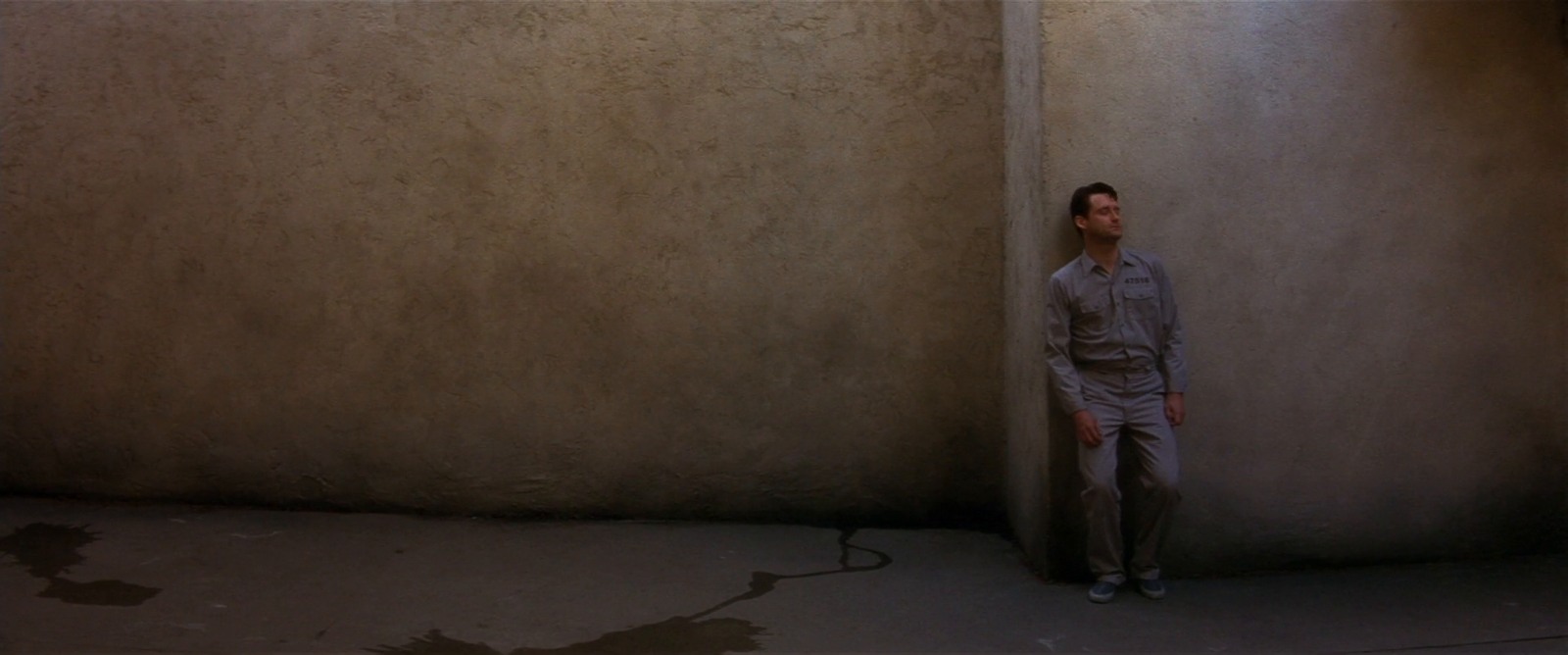
Confinement made visible
45:45The immense wall dwarfs the figure at its base. Instead of using bars alone to signify confinement, the composition makes the available space feel disproportionate to the person inside it. Fred’s smallness within the frame contrasts with the close, subjective images of distress that follow. Institutional scale and bodily crisis become two different ways of representing his imprisonment.
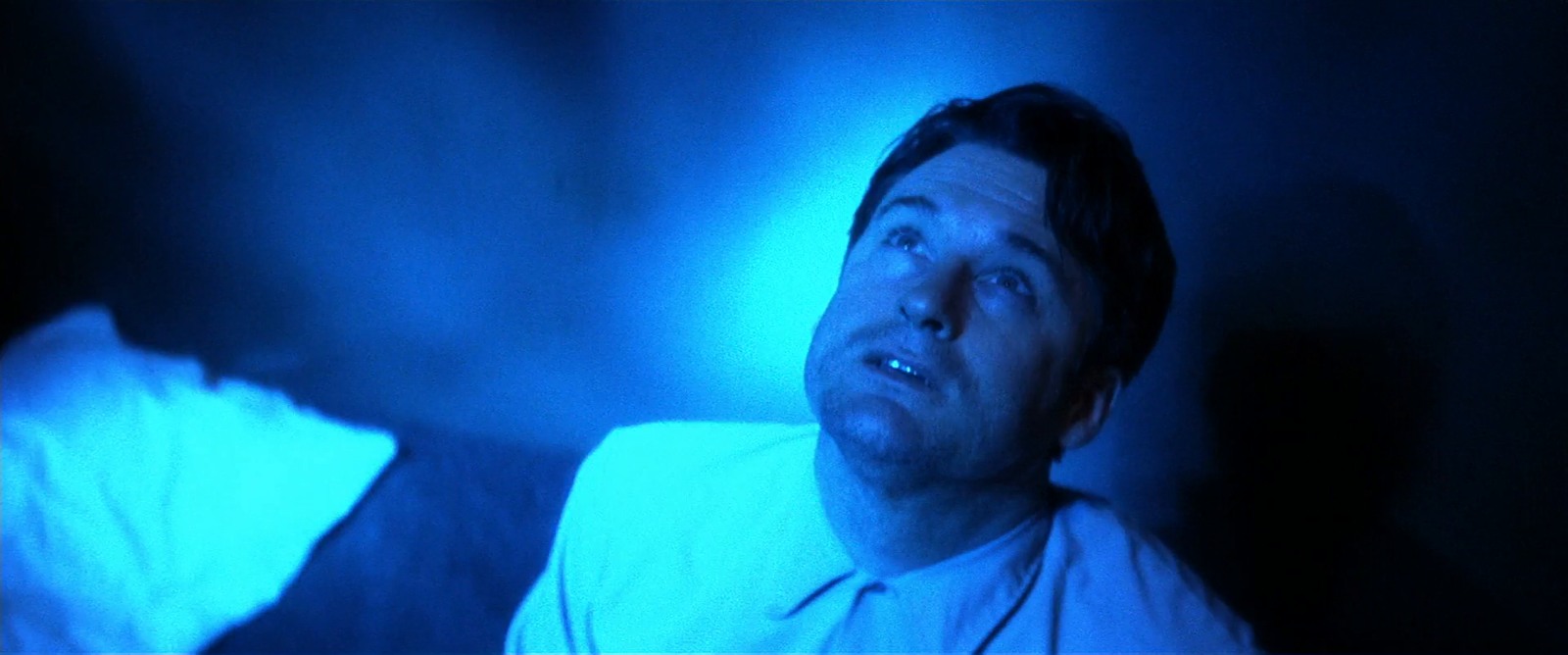
The cell loses its stable appearance
50:20Saturated blue light interrupts the prison’s more ordinary surfaces. The change does not provide a new location so much as make the existing one unstable. Around it, the film introduces the cabin, road and Pete, so the transformation operates through a succession of places and bodies. The editing research below explains why such moments cannot be reduced to a single makeup effect.
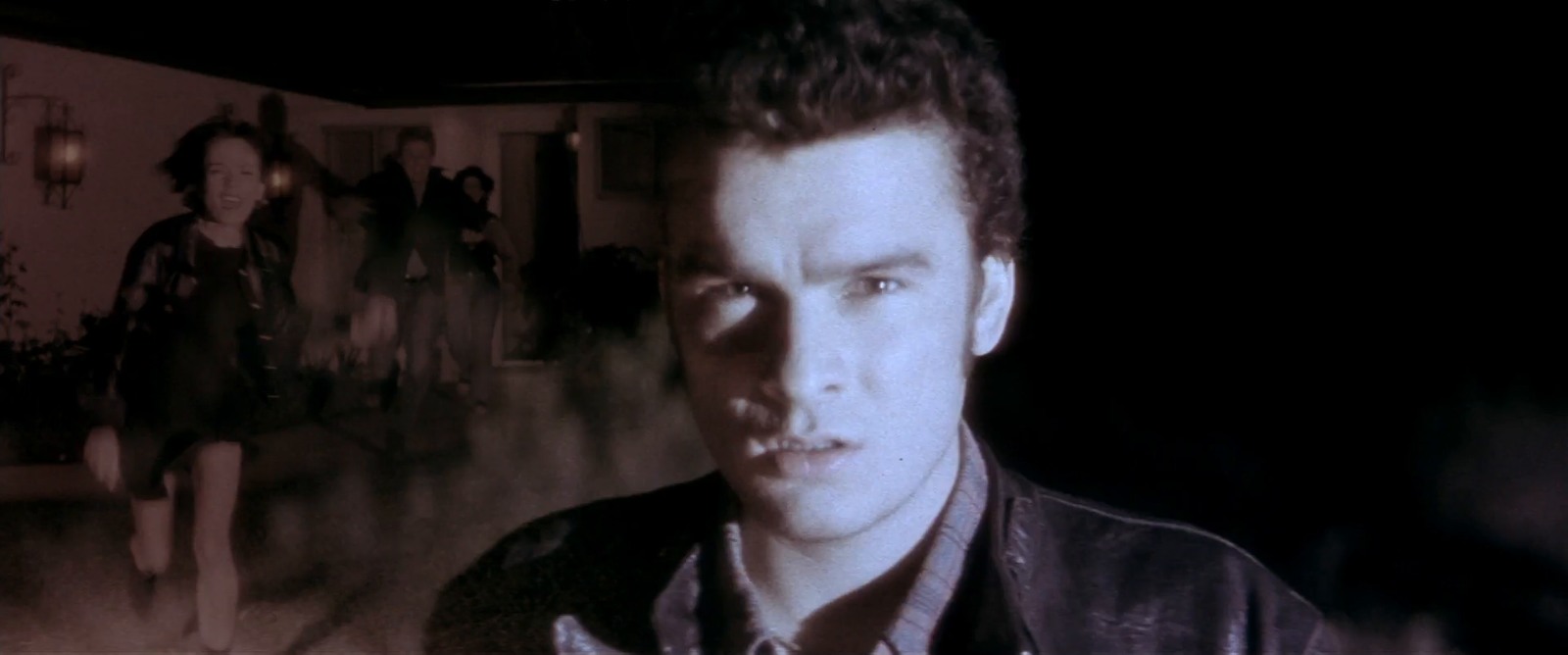
A second body enters the sequence
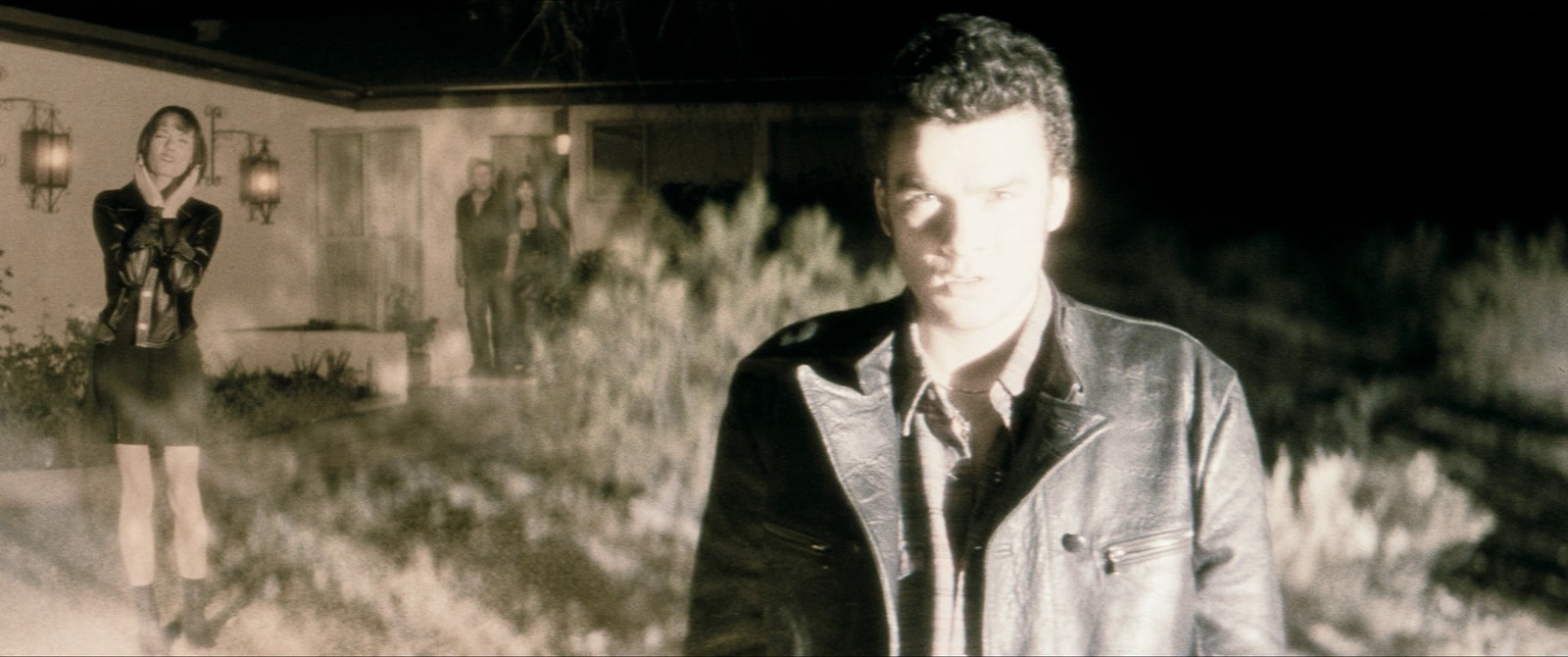
50:50Pete’s face is sharply exposed against the night, with other figures behind him. His appearance precedes the prison officials’ attempt to identify the man they discover. This order matters: the viewer encounters an image before receiving an institutional explanation. The film does not supply a calm, continuous demonstration of one identity becoming another.
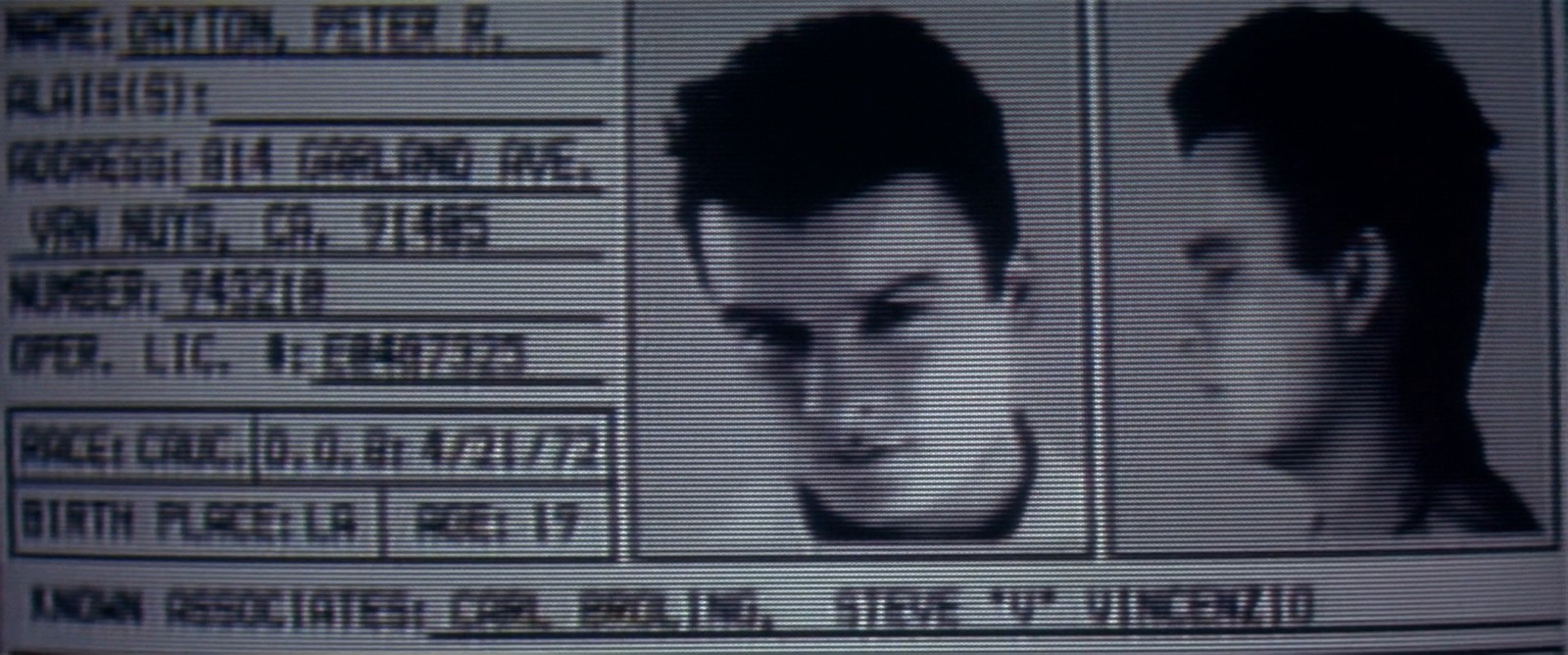
The new man acquires a record
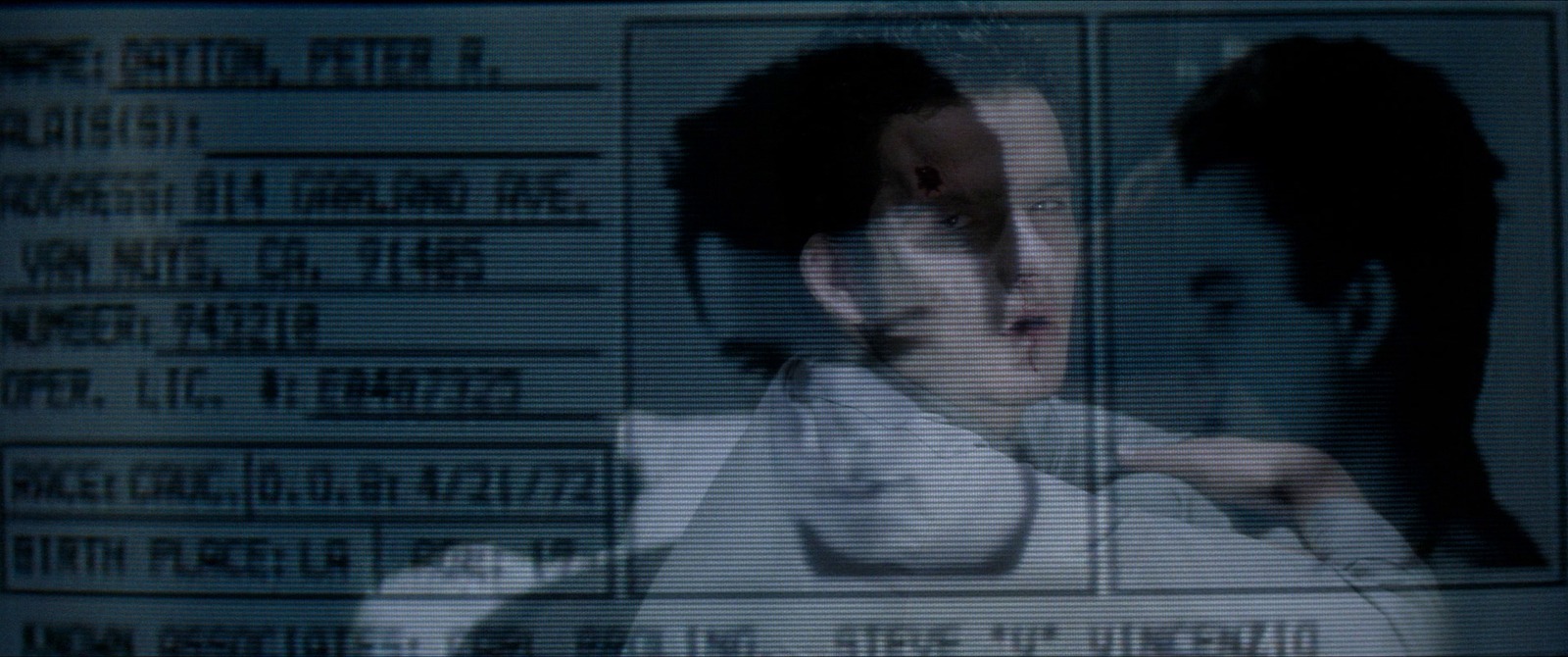
53:45The paired photographs and printed details restore an official form of recognition. Pete can be named and described even though his presence in Fred’s cell remains unexplained. The record answers one question while leaving the larger event intact. It is another image that seems authoritative without being able to account for everything the story asks of it.
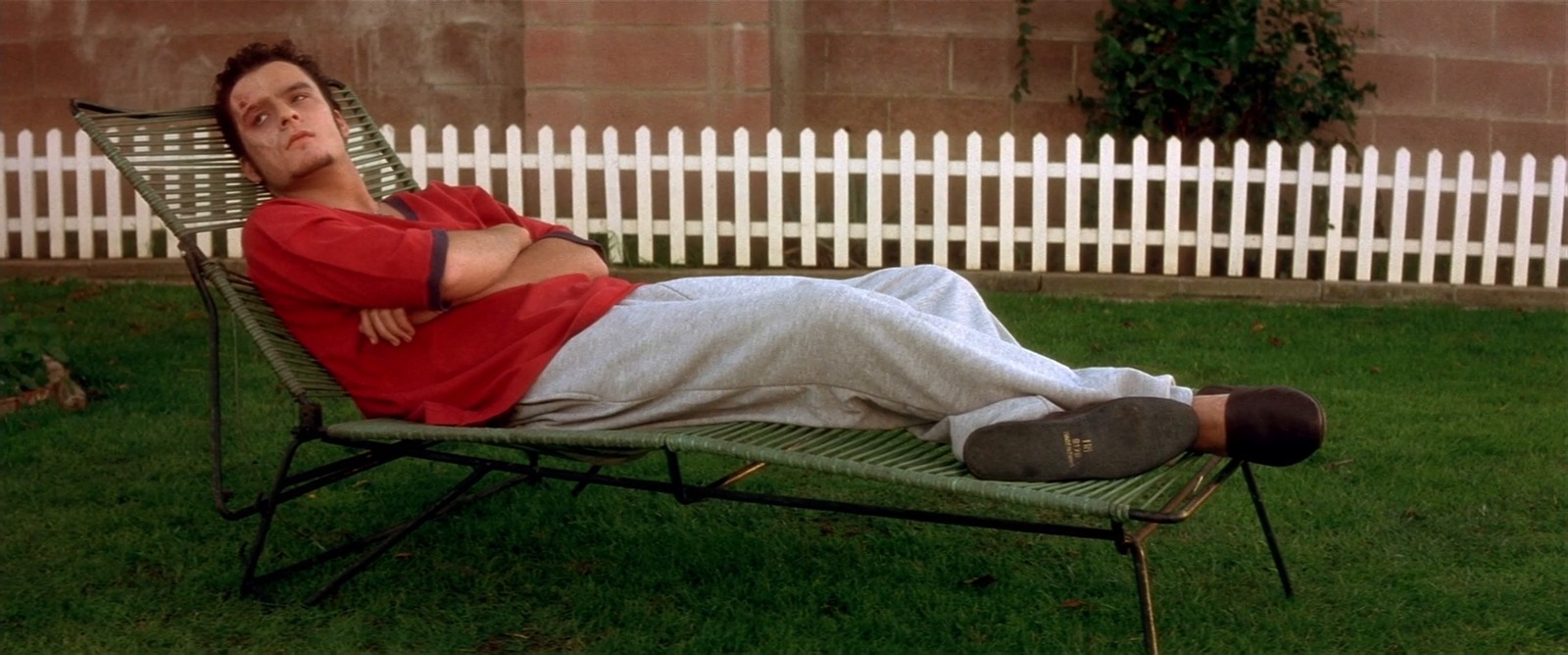
Daylight promises a different film
56:15The red shirt, green lawn and white fence are a striking change from the prison and Madison interior. Pete is given a family home and a recognizable place in its yard. The brightness can feel like release, but the surrounding unease prevents it from functioning as a clean reset. The film has changed its visual environment before it has resolved its previous story.
Scene studies / 03
Pete’s other life
Daylight, work and romance promise a new beginning. Familiar faces, objects and threats gradually occupy it.
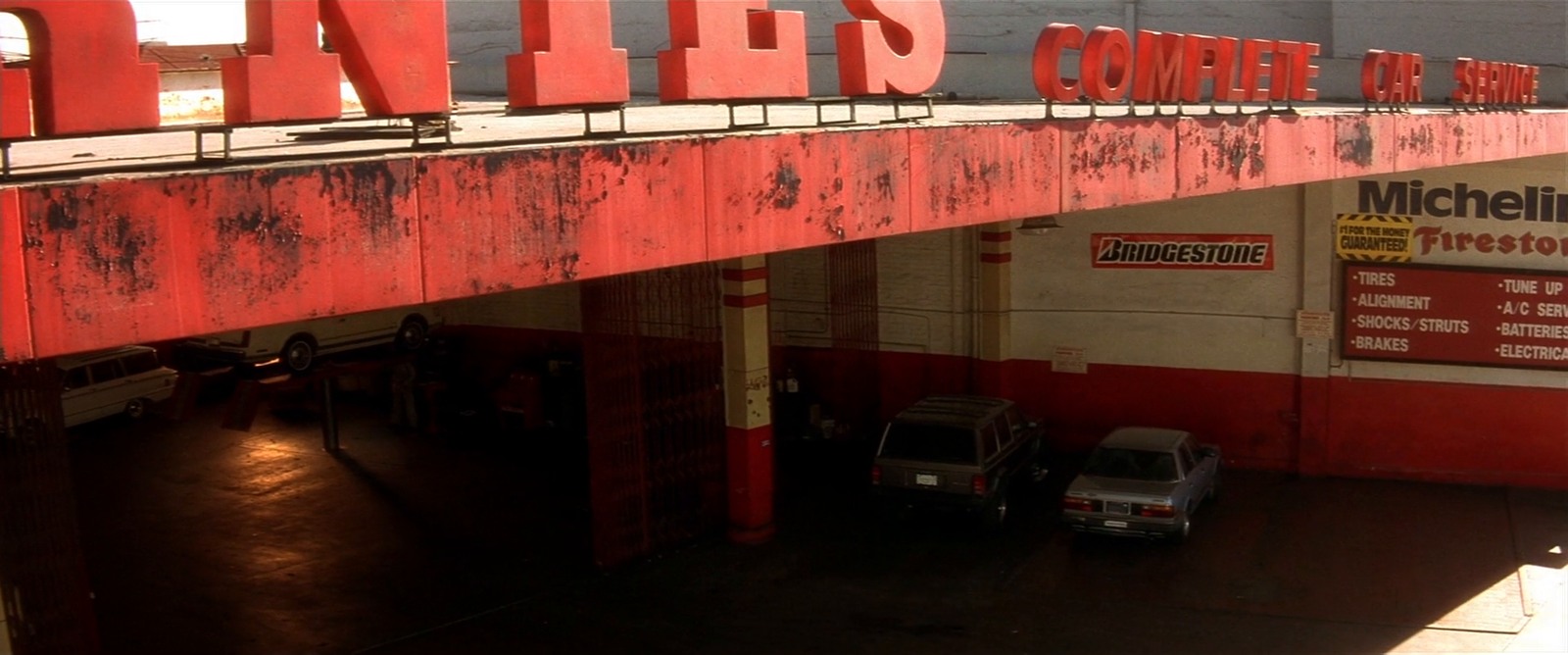
A new life begins at work
59:45The garage introduces a workplace with doors, tools and customers rather than an isolated domestic interior. Pete appears to belong to a social world that can recognize his skills. The wide entrance also gives arriving cars and passengers a strong visual role. Work supplies the setting through which Mr. Eddy and Alice will enter this apparently more ordinary life.
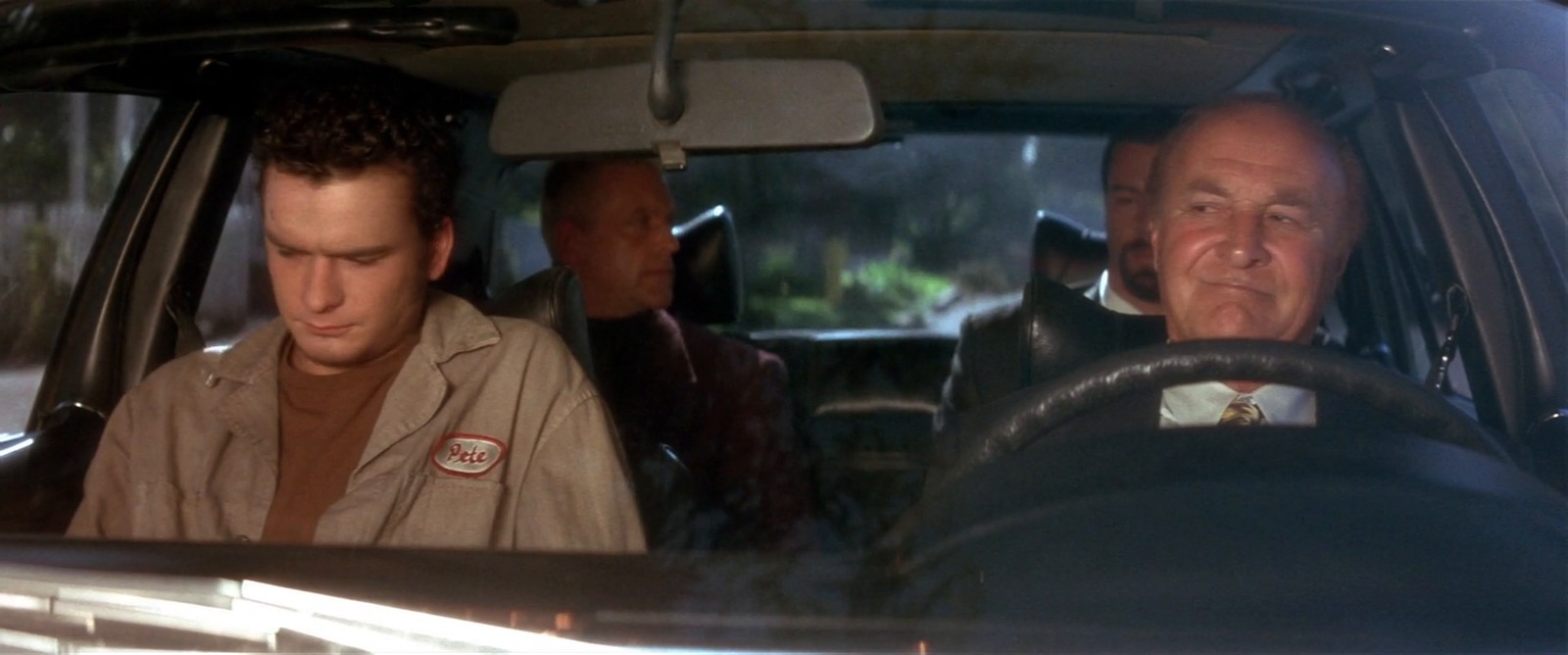
A passenger inside another man’s power
1:02:45The windscreen groups the men in the same moving enclosure, but their positions are unequal. Mr. Eddy controls the journey while Pete watches and reacts. The daylight road initially appears more readable than the opening highway. The subsequent confrontation changes its meaning: visibility and an open landscape provide no protection from the authority of the person driving.
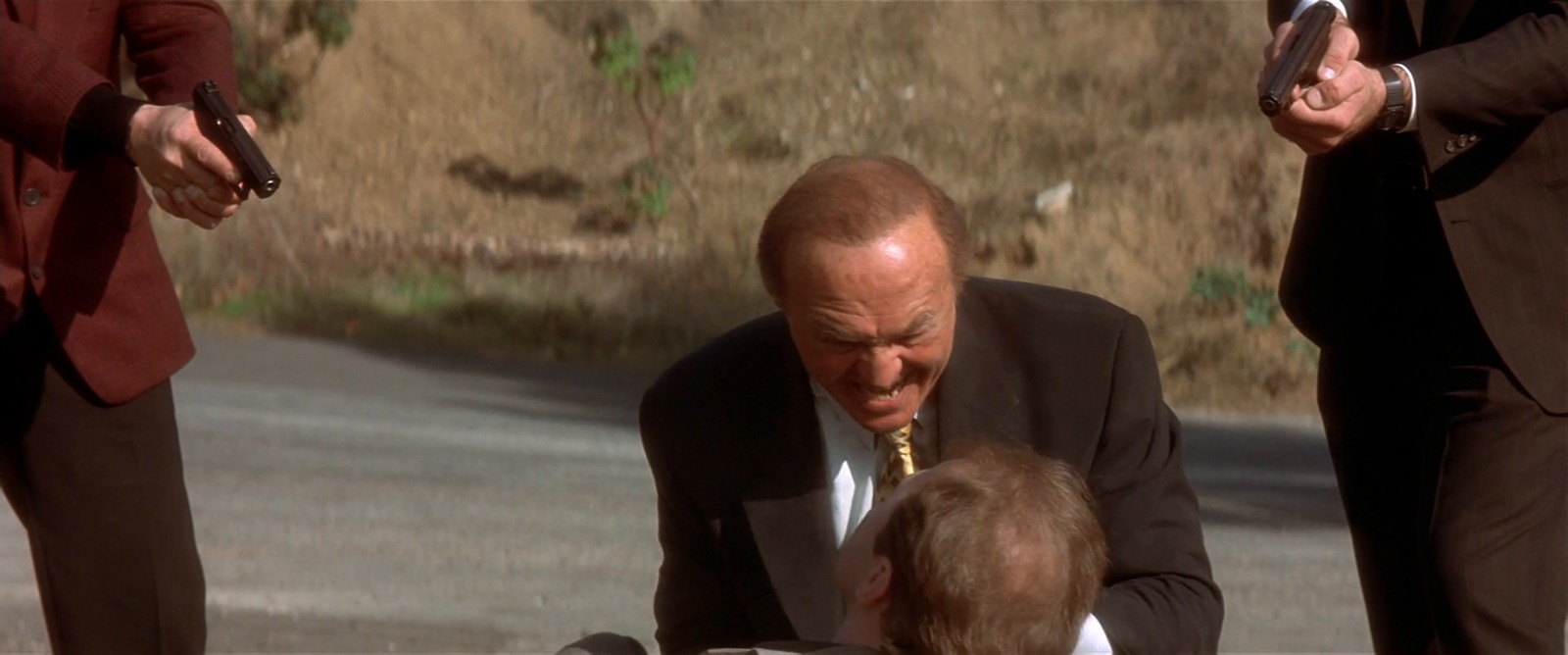
The road becomes a demonstration
1:06:15The roadside confrontation turns a journey into a staged exercise of power. Pete is made to witness what Mr. Eddy can do, while the other men help define the space around the motorist. Loggia’s performance mixes a public lesson with intimidation. The episode gives the later romantic triangle a material threat before Pete understands its full shape.
Recognition arrives with a changed appearance
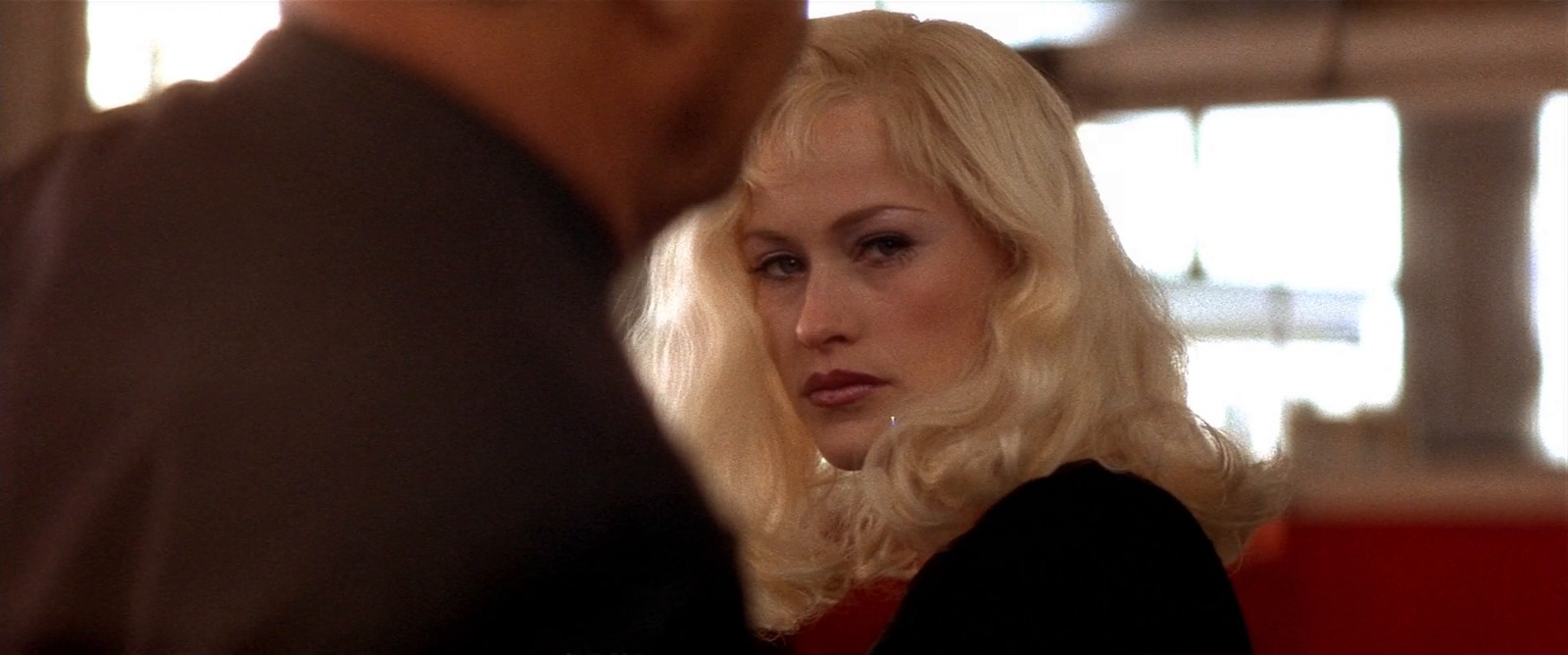
1:14:45Blonde hair and a light face against darker clothes give Arquette’s second entrance a different visual emphasis. Pete’s looking organizes the encounter, but the spectator also brings the memory of Renée. The recognition belongs to that doubled experience. Similarity of performer and difference of presentation coexist before the film asks how the two women should be named.
An invitation across the street
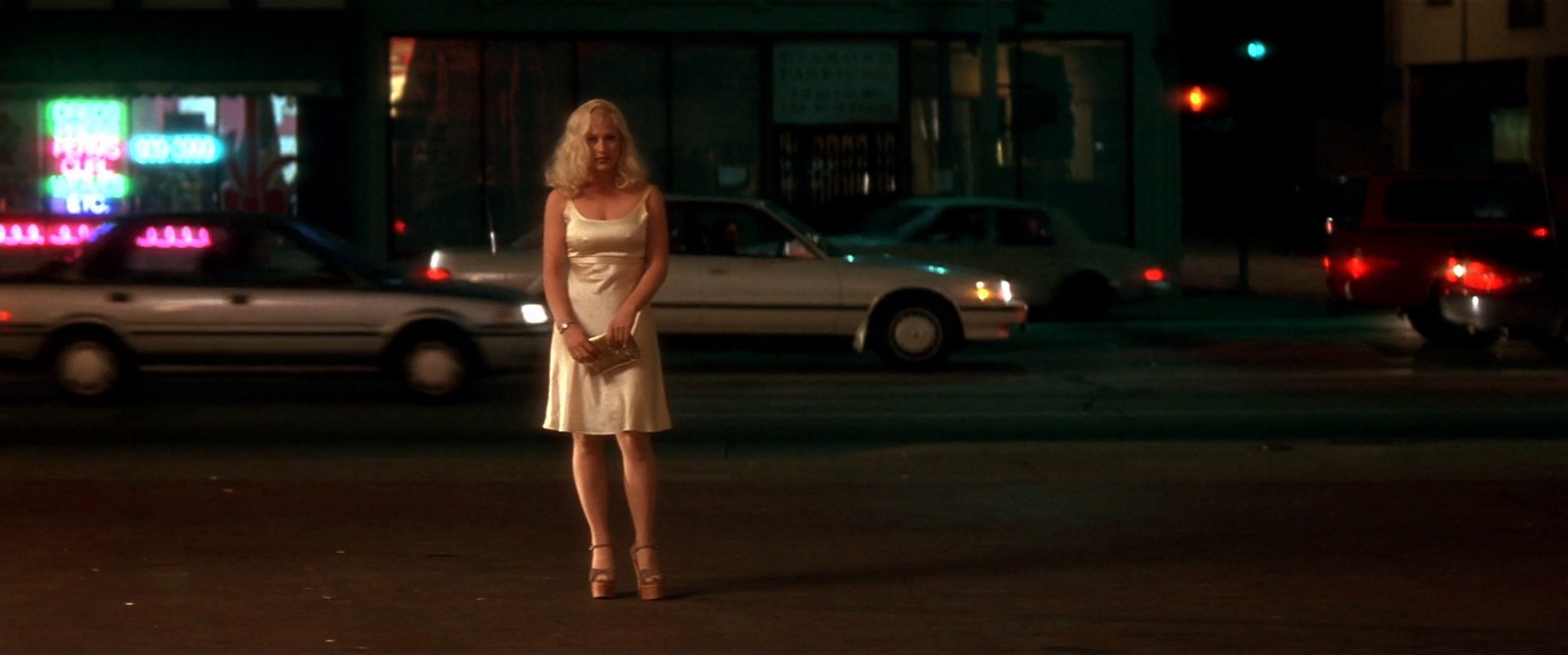
1:16:45Alice’s pale dress stands out against the traffic, storefronts and night. The wider view gives the invitation a public setting while preserving the distance Pete must cross. This is a different kind of exposure from the tapes: a person is visibly waiting, but her visibility does not make her circumstances or intentions fully available.
A familiar room changes register
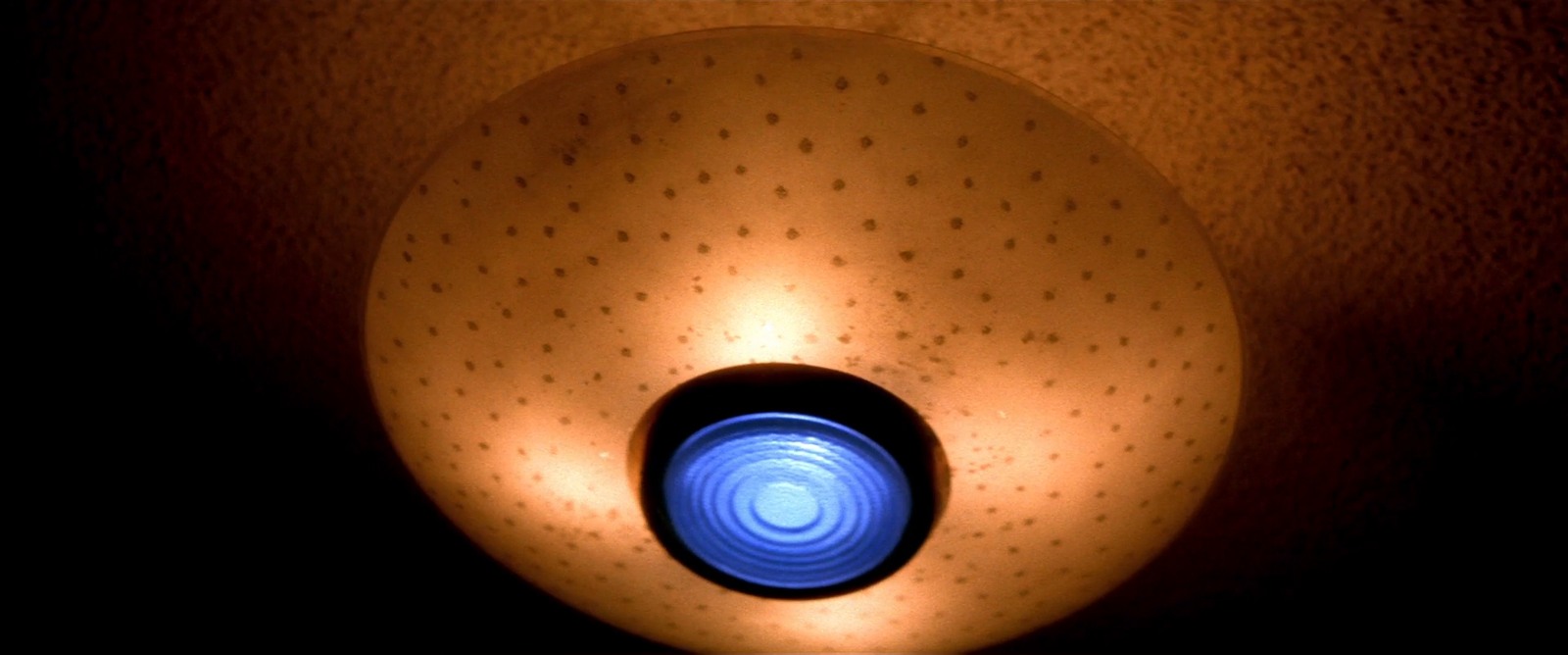
1:23:45The circular blue center of the lamp becomes an unusually insistent object in the room. After the romance, the film redirects attention toward disorientation and an unstable domestic space. Such details connect the two halves through sensation rather than a simple matching of plots. A ceiling, wall or corridor can become difficult to inhabit even when its shape remains recognizable.
A parent cannot complete the account
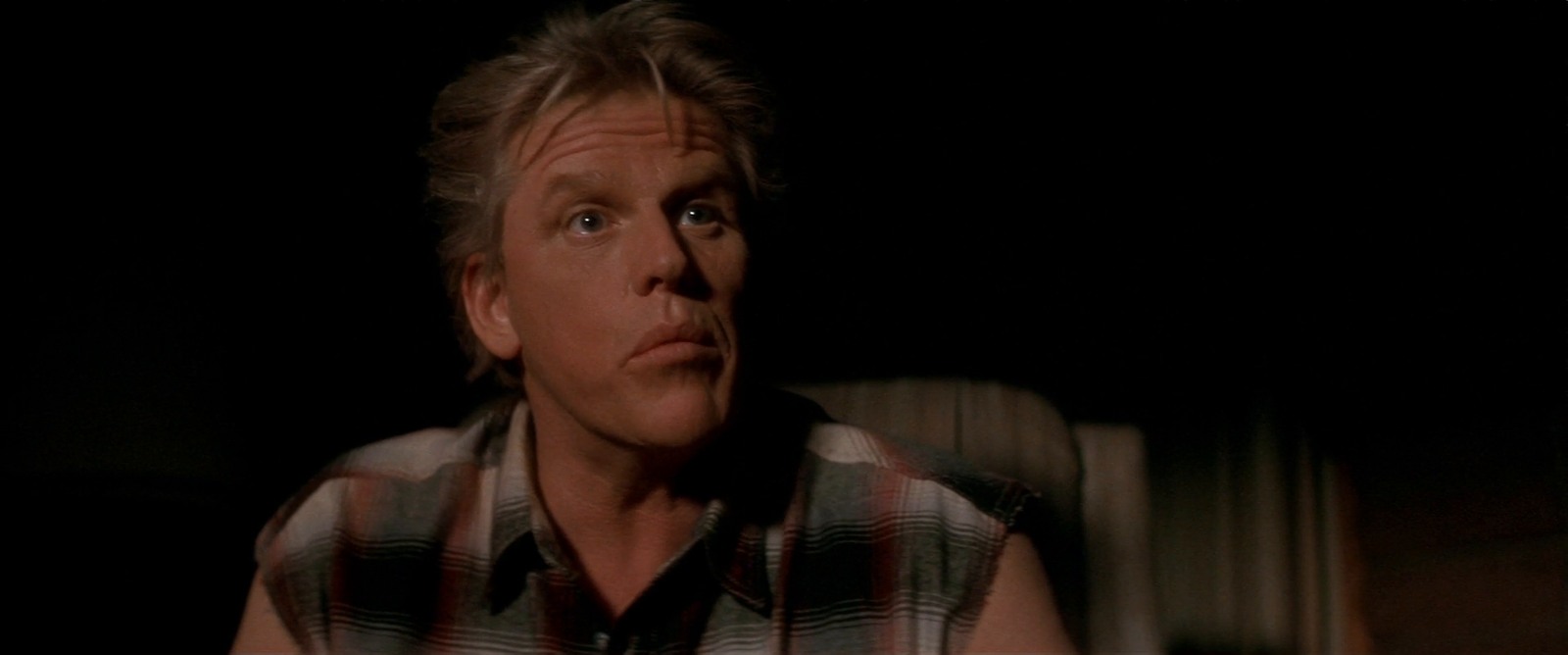
1:25:45The father’s face emerges from darkness while Pete seeks an explanation of the missing night. Family recognition, like the police record, does not become complete knowledge. The room offers intimacy without reassurance: the people who know him cannot make the interruption in his life ordinary. The restrained composition keeps attention on hesitation and the difficulty of giving an account.
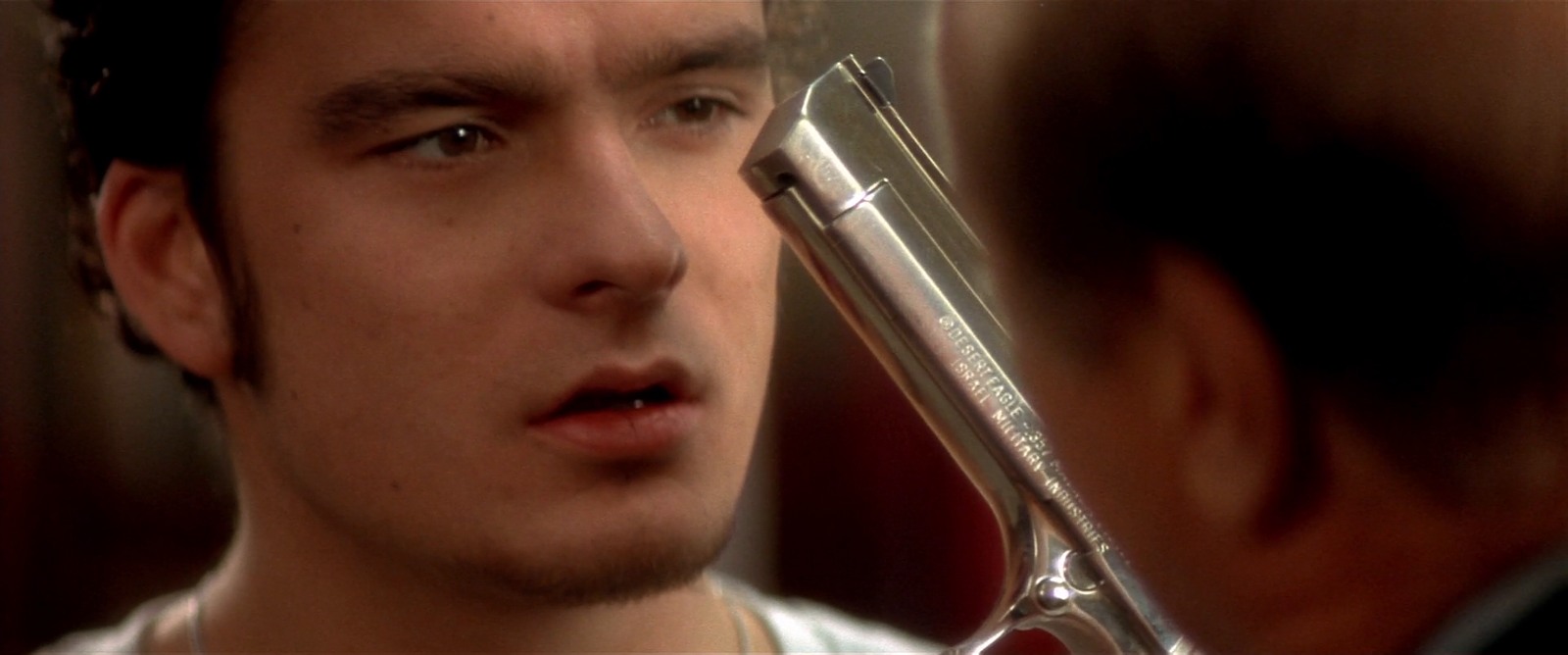
The friendly visit contains a weapon
1:28:15The pistol enters the space between two faces during a conversation. Its proximity turns apparently controlled social behavior into direct pressure. The image makes the imbalance unmistakable without needing a separate action sequence. Pete’s position as a valued mechanic has become entangled with the danger attached to Alice and the man who accompanies her.
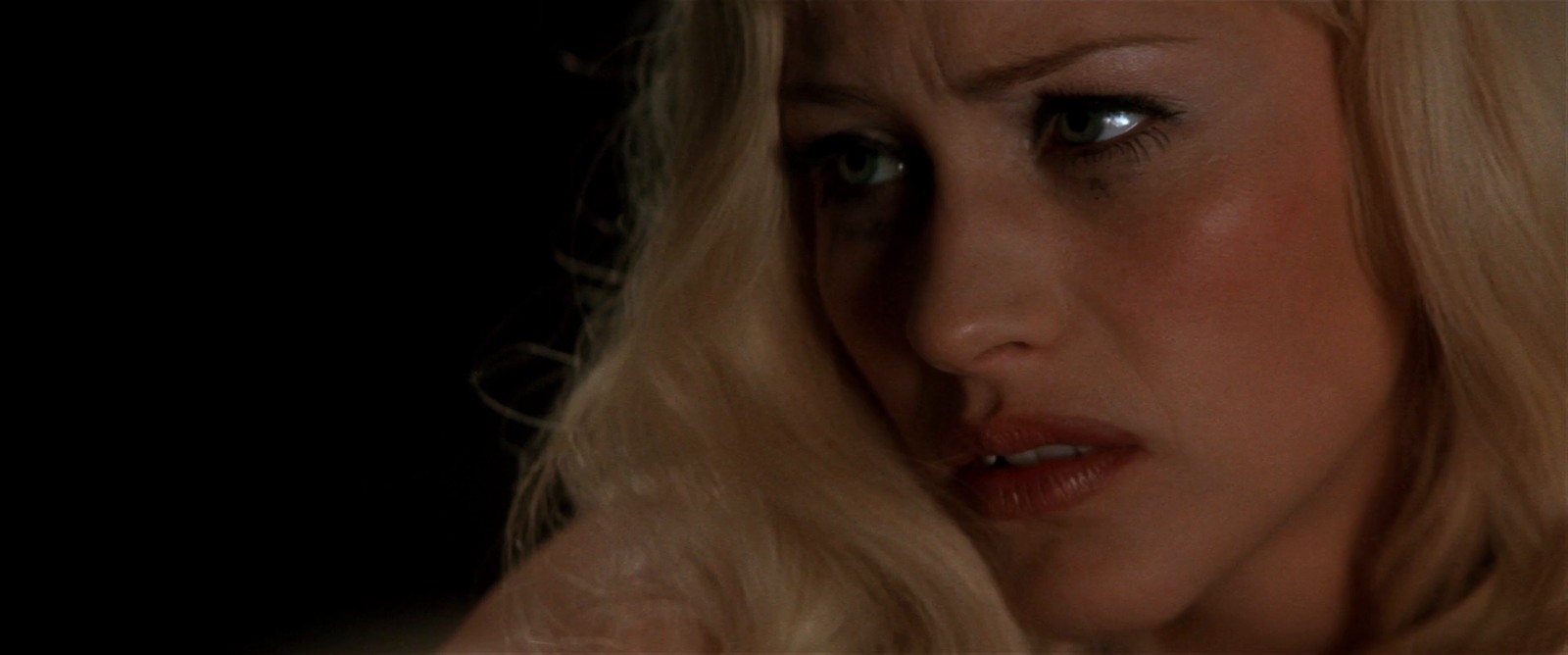
The woman tells a story of coercion
1:35:15Arquette’s close view carries the account that the film also stages in the mansion. The listener receives both her face and images of the situation she describes. Those forms should not be treated as interchangeable proof. Her visible distress and the surrounding threats matter in their own right, while the dossier’s discussion of looking asks how the film frames women through male suspicion and desire.
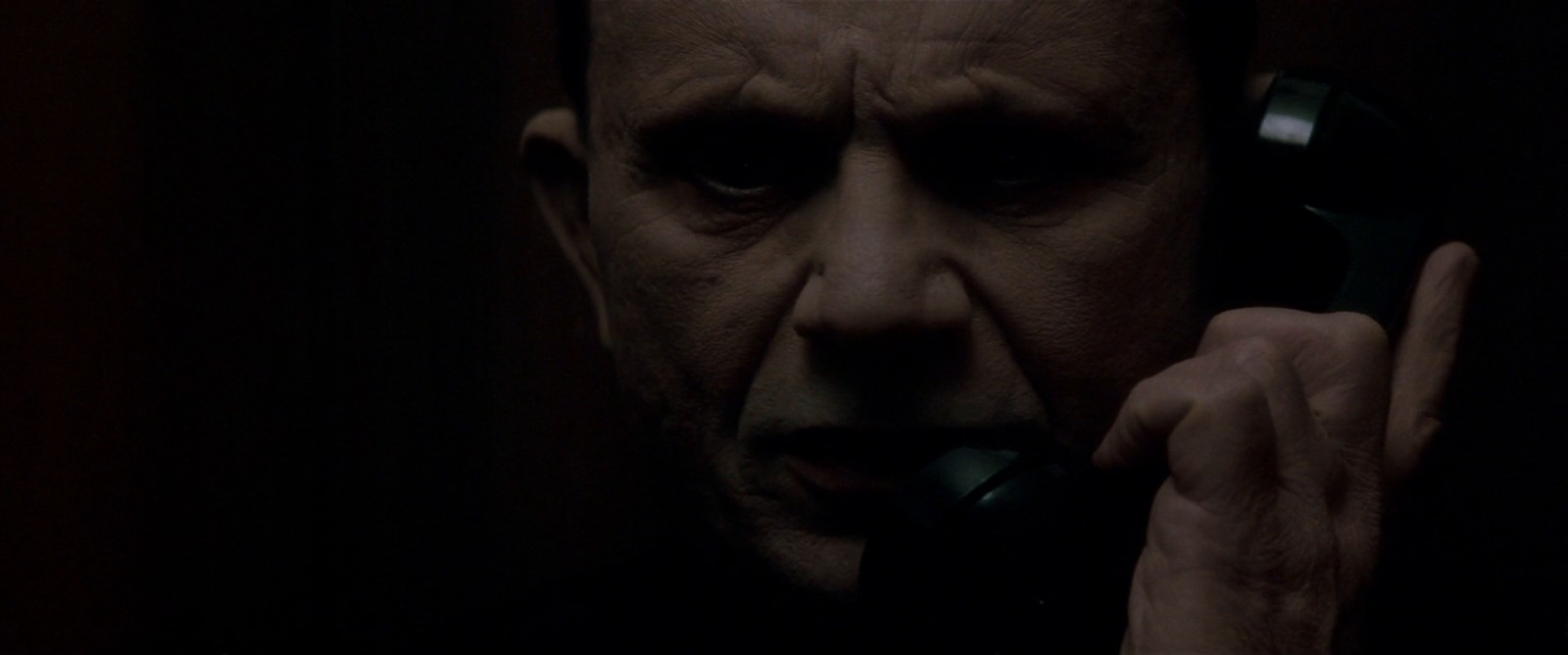
The impossible caller reaches Pete
1:40:15The telephone links Pete’s story to a figure already encountered by Fred. The close view is now markedly darker than the party, concentrating the face and receiver against an almost absent setting. A recurring device brings the two narratives into contact before their locations visibly converge. The return is recognizable even while the speaker’s relation to either man remains unsettled.
Scene studies / 04
The image returns
The photograph, cabin and camera bring the two stories together without making their relationship secure.
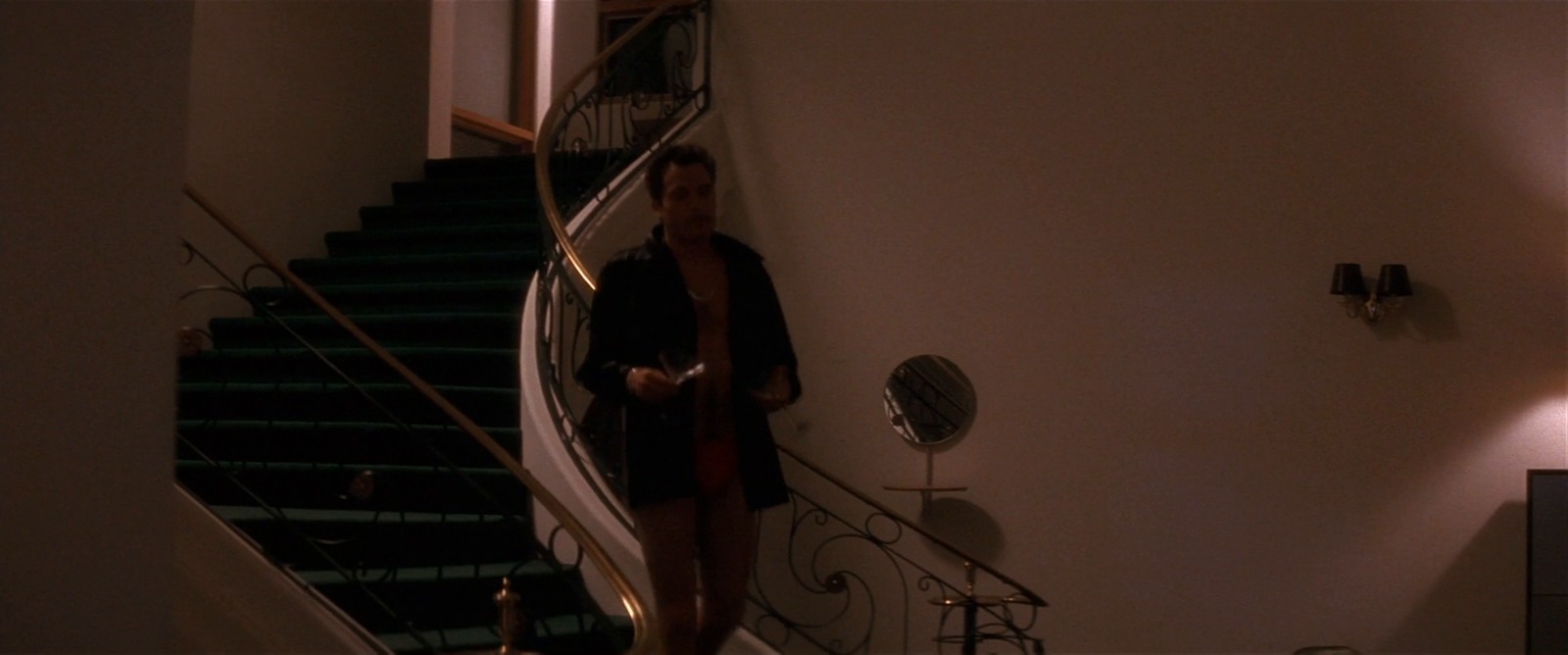
The mansion rearranges the encounter
1:43:45The staircase gives Alice a place above and apart from Pete, with an expansive interior surrounding them. The decorative room offers much more to look at than the Madison house, yet it is no easier to read. As the attempted theft becomes a death scene, the setting’s display of wealth and pleasure acquires a disturbing relation to the images being projected inside it.
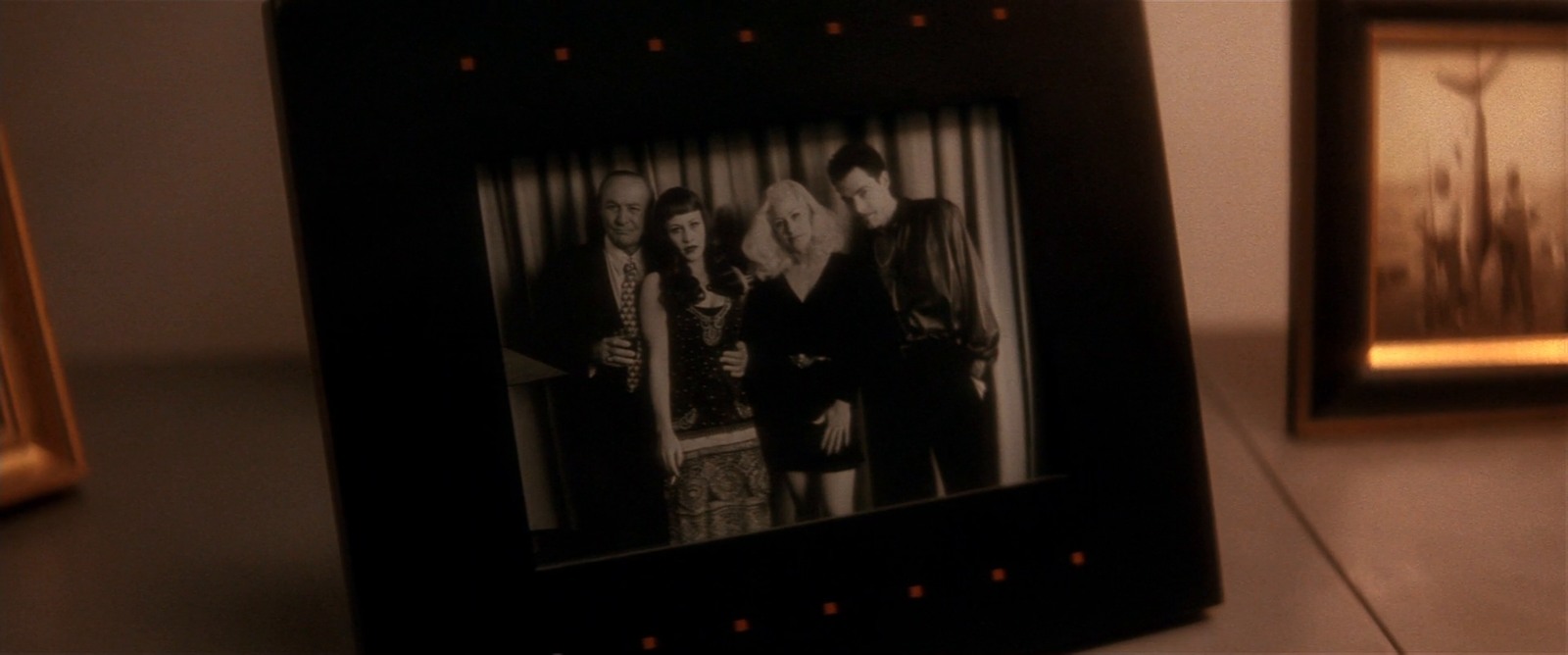
Two appearances share one photograph
1:46:40The framed image places both of Arquette’s appearances in the same group. Pete’s question follows a visual problem the audience can inspect for itself. A photograph seems to offer a stable object against which to test memory, but its later reappearance will change that promise. Compare this group with the image examined by the detectives near the ending.
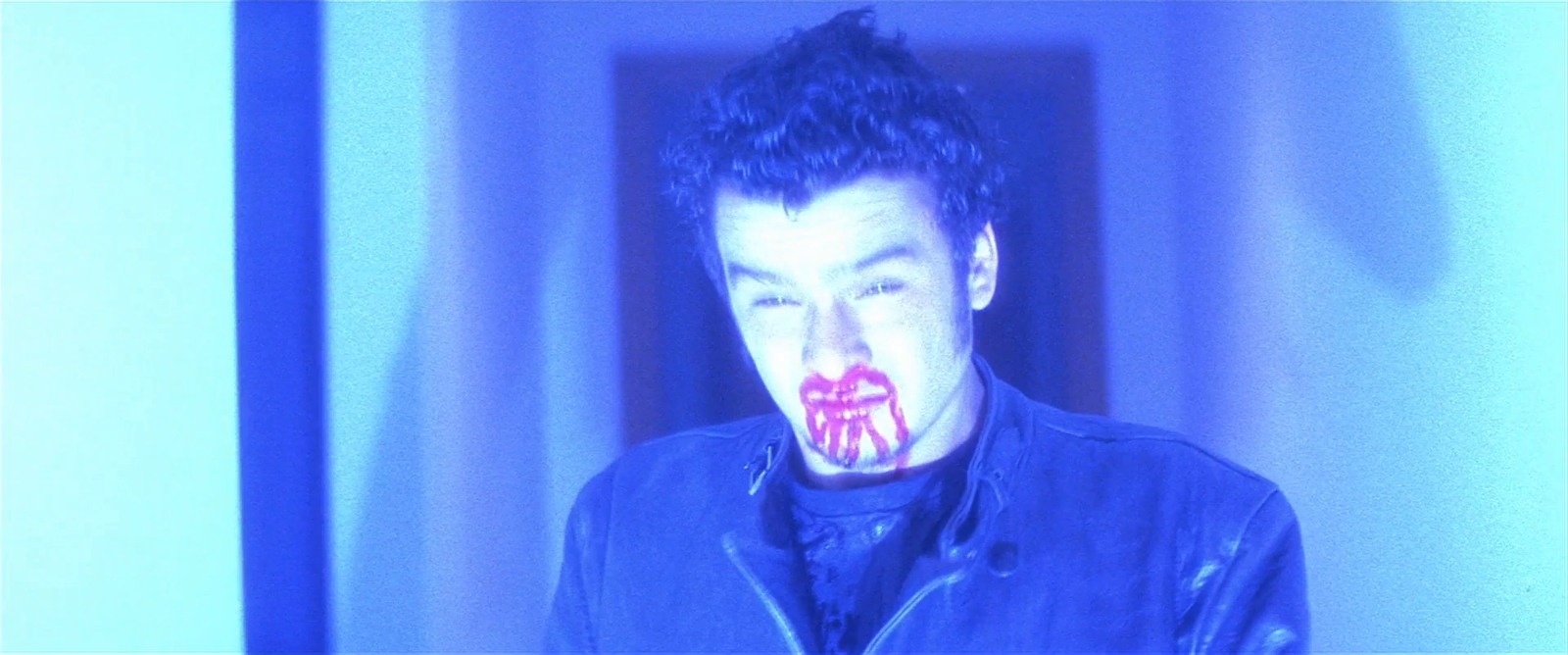
The corridor becomes a bodily crisis
1:47:50Blood at the nose and the abrupt blue illumination make Pete’s distress visible as he moves through the upstairs passage. The corridor’s geometry remains clear while his experience of it breaks down. This brings the mansion close to the Madison hallway and prison cell: separate places become connected by unstable perception and the failure of a body to remain composed.
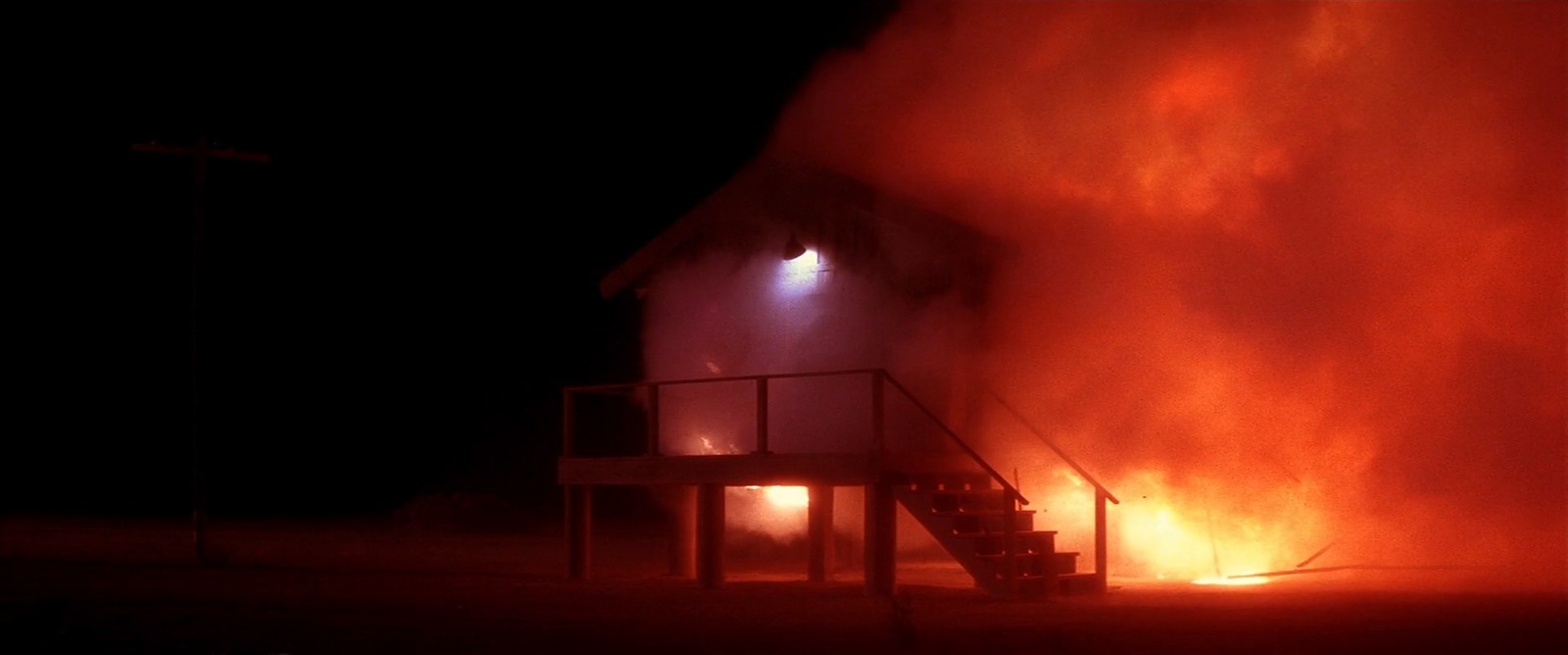
An earlier image finds a place in the journey
1:51:45The burning structure returns from the transformation sequence as Pete and Alice’s route approaches the desert. Its repetition makes an earlier intrusion feel newly connected to the journey without fixing when or how the images belong together. The production account of the cabin photography offers a concrete counterpart to that uncertainty: a constructed physical event becomes a recurring, unstable location.
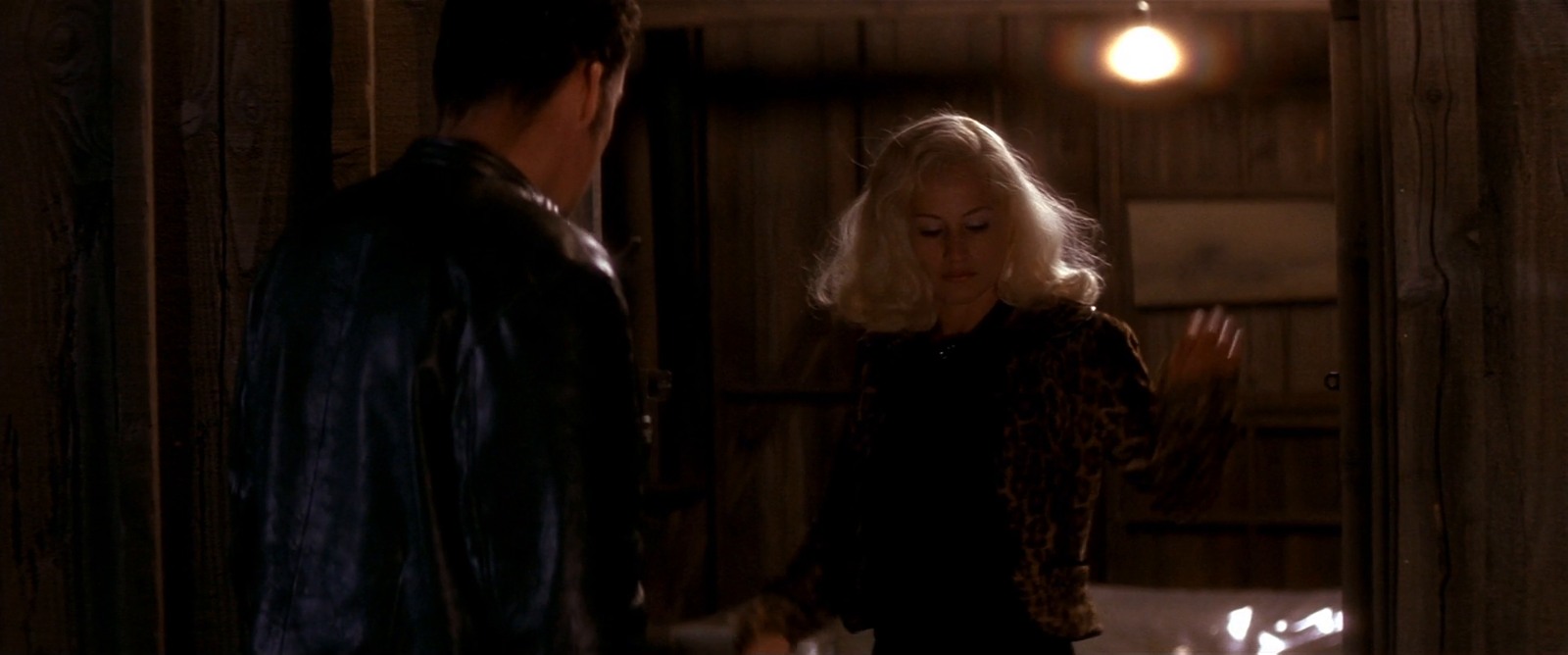
A threshold before the separation
1:53:15The doorway frames Alice as she looks back toward Pete. The pair have arrived at a destination, but the arrangement does not promise a shared future inside it. The sequence moves from the cabin’s dark surfaces into the harshly illuminated desert encounter. Arrival becomes another threshold at which Pete’s attempt to possess a secure story of the relationship fails.
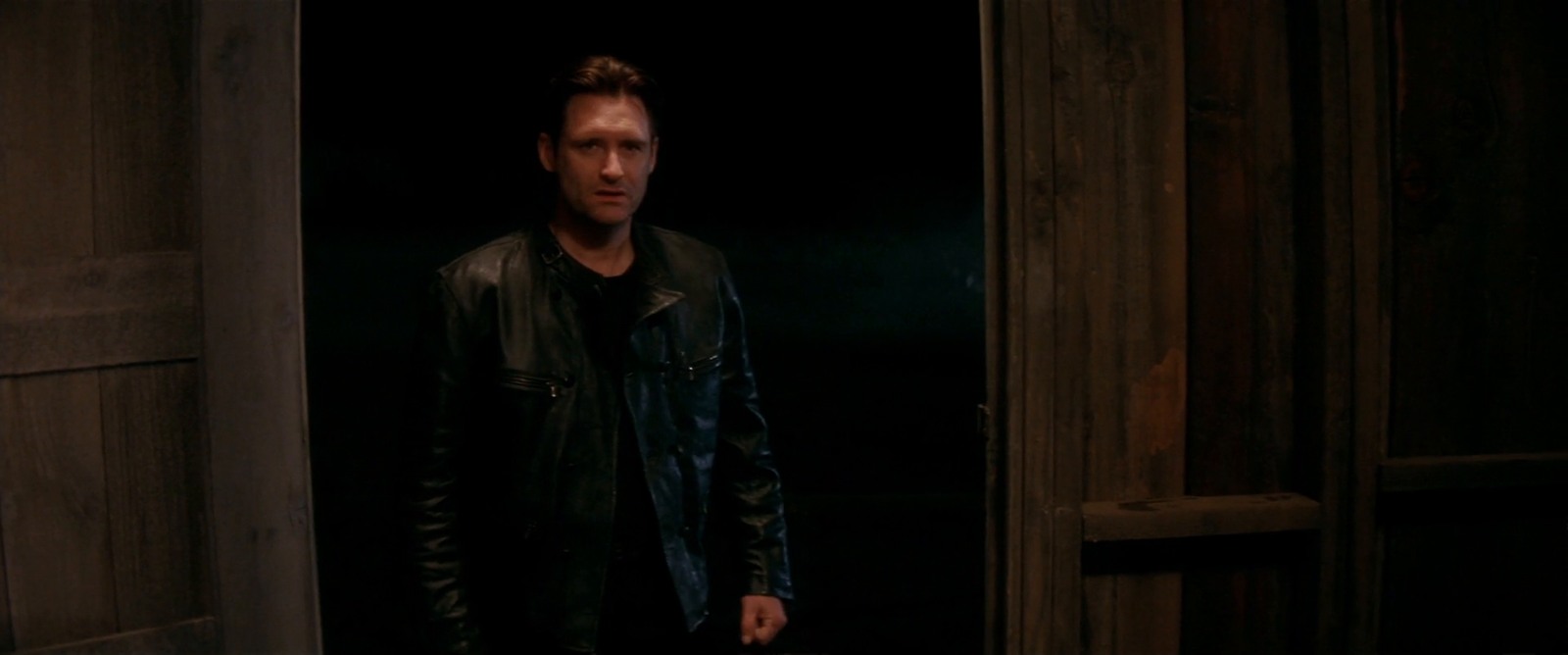
The face at the doorway is Fred’s
1:58:45The doorway now holds Pullman rather than Getty. The film makes the return of Fred visible without supplying the kind of continuous physical transition that would settle the event. Costume, body and setting reconnect the two narratives, but they do not erase the differences between them. The scene asks us to recognize a person while remaining uncertain about the history that recognition implies.
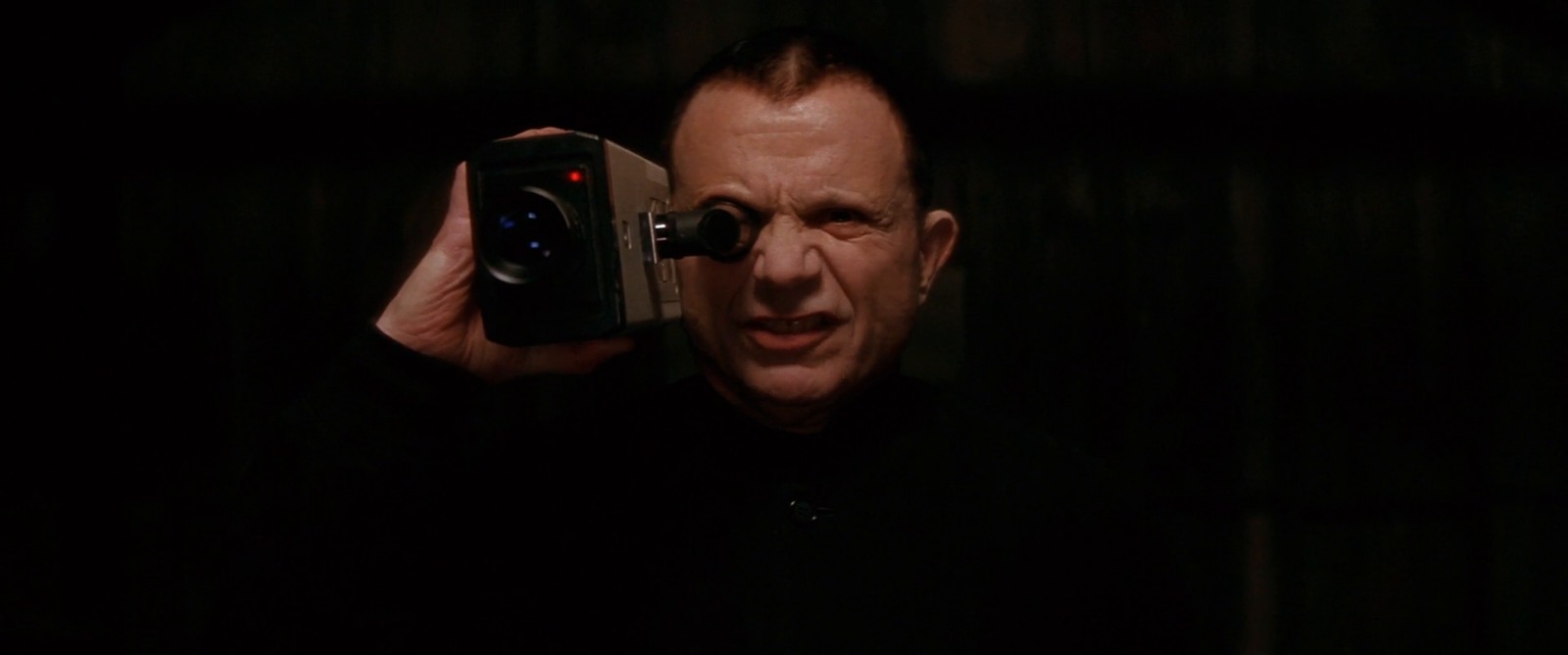
The observer carries his own camera
1:59:15The camera gives the film’s intrusive looking a visible operator. The figure whose appearances have disturbed both narratives now confronts Fred with an instrument of recording. This recalls the anonymous tapes without proving a complete explanation of their production. The image’s force comes from the confrontation itself: the man who distrusts recorded memory is placed before another recording device.
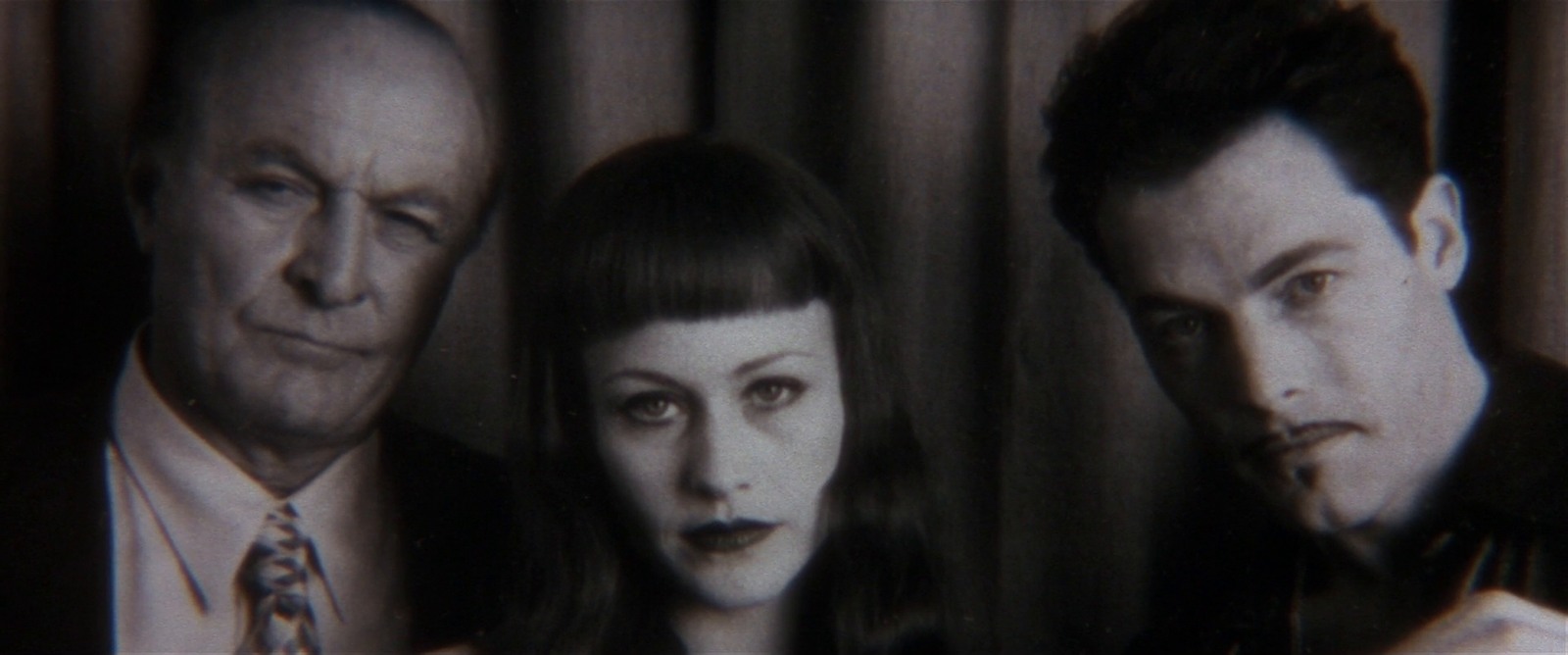
The photograph no longer holds the same group
2:07:45The group now contains Renée with Dick Laurent and Andy; Alice is absent from the image seen earlier. The detectives use the photograph as part of an investigation, while the audience has a competing memory of its contents. Placing the two appearances side by side keeps the discrepancy visible. It does not require the photograph to certify one final account of the entire film.
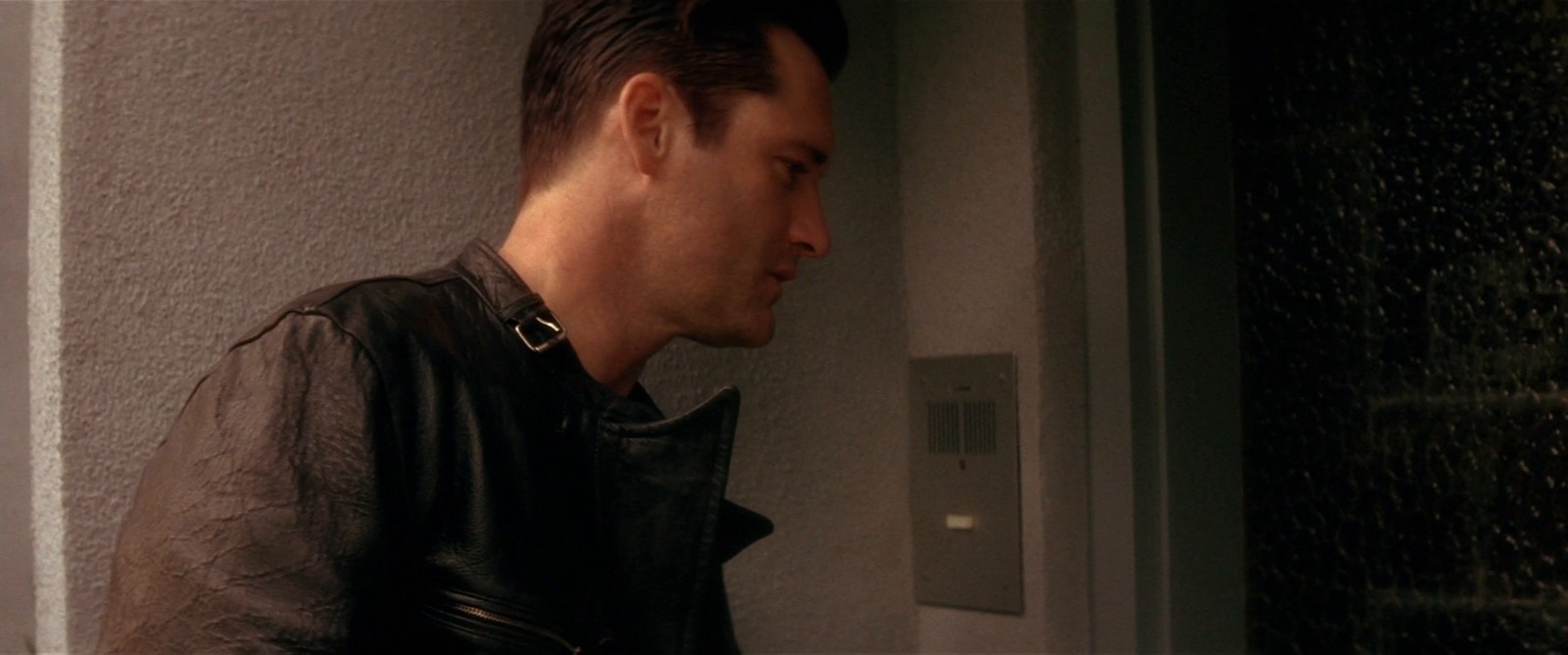
The listener becomes the messenger
2:09:15Fred stands at the exterior panel associated with the opening announcement. The change of position gives the return its precision: the man first shown listening is now shown delivering the message. The film reconnects an action with an earlier scene while disturbing a straightforward chronology. The discovery leads immediately into pursuit rather than a settled explanation.
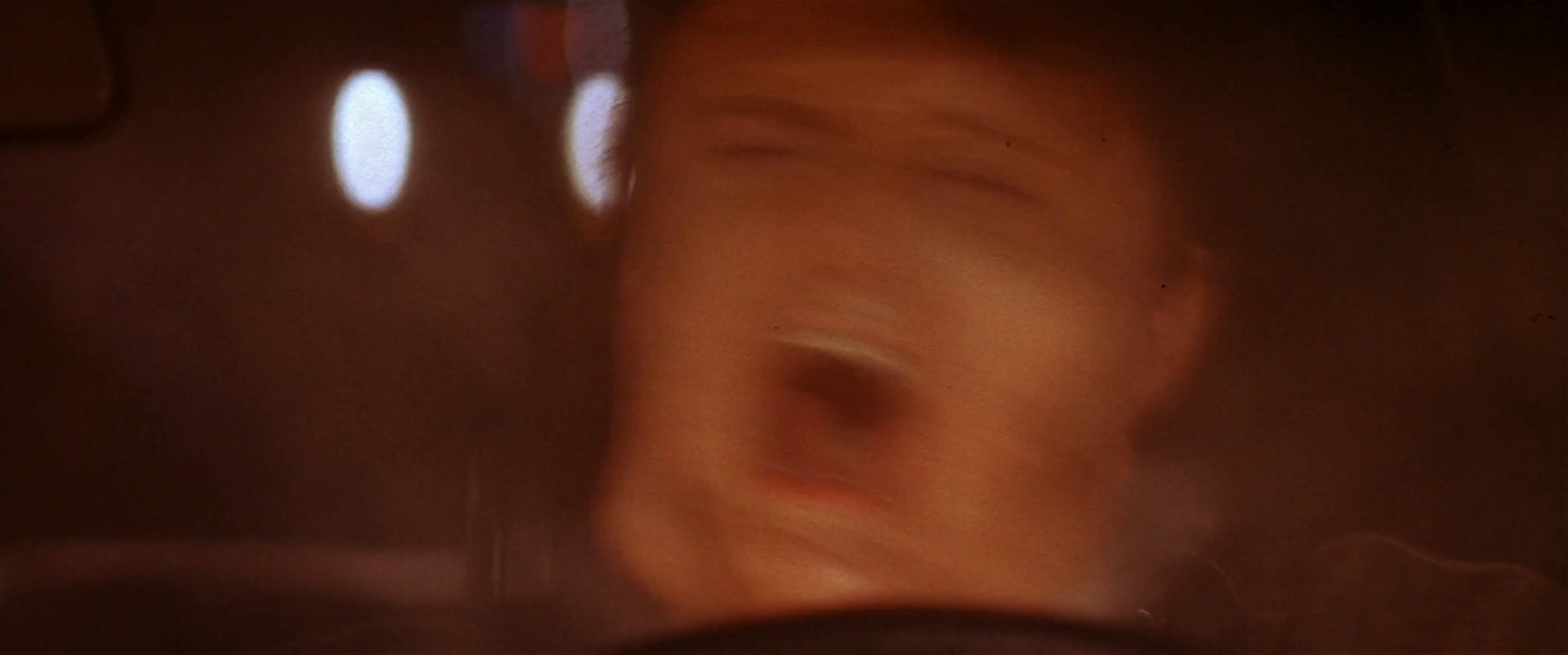
The road continues through the crisis
2:10:35The face breaks into motion and distortion while the road continues to pull forward. This ending joins the film’s two persistent uncertainties: a body that will not remain stable and a journey whose destination is withheld. The return of the headlight-lit highway closes a visual circuit, but the movement through it resists the reassurance of arriving somewhere outside the story.
Viewing this edition
The copy behind the scene guide
The illustrated moments come from a widescreen copy running 2 hours 14 minutes 57 seconds, including logos and closing credits, with an image approximately 2.39:1. The times identify this presentation; other editions may start the same scene at a different point.
The edition guide separately describes Criterion’s approved restoration, soundtrack options and published classification timings.
About the scene studies and images
Selected frames were examined across the complete running time, with closer checks of the prison transition, photograph and final drive. The guide offers scene readings rather than a cut-by-cut inventory. Embedded English subtitles support narrative identification. The dialogue and song studies add a complete-track speech-recognition review, selected centre-channel checks and closing-credit verification. The additional commentary identifies Tim Lucas; direct listening and comparisons between sound mixes remain separate work.
Film images: Lost Highway (1997). Captions describe the selected moments; the research below identifies the film’s collaborators and documentary sources.
Transformations
Bodies, fire and the cut
Follow the changing image through selected sequences. Each study opens into an enlarged gallery, with the production testimony kept alongside the visible effect.
A body changes between images
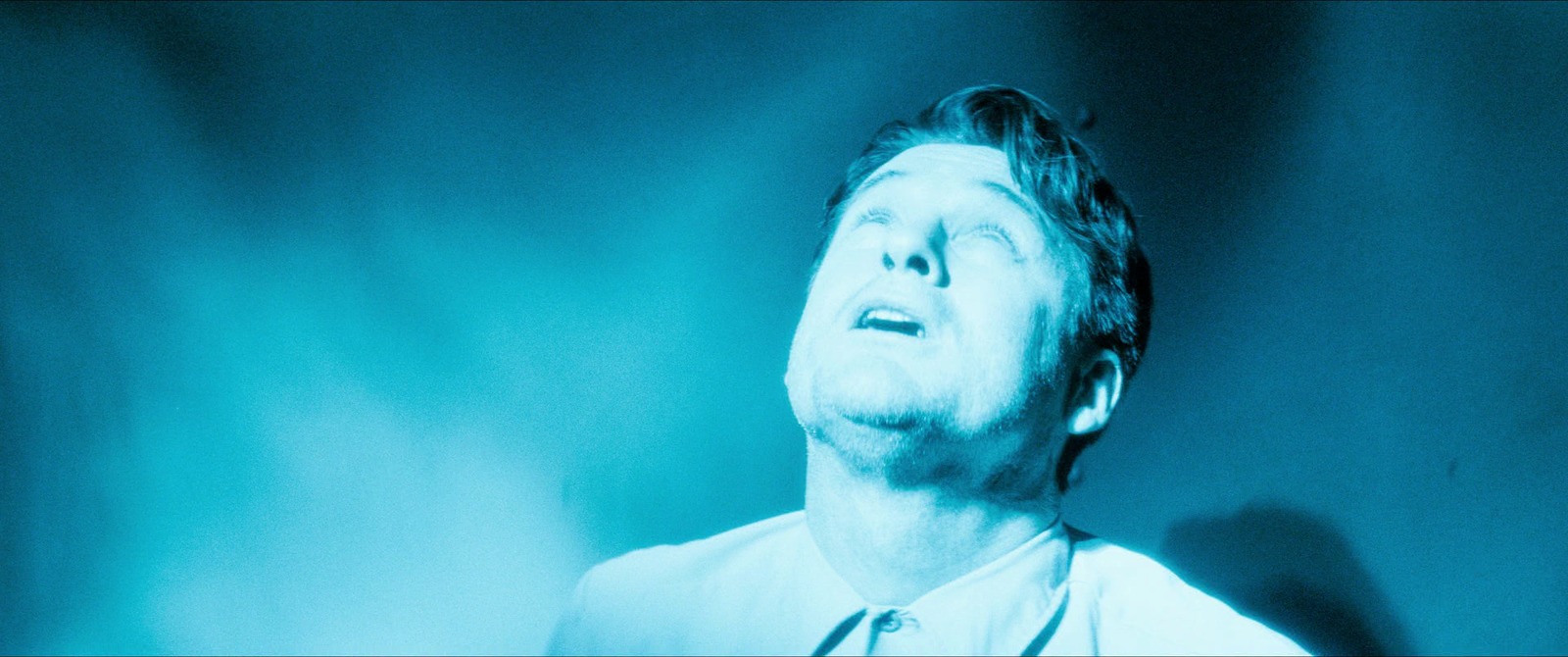
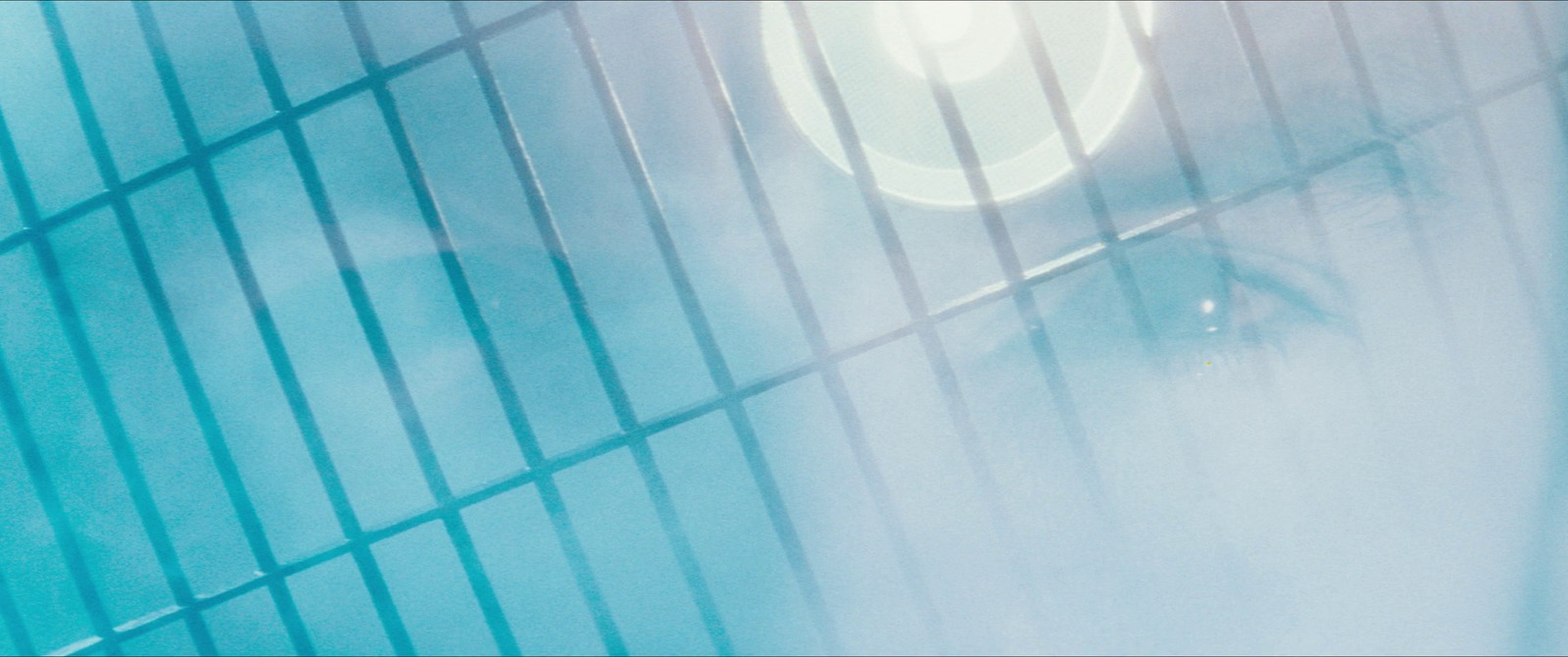
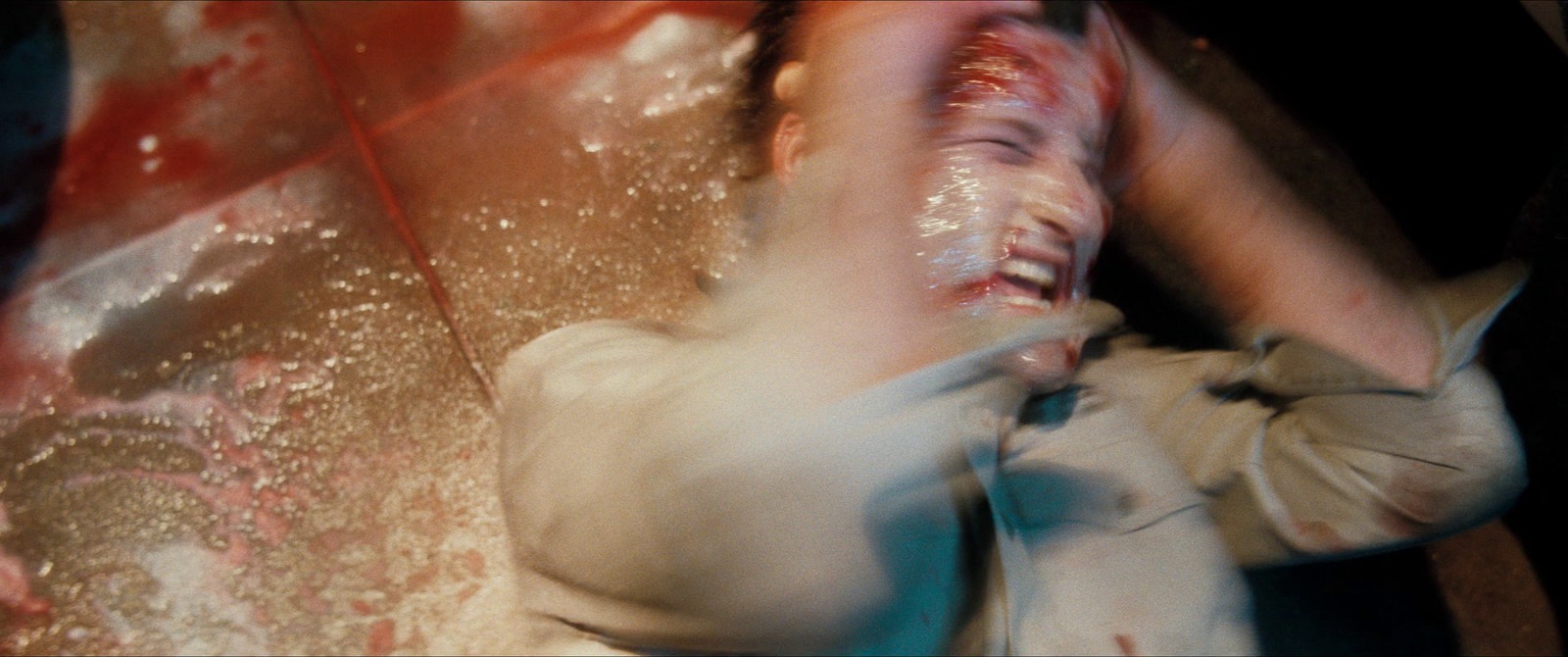
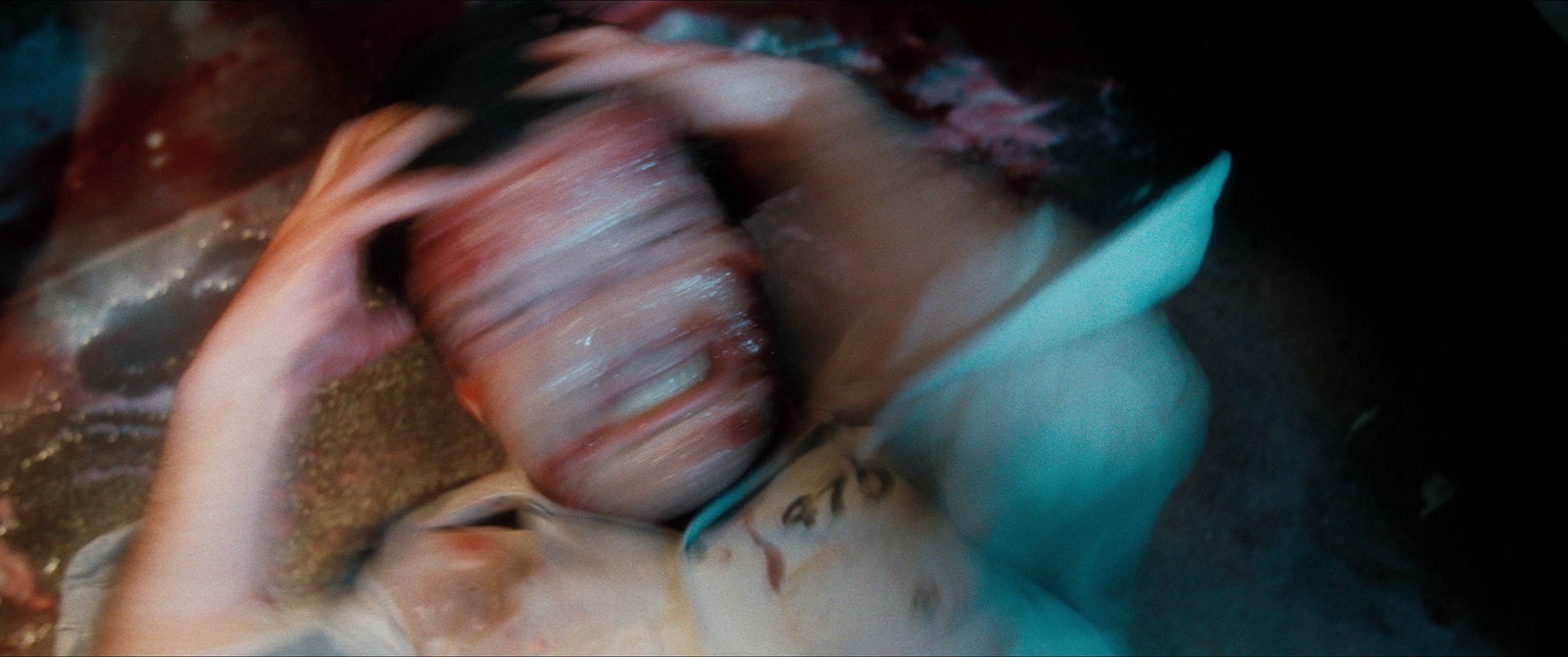
The prison transformation begins by changing the room around Fred. Blue light floods his face; the overhead grille becomes a tilted pattern; the highway and Pete’s illuminated figure interrupt the cell. The sequence gives us pieces of a passage between bodies before it supplies a new identity.
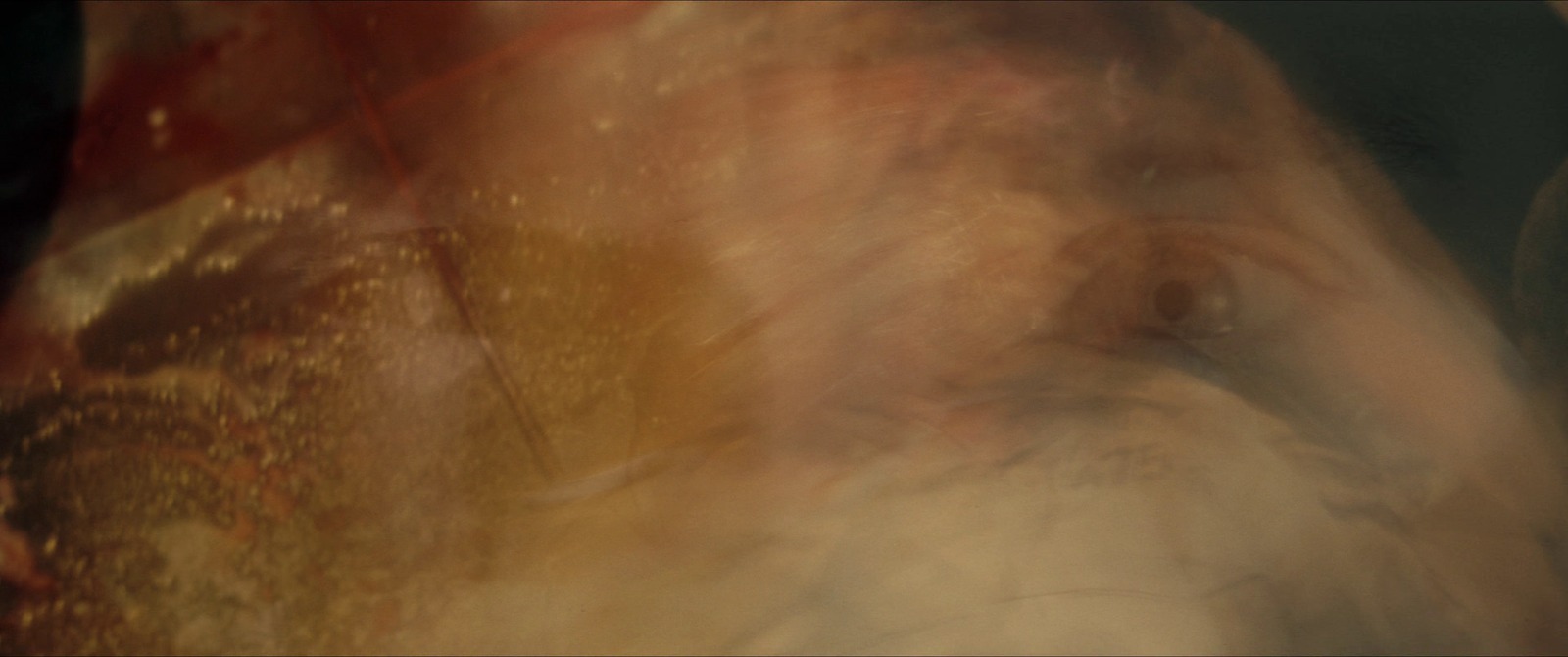
The most violent images arrive in a short cluster: an eye overlaps the grille, skin fills the frame, and Fred clutches a changing, bloodied head. Rapid movement and overlapping images prevent the body from becoming a stable object of inspection. The subsequent identification record gives Pete a name and a history, while the prison authorities remain unable to account for his presence.
The cutting-room passage in Pretty as a Picture shows Lynch and Mary Sweeney discussing white flares and the alternation of side and frontal views. Their conversation offers a practical way into the finished sequence: its force depends on the intervals between recognisable fragments as much as on the altered head itself.
Explore the image sequence · 7 stills
Criterion feature · 50:08–53:20; Pretty as a Picture · 76:01–77:24 · Programme guide
Inside the cutting room · Building the prison · The film’s structure
The fire pulls back into the shack
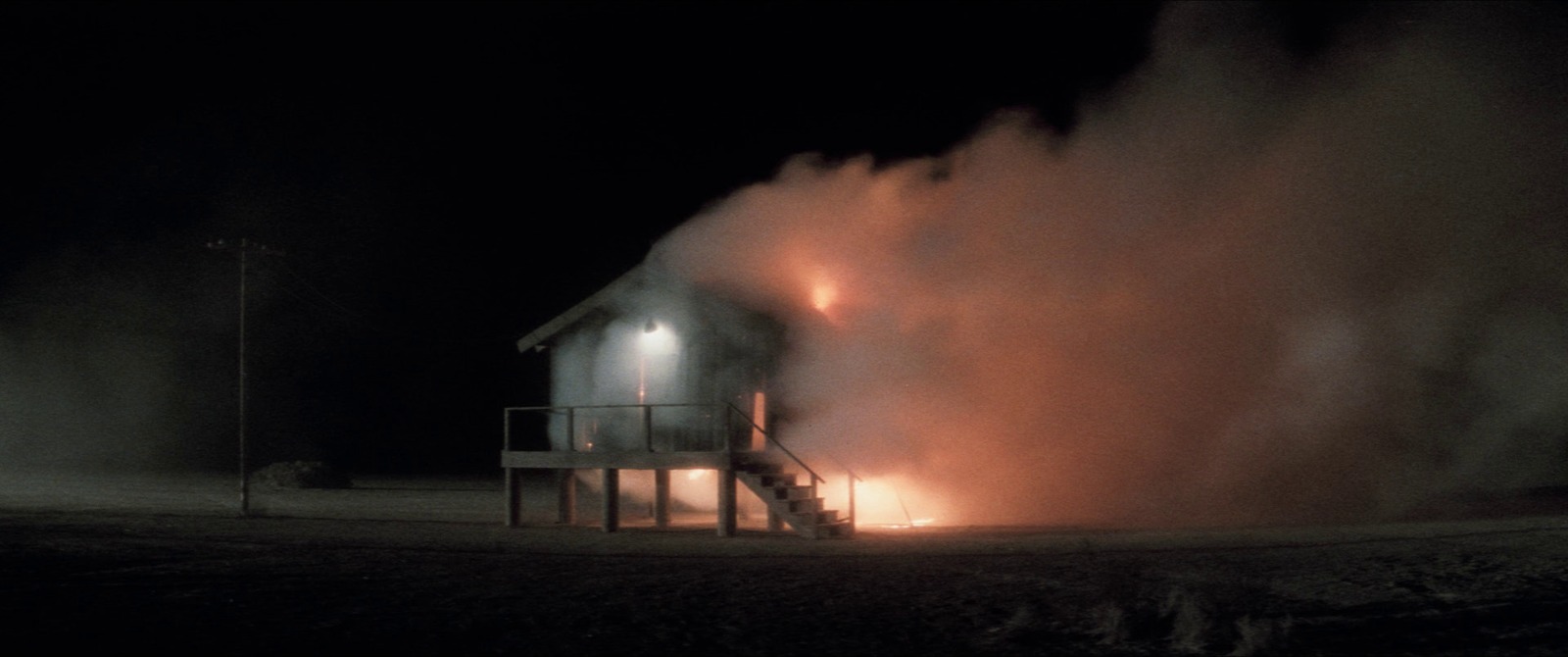
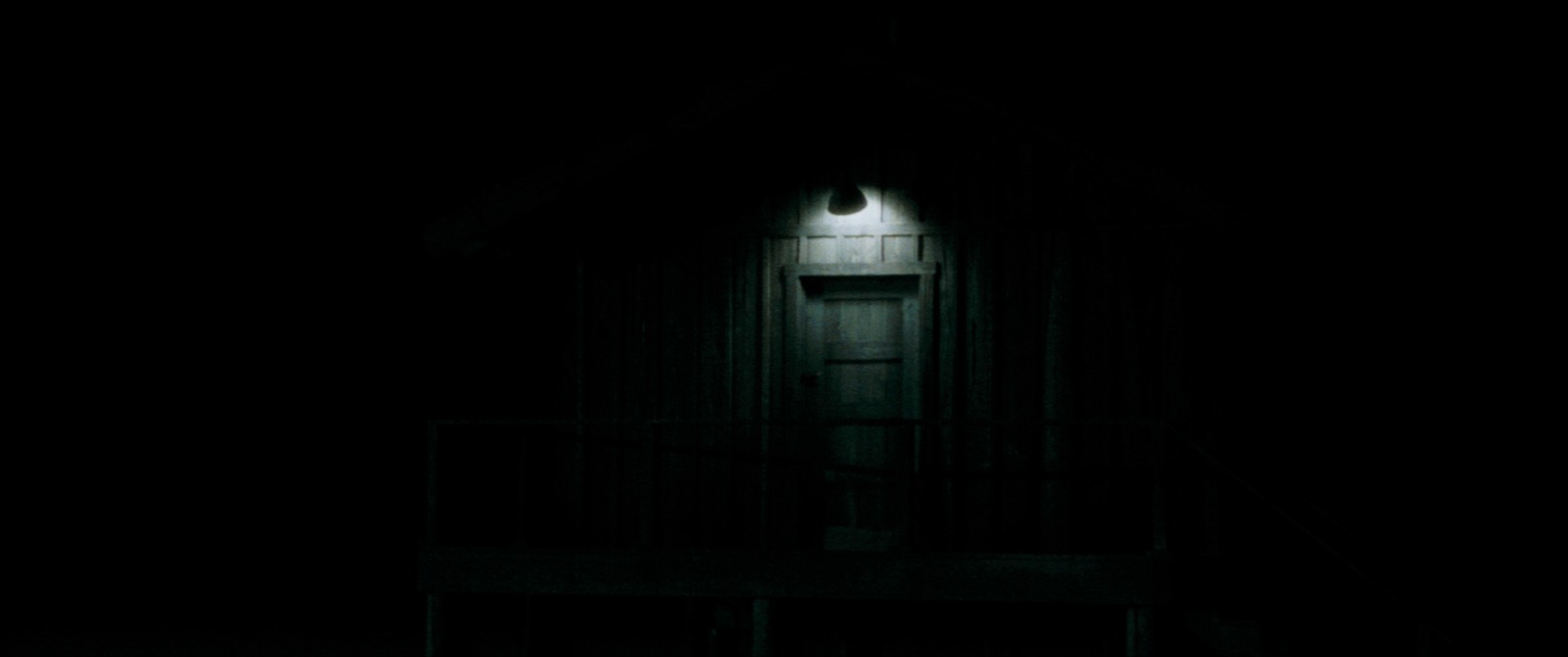
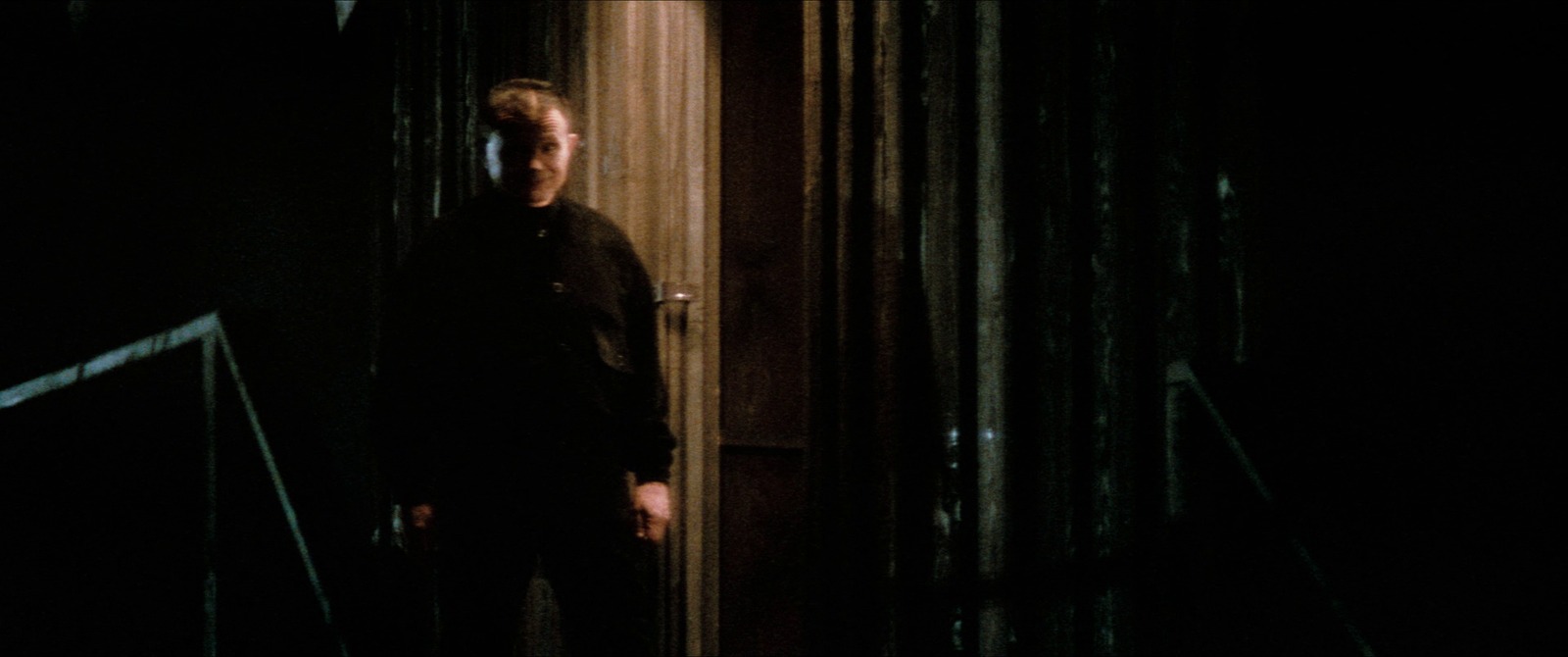
The burning shack enters Fred’s cell through a dissolve, then occupies the desert on its own. A long view gives way to a closer image of flames, smoke and the front door. As the fire contracts, the building returns to an intact, eerily quiet state. The Mystery Man’s appearance at the threshold turns the doorway into another interruption of ordinary space.
In Kristine McKenna’s Room to Dream reading, Peter Deming recalls Lynch asking to burn the shack after the location work had wrapped. Gary D’Amico’s recollection follows: strong wind changed the outward explosion he expected into a more vertical burn, and Lynch responded enthusiastically to the result. These are later production memories; the image sequence shows what the film makes of that physical event.
The reversal gives destruction the appearance of an arrival. The door survives the receding fire as a point of attention, linking the desert building with the film’s other difficult thresholds: the intercom, the Madison hallway and the prison cell.
Explore the image sequence · 6 stills
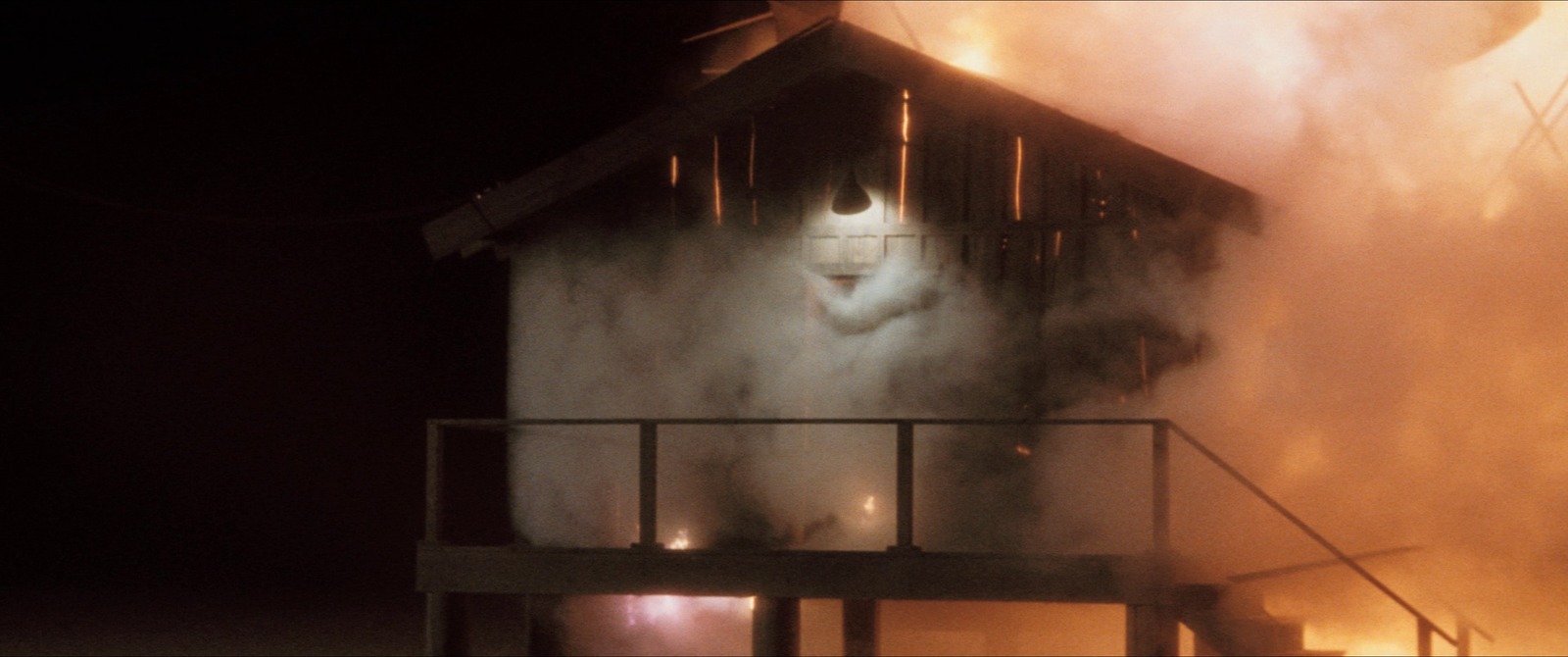
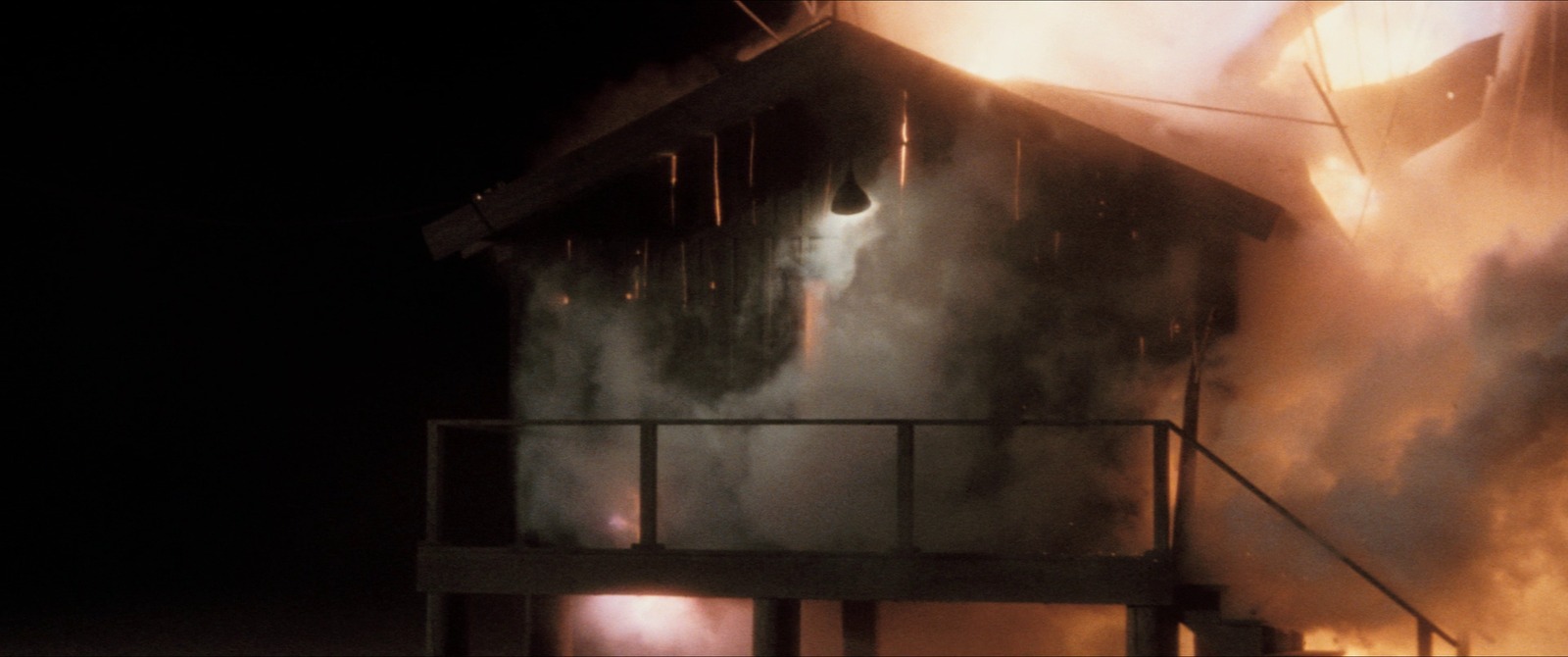
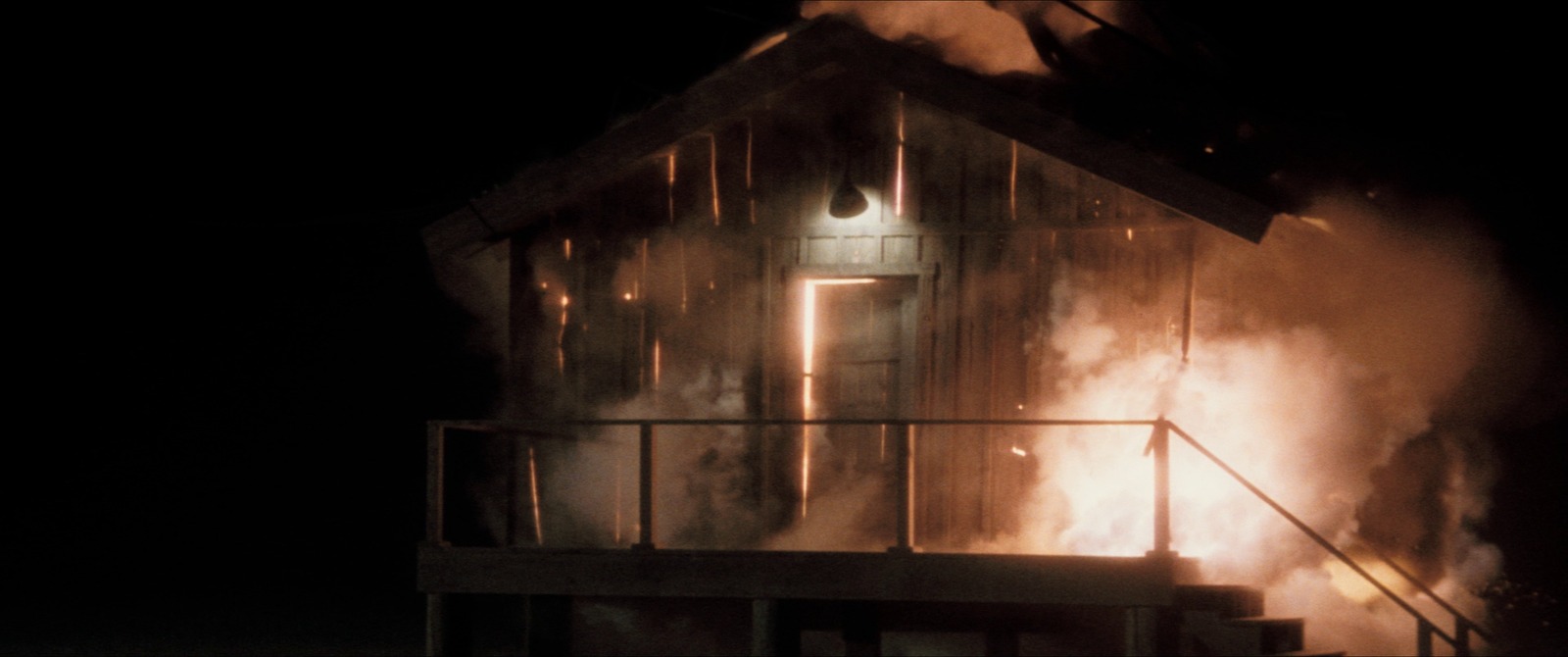
Criterion feature · 49:28–50:00; “Next Door to Dark” · 17:18–18:13 · Programme guide
An escape with no settled face
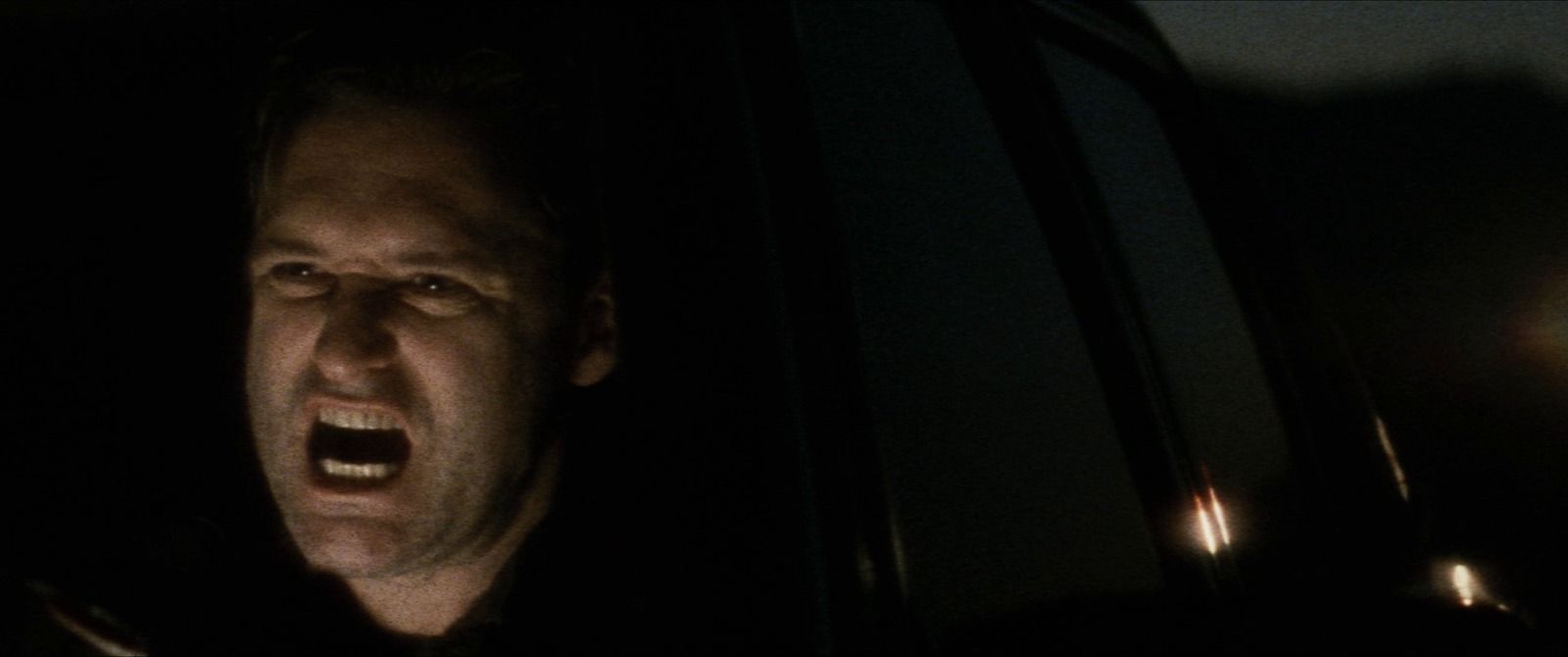
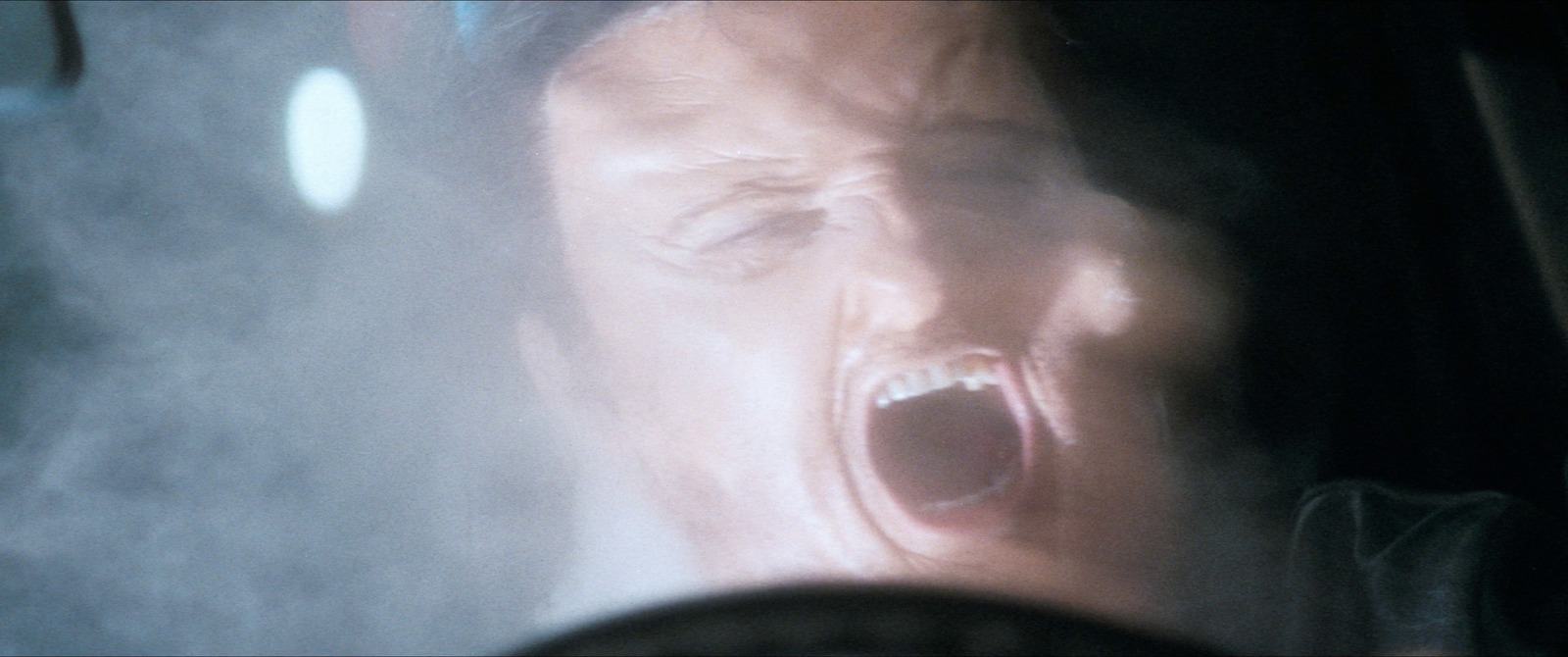
The final drive begins as an escape pursued by police headlights, then turns the driver’s face into the unstable centre of the image. Fred’s open mouth is followed by a swollen, stretched appearance; a side view through the car window gives way to blue light, blur and a twisting frontal view. Bright flares repeatedly erase the image between these fragments.
The sequence does not hold a completed second identity for us to recognise. It returns to the racing road, carrying the disturbance forward instead of resolving it. Seen beside the prison passage, the ending forms a visual rhyme: confinement and apparent escape both lead to a face that the cut will not allow to settle.
The gallery separates selected stages so that changes in angle, colour and facial shape can be compared. In the film, their brevity and the interruptions between them are part of the effect; a still isolates a detail that the moving sequence makes difficult to possess.
Explore the image sequence · 7 stills
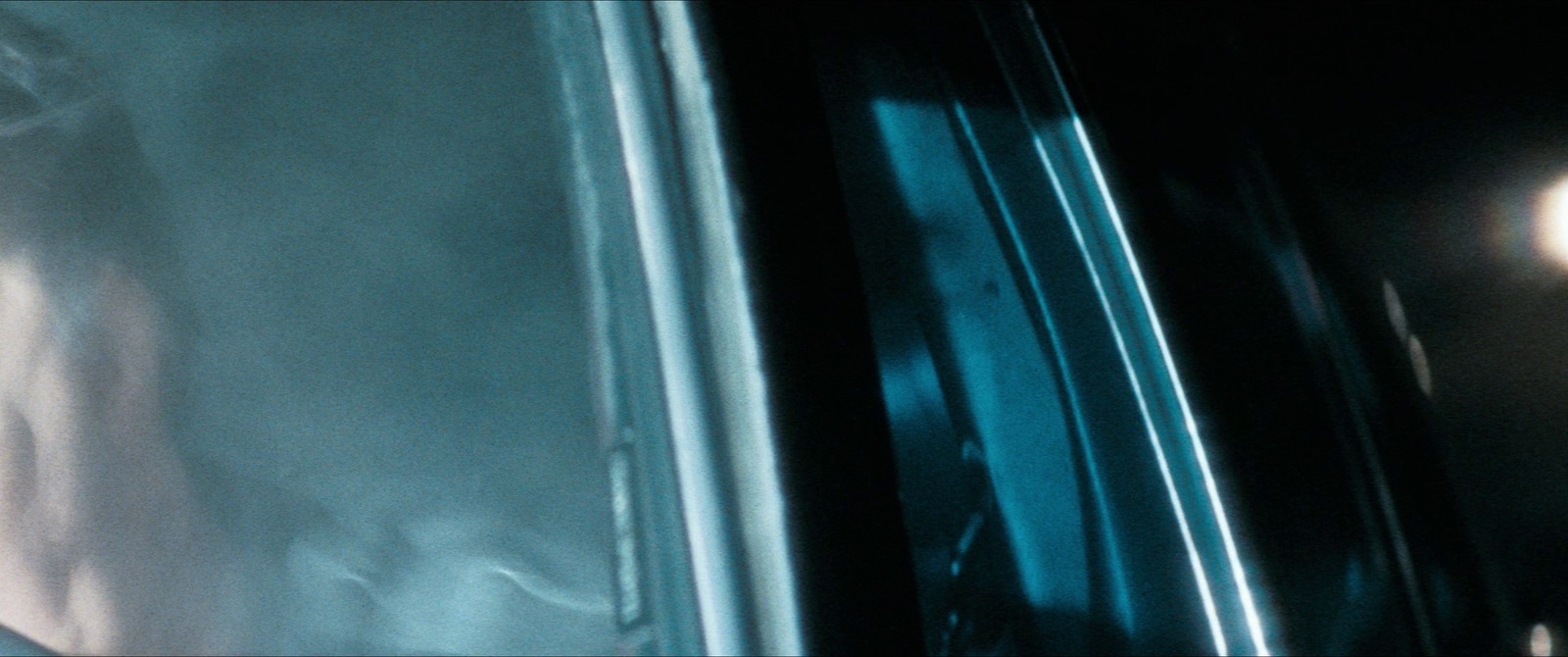
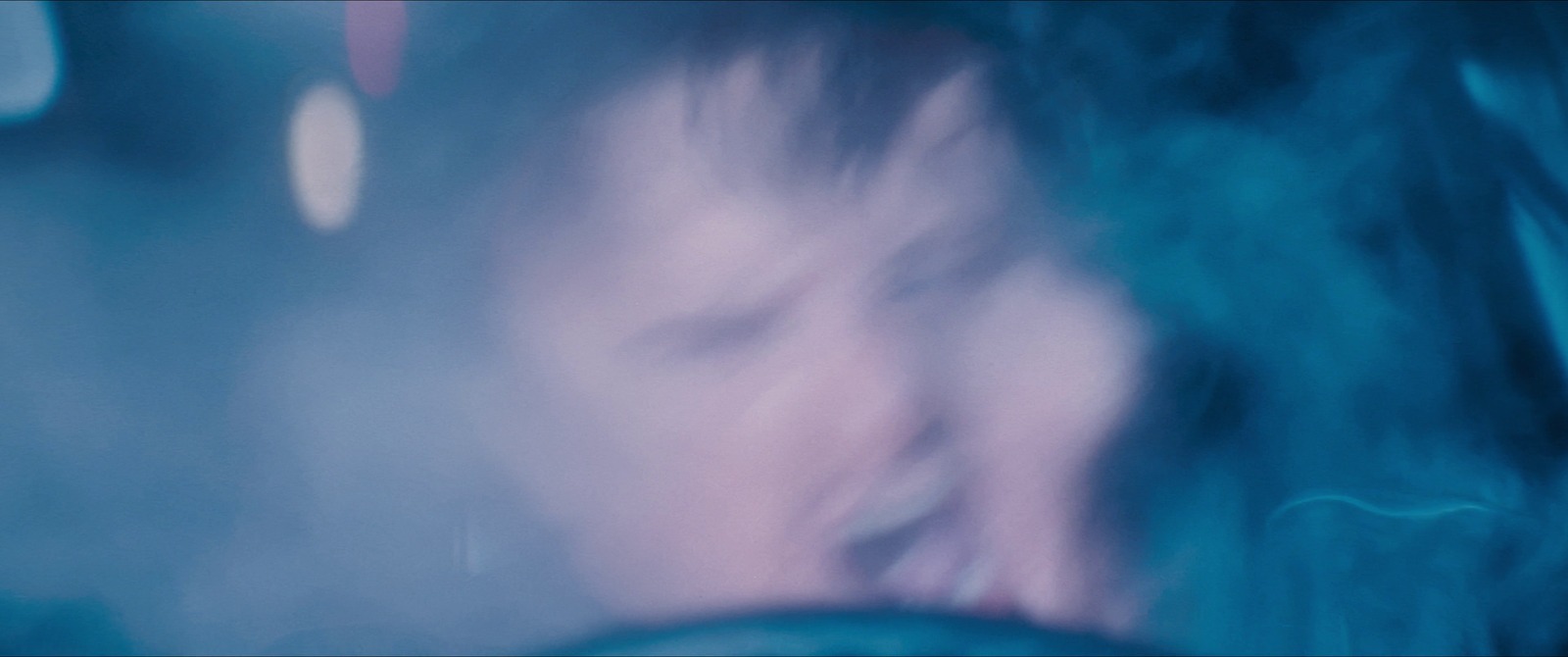
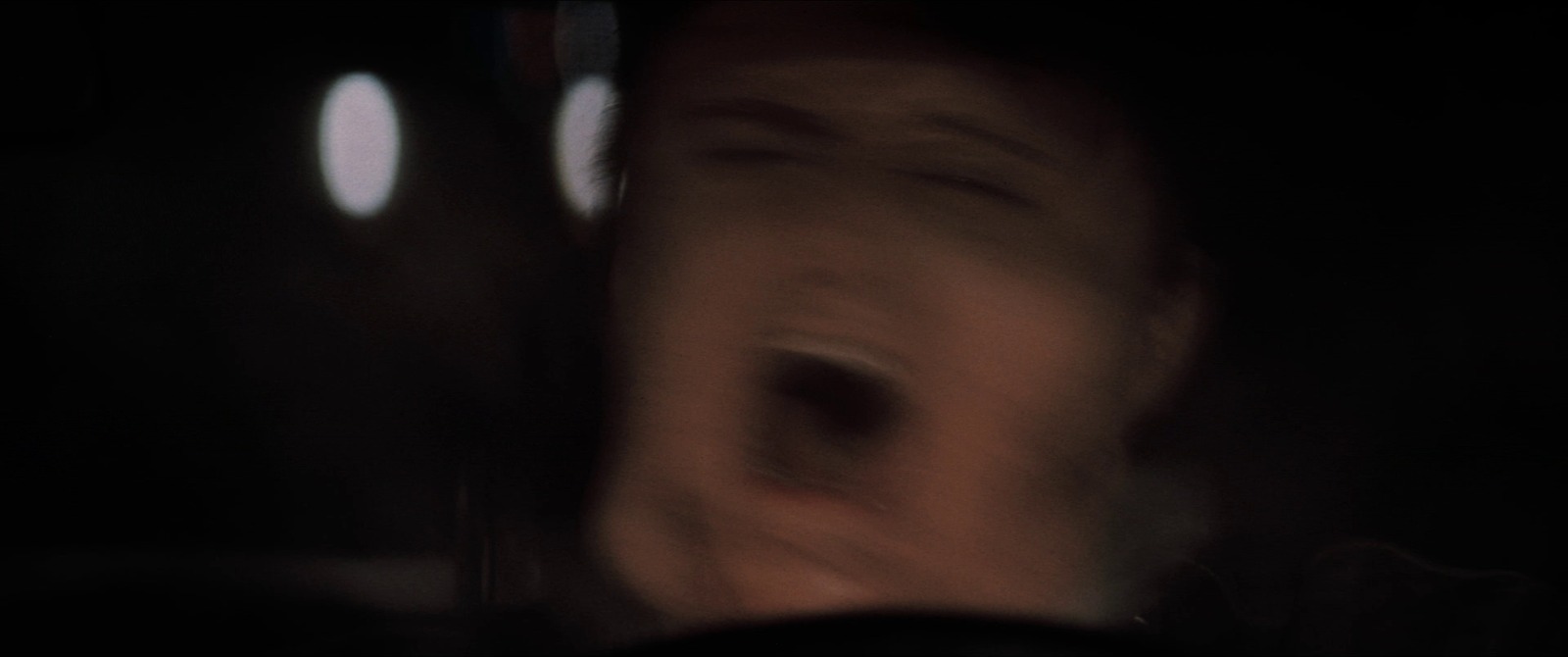
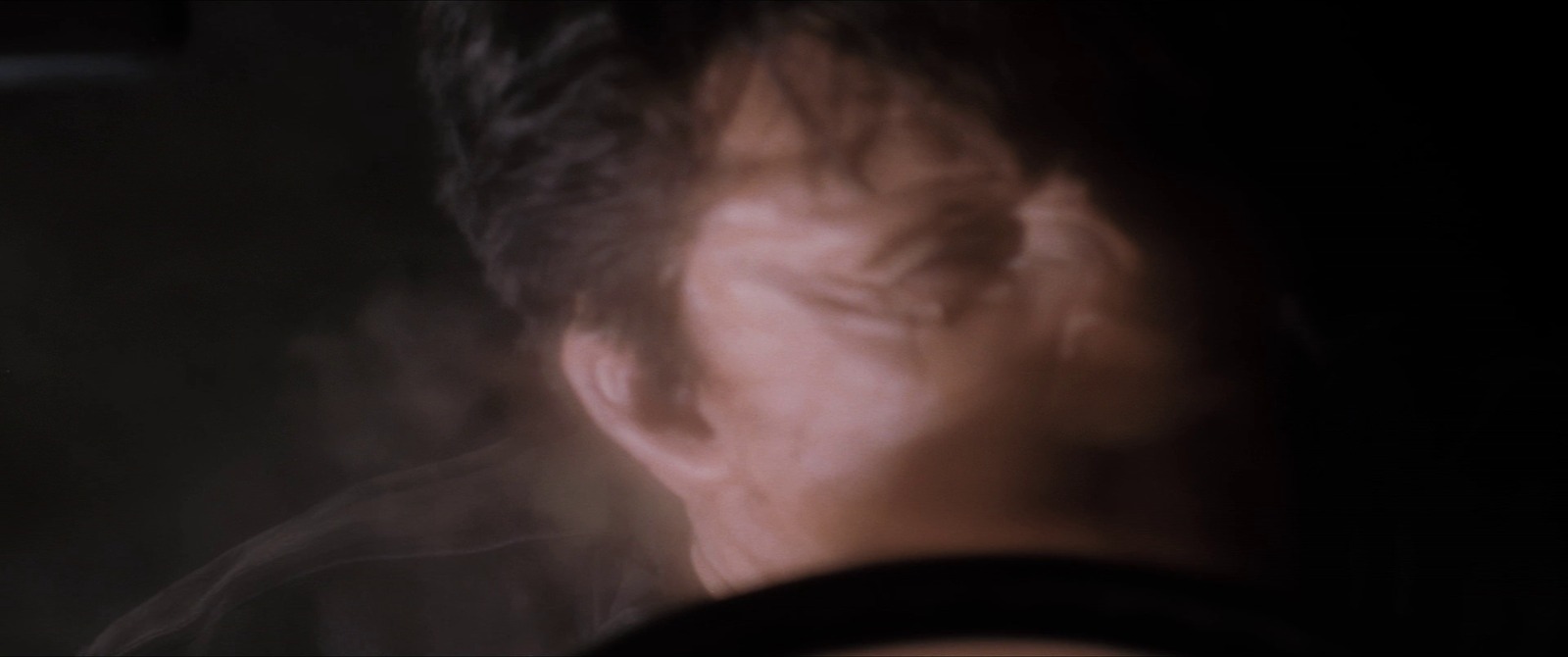
Criterion feature · 2:10:16–2:10:28 · Programme guide
The prison transformation · Loops and returns · Dialogue and listening studies
Inside the production
Building the rooms, recording the mood
A prison inside a fire station, a handmade table, clothes that distinguish two worlds and an orchestra recorded through unexpected materials. Toby Keeler’s documentary brings the work into view.
A fire station becomes death row
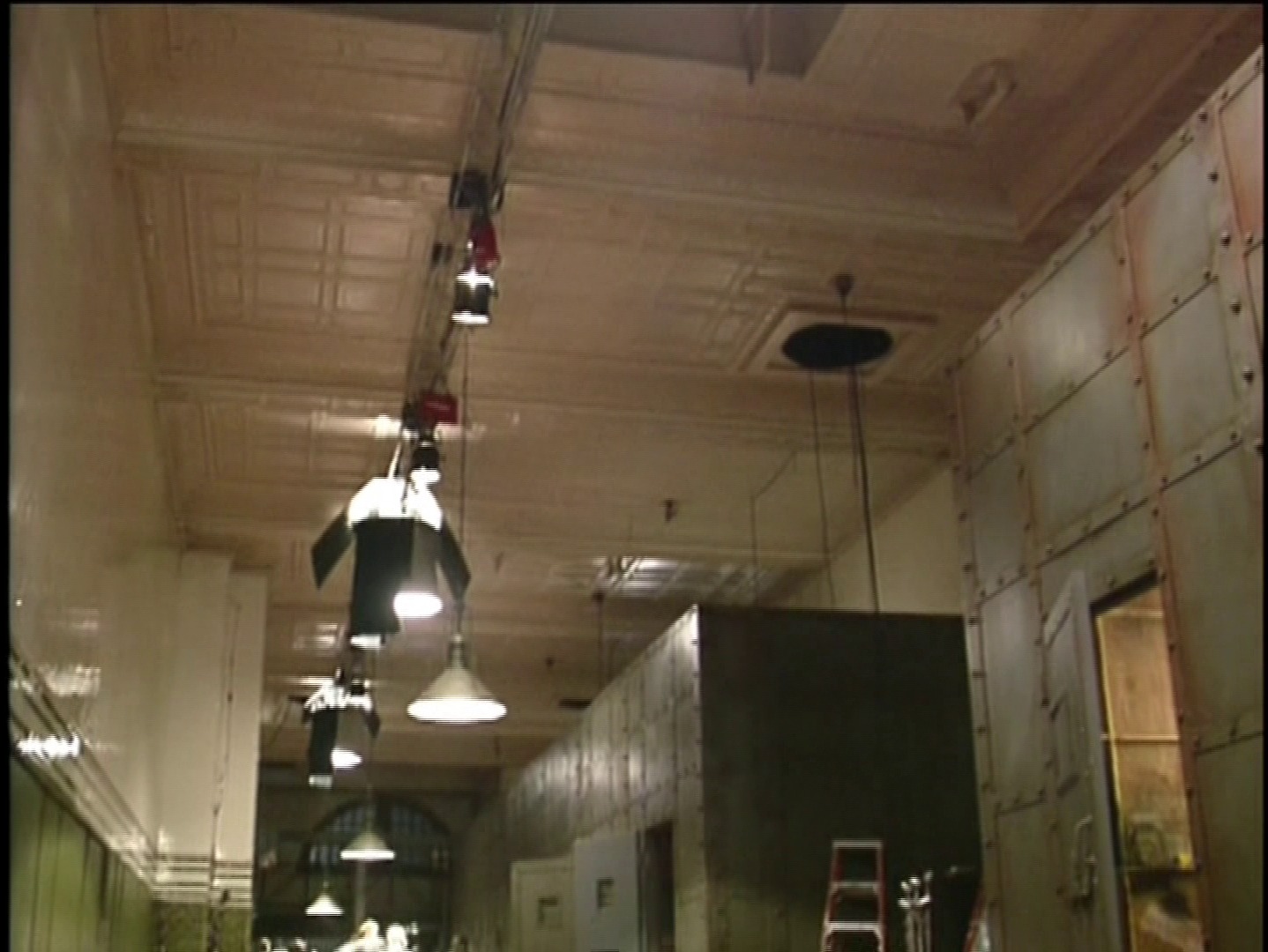
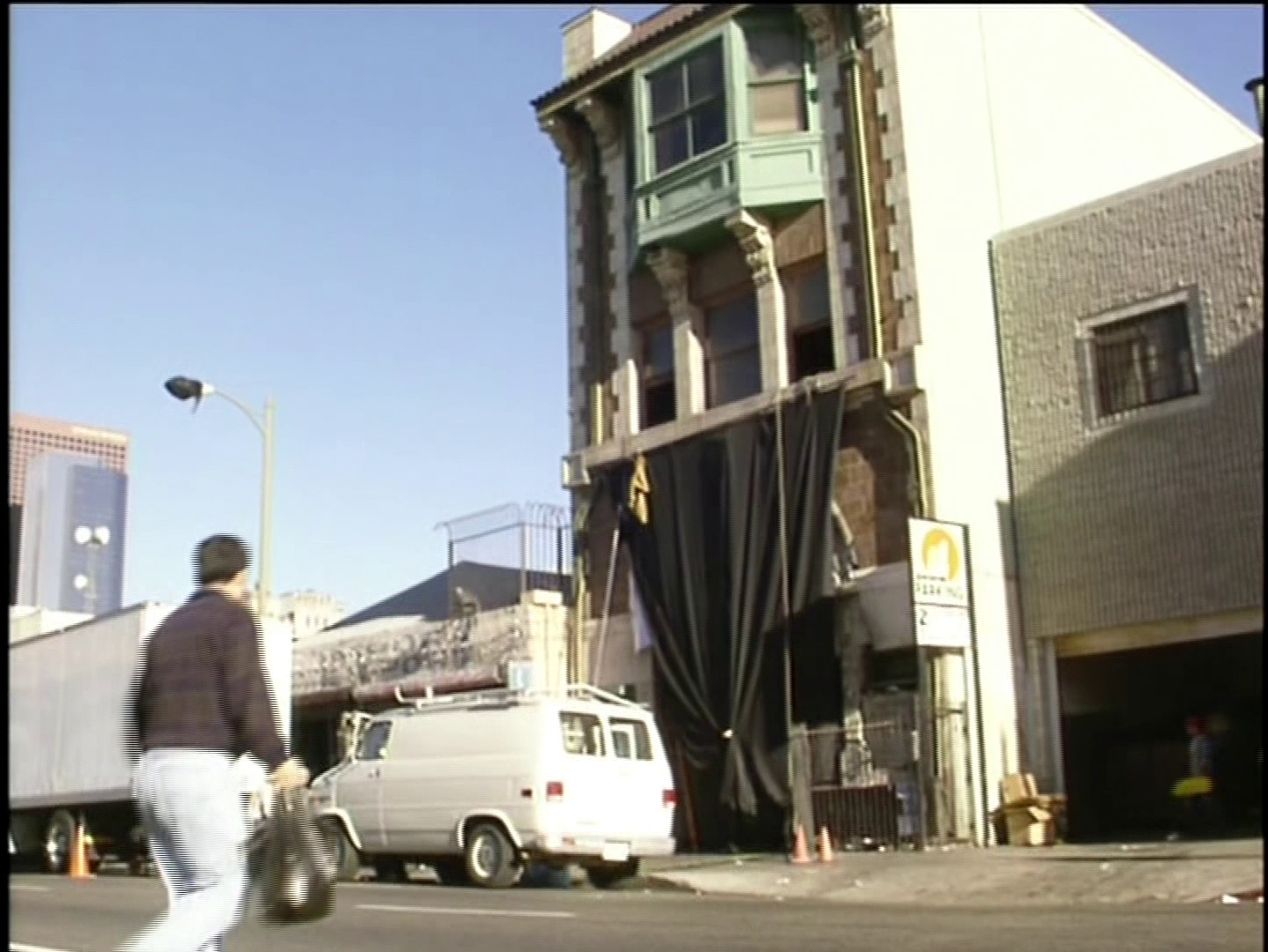
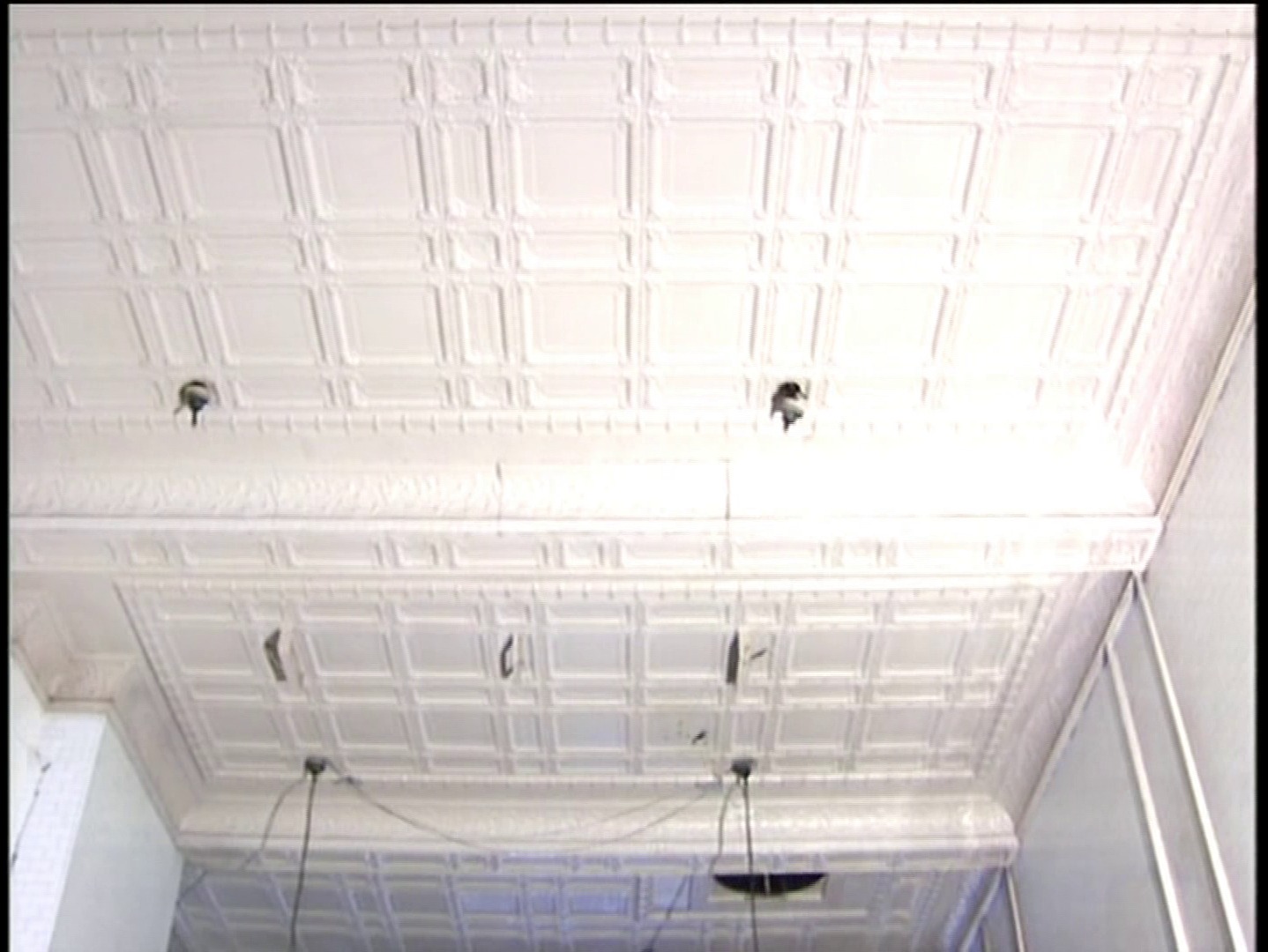
Deepak Nayar remembers his disbelief when a fire-station building was proposed for the prison. The documentary shows the transformation: the high ceiling and long interior remain, while cells, hanging lamps and a wet floor turn the space into Fred’s death row. Nayar’s account makes the achievement specific to the collaboration between Lynch and production designer Patricia Norris.
The construction gives the prison an unsettling mixture of institutional detail and theatrical emptiness. The documentary’s wide views let us compare the working building with the finished set; the floor being washed is a production task that also reveals how the corridor acquires its reflective surface.
Explore the image sequence · 4 stills
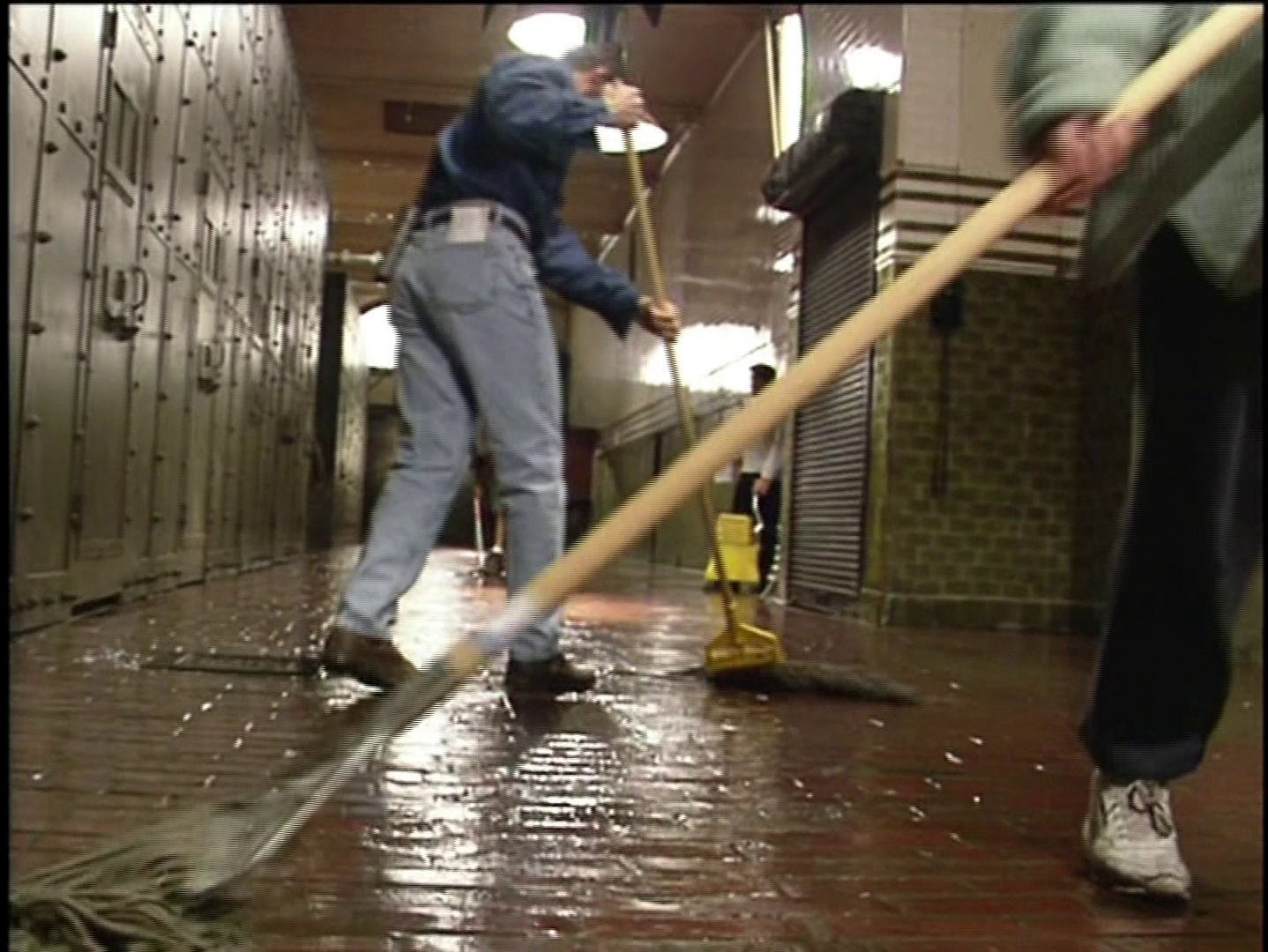
Pretty as a Picture · 37:20–41:10 · Programme guide
Clothes give the two worlds different shapes
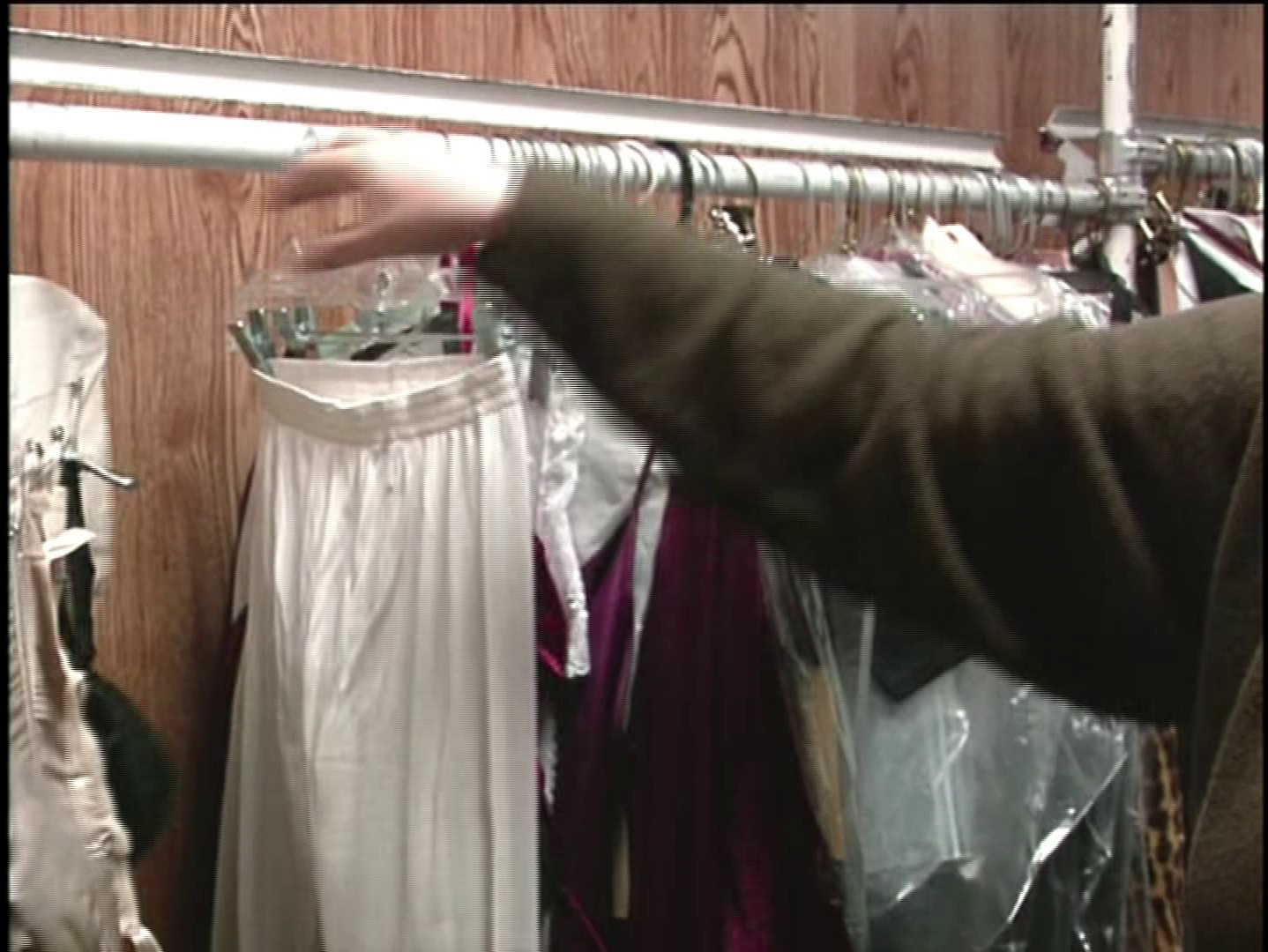
The wardrobe demonstration separates Mr. Eddy’s expensive suits and silk shirts from Pete’s work clothes and Andy’s flamboyant fabrics. It also describes the decision to keep blue largely out of the costumes. The clothes make differences in money, age and sexual display visible before the characters explain themselves.
Renée’s silhouette is described as long and lean, extended by high platforms; Alice’s is shorter, with more of the body exposed. This physical distinction belongs beside Arquette’s account of Lynch telling her that the women were the same person. Costume supplies a clear change in appearance while performance keeps the connection unresolved.
Explore the image sequence · 3 stills
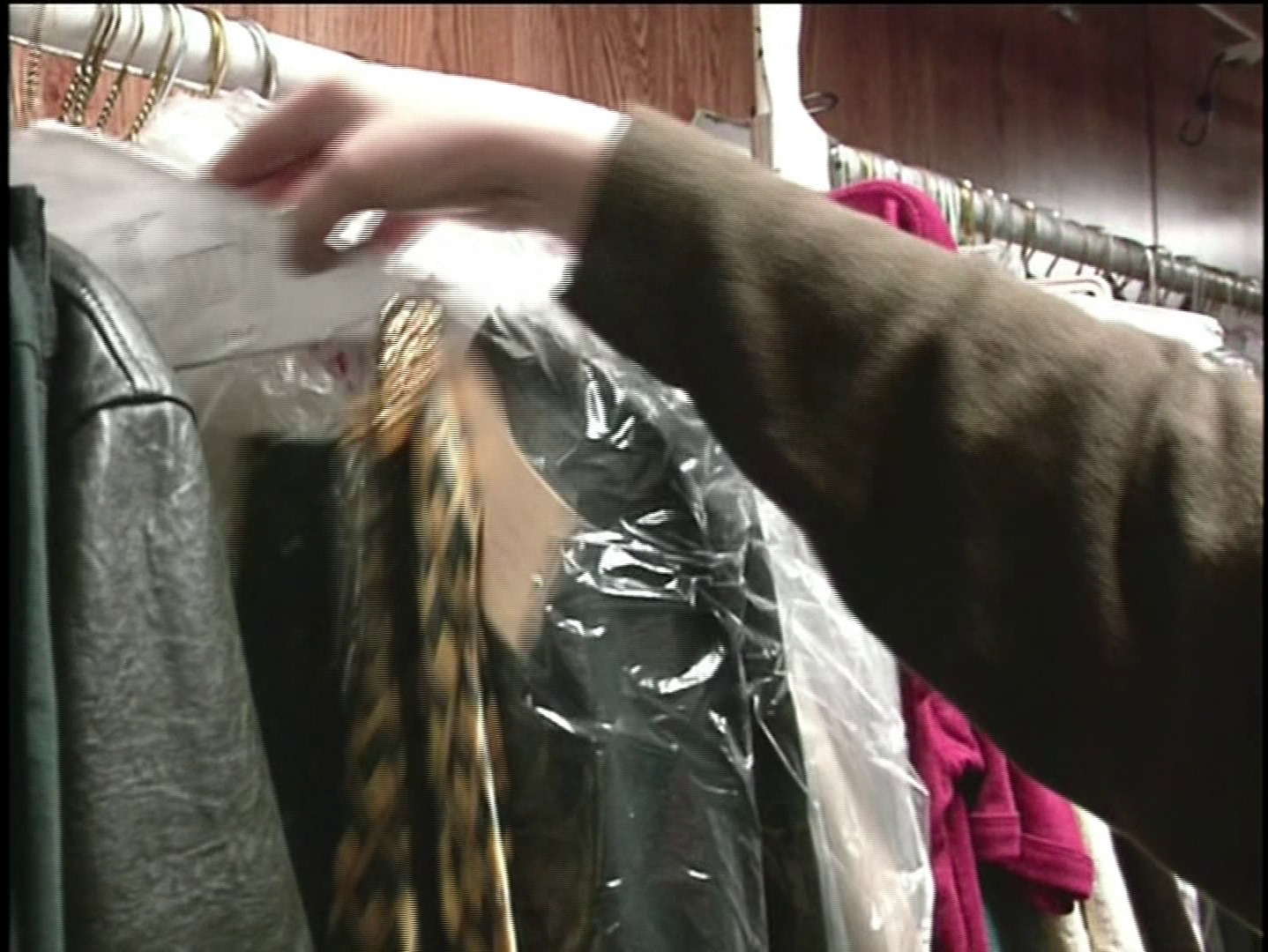
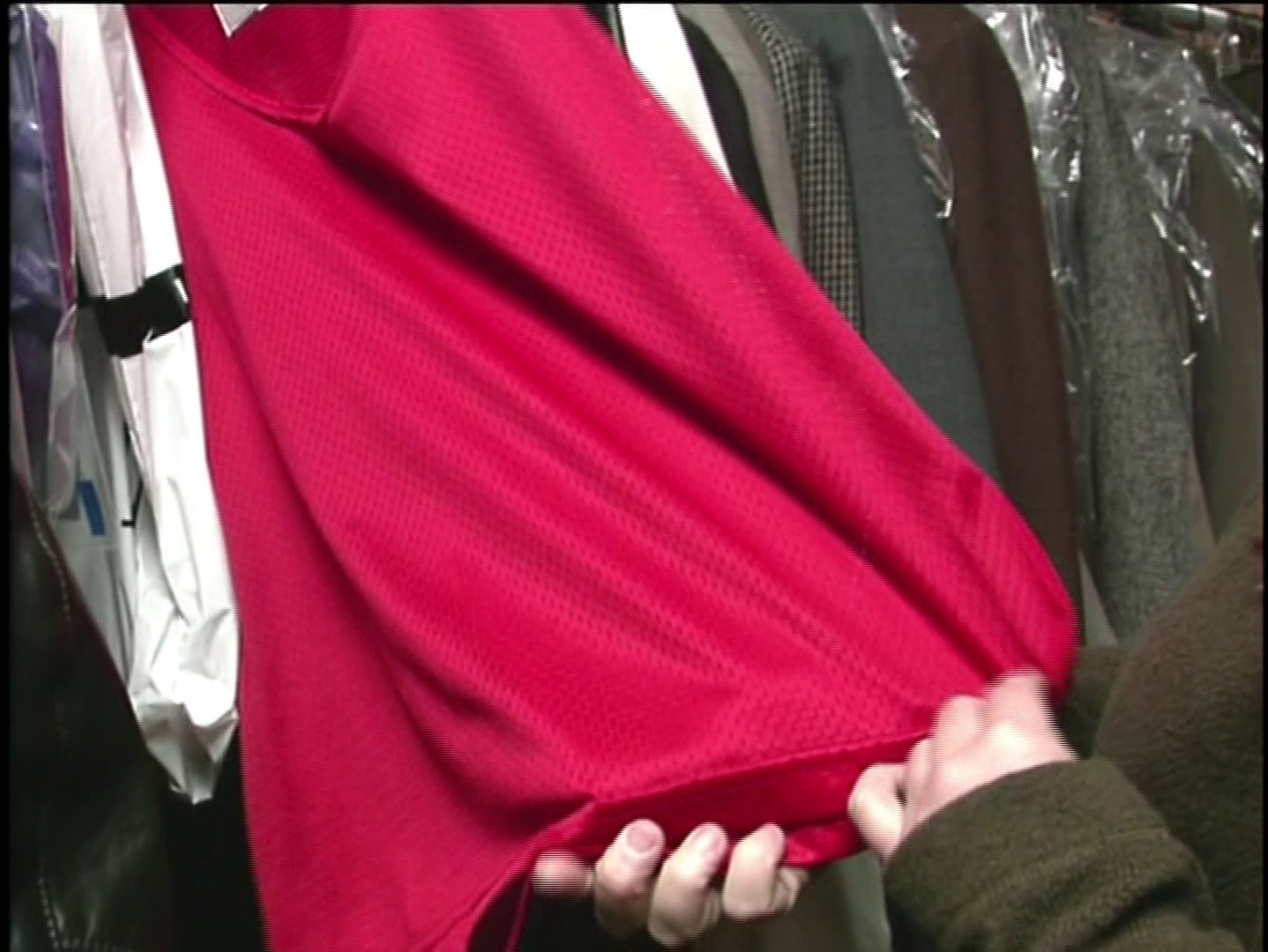
Pretty as a Picture · 39:15–40:43 · Programme guide
Arquette on Renée and Alice · Performance and interpretation
Building a piece of Fred’s house
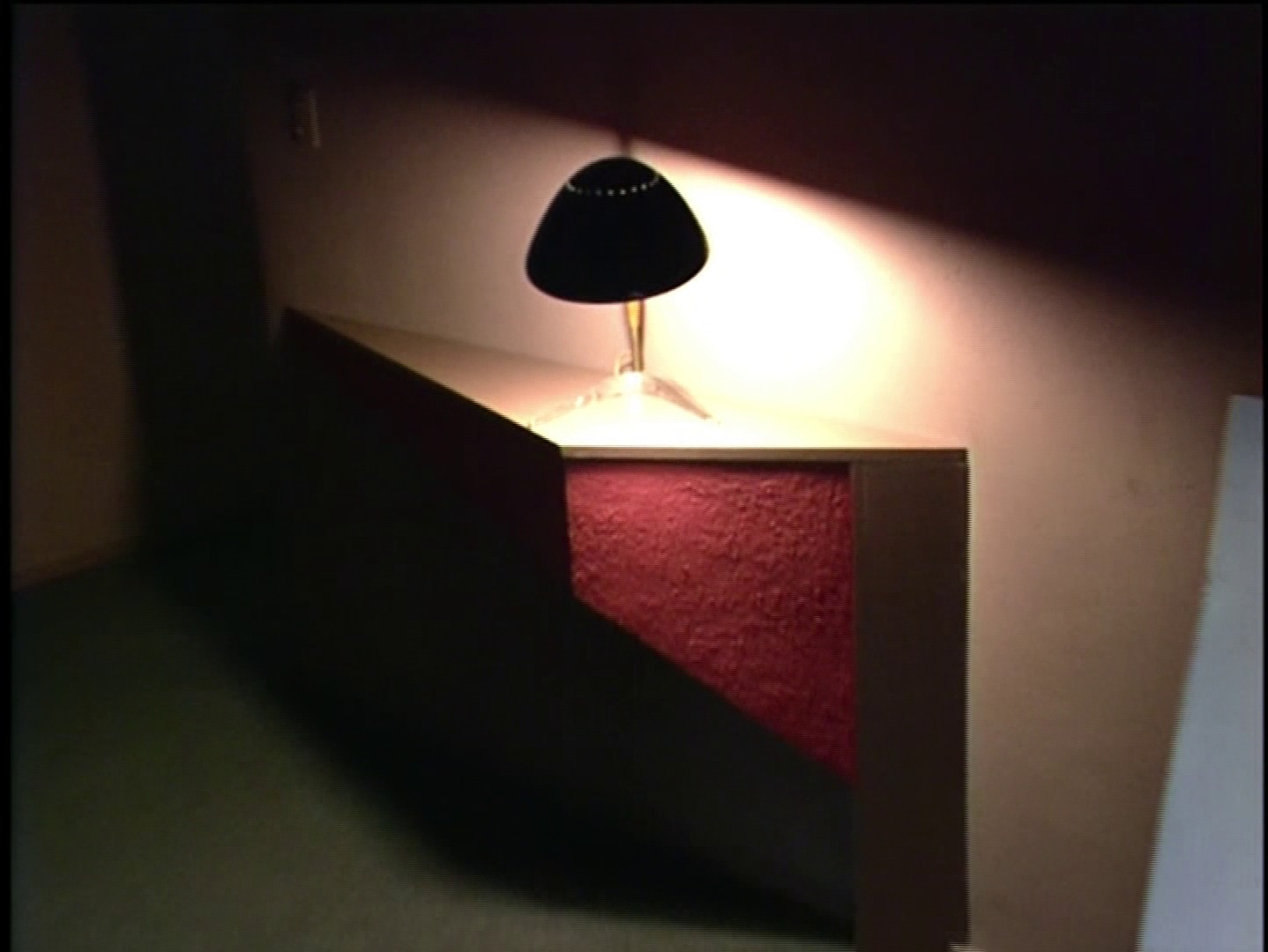
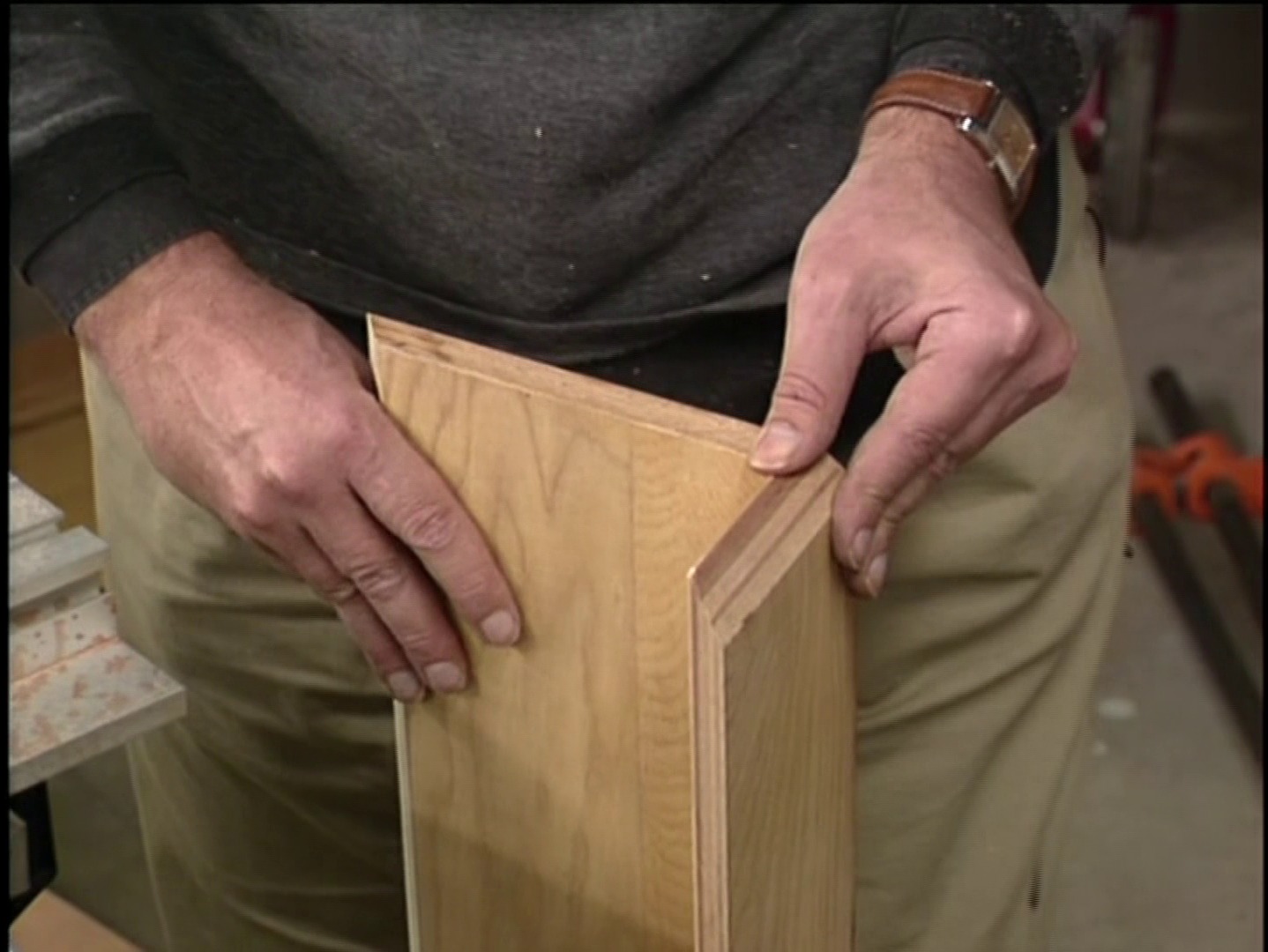
Lynch introduces a table he is making for Fred Madison’s house, identifying its leg and top before discussing the frustration of never having every tool he wants. The workshop sequence puts him in direct contact with the film’s material world: measuring, joining and handling surfaces rather than only approving a design.
The finished furniture and the work in progress belong to the same visual argument. A sharply lit object against a dark wall can establish the room’s proportions and give attention a precise place to settle. The sequence also connects the film to Lynch’s continuing furniture practice.
Explore the image sequence · 2 stills
Pretty as a Picture · 46:18–48:07 · Programme guide
Rain becomes a piece of business
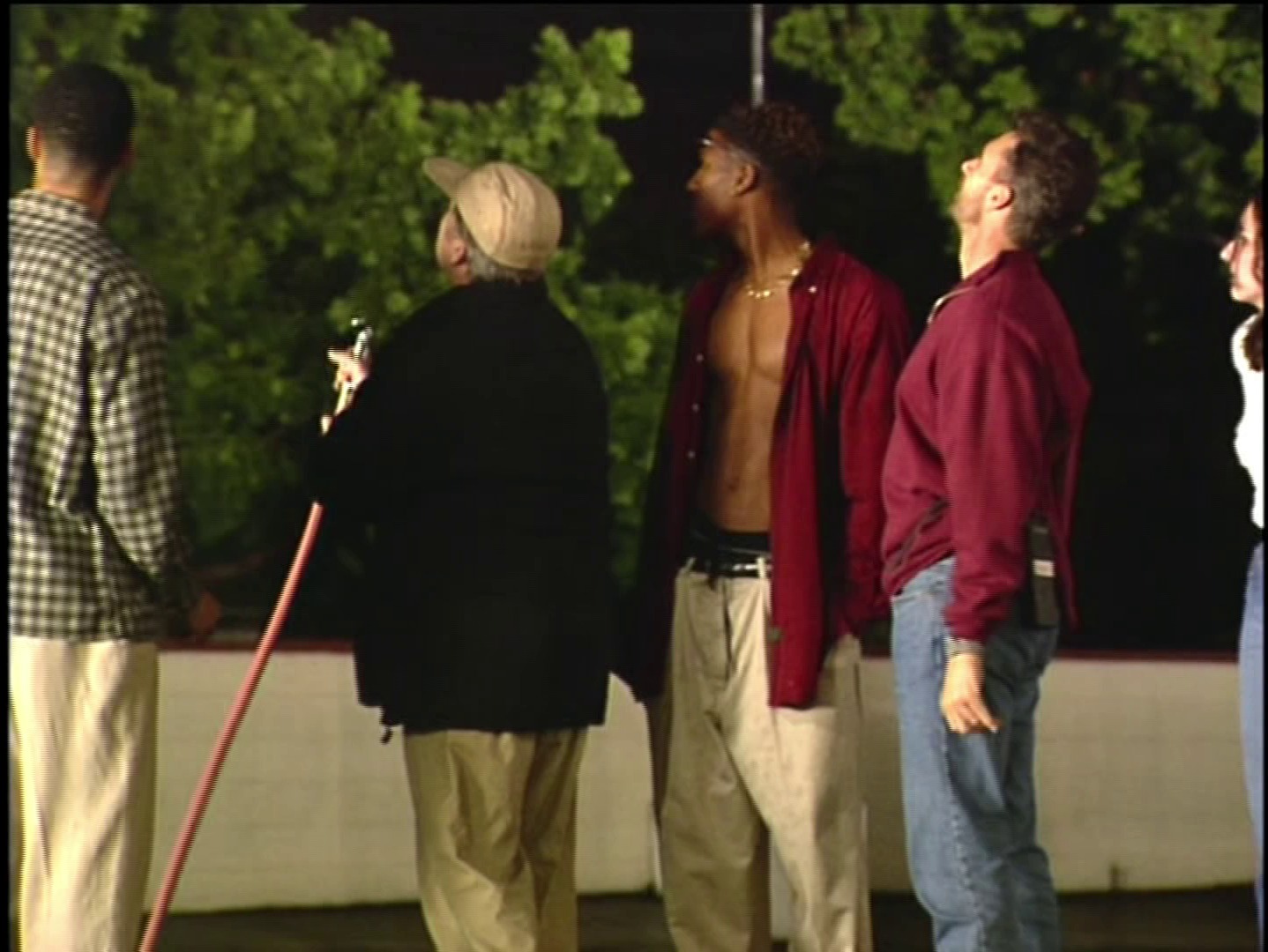
Nayar describes an expensive problem at Johnnie’s: a fully called crew, additional camera personnel, stunt performers and cars were ready for an exterior scene when heavy rain threatened continuity with dry scenes already filmed. Lynch’s solution was to put men playing with a hose into the action, giving the wet ground a visible cause.
The documentary shows the performers and Lynch on the wet forecourt, then connects their activity with the finished scene. It is a compact example of improvisation that serves continuity: an obstacle in the location becomes an event inside the fiction. The later Room to Dream account returns to the same decision.
Pretty as a Picture · 65:54–67:20; “Next Door to Dark” · 16:13–17:10 · Programme guide
Finding the orchestra’s uneasy beauty
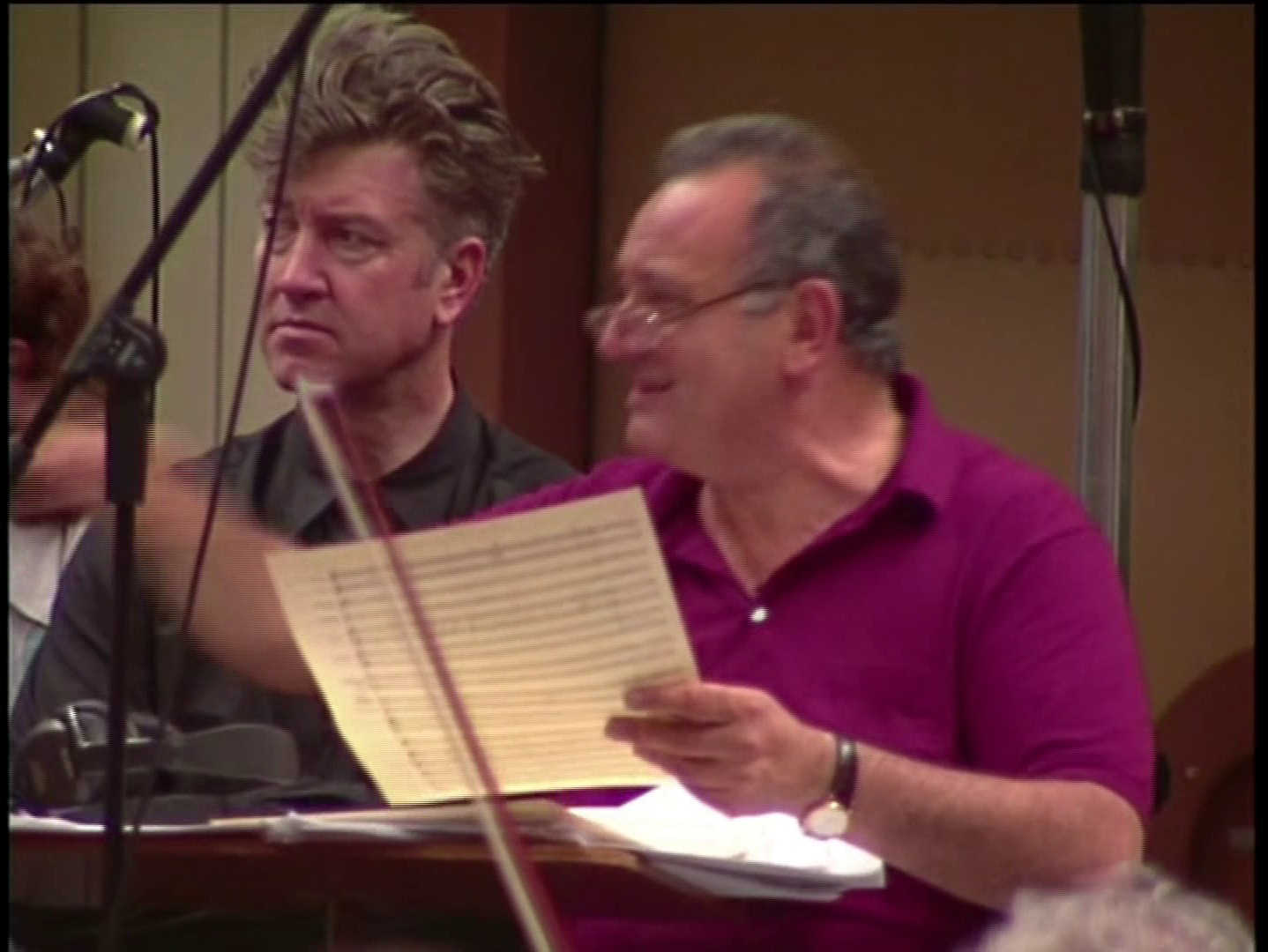
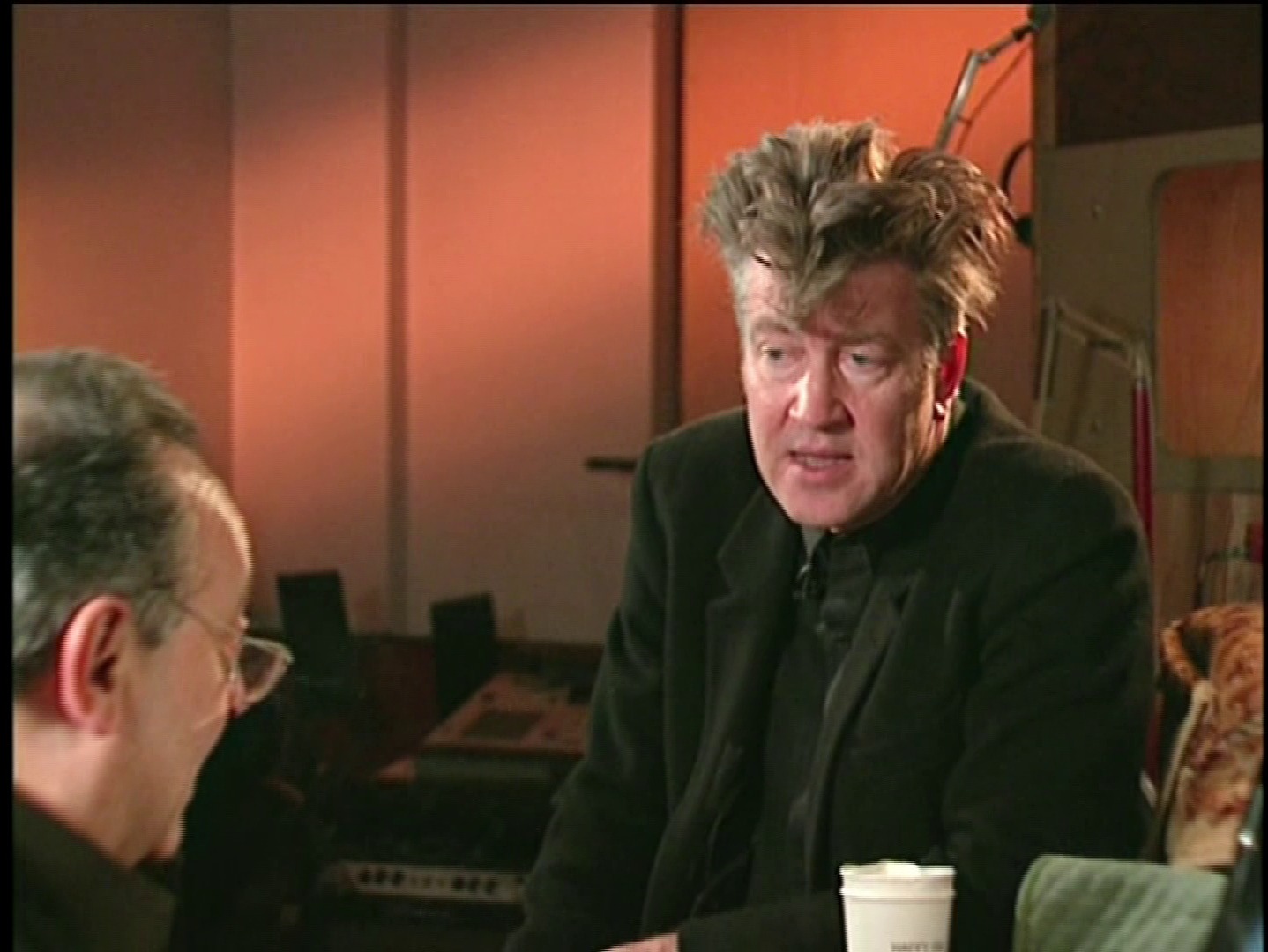
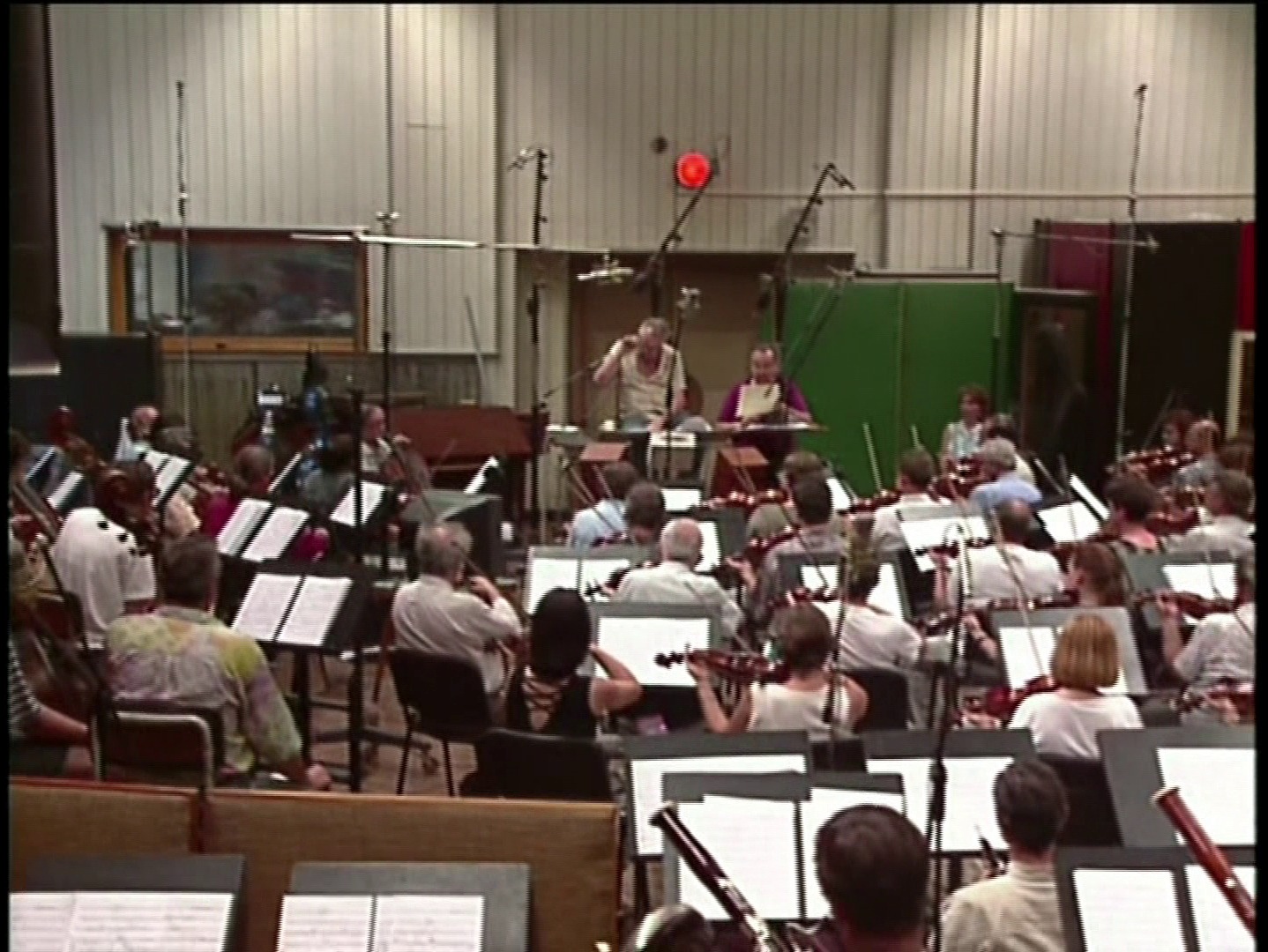
The recording-room footage makes the musical collaboration visible. Lynch and Angelo Badalamenti compare phrases, registers and patterns; singer and fiddle player Jocelyn West works through a passage while they listen and respond. Lynch describes the process as a dialogue in which a beginning suggests a direction and the musicians continue until they find the mood.
Later, the Prague orchestra sessions place that intimate exchange inside a larger ensemble. Badalamenti describes beauty within an uneasy, disturbing film; Lynch talks about finding homes for the recorded pieces during post-production. The score is being made as material that can be shaped around images, rather than as a fixed sequence already locked to every scene.
Explore the image sequence · 3 stills
Pretty as a Picture · 05:40–10:30 and 67:48–73:20 · Programme guide
An orchestra passes through a strange space
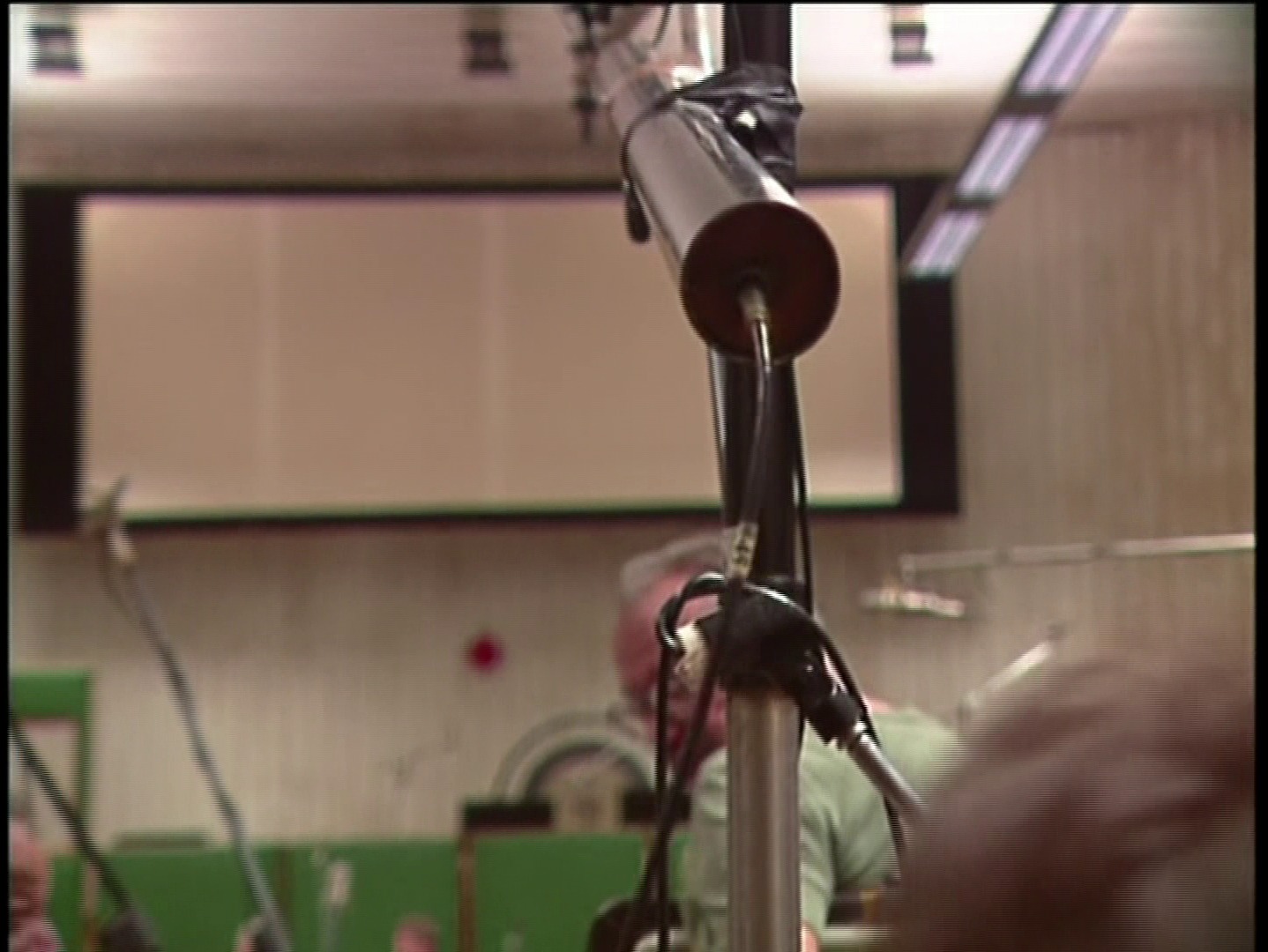
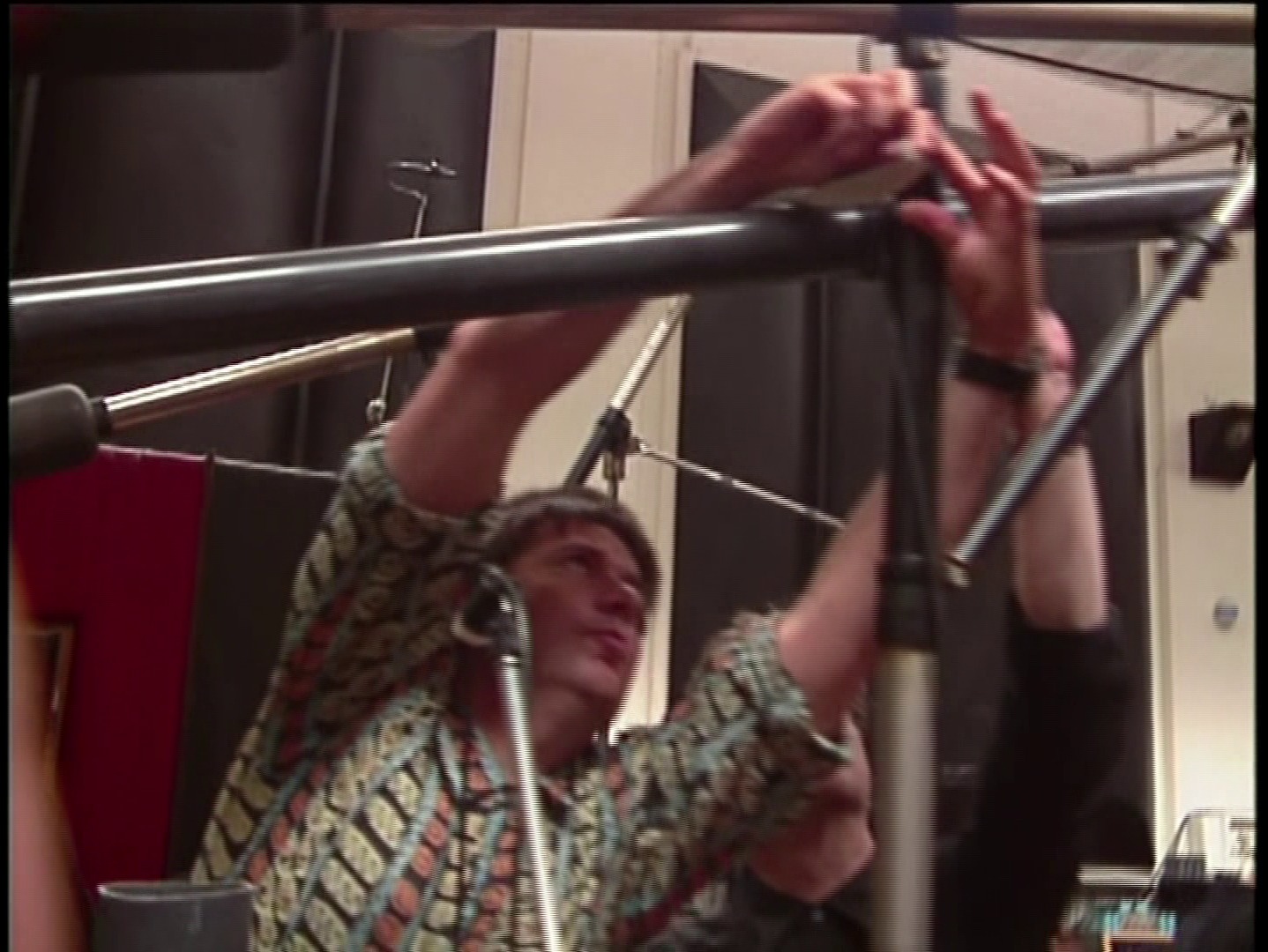
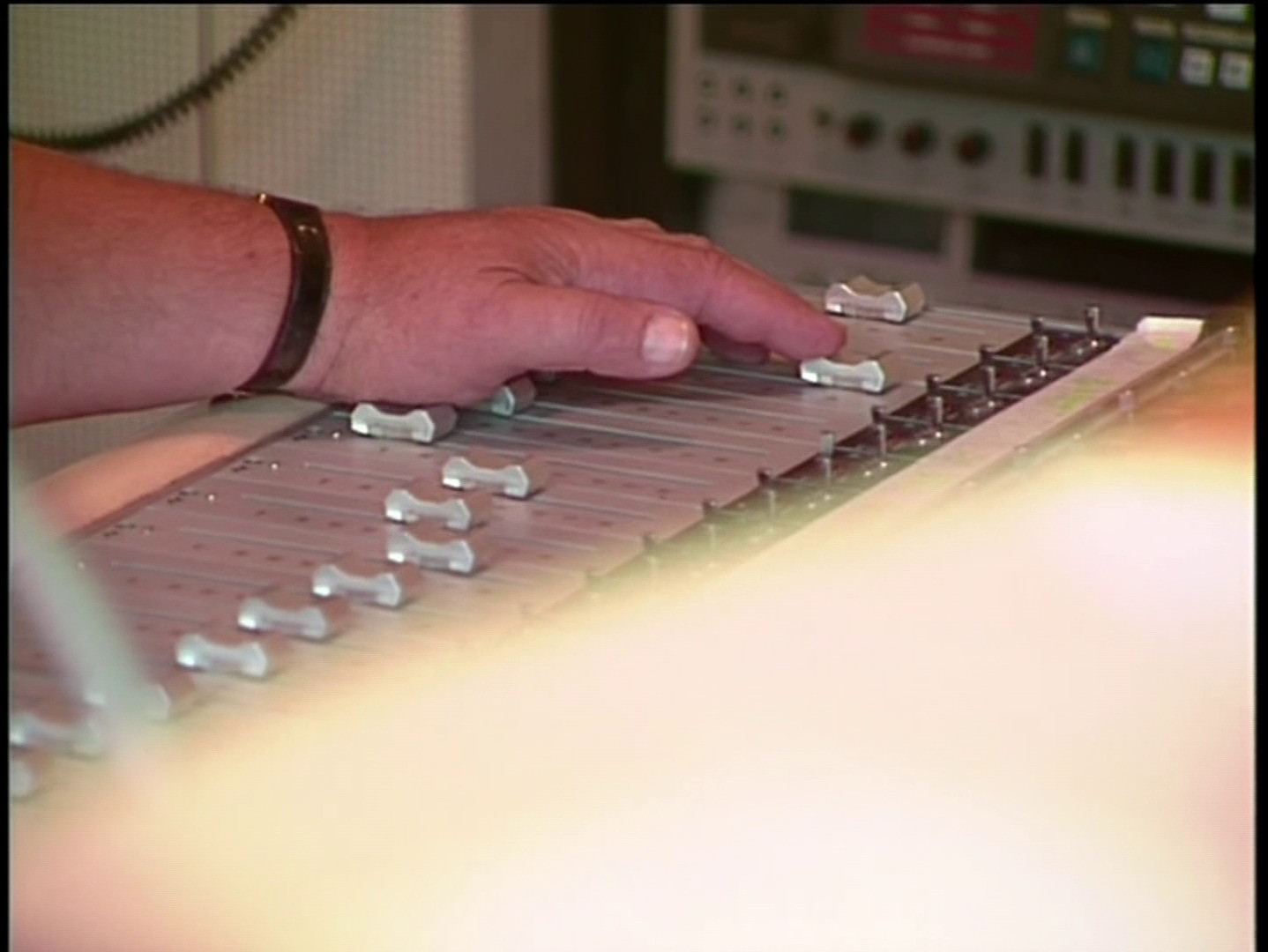
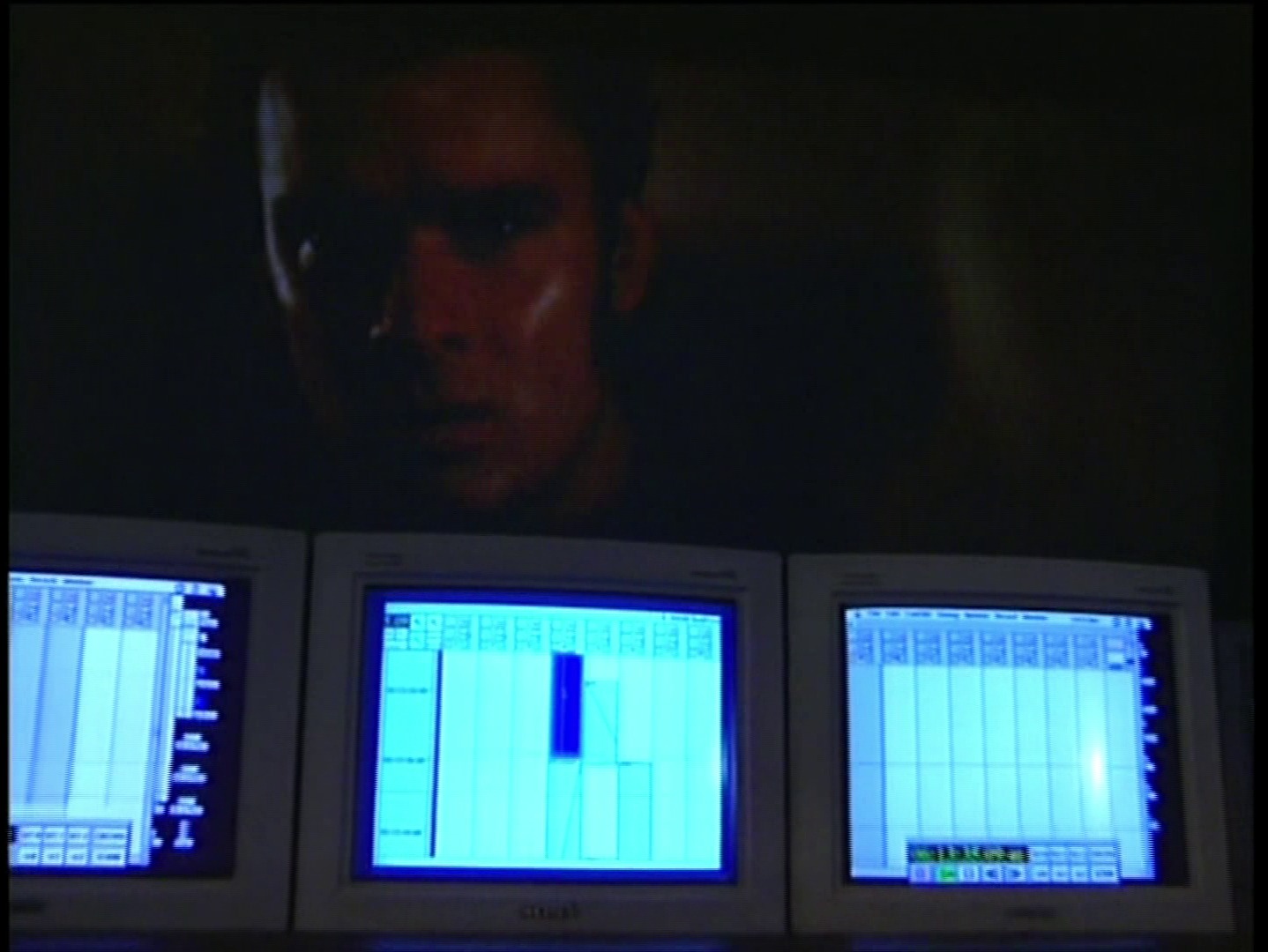
The documentary records an unusual extension of the orchestral sessions: microphones receive sound through a bottle and through lengths of tubing. The accompanying sound-team explanation describes the resulting distortions as colours that can remain connected to the original orchestral recording. The music can seem to disappear into an altered space and emerge again.
Back in the mixing room, Lynch listens against the picture and asks for a particular crack to break through a passage. The footage ties the film’s unsettling sound to practical acts of recording, selection and balance. A sound can retain a trace of a recognisable source while changing the apparent size and texture of the room around it.
Explore the image sequence · 4 stills
Pretty as a Picture · 73:20–76:06 · Programme guide
Making the transformation in the cutting room
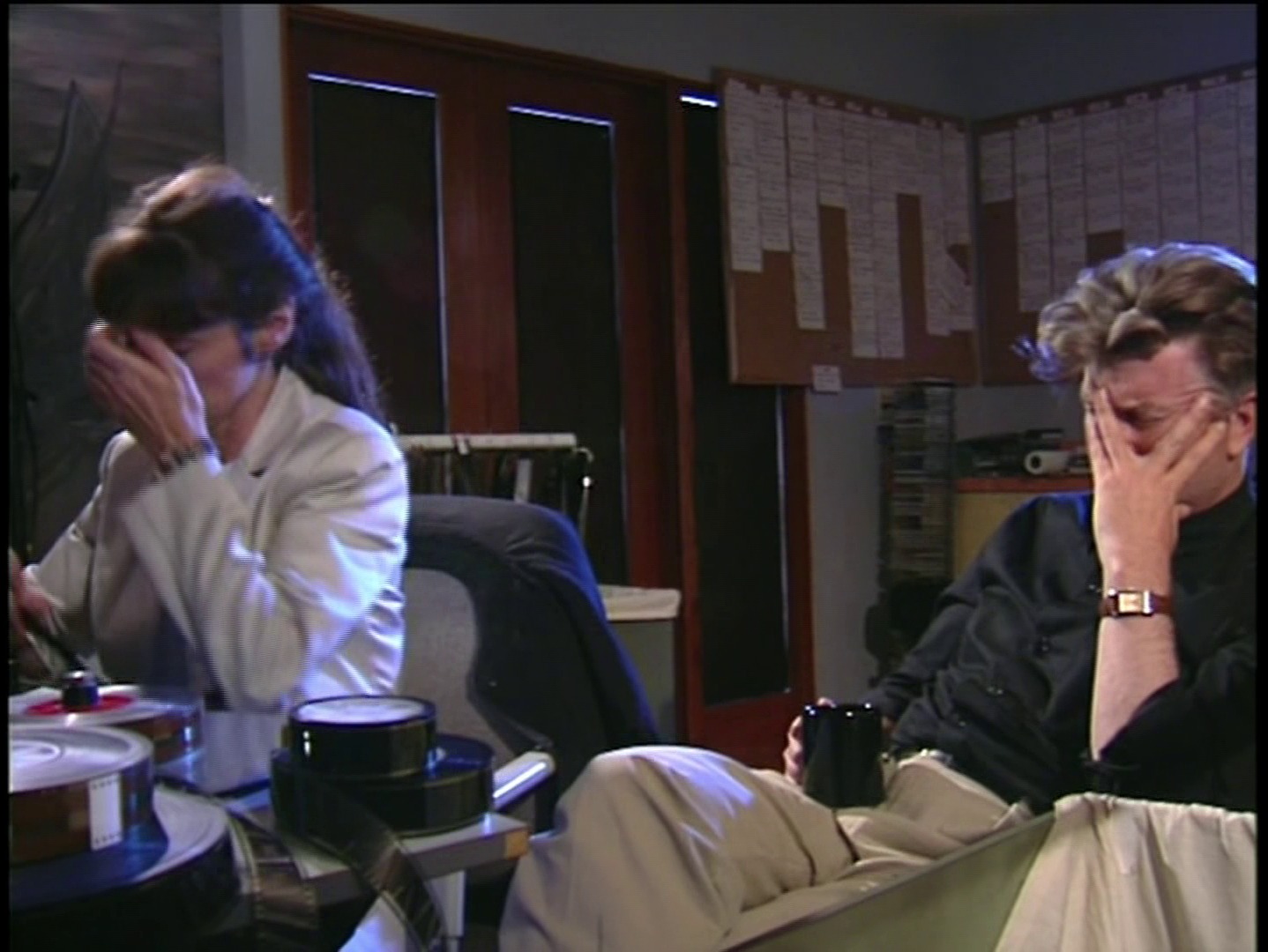
The editing-room passage places Lynch beside Mary Sweeney as they discuss white flashes and the order of side and frontal views. The surrounding images include the damaged face associated with Fred’s transformation. Rather than explaining the narrative as a solved puzzle, the footage shows the sequence being controlled through very small changes in duration and viewpoint.
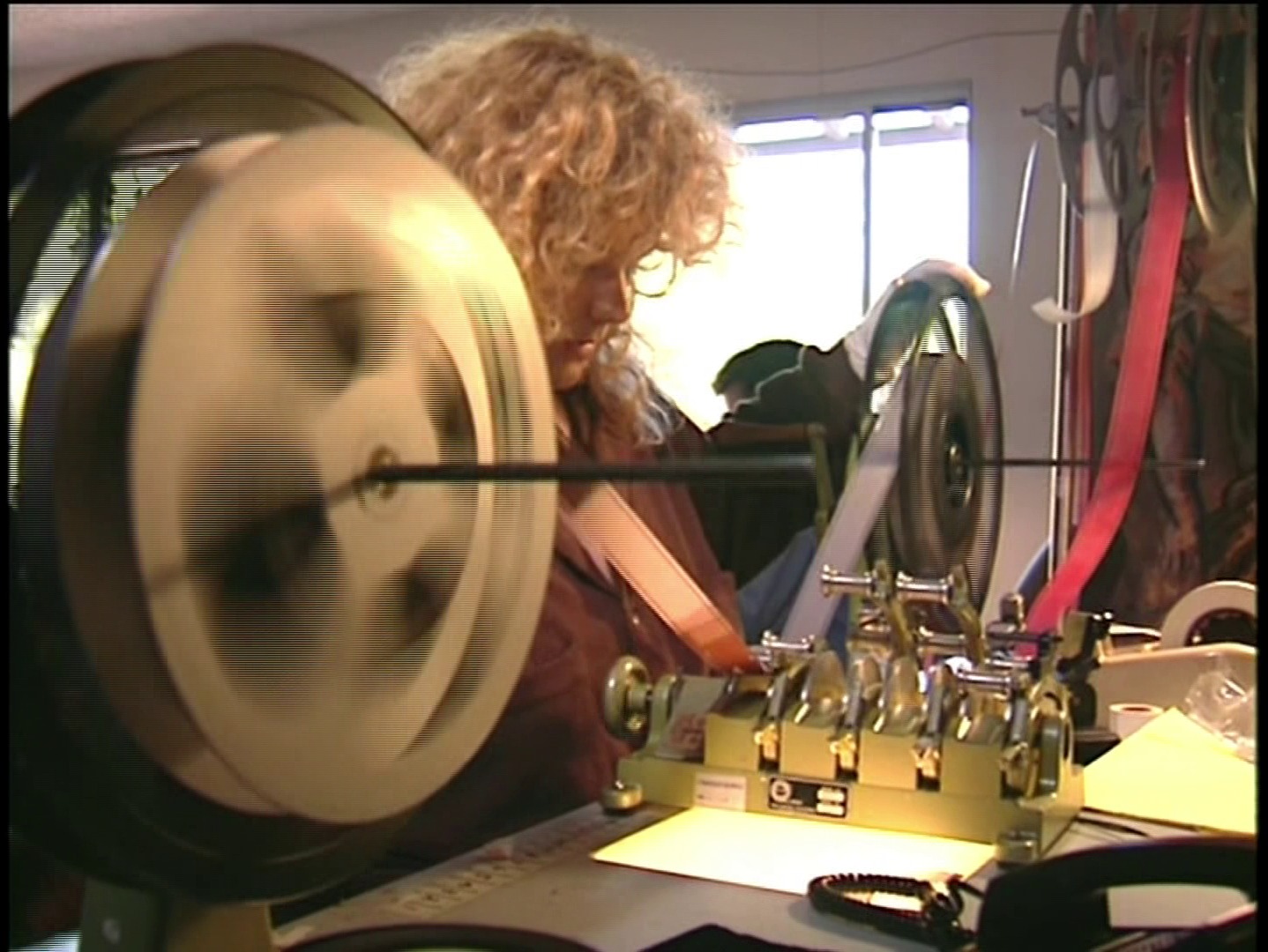
Sweeney describes long days, six days a week, with an editorial and post-production team. The moment is a useful companion to the finished transformation: its violence is partly a question of how long the eye is allowed to settle before the next image arrives.
Explore the image sequence · 2 stills
Pretty as a Picture · 76:01–77:24 · Programme guide
The film’s structure · Transformations and practical effects
The collaborators speak
Performance, memory and direction
The 1997 interviews and on-set recordings give particular decisions a voice. Follow the actors’ accounts back into the film’s scenes.
An interruption becomes a house
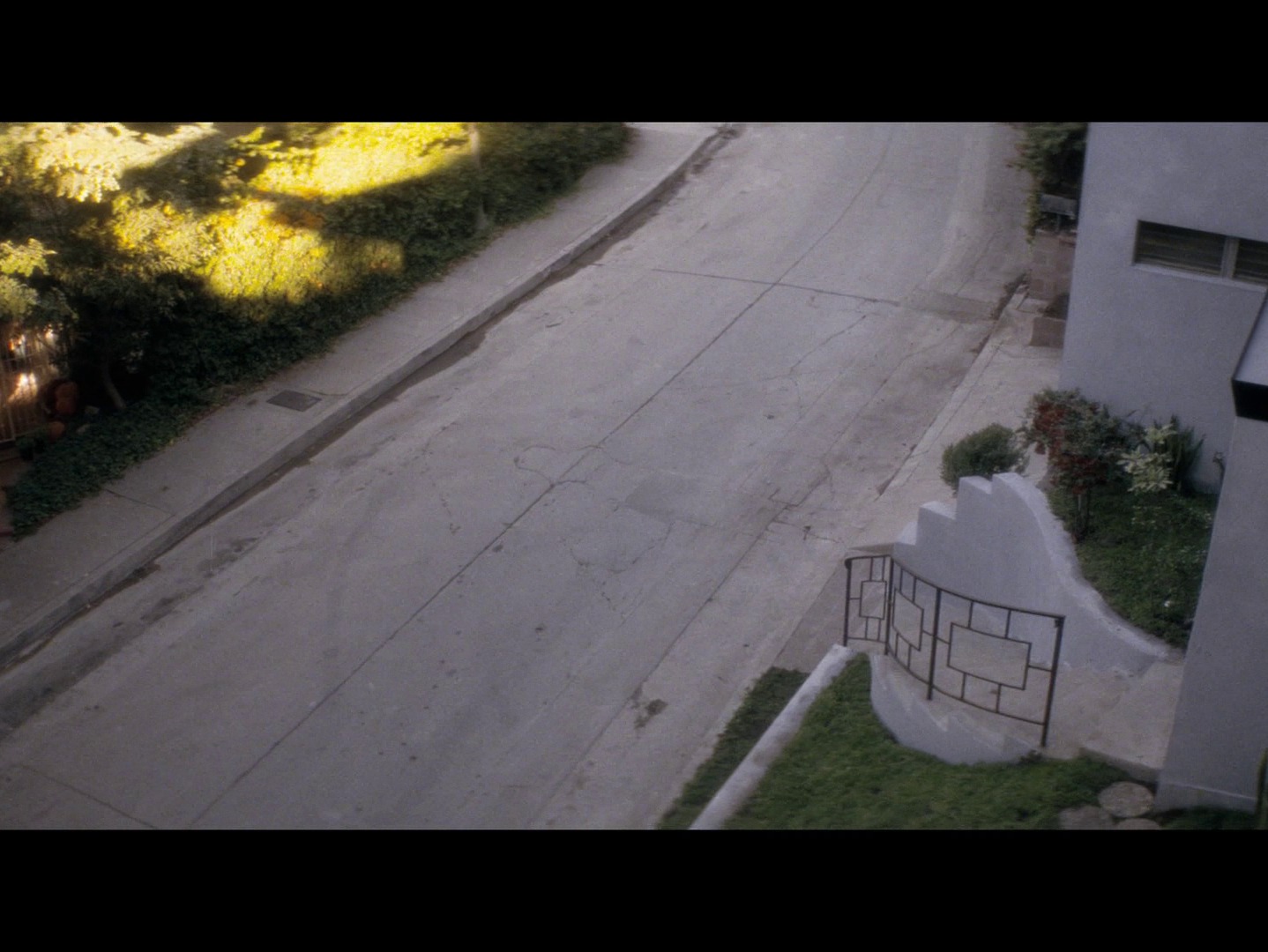
Lynch traces the opening intercom message to an incident at his own home: a caller announced Dick Laurent’s death, but by the time he reached a window the visitor had gone. In the 1997 interview, he explains that the difficulty of seeing the entrance became a requirement of the film’s location search. He eventually bought a house and altered its configuration.
The story connects the film’s architecture to an interruption in ordinary experience. Fred can hear the message before he can locate its speaker; movement through the house then fails to recover the missing person. The layout makes that delay physical. It gives the opening its uncertainty without requiring an explanation of the visitor.
David Lynch, 1997 · 04:05–05:40 · Programme guide
Arquette’s two roles, one difficult balance
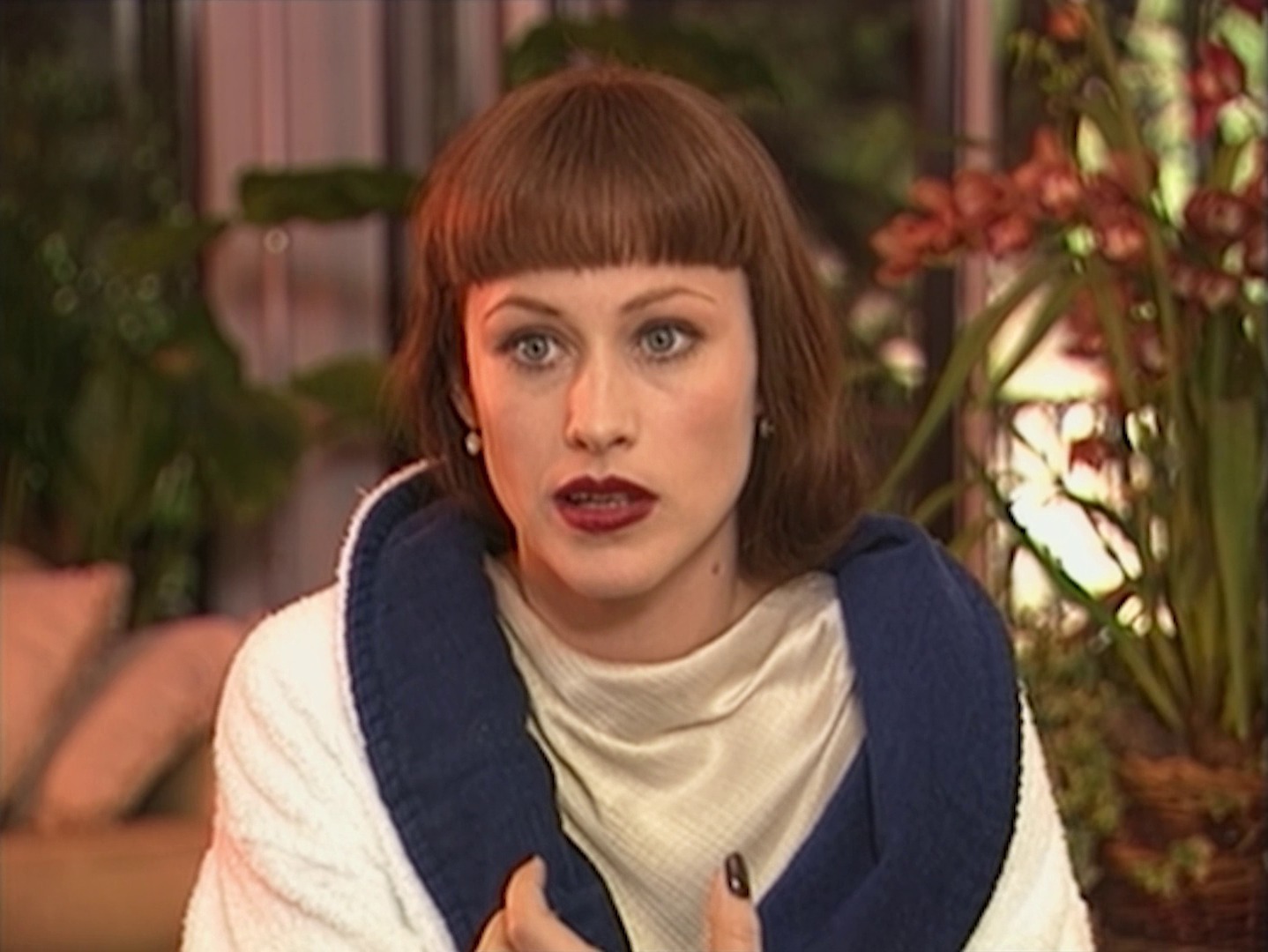
Patricia Arquette describes Renée and Fred’s marriage as a standoff: jealousy remains difficult to acknowledge, and Renée fears what Fred might do. Her account gives the stillness of the domestic scenes an active emotional basis. Silence becomes behaviour between two people, rather than an absence of performance.
Discussing Renée and Alice, Arquette recalls considering distinct voices, movements and ways of speaking. Lynch repeatedly told her that the women were the same person. She also raises the difficulty of playing a woman who may exist within a man’s imagination. Her testimony preserves the tension of the acting problem: the two appearances need recognisable differences, while their connection must remain alive.
Explore the image sequence · 2 stills
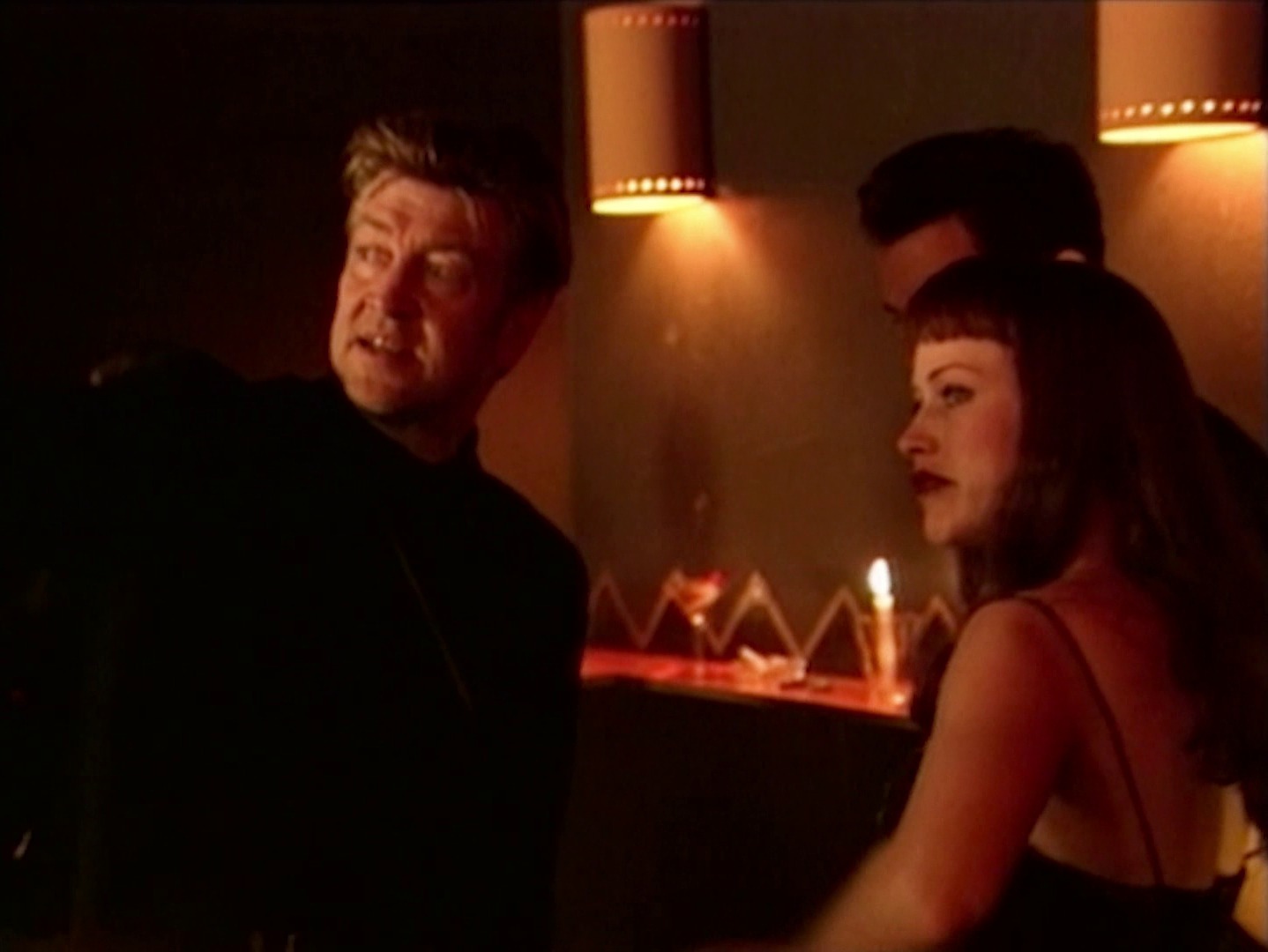
The Making of Lost Highway · 02:08–03:16 and 05:16–06:10 · Programme guide
Learning the horn, finding the rhythm
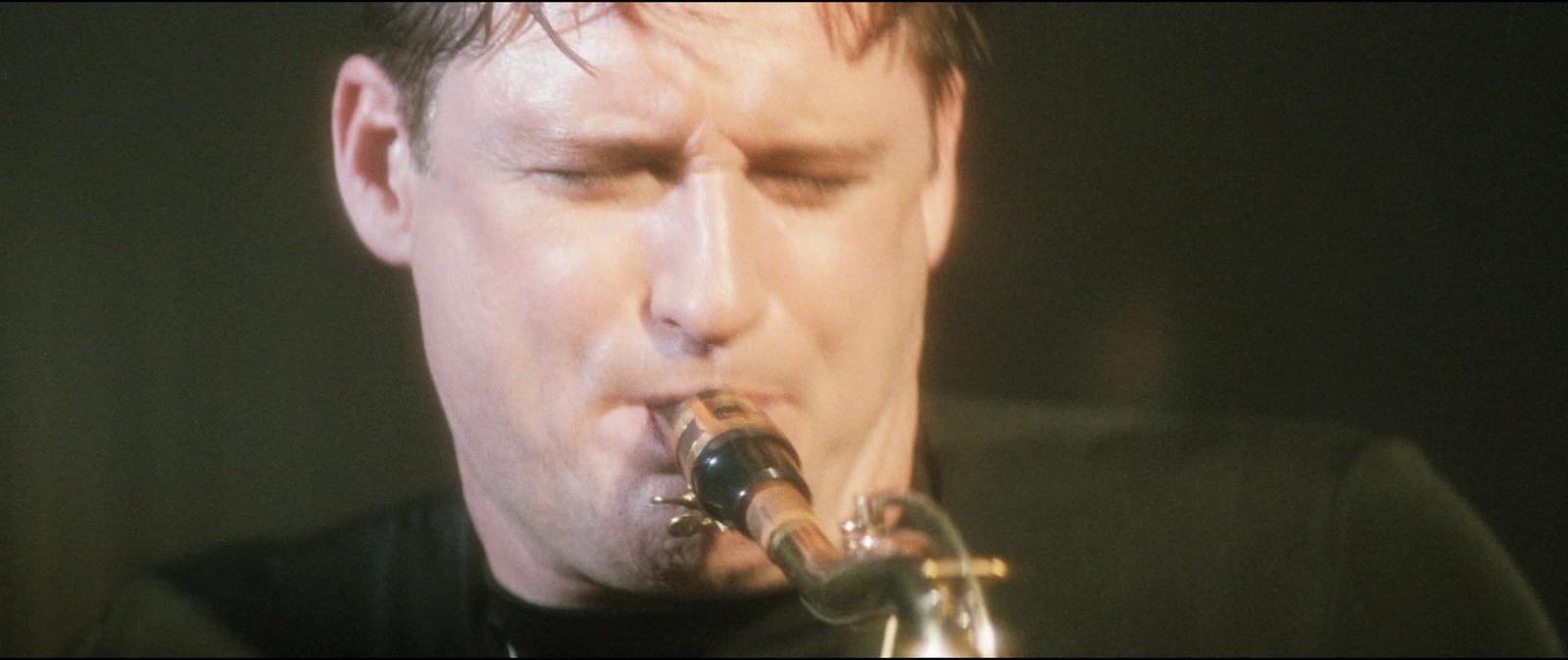
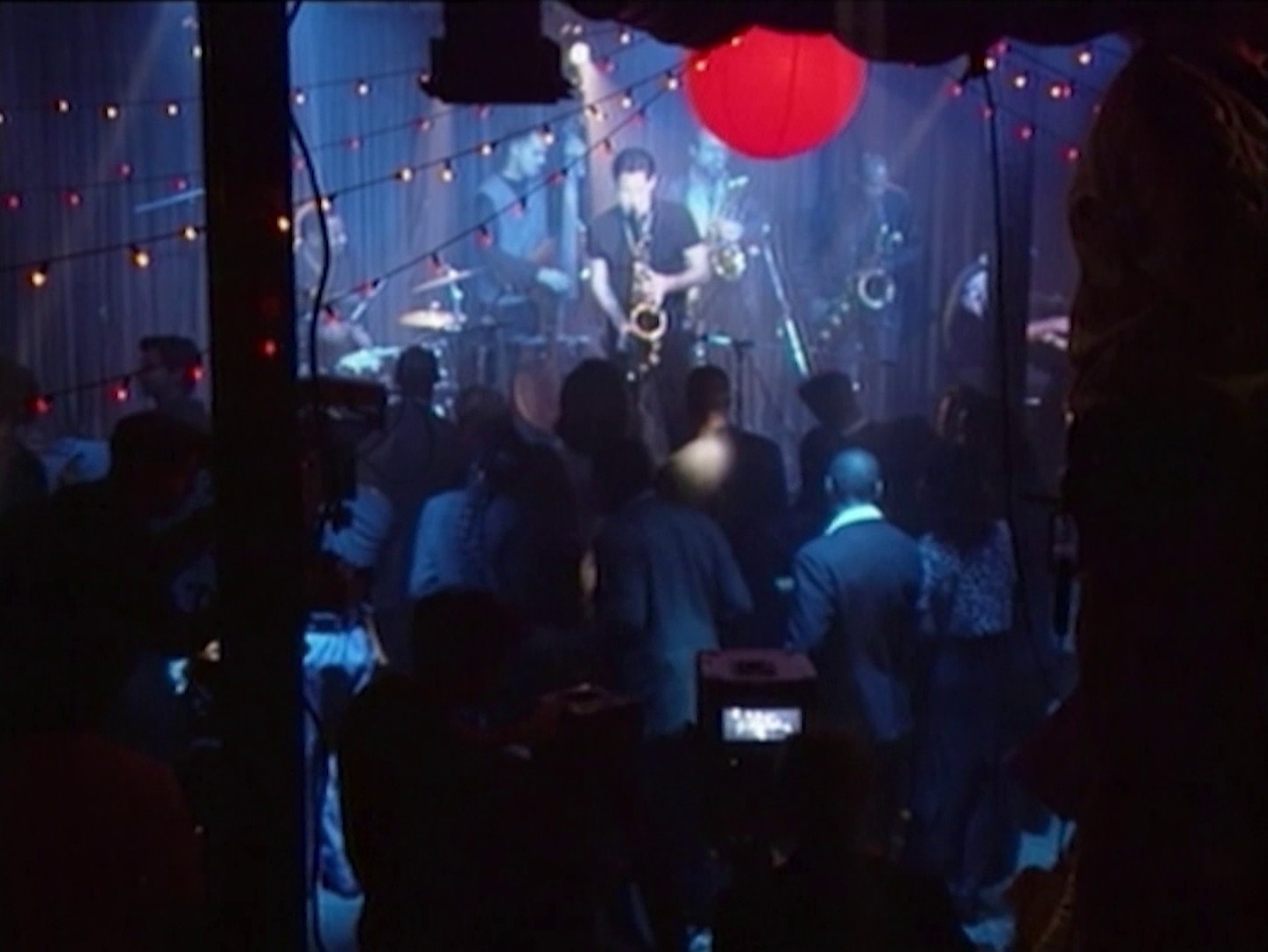
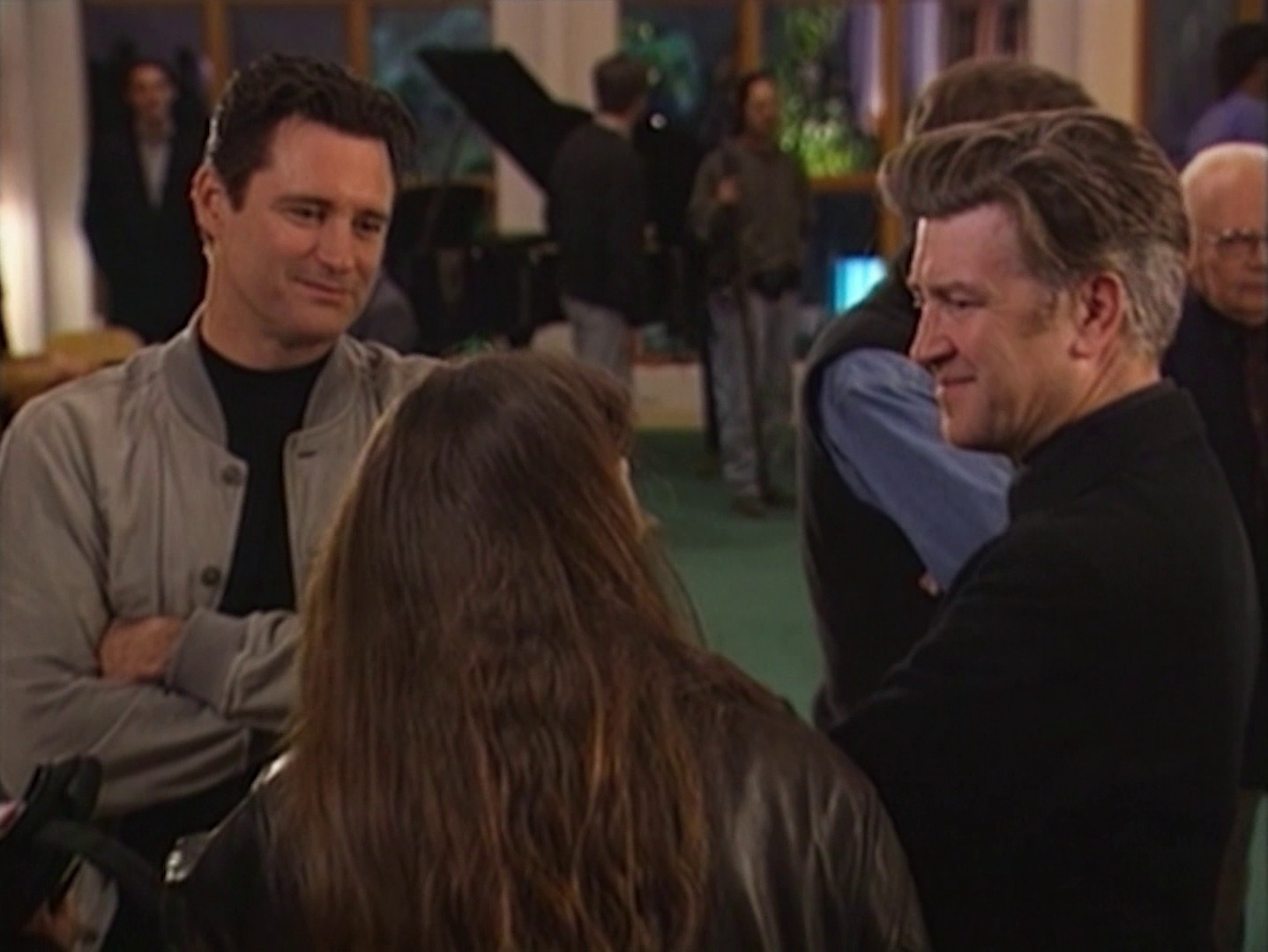
Pullman describes learning two demanding saxophone passages. Lynch adds that the actor took lessons, practised in front of a mirror and memorised the music’s individual notes. The preparation helps explain the conviction of Fred’s physical performance: breath, fingers, posture and sudden movement have work behind them.
Arquette describes another musical dimension of the shoot. Lynch listened to music while watching scenes, adjusted the performers’ pace and gave directions in terms of a rhythm that felt right. The supplement also shows the concert’s camera position and surrounding crew. The finished stage image brings these separate activities together: an actor’s preparation, a playback environment and the framing of an apparently spontaneous performance.
Explore the image sequence · 3 stills
The Making of Lost Highway · 09:39–12:30 · Programme guide
Mr. Eddy begins in a friendly place
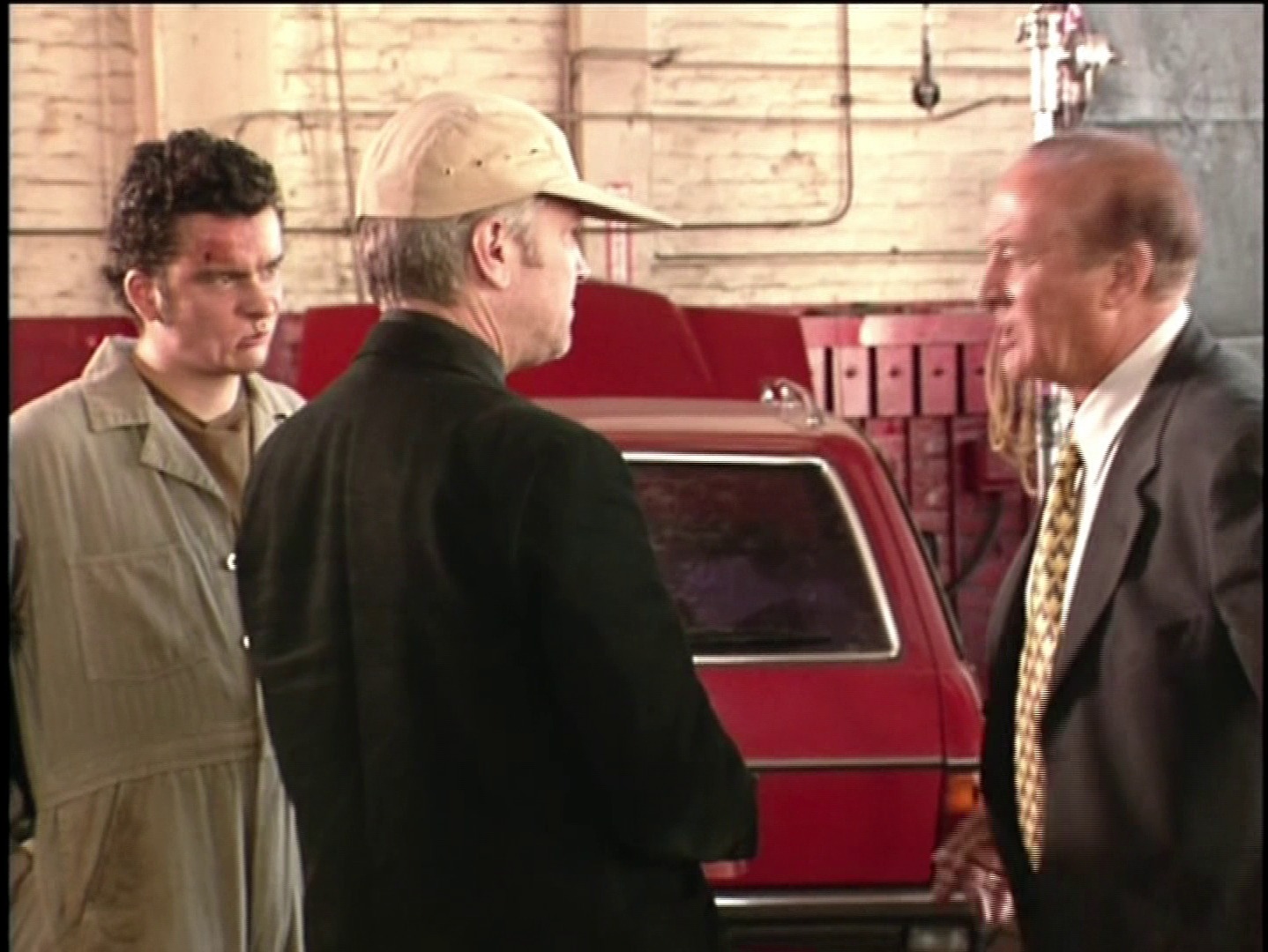
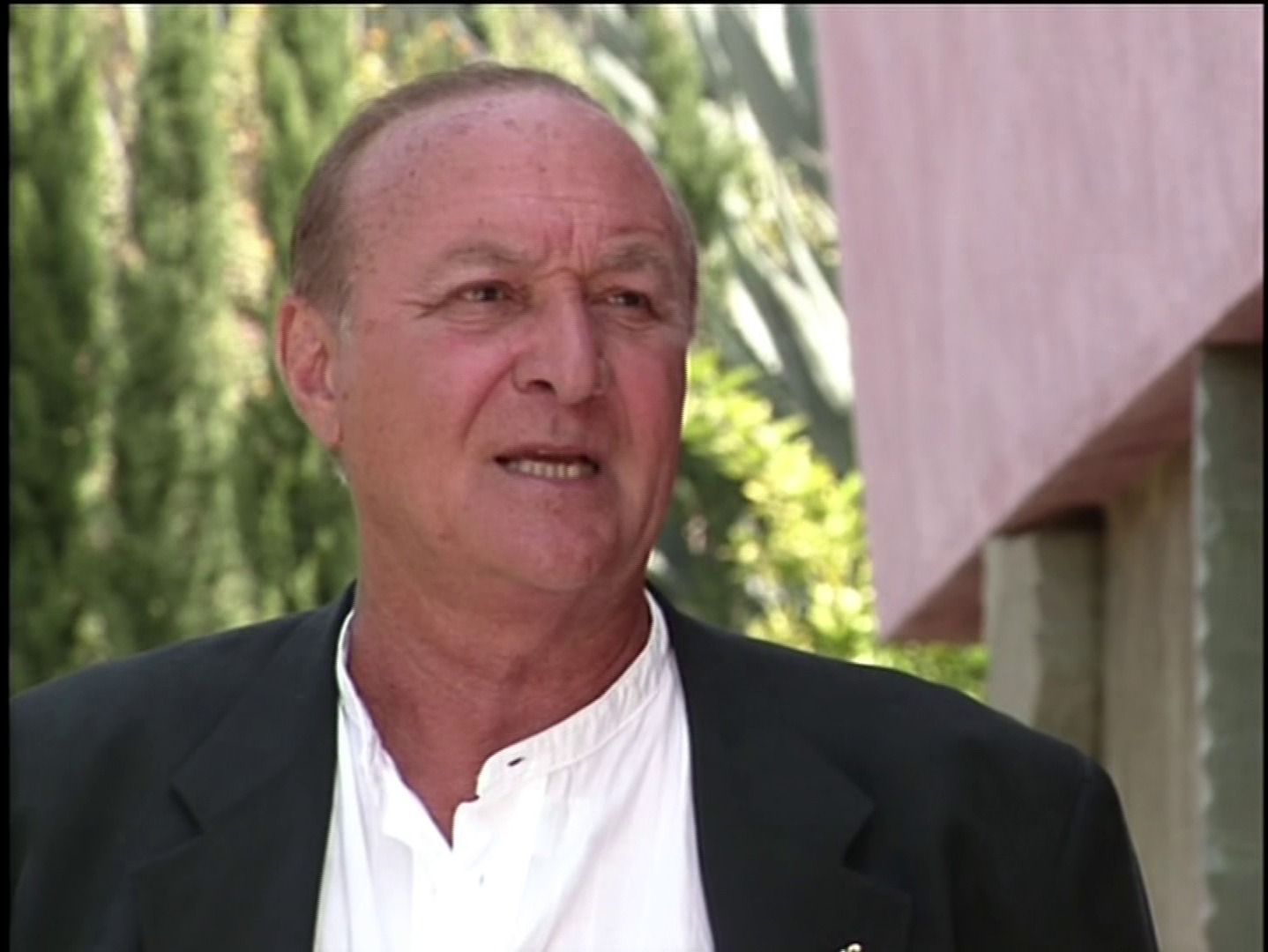
Robert Loggia recalls an angry meeting during the casting of Blue Velvet and believes that Lynch later drew on that memory when choosing him for Mr. Eddy. This is Loggia’s own explanation of the connection. The documentary then gives us something more immediate: Lynch directing his approach to Pete at the garage.
The instruction is to begin from friendliness because a threat will follow. On-set conversation and the finished exchange sit close together, allowing us to see how courtesy carries the aggression rather than simply preceding it. Mr. Eddy’s apparent generosity becomes the means of taking control of Pete’s movement.
Explore the image sequence · 2 stills
Pretty as a Picture · 52:36–56:16 · Programme guide
Performance and interpretation · Mr. Eddy in the scene guide
Room to Dream
The production remembered
The 2018 memoir brings a later layer of testimony: Kristine McKenna’s account, collaborators’ recollections and Lynch’s own reading. The passages below distinguish those voices from the contemporary production footage.
The script takes shape across a table
Kristine McKenna’s account places Lynch and Gifford at work in Berkeley in early 1995. Gifford recalls writing together in longhand; McKenna dates a second draft to March and the shooting script to 21 June. Later in the extract, Lynch remembers their first proposed ideas failing to interest each other before another fragment gave them a way forward.
The two voices describe a collaboration built through exchange. A borrowed phrase from Night People, an image of mysterious videotapes and the emerging characters do not arrive as a ready-made novel adaptation. They become a screenplay through the writers’ responses to one another. The memoir supplies a dated account of that process alongside the earlier interviews and reproduced script text.
Next Door to Dark, from Room to Dream · 03:28–04:51 and 39:08–40:07 · Programme guide
A hummingbird, a face, a pair of hands
McKenna relays two specific recollections from Balthazar Getty. For Pete’s encounter with his parents, Lynch asked him to imagine the wonder of a child seeing a hummingbird around his father’s head. For a hotel conversation with Alice, he asked Getty to sit on his hands. One direction supplies an unexpected mental image; the other removes a familiar means of expressing it.
Getty’s account makes the concentration on faces unusually concrete. A scene can change through the actor’s internal attention or through the restriction of a gesture. The extract also expands Pullman’s saxophone story: he recalls trying to learn from the session player whose recorded solo he had to embody. These are accounts of producing the performances, rather than explanations that close down the film’s identities.
Next Door to Dark, from Room to Dream · 09:24–11:23 · Programme guide
The actor’s working interpretation · Preparing Fred’s performance
The rehearsal changes the light
Peter Deming’s recollection, read by McKenna, begins with a correction. After lighting an apparently simple daytime conversation, he watched the first rehearsal and decided to start again: the exchanges carried a tension that the dialogue alone had not conveyed. Performance changed the photographic problem.
He also describes relighting Pete’s parents in their living room. Lynch rejected the illuminated interior lamps and wanted the scene to receive its light from outside. Darkness here is a decision about the room’s source of illumination, not a general instruction to make the exposure dim. The account gives a practical counterpart to the film’s recurring division between a visible face and a withholding space.
Next Door to Dark, from Room to Dream · 14:17–16:12 · Programme guide
The film returns
An image for the rerelease
A short trailer brings the telephone, the portrait and the Mystery Man together around the restored film.
The film becomes a small, unsettling screen
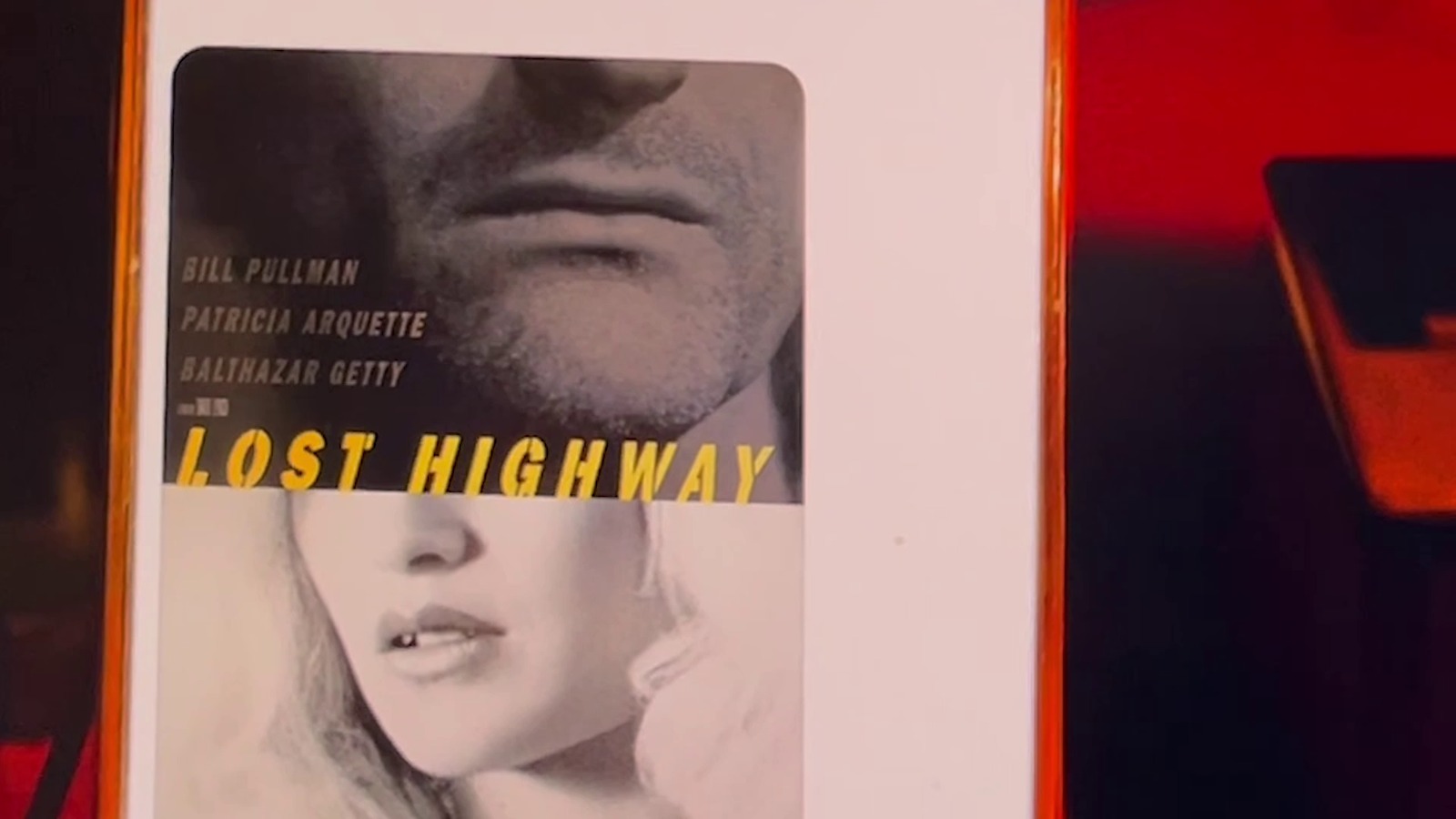
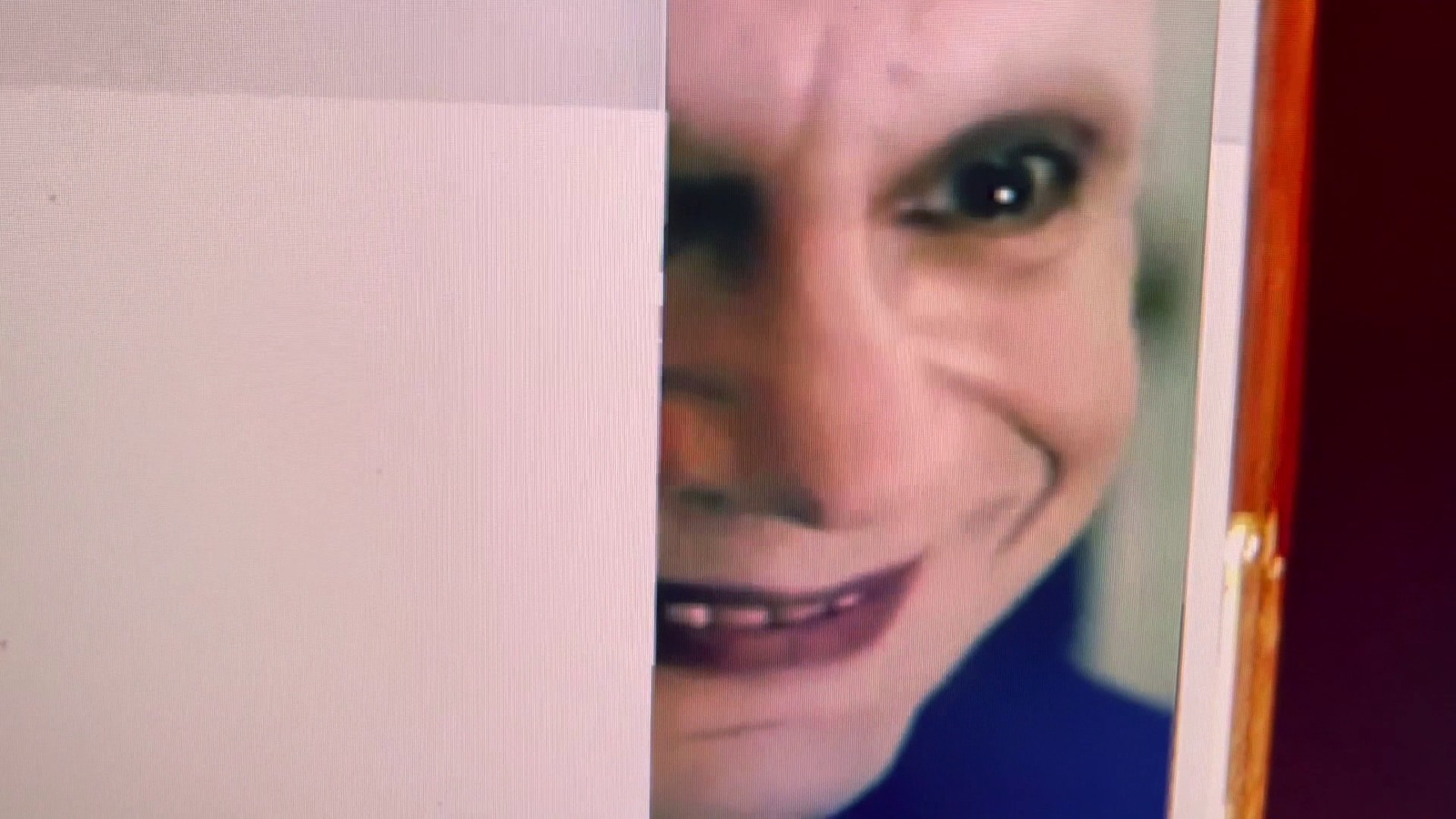
The rerelease trailer avoids a conventional succession of plot highlights. It approaches a phone displaying the poster, then introduces the Mystery Man’s face on the same small screen. The title’s split portrait and the smiling visitor become neighbouring images inside an everyday device.
The final cards announce a new 4K restoration and the forthcoming release. This is a distinct piece of marketing, with its own way of presenting the film’s threat: an image arrives in a personal screen space, echoing the feature’s concern with recordings and unwelcome access.
Explore the image sequence · 2 stills
Theatrical rerelease trailer · 00:02–00:53 · Programme guide
The Criterion supplements
Six ways into the working film
- Pretty as a Picture: The Art of David Lynch · Toby Keeler, 1997 · 1:20:39. Production footage, recording sessions and interviews connect Lost Highway with Lynch’s painting, furniture and earlier films. Enter the production studies →
- Pretty as a Picture: outtakes · 14:18. Further conversations include Lynch and Catherine Coulson on the Log Lady and Barry Gifford on Hotel Room.
- “Next Door to Dark” · 43:40. An audio extract from the 2018 memoir Room to Dream by David Lynch and Kristine McKenna. McKenna’s narration and quoted collaborators occupy the first part; Lynch’s reading begins around 27:57. Read the production memories →
- The Making of Lost Highway · 13:04. Archival interviews with Lynch, Patricia Arquette, Bill Pullman and Robert Loggia, intercut with the film and production footage. Performance and direction →
- David Lynch, 1997 · 11:26. The intercom incident, the writing partnership, the Madison house and working with actors. An interruption becomes a house →
- Theatrical rerelease trailer · 55 seconds. A compact presentation of the restored film built around its recurring telephone and faces. Explore the trailer →
Times attached to supplement studies refer to the named programme. The feature scene guide retains its original timeline; the new transformation galleries identify their Criterion feature times. The Criterion edition record identifies the Lynch-approved restoration, 5.1 soundtrack and alternate stereo track. The disc’s supplements are distinct from the earlier Tim Lucas commentary discussed in this dossier.
Follow the documentary across the archive
- Blue Velvet: Stockwell’s approach to Ben
- Dune: Stockwell remembers the invitation
- Twin Peaks: the Log Lady, the coffee and BOB
- Hotel Room: Gifford’s hotel childhood
- Short films: building Premonitions Following an Evil Deed
- Music: Chrystabell’s first studio meeting
- Art: texture before explanation · Furniture: a table for Fred Madison
- Unmade projects: Lynch on Dream of the Bovine
A title borrowed; a story written together
In his February 1997 Museum of the Moving Image conversation, Lynch located the title in Gifford’s Night People. Later, the two began developing a new screenplay together. Unlike Wild at Heart, this was not a straightforward adaptation of Gifford’s novel. Lynch’s contemporary account ↗
Gifford’s 2008 recollection dates the invitation to 1995 and describes a shared starting point: an unexplained change of identity and videotapes whose sender is unknown. He recalls working across a table from Lynch, and invokes Double Indemnity and Orpheus and Eurydice as points of reference. These are the co-writer’s later bearings, not a compulsory code for interpreting the film. Gifford on their collaboration ↗
The available IMSDb text contains an introductory statement dated 21 June 1995. That date belongs to the reproduced introduction; it does not authenticate the whole transcription. Its opening moves from a headlight-lit road to Fred’s bedroom and the intercom. The detectives’ later visit gives Fred a preference for his own recollection over a camera’s record. Inspect the online text ↗
These are two different forms of exposure. The intercom brings an uninvited voice into the house; the tape makes the house available to an unseen observer. Fred’s resistance to recording therefore has a practical setting before it becomes a theory about the whole narrative. A machine can be operated from inside the home while its information comes from somewhere the occupants cannot locate.
Lynch also described the script as a compact guide to ideas that acquire their full form in filming and editing. Script and realization ↗ That distinction prevents a tempting shortcut: an action missing from one online draft is not automatically an improvisation, and a written action is not proof that footage survives. The completion pass needs an authenticated text and a full, edition-specific comparison.
From the writing table to a working set
Set observer Roland Kermarec places shooting from late November 1995 to early March 1996, while saying some material preceded his arrival. His broad recollection is useful, but it is not a day-by-day production report. He describes a Madison-house passage acquiring smoke, altered picture-hanging and a fire as Lynch developed it on set. Kermarec’s set account ↗
That testimony gives a concrete meaning to “remaining open to ideas.” A scene can change through the placement of a familiar object or the atmosphere around an actor, without requiring a new plot event. The research question is how those choices accumulated: which were prepared in advance, which were tested during shooting, and which acquired their final force in the cut.
Swipe the table sideways to compare every column.
| Moment | Evidence | Limit |
|---|---|---|
| 1995 writing | Gifford’s later account; a June date in the online script introduction. | Neither establishes the custody or revision history of a production draft. |
| Late 1995–early 1996 shooting | Kermarec’s account of his time on set. | Principal-photography period. |
| 1996 sound work | Harper recalls working at Digital Sound and Picture. | No original session logs inspected. |
| 21 February 1997 | AFI lists the Los Angeles opening. | City theatrical opening. |
AFI release record ↗ · Harper’s work account ↗
The credited team includes cinematographer Peter Deming, production and costume designer Patricia Norris, and editor Mary Sweeney, also a producer alongside Deepak Nayar and Tom Sternberg. Principal craft credits ↗ The film’s atmosphere is best understood through these overlapping responsibilities: costumes occupy designed rooms, light makes their surfaces legible, and cutting determines how long we can look.
A house that withholds its information
Stephen Pizzello’s March 1997 production report distinguishes Norris’s spare Madison interior from the mansion’s more extravagant décor. Deming describes browns, yellows and reds, filtration and laboratory timing. For the dark hallway, the location was modified, windows blacked out and reflections controlled so Pullman could disappear into the passage. Design and lighting testimony ↗
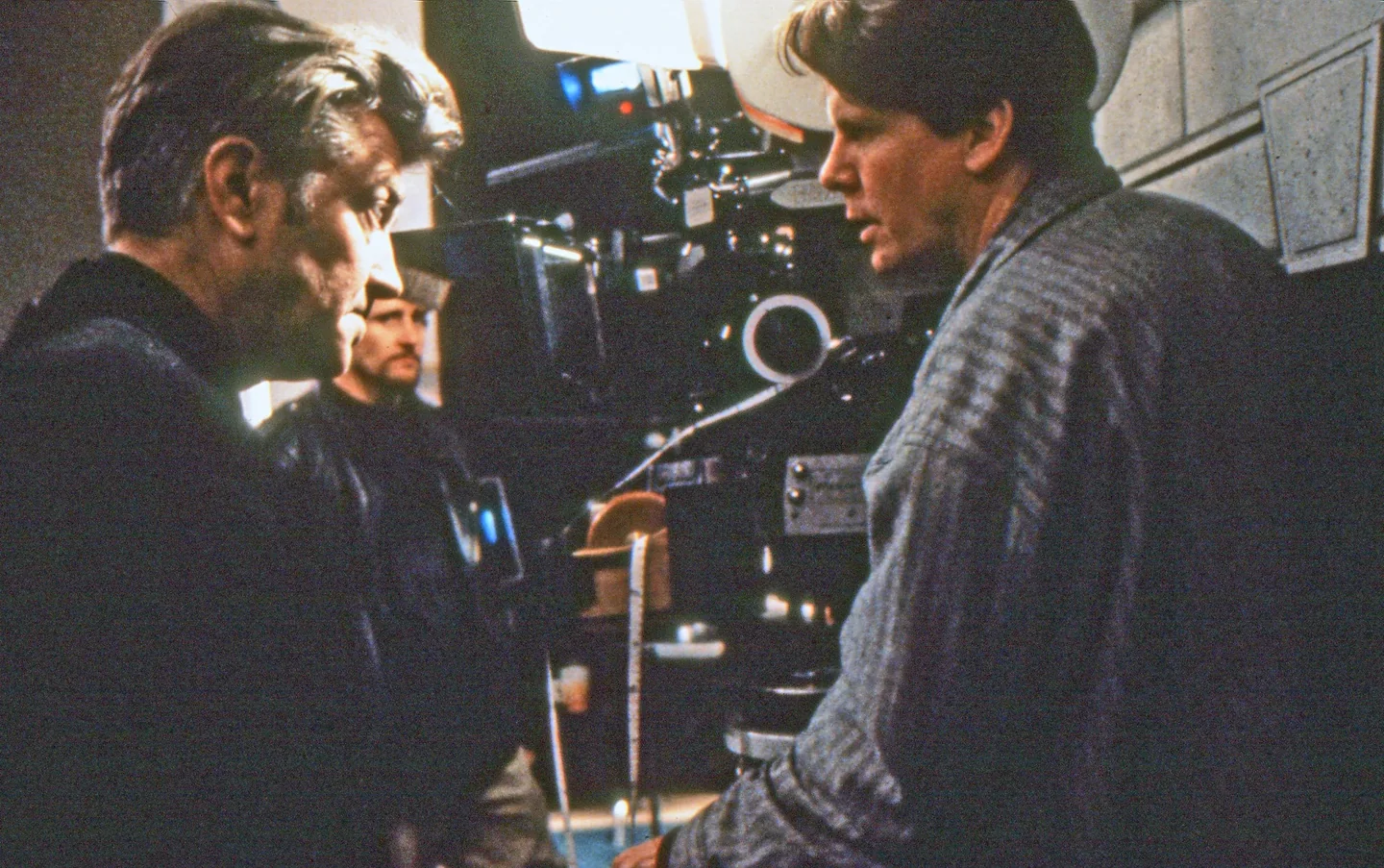
The hallway makes a physical threshold into a limit on knowledge. An open doorway usually promises access; here, access does not guarantee visibility. The practical work behind the image matters because the uncertainty is deliberately shaped. It is not simply the absence of enough light.
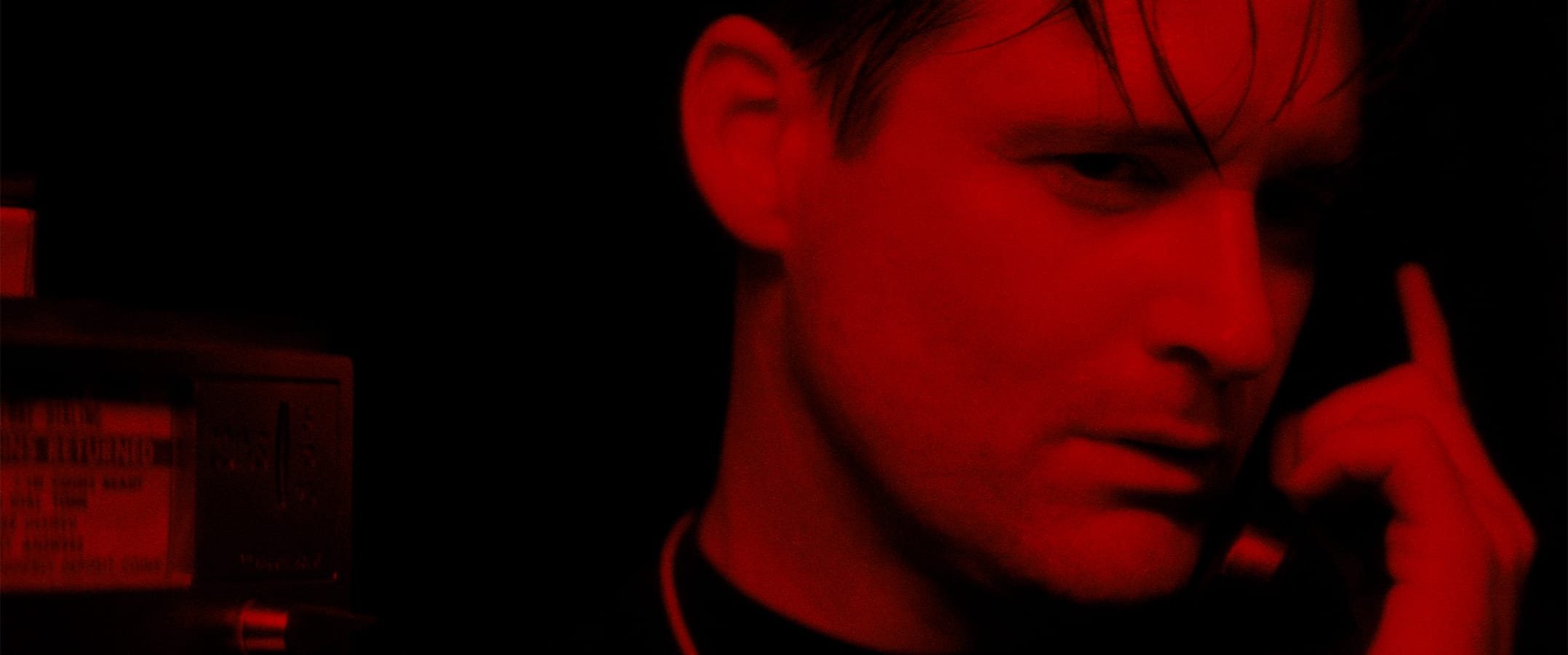
The red telephone image above offers another useful distinction. The hand, receiver and face identify a familiar action, while the light separates that action from ordinary domestic reassurance. Color need not have a fixed symbolic translation to change how a person appears to inhabit a room.
Deming also describes detaching and moving the lens to push the prison image beyond ordinary defocus, and overexposing the desert lovers with simulated headlights. Optical and exposure effects ↗ Darkness and brightness therefore require separate attention. Losing detail in shadow and losing it in glare can both frustrate recognition, though they produce very different sensations.
For comparison, Mulholland Drive’s camera study follows related questions of revelation and concealment. A shared collaborator or visual concern does not require the two films to obey the same narrative rules.
An actor’s interpretation is a working instrument
Bill Pullman plays Fred Madison, Balthazar Getty plays Pete Dayton, and Patricia Arquette plays Renée and Alice. Robert Blake’s Mystery Man and Robert Loggia’s Mr. Eddy/Dick Laurent complicate the relationships further. Cast record ↗ These credits identify performances; they do not settle the identities inside the story.
In Pauline Adamek’s interview, first published in March 1997, Pullman describes approaching the transformation as an escape from a condemned man’s situation into a younger person’s life. He also recalls a filmed sentencing scene and repeated high-angle scrutiny that did not survive in the form he remembered. Adamek reports differing interpretations among the actors. Pullman’s account ↗
His explanation is valuable because it shows what could sustain a performance from moment to moment. It is not an instruction that every spectator must adopt his model. A performer can work with a strong private account while the finished film leaves contradictory possibilities available.
Arquette’s double casting requires a different kind of attention. Renée and Alice can be compared as performances before being reduced to alternatives in a puzzle. Reserve, apparent invitation, pauses and the responses of the men around them all matter. The unresolved question is whether the film allows us to encounter a woman’s experience, or repeatedly returns us to a man’s attempt to define her.
That question also changes how we read fear. Fred’s distress may make his experience vivid without making his assumptions reliable. Sympathy with a performer’s vulnerability does not oblige us to accept the character’s judgments about another person.
The transformation was also a problem of cutting
In 2022, Sweeney recalled editing Lost Highway on film. The climactic effects required extremely short cuts—sometimes one, two or three frames—with practical constraints imposed by negative cutting. She describes trying to preserve a subjective emotional experience while concealing the mechanics of prosthetic material. Sweeney on the cut ↗
That testimony redirects attention from “How was the effect made?” to “How did separate pieces become an experience?” A photographed effect can look unconvincing when held too long and become disturbing when encountered at the edge of recognition. The interval between images can be as consequential as the material inside them.
Pizzello’s report records practical transformation imagery and a cabin burn photographed with several cameras, including reverse-running work. The production combines physical effects with photographic manipulation to make the film’s changes of identity and space tangible. Effects photography ↗
Sweeney also remembers a long master shot for the detectives’ bedroom visit, with humor and menace occupying the same space. Rhythm in the bedroom scene ↗ Her description concerns available footage and editing choices, not a measured duration of the finished scene. The contrast is productive: patient observation and fragmented physical crisis belong to the same film, but ask different kinds of attention from the viewer.
An intercom click can make the room unsafe
Lynch’s 1997 conversation describes sound work beginning immediately in post-production, with a recorded shot-by-shot discussion guiding the gathering of material. He also describes using music while filming. Sound as an early working process ↗ Sound therefore enters both the atmosphere of performance and the later construction of what an audience hears.
Foley artist Catherine Harper recalls receiving a recording of Lynch and supervising sound editor Frank Gaeta’s spotting session. Instead of proceeding mechanically through footsteps and props, the team prioritized particular sounds. Her examples include the exposed intercom click and prison footsteps and keys recorded with added ambience. Harper on Foley decisions ↗
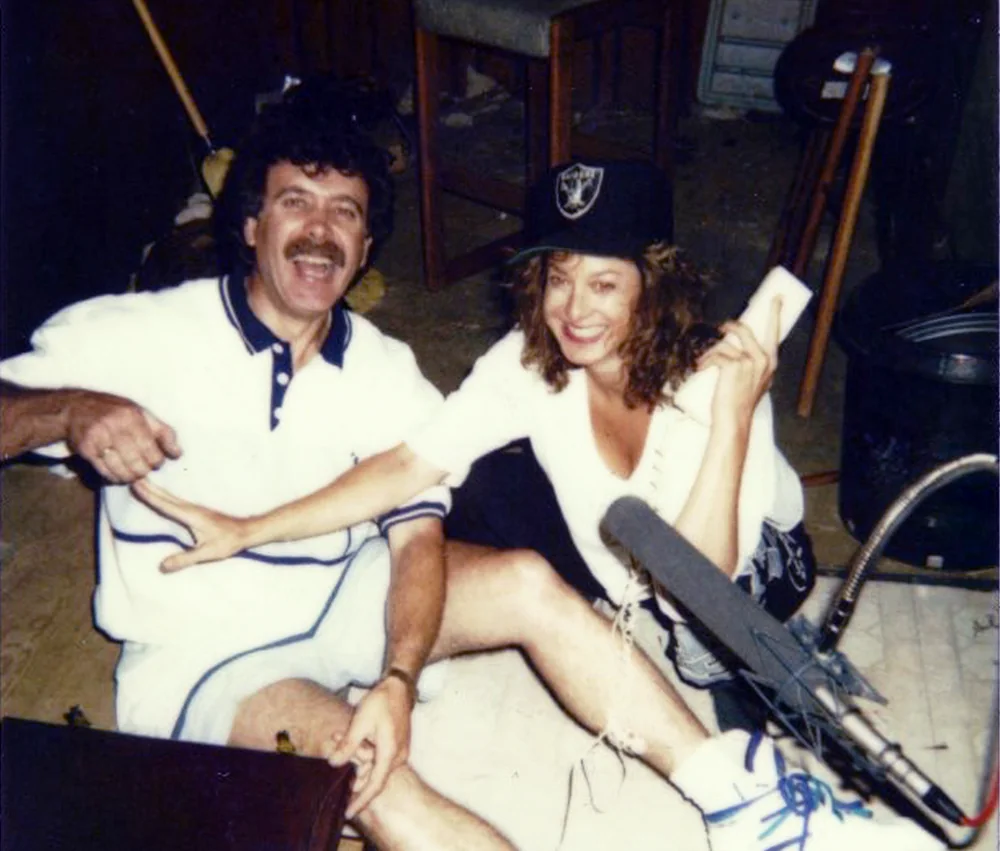
These examples make a useful distinction between loudness and prominence. A small sound can dominate when the surrounding field gives it space. A step can communicate a surface, a distance and a person’s movement at once; added reverberation can make that movement feel enclosed or exposed. The eventual listening record needs to describe those relationships, not just identify a noise.
Score, songs, sound design and the album
The BFI credits distinguish Badalamenti’s composition and conducting, Adamson’s additional music, Lynch’s sound design and the work of re-recording mixers John Ross, Frank Gaeta, Derek Marcil and Lynch. BFI craft credits ↗ The official Nine Inch Nails album record separately identifies Reznor as soundtrack producer. Official album record ↗
Swipe the table sideways to compare every column.
| Material | Published evidence | Use in this dossier |
|---|---|---|
| Badalamenti and Adamson | Score and additional-music credits. | Keep their roles distinct from album production. |
| Reznor / Nine Inch Nails | Album lists Reznor’s “Driver Down” and Nine Inch Nails’ “The Perfect Drug.” | An album track list is not a film cue sheet. |
| Bowie and Lou Reed | Album lists “I’m Deranged” and “This Magic Moment.” | Song and soundtrack references. |
Sweeney recalls visiting Bowie’s studio with Lynch to obtain separated musical elements of “I’m Deranged,” allowing components to enter gradually around the ending. Working with the Bowie recording ↗ That is a specific production memory to test against an identified audio track; it is not a substitute for listening to the complete mix.
Listening route: begin with the door and intercom, continue through the surveillance tapes and prison, then compare the desert and final drive. Record when a source becomes visible, when a sound crosses a cut, and when an apparently empty space remains acoustically active.
Giving an impact its physical detail
Harper’s account supplies a particularly specific example at Andy’s glass-table death. She recalls trying to satisfy Lynch’s request for air and blood at the impact, then creating the effect with swallowing and expelled air recorded using an ECM omnidirectional microphone positioned in the ear. She also describes the roadside assault’s gritty footsteps and final blood accent. These are her recollections of constructing the sounds, not conclusions drawn from the picture alone. Harper’s account of the effects ↗
Sound and dialogue collaborators in the closing credits
The closing roll makes the division of work more precise than a single sound-design credit. The following names were checked directly in the copy examined here.
- Sound design
- David Lynch
- Supervising sound editor
- Frank Gaeta
- Rerecording mixers
- John Ross, Frank Gaeta, Derek Marcil and David Lynch
- Supervising dialogue editor
- Thomas Jones
- Dialogue editors
- David Grant, Louis Creveling, Paul Longstaffe and Susan Shin
- Music editor
- Marc Vanocur
- ADR supervisor / mixer
- Tim Boggs / Derek Marcil
- Foley mixer
- Mary Erstad
- Foley artists
- Ossama Khuluki, Catherine Harper, Christopher Moriana and Ellen Heuer
Credits establish responsibilities across the film. They do not, by themselves, identify who created each individual cue.
Dialogue & song
Words that cross from one life to another
A greeting returns to another listener. A story about a job changes its speaker. A death announcement becomes an action. Fourteen studies follow the dialogue through both lives, alongside the songs that complicate the film’s promises of escape.
Times locate passages in the copy examined here. Explore four song passages or open the index to choose an exchange.
Choose from 14 dialogue studies
A message becomes an action
The announcement of Dick Laurent’s death changes function each time it returns. At the house, it arrives as unexplained information. At Andy’s party, Fred repeats it as a question and discovers that he cannot say how he knows. Near the ending, he delivers it himself. The repetition connects receiving, doubting and producing a statement. It gives the narrative a precise verbal return without explaining how its chronology works.
A simple answer becomes an interrogation
Renée says she will stay home and read rather than go to the club. Fred repeats her answer and asks what she will read. Nothing in that exchange establishes an affair; what it establishes is the pressure placed on an ordinary explanation. Her remark about still being able to make him laugh briefly returns the conversation to their marriage. The scene introduces suspicion through the way an answer is pursued, before any tape offers apparent evidence.
A familiar voice, an unfamiliar person
Fred recounts a dream in which Renée calls for him inside the house. He cannot find her, then describes a figure who looks like her but is not her. Later, her questions about his whereabouts return in the darkened home. The recurrence joins a narrated dream to a subsequent domestic scene. It is more specific than a general atmosphere of unreality: calling someone’s name no longer guarantees that the person found will be the person expected.
The musician who distrusts recording
Before the famous statement about remembering events in his own way, Fred identifies the other bedroom as a soundproof practice room and names the tenor saxophone as his instrument. The police move from where the couple sleep, to music, to cameras and the alarm. These practical questions locate Fred’s preference for memory inside a household inquiry. He depends on controlled sound for his work while rejecting a recorded account he cannot control. The exchange also lets Renée speak for him when she explains his dislike of cameras.
The telephone turns a claim into a test
The Mystery Man first asks Fred to recognize a previous meeting, then claims to be at Fred’s house while standing in front of him. Rather than merely insist, he gives Fred a telephone and asks him to call his own number. The conversation divides a single encounter between a visible person and a remote voice. His assertion that Fred invited him in makes access to the house a disputed act of consent. Fred’s request for an identity receives no explanatory answer.
A denial gives way to the sentence
Fred’s denial is followed by a request for someone else to tell him that he did not kill Renée. The distinction matters: a declaration becomes a demand for reassurance. The subsequent jury verdict and death sentence compress legal procedure into speech as the film enters the prison passage. The existing interview record describes filmed sentencing material that did not survive in the form Pullman remembered; that should not be confused with the absence of sentencing dialogue from the finished presentation. The guards’ hotel-like welcome adds a cruelly ordinary register to the new confinement.
Naming the stranger does not explain him
The officials first establish that the prisoner is not Fred Madison. A record then supplies Pete Dayton’s full name, age, previous arrest and family address. Bureaucratic language restores an identity without accounting for the substitution. Sheila later asks what has happened to him and whether he still cares about her. Her questions concern continuity of feeling and behavior rather than the name on a record. Both encounters recognize Pete, yet neither can make his missing history secure.
The useful ear and the rejected music
Mr. Eddy brings Pete a problem described in acoustic terms: something in the car does not sound right. He praises Pete’s ears after the adjustment. This gives the younger man an expertise that can be read alongside Fred’s musicianship, even though their occupations differ. Later, a dispute at the garage turns on Pete changing music that another worker likes. The dialogue moves from hearing as useful knowledge to hearing as something Pete wants to refuse. Identifying a precise musical reprise requires a separate cue comparison; the verbal contrast already matters.
The language of safety becomes a threat
Mr. Eddy makes his assault into a driving lesson, invoking stopping distance, road deaths and a demand to study the manual. These figures belong to his speech, not to a verified road-safety argument. The insistence on protecting lives accompanies a violent demonstration of his own authority. His apology to Pete afterwards attempts to restore the social ease of the ride without acknowledging the contradiction. The roadside episode prepares the later visits in which apparent friendship and a weapon occupy the same conversation.
The family knows more than it will say
Pete’s parents say they will tell the police nothing about the night, then admit that they saw him with Sheila and another man. His inability to remember and their decision not to speak are different problems. Later, Sheila calls him changed and urges his father to tell him. The film distributes knowledge unevenly among people who recognize the same person. It does not name the unknown man in these exchanges, so the gap should remain open rather than be filled by an assumed identification.
Renée’s brief story returns as Alice’s account
Both women describe meeting a man at Moke’s, becoming friends and hearing about a job. Renée’s answer stops at an inability to remember the job; Alice’s continues into an account of waiting, guards and coercion. Pete then asks why she did not leave and whether she liked it. His questions turn her account into an accusation. The repeated verbal pattern connects the two roles, but it does not make his suspicion reliable or convert coercion into consent. The difference between the two accounts deserves as much attention as their resemblance.
Concern becomes a rehearsed threat
Mr. Eddy repeatedly asks whether Pete is doing well, then passes him to the Mystery Man. The greeting about having met before reprises the party exchange with Fred; the follow-up story describes a condemned person unable to know when execution will come. That account is the character’s threat, not a factual description of a culture or penal system. Mr. Eddy resumes the language of concern afterwards. Together, the speakers turn a familiar telephone courtesy into a reminder that Pete can be reached and frightened at home.
Changing a pronoun changes the partnership
After Andy’s death, Pete speaks of shared responsibility and Alice assigns the killing to him. The move from “we” to “you” breaks the partnership that their escape plan had promised. Moments later, Pete asks whether both women in the photograph are Alice. She identifies herself without explaining the double appearance. In each exchange, an answer narrows what she acknowledges while leaving the larger problem unresolved. The photograph therefore continues a dispute already taking place in words.
Desire ends in a demand for a name
Pete asks why Alice chose him; she redirects the question toward whether he still wants her. His repeated declaration of wanting her culminates in her refusal to be possessed. When Fred reappears, the Mystery Man rejects the name Alice, supplies Renée and demands Fred’s own name. The sequence moves from desire to naming without making either a secure form of knowledge. Read beside the final police identification of Renée and the returning intercom message, it makes identity something people assert, contest and enforce throughout the film.
Songs as competing accounts
The film’s closing titles identify the recordings below; the English SDH captions locate their words in these passages. The times are reading landmarks, not exact cue boundaries.
I’m Deranged
David Bowie’s recording, written with Brian Eno, frames the returning road. The recurrence makes the ending a return to an already established musical identity as well as a visual one. Sweeney’s account of obtaining separate elements of the recording explains how the ending could be assembled from within a song, rather than simply placing a complete record over the picture.
Sweeney’s production account →This Magic Moment
Lou Reed’s version accompanies Alice’s arrival in Pete’s field of attention. The song supplies a ready-made account of romantic recognition before the two introduce themselves. Its promise belongs to the attraction; it does not establish that Alice is safe, available or understood. The later dialogue about escape exposes how much the apparent recognition has left unknown.
Alice at the garage →I Put a Spell on You
The credit names Jay Hawkins as writer and Marilyn Manson as performer. Set within Alice’s account of coercion, the song’s possessive language complicates the seductive presentation of the scene. It should not be treated as Alice’s own testimony or used to validate Pete’s accusation that she enjoyed what happened. Song, staged memory and the listener’s response remain distinct.
Compare the two accounts →Song to the Siren
This Mortal Coil’s recording is credited to writers Larry Beckett and Tim Buckley. Its movement between invitation and withdrawal meets Pete’s repeated desire and Alice’s refusal. The song gives the desert encounter a language of attraction that cannot be fulfilled by simple possession. Fred’s reappearance and the demand for his name then replace the lovers’ exchange with another crisis of recognition.
The recording also carries an earlier, unrealized association. In the Room to Dream extract included with Criterion’s Blue Velvet, Lynch recalls wanting “Song to the Siren” for that film but being unable to afford it; “Mysteries of Love” emerged from the search for another solution. He then identifies Lost Highway as the film in which he finally used the recording. This is Lynch’s retrospective account of the song’s route between projects, distinct from the function it acquires in Pete and Alice’s desert scene. Lynch’s account, 08:50–10:46 →
Desire and the demand for a name →The album is a different object. This Mortal Coil’s recording appears in the film’s credits but is absent from the official 23-track soundtrack reissue list. The film also credits Reznor’s Driving Theme and “Various Ominous Drones,” the latter created with Peter Christopherson; the album uses titles including Driver Down and Videodrones: Questions. These credit and naming differences should remain visible rather than be silently converted into an exact cue sheet.
Review scope and sources
The complete English soundtrack was processed locally with speech recognition and checked against all cues in both embedded English subtitle tracks. Fourteen selected passages received a second recognition pass using the centre channel. The commentary received a separate complete-track recognition pass. Unreliable words, invented repetitions and timing drift were excluded; no automatic transcript is presented here.
This is a machine-assisted dialogue review, not a continuous direct-listening assessment. Vocal delivery, exact music and effect boundaries, spatial placement in the surround mix and comparisons with other releases remain unverified. Song passages combine the SDH text with the examined images and closing credits; production claims are attributed separately to their published sources.
A critical companion
Tim Lucas’s separately released commentary
The additional track identifies its speaker as novelist and critic Tim Lucas, who introduces his account as a personal interpretation. In his 1 July 2019 publication note, Lucas explains that the commentary was prepared for Kino Lorber’s release, then omitted along with planned supplements because of contractual restrictions. He subsequently made it available separately.
Lucas repeatedly connects the film’s recording devices with intrusive observation. His reading of the party encounter treats the Mystery Man’s claim to occupy two places as a possible model for Fred’s imagined escape from responsibility. He also draws attention to repeated situations across the two lives, rather than relying only on the substitution of actors. These are useful questions to carry back to the telephone exchange and identity discussion; they remain a critic’s interpretation rather than the film’s authorized explanation.
The witness, the image and the preferred story
The photograph, twice
The mansion photograph and the detectives’ later view contain different groups. Compare the images before choosing an explanation for the change.
Compare the two photographs
Open the structural discussion — spoilers
A loop is present in the inspected text. The transcription begins with an unidentified intercom announcement and ends with Fred delivering that announcement before a pursuit. The closing directions combine a changing face, a scream and a siren. This establishes a written return, not a complete comparison with the released film. Opening and closing passages ↗
The return changes the status of information. What first arrives as news later becomes an action. A theory of the film must explain not only the repeated words but the change from receiving a message to producing it. Calling the structure a loop names its shape; it does not by itself account for responsibility, desire or fear.
The transformation into Pete offers one possible escape from Fred’s situation, as Pullman’s account suggests. Yet an escape reading must still confront the people, objects and evidence that connect the two stretches of the story. It should not make inconvenient details vanish merely because it supplies an emotionally satisfying answer.
The recording devices introduce another difficulty. An image may challenge a character’s memory without becoming a transparent guarantee of truth for the audience. We still need to ask who could make it, what access it presupposes and how it is presented. A photograph, a videotape and a person’s recollection do not become equivalent simply because each provides information.
Warner’s contemporary essay treats doubling and unstable identity through a wider imaginative frame than an individual diagnosis, while also questioning the film’s unequal allocation of interiority. Warner’s argument ↗ That criticism prevents the mystery from swallowing the ethical question: whose experience is being represented, and who is being turned into an image for someone else?
A psychological reading, a supernatural reading and a reading about cinema can illuminate different features. None earns priority merely by sounding definitive. This dossier keeps the distinction between what a character claims, what a source reports and what an interpretation proposes. No clinical diagnosis is offered as the film’s authorized solution.
The most rewarding question may be what an explanation makes us stop noticing. A convincing reading should bring us back to performances, spaces, images and sounds with more attention, rather than replace them with a plot diagram.
A runtime is a record, not a verdict on cuts
Criterion lists a Lynch-supervised and approved 4K restoration, a new 5.1 DTS-HD soundtrack and alternate uncompressed stereo. The UHD includes Dolby Vision HDR. Its inventory also lists Toby Keeler’s Pretty as a Picture, archival interviews and booklet excerpts from Lynch on Lynch. Edition and supplement inventory ↗
Swipe the table sideways to compare every column.
| Record | Listed duration | What it establishes |
|---|---|---|
| BBFC cinema, classified 10 February 1997 | 134 min 4 sec | A dated cinema-submission record. |
| BBFC video, classified 26 June 1998 | 128 min 29 sec | A separate physical-media entry. |
| BBFC video, classified 29 April 2002 | 128 min 49 sec | Another submission, not a measured scene comparison. |
| BBFC video, classified 30 August 2006 | 128 min 40 sec | A Cinema Club home-entertainment record. |
Inspect the classification entries ↗ The page also contains trailers and bonus material; those durations are not feature runtimes. Playback speed, logos and timing conventions can affect totals. These entries alone do not establish whether any scenes differ. That requires actual editions and comparison at a known timebase.
The BFI programme labels the production 1996; Criterion and AFI use 1997. A production-year label and a release-year label can differ without describing different cuts. We retain the discrepancy and use 1997 for this dossier’s public film heading.
The word “alternate” also matters. An alternate stereo track should not be called the original theatrical stereo mix without evidence of its provenance. Nor can a restored image be assessed merely by reading that it was approved: black levels, framing, color and compression need direct comparison.
The disagreement was already there in 1997
Kim Newman’s September 1997 review finds the Fred-centered opening more powerful than the Pete section, while praising the terror generated by the Mystery Man and Arquette’s withholding performance. His response combines reservations about the narrative with admiration for its frightening effects. Newman’s contemporary review ↗
Warner’s August essay asks a sharper question about looking: the men receive expressive anguish and interior life while Arquette’s characters are fragmented into desired images. She also attends to gaps and interruptions in the sound. Warner’s contemporary essay ↗ This is not the same objection as failing to solve the plot.
Adamek’s March account welcomes the film’s persistent, disorienting force and reports actors developing different ways into it. Another contemporary response ↗ Three articles cannot stand for every audience or territory, but they already resist a simple story of unanimous rejection followed by universal recognition.
The later restoration and renewed craft interviews create opportunities to ask better questions. They do not erase the earlier disagreements. A reception history should distinguish a critic’s argument, a distributor’s campaign, box-office evidence and a later act of canon formation; each tells us something different about a film’s public life.
Images that leave the film
Eight German lobby cards from the film’s 1997 publicity campaign and a later Doe Eyed Design print reveal two distinct visual approaches. Compare the cards’ individual scenes with the print’s concentrated graphic interpretation.

Doe Eyed Design’s print is a separate artist edition: the listing records a signed, numbered run of 100, released in 2011. Its later interpretation should retain that date rather than being folded into the theatrical campaign.
Explore all Lost Highway objects → The museum credits photographs and acquisition records to our sister sites, Rare Prints and Posters and Rare VHS and LaserDiscs.
Explore further
Follow the sources below, explore the museum collection, or continue through the Reading Room. New archival discoveries and contributions enrich the record of Lynch’s work.
Sources and the research record
Follow the production reports, collaborator interviews and critical writing behind this dossier.
- Criterion Blu-ray: the feature and six supplementary programmesContemporary production footage and interviews in Pretty as a Picture and the archival featurettes, further outtakes, the 2018 Room to Dream extract and the rerelease trailer. Each study identifies its programme and passage.
- Lost Highway: the copy examined for the scene guideSelected-frame visual study across the complete 2:14:57 presentation, with closer checks of the prison transition, photograph and ending. Both English subtitle tracks read; complete English soundtrack and Tim Lucas commentary processed with local speech recognition, with selected centre-channel cross-checks and on-screen credit inspection. See review scope.
- Tim Lucas: Hear My Lost LOST HIGHWAY Audio Commentary, 1 July 2019 ↗Author’s publication note read 8 November 2026. The additional local track identifies Lucas in its introduction; the full machine-assisted commentary review supplies attributed critical context, not a filmmaker-endorsed solution.
- Criterion Collection: Lost Highway ↗Film credits, image gallery, restoration specifications and supplement inventory. Edition listing rechecked 8 November 2026.
- David Lynch with David Schwartz, Museum of the Moving Image, 16 February 1997 ↗Published transcript read, including writing, music, locations and post-production. Recording not audited; a transcript is not a film-viewing record.
- Barry Gifford, in Bookforum’s Reflections, 2008 ↗Gifford’s retrospective contribution read. His account is distinct from the other contributors; no dated manuscript inspected.
- Lynch–Gifford screenplay transcription, IMSDb ↗Opening, detectives’ bedroom exchange and ending inspected. Introductory text bears 21 June 1995; this does not authenticate draft date, custody or fidelity.
- Stephen Pizzello: Lost Highway—Highway to Hell, American Cinematographer, March 1997 ↗Web republication dated 7 January 2020 read; production photograph inspected. Contemporary craft testimony, not camera reports or a shot-by-shot audit. Article credits unit photography to Suzanne Tenner.
- Roland Kermarec interviewed by Objectif Cinéma, English text ↗Published set-observer testimony read. Gives a broad shooting window and describes evolving staging. Interview date and original production paperwork not established.
- AFI Catalog: Lost Highway, record 61026 ↗Release fields and cited-source list inspected.
- Pauline Adamek: David Lynch interviewed for Lost Highway, March 1997 ↗Author’s 15 April 2020 republication read, including Pullman’s interpretation and account of omitted material. Original publication layout and interview recording unseen.
- Matt Fagerholm interviews Mary Sweeney, RogerEbert.com, 26 July 2022 ↗Published interview rechecked 8 November 2026. Later recollections of film cutting and Bowie stems; distinct from a direct mix comparison.
- Peter Tonguette: Catherine Harper on Lost Highway, CineMontage, 22 November 2017 ↗Published Foley interview rechecked 8 November 2026, including intercom, prison, roadside and glass-table effects. The 1996 work photograph was previously inspected; its maker is not identified.
- Nine Inch Nails: official Lost Highway soundtrack reissue ↗Album production credit and all 23 listed tracks rechecked 8 November 2026 against the film’s visible music credits. No album playback or exact cue comparison; availability and prices are not reproduced.
- Kim Newman: Lost Highway, Sight and Sound, September 1997 ↗BFI programme reprint and credits read. Notes may be edited or abridged. Its 1996 catalogue year is retained as a difference from Criterion’s 1997 label.
- Marina Warner: Voodoo road, Sight and Sound, August 1997 ↗BFI web republication read. Contemporary criticism of identity, looking and gender; not evidence that the filmmakers endorsed its interpretations.
- BBFC: Lost Highway release and classification records ↗Dated cinema and home-video entries inspected. Trailers and bonus material excluded from feature timings. Classifications alone do not establish cuts or frame rates.
Another doorway
Continue exploring
Music
Music
Explore David Lynch’s albums and collaborators, from Julee Cruise and Thought Gang to Chrystabell, with recording histories, edition notes and sources.
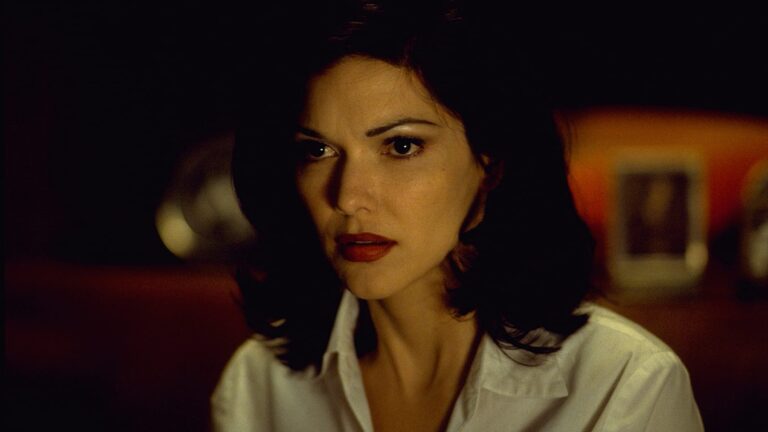
Films
Mulholland Drive
Explore Mulholland Drive through 45 illustrated scenes, dialogue studies, music and sound credits, Club Silencio, production history and edition research.

Museum
Museum — The Objects Remain
Explore David Lynch posters, artist editions and LaserDiscs through 35 illustrated records, edition comparisons, object histories and documented research.
Image credits and sources accompany each linked guide.