The Straight Story
The feature films / 1999 / A journey toward another person
A small machine. An immense landscape. The difficult work of coming back.
Alvin Straight cannot drive a car, but he means to reach his estranged brother. Richard Farnsworth’s traveler makes a lawnmower into a vehicle for reconciliation; Sissy Spacek’s Rose and Harry Dean Stanton’s Lyle give that journey its family stakes. David Lynch directs a screenplay by Mary Sweeney and John Roach. Official introduction ↗ · Film and cast record ↗
- Film year
- 1999
- Listed runtime
- 111 min
- Photography
- 35mm anamorphic
- Screenplay
- Mary Sweeney & John Roach
Reading note: plot spoilers, family estrangement and discussion of wartime trauma. The detailed ending study opens on request.
A real journey becomes a constructed film
Roach recalls researching the route with Sweeney and developing the script independently of Lynch, whose interest followed his reading of their work. Roach’s development account ↗ Authorship here begins well before the camera.
Sweeney’s 2026 recollection describes meeting Alvin’s children and recording their different memories. She also recalls initially protecting herself from extensive research while the rights were unavailable. The project emerged from persistence, access and selection, not simply from a director finding an appealing newspaper headline. Sweeney on research and rights ↗
The actual traveler, the written character and Farnsworth’s performance need to remain distinct. A family story changes when different relatives tell it; a screenplay changes again when an actor gives it a body. That does not make the adaptation less valuable. It makes its choices visible. The film’s central proposition is dramatic: an effort that could look impractical to an observer can be the only adequate way for a particular person to express remorse.
How far did he travel?
Even the apparently simple mileage requires care. These records describe different kinds of evidence, and they do not agree:
The newspaper lead
A library reference investigation identifies “Brotherly Love Powers a Lawn Mower Trek”, The New York Times, 25 August 1994, p. A12, and summarizes a 240-mile journey. We inspected that library record, not the original newspaper. Exact article locator ↗
The film’s publicity
Disney’s current synopsis gives 260 miles; Cannes gives 350 miles. These are published descriptions of the film’s story, not independently measured routes. Disney synopsis ↗ · Cannes synopsis ↗
We therefore avoid a single supposedly definitive mileage in the introduction. A route reconstruction would need the contemporary report, named stops and a distinction between the real trip, the fictional itinerary and the production’s travel. Repeating the most familiar number would conceal the question instead of answering it.
A screenplay lead with a clear limit
Mary Sweeney and John Roach’s The Straight Story: A Screenplay was published by Hyperion in 1999, first edition, ISBN 9780786885640. Library catalogue record ↗
The making of a modest-looking film
The film’s quietness can obscure the logistical undertaking behind it. Francis’s contemporary account describes a six-week location shoot and a requested ten-hour working day. Sweeney later recalls the production moving through the transition from summer to autumn. Francis on the schedule ↗ · Sweeney on the traveling production ↗
Those accounts support the broad picture more securely than an exact start date. Roach’s 2020 recollection puts shooting under way by late September; Sweeney’s 2026 account says August, with completion in October. We retain that discrepancy rather than silently selecting one memory. Dated call sheets or production reports are the next evidence needed. Roach’s chronology ↗ · Sweeney’s chronology ↗
The key collaborators span several forms of construction: Francis’s photography, Jack Fisk’s production design, Sweeney’s editing and Angelo Badalamenti’s music. Festival craft credits ↗ A road movie may appear to find its world ready-made, but choosing a house, arranging a room and framing a stretch of land are interventions. Natural surroundings do not remove design; they make the relationship between design and discovery especially important.
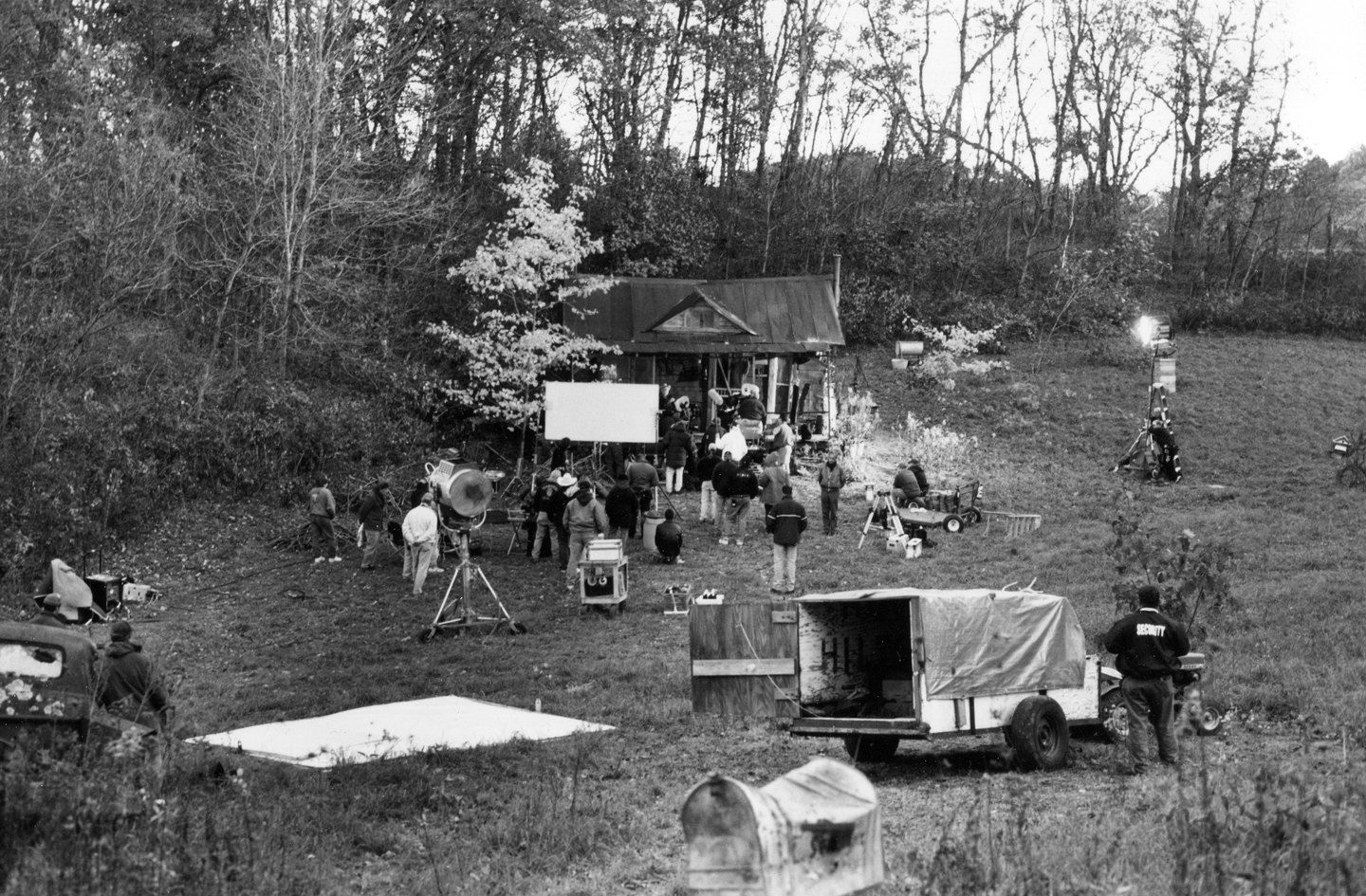
Reading the production photograph: the little building is surrounded by people, lamps, a large white surface and equipment. The mower and trailer occupy the foreground while the working unit fills the space behind them. This is useful evidence of scale: the single traveler’s story is being produced by a collective.
It also puts a limit on the phrase “simple film.” Simplicity can describe what reaches the spectator while hiding the coordination that made it possible. Keeping that distinction in view helps us recognize the crew’s contribution without turning every visible piece of equipment into a technical explanation we cannot substantiate.
Making distance visible, making room for strangers
American Cinematographer describes a crane movement beginning behind the mower, rising to reveal the highway, then lowering to show how little ground Alvin has covered. This is a reported shot description, not our timed viewing. The camera movement ↗
Two scales occupy the same action. From the driver’s position there is progress; from above there is an almost unreasonable amount of distance still to go. The joke does not cancel the undertaking. It lets determination coexist with an awareness of how vulnerable, and how faintly absurd, the traveler looks. A grand view can dignify a person without making him physically grand.
The encounters also resist a simple opposition between independence and help. Ebert’s contemporary review singles out Danny Riordan’s tactful hospitality and the bickering repairmen. These people make assistance, irritation and mutual dependence part of the trip’s texture. Ebert on the roadside community ↗
Alvin’s chosen means of travel need not imply that he can make the journey alone. Accepting a repair or a place to stop can preserve agency when the offer leaves room for a refusal. The distinction is between being helped and being taken over. That is why the roadside meetings matter beyond giving the story episodes: they test what another person’s dignity requires of a listener.
Does the journey move through the ages of life?
Asked whether the increasing age of Alvin’s encounters was planned, Roach said it had not been conscious. The age-pattern question ↗ A useful reading need not become a claim of deliberate design.
The temptation to organize every encounter into a life lesson should itself be questioned. A stranger has needs before becoming an emblem of youth or old age. The richest version of this reading keeps both scales: an encounter can contribute to the journey’s movement toward mortality while still involving someone whose life continues outside Alvin’s story.
That also complicates the title. A route can be forward-moving while its purpose is retrospective. Alvin is traveling toward a person, but he is also returning to a relationship. Progress and return are not competing directions here; each gives the other its meaning.
Farnsworth, Spacek, Stanton: the work between words
Francis emphasized the performers’ eyes and described the Varicon system’s moderation of contrast and slight softening. Francis’s photographic approach ↗ The resulting question is expressive rather than merely cosmetic: how does a face remain readable without making every feeling explicit?
Lynch’s contemporary discussion praises Spacek’s handling of Rose’s speech and describes her performance as a delicate balance. Lynch on Rose ↗ A pause should not be treated automatically as an absence of understanding. Speech, listening and bodily effort all contribute to a character’s presence. The daughter must remain a person with her own experience, not merely a measure of the father’s difficulty.
A correction to the prompting anecdote
Neff’s 2022 interview broadly connects pauses in Farnsworth’s delivery with off-camera prompts. When Fagerholm subsequently asked Sweeney about that account, she narrowed it explicitly: there was one particularly difficult, dialogue-heavy scene, the conversation between Alvin and another veteran in a bar. Neff’s account ↗ · Sweeney’s clarification ↗
Sweeney describes prompting Farnsworth there, and balancing his and Wiley Harker’s emotional performances through the edit. Her account does not support reducing the whole performance to memory trouble. Editing the veterans’ scene ↗
This distinction matters both historically and critically. A production solution can contribute to an expressive result without explaining away the actor’s craft. A pause has several makers: the performer who inhabits it, the editor who retains or shortens it, and the sound work that makes the exchange seem continuous. Its origin and its effect are different questions.
Nor should the bar scene become a general diagnosis of the historical Alvin. Lynch interpreted the exchange as a reciprocal sharing of painful memories, each man making himself vulnerable to the other. Lynch on the veterans ↗ That gives a strong dramatic reading; it does not authenticate a wartime event in the real traveler’s life.
Stanton’s Lyle is the destination against which the other meetings are measured. Keeping him in view as a person, rather than a promised reward, preserves the uncertainty of reconciliation: the traveler can choose to arrive, but cannot dictate the response. The ending’s spareness is considered below.
A worked landscape, not an empty one
Lynch’s 1999 interview expresses an attraction to the country’s machinery and industrial structures as well as its open spaces. Machines in the landscape ↗ The mower belongs to that world of work. A practical tool takes on an extraordinary purpose while retaining its ordinary material associations.
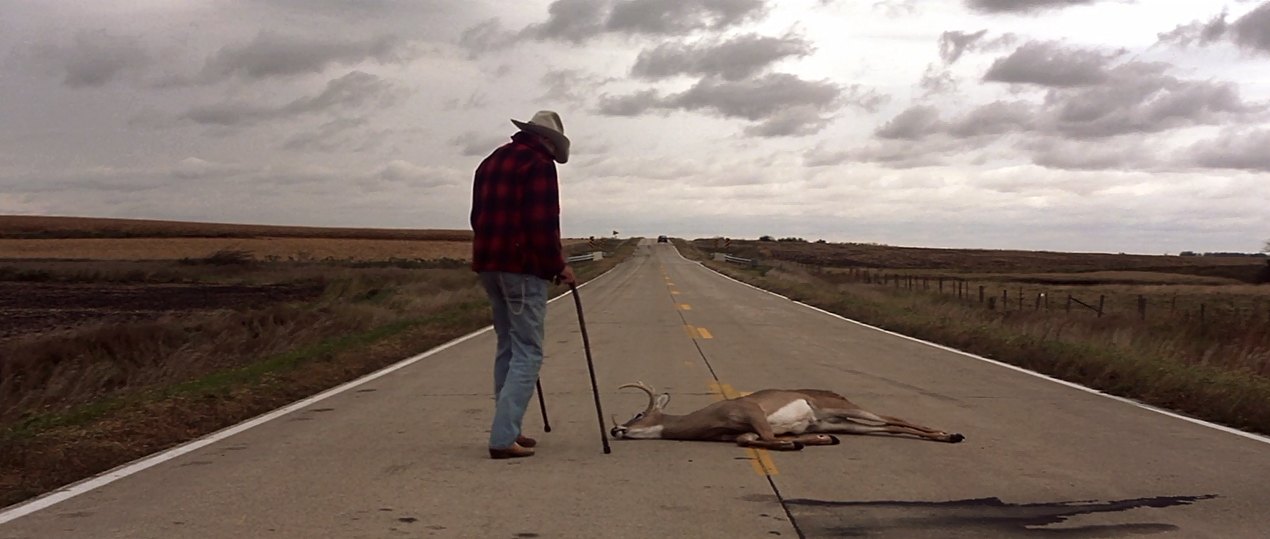
Reading the reproduced film image: the road’s center line draws the eye toward the horizon, but the deer interrupts it. Alvin’s upright figure and supporting cane create a second, fragile axis beside the animal. The weather carries weight without needing a visible threat. This is a close reading of the still; it cannot establish the shot’s duration, soundtrack or position within the final sequence.
The picture is especially useful against an account of the countryside as pure refuge. The road connects places and also brings incompatible kinds of movement together. A traveler, an animal and traffic share space without sharing speed or protection. Open visibility does not guarantee safety.
Lynch recalled unexpected wind and weather intensifying the deer encounter’s atmosphere. Weather on location ↗ That is a particular example of a planned scene acquiring something the unit did not completely control. The image’s power can belong partly to a decision to accept what the location offered.
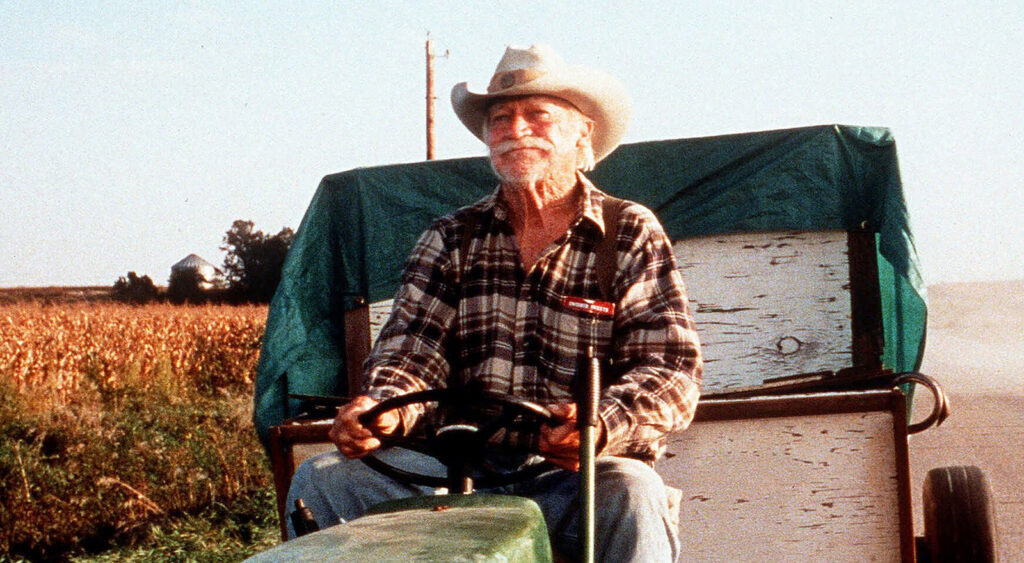
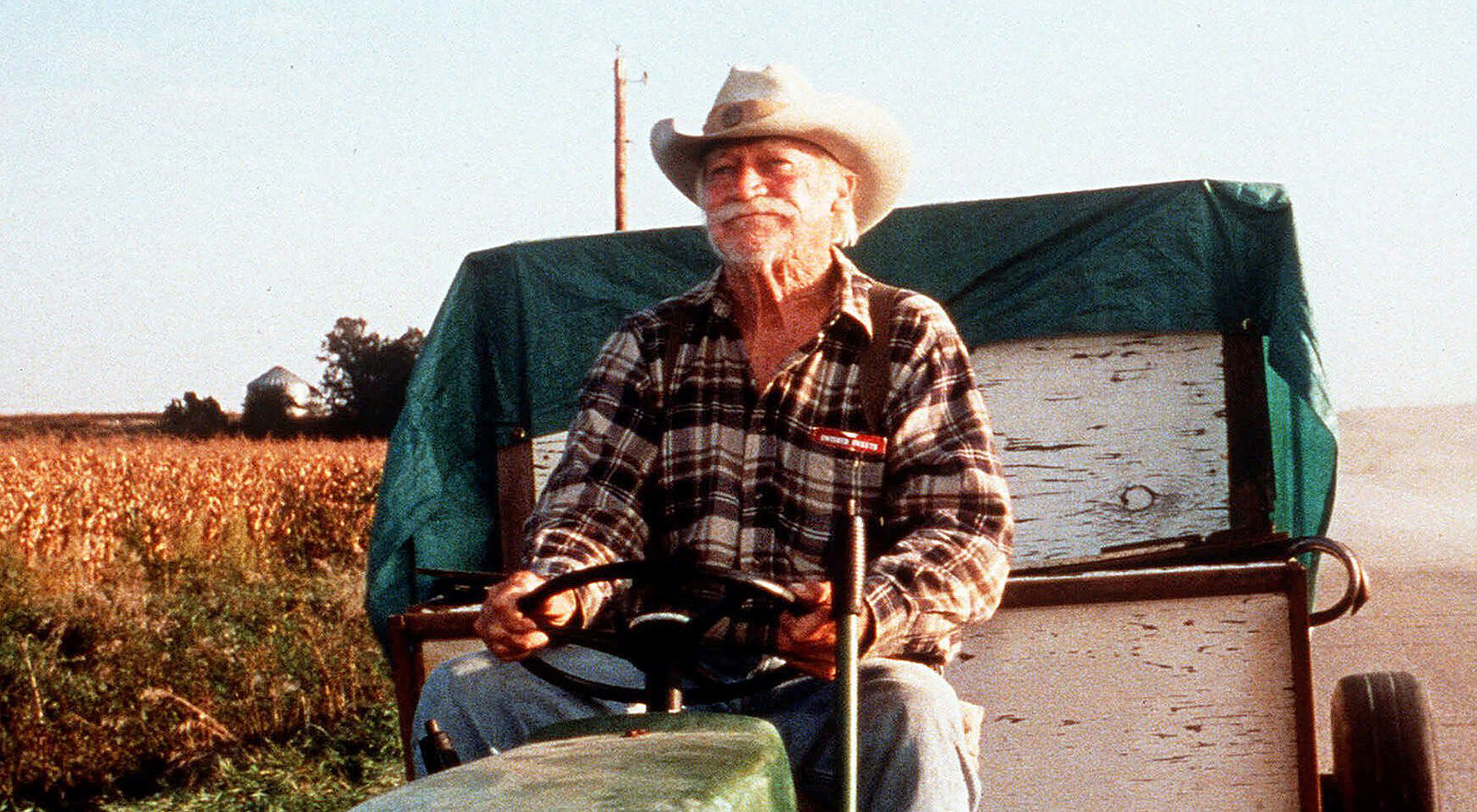
The header image presents another relation to the land. The field extends beyond Alvin, while his hands, wheel and improvised trailer make the undertaking tactile. The landscape is large enough to dwarf him, but the camera gives his practical world substance. These two images belong together: one presents purposeful movement, the other an interruption that asks the traveler to look.
Fisk’s design contribution deserves a fuller material record than the credit alone supplies. For now, visible buildings, vehicles and equipment are discussed as images. No surviving mower, trailer or location is authenticated here as an original production object.
The mower, the trucks and the emotional landscape
Badalamenti recalled initially struggling to connect musically with the material. Talking with Lynch about Rose helped him find the characters’ inner lives and a way into the score. This is the composer’s account of his process, not evidence that a specific cue accompanies every appearance of Rose. Badalamenti, section III ↗
Neff dates the score session at Lynch’s studio to 30 January 1999: fourteen string players and three guitarists, recorded in one twelve-hour day. He also recalls two pieces of his temporary music remaining in the film. Recording and temporary music ↗
For the trucks surrounding Alvin, Neff describes recording engines at the Castaic Truck Stop and using their weight in the 5.1 mix. He identifies Ron Eng’s effects work and Walter Spencer’s dialogue work alongside his own mixing role. Building the surrounding traffic ↗
Physical vulnerability can be constructed through relative sound scale. A machine need not move faster on screen to feel overwhelmingly powerful; its surrounding weight can change our sense of the smaller vehicle. This makes the mix part of the journey’s point of view, rather than a decorative accompaniment to the road.
Music and engine noise also have different temporal possibilities. A motor can insist that time is passing through continuous mechanical effort. A musical phrase can carry feeling beyond the limits of one exchange. Whether they overlap, alternate or leave room for a voice needs to be heard in the film; an album track list cannot answer those questions.
Editing toward an encounter
Sweeney says she wrote with an editor’s sense of flow and deliberately resisted demands for a more explanatory ending. Her 2026 interview further describes editing as a willingness to drop material that did not work emotionally, even when she had written it. Writing with the edit in mind ↗ · Choosing what the film needs ↗
Restraint is an active construction. It requires decisions about which information a viewer needs, what a performance can carry and how long an unresolved feeling can remain present. A film can move at a measured pace and still be selective. Slowness is not the same as retaining everything.
The last meeting: arrival is the statement — ending spoilers
In the contemporary Salon interview, Sragow notices Alvin calling Lyle twice where the published script, he says, has one call. Lynch responds by recalling the emotional force of Farnsworth’s breath near the ending. These observations are attributed to that exchange; they await our own book-and-film collation. Sragow and Lynch on the final moments ↗
Repeating a name can move from announcing presence to fearing that presence has come too late. It is a tiny verbal action with enormous stakes. The journey supplies what a speech could only describe: time spent, effort sustained, and the willingness to risk being refused.
The ending can therefore leave the original quarrel unresolved as information while making a new relationship possible as an action. Reconciliation need not mean that everything has been explained or that the past has been erased. An arrival asks for a future, however little future may remain.
That makes the final encounter different from a reward handed to an exemplary traveler. Alvin’s determination has brought him to a threshold. Whether another person receives him is still outside his control. The emotional force lies in that exposure: after so much practical problem-solving, the final step depends on someone else.
Warmth, sentiment and the Lynch signature
The film screened in competition at Cannes in 1999. Farnsworth subsequently received an Academy Award nomination for Actor in a Leading Role at the 2000 ceremony. These establish recognition, not unanimous approval or an award win. Festival record ↗ · Academy record ↗
Roach recalls Disney’s domestic distribution deal and the audience’s amused response to the combination of Disney and Lynch at Cannes. Roach on the premiere ↗ That juxtaposition is a useful reception fact, but it can become a distraction if the film is discussed only as a surprising brand combination.
Ebert: attend to the background
Ebert’s 15 October 1999 review values the people who listen and help, as well as the traveler. He finds mortality in the landscape and admires the ending’s refusal to over-explain. His argument moves the center of attention from a solitary feat to a social world. Read the contemporary review ↗
Rosenbaum: admiration with reservations
In his 22 October 1999 review, Rosenbaum praises the film’s artistry while questioning its national and familial mythology. He sees the narrative’s selective treatment of a real life as ideological, and some imagery as approaching idealized calendar pictures. That reservation tests how beauty can become reassurance. Read the author’s republication ↗
These responses point to a productive tension rather than a verdict to average. How can a film grant people dignity without turning a whole region into an ideal? What makes a beautiful field a lived place rather than a consoling image? The roadside interruption, the laboring machinery and the difficult conversation all provide ways to ask those questions.
Compassion is also a poor basis for treating the film as an isolated exception in Lynch’s work. The attention to an exposed person connects it to The Elephant Man; the tension between travel and escape invites comparison with Wild at Heart.
The film, its editions and its material record
STUDIOCANAL’s official restoration trailer listing was published on 26 January 2024. Park Circus announced another theatrical run in March 2026. The later announcement is evidence of renewed exhibition, not proof that the restoration first existed in 2026. Dated distributor listing ↗ · 2026 theatrical notice ↗
Restorations, territorial releases and alternate edits each form a distinct part of the film’s history. Edition records identify format, framing, sound and restoration credits.
The published screenplay gives the journey another form: a text for readers, carrying the film’s places, encounters and conversations across the page.
For the Museum, the next meaningful additions would be securely identified release publicity, a documented edition of the screenplay and verified home-video packaging. The mower is narratively central, but a pictured machine or a collector’s attribution is not enough to authenticate a screen-used vehicle. No ownership or survival claim is made here.
Explore further
Follow the sources below, explore the museum collection, or continue through the Reading Room. New archival discoveries and contributions enrich the record of Lynch’s work.
Sources and the research record
Contemporary interviews, later recollections, production records and criticism bring the film’s history into focus. Explore the sources below.
- Disney: The Straight Story ↗Official synopsis, rating and credits inspected. Publicity describes a 260-mile course; no film playback.
- BFI: The Straight Story (1999) ↗Catalogue record checked for year, runtime and principal credits; not a release comparison.
- Festival de Cannes: The Straight Story ↗Official 1999 competition entry, synopsis and craft credits. Includes the film’s publicised journey distance.
- ASC Staff, Straight Shooting on The Straight Story (1 November 1999) ↗Contemporary Francis/Hayman testimony: schedule, anamorphic photography, Varicon and crane movement. Three reproduced images inspected; production photograph credited to David Lynch.
- Michael Sragow interviews David Lynch, Salon (28 October 1999) ↗Contemporary testimony on development, landscape, Spacek, the veterans and the ending. Reported film/script differences remain attributed to the interviewer.
- Nathan Cone, The Story Behind ‘The Straight Story’, TPR (26 August 2020) ↗Edited John Roach interview transcript read; audio not auditioned. Route research, writing, Disney distribution and the age-pattern question.
- Matt Fagerholm interviews Mary Sweeney, RogerEbert.com (2022) ↗Straight Story passages read: writing/editing, restrained ending and her specific correction about Farnsworth’s bar scene.
- Alex Hewitt interviews Mary Sweeney, Little White Lies (16 February 2026) ↗Published interview read: rights/development recollection, editing and seasonal location work. Detailed dates require corroboration.
- Matt Fagerholm interviews John Neff, Indie Outlook (2 May 2022) ↗Straight Story section read: scoring session, temporary music, truck recording and 5.1 mixing. Prompting anecdote qualified against Sweeney’s account.
- Frances Badalamenti, An Interview with Angelo Badalamenti, The Believer (1 August 2019) ↗Section III inspected, particularly the composer’s account of finding a musical approach through Rose; no soundtrack audition.
- Reference Collaborative Database, case 1000348088 ↗Library reference investigation identifies the New York Times article of 25 August 1994, A12.
- Open Library: The Straight Story: A Screenplay, Hyperion, 1999 ↗Bibliographic record checked alongside WorldCat 42296113. First edition, ISBN 0786885645 / 9780786885640. The book itself has not been read.
- Roger Ebert, The Straight Story (15 October 1999) ↗Contemporary review read. Used as a critic’s response and attributed scene description, not a substitute for complete film inspection.
- Jonathan Rosenbaum, True Enough, Chicago Reader (22 October 1999), author’s republication ↗Straight Story discussion read in the author’s republication. Its political argument and aesthetic praise are a critic’s interpretation, not a consensus.
- Academy: 72nd Academy Awards (2000) ↗Actor in a Leading Role: Richard Farnsworth nomination verified; not a win.
- STUDIOCANAL, official 4K restoration trailer (26 January 2024) ↗Verified distributor’s dated listing and description inspected. Trailer not played or used as a full-film inspection.
- Park Circus, The Straight Story: 4K restoration in cinemas from 13 March (4 March 2026) ↗Official rerelease notice read; documents renewed exhibition and artwork. Does not establish a new edit or a worldwide first restoration date.
Another doorway
Continue exploring
Films
The Elephant Man
Explore The Elephant Man through Joseph Merrick’s history, David Lynch’s production, John Hurt’s performance, London locations and museum objects.
Music
Music
Explore David Lynch’s albums and collaborators, from Julee Cruise and Thought Gang to Chrystabell, with recording histories, edition notes and sources.
Films
Inland Empire
Explore David Lynch’s Inland Empire through Laura Dern’s performance, its evolving production, digital photography, sound, restoration and critical reception.
Image credits and sources accompany each linked guide.