The Angriest Dog in the World
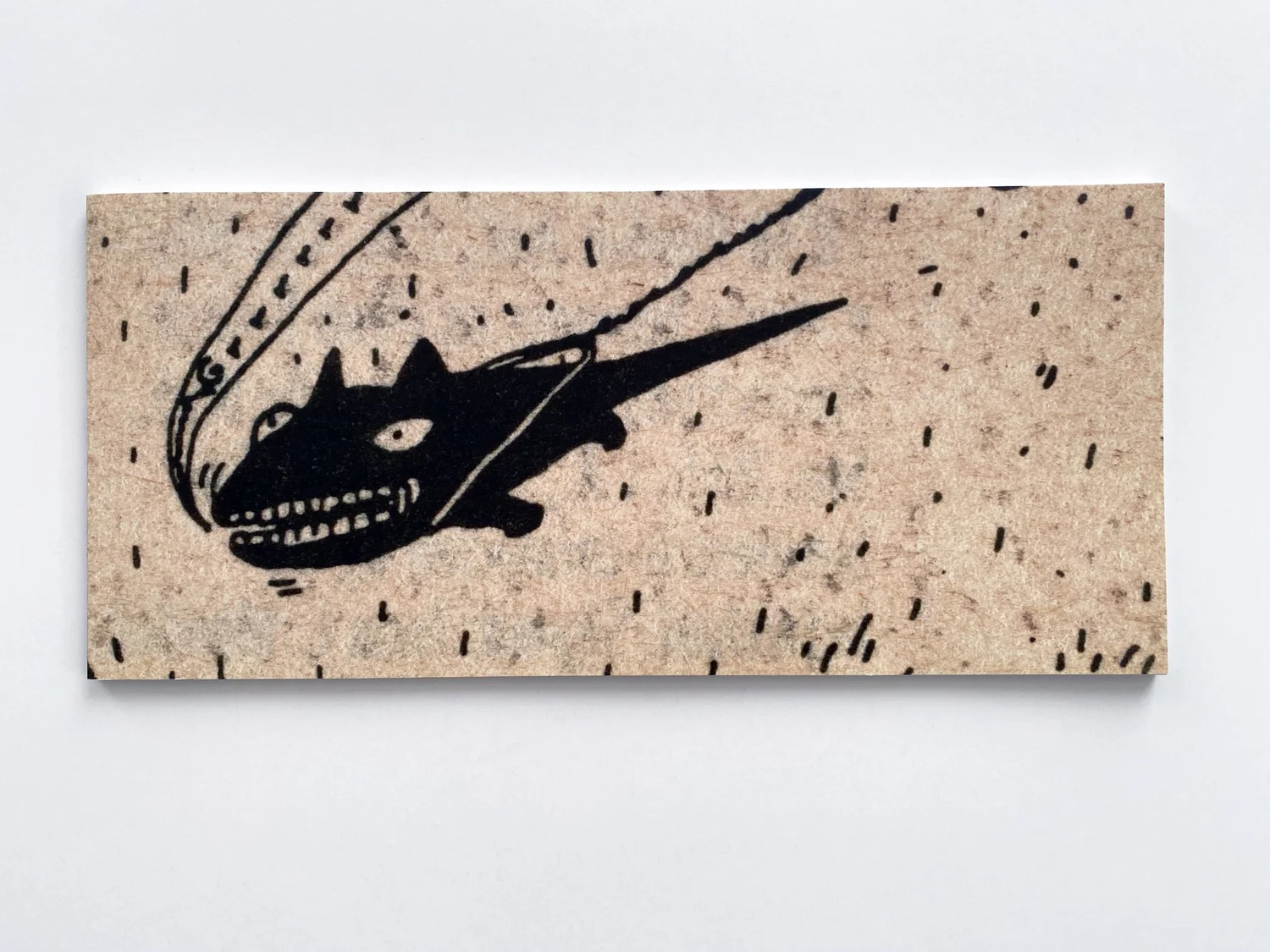
The printed image / A weekly comic, 1983–1992
The yard stays the same. The words keep coming.
The Angriest Dog in the World is David Lynch’s experiment in what a comic can do when almost nothing in the drawing changes. A tethered dog strains in a yard; speech emerges from the adjacent house; daylight gives way to darkness. The recurring image and the variable text make an unusually concentrated place to encounter his humor.
This dossier follows the strip’s form, production, newspaper setting and later editions. It takes the comic seriously as a printed work, with editors, letterers and changing formats. Its fixed drawing is a starting point for research, not a reason to dismiss nine years of publication as a single repeated joke. Explore Art, Dumbland and Online Works for related forms of drawing and repetition.
Four pictures, and a statement of the condition
The narrow introductory text block and the four picture panels have different functions. The caption tells us that anger has left the dog almost immobilized. Three daytime views repeat the yard; the final picture shifts to night. Counting the introductory caption as a panel produces five cells on the page. Describing four picture panels is therefore more precise than treating these counts as contradictory.
The animal is low to the ground, its body stretched along the line of its tether. The fence confines the view, while a house wall and window establish an unseen interior. Industrial chimneys occupy the distance. At night, a patch of light from the house preserves part of the yard while the rest disappears into black.
The house’s occupants can speak, but they are not given bodies within these panels. The dog has a body but does not deliver the conversation. That division creates a peculiar imbalance: the visible figure bears the emotional pressure, while the language arrives from elsewhere. A reader can connect the two without being told that the particular sentence caused the dog’s condition.
The repetition also changes the job of reading. Instead of looking for a new action in each drawing, we begin measuring the placement of a balloon, the intervals between words and the persistence of the animal. Nothing visibly resolves when night arrives. Time has passed, but the situation has survived it.
An idea before a weekly deadline
Rotland Press dates the conception to 1973 and the beginning of the Los Angeles Reader run to 1983, continuing through 1992. These are different milestones: an early idea is not a published installment. The dossier uses 1983–1992 for the run while leaving its exact first and last newspaper issues open for archival confirmation. Source ↗
In David Breskin’s 1990 interview, Lynch connects the strip to remembered anger, distinguishing that memory from his emotional state at the time of the interview. He describes meditation as changing his own experience of anger. This is the artist’s retrospective account of the work’s personal background; it does not supply a diagnosis of the dog or a single compulsory reading of every strip. Source ↗
There is a bibliographic discrepancy worth preserving. Joe McCulloch’s 2011 discussion gives 1982 as the origin year in the Reader, whereas the publisher’s later record and John F. Kelly’s report use 1983. A repeated date is not a substitute for locating the first printed installment. Source ↗ Source ↗
An image conceived earlier can acquire a different force when it enters a weekly publication. A private emblem becomes a recurring appointment with readers. The time between issues, not just the day-to-night sequence within a strip, becomes part of its experience.
A comic made through a newsroom
Richard Gehr’s recollection, recorded by John F. Kelly in 2015, supplies a practical production account. As an editor at the Los Angeles Reader, Gehr took Lynch’s telephone dictation, identifying the text panel by panel. Production staff then replaced the previous dialogue on the standing artwork. The account credits a chain of work beyond the originating drawing and words. Source ↗
Kelly also reports a different procedure demonstrated by editor James Vowell in a television documentary: an envelope containing dialogue and prepared balloons was delivered to the office. These accounts may describe different periods or methods. Source ↗
“phoned in” can describe a method without proving indifference. Dictation separates the writing from its graphic delivery. The person taking the call, placing the balloon or lettering the words affects what the reader sees. Reusing artwork also turns a weekly comic into a small production system: preserve the template, receive a variation, fit it to the space, reproduce it on deadline.
That system complicates a simple division between original and copy. The fixed picture can recur legitimately while each week’s layout remains a distinct printed object. A facsimile should preserve that week’s lettering and placement. A later edition which standardizes those elements may be authorized and carefully designed, but it is a different kind of evidence.
Page 11: a thought which cannot release the dog
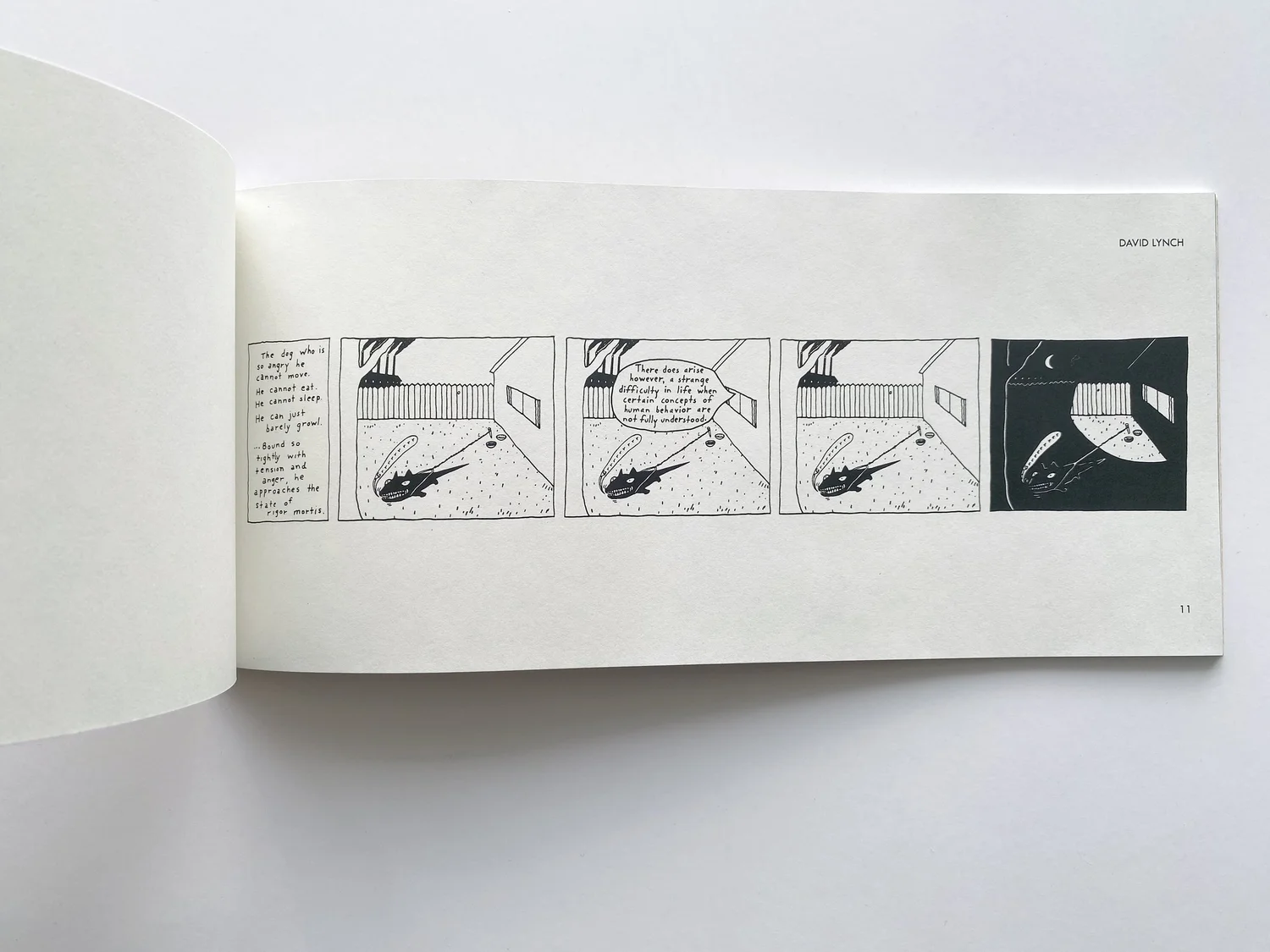
The publisher’s photograph shows page 11 of the 2020 Rotland edition. A balloon occupies the second daytime panel and offers a solemn observation about the difficulties arising from incomplete understanding of human behavior. The remaining picture panels provide no reply.
The sentence has the air of an explanation, yet it does not identify a particular event. It could be a general observation, a conversational evasion or a very elaborate way of saying little. Its abstraction sits above a fiercely specific posture: the dog’s teeth, the tether and the strained body.
The speech balloon briefly fills space which would otherwise belong to the fence and background. When it is absent in the next panel, the drawing seems to have absorbed the remark without changing. The reader supplies the duration of this pause. There is no soundtrack, recorded performance or mechanically fixed interval to tell us how quickly to move.
Night gives the strip a conventional ending while denying it a conventional resolution. The illuminated patch of yard connects the unseen domestic interior to the still-tethered animal. We may finish the sentence and turn the page, but the drawing keeps its condition intact.
Two readings remain possible. The inflated language can be funny precisely because it offers so little help. It can also feel disquieting: talk continues indoors while suffering persists outside. The page does not require us to choose permanently between those effects. Its economy comes from letting the same few marks sustain both.
The photographed page is from a later edition with replacement lettering. Its panel arrangement can be examined here; its typography should not be quoted as proof of the appearance of a particular original newspaper installment.
What the newspaper changes
Zachary Petit’s 2020 PRINT account reproduces the front and back of a Los Angeles Reader issue dated 26 January 1990. These reproductions offer a dated route into the comic’s publication setting. Source ↗
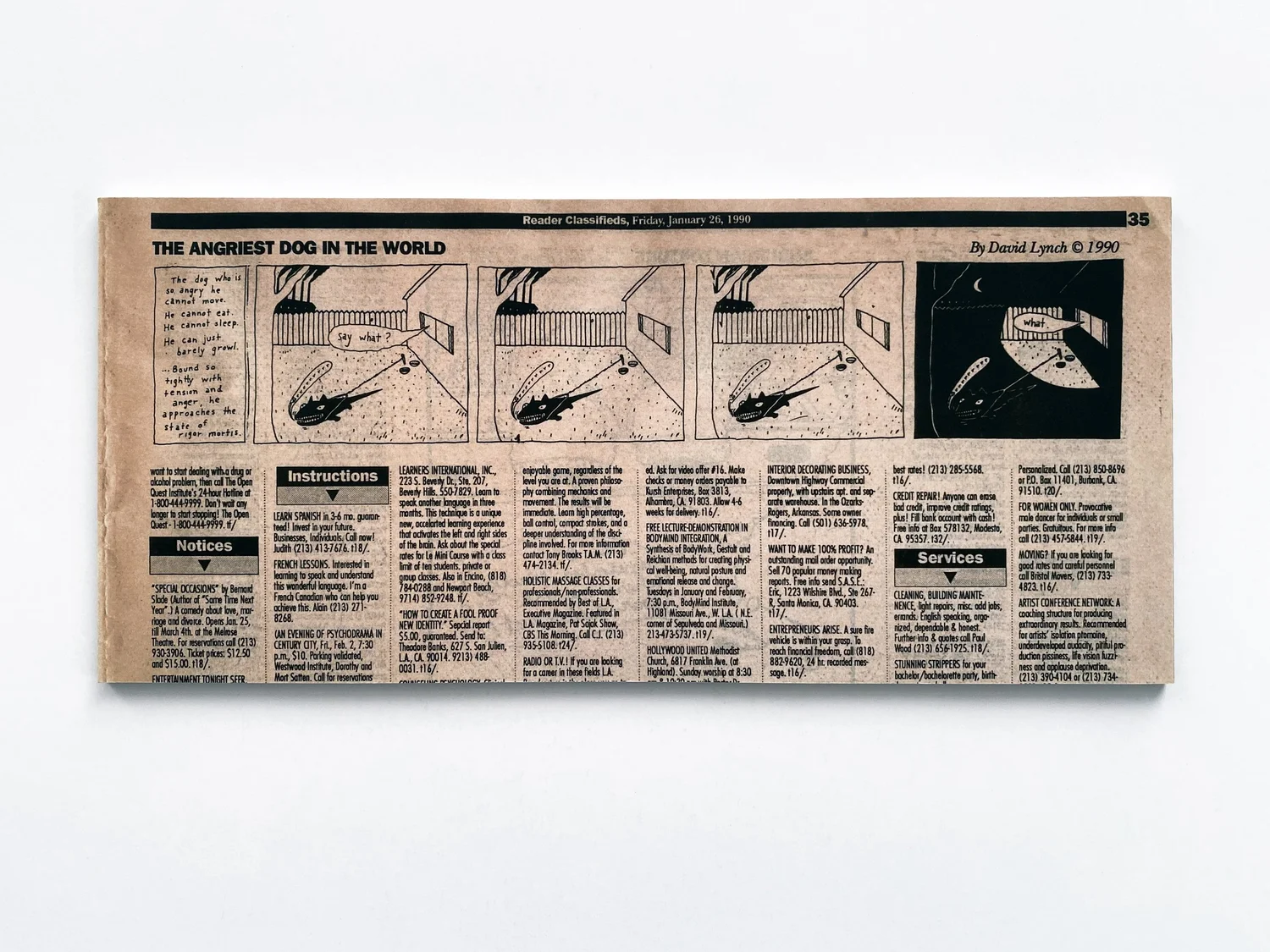
The strip appears above columns of classified advertising. The recurring yard shares a printed surface with offers, services and practical transactions. A person encountering it there could move between cultural amusement and ordinary business without entering a separate art-book space.
This context matters to the rhythm of repetition. A weekly reader meets the image after an interval; a book reader can encounter many versions in rapid succession. What feels like a familiar interruption in a newspaper may become insistent when collected. Neither experience is the definitive one, but they should not be treated as equivalent.
The newspaper also changes the status of scale and wear. A later cover can enlarge the grain and marks of an earlier reproduction until they become a deliberate visual surface. This makes the old printing process newly conspicuous. It does not turn the new book into the old newspaper, or establish that every irregularity was present in Lynch’s original drawing.
The dossier currently has a reliable Los Angeles focus. Other reported outlets need issue-level verification before a full syndication map is published. Circulation, local placement and readership will make a richer history than a list of newspaper names repeated without dates.
Reprints are new objects
| Object | What is currently supported |
|---|---|
| Los Angeles Reader 1983–1992 working chronology | Kelly’s report supports the working chronology. Original first/last issues and a complete sequence have not been collated. Source ↗ |
| Cheval Noir Dark Horse reprints | McCulloch dates the strip’s arrival to 1991 and discusses a hostile reader letter in issue 31, documenting the friction Lynch’s comic could produce in a new publication setting. Source ↗ |
| Rotland Press 2020 selection | Seventeen strips and a 500-copy printing, reported by PRINT as the first Lynch-approved reprinting. The publisher also credits a Michel Chion foreword. This is a selection, not the complete run. Source ↗ Source ↗ |
PRINT reports that Ryan Standfest replaced the varying original lettering with a typeface based on Lynch’s handwriting for Rotland’s edition. That gives the collection consistency while changing part of the printed record. The attribution of a design decision is different from a judgment that the decision was right or wrong. Source ↗
Uniform lettering can make the author’s visual identity stronger, yet it can also conceal how much the weekly strip depended on other hands. An edition comparison should therefore record letterforms, balloon shapes, line breaks, image size and sequencing. Comparing only the wording would miss part of the history.
Even the bibliographic descriptions need care. Rotland lists forty pages; Brian Nicholson’s review header lists thirty-four. Counting conventions, an error or an edition difference could explain the discrepancy, but the physical book has not been collated to decide which. Both records are retained in the investigation rather than silently harmonized. Source ↗ Source ↗
A disagreement about repetition and celebrity
Brian Nicholson’s 2020 review in The Comics Journal challenges the value of collecting the strip. He argues that celebrity and the vanished context of alternative weeklies do much of the work, and questions whether its anti-humor retains its force. His objection is a substantive part of the reception, not something to erase from a tribute archive. Source ↗
Rotland reproduces a contrasting assessment by Solrad’s Rob Clough, praising the gags’ freshness despite the repeated images. Source ↗
Our assessment: the disagreement helps identify what to test. Does an individual strip produce a relationship between its words and images, or merely ask the reader to enjoy Lynch’s name? Does reading several together reveal variation or exhaust it? How much depends on encountering the work unexpectedly among other newspaper material?
The page-11 study offers one local answer: the placement and disappearance of a balloon can produce an interval which the drawing alone does not supply. That does not vindicate every installment. A critical edition needs room for unevenness, failed jokes and different reader responses as well as admiration.
Connections without a single master key
Our comparative reading: the house, yard and anger invite a route toward Dumbland, where drawing is put into motion and given sound. The contrast is as useful as the resemblance: the Dog’s fixed image asks the reader to create the interval, while animation can control its duration and interruption.
Lynch’s online work offers other recurring formats and visits. Their shared regularity does not make a weather report a comic strip or prove a direct line of influence. It makes possible a question about repetition as an invitation to return.
McCulloch also places the strip beside On the Air and the later culture of repeated-art webcomics. That is a critic’s comparative argument. A history of influence requires more: identifiable statements by makers, dated references and direct comparisons with the relevant work. Source ↗
The Dog deserves its own dossier because the medium changes the questions. The small printed rectangle, the unseen speaker, the week between appearances and the hands of the production staff are all part of the work’s life. Its relation to the films is one route through it, not its entire reason to exist.
Explore further
Follow the sources below, explore the museum collection, or continue through the Reading Room. New archival discoveries and contributions enrich the record of Lynch’s work.
Sources and further reading
Read or reviewed on 18 October 2026. These notes separate inspected reproductions, source texts and participant recollections from original objects and complete editions still to be examined.
- Rotland Press: The Angriest Dog in the World, 2020 edition ↗Publisher record and six book photographs inspected, including page 11 and both covers. Clough’s assessment is known here through this publisher quotation.
- David Breskin interviews Lynch, Rolling Stone, 6 September 1990 ↗Author-hosted transcript; anger/meditation exchange and contemporary introduction read. Retrospective personal account, not a newspaper chronology.
- John F. Kelly, How He Did It (11 March 2015) ↗Interview/report read, including Gehr’s newsroom recollection and Kelly’s description of Vowell’s documentary appearance.
- Joe McCulloch, This Week in Comics (4 October 2011) ↗Opening essay read. Cheval Noir issue 31 and the early-date discrepancy are leads requiring original issues; not treated as independently inspected artifacts.
- Zachary Petit, Bringing David Lynch’s Cult Comic Strip Back to Life (20 August 2020) ↗Article and dated newspaper-image captions read. Edition-production reporting, not a complete original-run inventory.
- Brian Nicholson, The Angriest Dog in the World (15 October 2020) ↗Full review read. Critical position and bibliographic header distinguished from the publisher’s record; no agreement with every historical assertion implied.
Another doorway
Continue exploring
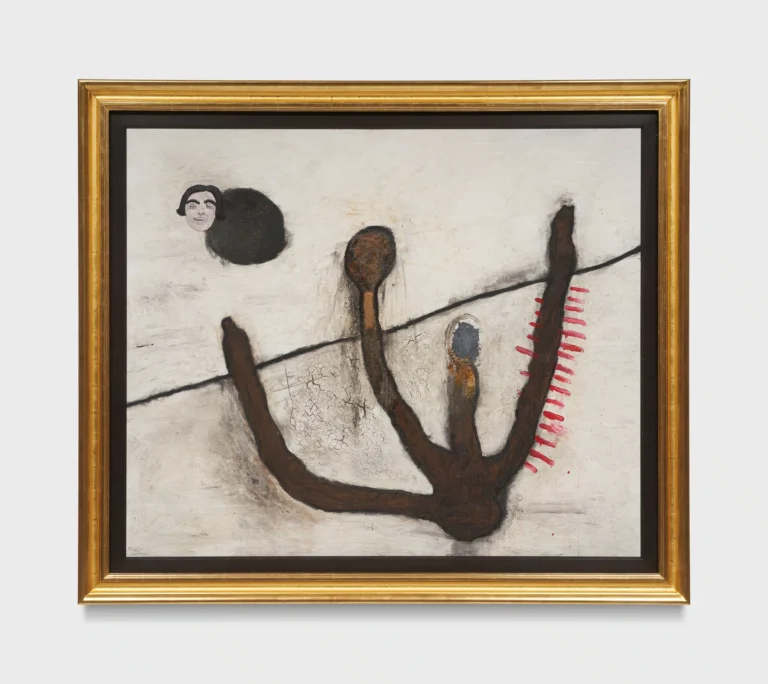
Art
Art
Explore David Lynch’s paintings, lithographs, sculpture and photography through close readings, exhibition histories, credited images and documented sources.
Short films
Short Films
Explore David Lynch’s short films, from The Alphabet to Rabbits and Fire, with production histories, collaborators, sound studies and viewing guides.

Online works
Online Works
Explore David Lynch’s online world: his original website, web series, Interview Project, daily weather reports and the art of returning every day.
Image credits and sources accompany each linked guide.