Industrial Symphony No. 1
PERFORMANCE & MOVING IMAGE / 1989 STAGE WORK · 1990 VIDEO
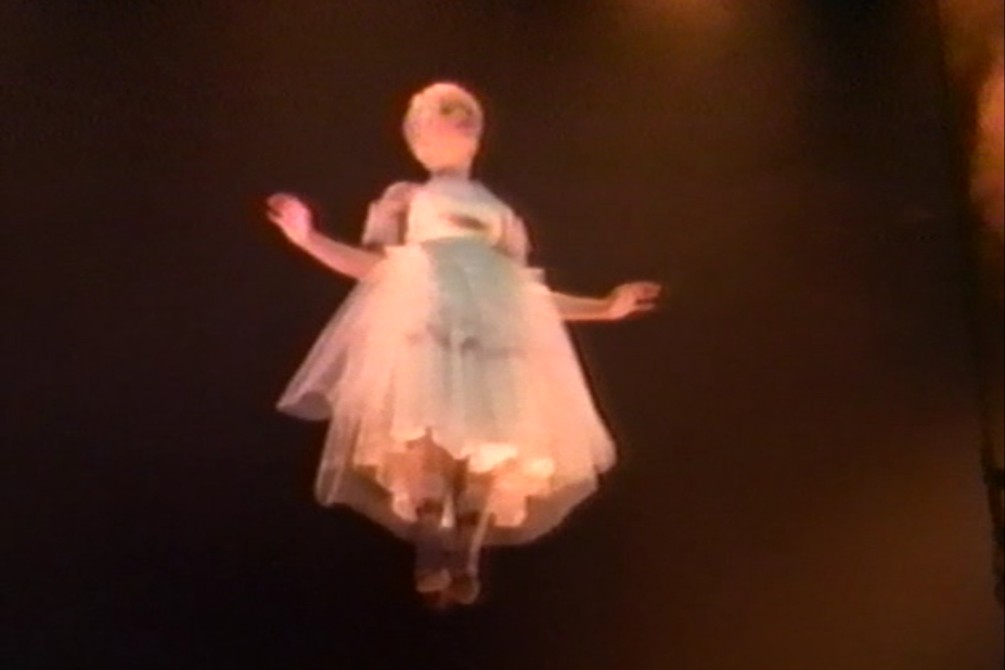
A broken heart, lifted above an industrial landscape.
Industrial Symphony No. 1: The Dream of the Broken Hearted brings David Lynch, Angelo Badalamenti and Julee Cruise together in a work that exists both as a staged event and as a constructed video. The setting of cranes, machinery and suspended bodies gives songs a physical world. The camera then makes another world from the performance.
This dossier traces the commission, the labour behind the spectacle, Cruise’s experience, the relationship between voice and image, and the changing presentation of the work. It connects to Music, Wild at Heart and Twin Peaks without treating shared collaborators as proof that their fictional worlds are identical.
New Music America, Brooklyn, November 1989
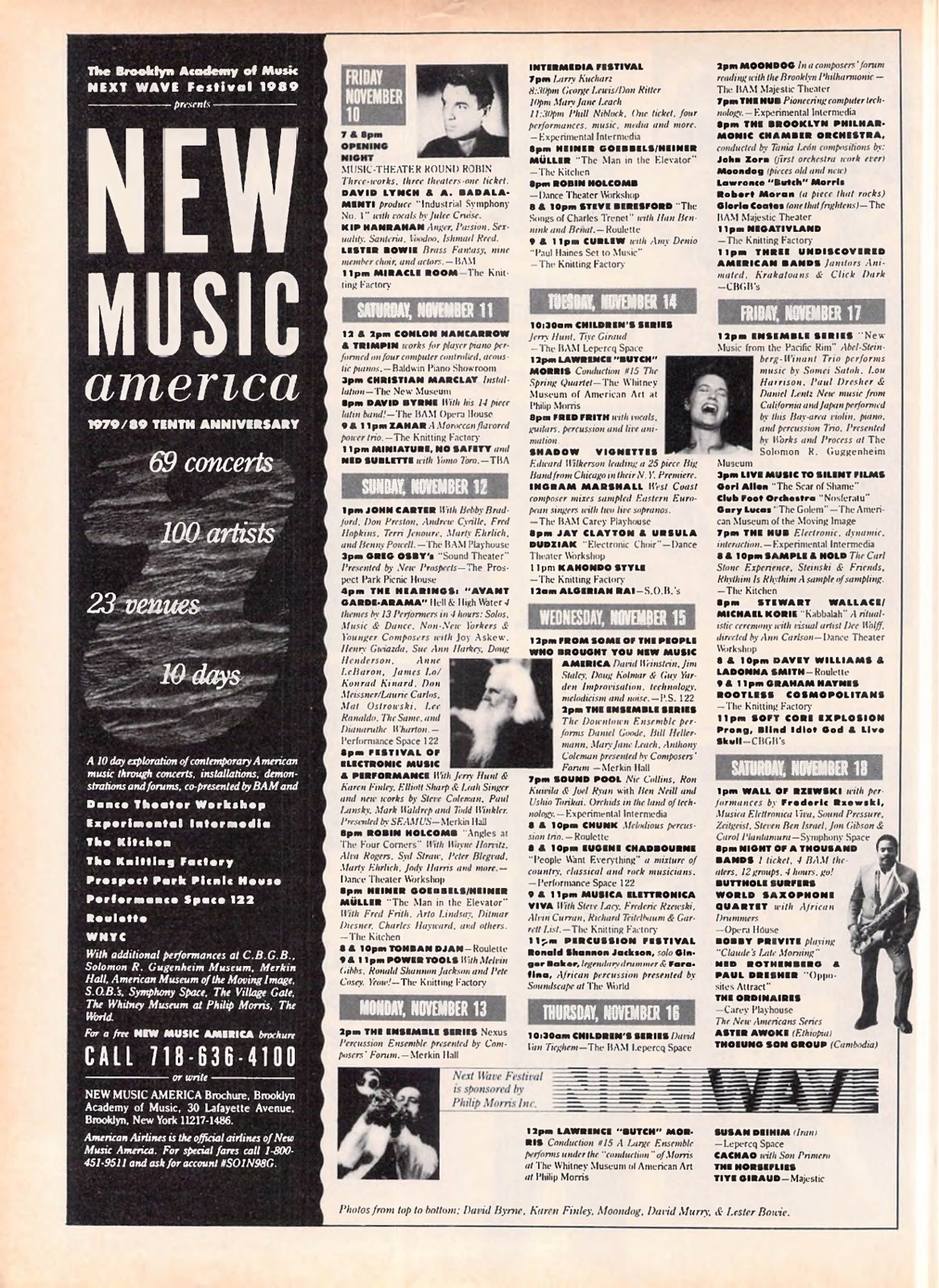
The original BAM advertisement in the September 1989 DownBeat places Lynch and Badalamenti’s work in the opening-night Music-Theater Round Robin on Friday 10 November. It advertises three works in three theatres on one ticket, with 7 and 8 p.m. times. The wider New Music America programme sits under BAM’s Next Wave Festival banner. Those labels describe related institutional contexts, not rival names for unrelated premieres. Original programme advertisement, PDF p. 7 ↗
The advertisement is evidence of the announced plan. A later technical account by festival coordinator Tom Gartland confirms that Lynch, Lester Bowie and Kip Hanrahan presented theatrical music pieces across three BAM theatres on the same night. Together, these records give the work a concrete festival setting. They do not establish an exact camera schedule. Recording Engineer/Producer, pp. 56–59 ↗
In the 1990 VH-1 interview transcribed by Steven Miller, Lynch remembers the project being accepted when he and Badalamenti had little more than its title. Badalamenti describes their wish to involve Cruise, and Lynch identifies a broken heart as its subject. VH-1 interview, part three ↗
Festival programmer Yale Evelev separately recalls bringing Lynch’s work into the ten-day New Music America programme. His account helps recover the curatorial work around the famous collaborators. A commission is made possible by people who choose, schedule and support a project as well as those visible on stage. Evelev’s recollection ↗
The machinery behind an industrial dream
Gartland’s April 1990 article supplies an unusually practical view. He describes tight resources, equipment circulating among venues, and the difficult changeover between Lynch’s set and David Byrne’s concert the following night. Mock oil derricks, water towers, a car and hanging dolls made assembly and removal complicated. This is evidence about material work and scheduling, not an invitation to assign every object to Lynch personally. Technical account, p. 58 / PDF p. 56 ↗
The set’s industrial appearance is also a record of human coordination. It had to be erected, lit, operated and dismantled within a functioning festival. That changes the questions worth asking of a production photograph: where are the support points, how can performers move, what does the audience see, and which elements belong only to the camera’s view?
The remaining craft-credit audit will separate scenic design, construction, lighting, choreography, flying, effects, stage management, house sound and the video crew. Online credit transcriptions are leads for that work; an authenticated programme and readable end credits are needed before assigning particular effects or objects to named individuals.
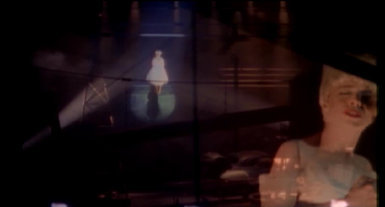
In the reproduced frame, the enlarged face and smaller suspended figure occupy the image together. This makes scale unstable. The viewer is offered intimacy and distance at once, while the stage remains visible as an environment. The frame supports that visual observation; movement, transitions and their precise timing require the complete video.
Julee Cruise: performance from inside the harness
Ralph Traitor’s January 1991 Sounds feature gives Cruise space to describe the experience. She recalls the suspension as physically demanding but also strangely pleasurable: bright light, fog and distance from the audience changed how the stage felt from above. She also explains the work as the dream of a woman after a breakup. This testimony concerns her embodied experience, rather than a critic guessing what the image meant to its performer. “High Flyer,” p. 18 ↗
“floating” is both a musical impression and a physical arrangement. The image may seem weightless, but the performer’s account brings back the body, the harness and the distance from the audience. That tension makes Cruise more than a decorative emblem of Lynch’s imagination. The work depends on a specific singer undertaking a demanding performance.
The filmed breakup uses Laura Dern and Nicolas Cage, while the stage dream is organised around Cruise. Music Box’s synopsis describes a heartbroken woman’s dream-self moving above an industrial wasteland. Shared actors with Wild at Heart are an important connection, but do not establish that these roles are Sailor and Lula. Synopsis and cast record ↗
Nor should Cruise’s resemblance to other blonde figures in Lynch’s work be turned into a definitive character identification. A comparison may be illuminating without making this a lost Twin Peaks episode. The dossier’s point of departure is the work’s own title, situation, performers and presentation.
A song cycle inside a sound environment
The musical relationship belongs to the collaboration between Cruise, Badalamenti and Lynch documented in the Music dossier. Sacred Bones’ reissue record for Floating Into the Night places the 1989 album within that partnership and supplies its track list. The album is a crucial listening companion, but it is not a substitute for the performance soundtrack. Album record ↗
Several distinctions matter when listening: the studio song, a performance playback source, a voice recorded in the theatre, the amplified sound heard by the audience, and the sound subsequently edited or mixed for the video. The fact that the event happened live does not establish that every sound originated live on stage.
John Gurrin’s NYU biography explicitly records his sound work on Industrial Symphony No. 1 at BAM for HBO. This gives a named participant and a recording context. It does not, by itself, identify the source of each vocal or prove the date of a broadcast. Participant’s professional record ↗
Chinita’s study distinguishes predominantly playback singing from a live vocal for “Rockin’ Back Inside My Heart.” That is a useful claim to test against recording documents and the identified video edition, not a completed stem-by-stem audio audit here. Performance and mediation discussion ↗
Our listening route: begin by noting what each sound appears to belong to. A voice can seem intimate while its body is far away. A mechanical sound can enlarge a space beyond what the frame shows. Then compare the corresponding album recording without assuming that a familiar melody means an identical take, mix or duration. The future cue sheet will record these relationships at edition-specific timecodes.
The performance and the camera are different witnesses
Chinita’s 2021 essay treats the stage event and video as distinct forms of sensory experience. Her examples include an onstage camera feed and the later screen image’s superimpositions and changes of scale. Her interpretation gives the video its own formal importance, instead of treating it as transparent documentation. Expanded Lynch ↗
A camera record selects an angle; editing selects a duration and relation between images. A video close-up can direct attention to a face that a theatre audience saw at a distance. This distinction is particularly useful here because the surviving image materials combine performance space and enlarged figures. The result should be studied as an audiovisual work, alongside the event it records.
A filming-date question we are keeping open
Traitor’s Sounds introduction states that filming happened the day after the live production. Miller’s later account of the “Rockin’ Back Inside My Heart” footage describes recordings of two live performances on 10 November. These are not equivalent claims. The first is journalistic introductory text, not a directly quoted statement by Cruise; the second is later specialist reporting. Neither alone resolves whether there were additional camera sessions, pickups or multiple recording dates. 1991 feature · Later footage history
The appropriate next evidence is a camera report, call sheet, stage diary, recording log or production correspondence. Until then, this dossier dates the stage event separately from the video’s release and leaves the precise filming schedule unresolved. It does not silently choose the most frequently repeated account.
The video object: marketing, formats and reception
| Record | What it establishes |
|---|---|
| 1989 programme | The advertised BAM event on 10 November. It is not a home-video release date. |
| 1990 trade listing | Billboard, 11 August, lists the work among Warner Reprise Video’s offerings, with Julee Cruise, at $19.98. This is a contemporary retail record. |
| 1991 British review | Sounds identifies a Warner Video release at £9.99. Prices describe those historical listings. |
| The Lime Green Set | DVDCompare records 1.33:1 and reformatted 1.78:1 presentations on disc eight, plus a 10:40 interview supplement. These are reported disc specifications, not our own playback measurements. |
DVDCompare reports durations of 49:24 and 49:25 for the two NTSC presentations, and different stereo encodings: Dolby Digital for 1.33:1 and LPCM for 1.78:1. A one-second difference does not demonstrate an added scene; a wider frame does not by itself establish additional photographed information. Framing, credits, sound and contents need direct comparison. Edition record ↗
Music Box’s retrospective page lists 140 minutes but explicitly includes a 90-minute programme of commercials and music videos before the work. That total should not be copied as the runtime of Industrial Symphony itself. The listing also shows the piece continuing to circulate alongside Lynch’s shorter commissioned images. Programme context ↗
Reception was not uniformly celebratory. Traitor’s contemporary review admires individual images while questioning the work’s obscurity and indulgence. Chinita’s later scholarship instead develops a sustained account of its relationship between media and sensation. Those positions ask different questions: whether the spectacle engages a viewer, and how its forms operate. Contemporary criticism · Later scholarship
Our assessment: the work deserves a place between music, theatre and moving-image practice because each changes what the others can do.
Continue into the music videos ↗ · Explore the museum’s edition research ↗
Explore further
Follow the sources below, explore the museum collection, or continue through the Reading Room. New archival discoveries and contributions enrich the record of Lynch’s work.
Sources and further reading
These notes distinguish records read, images inspected, participant accounts and uncompleted viewing. All web sources were checked on 18 October 2026. Linked catalogue information does not establish the contents of an unseen edition.
- BAM: New Music America advertisement, DownBeat (September 1989) ↗PDF p. 7 visually inspected. An original advertisement establishes the announced programme, not actual running times or camera dates.
- Tom Gartland, Sound for Multi-Venue Festivals (April 1990) ↗Recording Engineer/Producer, printed pp. 56–59 / PDF pp. 54–57. Text inspected; p. 58 rendered and checked. Participant report about festival operations.
- Steven Miller, VH-1 To One: Julee Cruise’s Floating Into the Night (2025 transcription) ↗Parts one to three and the introduction read.
- Yale Evelev interview, Superfly Records ↗Participant recollection, the “What’s happening?” answer on BAM and New Music America; not a contemporary production document.
- Ralph Traitor, High Flyer and video review, Sounds (26 January 1991) ↗Printed/PDF p. 18 visually inspected. Interview testimony, introductory reporting and review are treated separately; the filming-date assertion belongs to the introduction.
- John Gurrin, NYU Tisch faculty biography ↗Paragraph on Film/Music recording projects inspected. A participant credit lead; no production sound log or HBO transmission record inspected.
- Sacred Bones: Julee Cruise, Floating Into the Night ↗Reissue description and track list read; the 2023 issue date is separate from the 1989 album.
- Fátima Chinita, Expanded Lynch (WiderScreen, 2021) ↗Peer-reviewed study: stage/video distinction, playback discussion and image 11 inspected. Interpretations and audio assertions remain attributed.
- Billboard: Warner Reprise Video listing (11 August 1990) ↗Printed p. V-16 / PDF p. 62, last column near bottom, visually checked. Contemporary retail listing.
- DVDCompare: Industrial Symphony No. 1, Lime Green Set ↗Vincent Prendergast’s 4 April 2021 comparison read. Reported framing, timings and audio formats; no disc inspected in this pass.
- Music Box Theatre: Industrial Symphony No. 1 ↗Exhibitor synopsis, programme note and supplied still inspected in browser. Its 140-minute listing includes a preceding 90-minute programme.
Another doorway
Continue exploring
Music
Music
Explore David Lynch’s albums and collaborators, from Julee Cruise and Thought Gang to Chrystabell, with recording histories, edition notes and sources.
Music
Music Videos
Explore David Lynch’s music videos, from Chris Isaak and Moby to Nine Inch Nails and Chrystabell, through the artists, images and collaborations.
Films
Wild at Heart
Explore Wild at Heart (1990) through 32 illustrated scenes, 14 dialogue and song studies, screenplay research, sound credits and release history.
Image credits and sources accompany each linked guide.