Unmade & Unfinished Projects
Development archive / Scripts, drawings and roads not taken
The films that remained on paper still have histories.
A black binder, a yellow floor plan, a remembered pitch: David Lynch’s unmade work survives in very different forms. Some projects reached a screenplay or design meeting. Others entered preproduction, circulated among financiers, or changed through years of rewriting. Their absence from the screen does not make them interchangeable.
This dossier follows the most substantial evidence available here, from Gardenback and Ronnie Rocket to Snootworld and Unrecorded Night. It brings together document studies, participant accounts and an annotated project register. It also asks what these works reveal about collaboration, adaptation and the conditions under which a film can become possible.
What does “unmade” mean?
A surviving work on paper
A dated screenplay, drawing or treatment is an object that can be described. It records one stage of a project. It cannot tell us the finished film’s rhythm, performances, soundtrack or final cut.
A proposed production
A pitch, financing conversation or preproduction period has its own evidence. A participant’s later account is valuable testimony; a signed agreement or dated production file would answer different questions.
We use unmade for a proposed screen work that did not become a completed released production, and unfinished when the surviving evidence concerns an incomplete document or an interrupted process. A script can be finished while its film remains unmade. A rejected pilot that becomes a feature has a different history again.
The distinction protects the work from two tempting stories: that every title was a fully planned masterpiece, or that every abandoned project was a failure. Both judgements presume the film we cannot see. The available materials are more interesting when allowed to remain scripts, drawings, choices and negotiations.
Ronnie Rocket: opening the binder
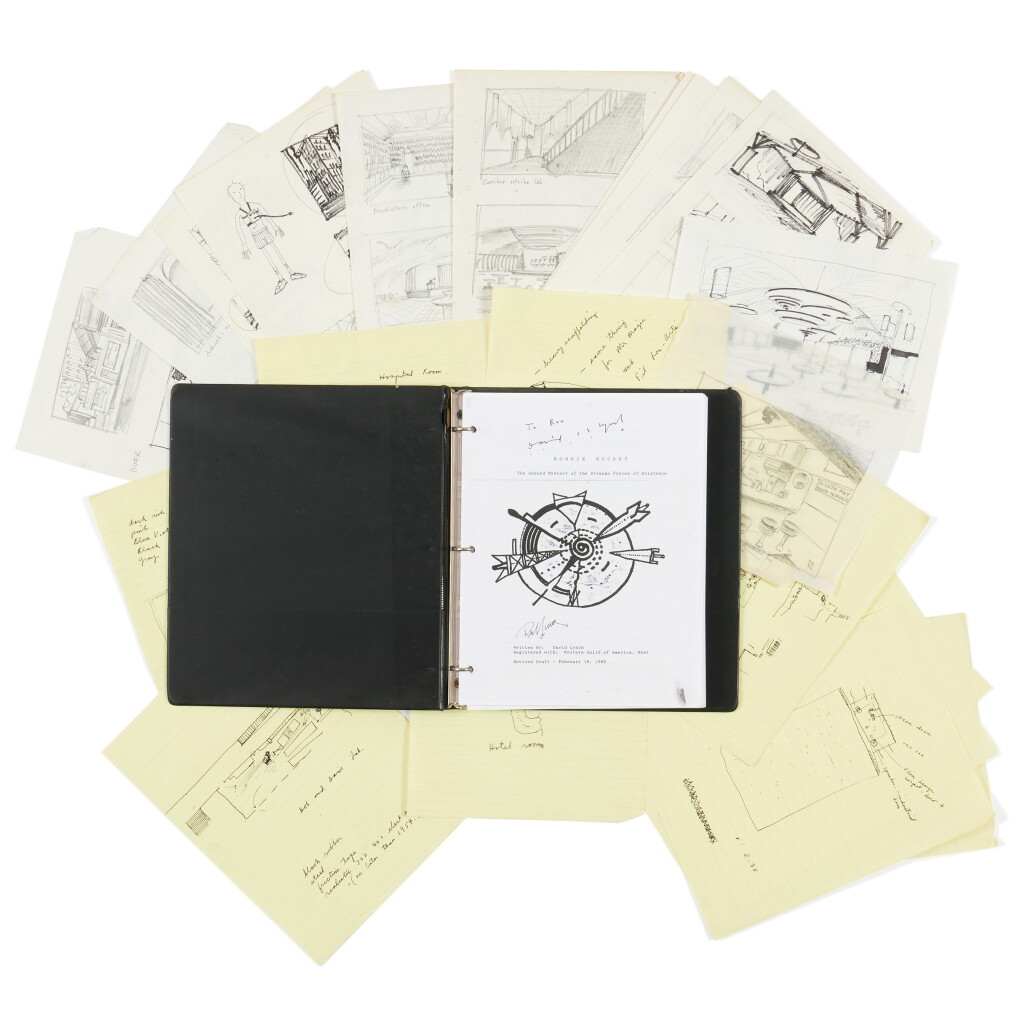
Sotheby’s 2025 catalogue records a revised draft of Ronnie Rocket: The Absurd Mystery of the Strange Forces of Existence, dated 18 February 1988, from illustrator Ron Miller’s collection. The bound script is accompanied by eleven drawings attributed to Lynch and twenty-two to Miller. [1]
In Margo Gonzalez’s accompanying feature, Miller recalls meeting Lynch at his home in 1988 to discuss the project’s visual world. Lynch’s floor plans and Miller’s drawings made the discussion concrete: rooms, businesses and urban spaces could be considered as environments to build. Miller also recalls returning to the ideas digitally much later. That later activity belongs to the project’s long afterlife, not automatically to its 1988 design phase. [2]
A document study: two kinds of drawing
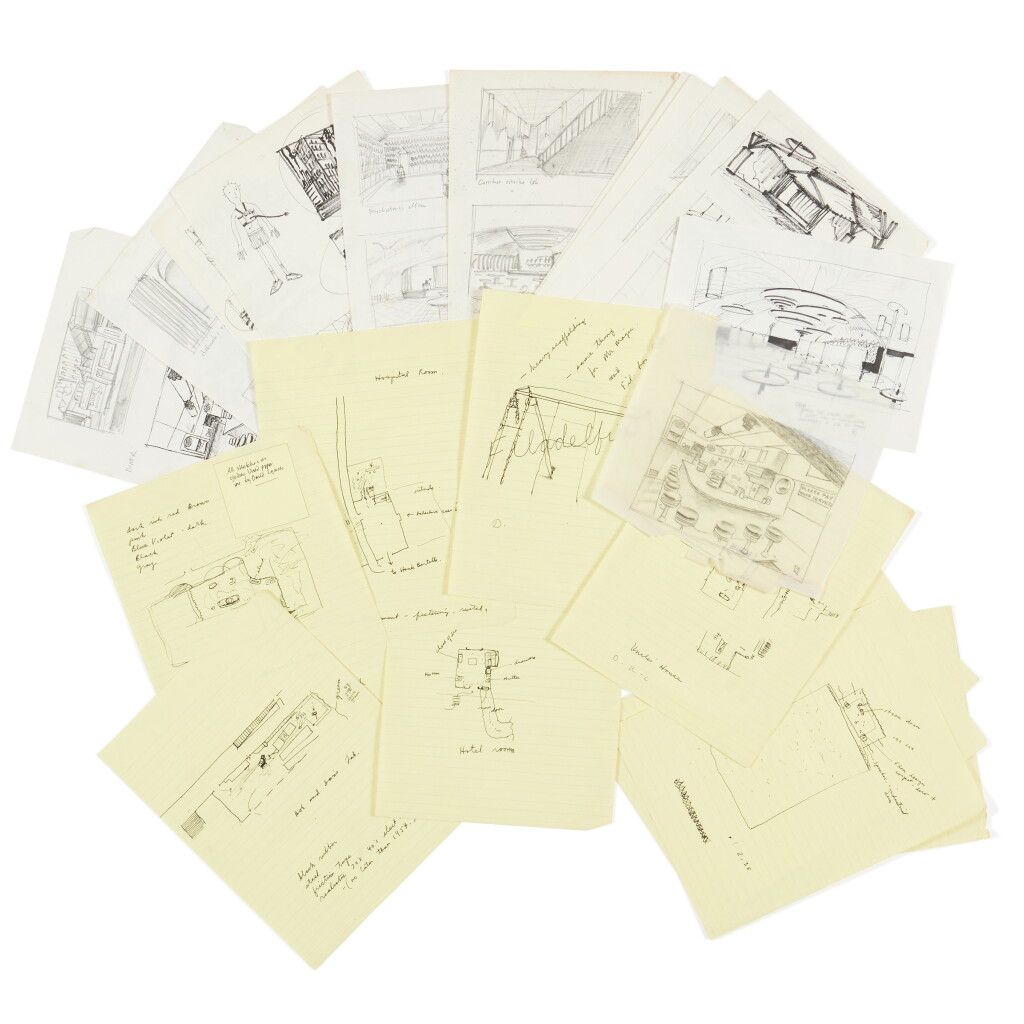
The yellow sheets and white sheets do different jobs. The yellow plans flatten spaces into arrangements of boundaries and connections. The white drawings offer more immediately pictorial views, with perspective and architectural detail. A plan can organize where a body might move; a perspective can propose what that movement might feel like to see.
The display also makes the binder an anchor. In the opening photograph, its dark rectangle holds the centre of a fan of loose papers. The photograph presents a coherent collection, but its arrangement is an auction presentation, not evidence that Lynch and Miller worked with the documents in this order. The overlapping sheets conceal portions of the drawings. Reading every inscription, identifying every space and matching a drawing to a script scene require the individual documents.
This is a useful alternative to illustrating an unmade film with a fabricated frame. We can see real preparatory labour: changing scales, the division between plan and view, and the physical separation of script and drawings. We cannot see a lost shot from Ronnie Rocket. The image’s credit therefore identifies the object and its presentation, rather than pretending it is a production still.
A project that did not have one ending
At the 1992 Cannes press conference for Fire Walk with Me, Lynch said he was not making Ronnie Rocket immediately and was considering One Saliva Bubble, without certainty. This contemporary statement is narrower than a permanent cancellation announcement. The preserved transcript comes through Cinema Papers material reproduced by Twin Peaks Blog. [3]
Phil Hoad’s production-history feature places the project among the difficulties of financing Lynch’s work and describes an unsuccessful Ronnie Rocket pitch within the Ciby 2000 relationship. This supplies an industrial context; it does not establish a single cause for every period in which the film remained unmade. [4]
One Saliva Bubble: a tiny accident, a designed world
The Lynchnet transcription credits David Lynch and Mark Frost and identifies a first draft dated 20 May 1987. Mike Dunn’s transcription alters the formatting and removes page numbers, so the guide uses scene headings to locate passages. [5]
In the opening tracking-station sequence, an elaborate military installation is disrupted by a guard’s saliva bubble. The next movement introduces Newtonville, Kansas, through electrical signage, a roller rink and aggressively comic businesses. The script moves from microscopic accident to a town already organized around charge, light and exaggerated behaviour. [5]
The visual joke depends on scale. An institution equipped to control immense forces is vulnerable to an almost negligible bodily event. The subsequent town introduction makes electricity a civic style as well as a plot mechanism. This is a specific written construction; comparison with the electrical worlds of Lynch’s completed films is suggestive, but does not prove that any later scene was transferred from this draft.
Frost’s coauthorship matters here. Treating the screenplay simply as an extension of Lynch’s private imagination would erase the collaboration named on its title page. Conversely, the byline cannot tell us who supplied a particular joke, scene or structure. That requires drafts or the writers’ specific testimony.
The 1992 Cannes remarks show that Lynch was still publicly considering the project five years after the transcription’s stated draft date. They do not certify the draft then in circulation, a cast, or secured financing. A script can remain alive as a possibility while its practical form changes. [3]
Adaptation: when the source resists the film
The Metamorphosis
Matteo Marino’s account of a September 2014 Lucca Film Festival question preserves Lynch’s explanation in Italian: he had written an adaptation, anticipated a limited audience and expensive insect effects, and ultimately felt Kafka’s work should remain a book. The account combines commercial and artistic reasons. Reducing it to “the insect could not be built” loses Lynch’s judgement about the original medium. [6]
Choosing to stop can be an artistic decision. An adaptation is not obliged to demonstrate that every image in a book can be manufactured. It has to discover what a different medium can add. Until the screenplay and its drawings are examined, we should not substitute a catalogue of Kafka-like moments in other films for an account of this particular adaptation.
Dune II: a partial script is not a missing sequel
Max Évry found fifty-six pages in the Frank Herbert papers at California State University, Fullerton, in July 2023. His Wired account describes dates of 2–9 January 1984 and annotations by Herbert. He reads the opening as a substantial reworking of Dune Messiah, with Scytale and Duncan Idaho given particular prominence. [7]
The university’s research guide confirms the Herbert collection as an archival route. It is not itself a facsimile of this script or a substitute for a box-and-folder citation. [8] Our Dune dossier supplies the completed film’s production context. Keeping these records distinct prevents the sequel’s potential from becoming evidence about what the 1984 film actually contains.
Love in Vain: whose screenplay?
In a November 2012 account published by University of Minnesota Press, writer Alan Greenberg said Lynch was trying to produce and direct his Robert Johnson project with French financing. The screenplay is Greenberg’s. The article’s confidence that the film would eventually be made is a participant’s expectation at that date, not a subsequent production record. [9]
This case expands the meaning of the archive: Lynch’s involvement might be as a prospective interpreter and producer of another writer’s work. Authorship, financing and direction need their own credit fields.
Late projects: collaboration and continued revision
Snootworld
Andreas Wiseman’s April 2024 interview with Lynch and Caroline Thompson provides a particularly clear account of collaboration. The proposed animation grew from Lynch’s drawings; Thompson describes writing the first and third acts, with Lynch writing the middle. Its small creatures and an episode of becoming lost in a carpet point toward a fantasy built around changes of scale. [10]
Lynch said Netflix had rejected a recent pitch. His explanation of the rejection expresses his view of contemporary animation, not a confirmed account of Netflix’s reasoning. Direction was also unsettled in the interview: he discussed several possibilities. It would be misleading to turn that conversation into a fully staffed production announcement. [10]
Unrecorded Night
Producer Sabrina Sutherland’s May 2025 interview with Matt Fagerholm describes a project assembled from older writing and new work, interrupted around the 2020 production shutdown, then extensively revised. Her account of Dream of the Bovine also recalls preproduction after Lost Highway. [11]
In a separate July 2025 interview, Sutherland again describes the Netflix preparation and continuing rewrites. She expresses hope that the writing could become available in book form. Hope for publication is not an announced edition or release date. Nor are two interviews with the same witness two independent confirmations. [12]
Repeated revision changes what “the project” means. A preproduction version and a later rewritten version may share a name while differing substantially. We make no claim here about a secret completed film, a definitive episode count, or the identity of publicly discussed working titles.
A selected project register
Ten projects trace the changing shape of Lynch’s unmade work, from early screenplays to late collaborations. Dates identify the document, development period or published account.
| Project | Evidence in this dossier | What remains open |
|---|---|---|
| Gardenback | Lynch’s retrospective account to Chris Rodley: a short script expanded through AFI discussions before he moved to Eraserhead. [13] | Original and expanded drafts; AFI records and collaborators’ accounts. |
| Ronnie Rocket | 1988 revised-draft catalogue record; photographed designs; Miller’s recollection. | Draft comparison and full drawing-to-scene identification. |
| The Metamorphosis | Lynch’s adaptation and abandonment account at Lucca, 2014. | Screenplay, storyboards and original-language recording. |
| Dune II | Évry’s report of a partial 1984 script in the Herbert papers. | Direct archival inspection and Herbert’s individual annotations. |
| One Saliva Bubble | 1987 first-draft transcription; selected opening passages read; 1992 remarks. | Complete authenticated draft and version history. |
| The Lemurians | Hoad’s production history describes an unsuccessful Lynch–Frost proposal to NBC. [4] | Pitch documents, dated correspondence and proposed format. |
| Dream of the Bovine | Sutherland’s 2025 recollection of preproduction. | Dated production records and screenplay credit/version checks. |
| Love in Vain | Greenberg’s 2012 account of Lynch’s proposed involvement. | Published screenplay, agreements and later development history. |
| Snootworld | Lynch and Thompson’s April 2024 interview. | Complete script, dated designs and financing documentation. |
| Unrecorded Night | Sutherland’s 2025 accounts of preparation and rewriting. | Version chronology, production records and any authorized publication. |
Gardenback is especially revealing. In Rodley’s published excerpt, Lynch describes how the demand for a longer script led to meetings with Frank Daniel and other AFI colleagues. He judged the expanded result diluted, yet also acknowledged learning about scenes and structure. An abandoned work can leave a method behind without becoming the same story under a new title. [13]
Lynch’s account of Dream of the Bovine
In the 2018 Room to Dream reading “Next Door to Dark,” Lynch remembers writing Dream of the Bovine with Bob Engels and approaching Marlon Brando through Harry Dean Stanton. In Lynch’s telling, Brando disliked the script. The passage records a proposed collaboration that did not happen; it does not establish a cast commitment or a completed film.
This earlier account belongs beside Sutherland’s later recollection of another period of preparation. Keeping the witnesses and the moments separate allows the project’s development to remain a history of changing possibilities. Next Door to Dark, 27:57–29:03 · source guide →
The afterlife of an unmade work
There are several kinds of reception here. A financier evaluates a proposal; a collaborator remembers working on it; an auction catalogue makes a physical object legible to buyers; a critic imagines how a surviving script might have played. Their judgements answer different questions. A seller’s enthusiasm and a researcher’s counterfactual excitement should not be mistaken for reviews of a film that exists.
The archive’s task is to preserve those encounters without collapsing them. A screenplay’s publication could make sustained textual criticism possible. An exhibition could reveal a drawing’s scale and surface. Neither would recover performances or editing that were never completed. A later adaptation by someone else would create another work, with another authorship history.
There is also a productive contrast with Mulholland Drive, whose television origins and feature transformation belong to a documented completed work. Reworking, cancellation, interruption and non-release are different outcomes. The same care applies to material removed from a finished film: see Fire Walk with Me and The Missing Pieces.
Their detailed histories should grow from identifiable scripts, contemporary reporting and credited participants, rather than a recycled list of intriguing titles.
Explore further
Follow the sources below, explore the museum collection, or continue through the Reading Room. New archival discoveries and contributions enrich the record of Lynch’s work.
Sources and further reading
Interviews, production records, criticism and image sources behind this dossier.
- Sotheby’s, lot 48: Ron Miller / Ronnie Rocket (3 April 2025) ↗Auction catalogue and photograph of the binder and drawings, with attribution and provenance information.
- Margo Gonzalez, A Rare and Intimate Look Inside David Lynch’s Unmade Film Ronnie Rocket (26 March 2025) ↗Miller’s interview and three collection photographs inspected. Auction-house editorial and participant recollection; not independent authentication. Image studies concern the reproductions shown.
- 1992 Cannes press conference, reproduced by Twin Peaks Blog (16 June 2021) ↗Ronnie Rocket / One Saliva Bubble exchange read in the reproduced Cinema Papers transcript. Original conference recording not reviewed here.
- Phil Hoad, David Lynch: indie empire (BFI / Sight and Sound) ↗Ronnie Rocket/Ciby 2000, Lemurians and financing passages read. Web publication 20 January 2026, from the October 2025 issue.
- One Saliva Bubble, first-draft transcription, 20 May 1987 ↗Mike Dunn’s transcription: title/byline/date and opening tracking-station and Newtonville passages read. Page numbers removed by transcriber; neither complete screenplay study nor authenticated facsimile comparison completed. The source is HTTP-only.
- Matteo Marino, Lynch explains The Metamorphosis at Lucca (10 November 2014) ↗Italian account and translated answer read. Question dated 29 September 2014.
- Max Évry, I Found David Lynch’s Lost Dune II Script (Wired, January 2024) ↗Researcher’s discovery account and opening-script discussion read.
- California State University, Fullerton: Frank Herbert’s Dune research guide ↗Institutional collection context inspected. This guide does not establish an item-level shelf mark for Lynch’s sequel draft.
- Alan Greenberg, Calling Hollywood’s Bluff, part 3 (28 November 2012) ↗Writer’s account of prospective Lynch involvement read. Publication expectation remains a dated claim.
- Andreas Wiseman interviews Lynch and Caroline Thompson on Snootworld (Deadline, 8 April 2024) ↗Published participant statements read, including writing division, pitch and unsettled direction.
- Matt Fagerholm interviews Sabrina S. Sutherland (Cinema Femme, 23 May 2025) ↗Dream of the Bovine, Unrecorded Night, rewriting and archival hopes passages read. Retrospective producer testimony.
- Sabrina S. Sutherland interview (New England Sounds, 7 July 2025) ↗Netflix preparation, shutdown, later rewriting and possible book discussion read. Same witness as Cinema Femme; not independent corroboration.
- Chris Rodley, I See Myself: Eraserhead (Criterion, 16 September 2014) ↗Gardenback/AFI passages read in the authorized excerpt from Lynch on Lynch (1997); interviews conducted 1993–96.
Another doorway
Continue exploring
Films
Dune
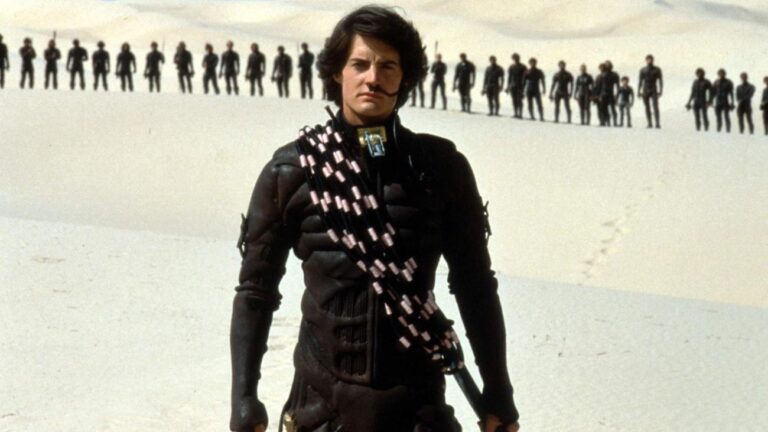
Explore David Lynch’s Dune through Freddie Francis’s photography, Kyle MacLachlan’s testimony, adaptation, critical reception and original museum objects.
Films
Mulholland Drive
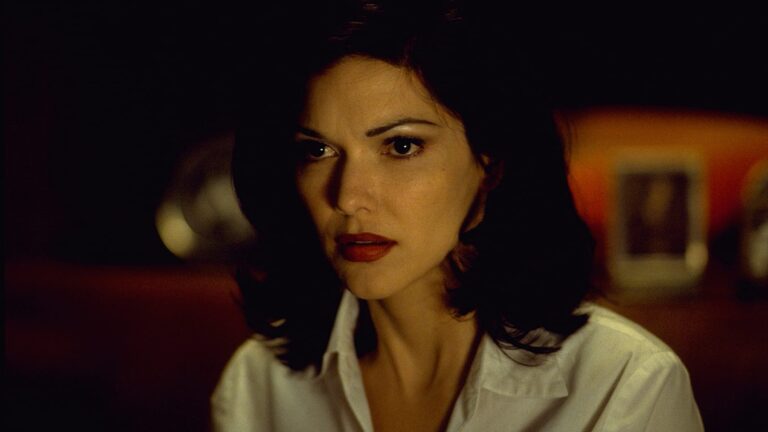
Explore Mulholland Drive through 45 illustrated scenes, dialogue studies, music and sound credits, Club Silencio, production history and edition research.
Films
Lynch as an Actor
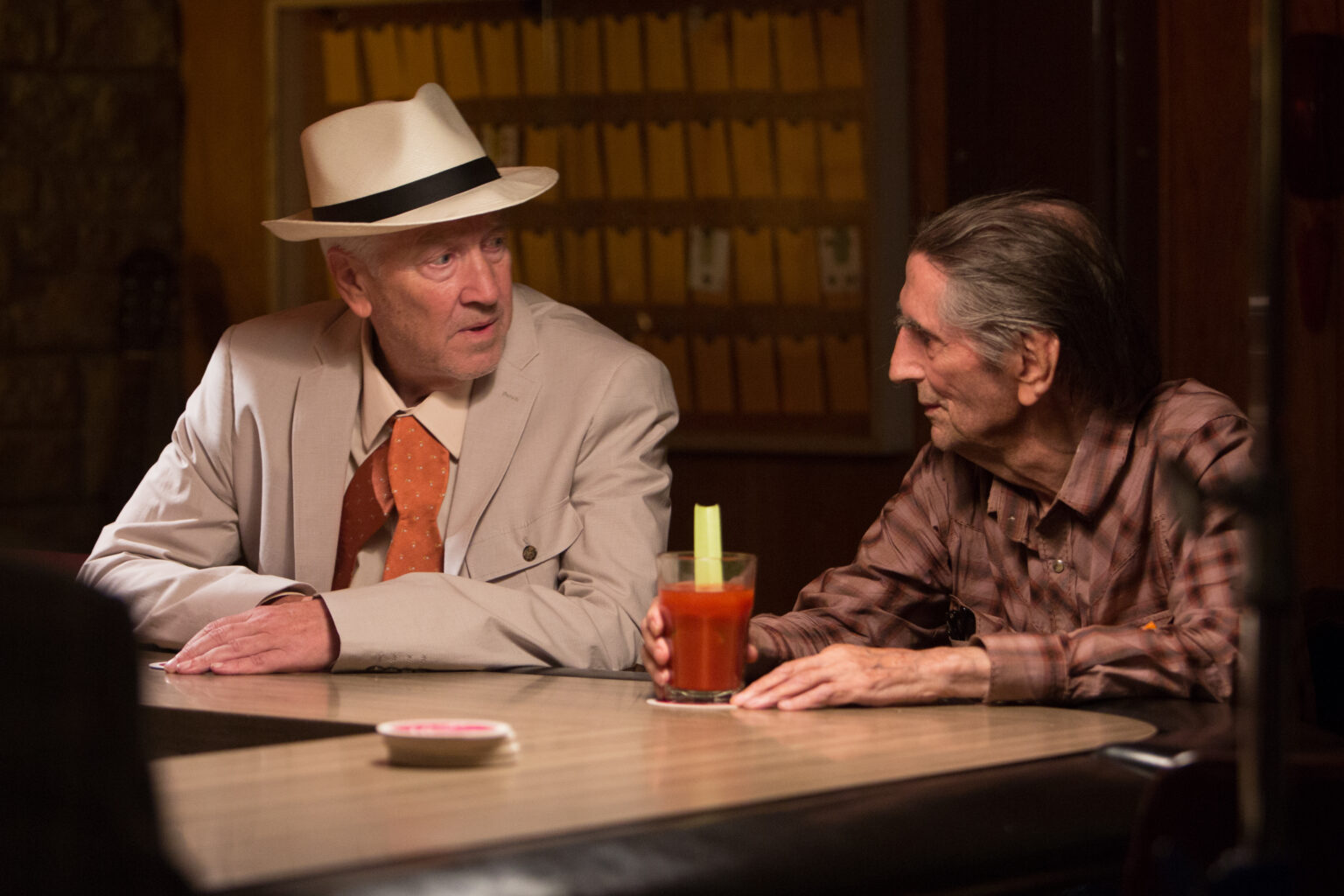
Explore David Lynch’s acting in Twin Peaks, Zelly and Me, Louie, Lucky and The Fabelmans, with collaborator testimony, credited stills and research notes.
Image credits and sources accompany each linked guide.