Twin Peaks: Episode 5 — Cooper’s Dreams
1990 · Written by Mark Frost · Directed by Lesli Linka Glatter
Witnesses speak through objects, rooms and other people. Follow the Log Lady’s testimony, Audrey’s concealed viewpoints and the hotel party that turns grief into a dance.
Regular Episode 5 · Often listed as Season 1, Episode 6. Contains episode spoilers.
Explore this episode
A town that will not let Cooper sleep
Cooper begins by trying to narrate an inconvenience into order. He records the time, the hotel noise and his resolution to travel with earplugs. The detective who can organise an investigation cannot control the room around him. At breakfast, Audrey arrives with her own proposal: working in her father’s department store might help her discover what happened to Laura. The episode immediately puts professional and unofficial investigation beside one another.
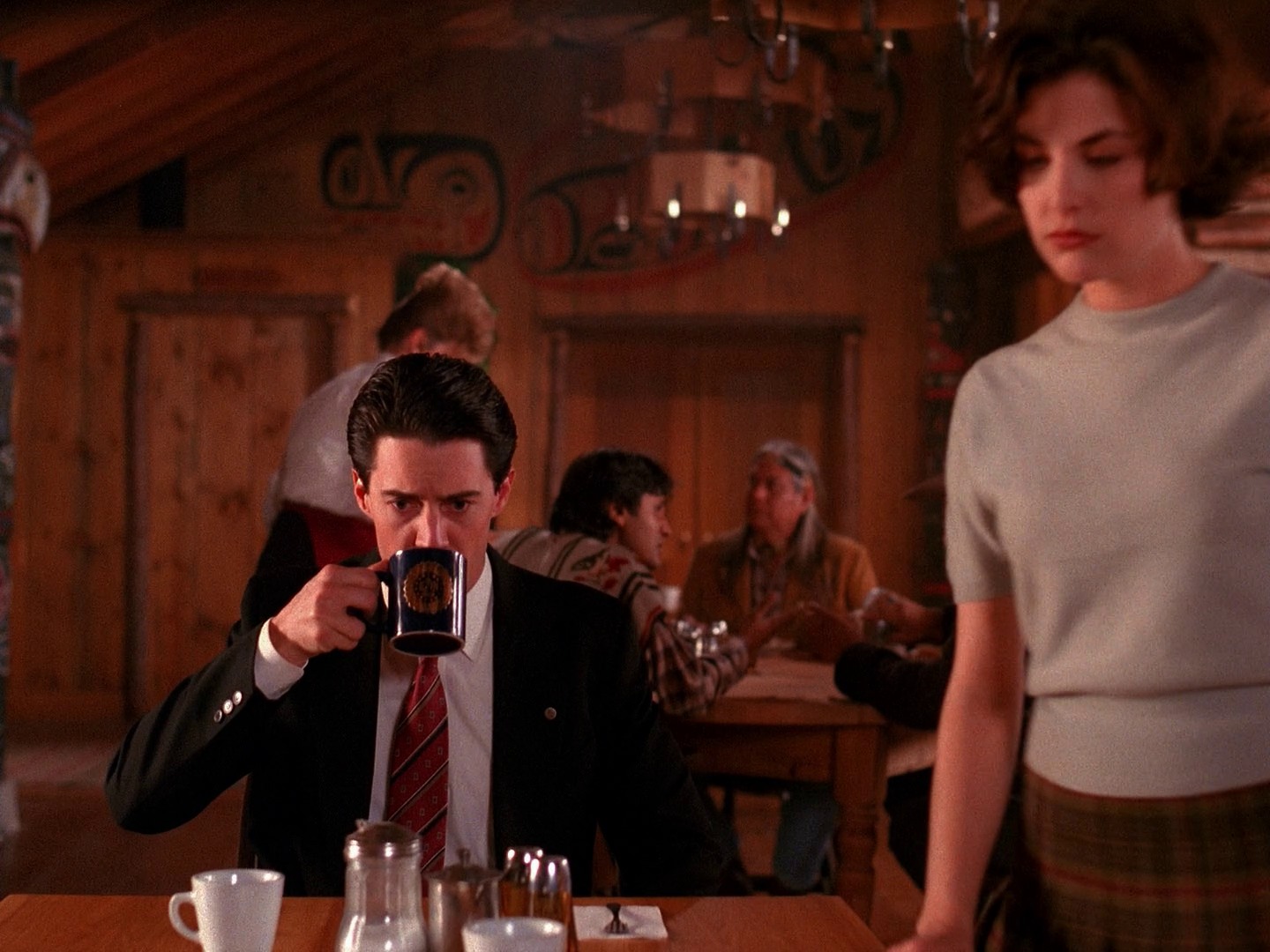
The Icelandic visitors connect the opening disturbance to the Horne family’s commercial ambitions. Jerry returns with a leg of lamb and extravagant enthusiasm; Ben has investors to entertain. Leland wants to work because idleness leaves him with his grief. Three kinds of appetite occupy the same business: profit, pleasure and the desire to stop thinking. The party later brings them into a single crowded room.
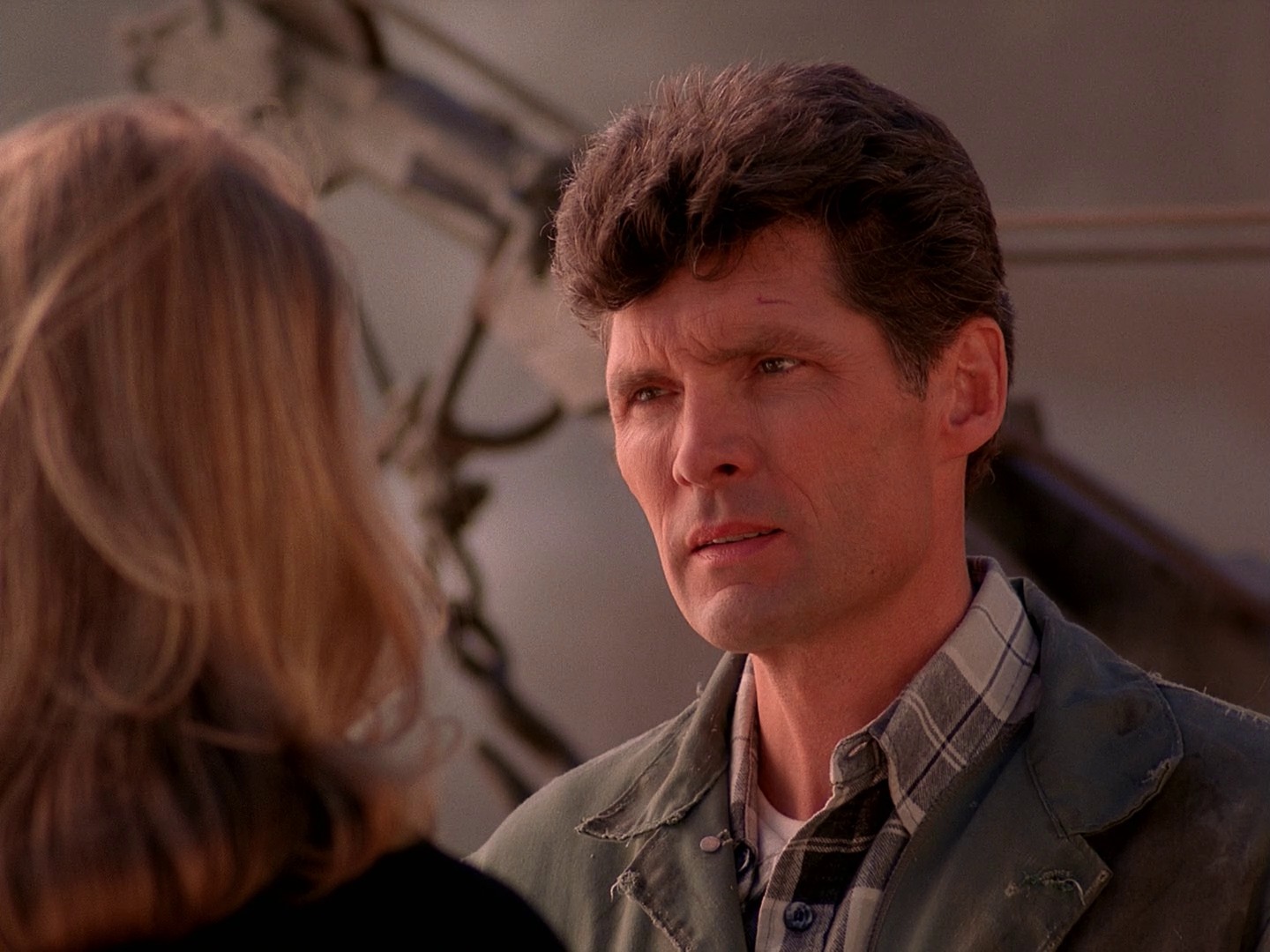
Norma and Ed’s conversation at the garage supplies a quieter counterpoint. His life with Nadine and her marriage to Hank are not obstacles that can be solved by a clever investigative performance. They talk about what they have accepted and what remains unfulfilled. The service station’s ordinary working environment makes their suspended life especially palpable.
Who gets to tell Laura’s story?
The search of Jacques Renault’s apartment turns printed matter into a route through the case. Blood typing changes the meaning of Leo’s shirt. A magazine image, its background and the connection to Jacques’s address invite Cooper to move between a photograph and a place. The deduction is persuasive because an overlooked piece of scenery becomes evidence, rather than because the image simply names its subject.
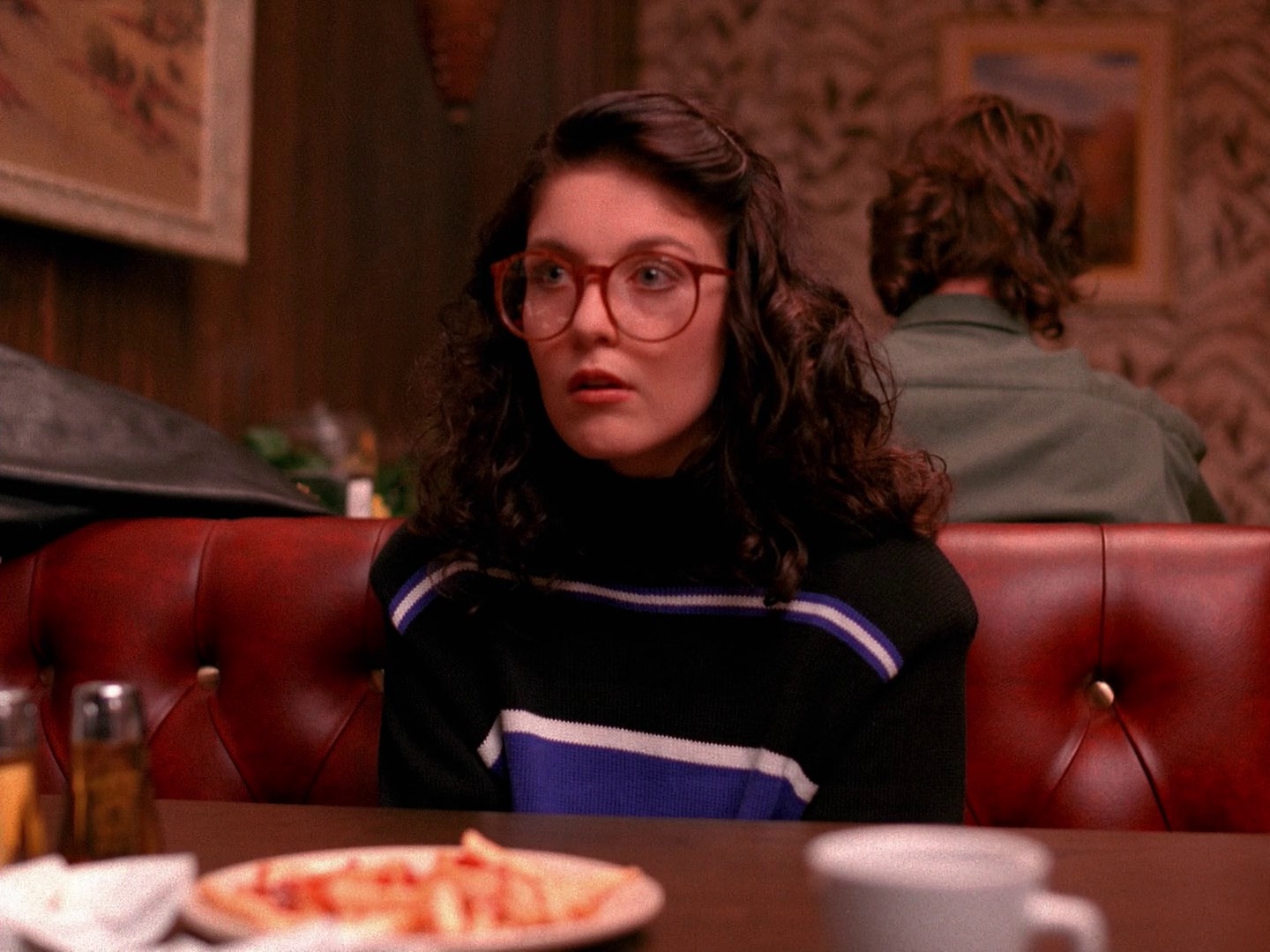
At the diner, Donna and James recruit Maddy into a different investigation. Her resemblance to Laura is already emotionally charged, but she is also a relative with access to the Palmer household. The scene gives her a task rather than treating her only as a disturbing likeness. Her later discovery of the tape in the bedpost joins the episode’s network of concealed objects and private messages.
Jacoby’s questioning of Bobby is much less neutral. After the parents leave, his language becomes deliberately provocative. Bobby’s defensiveness changes into distress, and the scene offers an account of Laura’s despair and the pressure surrounding drugs. Yet this is an exchange between a grieving, implicated young man and a therapist who is actively shaping the conversation. Jacoby’s claim about Laura’s motives must remain his interpretation, not become the dossier’s diagnosis of her.
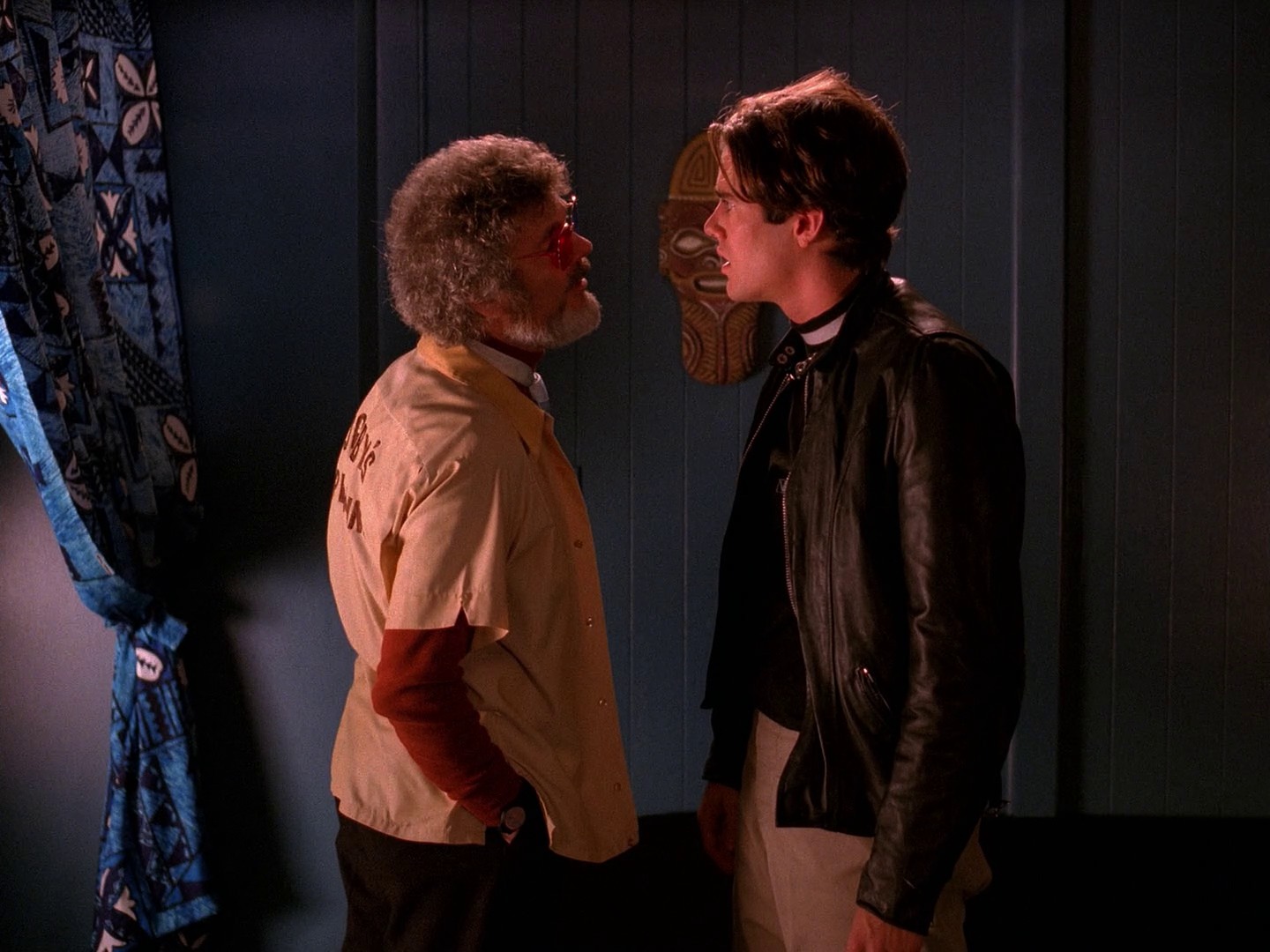
The blocking reinforces that pressure. Jacoby closes the physical distance; Bobby moves from a sprawled posture to a more exposed position. The scene replaces the comfortable model of an interview that merely retrieves facts with an encounter that produces its own emotional conditions. What Bobby says matters, and so does how he is led towards saying it.
Tea before testimony
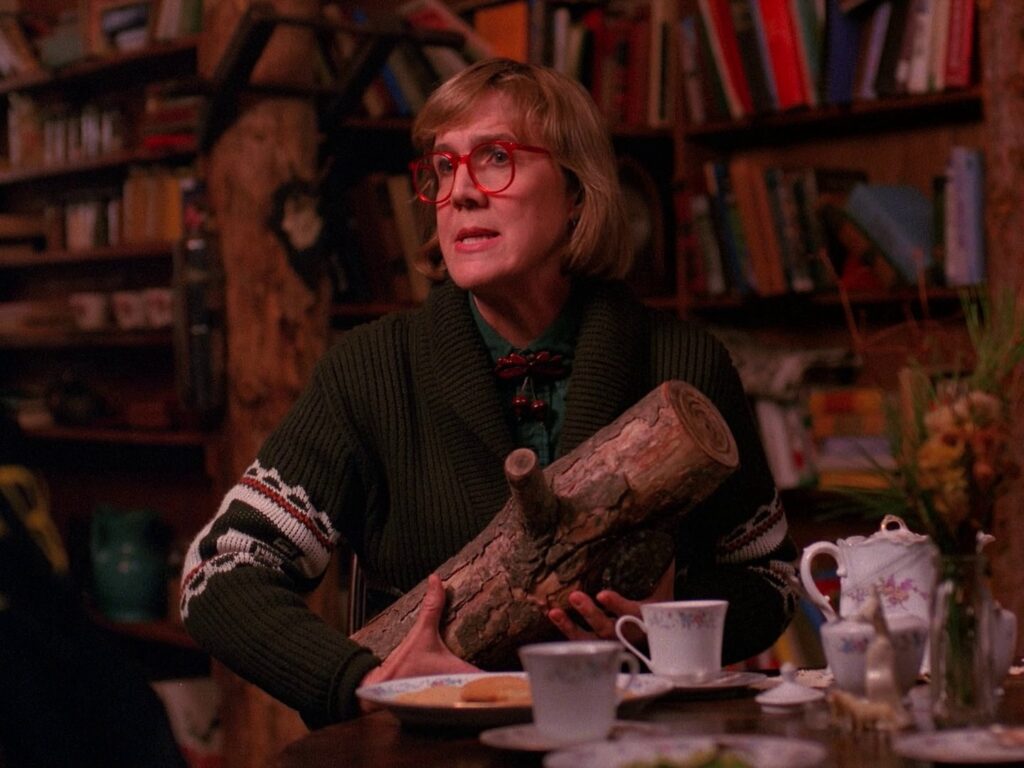
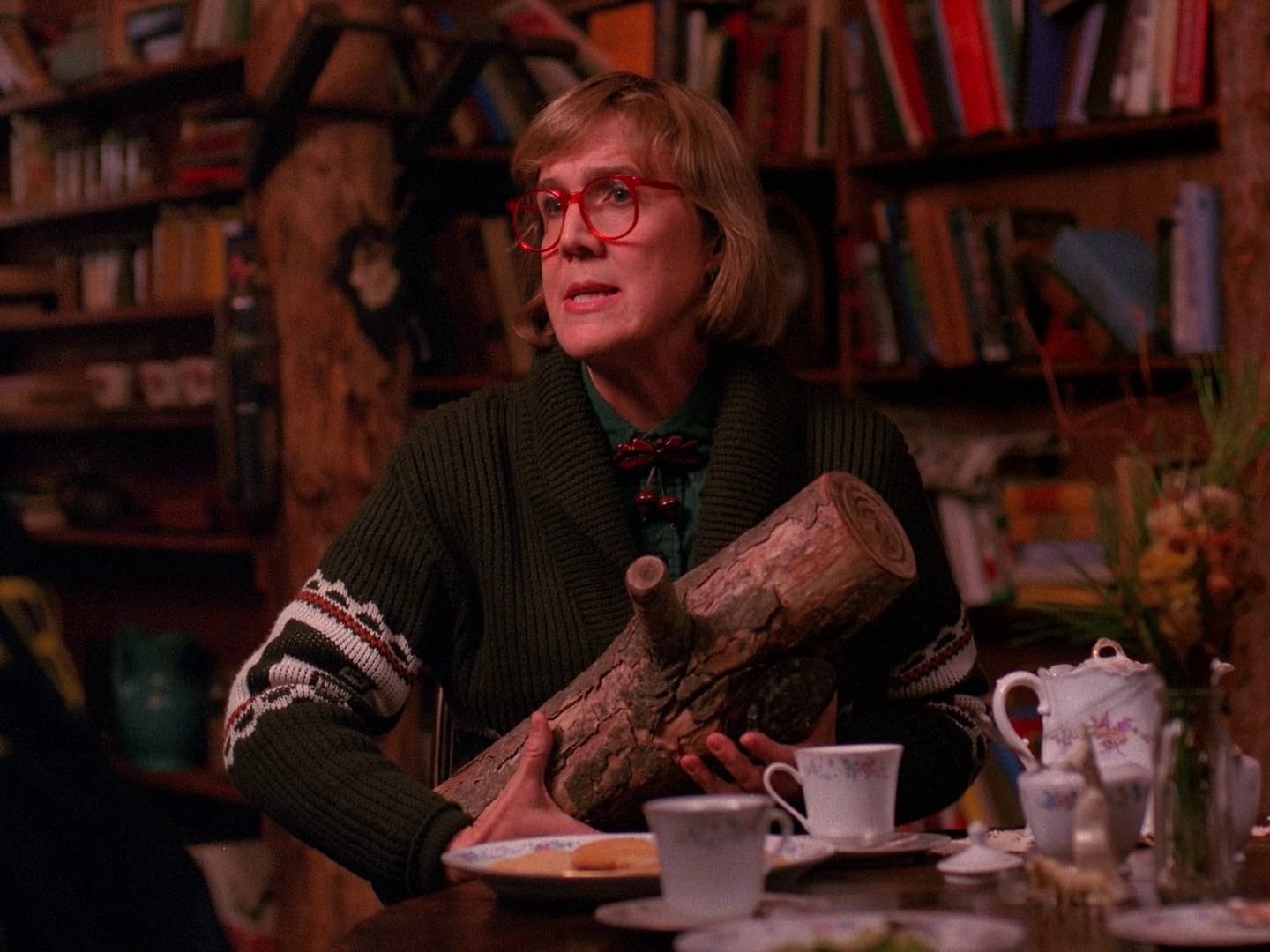
The armed approach to the cabin is answered by the Log Lady’s domestic authority. She has been expecting the visitors and decides the order of events: hospitality comes first. Tea, cookies, chairs and a crowded table replace the investigators’ outdoor formation. They have entered someone else’s method of knowing.
Her description of her husband, fire and the surrounding woods situates testimony within a history of loss. When she speaks for the log, the account is primarily a sequence of sounds and movements: laughter, people arriving, footsteps and a scream. It does not offer a clean view of the crime. The scene asks the investigators to receive an indirect witness, one whose report depends on an interpreter.
Inside the Log Lady’s home · 3 images
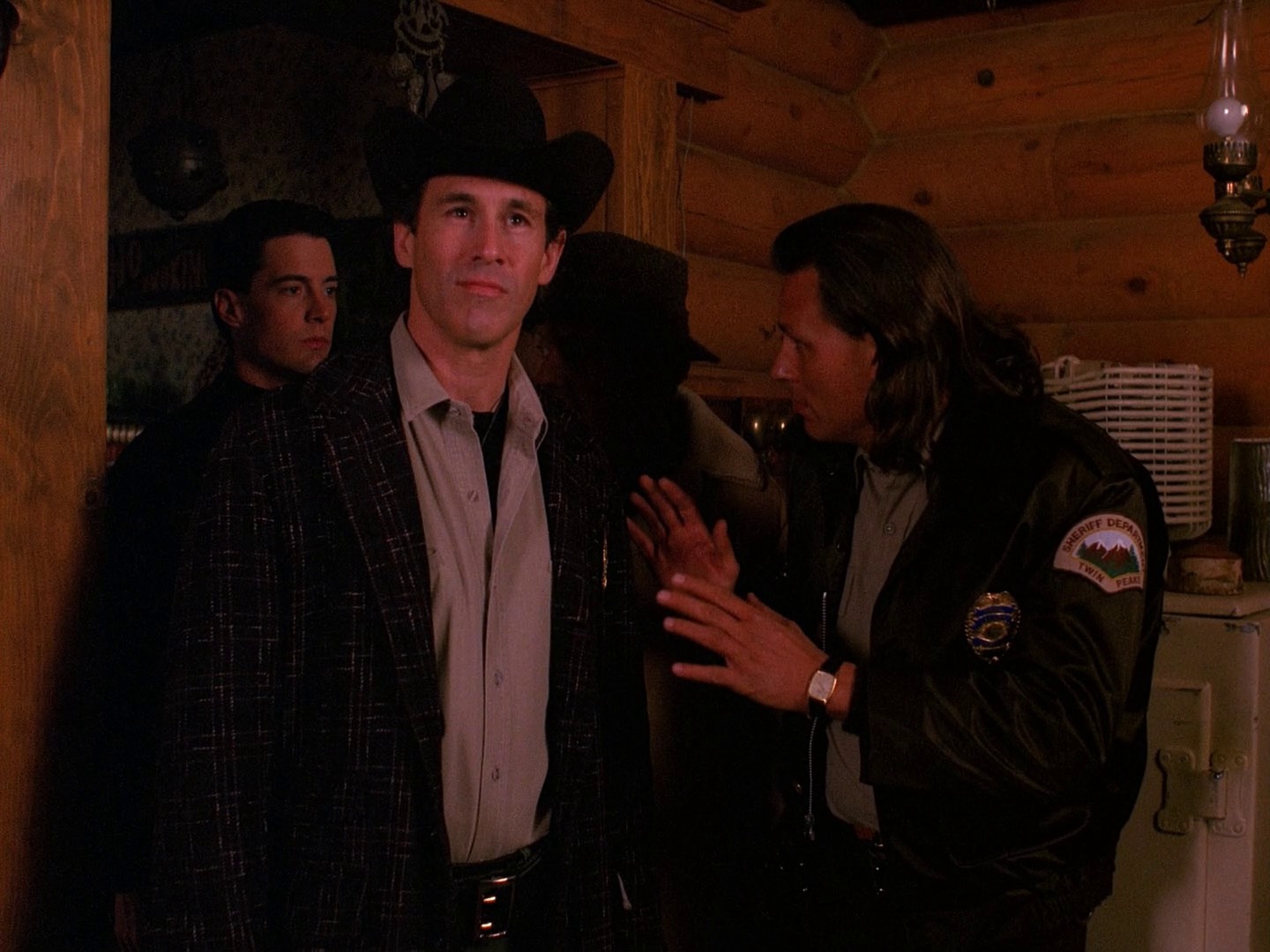
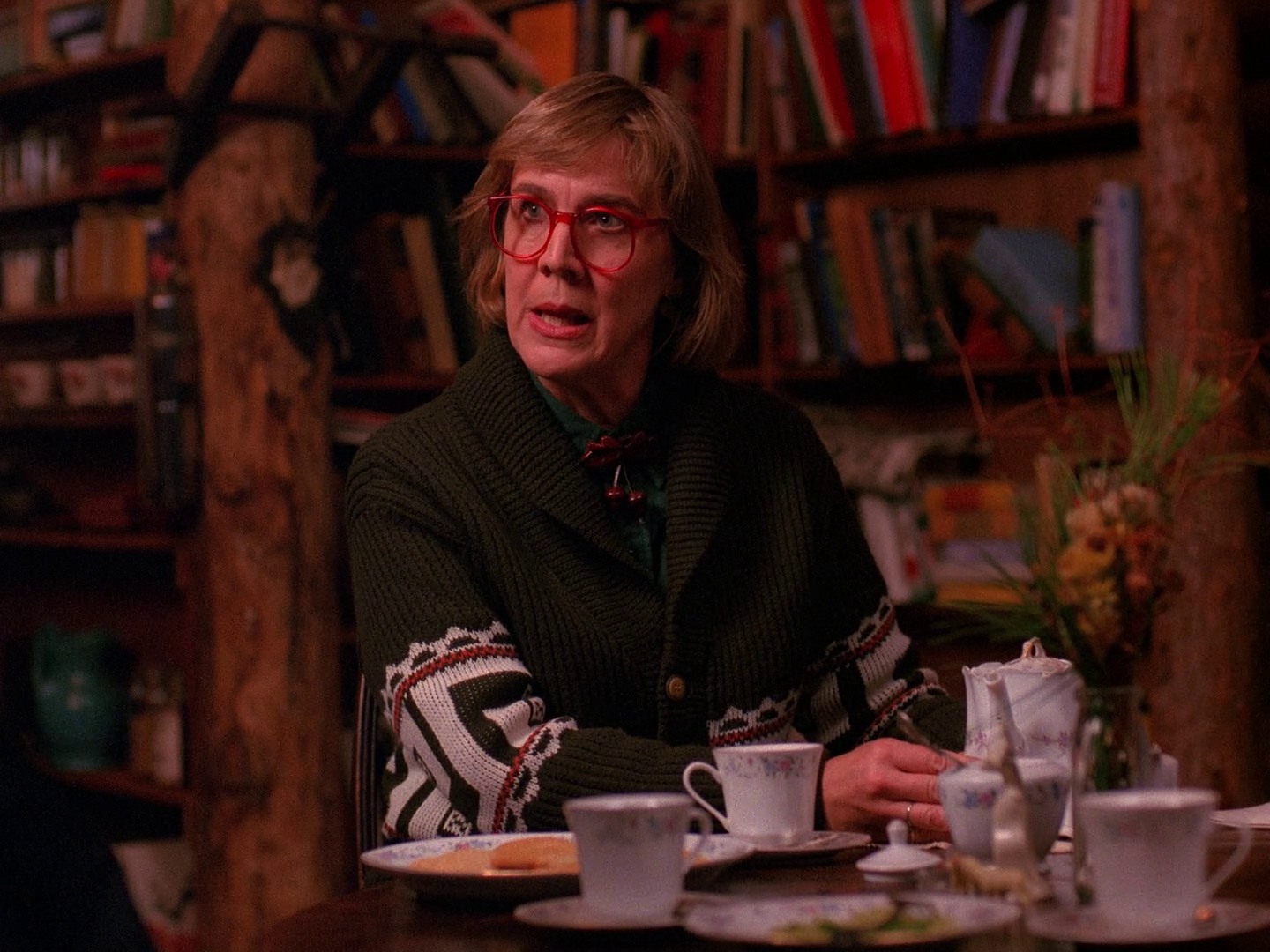
Cooper’s willingness to attend to this testimony is not the same as having solved it. The number of people, the order of arrival and the distinction between a scream and silence remain things to test. The Log Lady’s certainty about the importance of what was witnessed coexists with the incompleteness of the account. This is a scene about how to listen before it is a scene about what to believe.
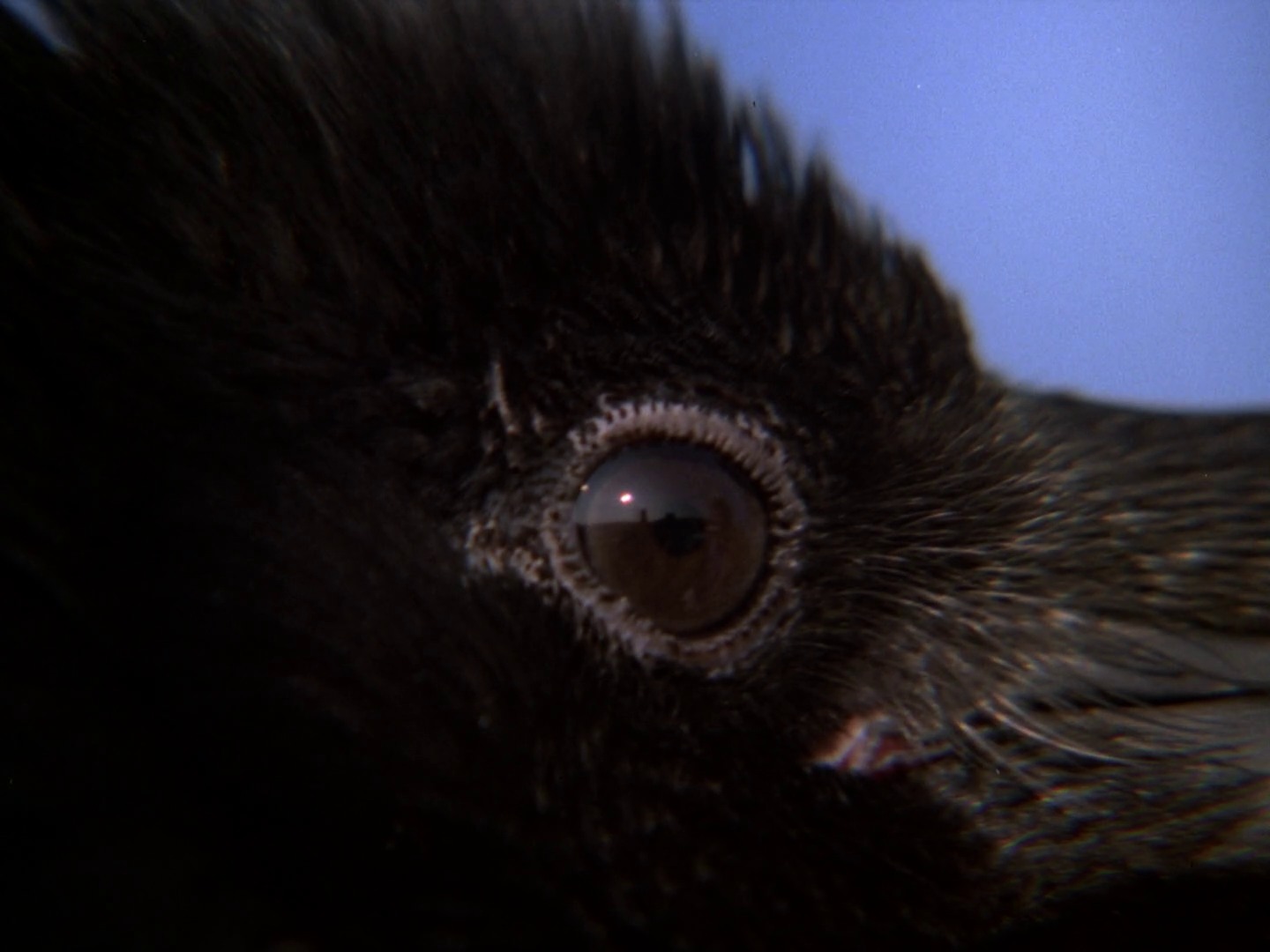
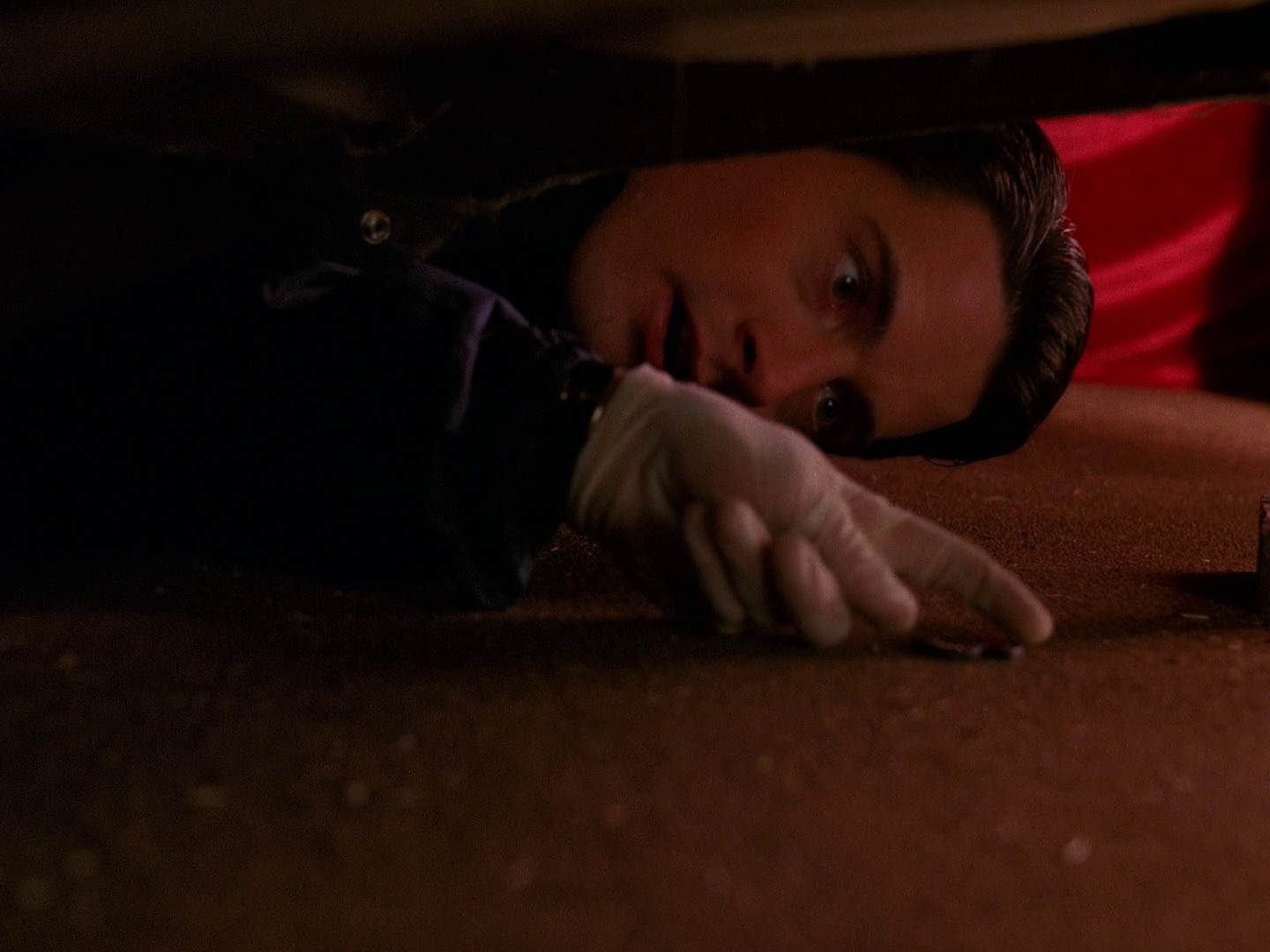
The movement towards Jacques’s cabin introduces a different witness: Waldo. Bird, record player, camera and poker chip inhabit a room that preserves traces after its occupants have gone. Cooper’s low position on the floor turns a small object into the scene’s destination. The episode moves from a testimony that seems impossible to a physical clue that can be carried away.
Margaret’s introduction
The separate Log Lady introduction considers whether an answer can be heard before its listener is ready. Its image of unkind fire resonates with both the threatened mill and the Log Lady’s own account. The recap selects the hidden ledgers, Hank’s release, Maddy and the woods investigation; the preview turns towards One Eyed Jack’s and the impersonation of Laura. These surrounding pieces frame the drama without belonging to its original scene chronology.
Audrey constructs a viewpoint
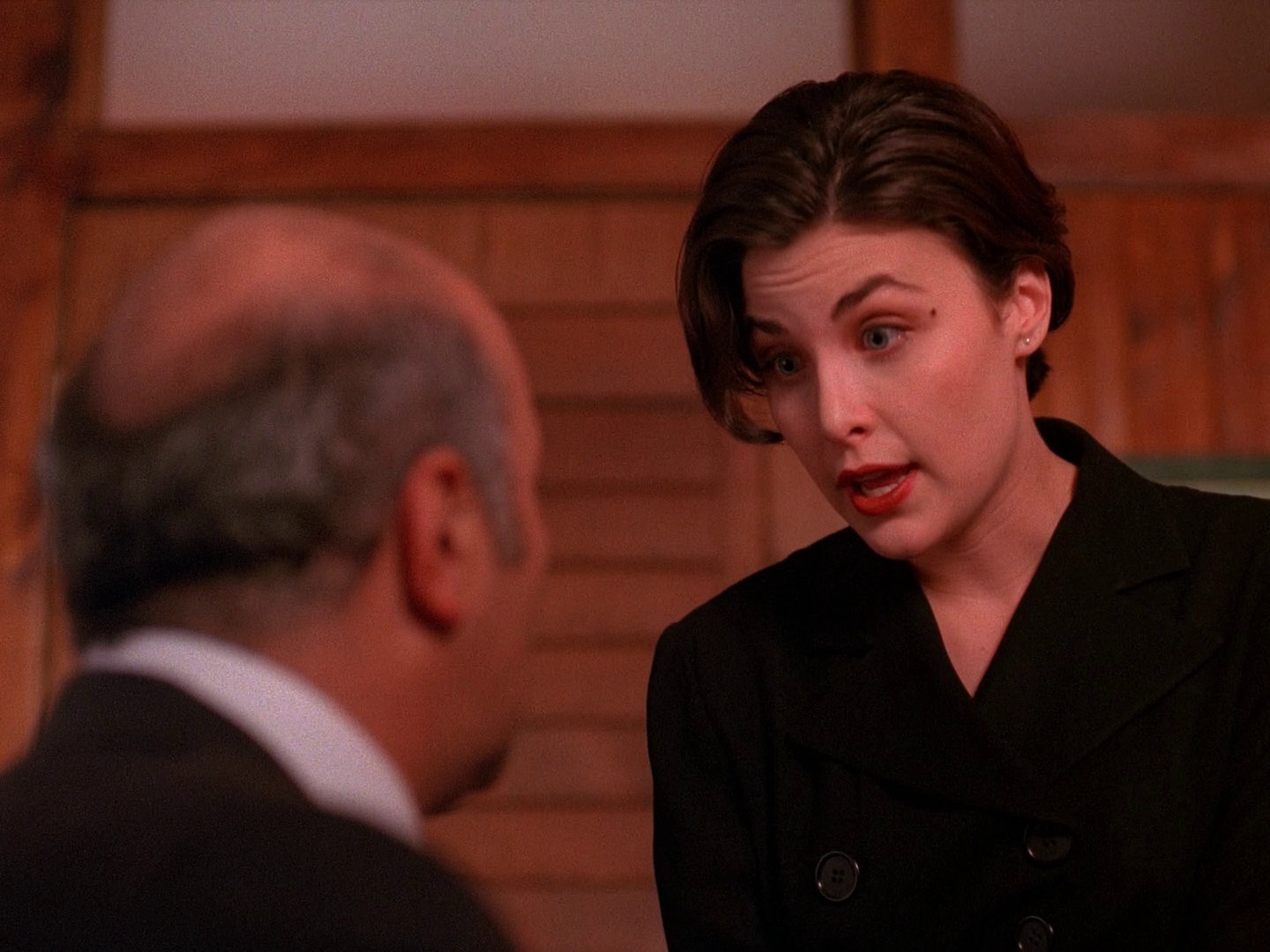
Audrey does not drift into detective work. She manoeuvres for the perfume counter, identifying it as the useful position in her father’s store. Her threat to Emory Battis is coercive and dishonest; the scene makes her investigative energy inseparable from an ability to manipulate the adults around her. That complication prevents her from becoming a harmless teenage assistant.
At the hotel, architecture gives her a second route to information. A concealed opening allows her to watch Ben and Catherine from a place they have not accounted for. Their discussion makes the planned destruction of the mill part of the private life behind the public investment presentation. The contrast between reception room and hidden viewing space turns the building into a diagram of unequal knowledge.
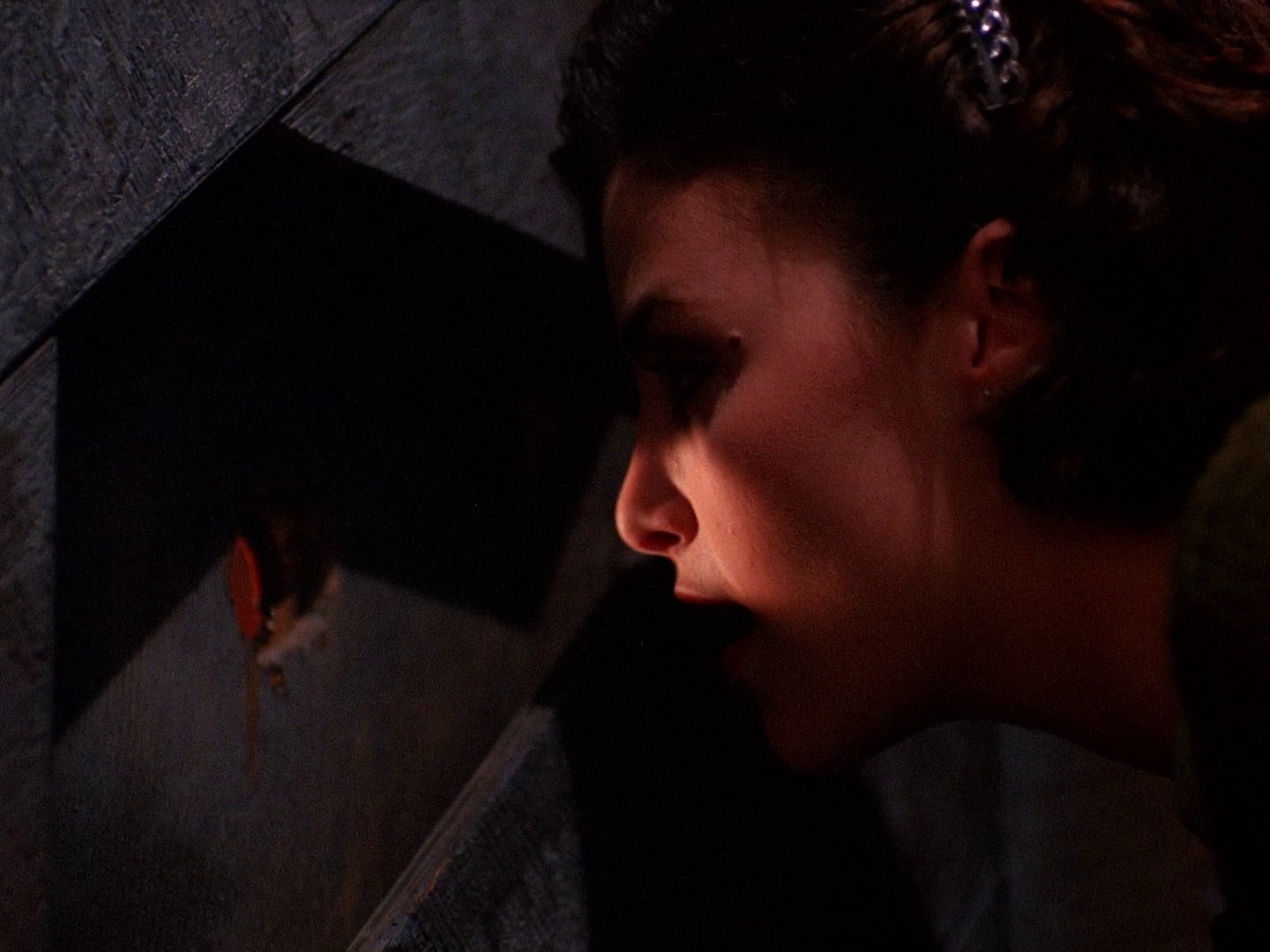
The viewpoint also has an emotional cost. Audrey can discover a secret without knowing how to act on it. Later, she sees Leland’s grief while other people convert it into entertainment. Her observational skill exposes her to more than a clue. The episode gives her seeing a moral weight that her earlier manipulation of Battis did not possess.
When grief becomes a party trick
The Ghostwood presentation sells a controlled future. Leland’s movement interrupts that smooth public performance. He is not simply another cheerful guest, but the room finds a way to absorb his distress into its social machinery. Catherine is drawn into the dance; gestures of anguish become motions that others can copy.
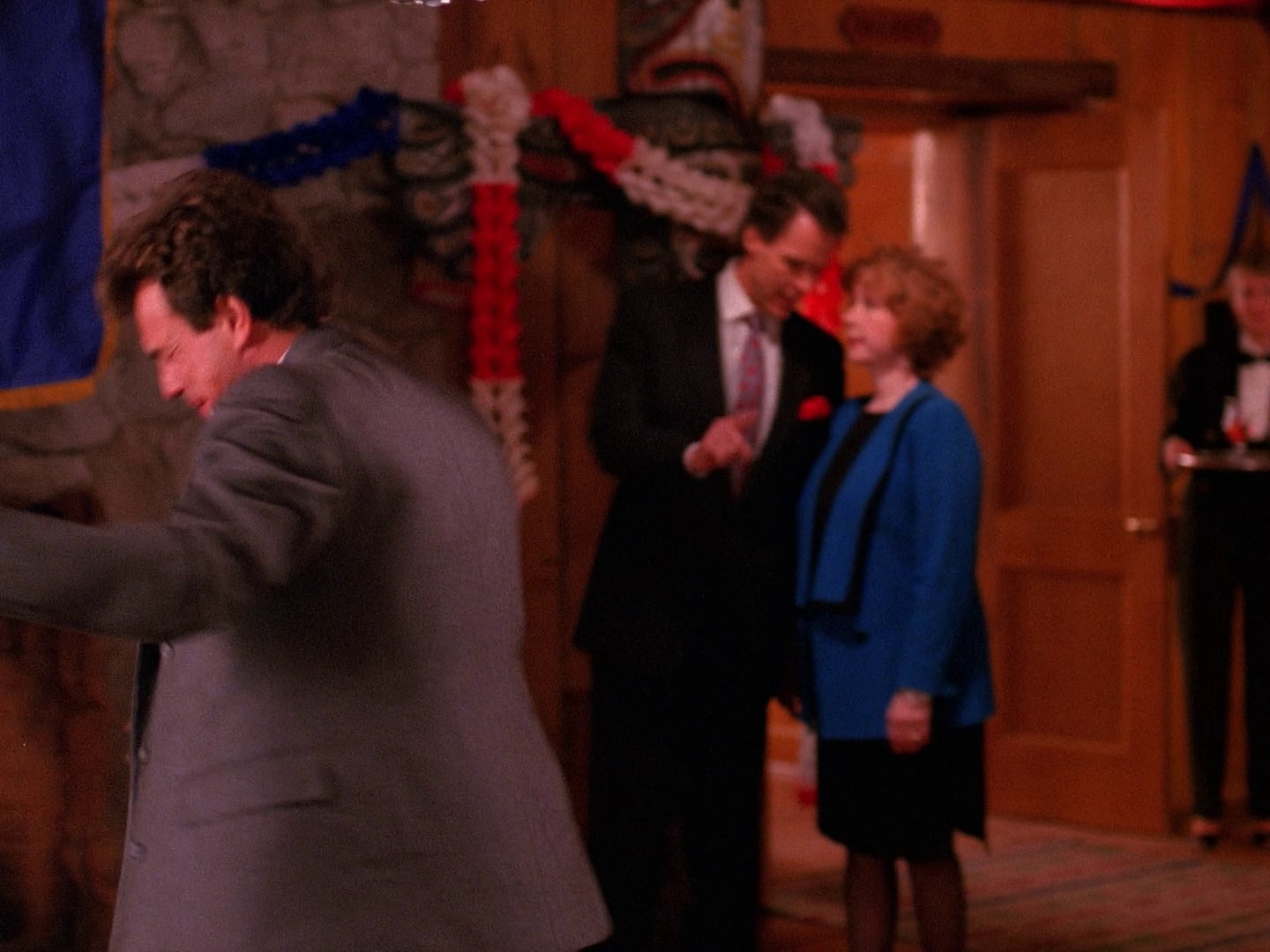
The sequence depends on the difference between seeing a gesture and recognising the feeling behind it. A crowd can reproduce the movement without understanding its cause. The resulting comedy is uncomfortable because the party has not stopped being a party. Business continues by translating pain into a form the room can accommodate.
The dance and its witnesses · 3 images
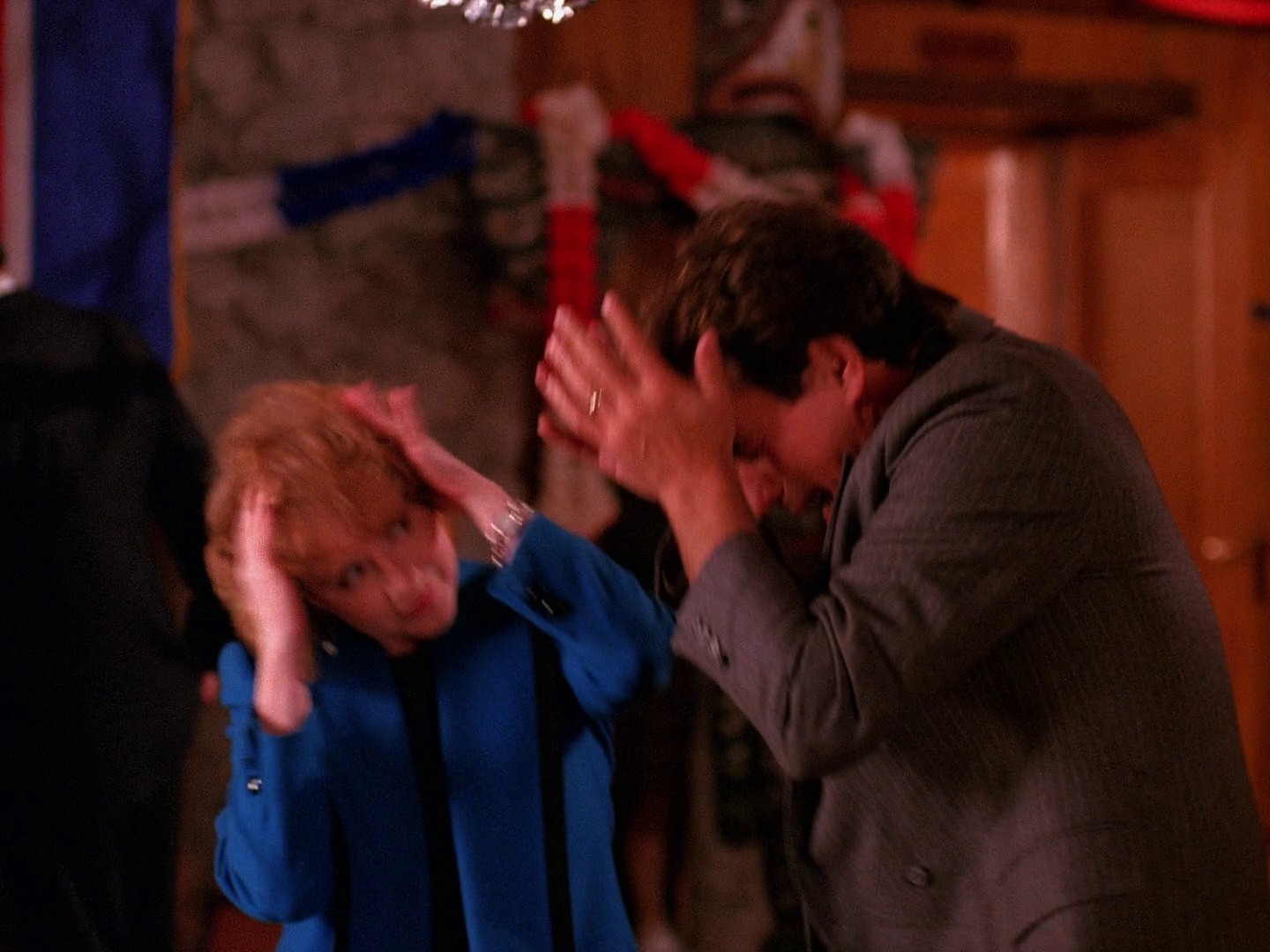
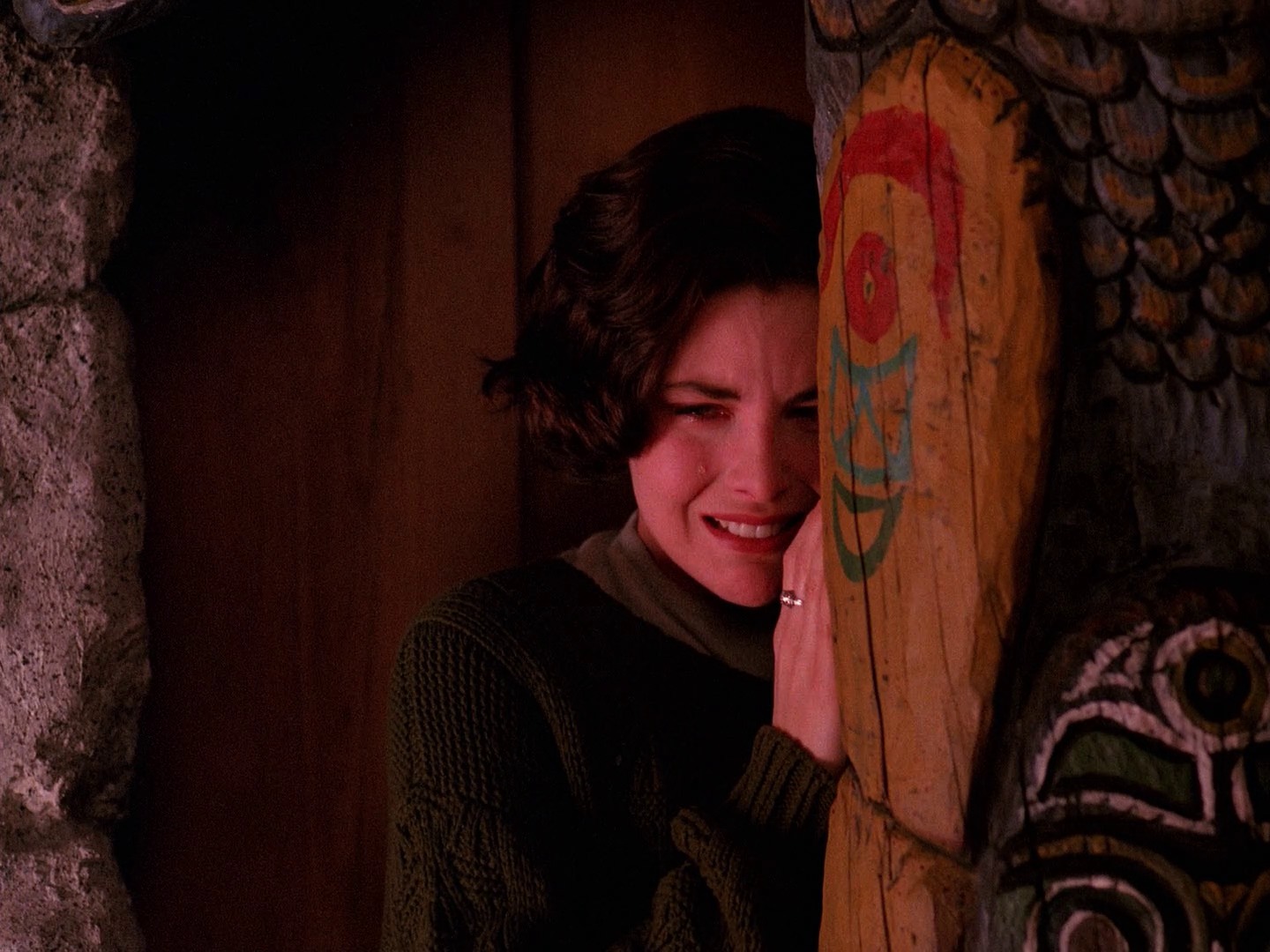
Audrey’s reaction breaks that translation. Her tears provide a counter-image to the public imitation. The cut between the lively room and the partly concealed observer keeps two accounts of the same event in play: a gathering that treats movement as amusement, and a witness who sees suffering. Read beside Leland’s earlier dance with Laura’s portrait, this is a further stage in grief’s exposure to other people.
Promises turn into threats
The closing movements tighten the connection between commercial conspiracy and domestic violence. Ben and Josie discuss their arrangement away from the public party; Hank attacks Leo; Leo then brings violence home to Shelly. Power passes between rooms in which different people believe they hold the advantage.
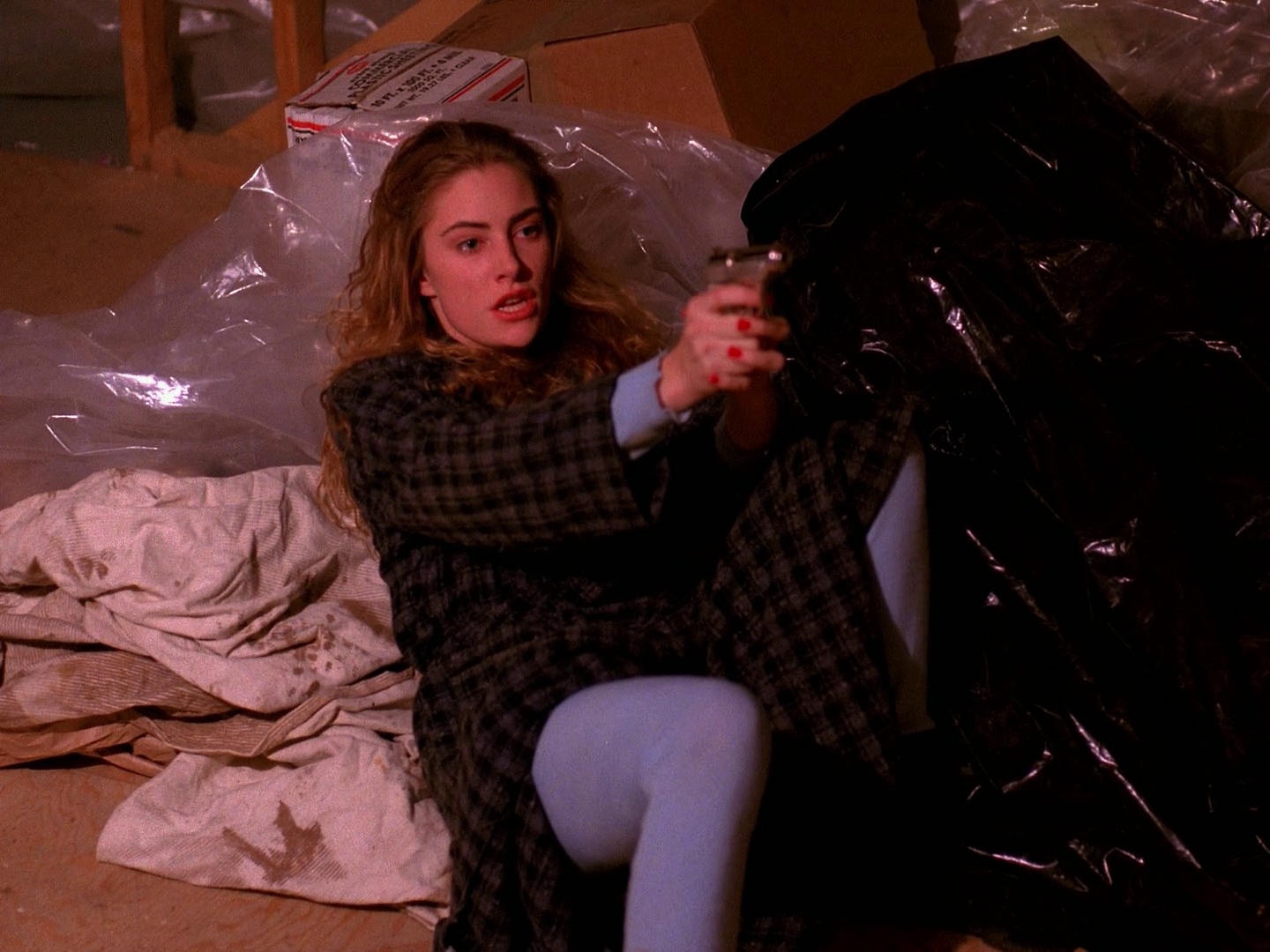
Shelly’s gun has already been handled in an intimate scene with Bobby. Its return in the confrontation with Leo changes that earlier play-acting into an immediate attempt at self-defence. The episode does not treat the object as a newly introduced solution. It makes us remember the unstable mixture of pleasure, bravado and fear attached to it earlier.
Cooper’s return to his hotel folds the investigation back into private space. The disturbance in his room provokes a defensive response before he understands Audrey’s presence. The episode closes on an encounter whose practical and ethical terms will have to be settled in the next instalment.
Voices, sound and dialogue
A room Cooper cannot control
Cooper’s early-morning dictation turns the Icelandic visitors’ singing into part of his report to Diane. He explicitly invites her to notice the noise behind his voice, then requests earplugs. The recorder documents his lost sleep as well as his investigation. His complaint about a traveller’s loss of control is a compact description of his position in the hotel: he can identify a disturbance without being able to end it.
The singing returns around the hotel’s business and social activity. What disturbs Cooper is welcome to the Hornes as evidence of an exuberant investment party. The same sound has incompatible meanings for people occupying the same building. Follow the earplug request to Cooper’s final dictation of the season, when the apparent end of the disturbance offers false reassurance.
Reported sounds and a sound to follow
Margaret’s testimony is organised around laughter, footsteps, distant screams and the owls’ silence. These are sounds described by a witness, not an unrestricted replay of the night of Laura’s death. Her corrections to the detectives’ procedure keep the account from becoming a simple list of answers: she decides when the questioning may begin and who will speak.
After the visit, Cooper asks whether the others hear the music. The subtitles mark music in the distance, then music at the cabin, alongside Waldo’s squawks and the cuckoo clock. The investigation moves from listening to an account of the past to following a present cue towards a place. That distinction matters: the cabin can supply objects for examination without resolving everything Margaret has described.
A business speech gives way to a dance
The address to the reception is interrupted by the jazz cue and Leland’s distress. Ben’s instruction that Catherine dance with Leland treats participation as a way to manage the disruption. The performance begins to stand in for care. Audrey’s response, already traced in the party gallery, makes visible what the gathering’s efforts to keep things moving cannot absorb.
A route through Episode 5
- The disturbed hotel. Cooper records his sleepless night; Audrey offers to help at breakfast.
- The Horne office. Jerry returns from Iceland and Leland asks to resume work.
- Jacques’s apartment. Blood, a magazine and photographs reshape the search.
- Shelly’s morning. Bobby’s bravado gives way to Andy’s questions and Leo’s call.
- Norma and Ed. The lovers confront the compromises of their marriages.
- The perfume counter. Audrey pressures Battis for a position that gives her access.
- James and Donna. James speaks about his family; the pair recommit to finding the truth.
- The cabin lead. Objects and a background image point the investigators into the woods.
- Recruiting Maddy. Laura’s cousin joins the search for hidden material.
- Hank returns. His offer to wash dishes inserts him back into Norma’s workplace.
- Jacoby and Bobby. A family appointment becomes an emotionally forceful private interview.
- The Log Lady. A domestic ritual prepares an indirect account of the night in the woods.
- Jacques’s cabin. The investigators find Waldo and the poker chip.
- The hotel party. Audrey observes Ben and Catherine, then witnesses Leland’s public distress.
- Messages and violence. Maddy finds a tape; the mill scheme advances; Hank and Leo attack.
- The hotel room. Cooper encounters Audrey, creating the next episode’s opening problem.
Credits, introductions and connections
Dialogue and sound-cue references in the voice study follow the episode’s English SDH subtitles; interpretations are Lyncharium’s.
Primary screen source: regular Episode 5, Twin Peaks: From Z to A. The on-screen credits identify Mark Frost as writer and Lesli Linka Glatter as director. Angelo Badalamenti is credited for composing and conducting the music; Frank Byers is credited for cinematography. The scene readings are Lyncharium’s analysis of the episode.
This is regular Episode 5, following the pilot. Services that count the pilot as the first instalment list it as Season 1, Episode 6. The season index supplies both numbering systems and the distributor’s episode titles. Continue through the introductions, recaps and previews.