Twin Peaks: Episode 2 — Zen, or the Skill to Catch a Killer
1990 · Regular Episode 2 · Directed by David Lynch
Stones, records and dreams. An illustrated study of Cooper’s methods, Audrey and Leland’s dances, and the Red Room’s transformation of the investigation.
Regular Episode 2, after the pilot and Episode 1. Often listed as Season 1, Episode 3. Contains episode and alternate-pilot spoilers.
Explore this episode
Appetite and authority
The episode sets several kinds of explanation beside one another: family argument, criminal threat, forensic investigation, intuition and dream. It is not enough to say that Cooper rejects rationality. He records, measures and organises even when the source of his method is a dream. The tension comes from how precisely a procedure can be performed while its authority remains uncertain.
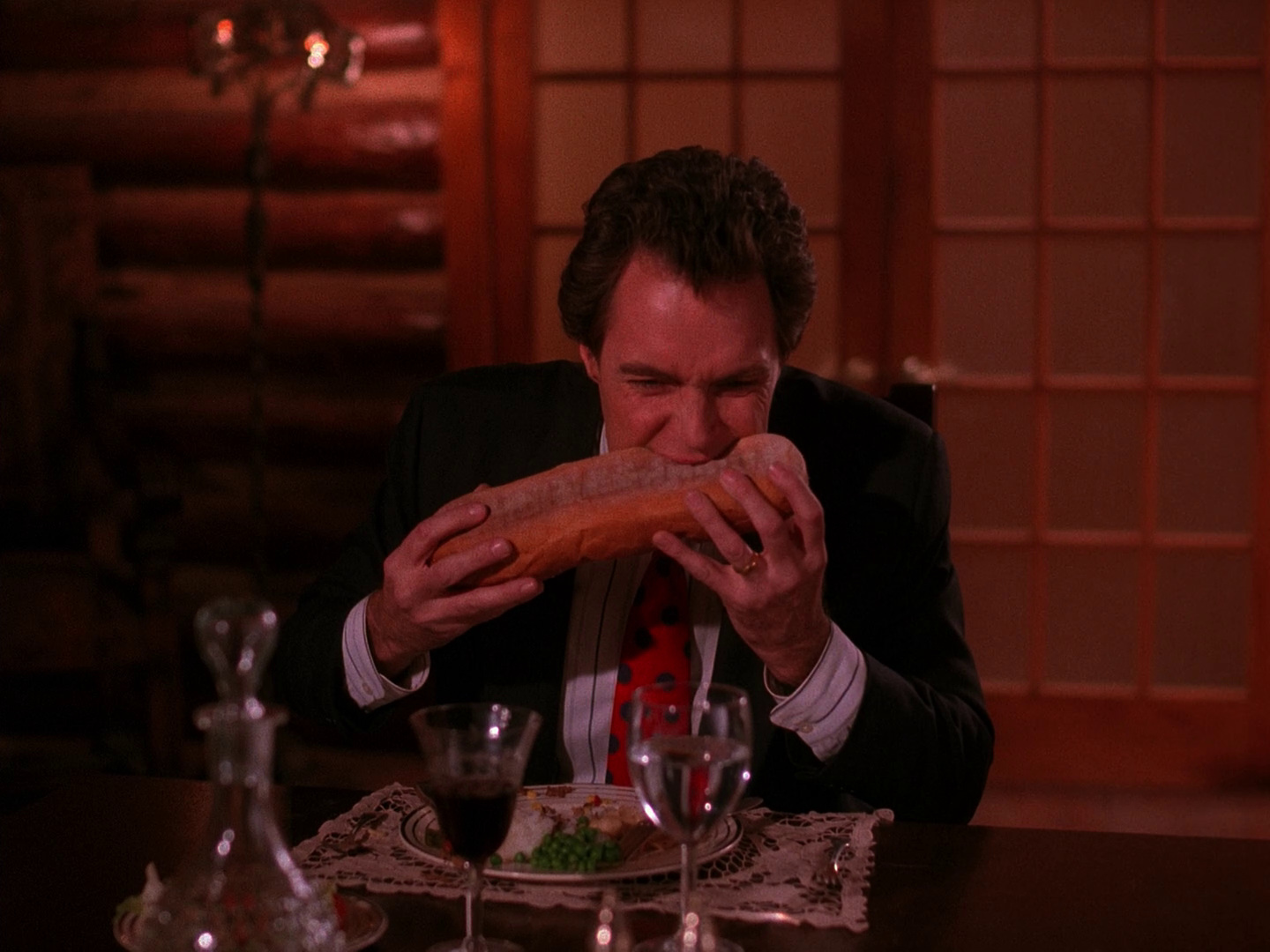
The Horne dinner provides an early miniature of the episode’s priorities. Jerry’s arrival with food pulls attention away from the family at the table. Ben’s failed deal and the town’s tragedy are absorbed into a conversation driven by appetite and acquisition. The visit to One Eyed Jack’s extends that economy into a space where pleasure, money and display are openly connected.
The red-draped environment of One Eyed Jack’s anticipates a visual association with the Red Room, but the two spaces do different work. One is a commercial destination reached by the brothers. The other will interrupt Cooper’s sleep and ordinary relations of time. Similar colour does not make them equivalent places.
James and Donna’s quieter exchange asks whether their relationship could have happened without Laura’s death. Their desire for a cleaner story collides with the order in which events occurred. Elsewhere, Bobby’s meeting with Leo makes concealment an immediate survival tactic: knowledge of Shelly’s situation cannot be openly admitted.
The stone test: intuition with a clerk
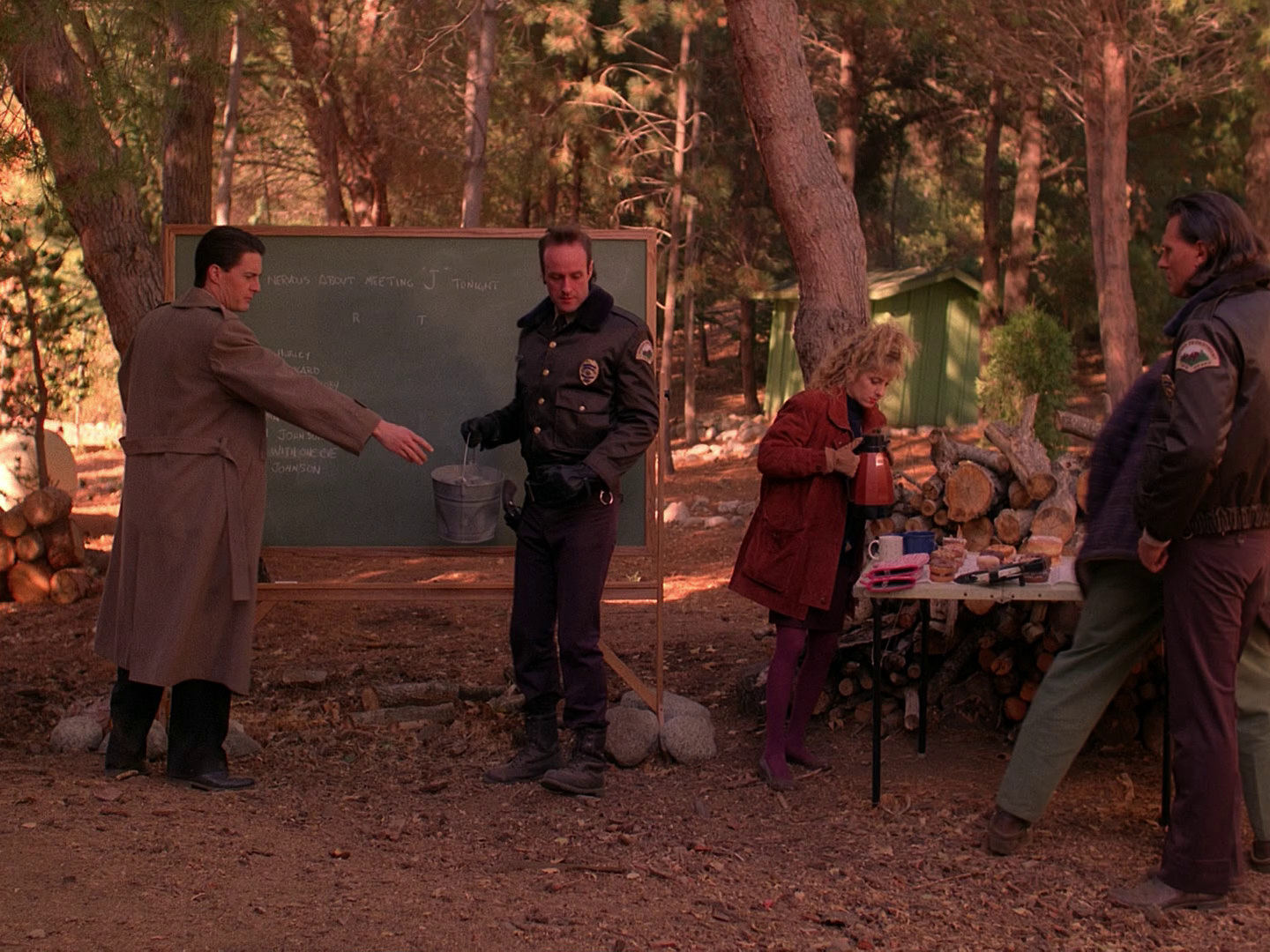
The outdoor exercise is carefully staged. Cooper supplies a map and an account of Tibet, names are prepared, distances matter and Lucy records the results. Truman and Hawk provide practical assistance. This is an administrative performance built around an intuitive premise: the apparent seriousness comes partly from the work required to organise it.
The sequence does not become less comic because it is precise. A stone striking Andy introduces bodily error into the system. A hit that does not break the bottle must be distinguished from one that does. Lucy’s notation turns the irregular results into a record. The programme allows us to enjoy the ritual while leaving the inference from a successful throw to criminal guilt unresolved.
The method, step by step · 4 images
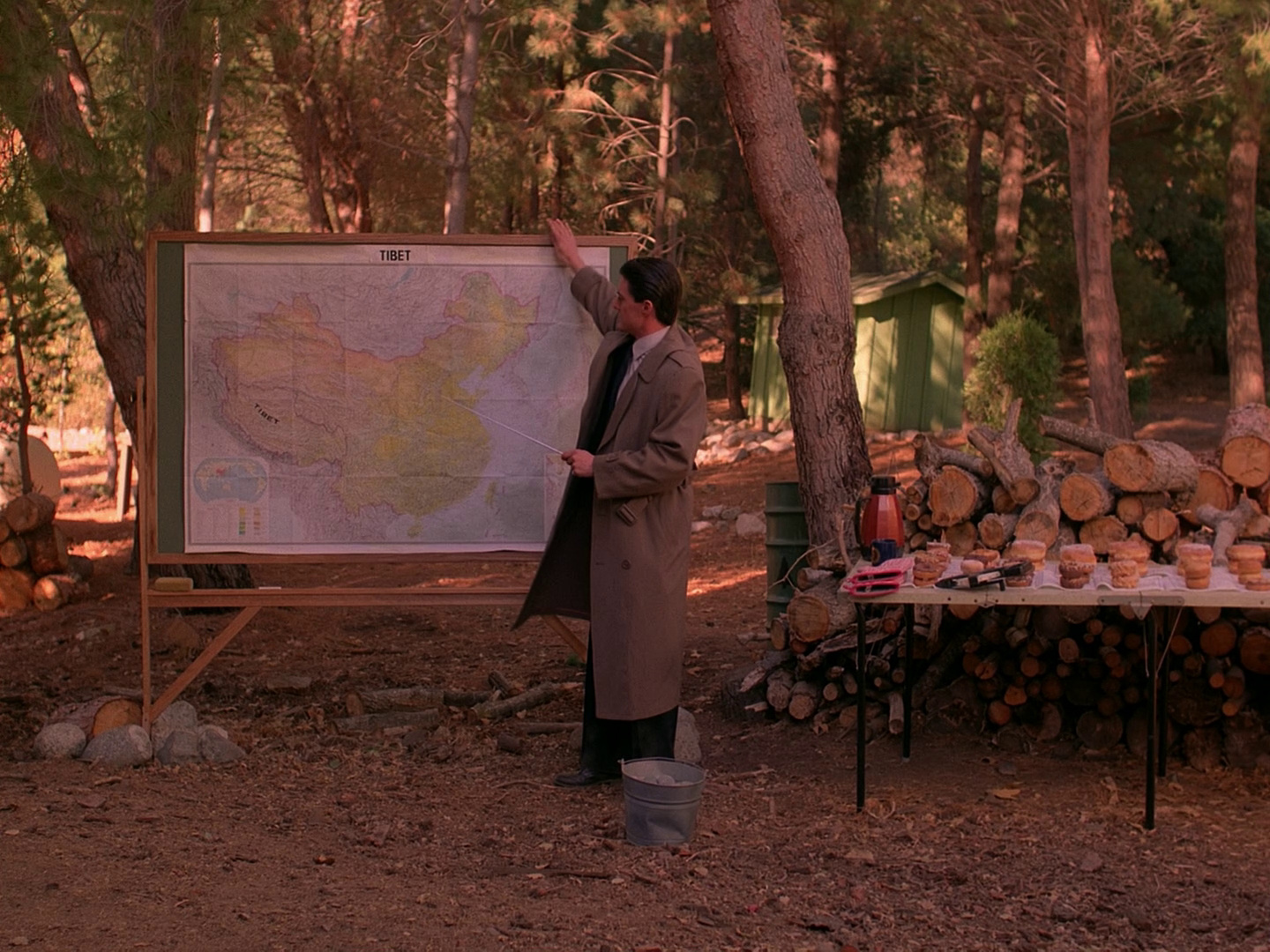
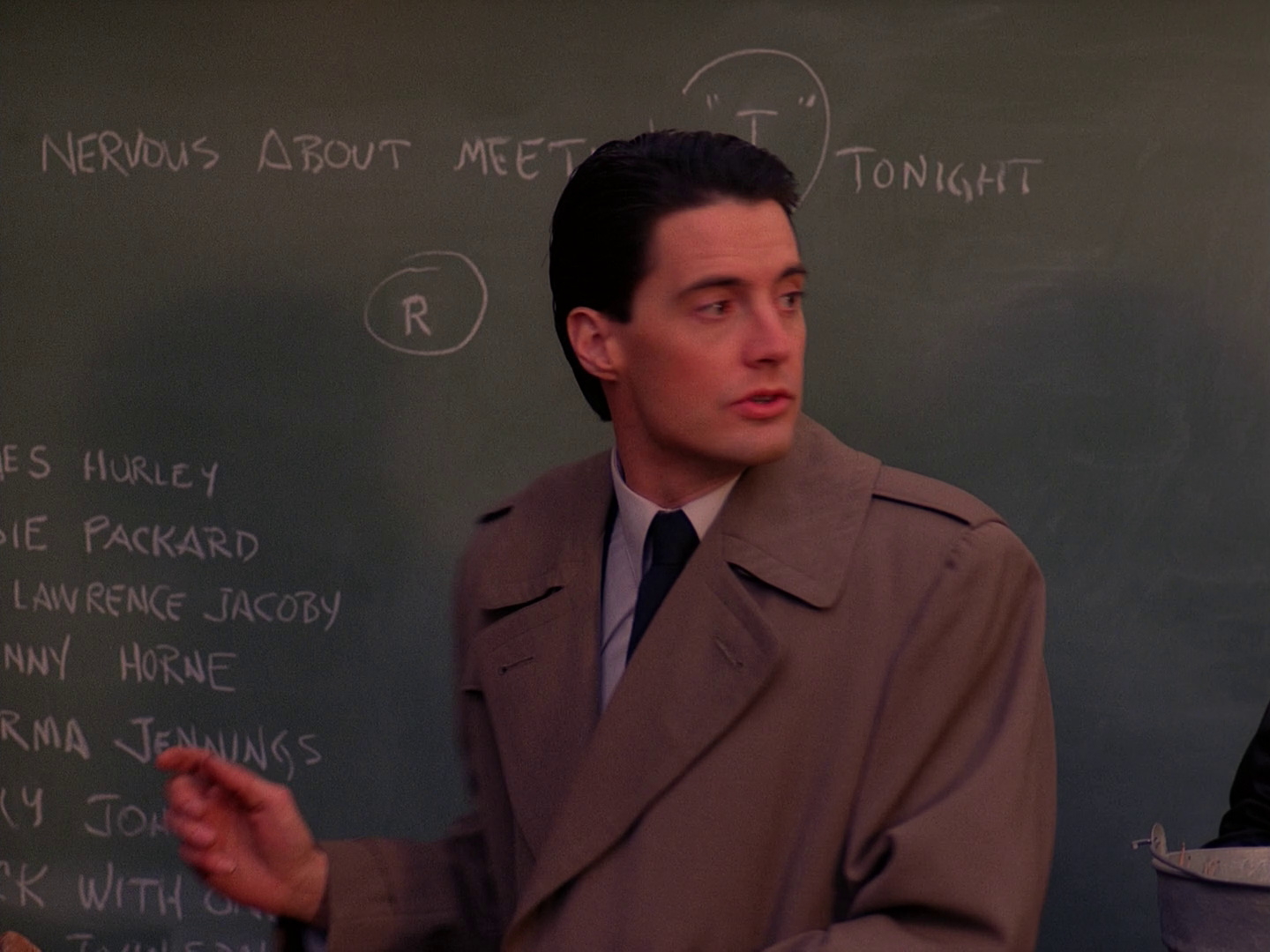
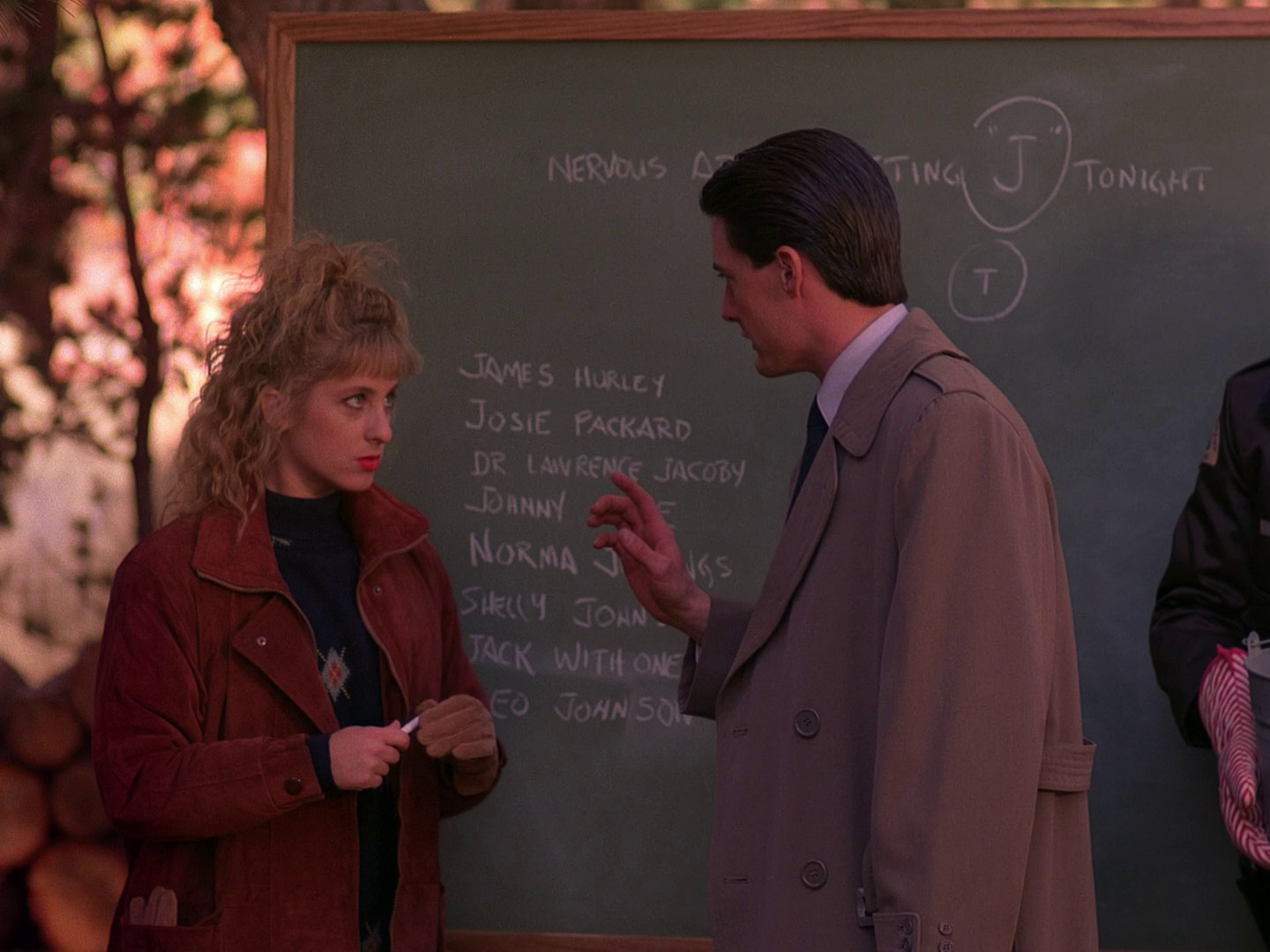
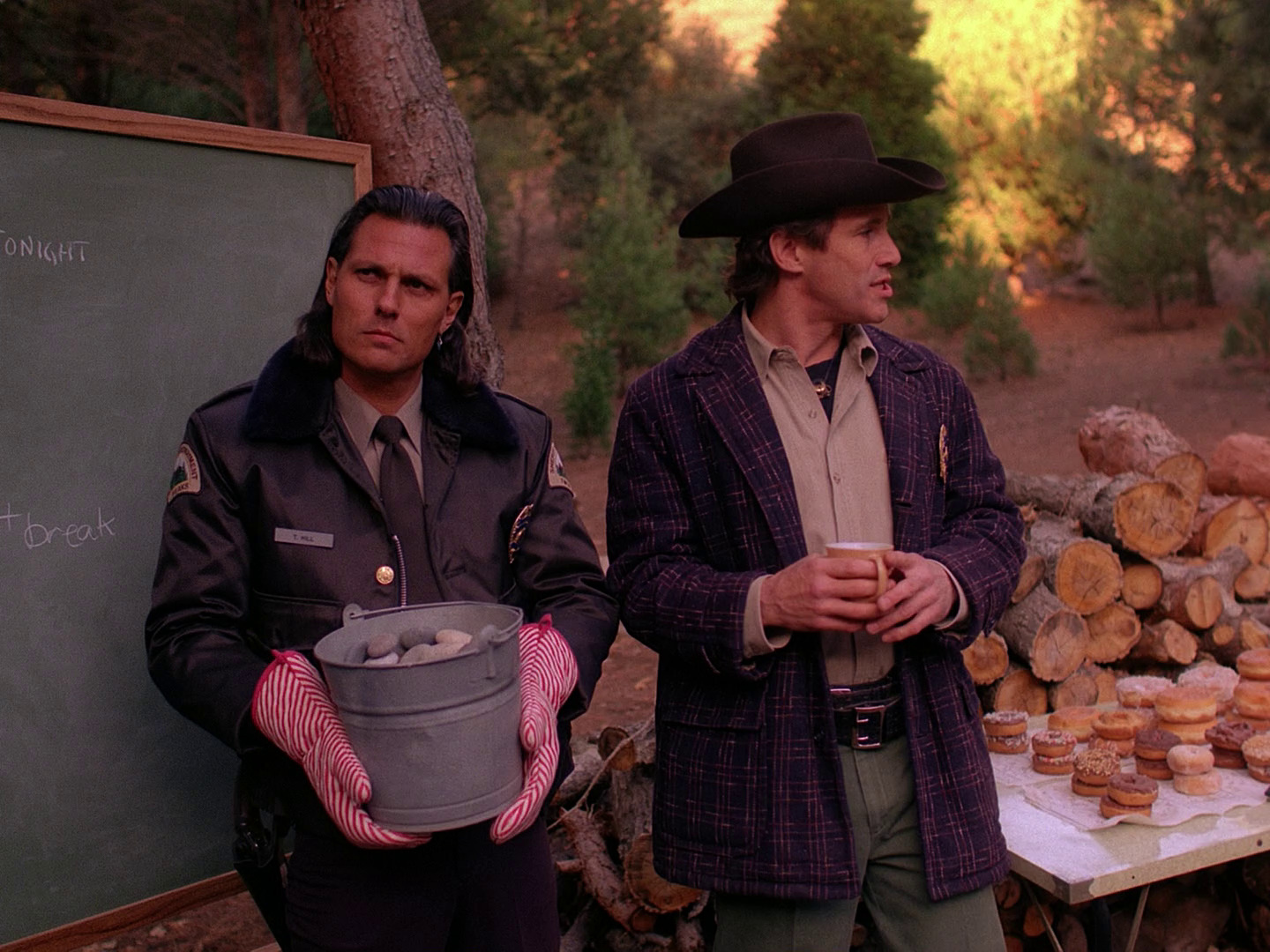
Cooper’s speech should be understood as the character’s account of his own inspiration, not as documentation of an authentic Tibetan investigative practice. The dramatic achievement is to make an eccentric procedure feel socially possible. His colleagues do not simply watch a visionary perform; they help make the performance happen.
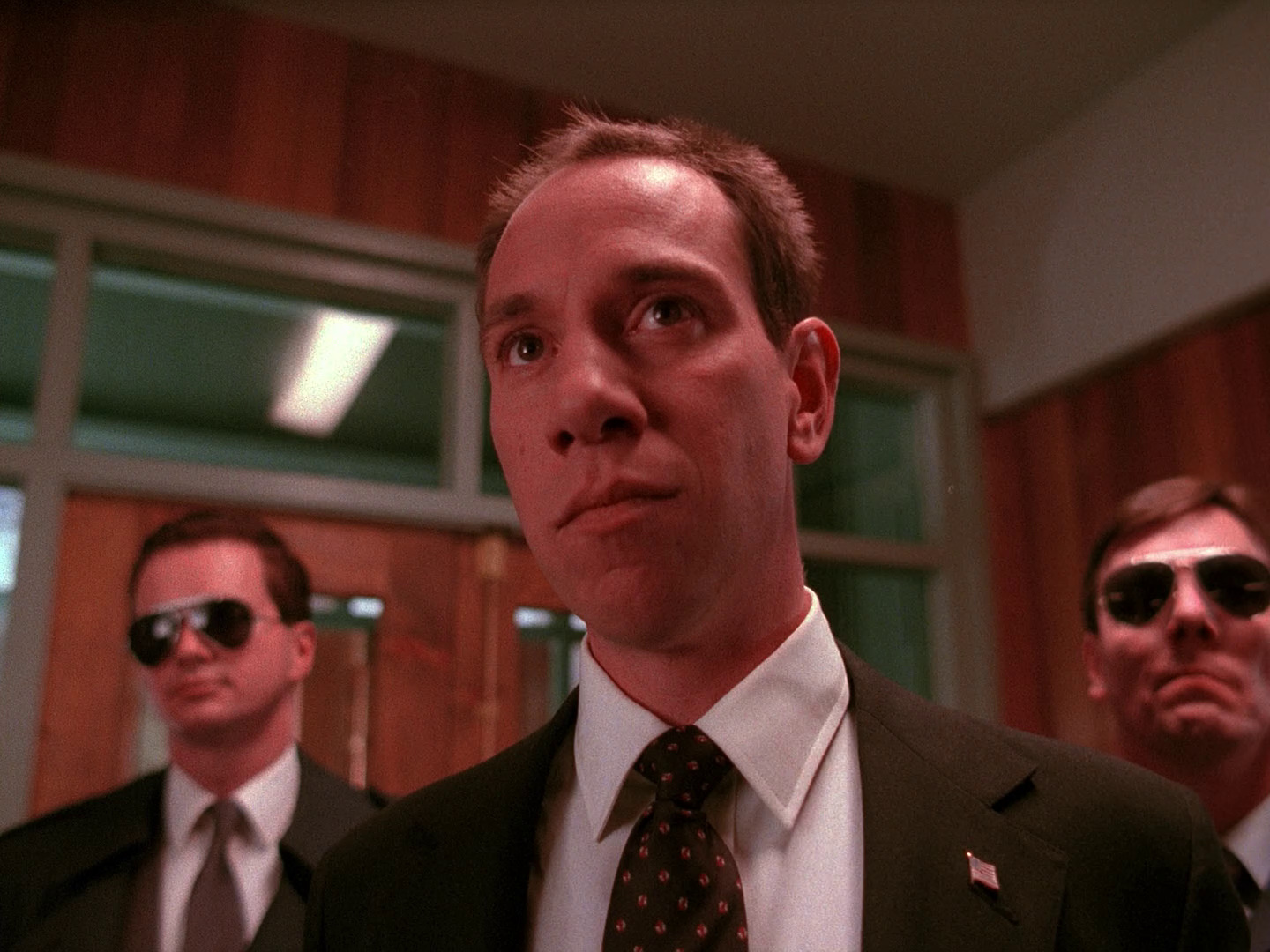
Albert’s arrival later offers a deliberately abrasive counterweight. He brings forensic authority but expresses it through contempt for the local report and the people who produced it. Truman’s objection concerns how knowledge is delivered as much as what it contains. The episode refuses the easy choice between a charming intuition that must be right and a rude professional who must be wrong.
Letting the throws continue
MacLachlan remembers Lynch allowing the camera to keep running while he repeatedly tried to hit the bottle, rather than limiting his work to a couple of illustrative throws. He recalls glancing it once and describes Robertson’s excited response as genuine. His estimate of the filming time is a recollection, not a measured take length. The account nevertheless supplies a useful production context for the scene’s mixture of formal procedure, waiting and sudden reaction.
A Talk with Kyle MacLachlan and Sheryl Lee, 02:33–03:20. The performers’ later recollections are read alongside the finished work and other production evidence.
Small discoveries, hidden accounts
The drape-runner story offers a quieter model of discovery. Grease and cotton balls solve Nadine’s practical problem through an accident in the household. A useful result emerges without the formal organisation of Cooper’s experiment. The contrast is comic, but it also belongs to the episode’s larger interest in ideas that arrive by unexpected routes.
Josie’s discovery of two ledgers introduces a much more conventional puzzle. Here the problem is not dream logic but competing records of the same business. The books make deception tangible. Placing accounting beside intuition prevents the episode’s famous dream from becoming its only way of representing knowledge.
Hawk’s earlier telephone conversation with Cooper concerns Ronette and the one-armed man. It prepares the detective to think about a person whose condition cannot be reduced to an uncomplicated report. The note delivered under the hotel door makes another kind of message arrive across a physical threshold. Throughout the episode, information is carried by objects, gestures and interruptions as well as by direct answers.
Three dances, three kinds of attention
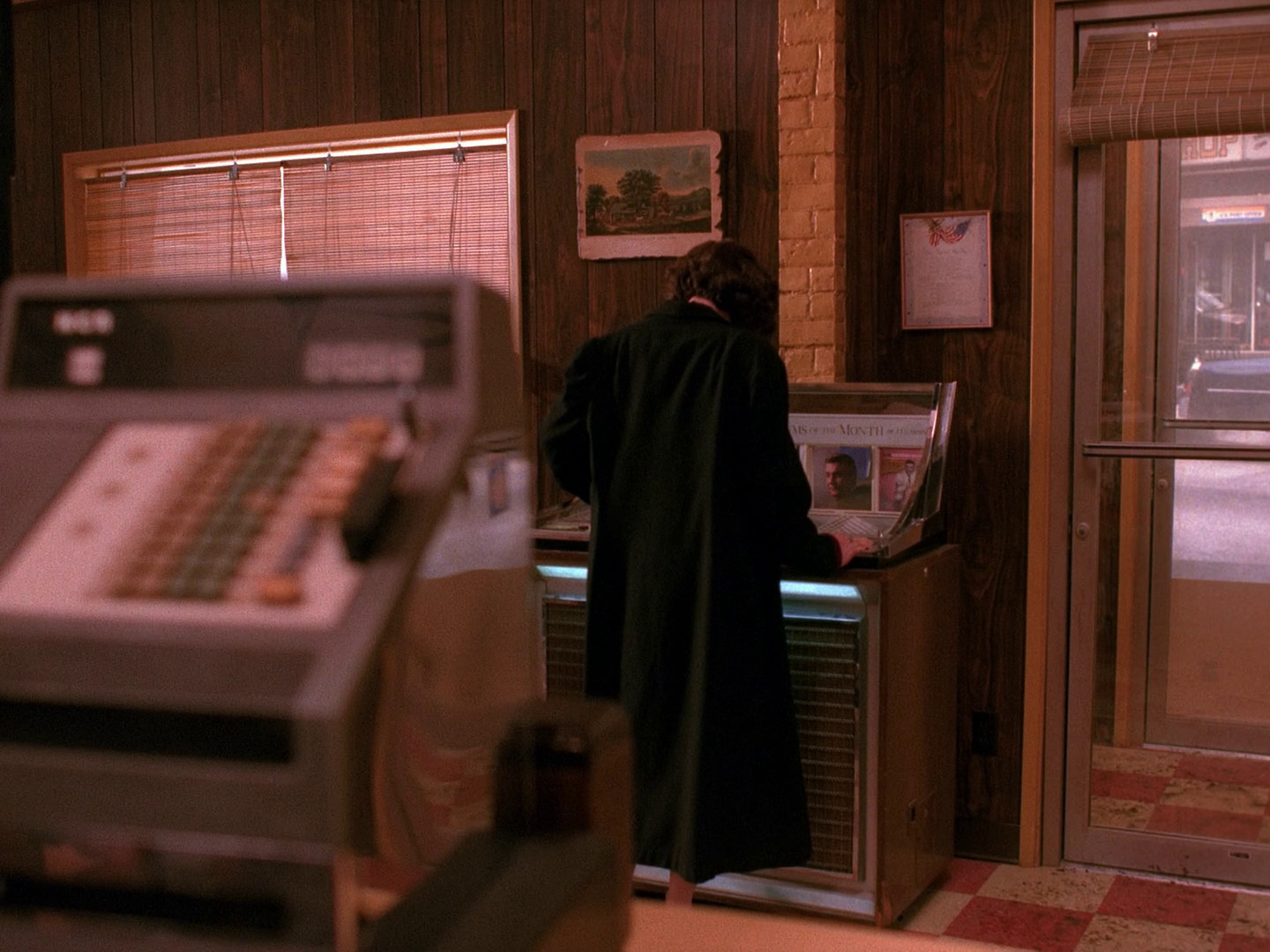
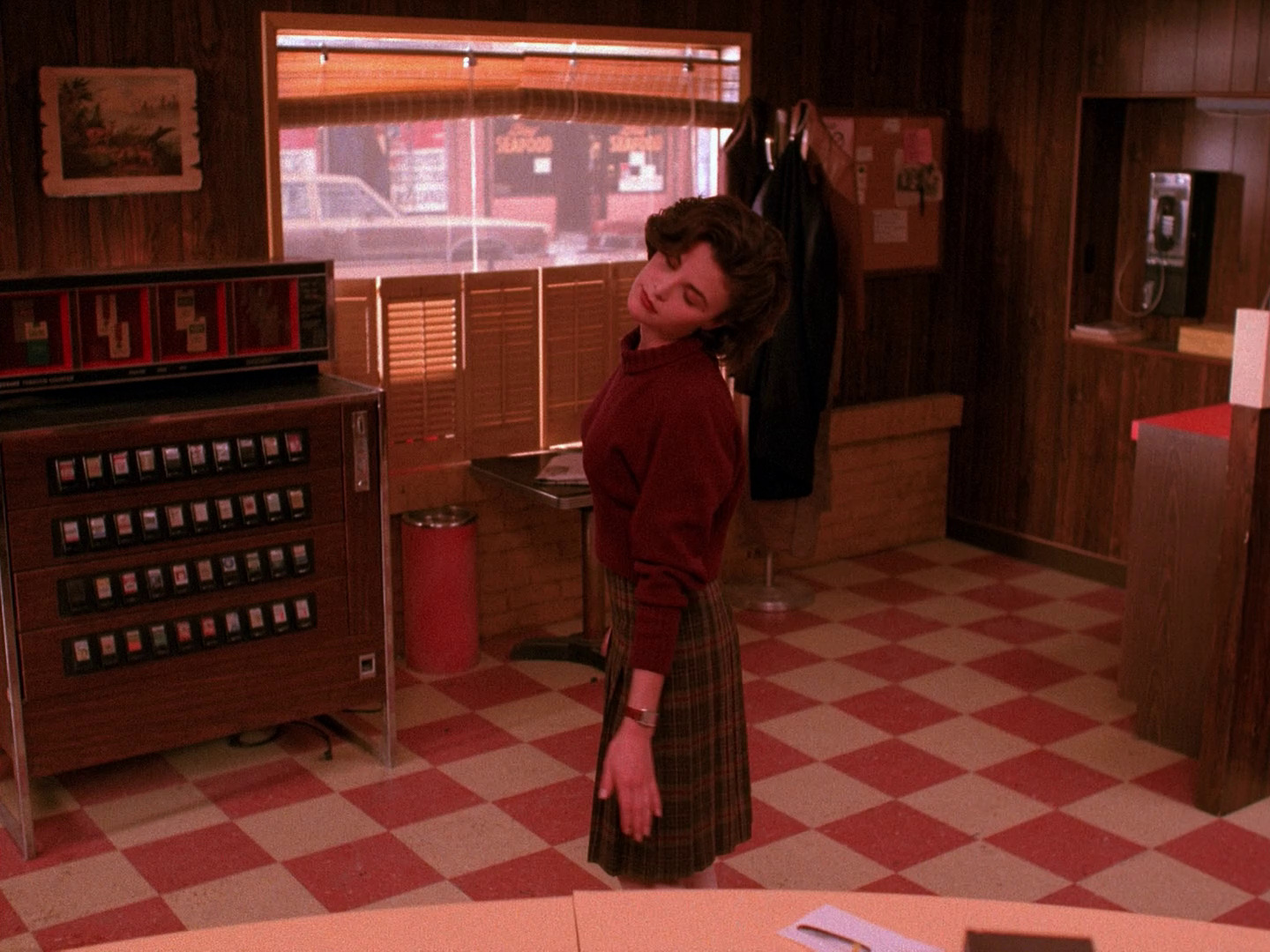
At the diner, Audrey’s use of the jukebox establishes music as something she chooses within the scene. Her conversation with Donna moves close to the investigation, then gives way to dancing. Movement takes over from verbal disclosure. Audrey makes a public place temporarily follow her own rhythm.
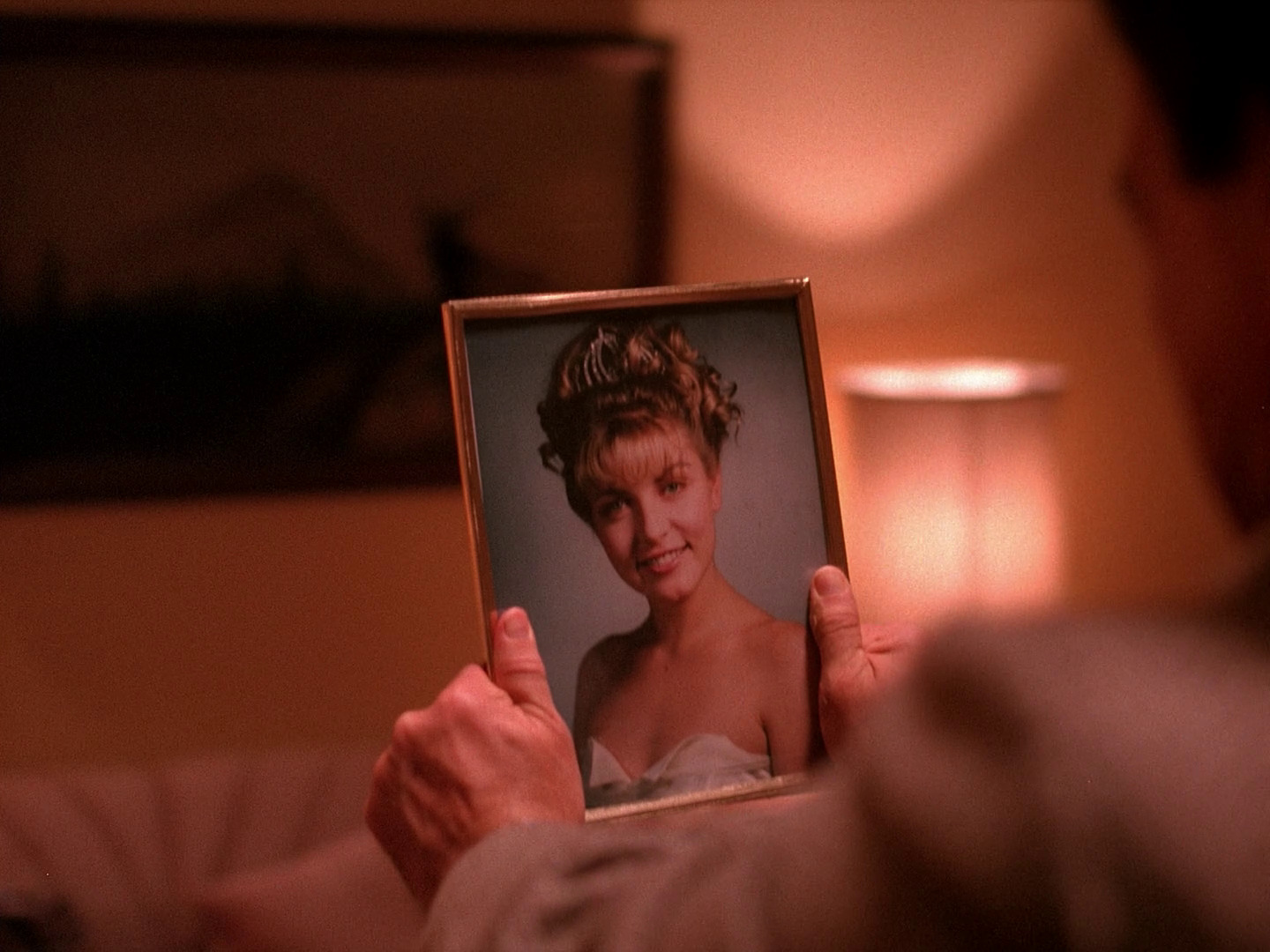
Leland’s dance with Laura’s portrait is a much more painful attempt to animate an image. He starts the record and holds the photograph while Sarah tries to intervene. The frame breaks; blood marks the encounter with the picture. The domestic ritual of playing a record becomes an action that cannot restore the person it addresses.
The Red Room dance later removes the everyday location that made the earlier movements legible. Audrey has a jukebox and Leland has a record player; the dream does not offer the same reassuring account of its sound and space. Comparing the three dances reveals an episode organised around bodies responding to music in radically different emotional situations. One asserts independence, one enacts grief, and one makes an already unstable encounter stranger.
Cooper’s dream changes the evidence
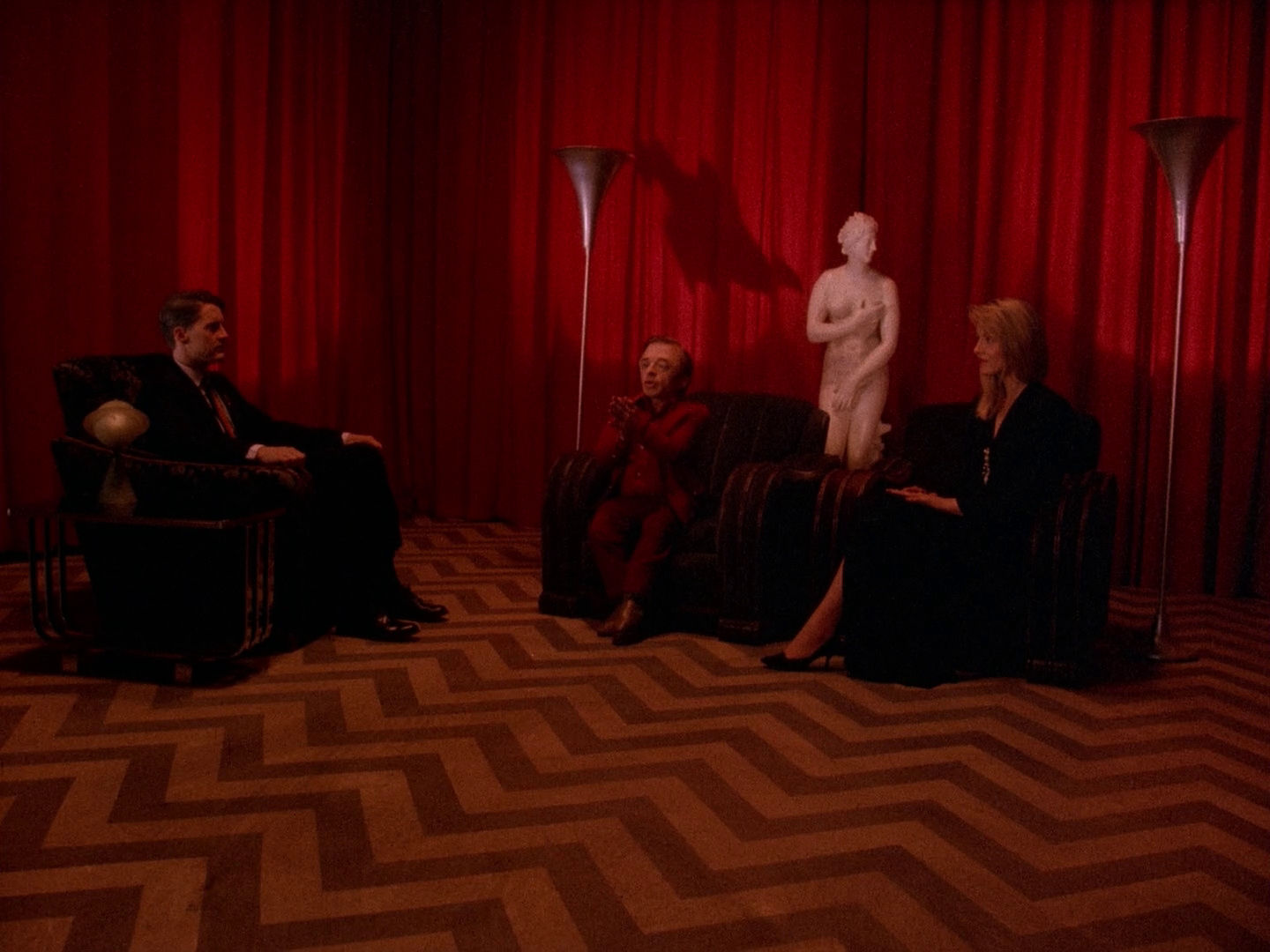
The dream gathers fragments associated with MIKE, BOB and Laura before settling into the curtained room. An aged Cooper, the chevron floor, the statue and the seated figures establish a space that is immediately memorable without becoming geographically secure. Dialogue offers clues, but the delivery, bodily movement and interruptions resist the rhythm of an ordinary interview.
Laura’s likeness is both an apparent recognition and a problem. The dream places a face already circulated in photographs and recordings before Cooper as a speaking presence. The whisper promises an answer at the point where the viewer cannot simply share his knowledge. The detective wakes with a claim of certainty, yet the programme preserves a gap between his declaration and an explanation we could independently follow.
From apparition to waking · 5 images
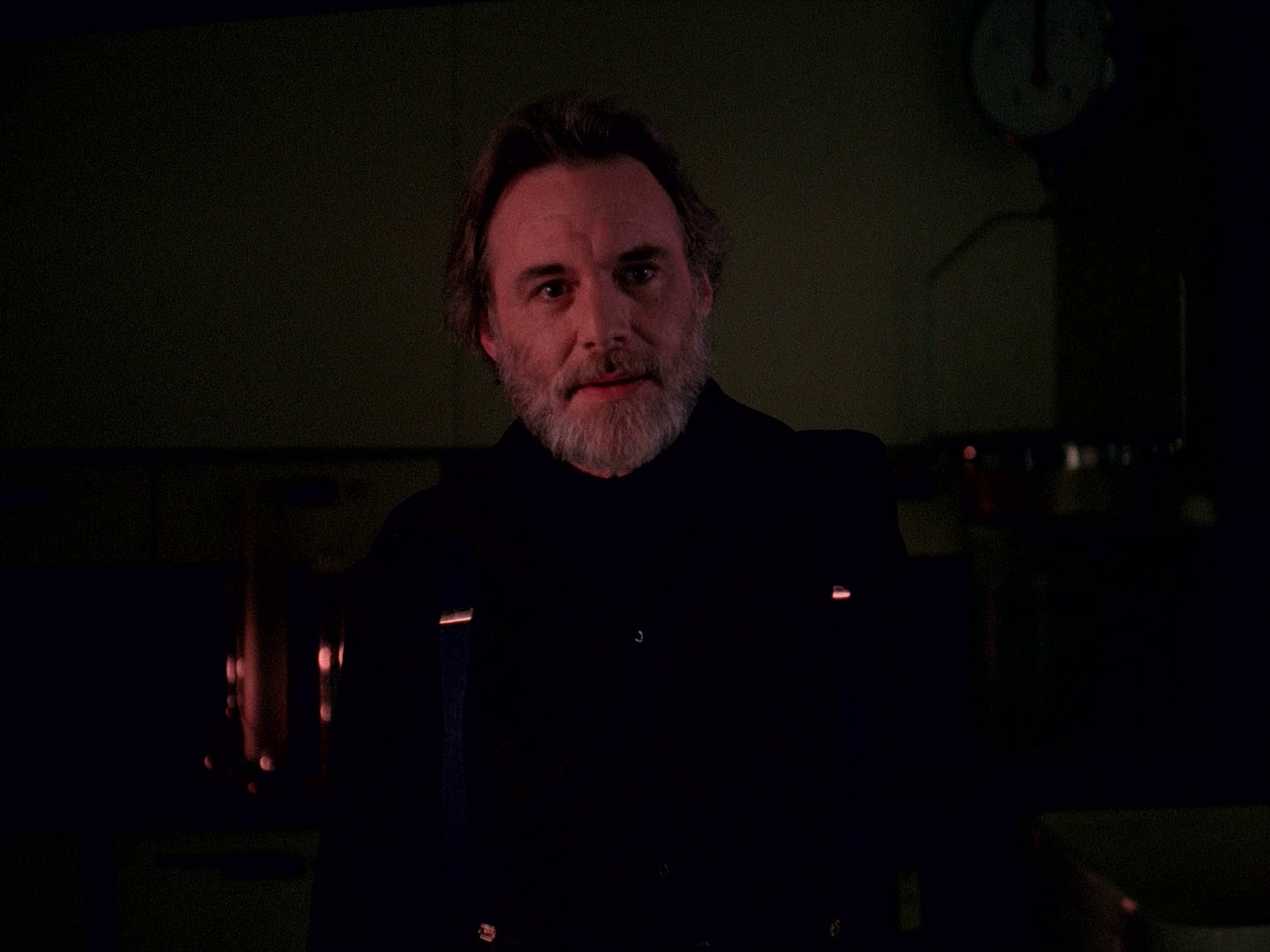
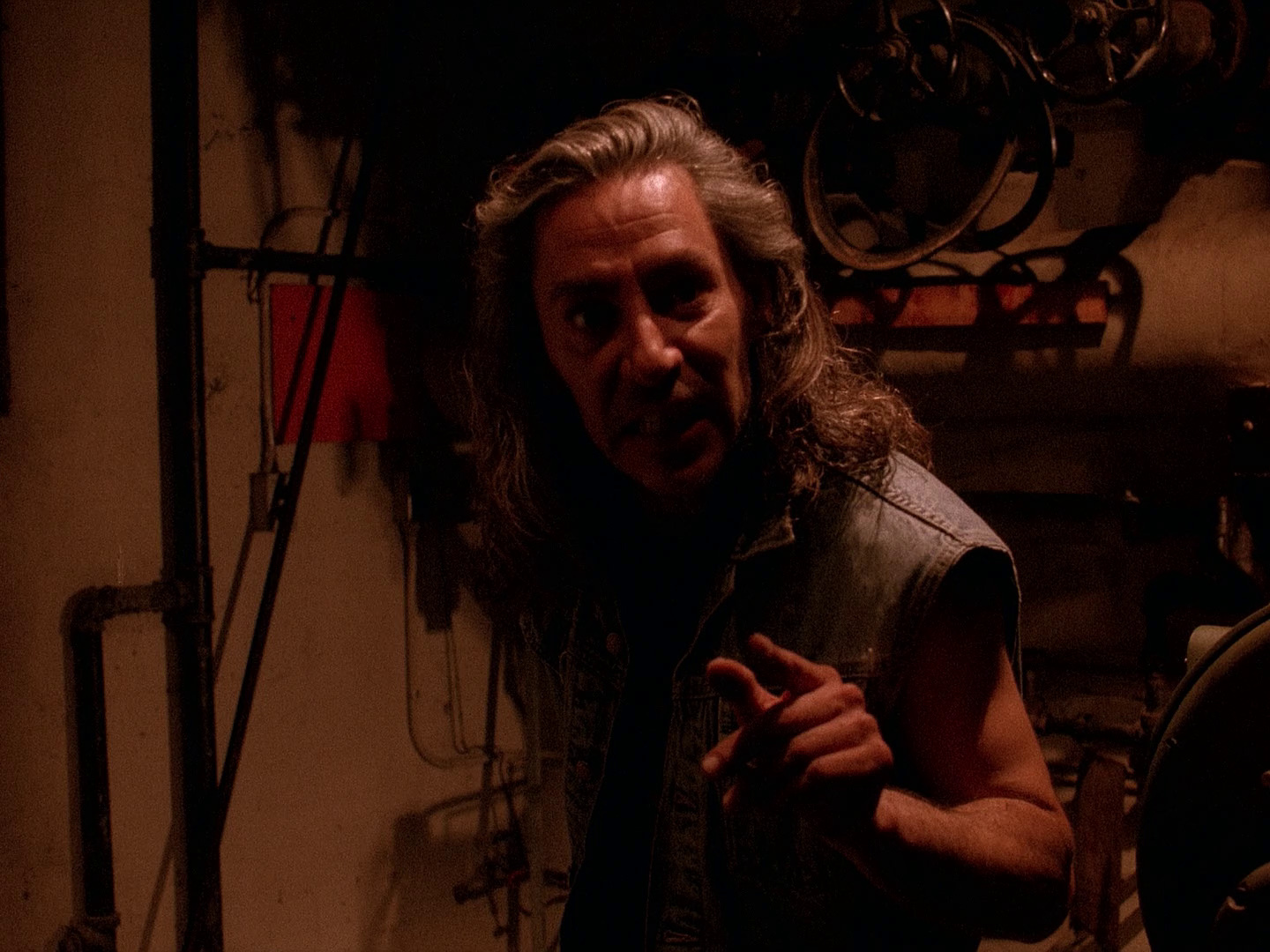
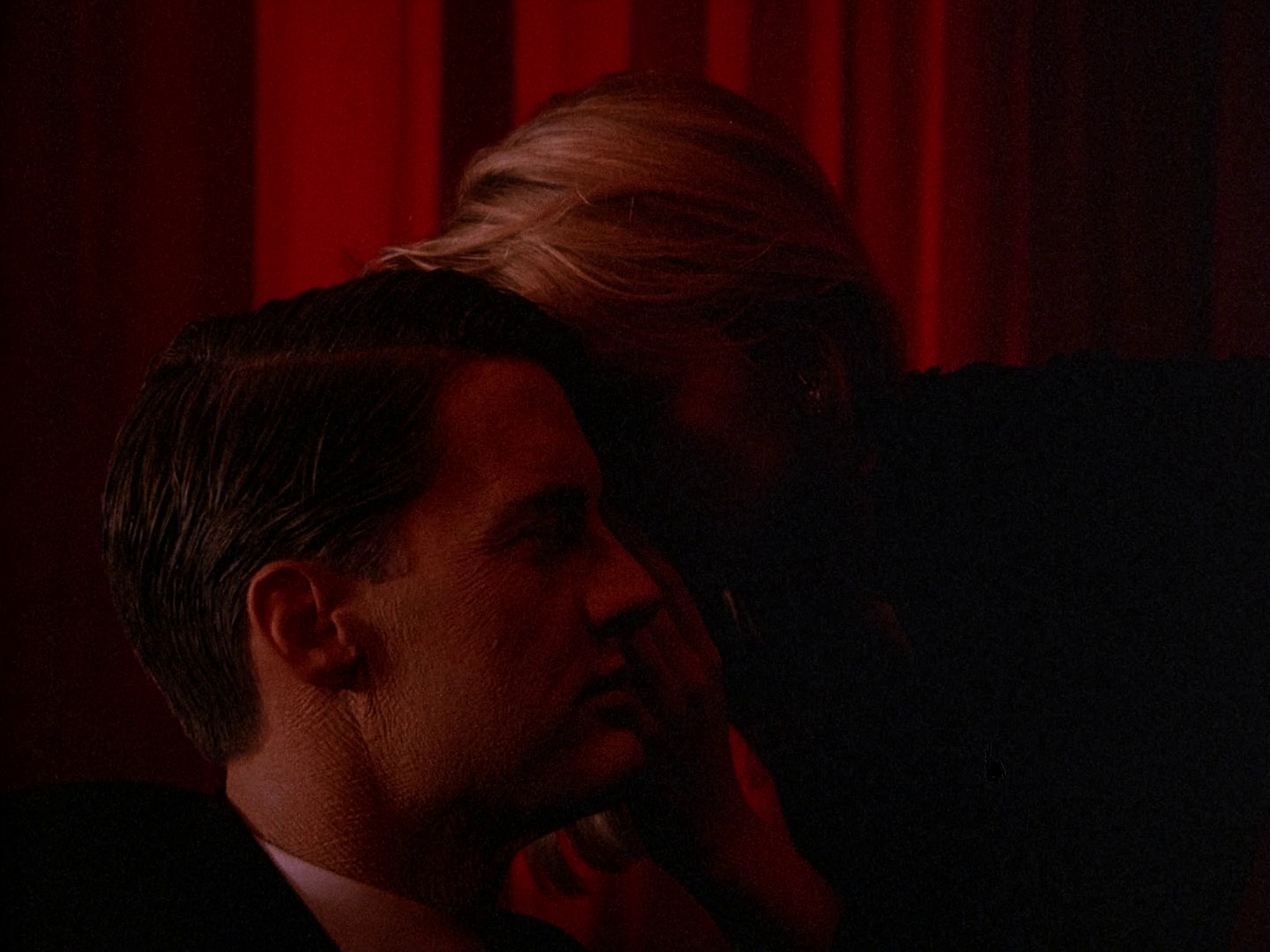
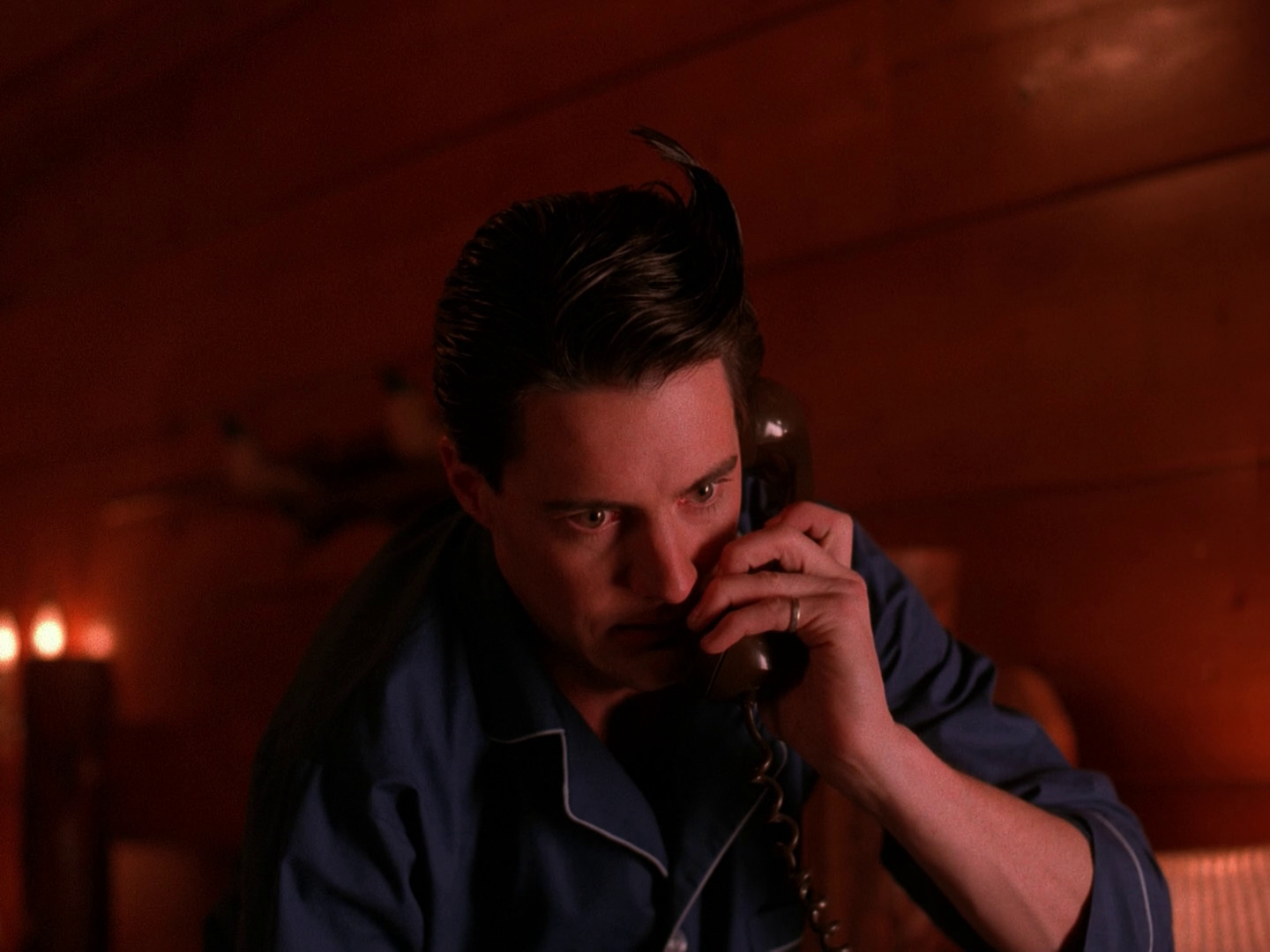
This sequence also asks to be read as an act of editing. The international pilot ending contains a longer hospital and boiler-room route before its Red Room passage. Episode 2 does not carry that entire resolution into the continuing series. It places selected material inside a dream and turns it into something an investigator must interpret.
That change matters more than simply identifying reused shots. A confrontation can close a plot; a dream can generate future plots by being remembered imperfectly, tested, misread or recognised later. Cooper’s final phone call turns an intensely private experience into a promise to the investigation. The audience is left waiting to learn what that promise means.
Margaret’s introduction
The separate Log Lady introduction for this episode describes ideas as constructive or destructive and points to dreams as a way ideas arrive. It offers an interpretive threshold, not a solution to the dream. Read the introductions and interview guide and the Season 1 sound study.
Speaking backwards is a performance
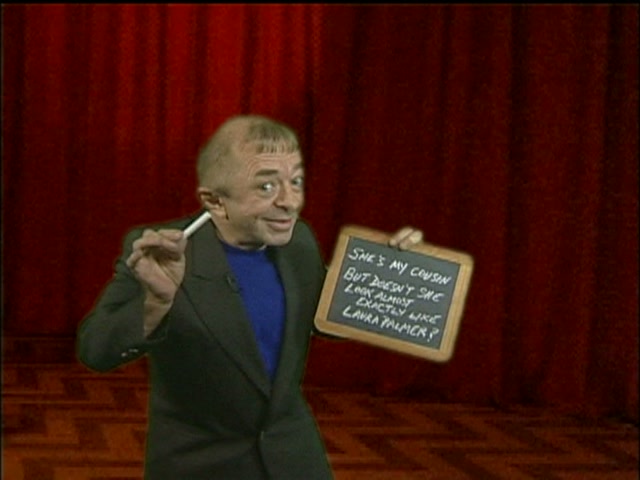
Michael J. Anderson’s demonstration in Learning to Speak in the Red Room makes a crucial distinction: the unit is the sound, not the printed letter. He begins with the end of the intended sentence, works through the sounds in reverse order and demonstrates the altered delivery with a chalkboard. Questions introduce an additional problem of intonation.
This turns an apparently effortless uncanny voice into a learned physical procedure. A performer has to construct unfamiliar mouth movements before the recording is reversed. The resulting speech combines intelligibility with stresses and transitions that do not follow ordinary conversational habits. Anderson’s lesson gives a practical basis for studying the dream’s speech without reducing the dream to a technical trick.
The chalkboard demonstration also belongs beside the episode’s stone test: both stage a procedure for an audience, but one is an explanation of an actor’s craft and the other is Cooper’s fictional method. Keeping those levels distinct allows the making of the sequence to deepen our attention to the scene.
The dream is also designed to be read. A handwritten subtitle-planning sheet headed Twin Peaks — 25 Years Later — Subtitles specifies Helvetica, a thirty-character line target, numbered cues and proposed line breaks. Its annotations work through the Man’s and the Woman’s speech as a sequence of readable units. Alongside Anderson’s phonetic demonstration, the sheet reveals a second kind of construction: unfamiliar delivery is made legible through carefully arranged writing. The handwriting is not signed on the reproduced page, so it should not be attributed to Lynch solely from its appearance. Source: subtitle-planning sheet, two enlarged views in the production-document gallery of Twin Peaks: From Z to A.
Source: Learning to Speak in the Red Room, demonstration through 03:20; produced by Three Legged Cat Productions, producer and camera Mark Rance, in Twin Peaks: From Z to A.
Speech, silence and interrupted listening
Nadine asks Ed to listen to her newly silent drape runners. Her explanation supplies the accidental chain of events: grease reached the cotton balls, she tried them rather than throwing them away, and the result becomes a promise of wealth. The scene makes an absence of noise the object of an excited demonstration. Its modest domestic discovery belongs beside Cooper’s elaborate experiment in the woods: both require other people to attend to a result and accept what it means.
Elsewhere, the television announcement of Invitation to Love places another serial drama inside Shelly’s home. It is a small but important change of register. Manufactured romance occupies the same domestic space as bruising, secrecy and Bobby’s visit. The episode does not have to stop and explain this relationship; the programme within the programme gives the room an additional voice.
The dream’s whisper reverses the outdoor test’s public organisation. Lucy can record what everyone sees at the bottle; the viewer cannot transcribe what passes privately to Cooper. His subsequent telephone call declares that he knows the killer, but postpones explanation until breakfast. Speech therefore ends the episode by creating a new interval of waiting. The certainty of the statement and the audience’s access to its basis are deliberately unequal.
Selected screen credits
The titles credit David Lynch as director and Mark Frost & David Lynch as writers. Jonathan P. Shaw receives the editing credit. The closing dance continues behind the credits, extending the Red Room’s presence beyond Cooper’s return to his hotel room.
Filmmakers, music and sound
- Written by
- Mark Frost & David Lynch
- Directed by
- David Lynch
- Production designer
- Richard Hoover
- Editor
- Jonathan P. Shaw
- Music composed and conducted by
- Angelo Badalamenti
- Sound mixer
- Walter Hoylman
- Music editor
- Lori L. Eschler
- Assistant music editor
- Alexis Seymour
- Dream figures in the cast credits
- Michael J. Anderson — Man From Another Place; Frank Silva — Killer Bob; Al Strobel — One-Armed Man
Source: the episode’s opening and closing screen credits, dialogue and English subtitles. Compare the pilot credits and the pilot versions and framing.
A route through Episode 2
- The evening’s arrangements. The Horne dinner, James and Donna, One Eyed Jack’s and Cooper’s hotel call.
- A meeting in the woods. Bobby and Mike face Leo; concealed knowledge becomes a threat.
- Methods of discovery. Cooper’s stone test, Lucy’s record, Audrey’s conversation and Albert’s arrival.
- The household as evidence. Silent drapes, hidden ledgers and Leland’s dance with the portrait.
- The dream. MIKE and BOB, the curtained room, the dance and Laura’s whisper.
- A claim on waking. Cooper calls Truman and says he knows who killed Laura.
Sources and connections
Primary screen sources: regular Episode 2 and the international pilot ending of Twin Peaks: From Z to A. The comparison concerns the arrangement and dramatic status of the screen material. It does not assign every repeated image a literal place in the series’ chronology.
Episode numbering here follows the pilot plus regular episodes: this is regular Episode 2, commonly displayed as Season 1, Episode 3. The title Zen, or the Skill to Catch a Killer follows the distributor listing linked in the season index.
Further performer testimony: A Talk with Kyle MacLachlan and Sheryl Lee. Produced and directed by David Naylor; edited by Michael Frost (2019). Viewed in Twin Peaks: From Z to A. Timed passages: 02:33–03:20. Timings refer to the conversation. Retrospective testimony is attributed to its speaker and distinguished from analysis of the finished scenes.