Photography
Photography / Factories, bodies and constructed worlds
A window can be a picture. A picture can become a world.
David Lynch’s photographs ask us to linger in a single image. A factory window, a fragment of a face or an impossible head can hold attention without a camera move or an explanatory sequence. The photographs belong to his wider art practice, but they also have their own histories: journeys, commissions, selections, prints, books and exhibitions.
This dossier follows those histories through selected works and documented presentations. Its centre is the encounter between a physical subject and the way a photograph transforms it. It also distinguishes pictures Lynch made from photographs he selected, and a photograph’s exposure date from the later life of its prints. Continue into Art, Furniture Design or The Angriest Dog in the World for other forms of the still image.
Looking without waiting for a cut
The useful first question is what an image does to our attention. Where is the brightest surface? Which edge blocks our access? Is a shape legible as architecture, or does it become an abstract division of dark and light? These questions let the photographs establish their own terms before familiar film titles enter the conversation.
A silver-gelatin print, a large pigment print, a book reproduction and a web image each offer a different encounter with a photograph. Scale, tonal range and surface shape that encounter. The illustrated studies below connect the images to their publication and exhibition histories.
The image’s history
Record the title, subject, exposure date and location when supported. An approximate date should stay approximate; an untitled picture needs another reliable identifier.
The object’s history
Record the print process, dimensions, edition, printing date and exhibition separately. A later print does not make the exposure a later photograph.
Factories: attraction, disappearance and selection
In Petra Giloy-Hirtz’s published conversation with Lynch, he describes his attraction to abandoned factories being reclaimed by nature, his preference for winter branches, and the pull of increasingly close details. He also recalls a disappointing trip north from London with cinematographer Freddie Francis after The Elephant Man: many of the buildings he hoped to photograph had gone. He does not supply a precise date for that journey. Source ↗
The recollection establishes a way of looking and a remembered collaboration. It cannot date every English negative. Nor should affection for an industrial atmosphere be confused with a complete social history of the site. Lynch acknowledges the pollution associated with the factories even as he mourns their disappearance. Source ↗
Fondazione MAST’s 2014 presentation gathered 111 photographs, describing exposures from 1980 to 2000 in Germany, Poland, England and the United States. Its technical note distinguishes larger archival pigment prints from smaller silver-gelatin prints. The exhibition also included three short moving-image works and a sound installation. That is an exhibition’s selection and installation, not a count or a date range for every factory photograph Lynch ever made. Source ↗
These pictures can preserve the appearance of threatened places while withholding much of the information expected of an industrial survey. A dark window gives an intense sense of enclosure without supplying the name of the business, the work done there or the experiences of its workers. Their historical interest and their omissions are both worth keeping visible.
Watching the photograph being made
LYNCH (one) (2007), directed by blackANDwhite, adds an observational account to the later interview testimony. During the factory visits, Lynch discusses exposure and camera stability, studies the architecture and examines photographs. He singles out the routes of electrical fittings, the shape of broken windows and the way nature has altered the walls. His preference for grey skies, cold and rain connects the conditions of looking to the atmosphere he wants the pictures to hold.
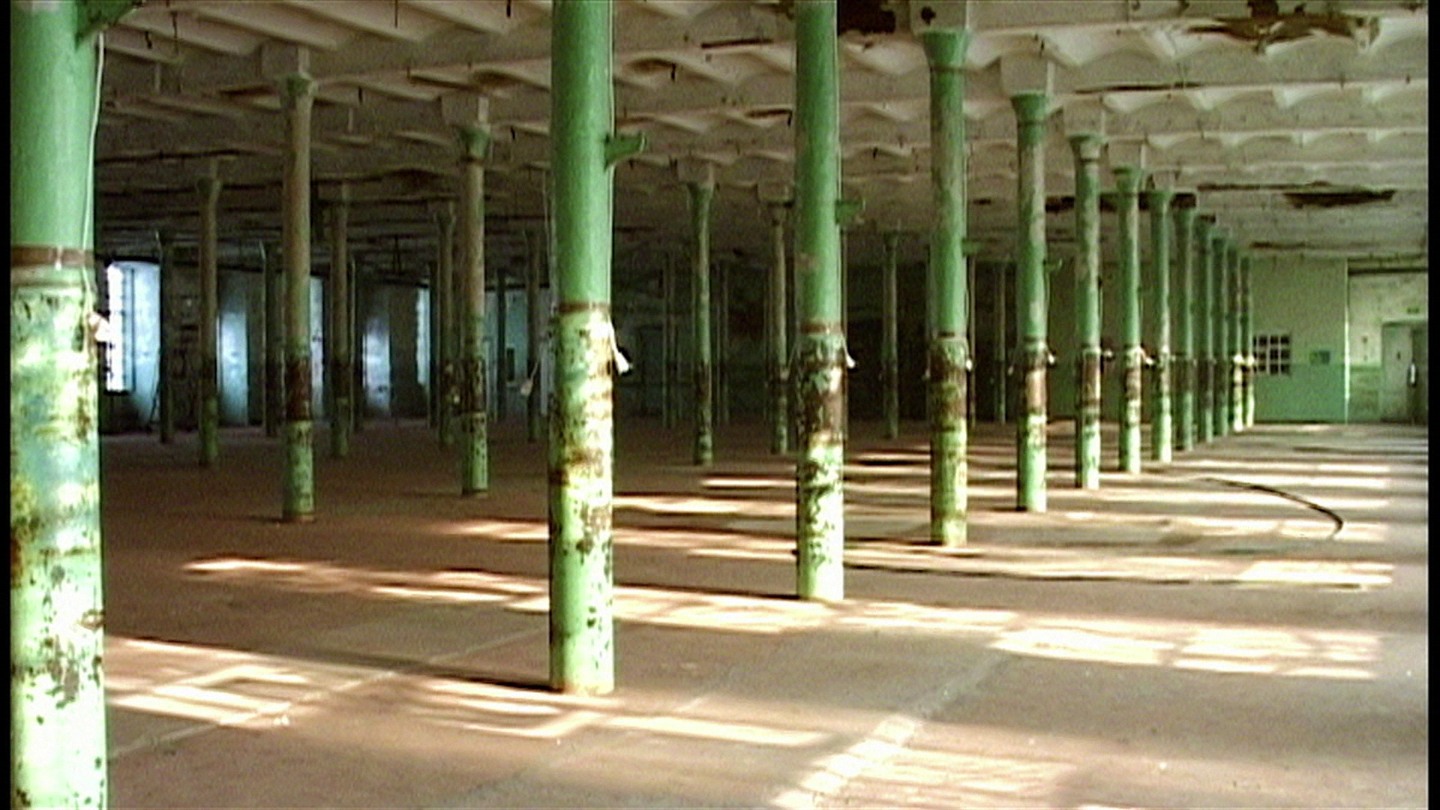
Later in the documentary, he connects those visits in Łódź and the collaboration with the Camerimage group to the developing Inland Empire experiment. This gives the photographs a place within an ongoing practice of finding locations and ideas, while leaving each photograph’s individual exposure date and identity to its own record. Documentary passages, 12:19–17:40 and 42:27–43:17 → · Continue into the production study →
Two images from Łódź
The window: an image inside the image
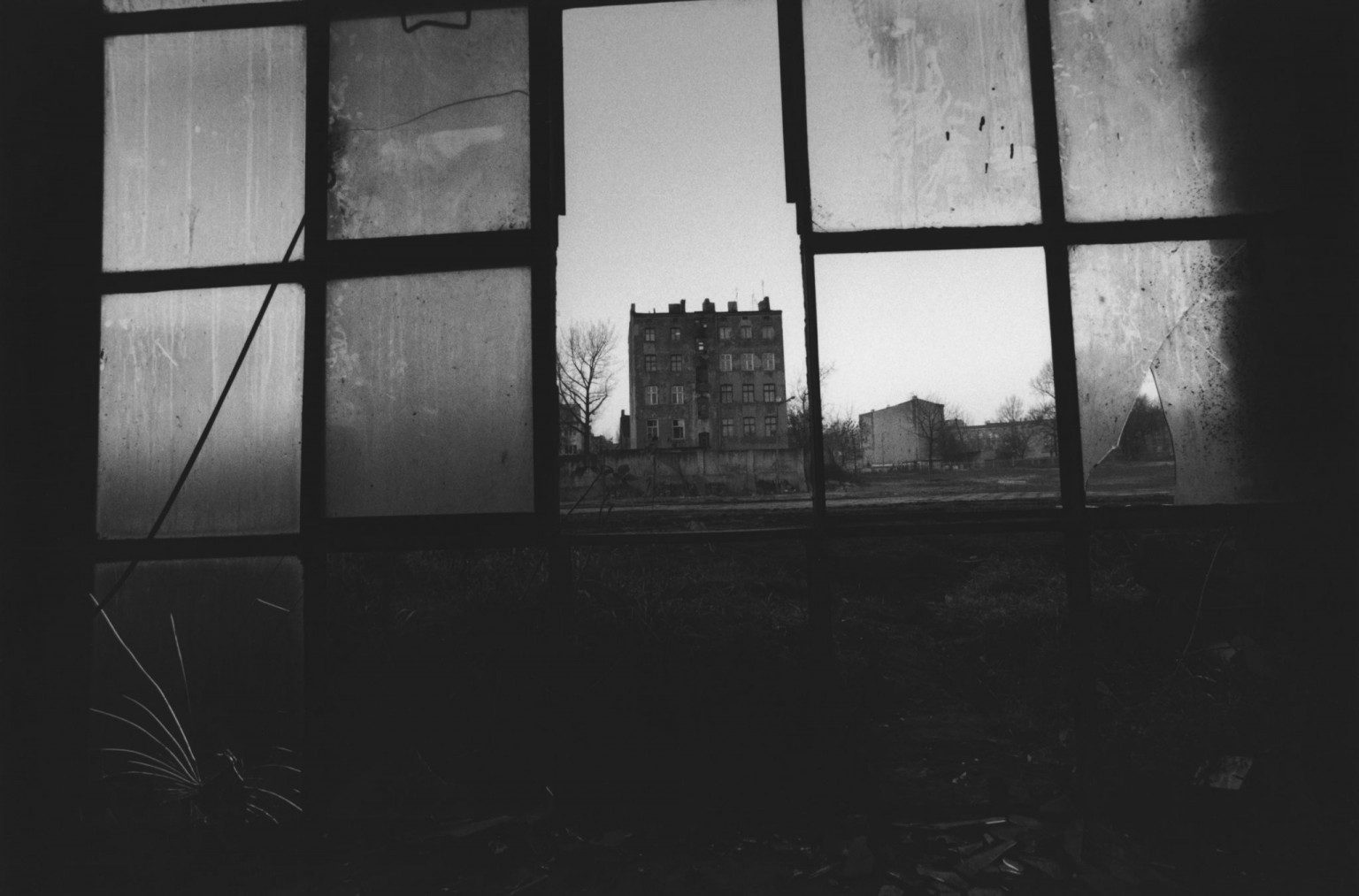
Untitled (Łódź), 2000, used at the opening of this dossier, is identified that way in PhotoBite’s interview presentation. The window’s dark bars divide the view into unequal rectangles. Dirty or opaque panes interrupt the sky; a clearer central opening gives access to the building beyond. The interior below is so dark that it resists an easy inventory. Source ↗
The photograph gives us an exterior by insisting on an interior. The window does two jobs: it is part of the factory’s fabric and an arrangement of frames. The distant building seems available to inspection, yet the foreground continually reminds us that we are looking through damaged material. What might have been a straightforward view becomes a study of partial visibility.
The intact dark geometry and the irregular marks on the panes also establish different kinds of time. The grid records a built order; the dirt and damage make that order porous. We can describe that relation without inventing the precise factory, a demolition date or a story about an absent worker. Those identifications belong to the open location investigation.
The chimney: a diagonal through the sky
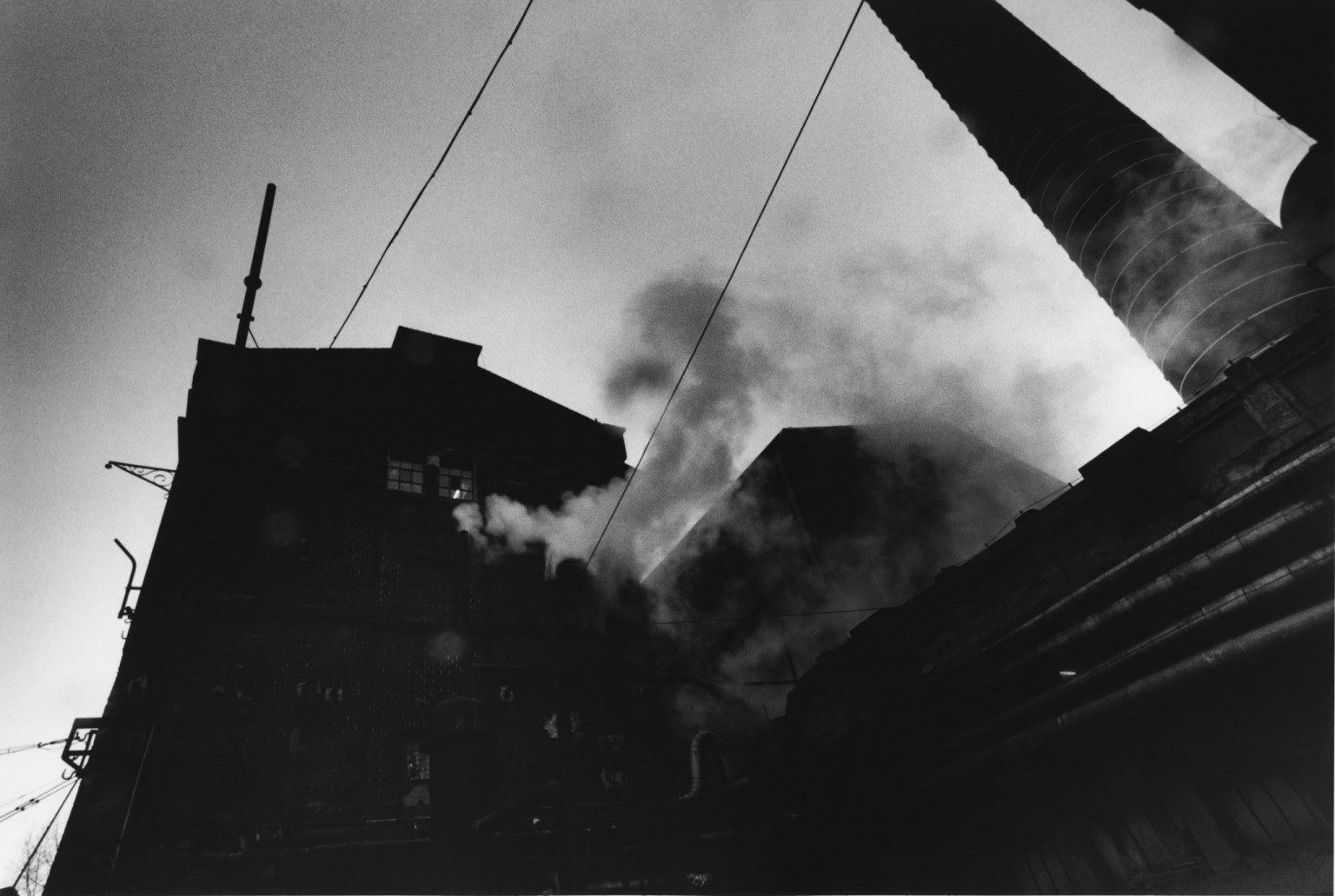
This second reproduction carries the same broad title and year, Untitled (Łódź), 2000. It is a different image: a low viewpoint, a strongly tilted chimney, dark industrial walls and pale vapor. The paired titles demonstrate why a research record needs an image reference as well as a name.
The architecture occupies the edges and pushes into the sky. Thin cables draw finer diagonals across the heavy silhouettes. Vapor interrupts the boundary between solid structure and open air: it has volume, but no stable outline. In the window image, an obstruction organizes our looking; here, an escaping substance makes the scene feel active.
These images reward comparison because their spaces work differently. One holds the viewer behind a plane; the other turns the sky into a channel between buildings. Neither needs to be treated as a disguised frame from Eraserhead to sustain an argument about framing, density and light.
Small Stories: constructing the impossible
The Maison Européenne de la Photographie gave Lynch carte blanche for Small Stories, shown from 15 January to 16 March 2014. Its account describes about forty black-and-white photographs created for the exhibition, curated by Patrice Forest, Jean-Luc Monterosso and Pierre Passebon, with Galerie Item as coproducer. This was a commissioned body of work, not simply a general retrospective of old photographs. Source ↗
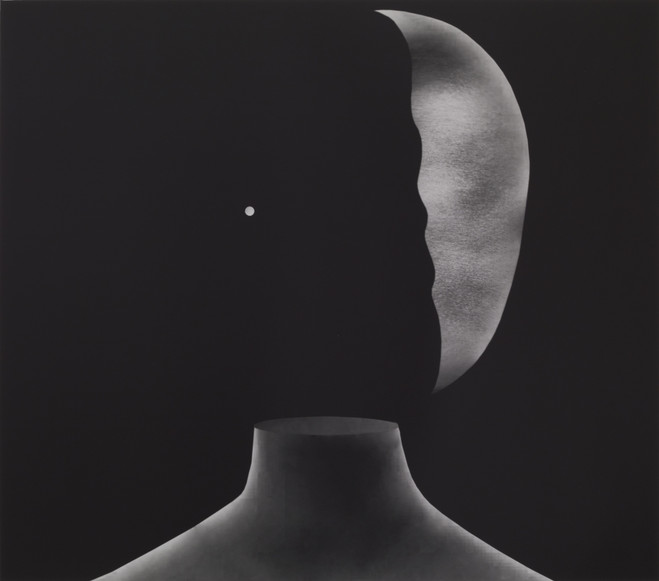
Slash Paris identifies the image above as Head #15, crediting David Lynch and Galerie Item. Its published exhibition text includes Lynch’s account of a still image prompting stories that can expand in a viewer’s mind. That is an invitation to interpretation, not a supplied solution to this particular image. Source ↗
A gap separates the head from its neck. A crescent of light describes part of the face, while the rest almost merges into the background. A small bright point interrupts the dark mass. The eye tries to assemble a coherent head from incompatible cues: volume is suggested, attachment is denied, and illumination seems to carve the face into a second object.
The resulting story need not be a plot. It can be the brief mental event of recognition failing and beginning again. The factory window makes an existing structure difficult to see through; this image makes a seemingly recognizable body difficult to put together. The exact construction process cannot be inferred securely from the finished reproduction. Montage, lighting, source imagery and digital manipulation require production evidence.
Bodies, abstraction and the designed book
Nudes and Digital Nudes are distinct publications. Fondation Cartier identifies the latter as a 2021 collection of 125 digital photographs, following the 2017 book of analogue work. Its catalogue lists a bilingual French/English hardback, 240 pages, designed by Atelier Dyakova. “Digital” describes a body of work and its means of production; it should not be silently treated as a revised printing of the earlier volume. Source ↗
The designers describe the books through different tactile entrances. For Nudes, a film jacket reveals an image across the hardback, and the lack of text encourages sustained looking. For Digital Nudes, they describe removing the jacket, choosing a textured cover and inserting uncoated papers of different hues. These are named collaborators’ design decisions, not incidental packaging around the artist’s photographs. Source ↗ Source ↗
The Helmut Newton Foundation’s account of its 2018–19 exhibition locates much of Lynch’s nude work in Łódź and Los Angeles. It describes unusual viewpoints, fragmented bodies and enlarged prints, and identifies the subjects as professional models. The museum’s interpretation stresses an impression of intimacy created by close detail. That impression is an effect of the image; it is not evidence about a sitter’s private relationship with the photographer. Source ↗
The photographic books bring bodies, surfaces and landscapes into an uneasy relation. Framing can make a familiar form strange, while the sequence of pages builds associations that extend beyond a single image.
A book spread creates echoes of line, colour and gesture between photographs. Paper, binding and page order give that sequence its physical rhythm.
Beyond the factories
Pace’s September 2026 LA presentation brings together five photographic series made between 1979 and 2008: city views, figures and smoke, nudes, the Couch Series and Kits. The gallery describes superimposed or distorted reclining figures and photographs that break down animals into components accompanied by reassembly instructions. These records expand the photographic practice beyond abandoned buildings and monochrome atmosphere. Source ↗
The distinction between discovering an image and arranging one is useful here. A city view selects from an existing world; a deliberately constructed scenario can make the photograph itself the location of an impossible proposition. That is a spectrum, not a clean division: viewpoint, timing and display also construct an apparently observational picture.
Dark Night of the Soul is a further meeting point with music. Shelley Leopold’s 2014 account in Artillery describes the 2009 Michael Kohn Gallery presentation of fifty Lynch photographs with music, including speakers associated with individual images, followed by a book/CD form. Her account also argues for the independent strength of his photographic compositions. The installation has not been reconstructed here from a plan or a complete recording. Source ↗ Explore the collaboration through Music.
Paris Photo: looking at other people’s photographs
Paris Photo by David Lynch records a different role. Steidl’s 2012 book presents his selection from the fair and frames it as a route through other exhibitors’ work. The publisher lists a 208-page English paperback, first issued in November 2012. It belongs in a history of Lynch as a viewer and selector, rather than being catalogued as a volume of photographs all taken by him. Source ↗
That distinction also matters for this website’s imagery. A portrait of Lynch may illustrate an interview or exhibition announcement without being a photograph by Lynch. The maker of the photograph, its subject and the artist being discussed are separate credit fields.
An exhibition and edition map
The dates below identify presentations or publications. They do not date every image within them. The record is selective and keeps the institutional source alongside the event.
| Presentation / edition | What it establishes |
|---|---|
| The Factory Photographs London and Bologna, 2014 | Pace records the Photographers’ Gallery dates, 17 January–30 March. MAST documents its own 17 September–31 December presentation, print types and accompanying sound/moving images. Source ↗ Source ↗ |
| Small Stories Paris, 2014 | A commissioned photographic exhibition with named curators and Galerie Item collaboration. The MEP record is the basis for the dates used here. Source ↗ |
| Nudes / Digital Nudes 2017 / 2021 | Separate books present different photographic selections and distinct design treatments. Source ↗ Source ↗ |
| Infinite Deep 2021–23 | Pace records presentations in Olten, Copenhagen and Helsinki. Their individual checklists and arrangements are not established by the shared exhibition title. Source ↗ |
| LA Los Angeles, 2026 | A later gallery presentation drawing together five series. Its retrospective selection is separate from their original exposure dates. Source ↗ |
What a fuller photographic history should keep in view
The dominant institutional language emphasizes dreams, mystery and the continuity of Lynch’s artistic vision. Those are useful starting points, but they can make very different photographs sound interchangeable. The window, the chimney and Head #15 instead offer specific operations to examine: obstruction, directional force and disrupted recognition.
Our critical position: Lynch’s name should open the enquiry rather than settle the value of an image. Industrial beauty can be considered beside labor, environmental damage and redevelopment. Bodily abstraction can be considered beside the presence and authorship of the model. The atmosphere of a book can be considered beside a designer’s decisions. These are questions for further evidence and criticism, not accusations or a claim to know the artist’s hidden intention.
Follow the photographs into their books and exhibitions. The scale of a print, the turn of a page and the sequence of images extend the work beyond any single reproduction.
Explore further
Follow the sources below, explore the museum collection, or continue through the Reading Room. New archival discoveries and contributions enrich the record of Lynch’s work.
Sources and further reading
Read or reviewed on 18 October 2026. These notes separate inspected reproductions, source texts and participant recollections from original objects and complete editions still to be examined.
- Petra Giloy-Hirtz in conversation with Lynch, via PhotoBite ↗Interview text and five captioned factory images inspected. Participant recollection; original negatives and prints unexamined.
- Fondazione MAST: The Factory Photographs (2014) ↗Institutional record preserved during the Art research pass and reread here. Used for selection, dates, media and the installation statement.
- Maison Européenne de la Photographie: Small Stories (2014) ↗French institutional text read: commission, approximate selection size, dates and curatorial credits. Exhibition not visited.
- Slash Paris: Small Stories / Head #15 ↗Head #15 reproduction, credit and exhibition text inspected. Richard Dumas’s portrait on the same page is a separate photograph.
- Fondation Cartier: Digital Nudes ↗Publisher description and bibliographic fields read.
- Atelier Dyakova: Nudes, book design ↗Designer’s written account inspected. Used for design decisions, not a page-by-page appraisal.
- Atelier Dyakova: Digital Nudes, book design (2021) ↗Designer’s written account of cover and papers read. Tactile properties are attributed, not personally tested.
- Helmut Newton Foundation: Leiter, Lynch, Newton — Nudes ↗German exhibition text, especially the Lynch paragraphs, read. Its book date and selected-image count require reconciliation with publisher/final checklist records; omitted from the narrative.
- Pace Gallery: David Lynch — LA (2026) ↗Gallery series descriptions read. Only the September presentation is dated here; inconsistent opening/closing fields are not harmonized.
- Shelley Leopold, One Frame at a Time (1 July 2014) ↗Critical feature read; Dark Night of the Soul installation account attributed. Not an installation plan or independent listening session.
- Steidl: Paris Photo by David Lynch (2012) ↗Publisher’s curatorial description and edition fields read through the web index.
- Pace Gallery: Lynch exhibition chronology ↗Gallery exhibition chronology, including the 2014 and 2021–23 presentations.
Another doorway
Continue exploring
Art
Art
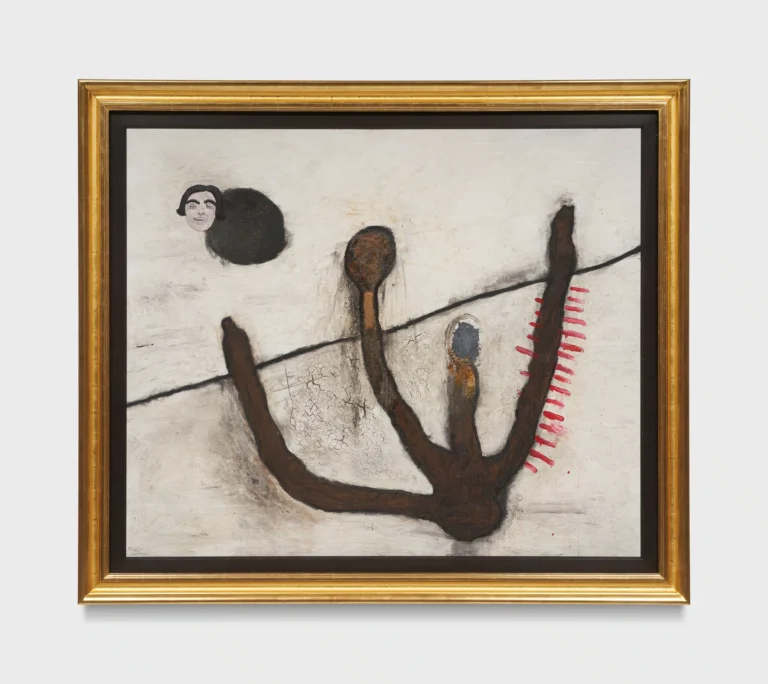
Explore David Lynch’s paintings, lithographs, sculpture and photography through close readings, exhibition histories, credited images and documented sources.
Art
Furniture Design
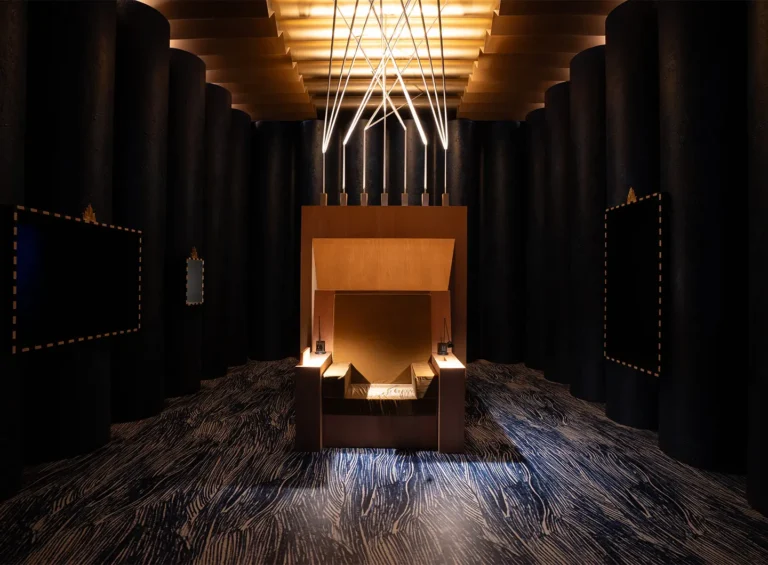
Explore David Lynch’s furniture design, from the Espresso table and Wire chair to Silencio and the Thinking Rooms, with object records, images and sources.
Music
Music
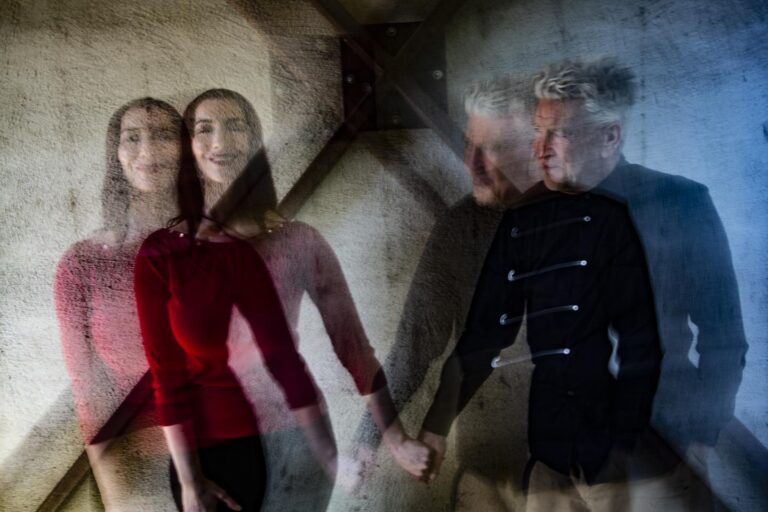
Explore David Lynch’s albums and collaborators, from Julee Cruise and Thought Gang to Chrystabell, with recording histories, edition notes and sources.
Image credits and sources accompany each linked guide.