Art
Beyond the frame / David Lynch’s visual art
A surface becomes a place. A lamp becomes a presence.
Look at Lynch’s art long enough and the categories begin to move. A picture has a body. A printed line becomes a character. A room gives paintings a soundtrack. This dossier follows the decisions behind those encounters, from the Philadelphia studio to the print workshop and the exhibition floor.
Start with the artworks, follow their material histories, or explore the exhibitions that bring them together.
Three ways into the work
The object
Begin with a surface
Compare the crowded, framed space of Big Bongo Night with the broad black marks of Woman with Abstraction and the soft tonal image of Louise. What changes when a mark has thickness, when it is printed, or when its edge dissolves?
Look at the works →The encounter
Begin with a room
Follow lamps, photographs and installations into exhibitions. Scale, sound and neighbouring objects change the way an image meets a visitor. An exhibition has a history of its own.
Enter the exhibitions →For the artist’s voice, read his conversation with Phong Bui. For moving images, continue to Short Films. The museum provides a complementary history of posters and editions: an interpretation of a Lynch film by another artist retains that artist’s authorship.
Philadelphia: a practice, a community, a moving painting
Robert Cozzolino’s catalogue essay dates Lynch’s PAFA attendance to January 1966–May 1967. It places him among teachers including Elizabeth Osborne and Hobson Pittman, and peers including Jack Fisk and Peggy Reavey. Bushnell Keeler’s earlier mentorship had already shown him that painting could be a way of life. These are social and working relationships, not simply a list of stylistic influences. Catalogue excerpt, pp. 16–19
Cozzolino’s central argument is that Six Men Getting Sick should be understood as a hybrid artwork: a projected loop meets a sculptural screen, made with Fisk’s assistance, and sound. The account resists treating the piece only as an apprenticeship for feature filmmaking. Catalogue excerpt, pp. 13–14
The decisive change is in the visitor’s relation to the work. You can choose the order in which you inspect a stationary picture. A loop supplies its own recurrence. A relief catches light from the room while a projection changes the light falling on it. Neither experience is exhausted by a photograph of the screen or by the film detached from that screen.
PAFA’s The Unified Field, curated by Cozzolino, ran from 13 September 2014 to 11 January 2015. Approximately ninety paintings and drawings, dating from 1965 onward, and a reconstruction of the early installation gave this continuing practice a substantial public setting. The reconstruction is a later exhibition object; it should not be silently identified with the surviving condition of the 1967 original. PAFA exhibition record
That history changes the questions we bring to the films. Instead of searching a painting for a hidden explanation of Eraserhead, we can ask how an image is assembled, how long it asks us to attend to it, and how sound changes its space. The short-film dossier follows the early works and their separate viewing reservations.
Texture before explanation
Pretty as a Picture brings the material practice into view. Jack Fisk remembers Lynch welcoming a moth that became caught in wet paint; Lynch describes collected organic matter in terms of texture. Later footage shows him working directly on a densely built surface and watching insects move through another work. These are accounts and images of a working process, not a key that translates every object into a fixed symbol.
The distinction matters to the films too. A surface can attract attention through density, movement and resistance before the viewer decides what it represents. Keeler’s documentary lets that physical labour sit beside sets, costumes and sound recording, making the continuities between the practices visible. Pretty as a Picture, 13:18–16:24 and 35:21–37:00 · source guide →
Big Bongo Night: the picture and its boundary
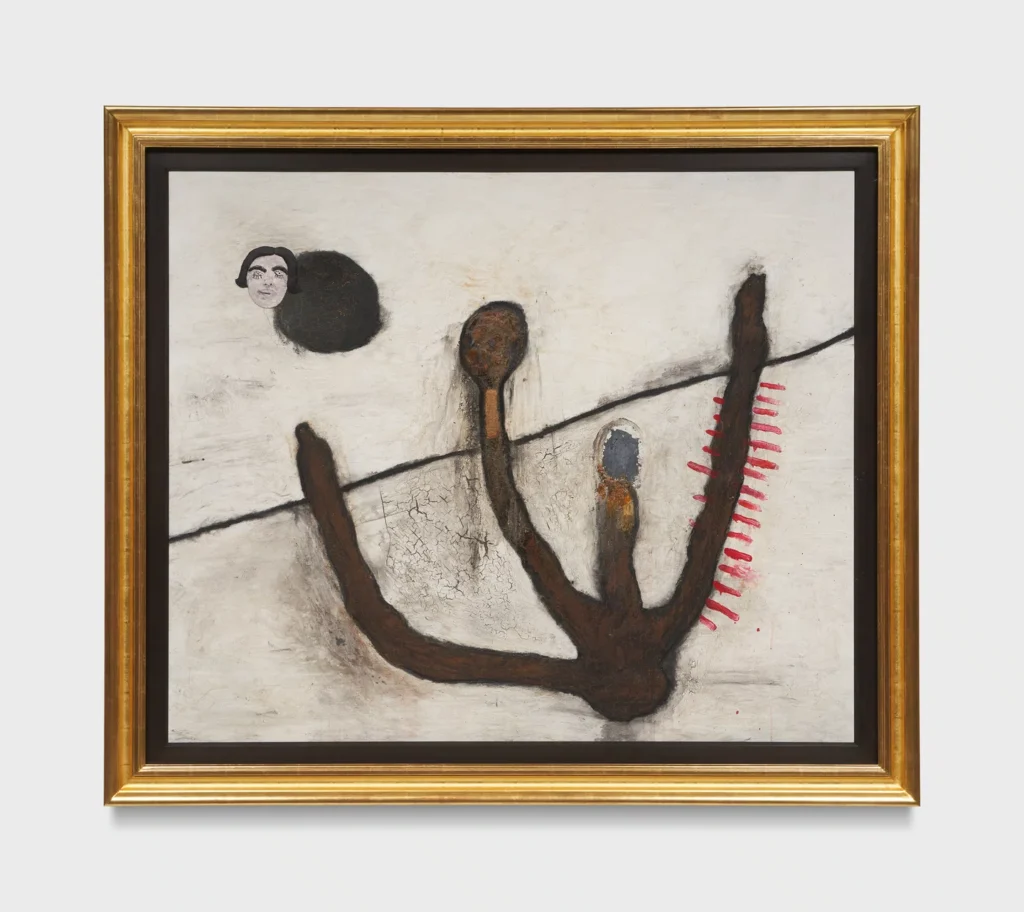
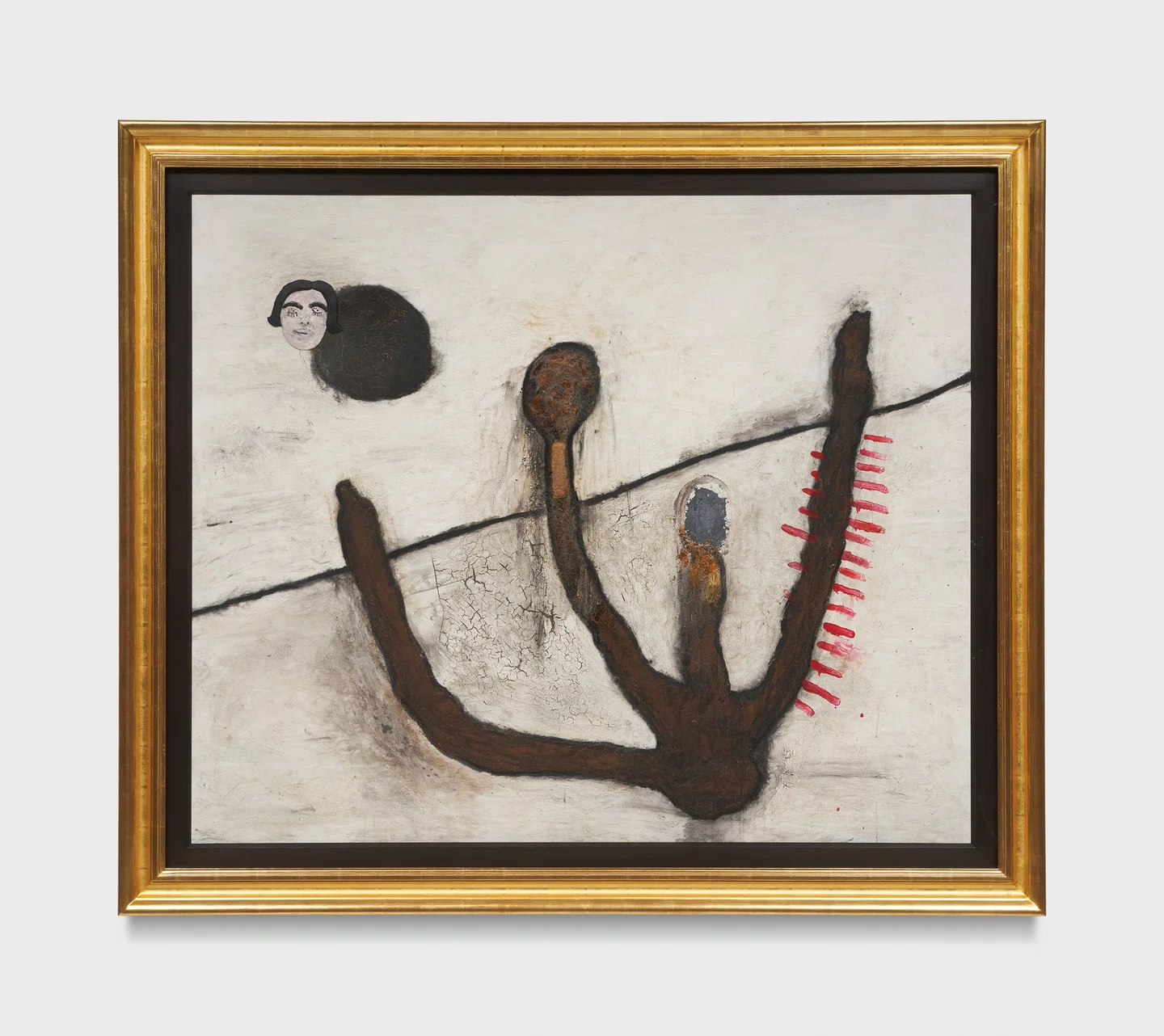
The opening image is Big Bongo Night (2021). Pace records mixed media, 127 × 152.4 cm unframed; the framed object is larger and has depth. Those measurements matter: the work is a substantial physical presence, whereas a phone makes it a small luminous rectangle. Pace, Featured Works
Close reading of the reproduction: dark branching forms pull the eye across a pale field. A small face and red marks interrupt their movement. The ornate gold frame offers the promise of a settled, bounded picture, while the shapes inside refuse an equally settled identity. The contrast between decorative border and uneasy interior is something we can describe without deciding who the figure is or what happened to it.
The title supplies rhythm and a time of day. Read it after looking at the image: “night” changes the pale field’s atmosphere, while “bongo” brings an imagined sound into an otherwise silent object.
The work’s surface makes light part of the image. Marks and relief combine with cast shadows, adding another layer to the composition.
In his 2019 interview with Bui, Lynch describes casting clay elements, attaching them with wire and glue, and combining paints and other materials. He also discusses leaving paper unpainted so that its whiteness remains visible. These are accounts of his practice, not a recipe proven for every part of Big Bongo Night. Bui interview, materials and paper
Printmaking: the image passes through other hands
A print is an object produced through a process. Idem’s workshop account describes lithography as a flat printing method using the opposition between grease and water, and emphasizes the collaboration between artist and printer, including the choice of paper. Its broader production capabilities are a reminder to establish the process for a particular work rather than assume every print began on the same kind of matrix. Idem, The Workshop
Lynch told Bui that his Post-it drawings were first translated onto aluminium plates; working on stones followed. He describes learning from what happens between a drawing and its printed result. That testimony gives the printer and the sequence of operations a place in the artwork’s history. Bui interview, lithography
Woman with Abstraction · 2007
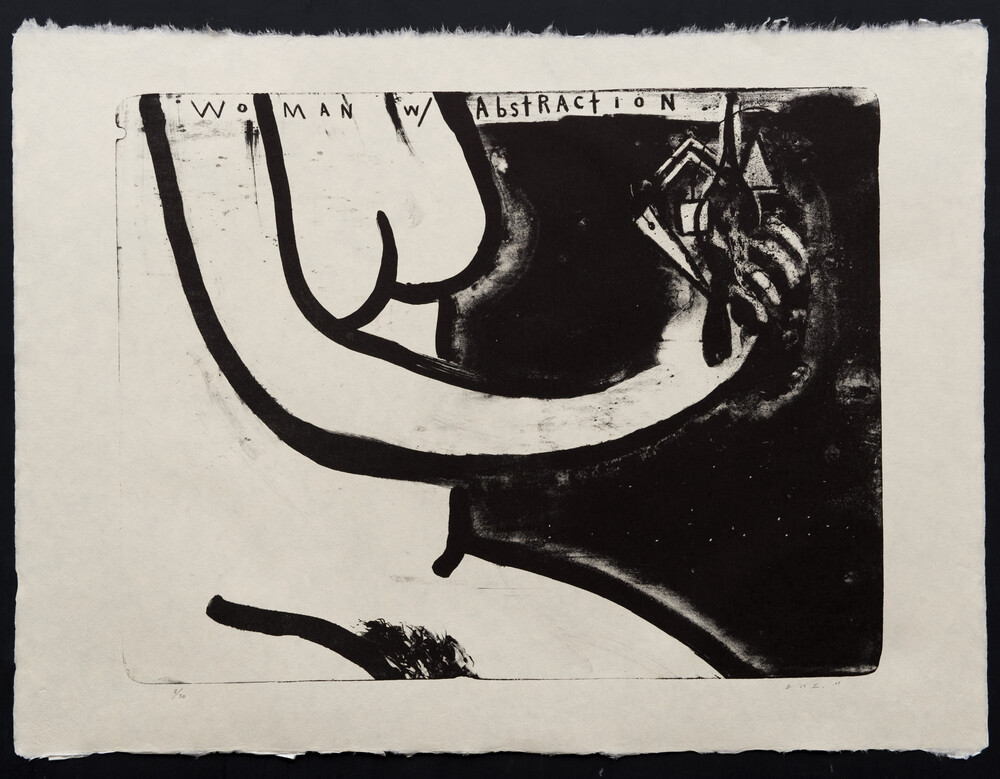
The edition measures 67 × 89.5 cm, with thirty impressions on Japanese paper.
Close reading: the sweeping curved marks are immediately forceful; the wording along the top asks us to recognize a woman and an abstraction. The pale reserve between black forms can become as active as the marks. Neither title nor contour resolves the image into a stable diagram. The visible paper edge also resists the illusion that we are looking through a seamless window.
Louise · 2019
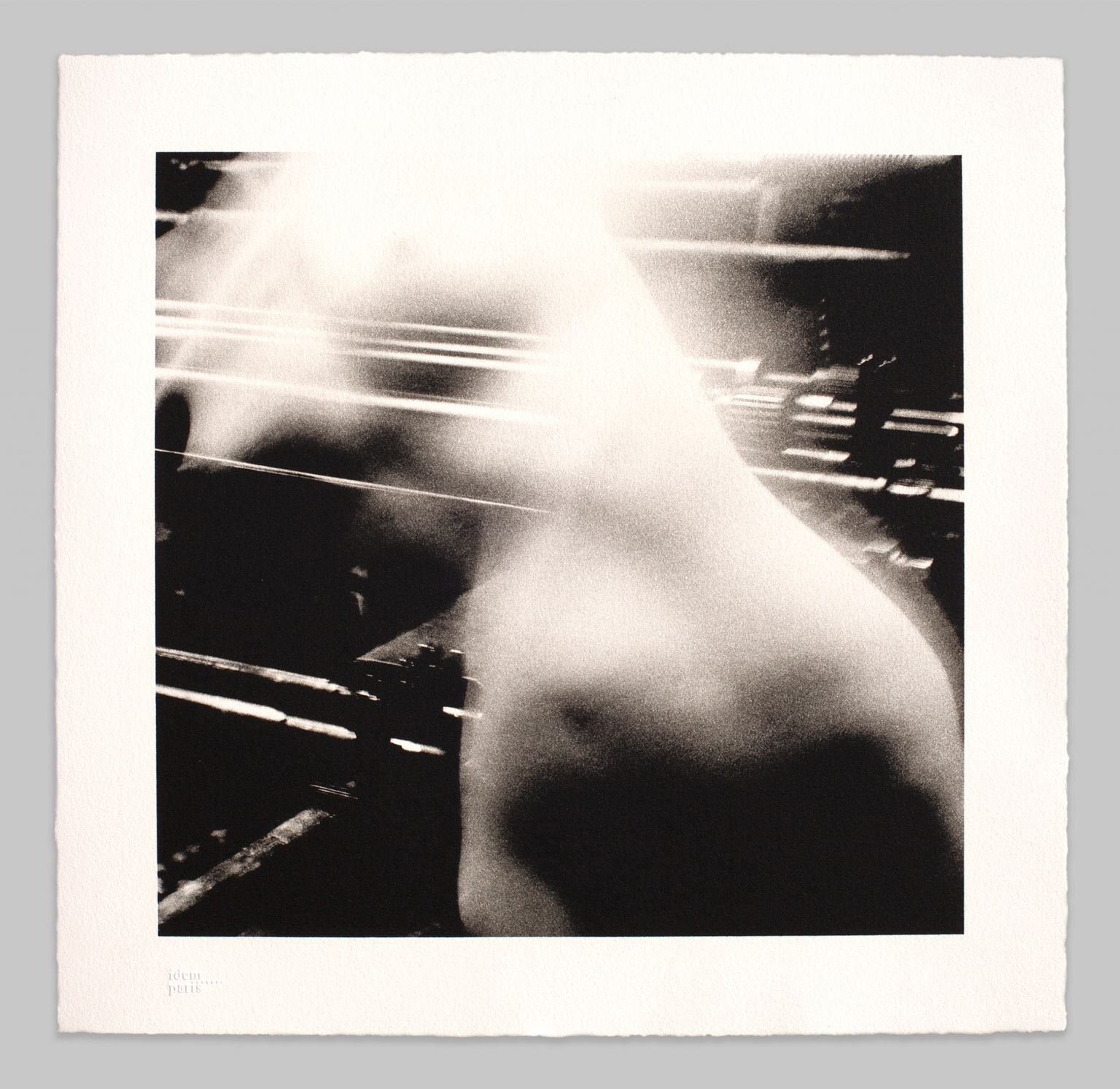
The lithograph measures 30 × 30 cm, in an edition of eighty on BFK Rives paper. Its broad margin and workshop blind stamp make the printed sheet part of the composition.
Close reading: the figure’s softness and the bands of light suggest movement or a fleeting appearance. Yet this encounter is with a stationary printed image. Compared with Woman with Abstraction, the transition between dark and light becomes gradual and grainy rather than a clearly bounded stroke. The shared medium accommodates markedly different kinds of mark.
These two records make “a Lynch print” a more useful description: each has a title, date, support, dimensions and stated edition. None of those facts establishes an asking price, authenticity of another impression, or superiority over another printing. For a museum object, the next step is a photograph of the actual sheet, its inscriptions and its provenance.
Words, names and the temptation to solve a picture
A name printed or painted in an image can sound like the start of a story. It can also give an anonymous shape a comic, ordinary identity. Asked about his 2000 Bob paintings, Lynch told Bui that the name need not refer to one person; it could belong to different people. Bui interview, Bob series
That statement is particularly useful beside the Galerie Duchamp’s 2025 press dossier, which links a recurring Bob to Twin Peaks. The dossier supplies a curatorial interpretation; Lynch’s answer prevents us from promoting that association into a universal identification. Similar names can open a comparison without proving that two figures are the same character. Press dossier, p. 4
A title can disclose an event while the image withholds its cause. It can also add an implausibly precise statement to a body that is barely described. The tension is worth preserving. Read what the words assert, describe what the image actually shows, and notice what remains between them. An unresolved relationship can be the work’s productive condition.
A lamp shares your room
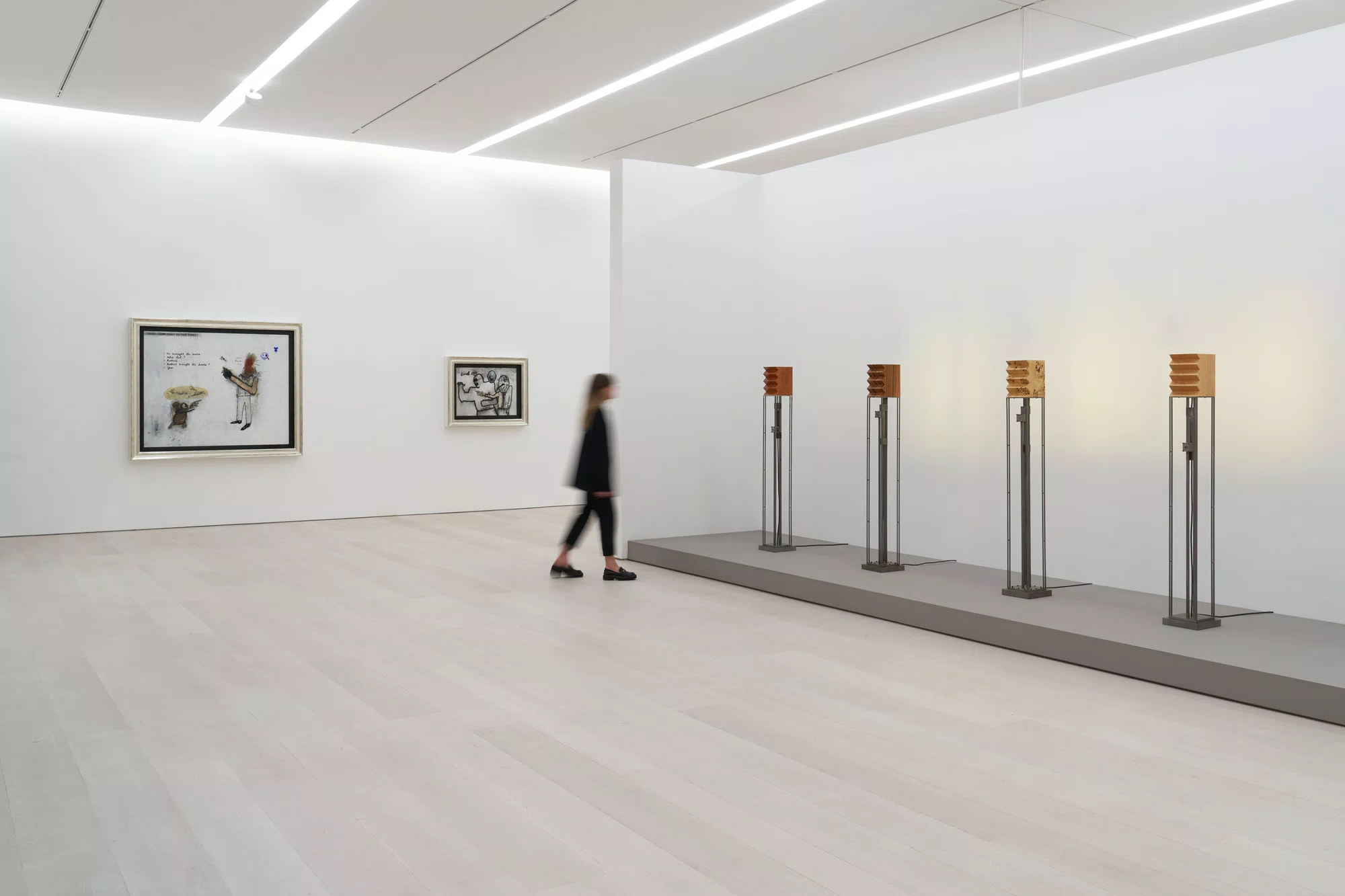
Pace’s exhibition ran from 4 November to 17 December 2022. Its object list distinguishes Ladder Lamp (2022), in cold-rolled steel, plaster and resin, from Mappa Burl Top Lamp (2022), in cold-rolled steel, mappa burl and plexiglass. Their listed heights are 153 cm and 156.2 cm respectively. The materials belong to particular works; they are not interchangeable descriptions of every lamp in the installation. Pace object records
Reading the installation photograph: the visitor supplies a human scale that a cropped product image would lose. The lamps stand forward of the wall pictures. They share the floor, making the gap between viewer and object part of the composition. Their narrow bodies and differentiated heads invite comparison with figures, although that resemblance does not turn them into portraits.
A lamp brings its own light into an exhibition. Its shape, glow and position change the relationship between the pictures, the room and the visitor.
Photography and the comic strip
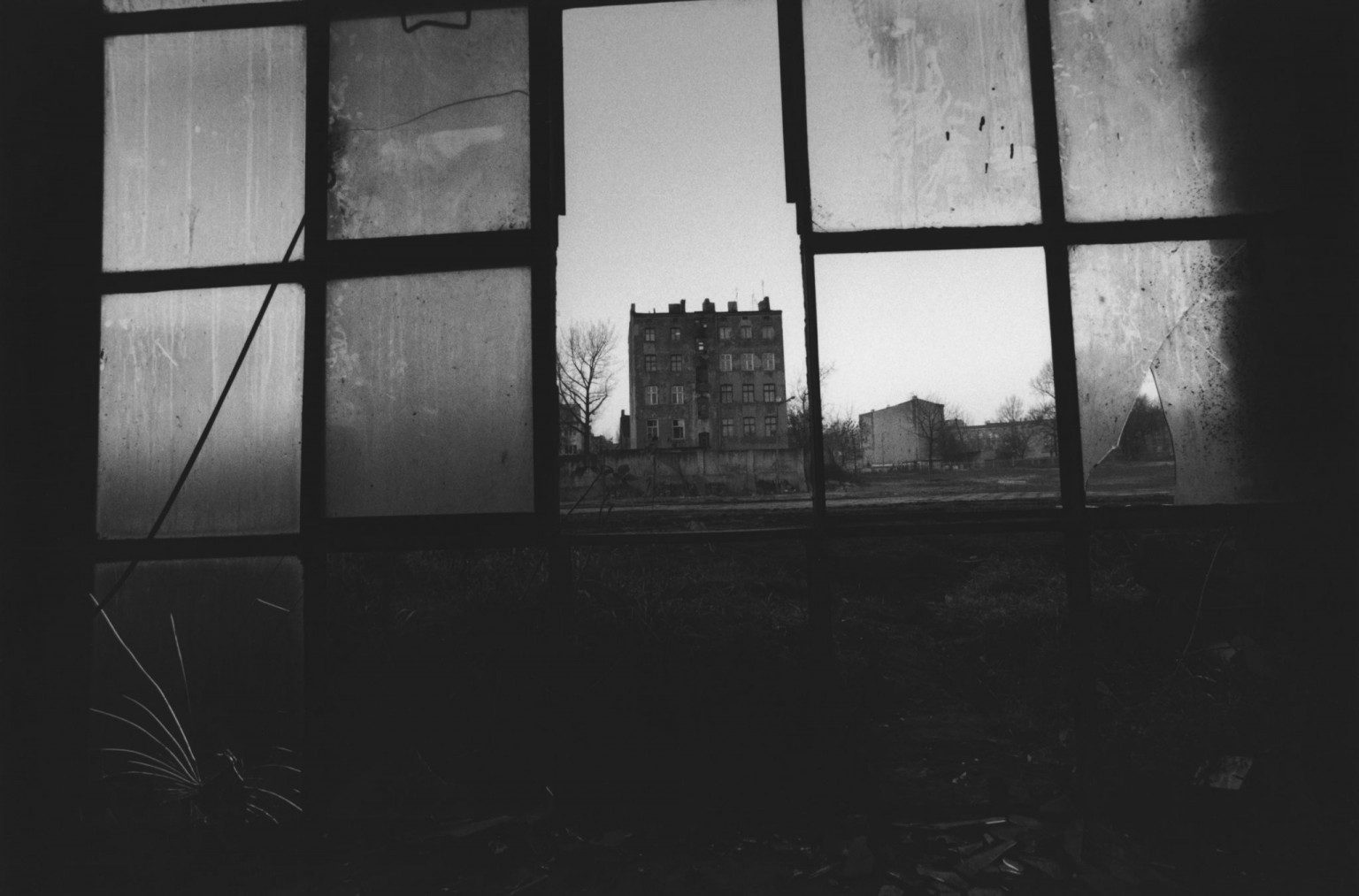
Photography ↗
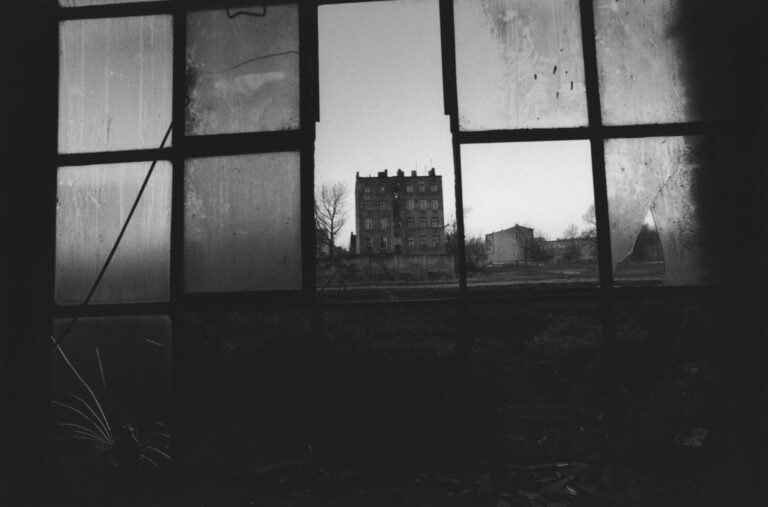
A factory window, an impossible head, a photograph held in a book: look closer at Lynch’s still images.
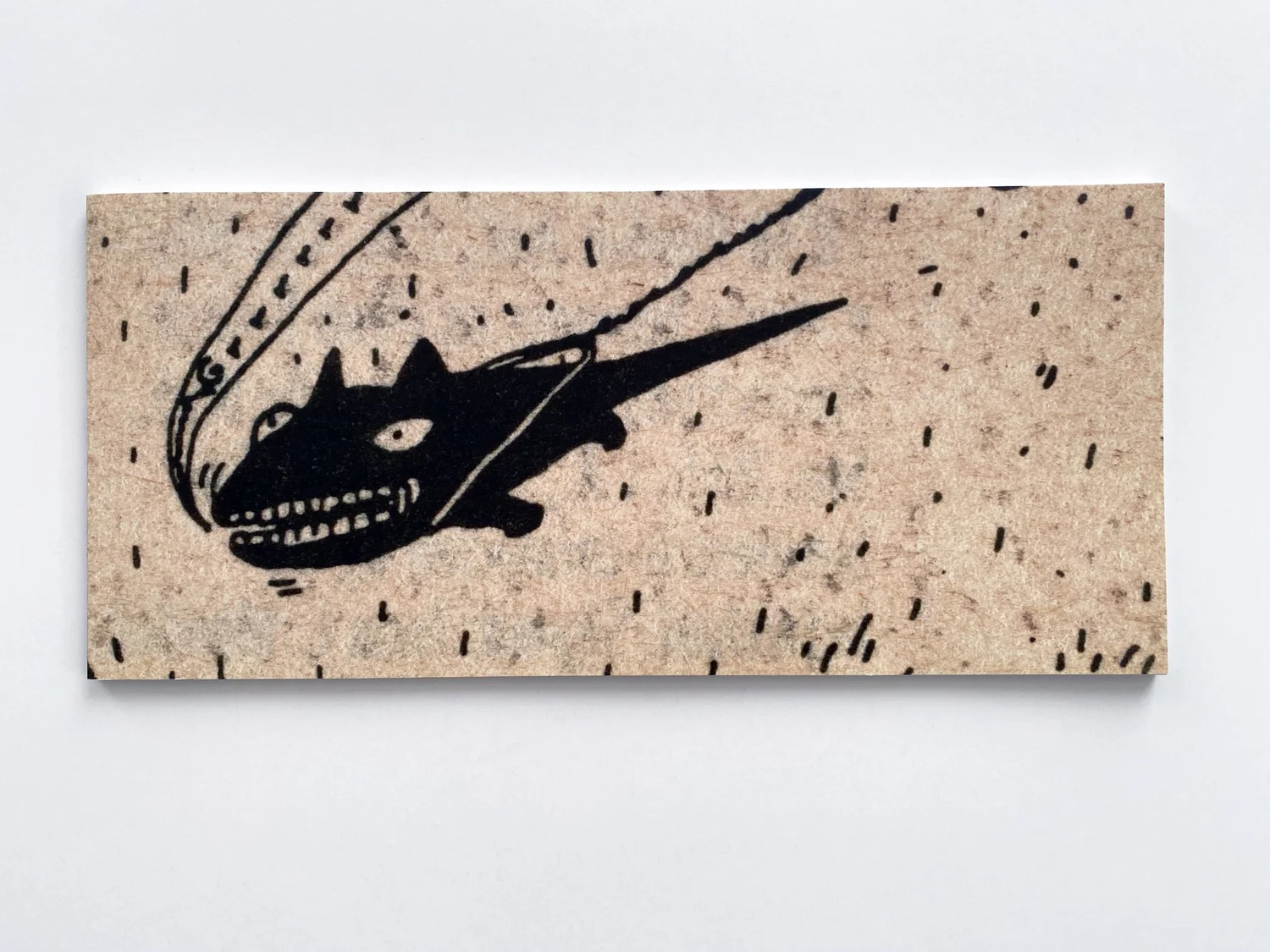
The Angriest Dog in the World ↗
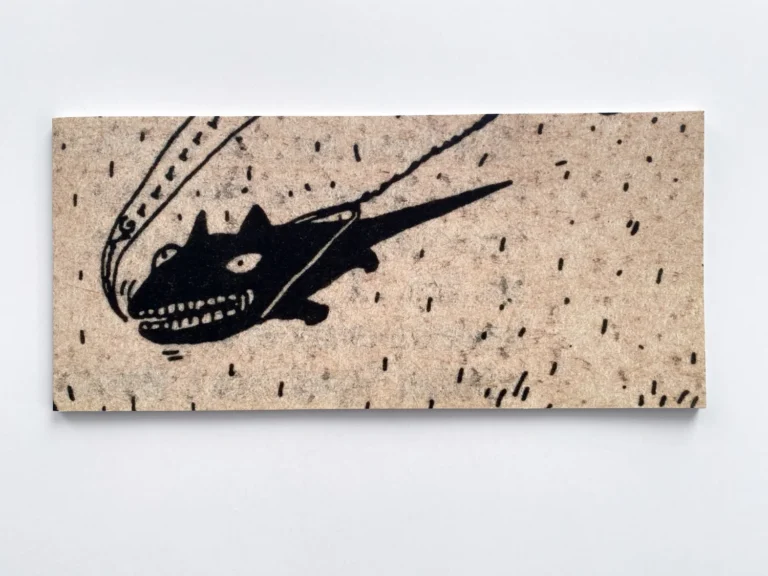
A fixed yard and changing words: enter the comic’s newspaper life, production and later editions.
Factories: images with their own dates and materials
Follow the expanded Photography dossier for image studies, photographic books, exhibition histories and the dedicated investigation record.
At MAST in Bologna, The Factory Photographs ran from 17 September to 31 December 2014. The exhibition brought together 111 black-and-white photographs made during 1980–2000, with locations including Berlin, Poland, England and the United States. Petra Giloy-Hirtz curated the project in collaboration with MAST and The Photographers’ Gallery. MAST exhibition record
The institution distinguishes large archival pigment prints from smaller archival silver-gelatin prints. It also lists three shorts—Industrial Soundscape, Bug Crawls and Intervalometer: Steps—and the sound installation The Air Is on Fire_I (Station). The presentation therefore joined different print processes, moving images and sound; it was more than a row of interchangeable industrial views. MAST, works and installation description
A comparison to make: examine the relationship between machinery and the space around it. Does an opening promise access or become an opaque black shape? Is a human body visible, implied by a scale of construction, or absent? Those questions concern the photograph before it becomes an illustration of a film.
The industrial photographs and Eraserhead share an attraction to worn surfaces, machinery and environments charged with human absence. Seen together, they reveal a visual preoccupation extending across Lynch’s media.
Furniture: from the table to the room
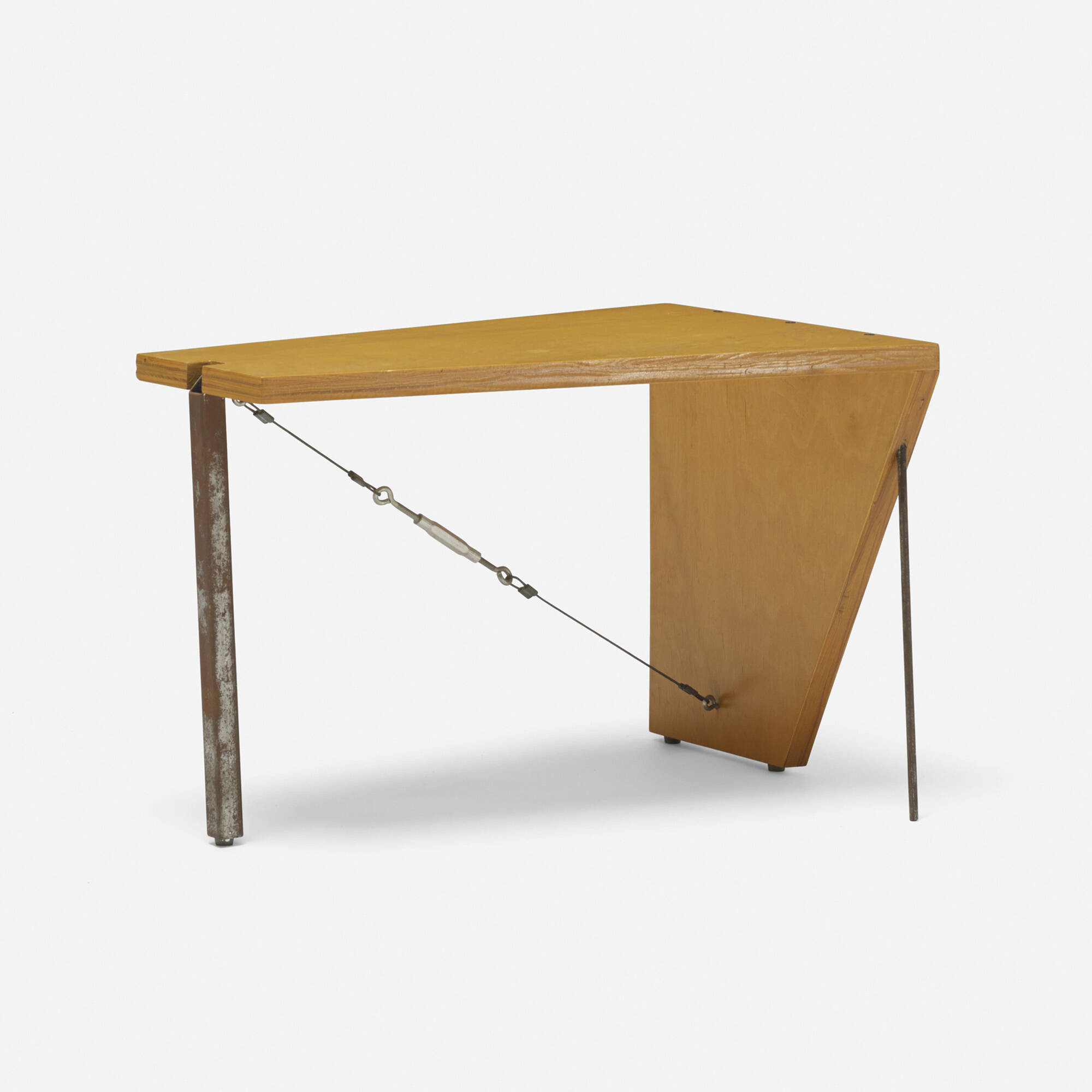
A dedicated design dossier
A useful object can change the way we look
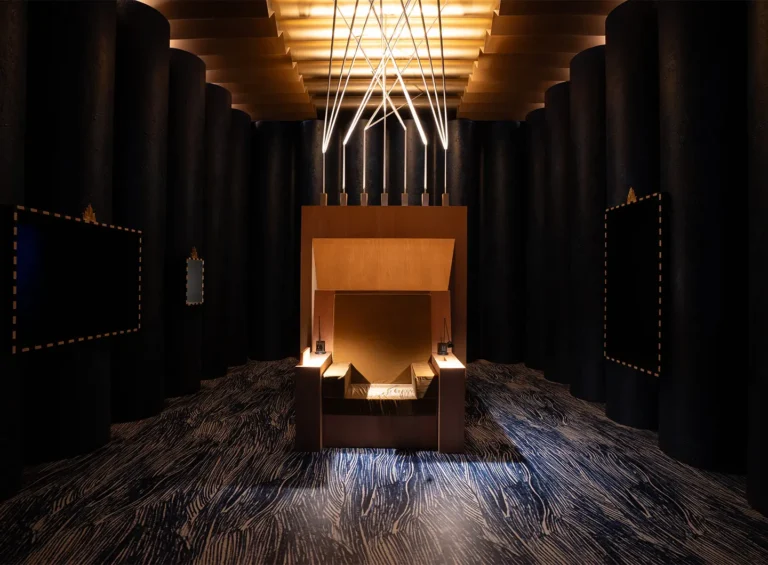
Follow the Espresso table, Casanostra designs and Wire chair into Silencio and the 2024 Thinking Rooms. Six credited photographs accompany object studies, a model comparison, collaborator histories and critical perspectives.
Explore the designs, manufactured pieces and interiors in the Furniture Design dossier.
Explore Furniture Design →The exhibition becomes part of the work
Paris, 2007: a designed environment
For The Air Is on Fire, 3 March–27 May 2007, Fondation Cartier describes spaces conceived by Lynch: a drawing of a living room remade at full scale, curtained structures carrying paintings, and a small cinema inspired by Eraserhead. Pervading sound and live events extended the encounter beyond the walls. Fondation Cartier archive
The visitor could encounter a drawing twice—first as a bounded image, then as a space to enter. A curtain might belong to a painting and also organize the room around it. This is a change of scale and bodily relation, not merely the repetition of a familiar Lynch motif. The Music dossier follows the exhibition’s recorded sound counterpart.
Philadelphia, 2014–15: a historical argument
PAFA’s span of works and reconstruction encouraged viewers to place paintings and moving images in one developing practice. Its accompanying exhibition, “Something Clicked in Philly”: David Lynch and His Contemporaries, also made the surrounding artistic community part of the subject. PAFA programme
Yvetot, 2025: a proposed sequence of prints
The Galerie Duchamp press dossier announces a 21 June–21 September 2025 exhibition of lithographs. It proposes about fifty works from 2007–2020, arranged across 200 square metres in a linear hang compared to a storyboard. Press dossier, pp. 1–2
These three approaches ask different things of the visitor: enter a constructed environment, trace a practice through time, or read a sequence across a wall. A web gallery rearranges them again. This dossier keeps image records beside interpretations so that the new arrangement remains visible.
Read the exhibition through another visitor’s eyes
Thérèse Guilbert’s French-language essay on the Cartier show describes a tension between its bright pink exterior sign and its dark interior. In paragraphs 2–3 she follows the curtains, drawings, photographs and reconstructed room; her larger argument treats exhibition design as an act of representation in its own right. The journal issue is dated 2007; the page records online publication on 14 May 2008. Transatlantica, paragraphs 1–3 and 9
Guilbert’s response is useful because it records a critic moving through an exhibition, rather than simply repeating an institution’s inventory. Her associations remain interpretations. The essay also contains film dates and episode details that need independent checking; it is used here for its account and reading of the display, not as the authority for the filmography.
Place that response beside Cozzolino’s emphasis on an integrated practice and Lynch’s practical descriptions of materials. Each answers a different question: what it felt like to encounter the exhibition, how to situate a career, and how the artist says he made things. None has to replace the others.
David Lynch: The Art Life is a further route into remembered experience. Criterion lists the 2016 documentary by Jon Nguyen, Rick Barnes and Olivia Neergaard-Holm at 88 minutes, with an interview supplement featuring Nguyen. Only the publisher record was checked in this pass; no fresh viewing or timecoded account of the film is claimed. Criterion edition record
Explore further
Follow the sources below, explore the museum collection, or continue through the Reading Room. New archival discoveries and contributions enrich the record of Lynch’s work.
Sources and image records
- PAFA — David Lynch: The Unified Field ↗Institutional exhibition record; dates, curator, scope, reconstruction and companion exhibition. The exhibition itself was not visited.
- Robert Cozzolino — The Unified Field, catalogue excerpt ↗University of California Press, 2014, printed pp. 13–19 (seven-page PDF). Read the authorized excerpt; page 17 visually checked.
- Pace — Big Bongo Night ↗2022 exhibition page, Featured Works and Installation Views: object specifications, artwork reproductions and installation photographs.
- Phong Bui with David Lynch — The Brooklyn Rail, December 2019 ↗Participant interview: lithography, materials, unpainted paper and the Bob paintings. Later recollection; interviewer premises are not automatically treated as Lynch’s testimony.
- Idem Paris — The Workshop ↗Printer’s process account: artist/printer collaboration and lithography. General workshop information is not a matrix record for every Lynch print.
- Galerie des Galeries — Woman with Abstraction ↗Object record and reproduction; date, stated medium, dimensions, edition and paper. Courtesy Item éditions, Paris. Sheet/image dimensions are not separately identified.
- Idem Paris — Louise, Échos d’Atelier ↗Object record and image: 2019, lithograph, 30 × 30 cm, edition 80, BFK Rives; printer/publisher. Individual impression history not supplied.
- MAST — The Factory Photographs ↗2014 institutional record: scope, locations, print processes, accompanying shorts and sound installation.
- Fondation Cartier — The Air Is on Fire ↗Current English exhibition archive, 2007 dates and designed environments. Replaces the obsolete route encountered during source checking.
- Galerie Duchamp — David Lynch, 2025 press dossier ↗French PDF hosted by the Ministry of Culture; pp. 1–4 read and p. 2 visually checked. Plans and curatorial interpretation, not proof of the final installation.
- Thérèse Guilbert — The Air Is on Fire: Un parcours-représentation ↗Transatlantica 1 | 2007, online 14 May 2008; paragraphs 1–3 and 9 for the visitor’s route and critical argument. Film chronology elsewhere in the essay is not adopted.
- Criterion — David Lynch: The Art Life ↗Film information, credits, restoration specifications and edition features.
Another doorway
Continue exploring
Art
Photography
Explore David Lynch’s photography through factory images, Small Stories, photographic books, collaborators and exhibitions.
Art
The Angriest Dog in the World
Explore David Lynch’s The Angriest Dog in the World: fixed images, changing conversations, newspaper production, reader responses and collected editions.
Art
Furniture Design
Explore David Lynch’s furniture design, from the Espresso table and Wire chair to Silencio and the Thinking Rooms, with object records, images and sources.
Image credits and sources accompany each linked guide.