Twin Peaks: Episode 14 — Lonely Souls
1990 · Season 2, Episode 7 · David Lynch
A convincing arrest, an ordinary farewell and a warning that cannot prevent catastrophe. Explore the diary, Maddy’s future, the Palmer house and the Roadhouse ending.
Season 2, Episode 7 / overall Episode 14. Contains major episode spoilers; the violent image sequence is expandable.
Explore this episode
Recognition is not yet explanation
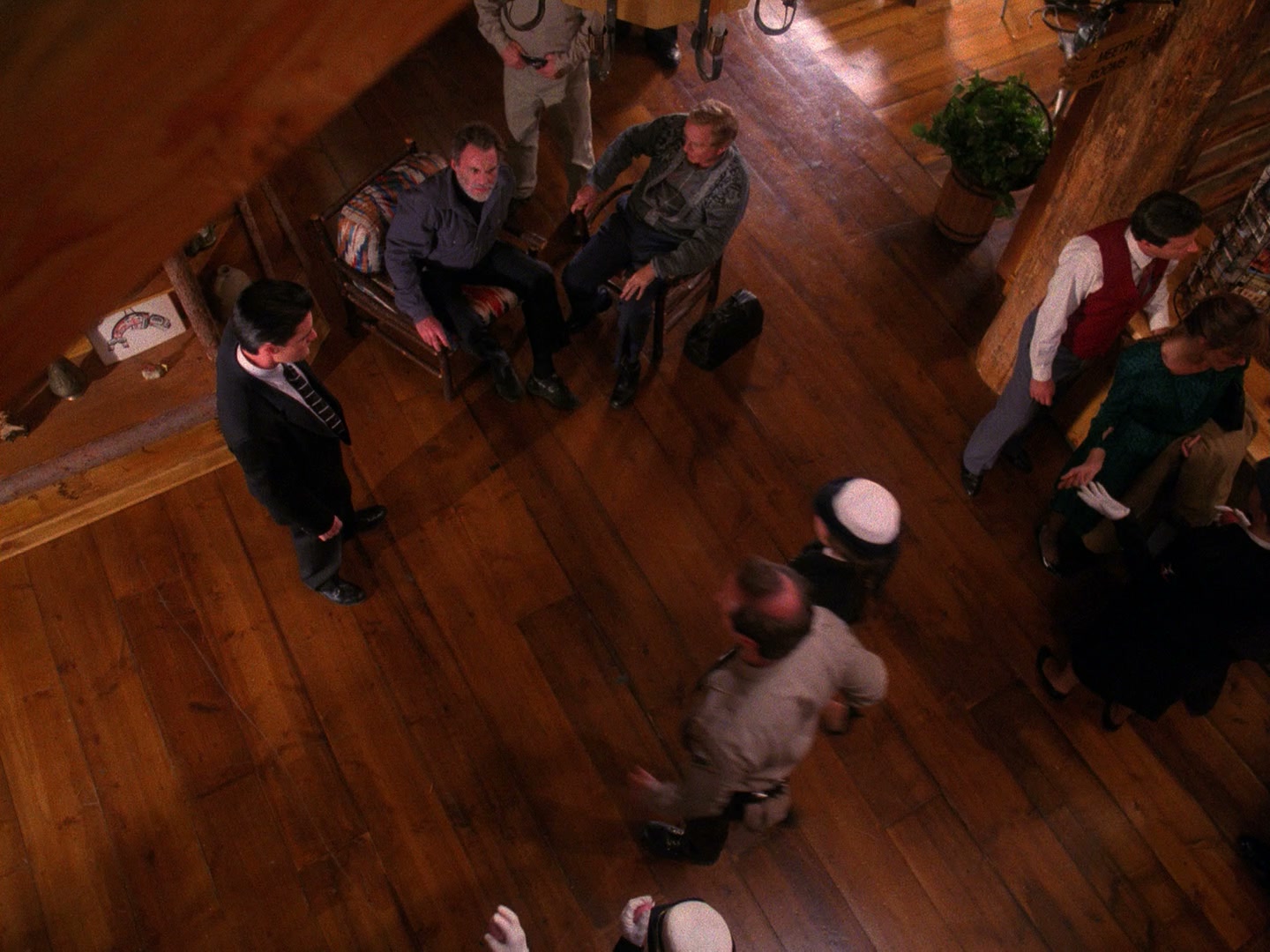
Cooper brings Mike’s account of Bob to the Great Northern and tries to make it into a test. A familiar hotel becomes a place where a person might be identified through another person’s reaction. The procedure depends on testimony whose terms the investigators cannot independently establish.
The visiting sailors make the space unusually busy. Their bouncing balls, interruptions and movement complicate any clean arrangement of observer and suspect. Ben’s entrance coincides with Mike’s collapse. That conjunction will help make a case against Ben seem coherent, but the episode ultimately separates a persuasive inference from a complete explanation.
The test also continues the ethical problem in Gerard’s interrogation. His body is being used as an investigative instrument. The officials are trying to discover a danger, yet they cannot guarantee either his well-being or the meaning of what happens to him.
The diary survives its keeper
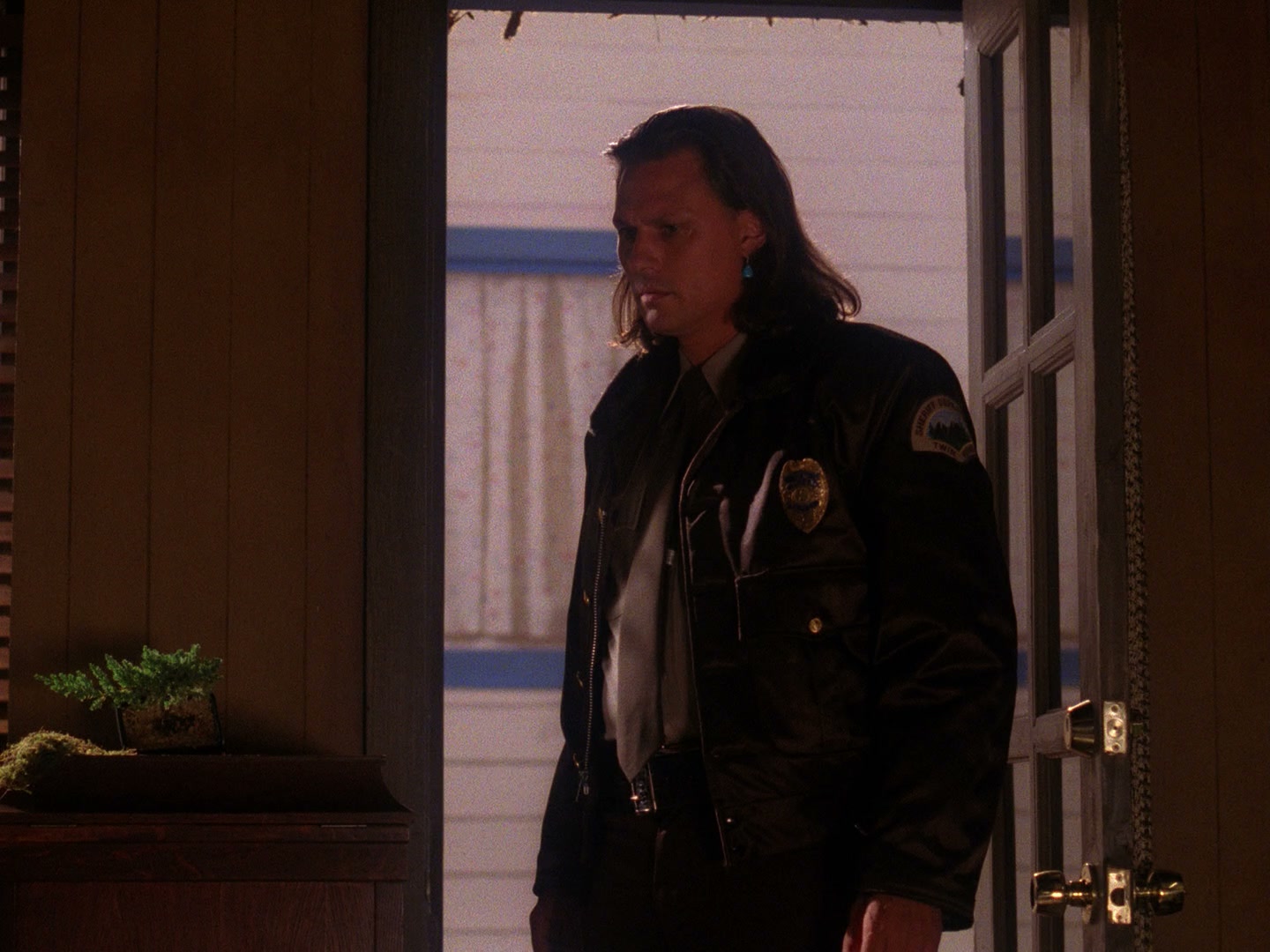
Hawk enters a room in which the orchids have been destroyed. The camera’s inspection of broken objects precedes the discovery of Harold’s body. The damage gives the house a history before the investigators convert it into evidence. It is the aftermath of the betrayal and crisis shown in “The Orchid’s Curse” and “Demons.”
Harold’s note describes a lonely soul. The phrase gives this episode its familiar title, but its relevance spreads beyond the person who writes it. Several characters seek another person’s protection or recognition; the ending will gather people who share a feeling without sharing an explanation.
The diary is damaged too. Its recovery does not produce a complete, authoritative story that can simply replace the dead writer’s silence. Cooper must work with fragments. Laura’s earlier writing connects Bob, sexual violence and Ben Horne, but the different kinds of relationship named in those pages still require interpretation.
A record in fragments · 2 images
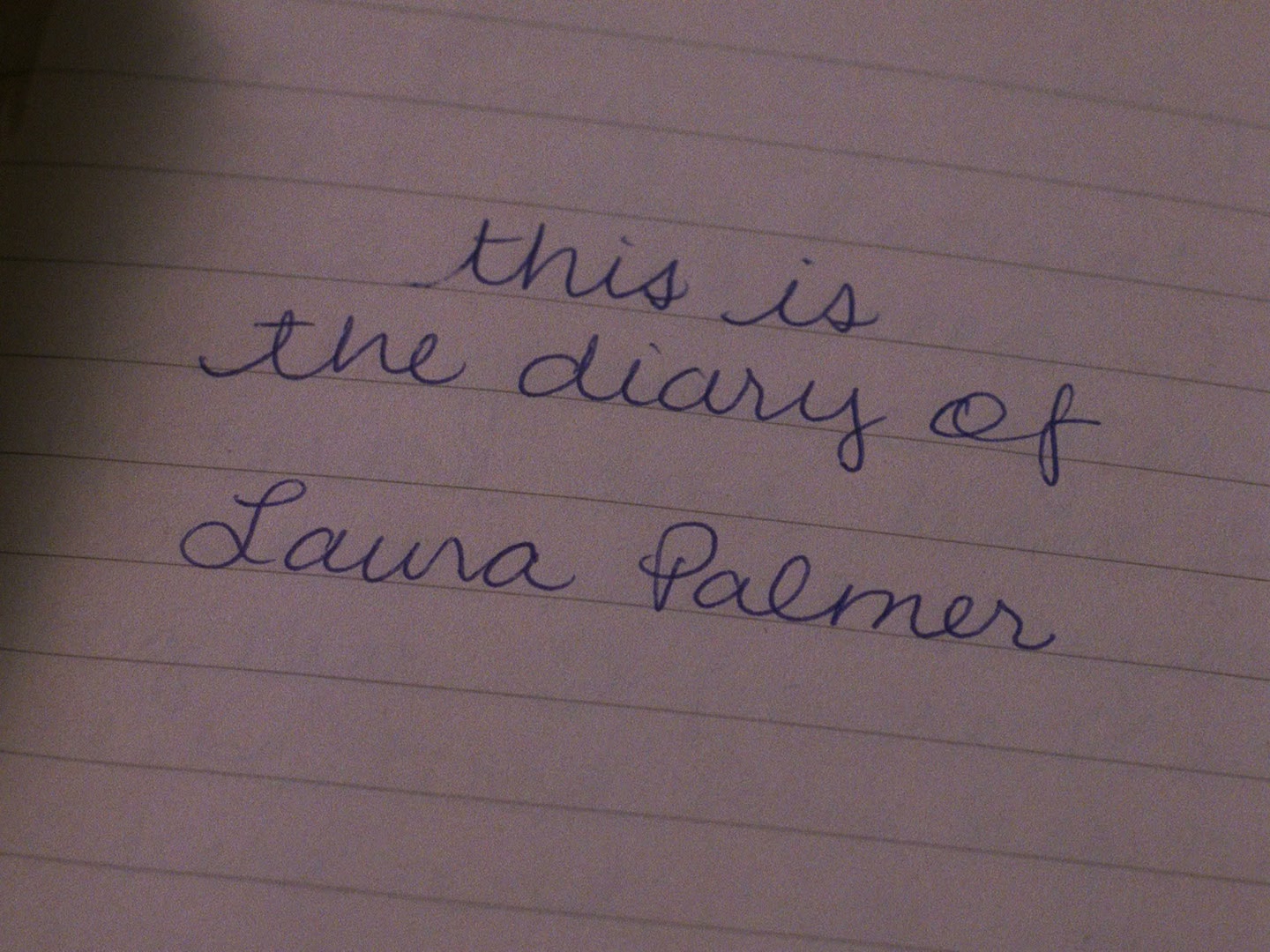
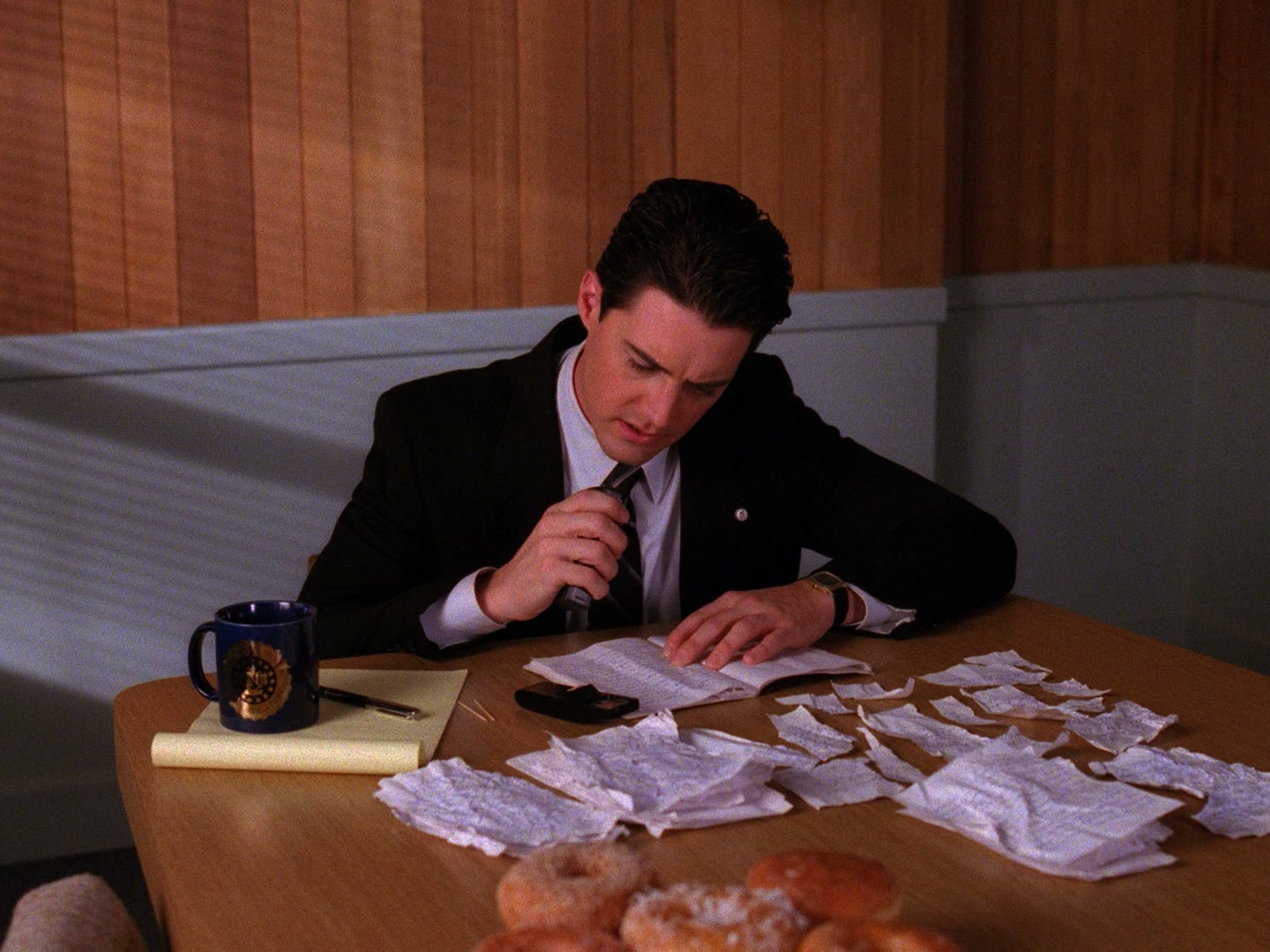
The material form matters: torn pages spread across a table make incompleteness visible. The investigation can recover words while remaining unable to protect the people to whom those words refer. Donna’s later grief at the Roadhouse returns the diary operation to its human cost.
Lenny Von Dohlen: an alternative farewell
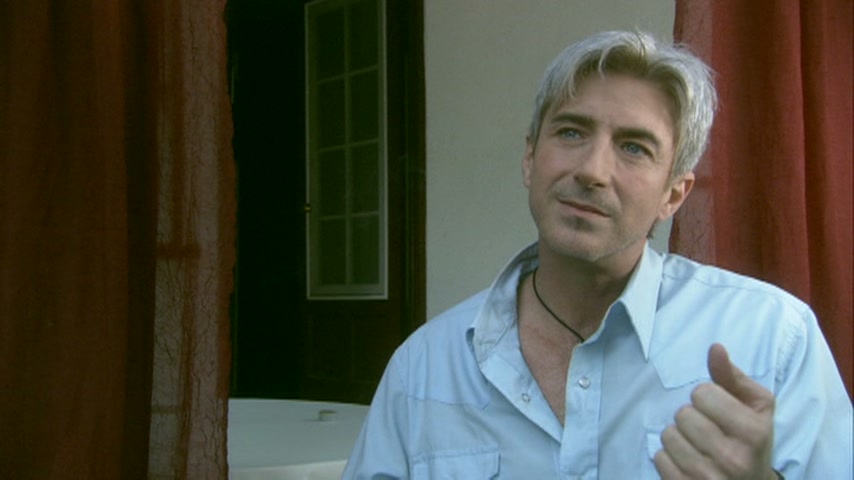
Von Dohlen says he knew Harold would die, but not how. When the new pages specified a hanging, he proposed a different ending: a movement into the greenhouse, damaged orchids, and Harold found among the things he cherished. He remembers leaving the idea on Lynch’s answering machine shortly before the shoot.
In the actor’s account, the practical preparations for the hanging were already in place, so the proposed alternative was not adopted. He adds that someone else performed the hanging image. This recollection supplies a valuable distinction between an actor’s conception of his character’s death and the scene actually made; it does not establish that the alternative was filmed.
Interview source: Lenny Von Dohlen, “Production,” 00:00–01:17; Twin Peaks: From Z to A. Retrospective testimony, identified separately from the finished episode.
Maddy’s ordinary future
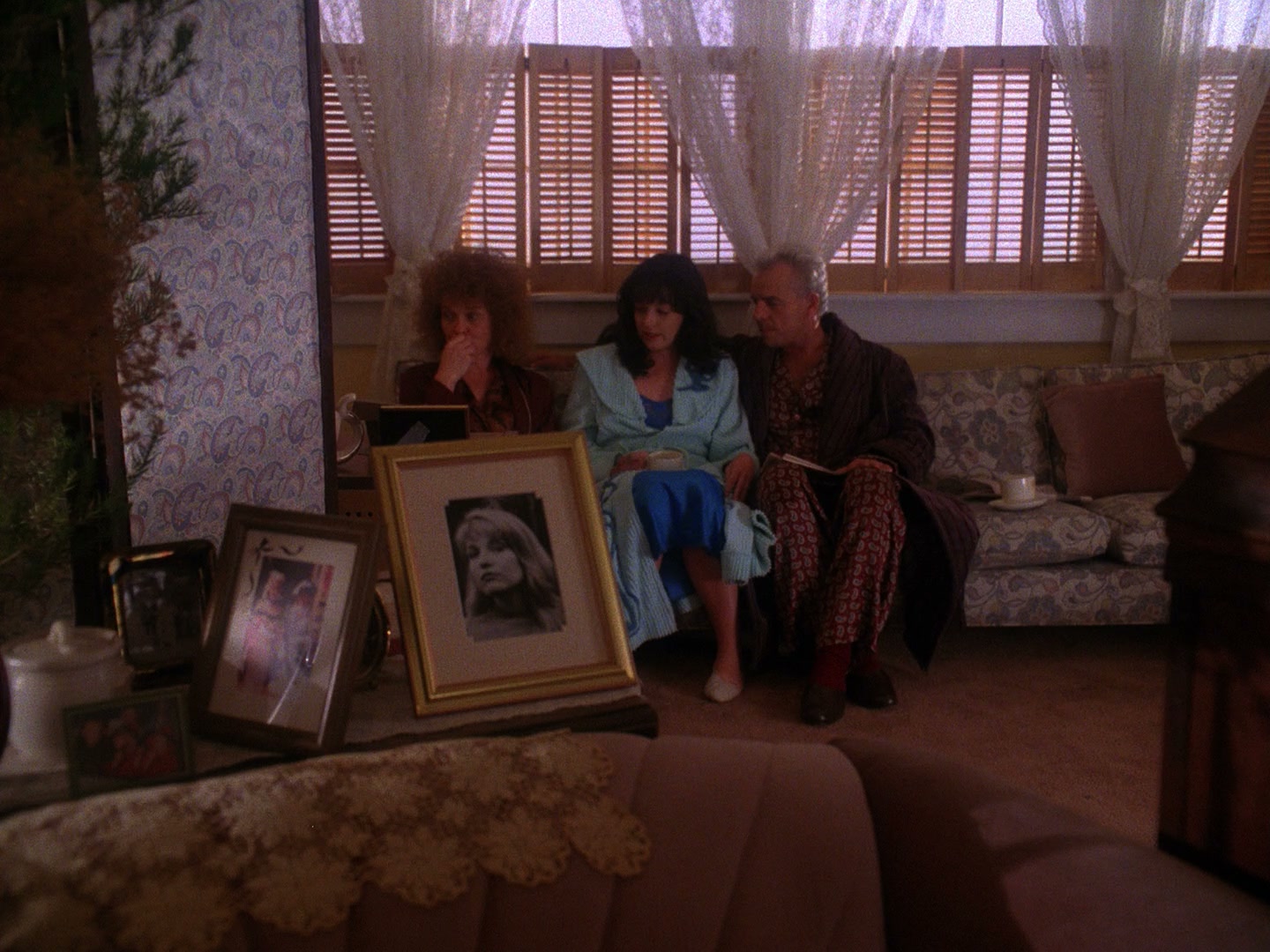
The morning at the Palmer house gives Maddy an ordinary future. She wants her apartment and job, and plans to leave the next day. These modest wishes continue her conversation with James, where she tried to distinguish her own life from the temporary attraction of becoming Laura.
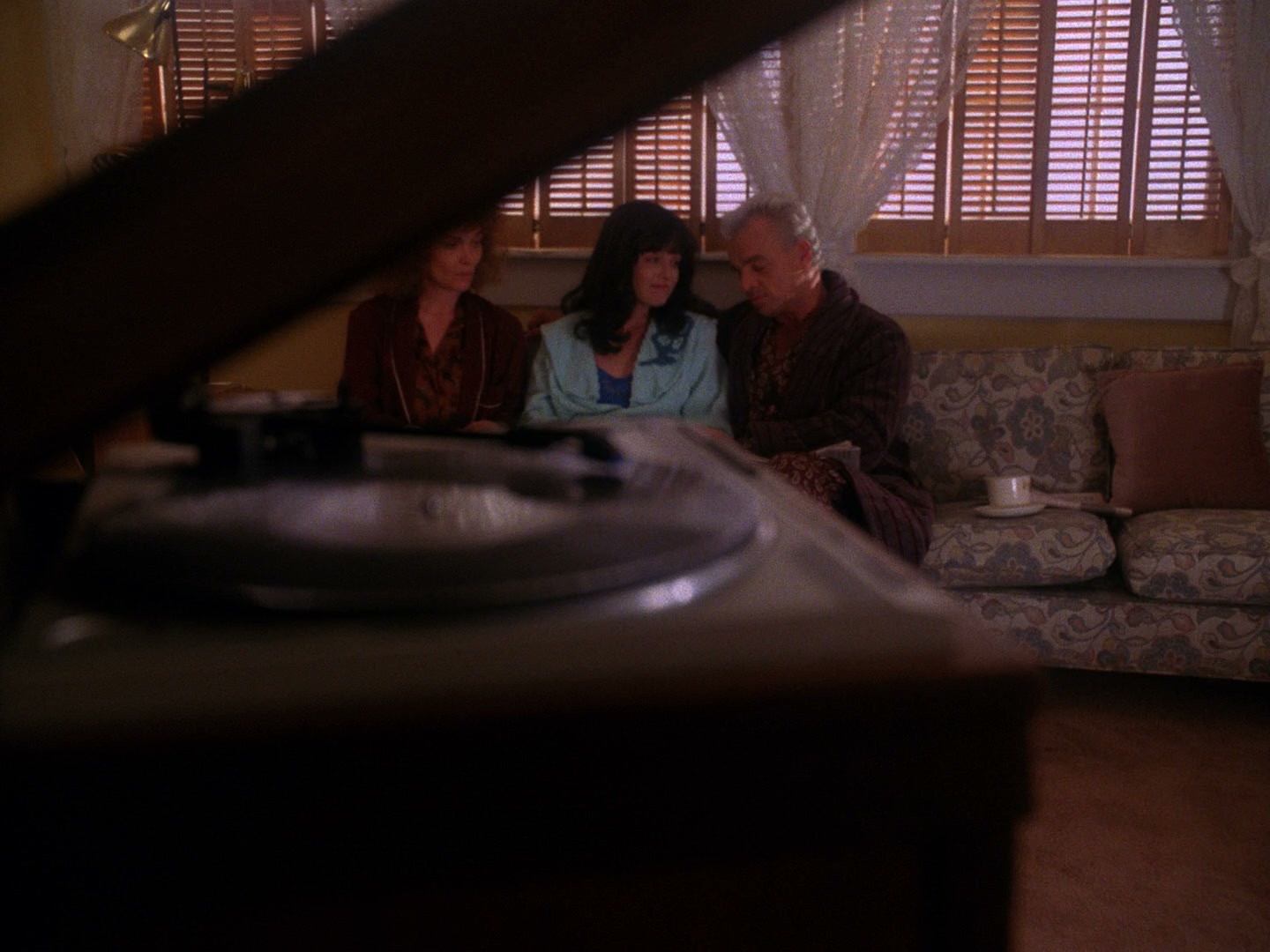
The camera travels through the family’s objects and photographs before settling into conversation. Laura’s portrait is one presence among a larger arrangement of domestic memory. The record player joins that arrangement. The English caption track identifies Louis Armstrong’s “What a Wonderful World,” placing the scene’s image of home beside a song of reassurance.
This sequence should not be treated only as a coded warning. Maddy’s desire to go home is credible in itself. Giving that desire time and space makes the later violence a destruction of a particular person’s future, rather than merely the next revelation in Laura’s murder mystery.
Audrey asks the question directly
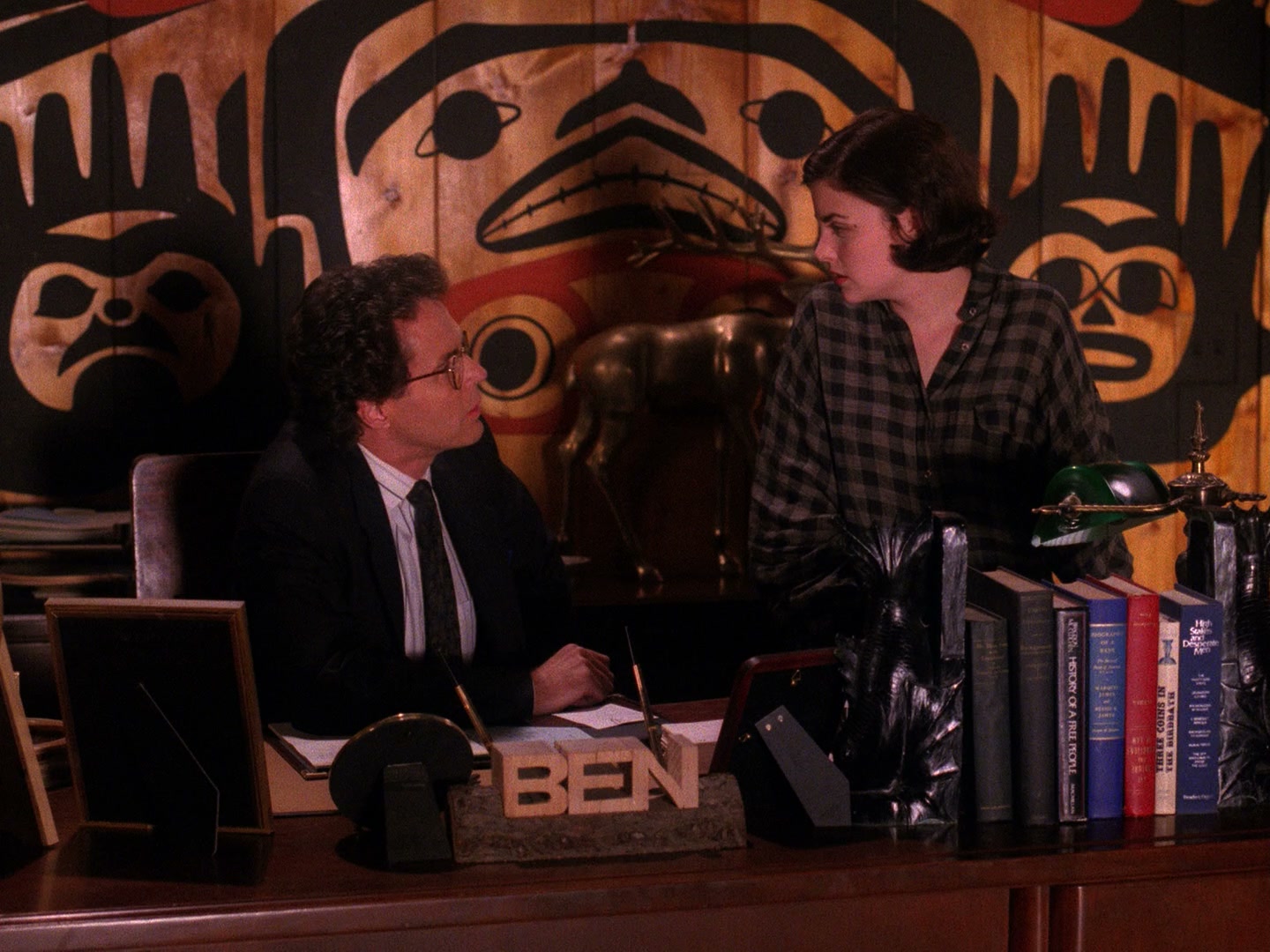
Audrey begins with ownership: does Ben own One Eyed Jack’s? She then asks about his relationship with Laura. Her investigation makes the financial structure of exploitation and the intimacy of family life collide in her father’s office.
Ben’s answers try to separate business from personal conduct. Audrey refuses to leave the questions at that level. When she asks whether he killed Laura, he answers that he loved her. The declaration does not answer the accusation. Its emotional force cannot be treated as evidence of innocence, or as a justification for the relationship.
The exchange develops the boundary Audrey set at her bedside in “Demons.” She has moved from quietly choosing Cooper’s help to confronting her father with what she knows. Her later report to Cooper places a daughter in the role of a witness against him.
An admission becomes evidence · 3 images
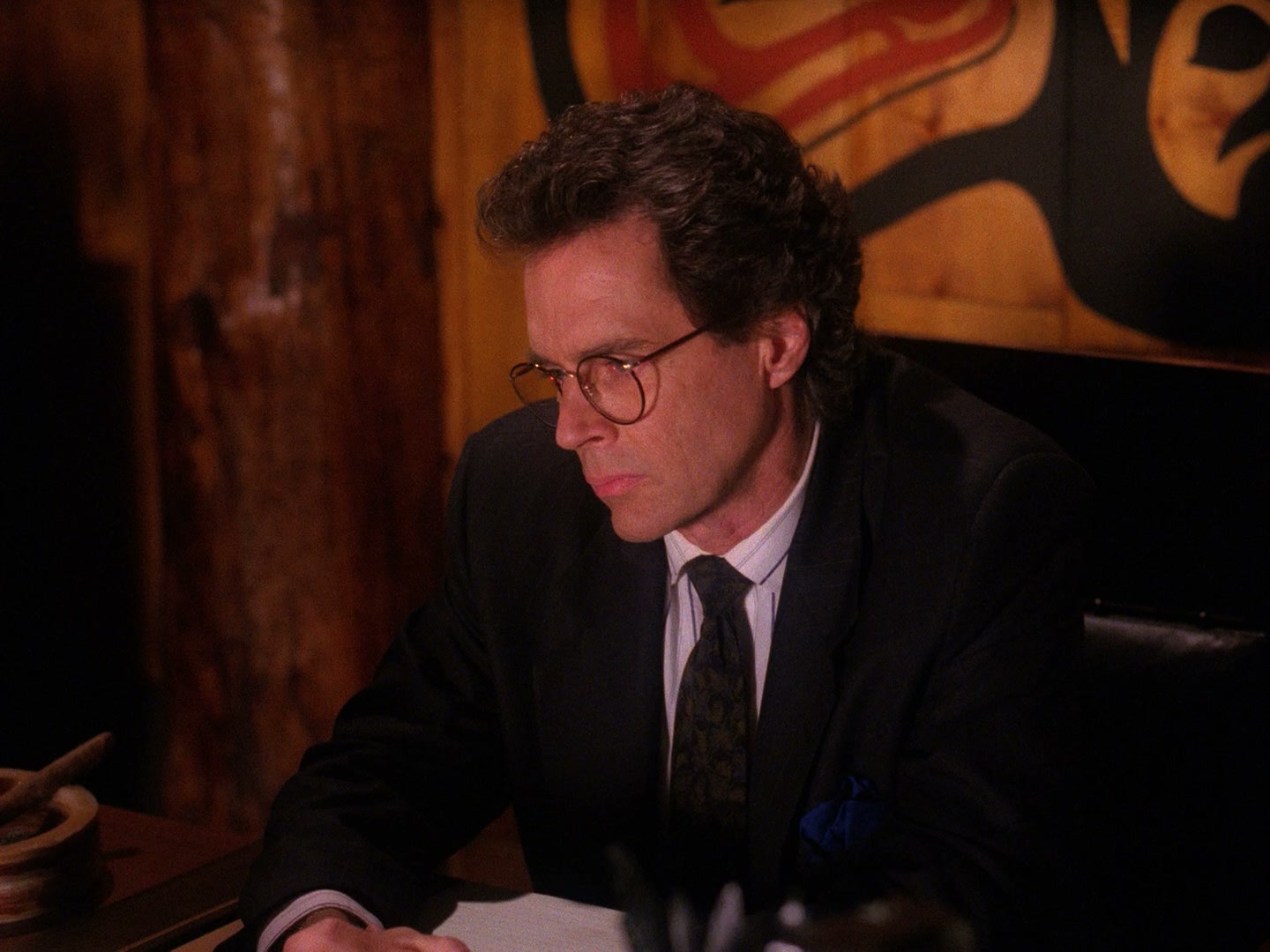
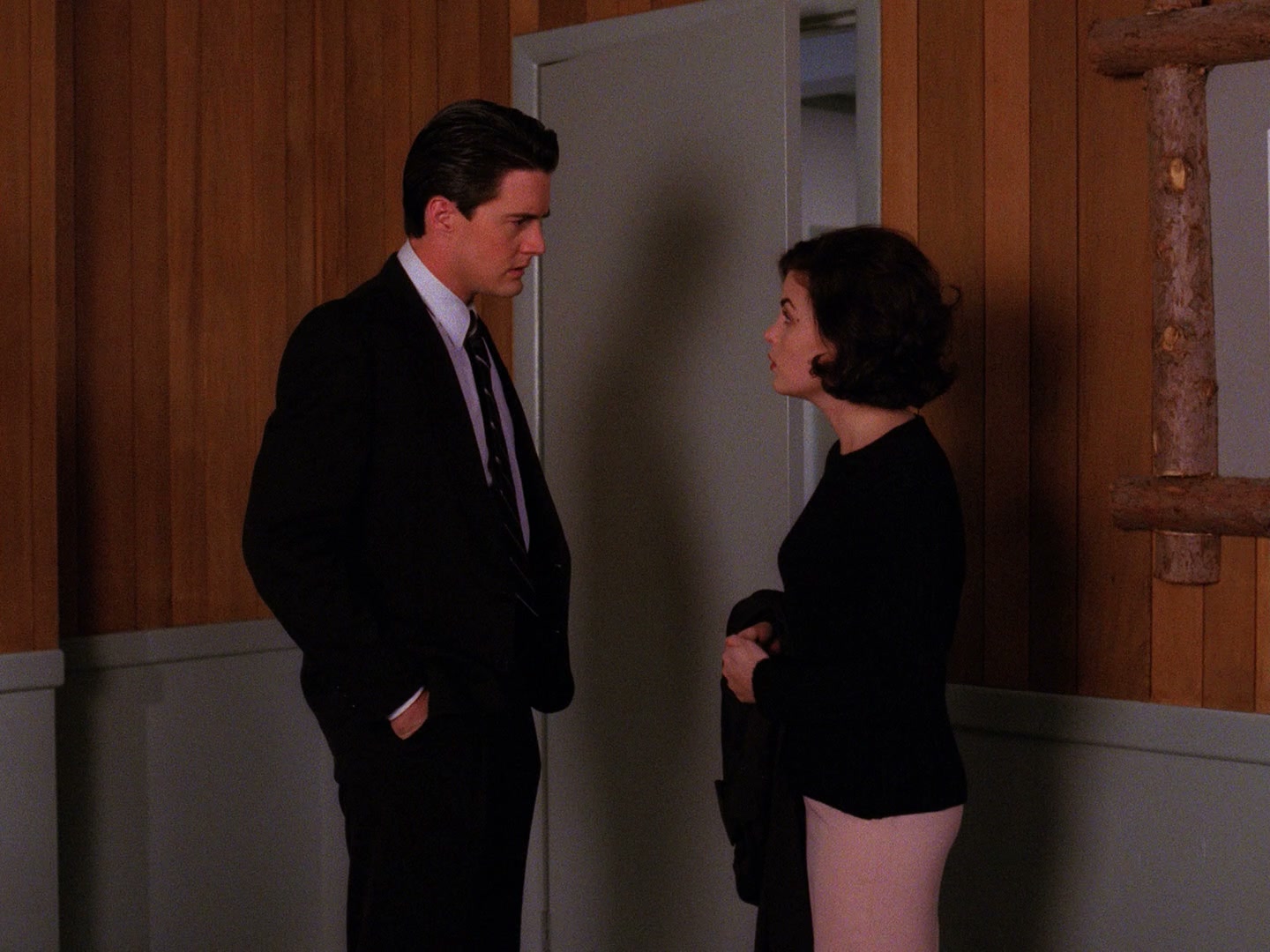
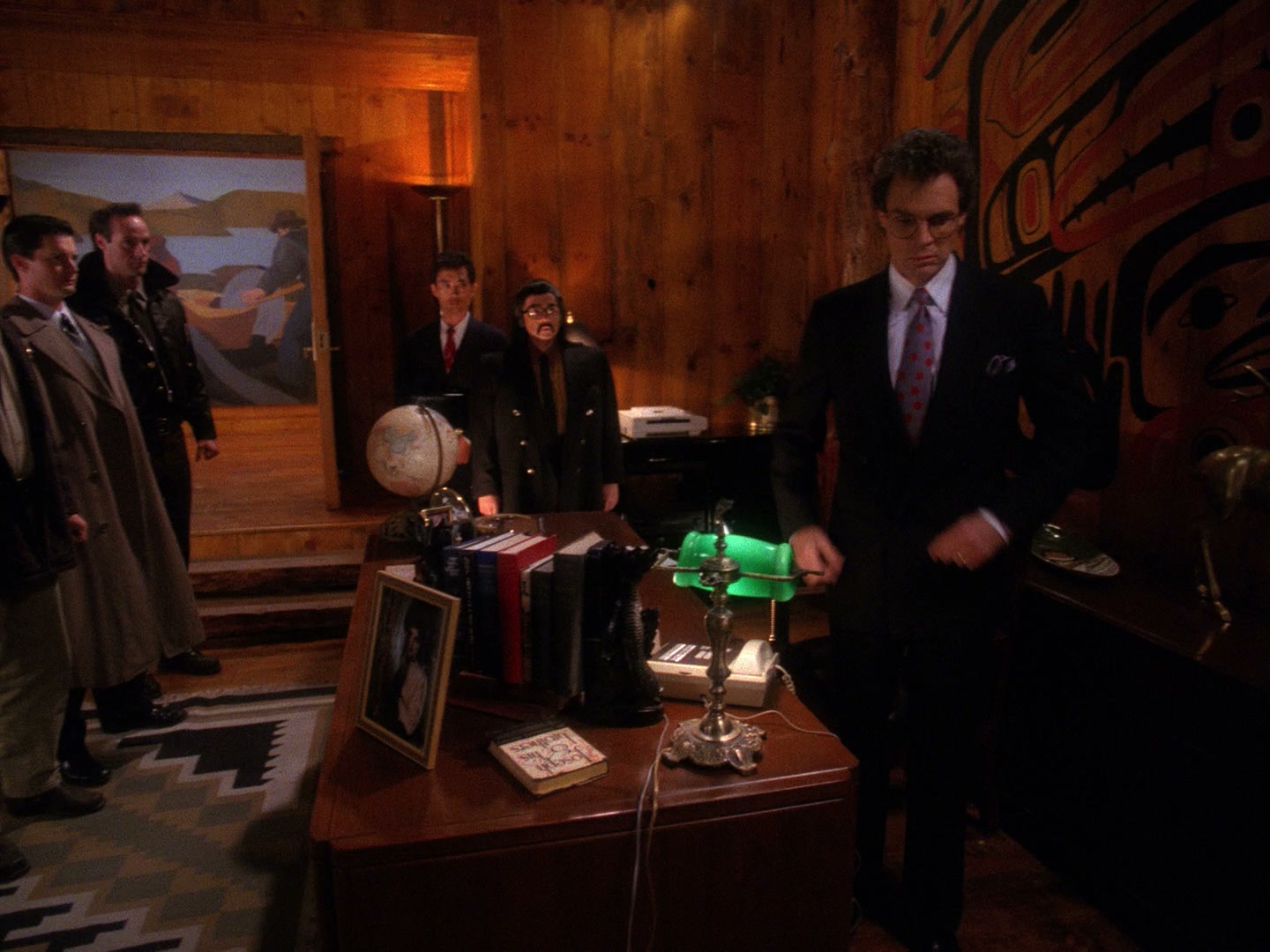
The diary, Audrey’s account and Mike’s reaction make Ben’s arrest intelligible. The episode does not have to make the investigators foolish in order to show the limits of their conclusion. They have reasons, but the reasons do not yet encompass the event that the audience will witness. The arrest gives the plot a sense of progress just before the ending destroys its reassurance.
Who can afford to stay home?
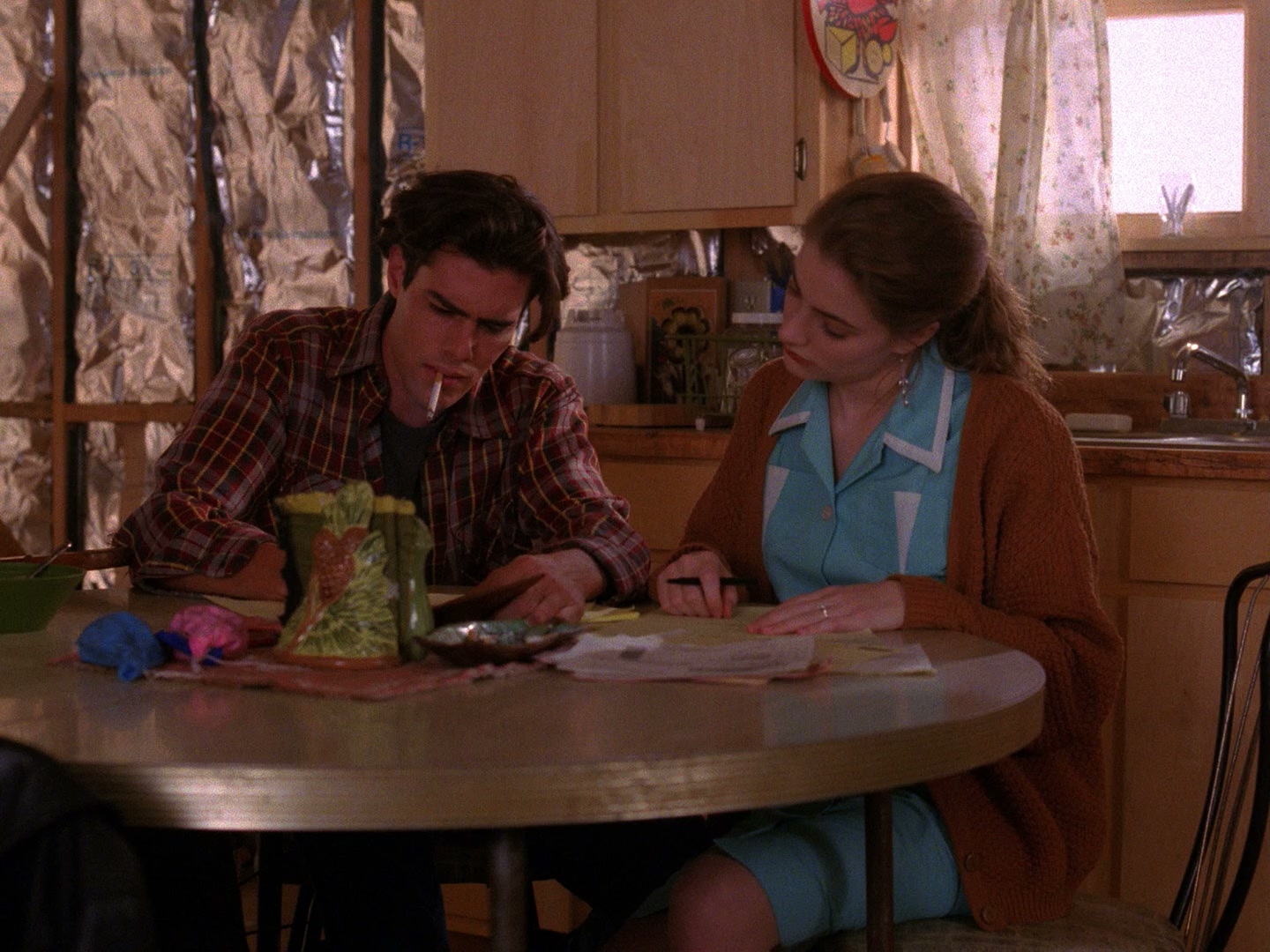
Shelly counts what remains after the household bills. Bobby’s joke about economics cannot solve the contradiction: caring for Leo prevents her earning the wages on which the arrangement depends. The welcome-home scheme now has a daily price.
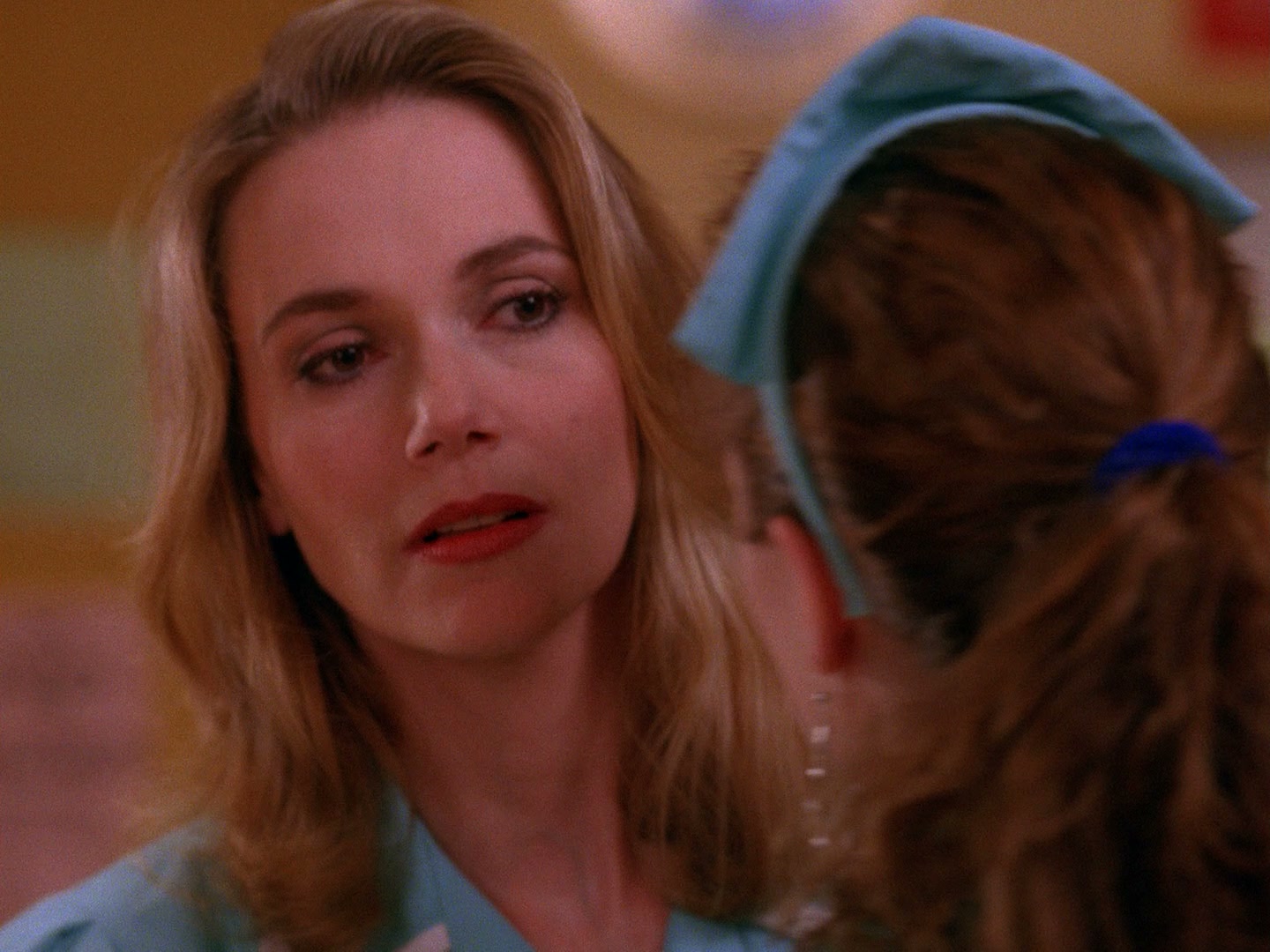
At the diner, Shelly tells Norma that she must leave. Norma’s response recognises both the immediate necessity and the possibility that Shelly may need to return. The promise of a place at the Double R becomes a practical form of care. It contrasts with the household in which care is expected from Shelly while her own options shrink.
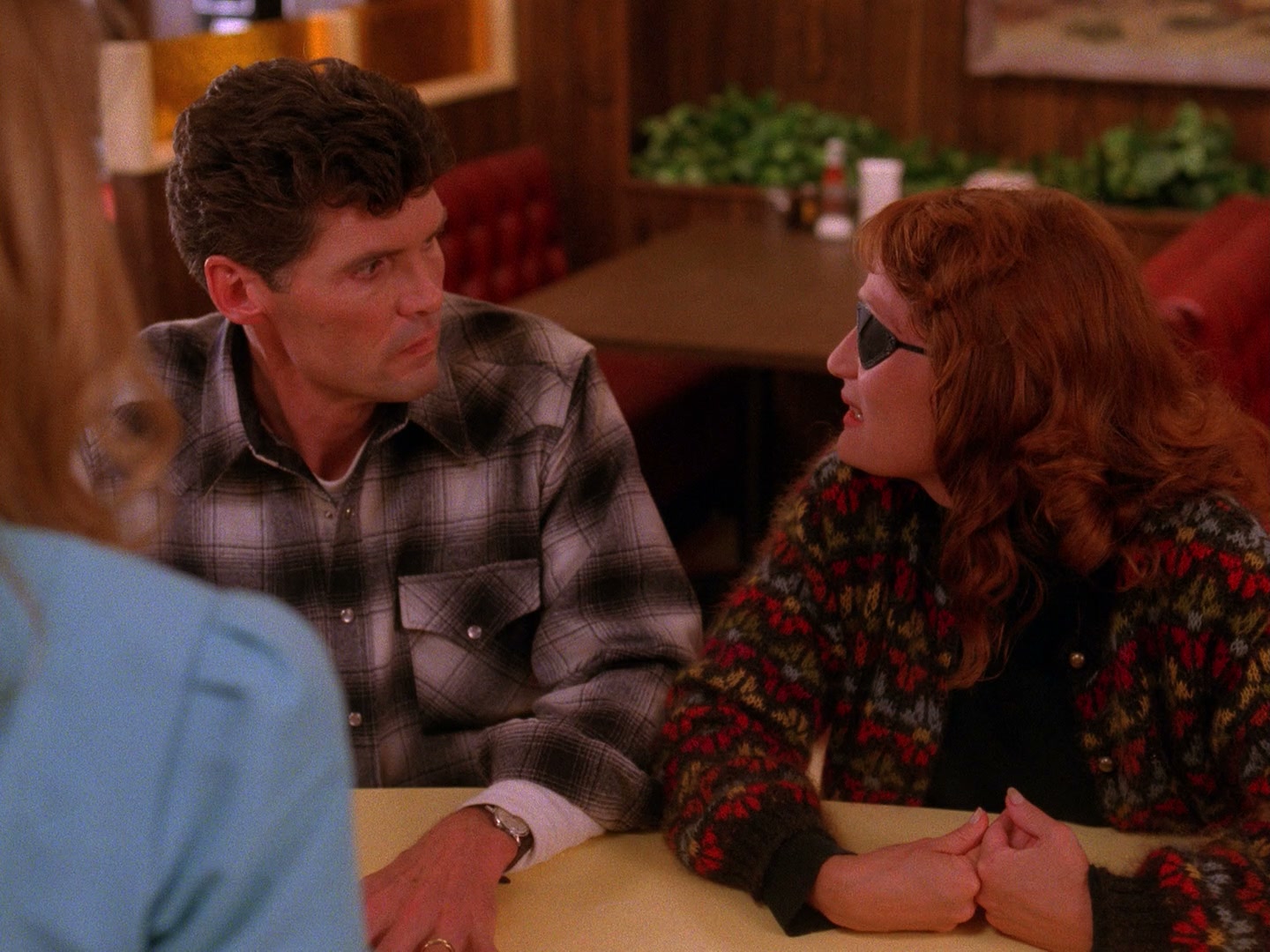
Nadine’s arrival creates a different mismatch between present circumstances and remembered relationships. Ed and Norma have to respond to a version of the past that Nadine experiences as current. The broken glass gives the emotional disturbance an abrupt physical form. The scene’s comic and painful elements depend on the unequal knowledge of the people at the table.
Two households under pressure · 2 images
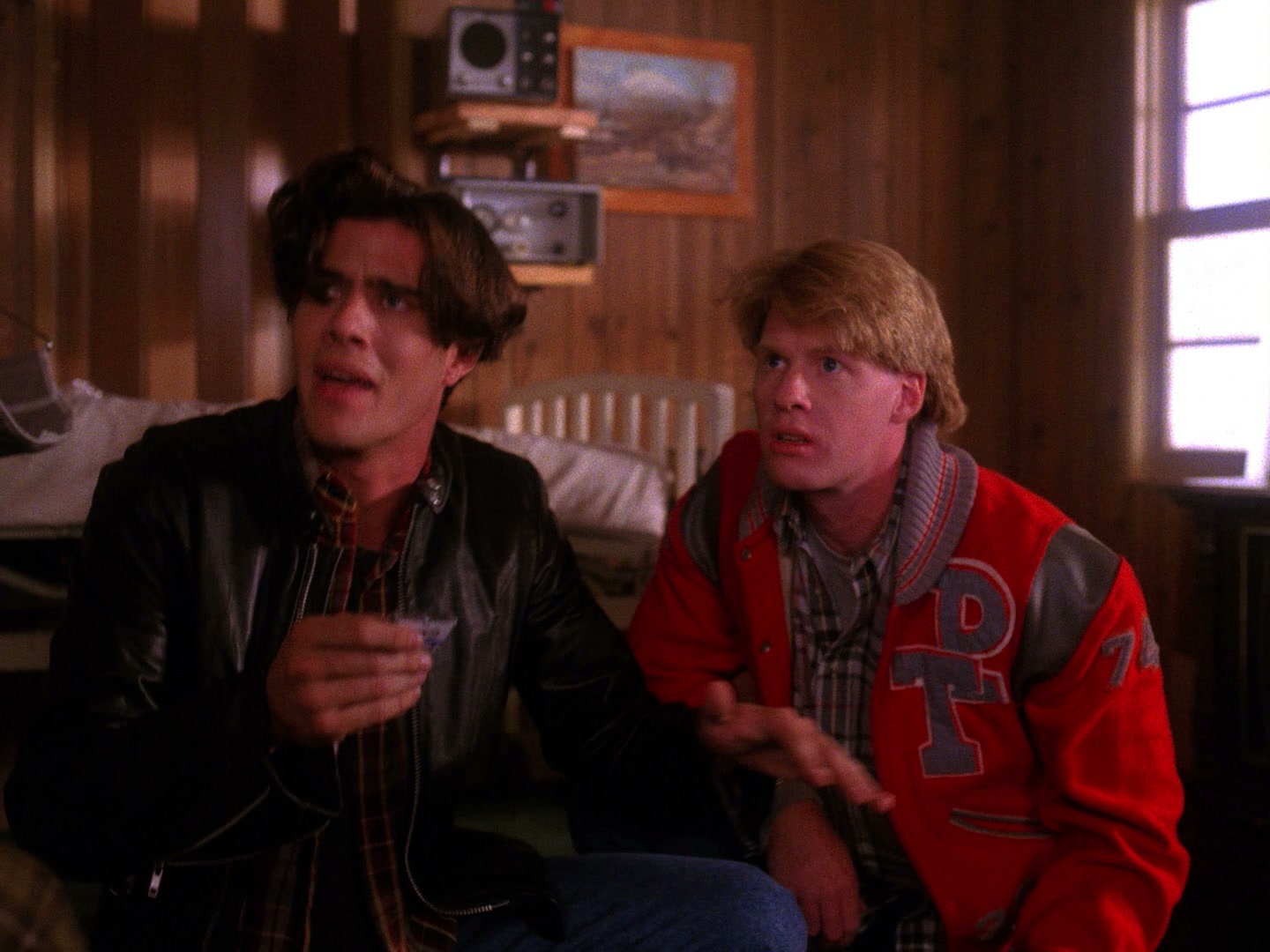
Back at home, Leo’s reference to new shoes leads Bobby to a recording hidden in a boot. A domestic object becomes a store of evidence. As with Laura’s diary, a voice survives in a form that can travel away from its speaker and acquire new uses. Bobby’s discovery links the care story to the town’s larger economy of secrecy.
Two returns, very different consequences
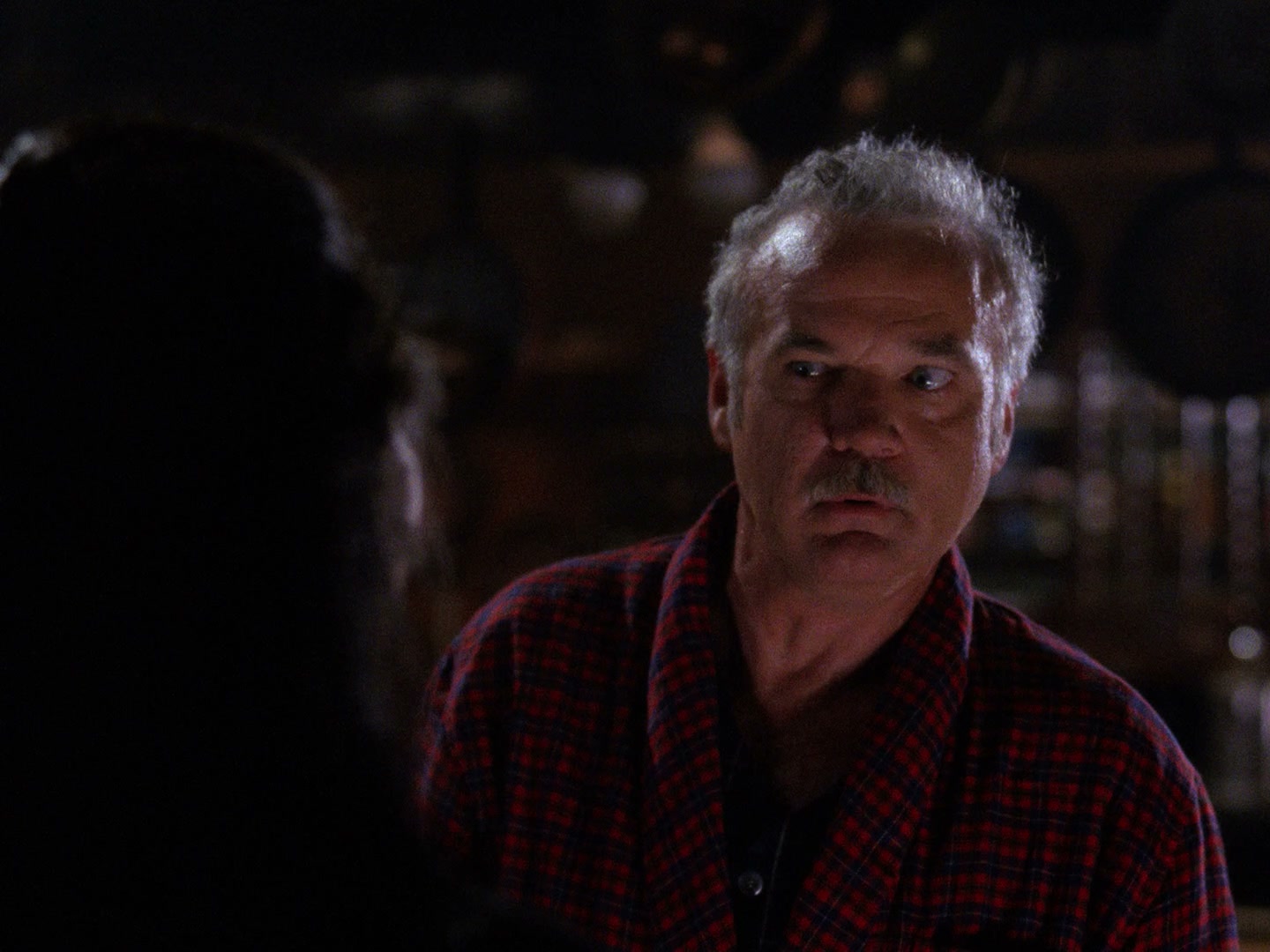
Tojamura’s visit to Pete turns a threatening intrusion into Catherine’s return. Pete must revise what he thinks he is seeing before he can respond to the person beneath the disguise. The scene permits surprise to become reunion.
Its placement matters. Another household is about to produce a revelation that will make recognition more terrifying, not more reassuring. Catherine’s return and Leland’s reflection both require a face to be understood differently, but they lead to radically different emotional outcomes. The comparison concerns how the episode arranges disclosure; it does not make the disguises morally equivalent.
The Log Lady’s warning takes Cooper and Truman toward the Roadhouse. Their departure shifts the action from the official investigation to a public room whose occupants will register something they cannot account for.
The Palmer house: objects, bodies and interruption
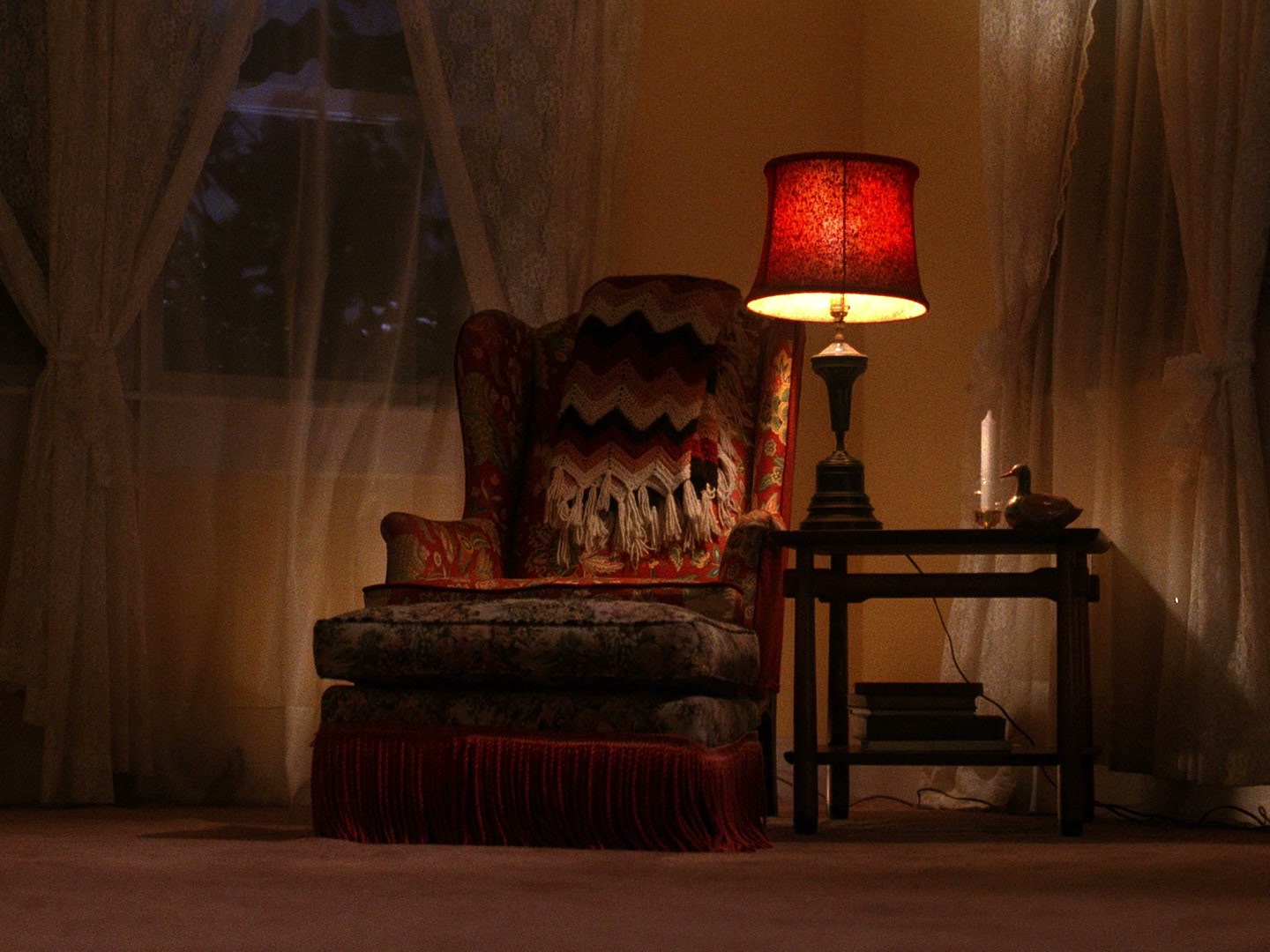
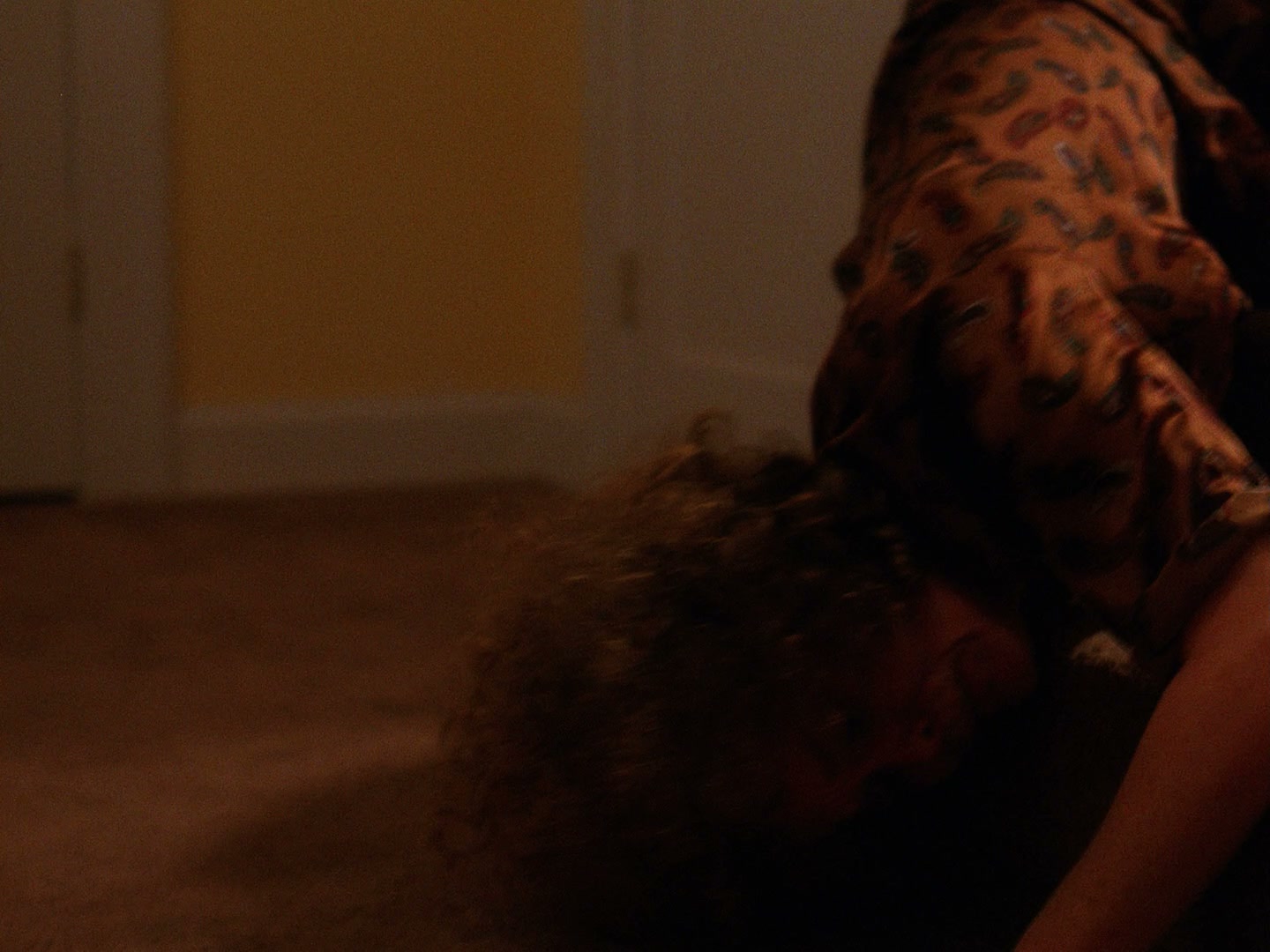
At night, the same living room is organised around absence and delay. The record player returns, now associated with repetition rather than the morning’s reassurance. Sarah struggles on the stairs and then across the floor. The house remains recognisable, but its ordinary passageways no longer permit ordinary movement.
The pale horse appears within that familiar room. It is shown as an interruption of the space, followed by Sarah’s reaction and the room without it. The sequence gives the apparition a concrete visual relation to furniture, doors and light without reducing it to a single explained symbol.
The room and the apparition · 2 images
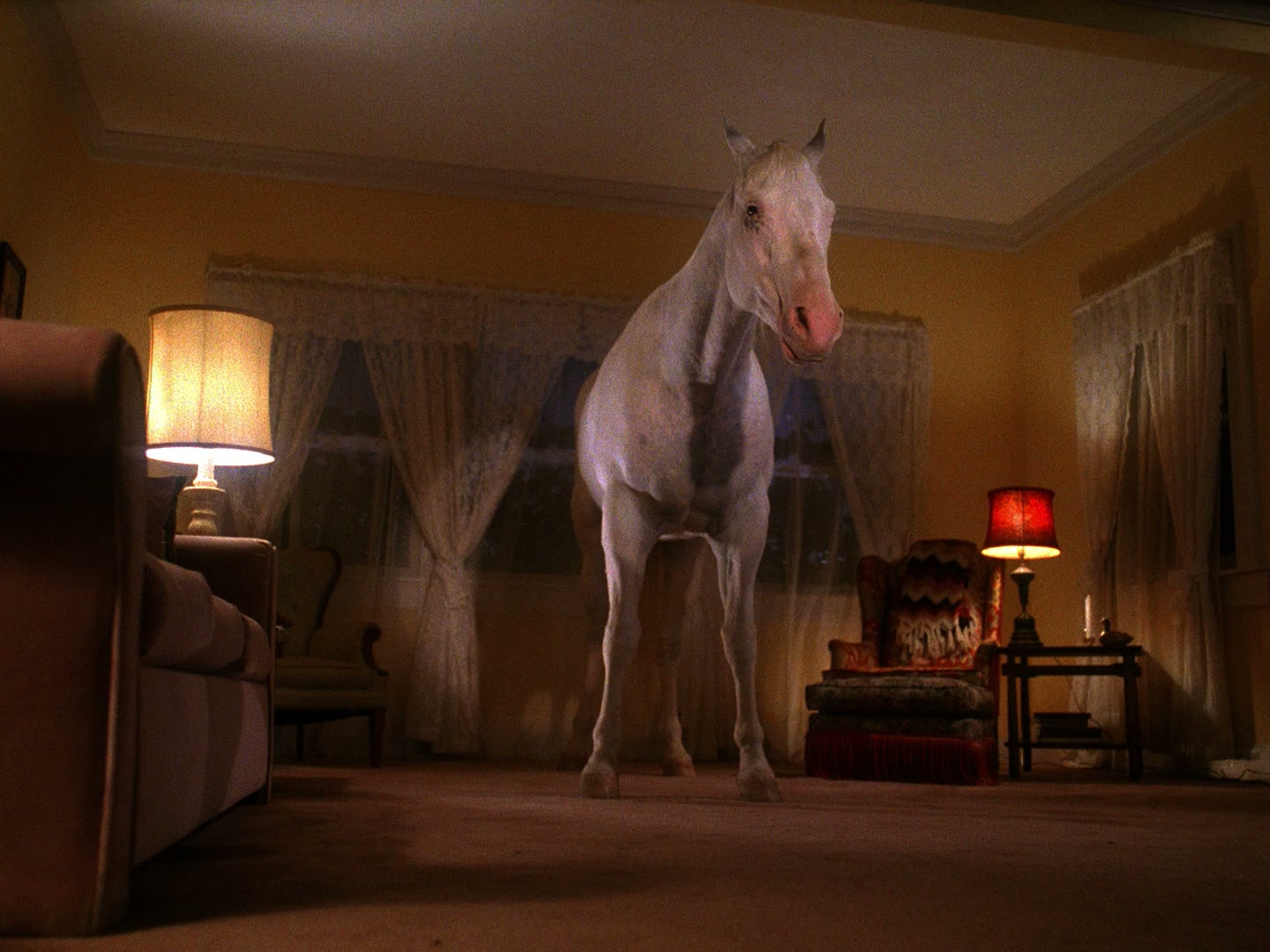
The horse can be followed across Twin Peaks, but here its immediate force comes from Sarah’s condition and the threatened household. The later Log Lady introduction explicitly returns to the pale horse and to pain passing between people. That introduction supplies another way of approaching the image; it does not replace the scene with a definitive decoding.
The Roadhouse cannot stop what it senses
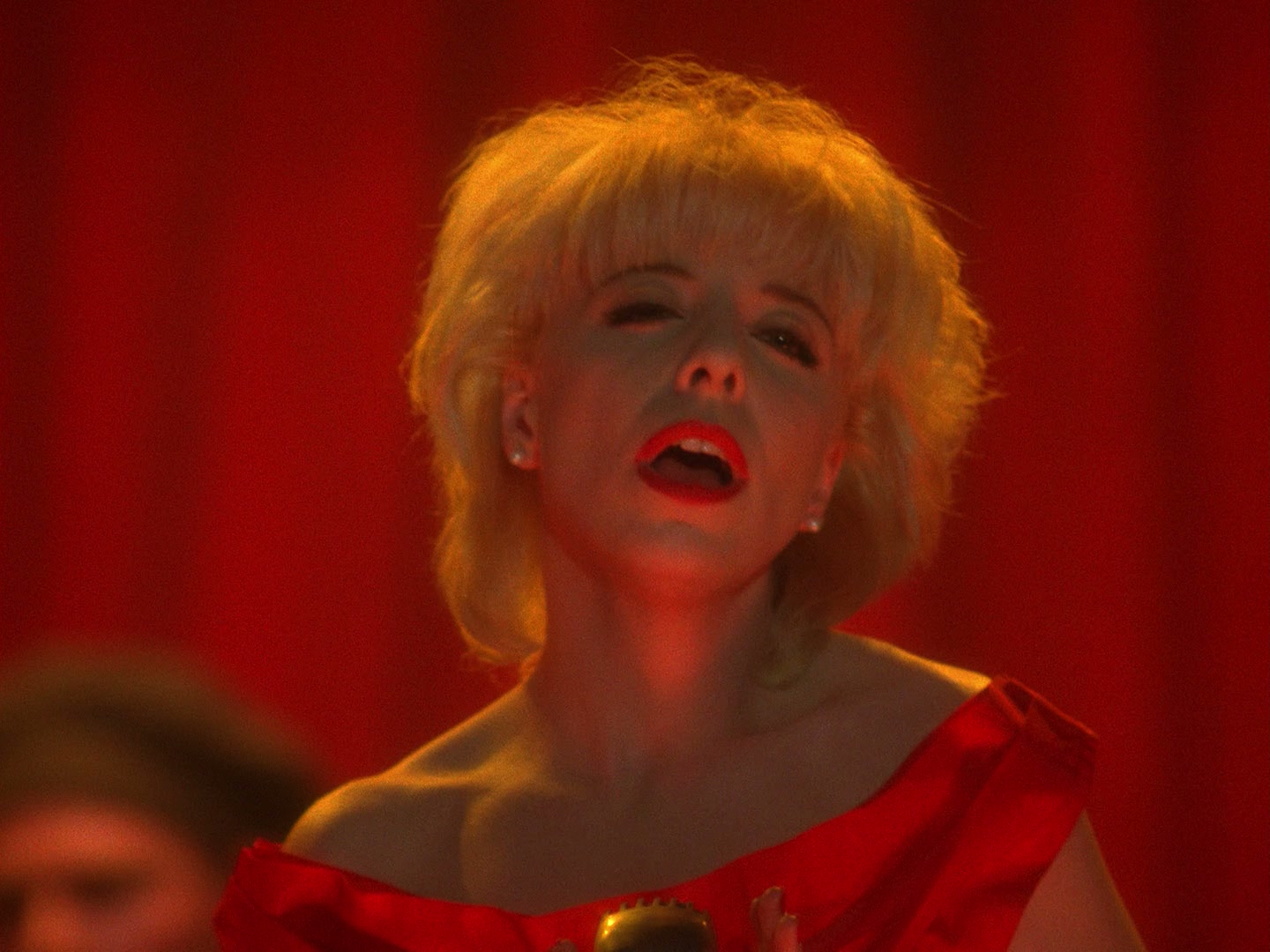
The Roadhouse holds several stories at once. Donna tells James about Harold’s death; other people sit, listen or watch. Julee Cruise’s performance gives them a shared setting without requiring a shared understanding. The caption track identifies “Rockin’ Back Inside My Heart” and “The World Spins” across the sequence.
The Giant appears in place of the singer and tells Cooper that it is happening again. The warning is both precise and insufficient: repetition is announced, but Cooper is given no location or action that will stop it. The scene grants him recognition without effective intervention.
A stage becomes a warning · 3 images
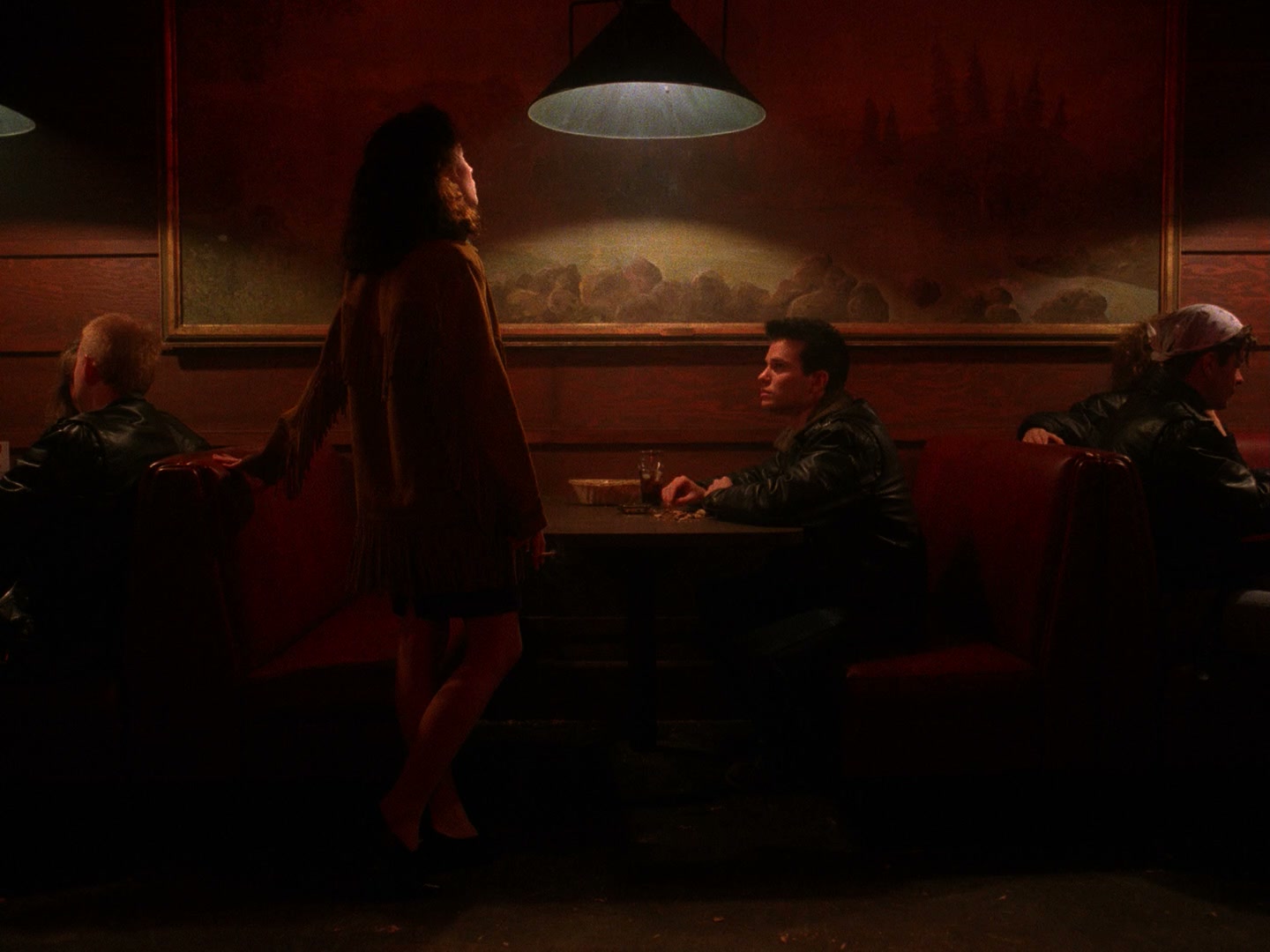
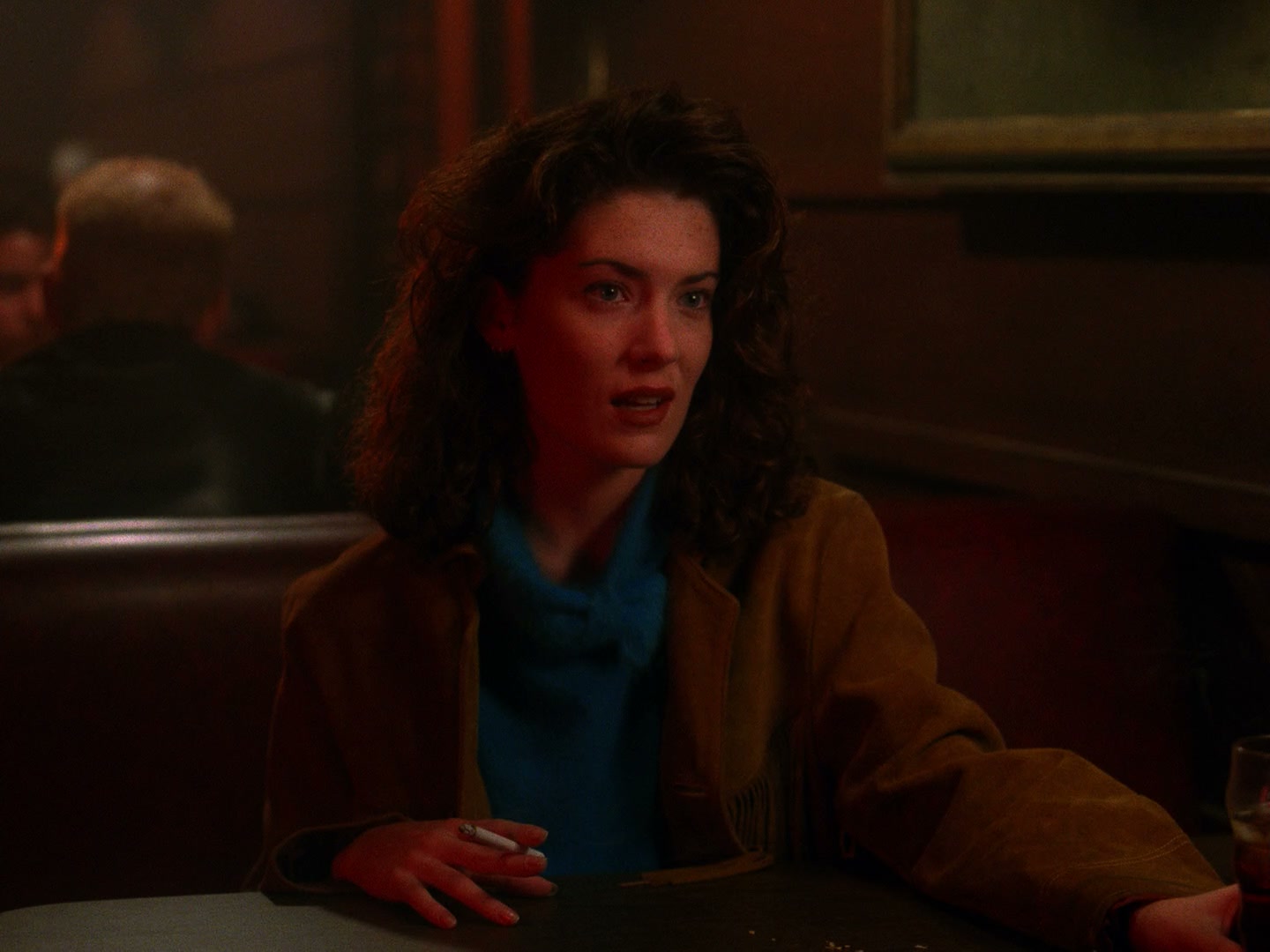
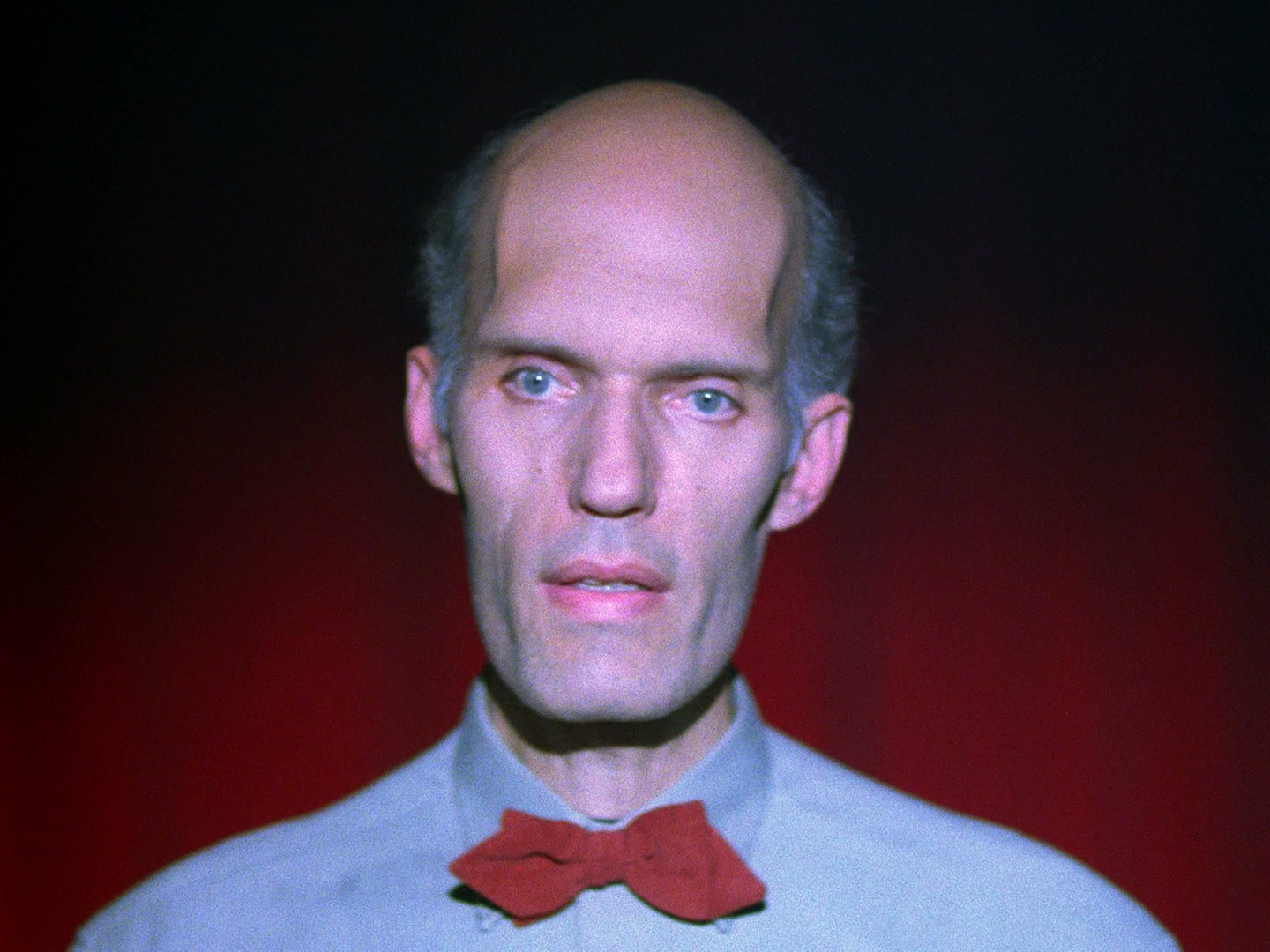
The editing then moves between a public room and the private violence at the Palmer house. These are not presented as a rescue party racing toward a known destination. The people at the Roadhouse do not possess the information that the viewer now has. The distance between feeling and knowledge becomes one of the ending’s central forms.
Two kinds of repetition
The record player and the Roadhouse performance offer different forms of return. In the Palmer house, the captions mark the player’s clicking after the morning’s reassuring song. At the Roadhouse, they identify “The World Spins” before the Giant’s warning and again after the attack on Maddy. The recurrence of the song brings the episode back to the public room, but the faces there no longer belong to the earlier social evening.
That return gives the music a structural role: the ending revisits a performance whose listeners have changed, without supplying them with a report of what has happened. Read beside the record player, it connects a familiar sound source with the failure of ordinary domestic reassurance. Music-cue notes ↓
The revelation and Maddy’s murder
Major episode spoilers. The following study discusses the killer’s revelation and the violence against Maddy. The image sequence is optional.
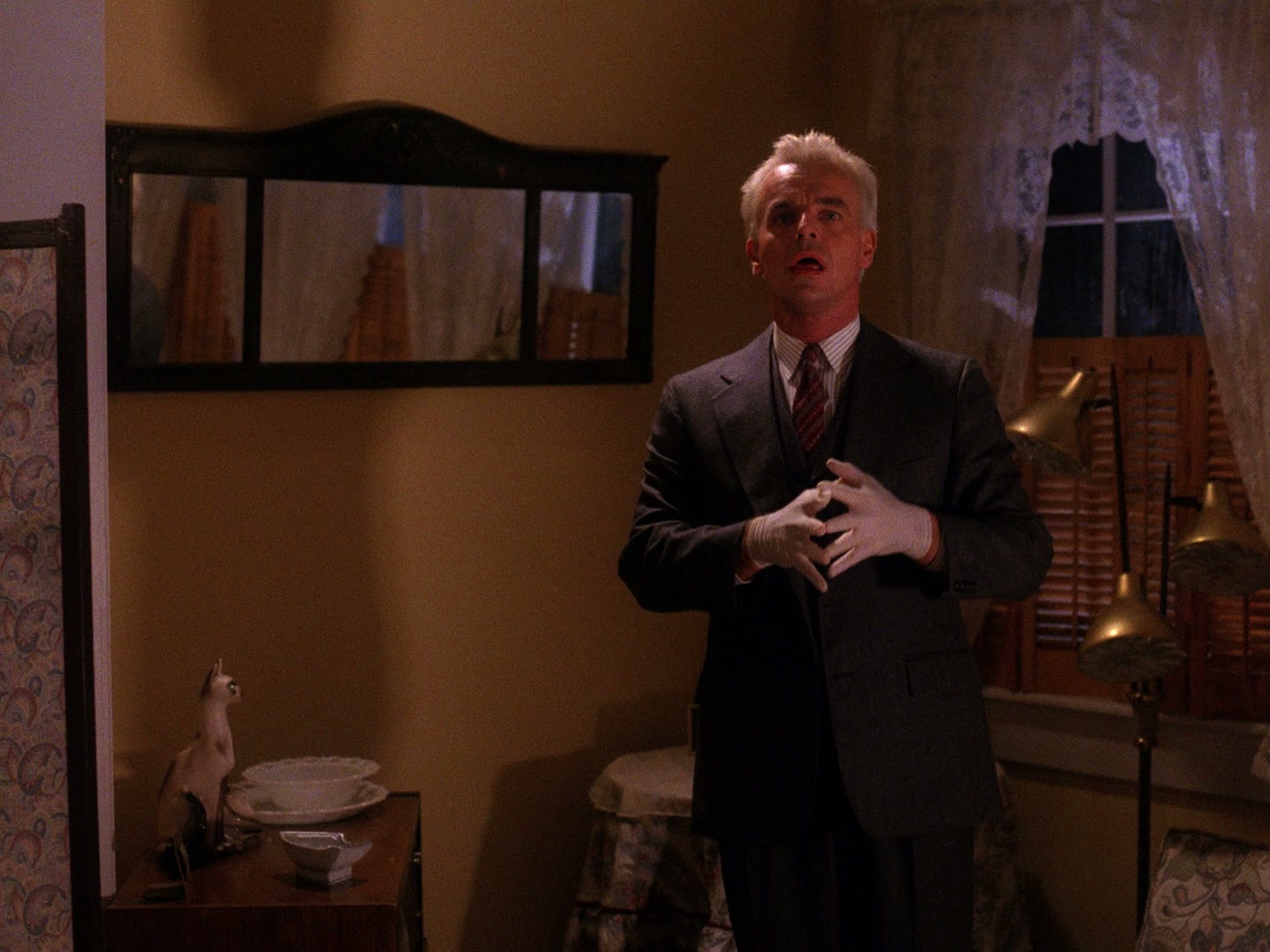
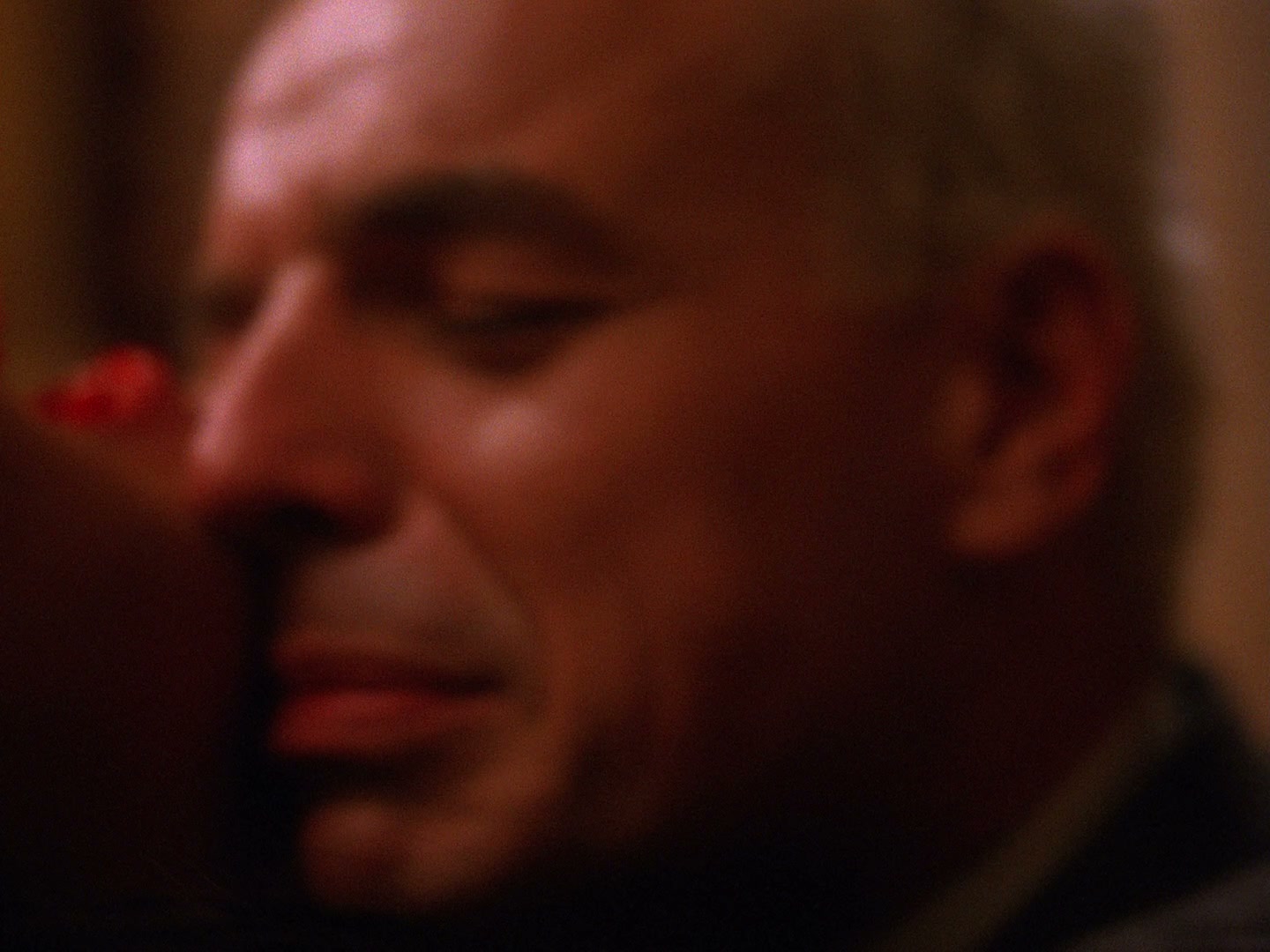
Leland’s reflection gives way to Bob. The relation between the two faces is then repeated through the assault, rather than being contained in a single revealing mirror shot. Gloves, gestures, changes of face and the arrangement of the room make the revelation inseparable from an action against another person.
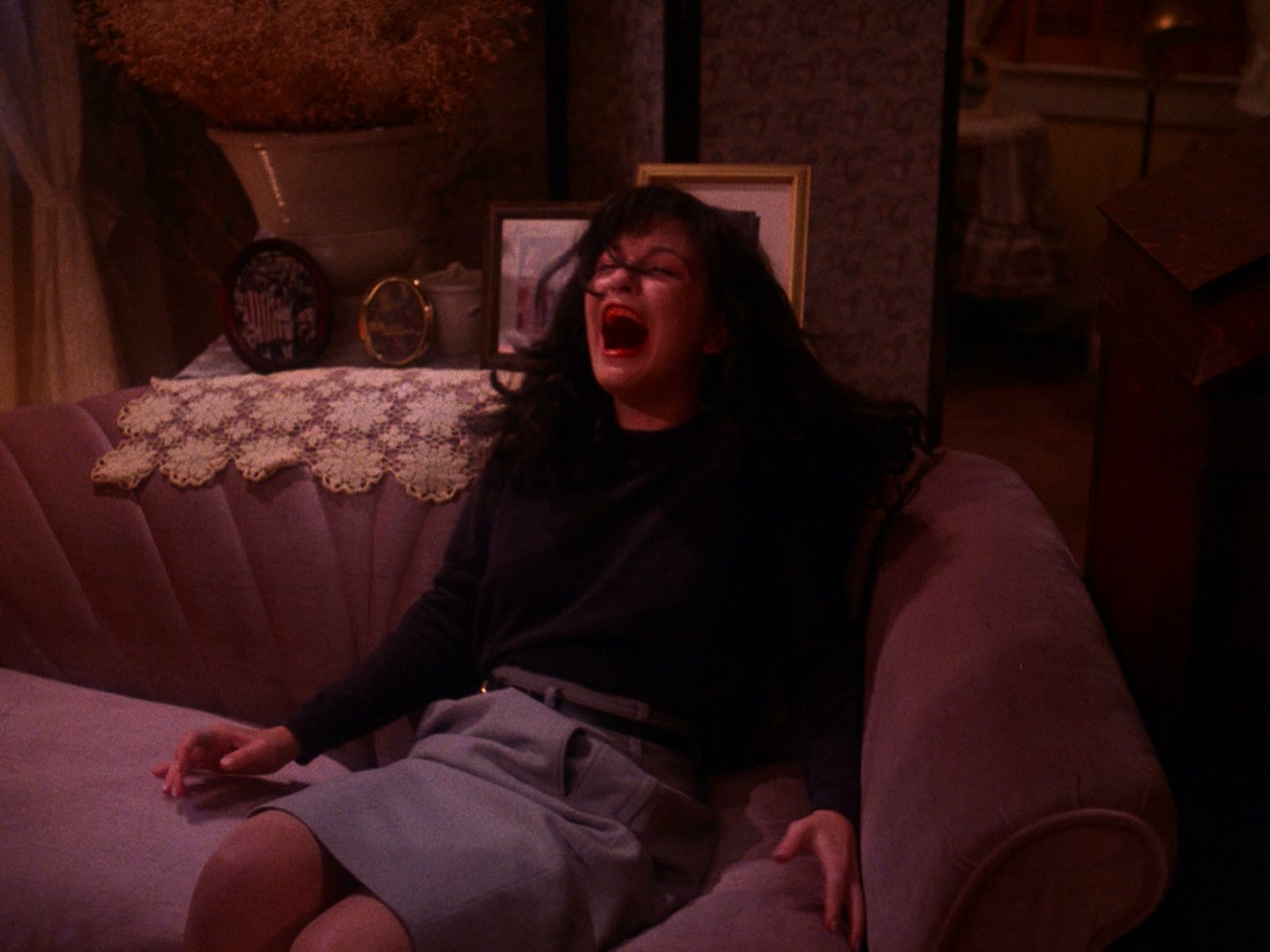
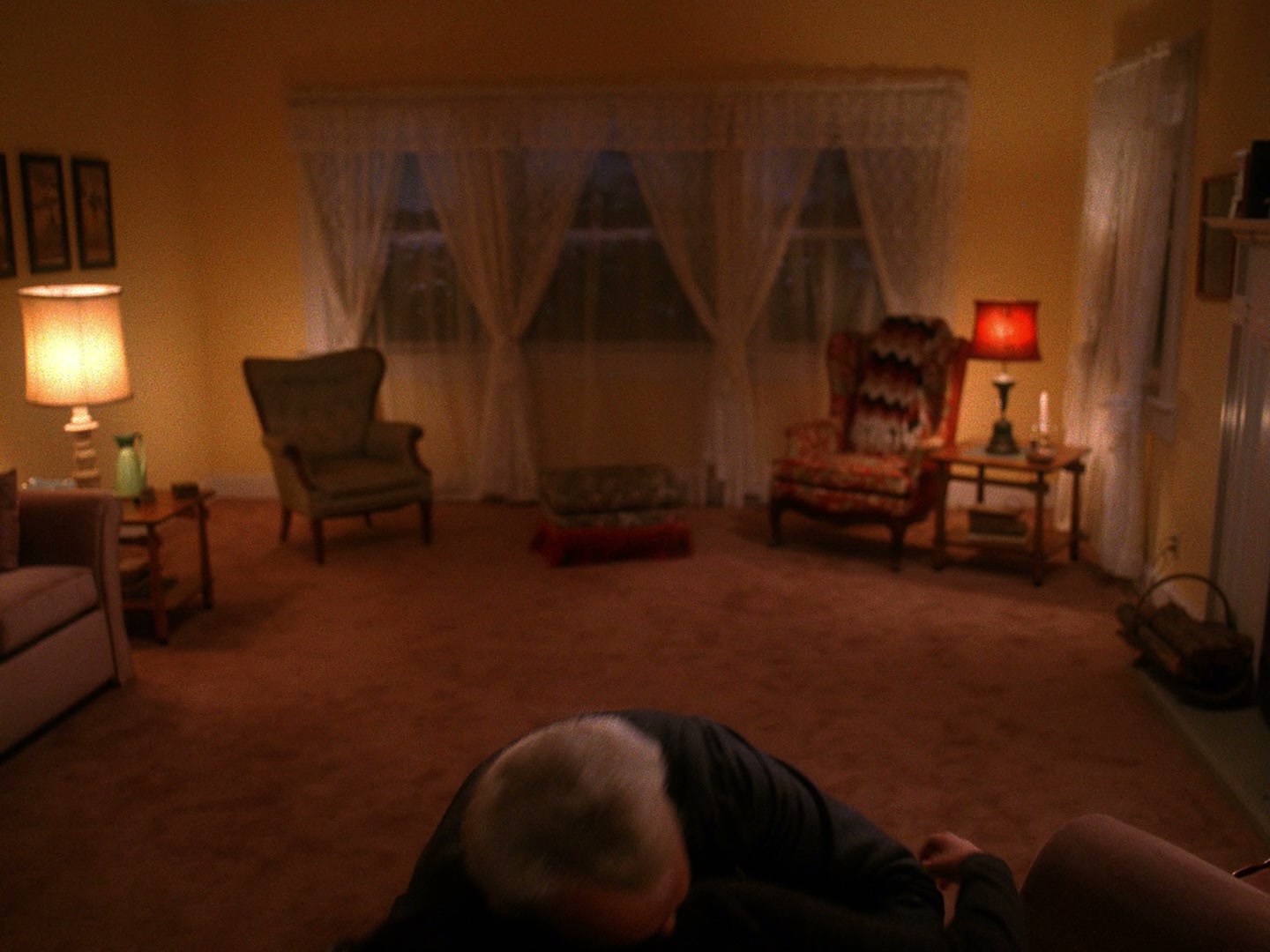
Maddy enters because of a burning smell. Her ordinary question is met by an assault in the place that has presented itself as a family home. The episode alternates views of the attacker and Maddy’s terror, while wider views retain the surrounding room. This is the same space in which she had been allowed to imagine leaving.
Leland’s use of Laura’s name makes misrecognition part of the violence. Maddy is not simply disclosed as a replacement body in a plot mechanism: the earlier scenes have established her wish to stop being treated as Laura. The murder destroys that attempt at separation.
The sequence changes the audience’s knowledge more decisively than the investigators’ knowledge. It identifies a relationship between Leland and Bob without settling every question about control, responsibility or the series’ supernatural world. Those questions should not displace the immediate fact of what happens to Maddy.
The mirror and the living room · violent sequence · 5 images
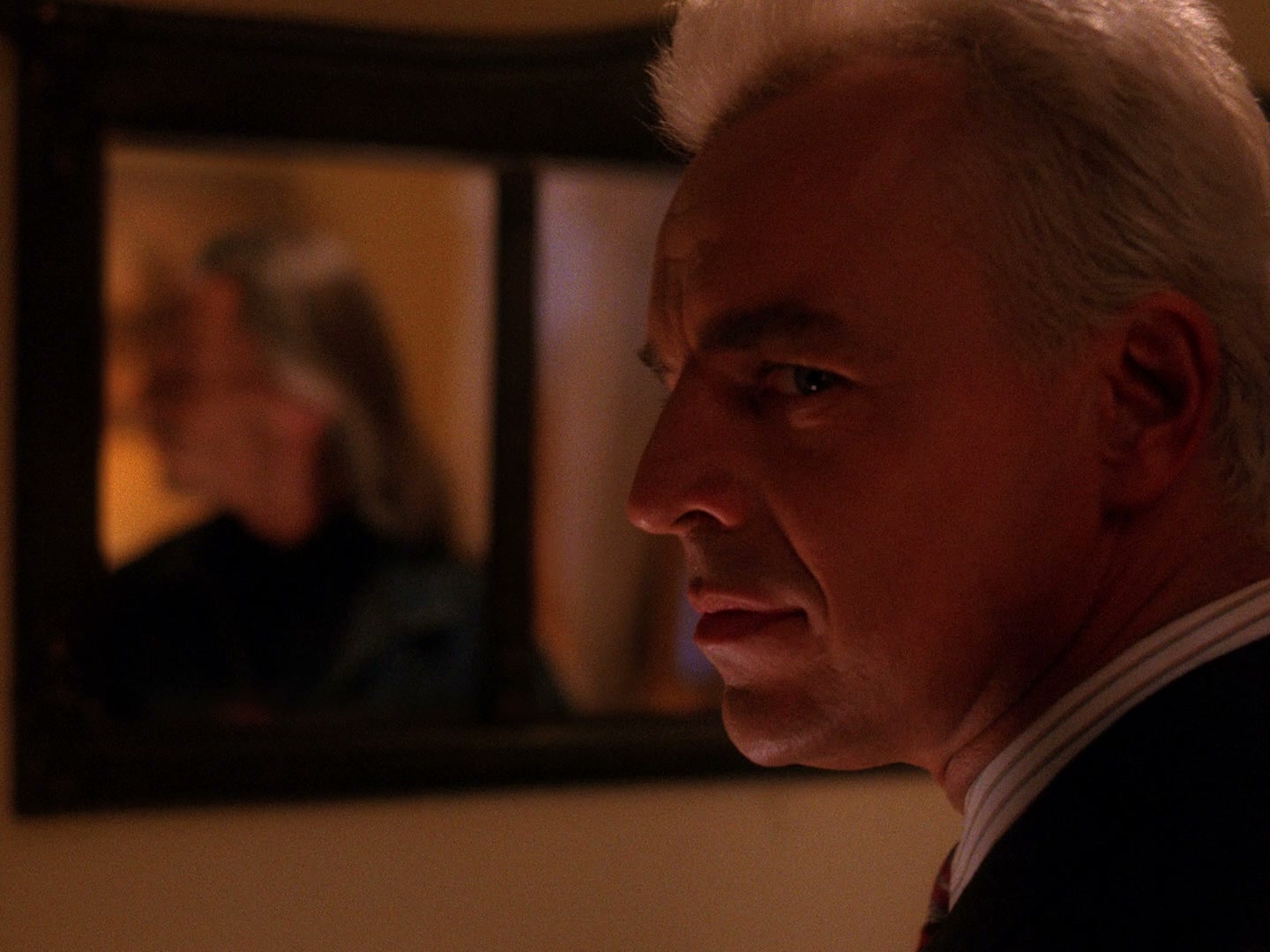
Filming a secret: the actors’ accounts
Into the Night: Creating Season Two adds a production history to the revelation. Ray Wise remembers filming Maddy’s murder with Leland, Ben Horne and Bob presented as attackers, so the crew would not be able to identify the intended solution from the work on set. His account concerns the competing versions filmed around the disclosure; it does not make all three men killers within the finished story.
Sheryl Lee describes the long physical day and the emotional effect of repeatedly performing an assault. She also remembers the care of the actors working with her. Read beside the episode, her testimony returns attention to the labour behind an image often discussed only as a puzzle’s solution. Concealing a narrative secret required additional performances by the person playing its victim.
Mark Frost recalls elaborate precautions, including numbered scripts, invented scenes and a plan involving several possible revelations. These memories do not all enumerate the alternatives in the same way. Wise’s account of the scenes he performed is therefore kept distinct from Frost’s recollection of the broader plan. The documentary supports an account of deliberate secrecy, without turning recollection into a complete inventory of surviving alternate footage.
Source: Secrets from Another Place: Creating Twin Peaks, “Into the Night: Creating Season Two,” approximately 1:36–5:27, in Twin Peaks: From Z to A. See also Julee Cruise on the work of singing “The World Spins”.
Grief without an explanation
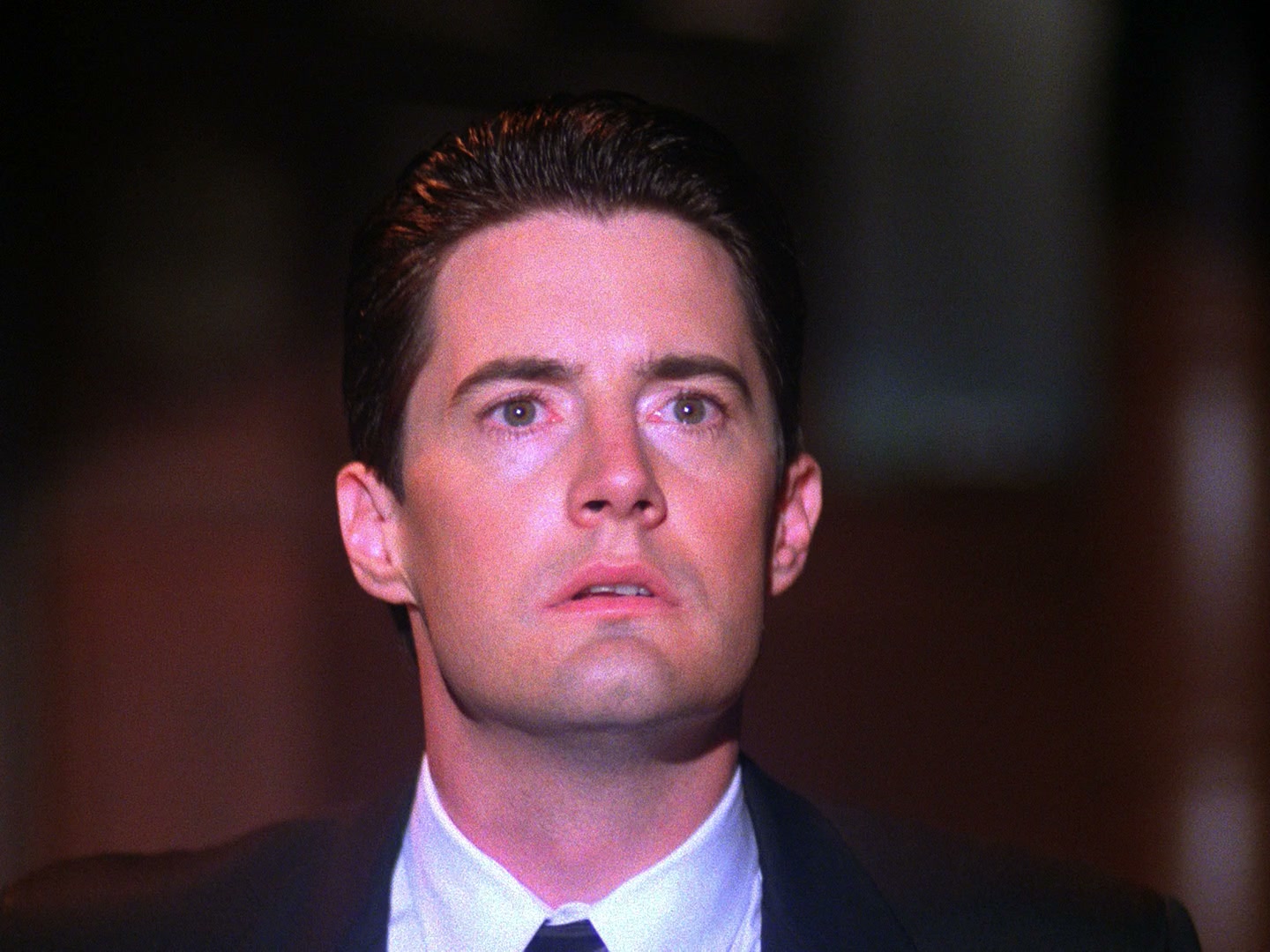
When attention returns to the Roadhouse, the event has not become a report that Cooper can act upon. The waiter’s apology offers sympathy without an account. Donna weeps; the scene holds other faces as if an experience has reached the room before information has.
This ending transforms a familiar investigative promise. The detective has received a warning, but the warning has not prevented the crime. The audience has seen a revelation, but the revelation has not brought relief. Knowledge and power have separated.
Cooper’s face continues into the closing credits. The image refuses a quick return to the neutral surface of an ending. The programme remains with the person who has sensed a catastrophe and cannot yet name it. The emotional aftermath is allowed to outlast the revelation itself.
The Roadhouse after the warning · 3 images
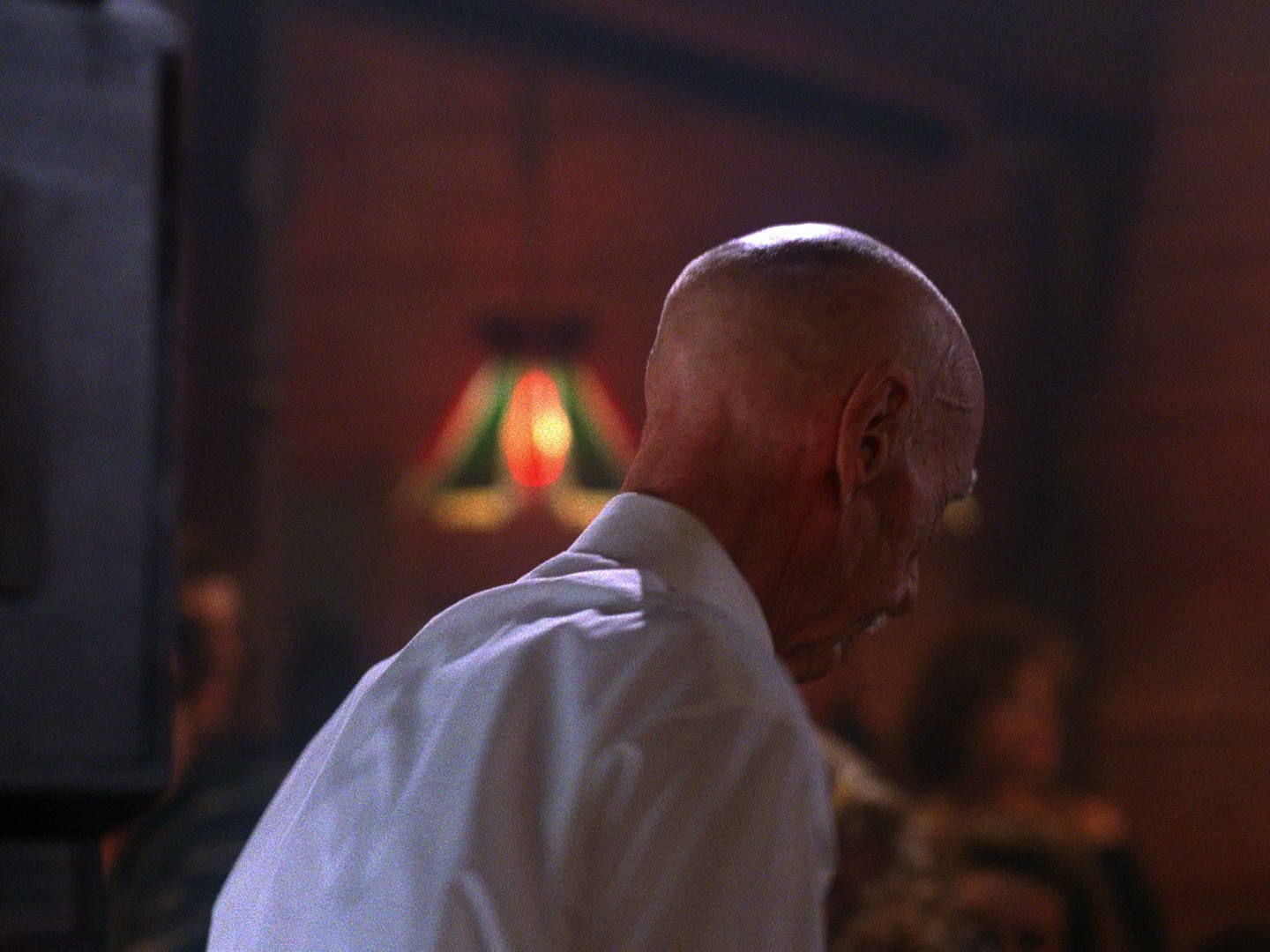
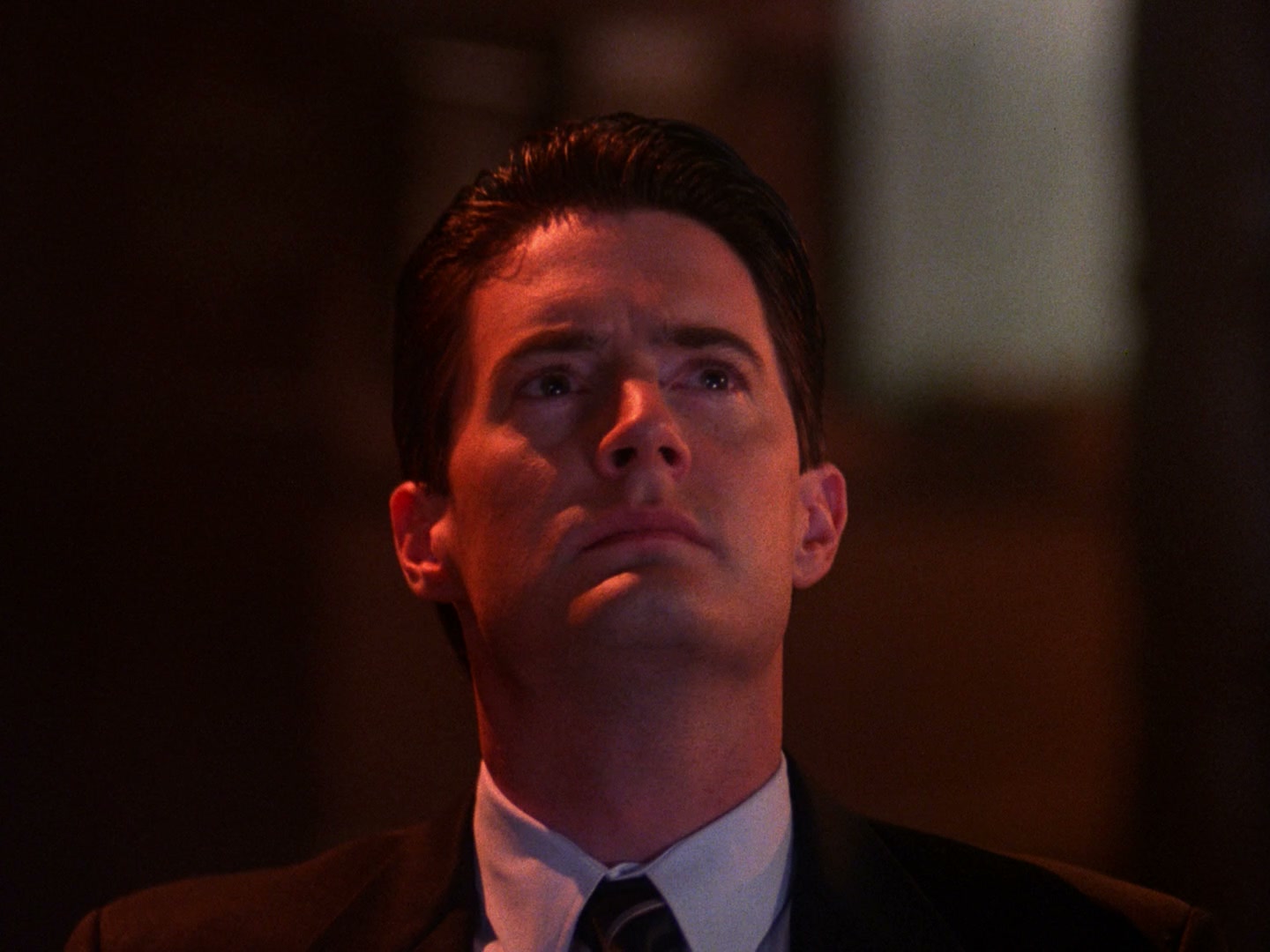
The later Log Lady introduction asks how pain can move from an injured person to another person. Read beside this ending, that question concerns an ethical cycle as well as an enigmatic image. It need not erase the distinction between someone harmed and someone doing harm.
A route through Lonely Souls
- The hotel test. Mike’s reaction makes recognition appear possible.
- Harold’s room. A death and a damaged diary follow the failed intrusion.
- Maddy’s morning. A return to her own life seems close.
- Audrey’s questions. Family knowledge becomes evidence against Ben.
- Shelly’s work. Home care narrows her choices; Norma keeps a door open.
- The arrest. The investigation assembles a persuasive but incomplete account.
- Two houses. Catherine returns while the Palmer home becomes threatening.
- The Roadhouse. Performance gives way to warning and then shared grief.
- The revelation. The viewer sees what the investigators cannot yet explain.
Sources and connections
Primary source: Twin Peaks, “Lonely Souls,” Season 2, Episode 7 / overall Episode 14, presented in Twin Peaks: From Z to A. The opening credits identify writer Mark Frost and director David Lynch; closing credits identify cinematographer Frank Byers. Scene studies derive from the episode. Dialogue references and named music cues were checked against its English subtitle track.
Companion source: the separately filmed Log Lady introduction for Episode 14, preserved in Twin Peaks: From Z to A. It is discussed as a later interpretive frame.
Continue reading: Demons, the Season Two dossier, and the study of Laura, Johnny and conflicting accounts of care.
Sound-sequence locators: English SDH cues in Twin Peaks: From Z to A: record-player clicking, approximately 29:35; “The World Spins,” approximately 37:56 and 44:17. The cue identifications were checked against the subtitle images and read alongside the illustrated scene sequence.