Mulholland Drive
The feature films / 2001 / Scenes & research
A new life in Hollywood. A performance that changes everything. A voice that outlives the illusion.
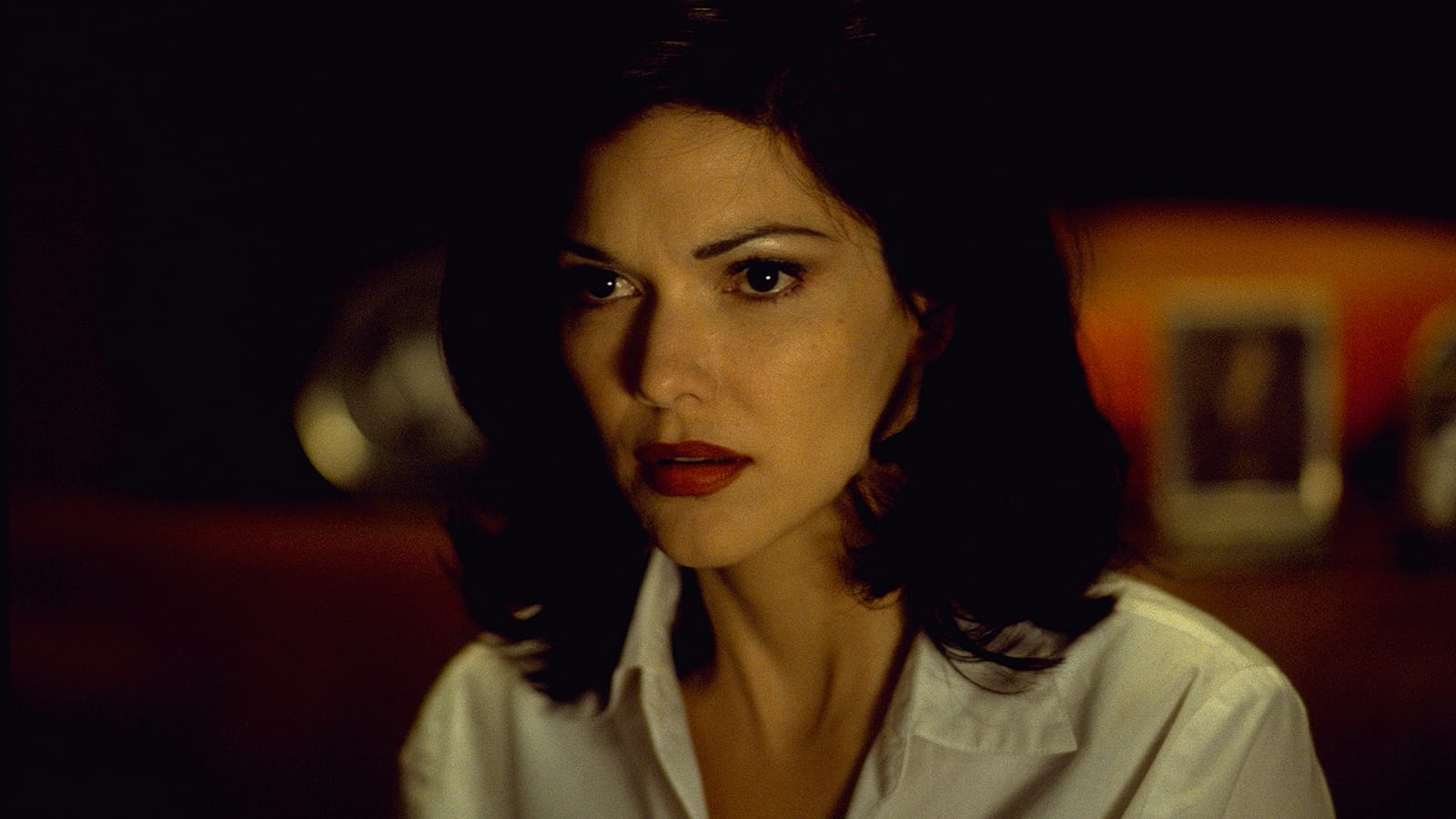
Betty arrives in Los Angeles hoping to act; Rita arrives without a usable past. Their search for an identity intersects with a director losing control of his film. Mulholland Dr. makes the promise of becoming somebody inseparable from the fear of being replaced. Naomi Watts, Laura Harring and Justin Theroux lead David Lynch’s 2001 feature. Film and cast record ↗
- Film year
- 2001
- Listed runtime
- 146 min
- Image
- Color
- Edition ratio
- 1.85:1
Explore the dialogue studies →Music & sound credits →
Arrivals, performances and returning images
Follow the film, image by image
Forty-five selected moments connect the two arrivals in Los Angeles, the struggle over casting, Betty’s audition, Club Silencio and Diane’s changed world. Enlarge the stills, compare the recurring objects, and follow each scene into the existing production and critical research.
The guide discusses the complete story and ending. Times locate the selected images in the copy examined here.
Browse all 45 scene studies
Two arrivals, two kinds of uncertainty
01:45A performance before a protagonist02:45The picture approaches a place of sleep05:15A passenger whose destination is withheld06:45Survival begins with disorientation08:15The city offers cover before it offers a home15:15A story changes the room around its teller16:55A corner holds back the next image18:45Hollywood begins as a welcome22:15An entrance comes with a gatekeeper25:45A name borrowed from another filmWho gets to choose?
29:15The director is seated inside someone else’s decision33:15A small judgment dominates the room36:15Authority is placed at a distance38:45A planned act loses its clean outline45:05An object supplies another question55:15A name becomes a lead56:45Two people listen through one instrument1:07:15A casting decision is restaged as a lesson1:10:45A scene can be tried on and put asidePerforming and looking
1:15:15An ordinary office becomes a stage1:18:45The distance between performers changes everything1:23:45A finished image reveals its workplace1:26:15A candidate is already marked for selection1:31:15An address does not guarantee recognition1:35:45The investigation enters a room it cannot master1:38:15Resemblance is made in front of a mirror1:41:45The relationship exceeds the investigationSilencio and the blue box
1:45:15A destination replaces the search for an address1:46:45An explanation becomes another performance1:50:45A face gives the recording a present tense1:51:45Understanding the trick does not end the feeling1:52:15The microphone remains after the performer falls1:55:45The key finally meets a visible opening1:56:30A familiar room remains without its companions1:58:15The body returns with another set of circumstancesDiane and the returning images
1:59:45Another apartment carries another social history2:04:45The aspiring performer watches from the edge2:09:15The passenger changes; the route returns2:11:15An invitation has its own imbalance2:13:15A life story becomes a public performance2:17:10A photograph becomes an instruction2:19:40The returning color belongs to a different object2:20:00The room offers no secure refuge2:22:20The city returns through the women’s faces2:22:50A final spectator remainsScene studies / 01
Two arrivals, two kinds of uncertainty
Dance-floor exhilaration, a broken journey and a Hollywood welcome establish different promises of a new life.
A performance before a protagonist
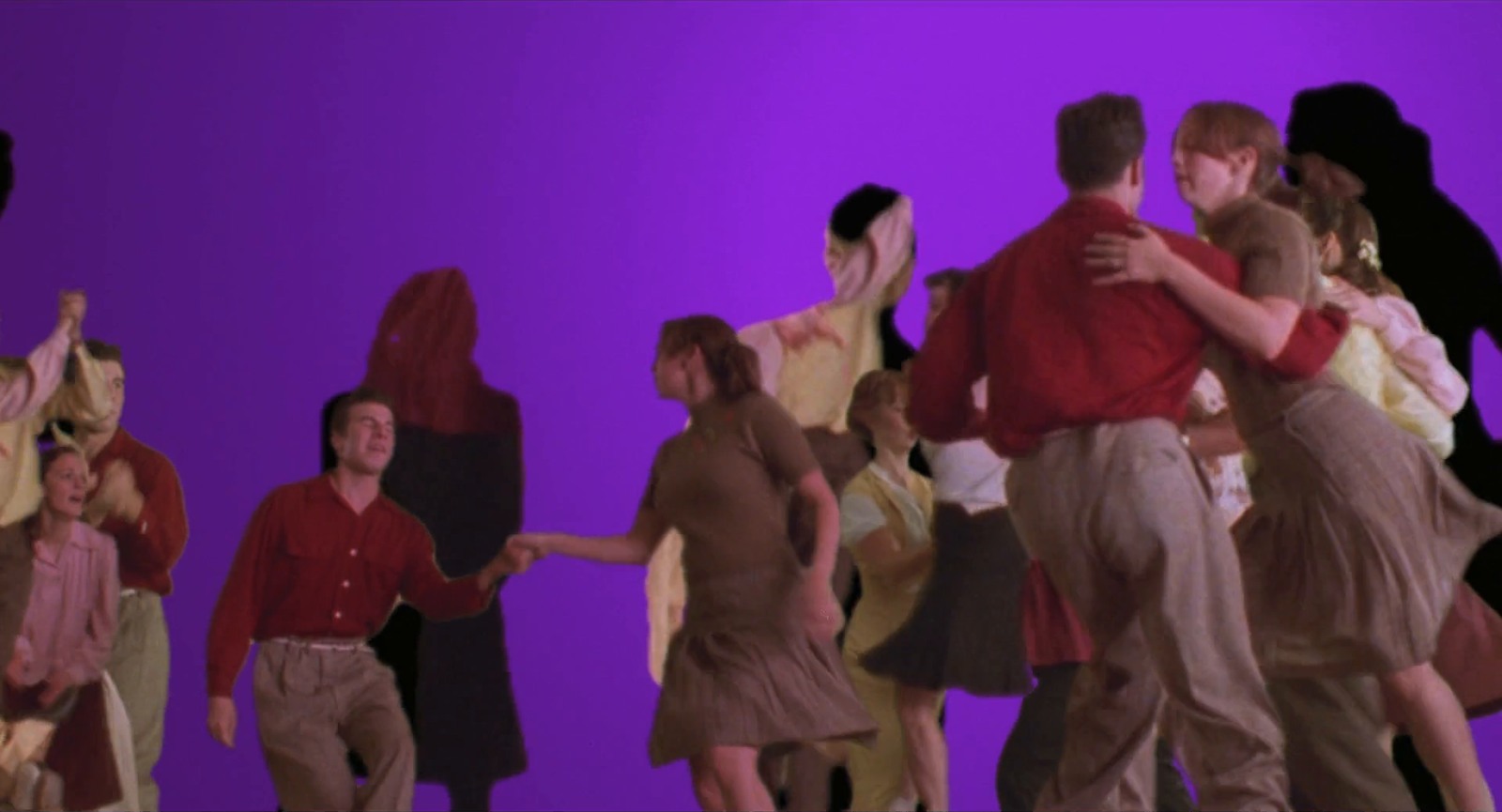
01:45The opening presents bodies, shadows and superimposed figures before giving us a stable dramatic space. The dancers seem to occupy both a stage and a graphic field. This first image of performance belongs beside the later auditions: being seen and being selected enter the film before Betty arrives in Hollywood.
The picture approaches a place of sleep
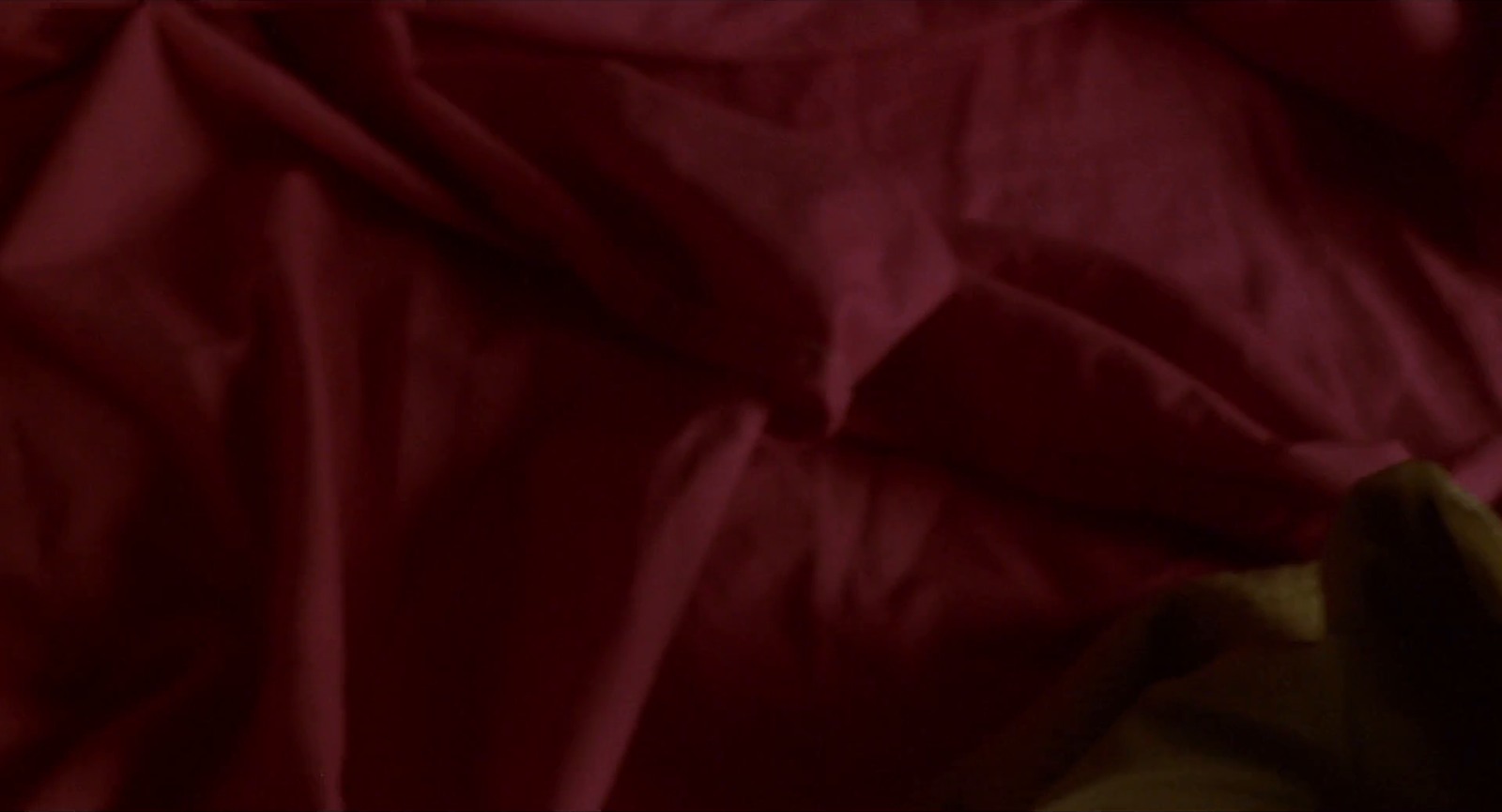
02:45After the bright dance imagery, the red bedding changes the scale of attention. The frame offers proximity to a bed without an establishing view that securely names its occupant. It is a suggestive threshold, but treating it as a label explaining everything that follows would replace the film’s unfolding experience with an answer supplied in advance.
A passenger whose destination is withheld
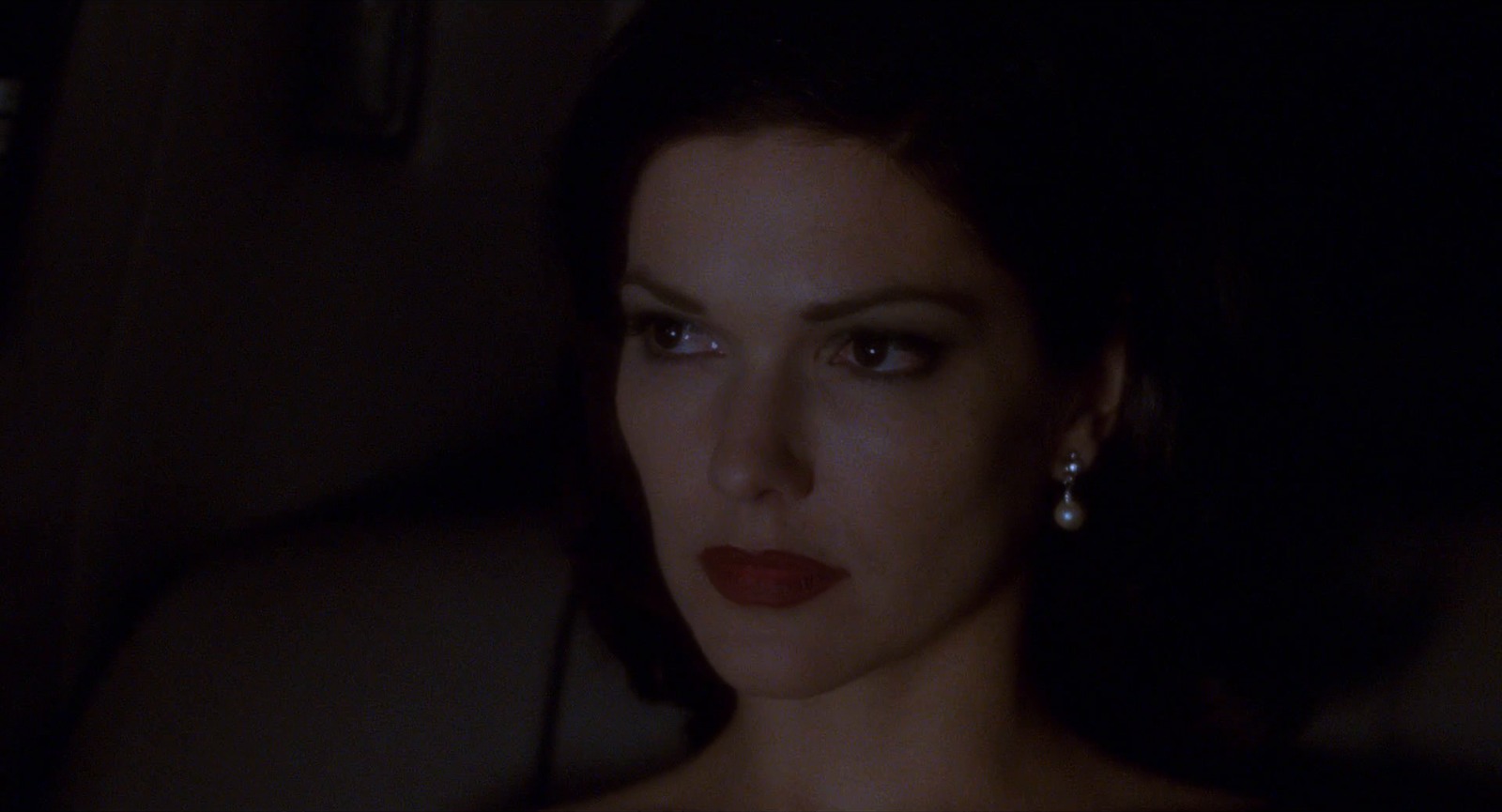
05:15The isolated face and surrounding darkness make the passenger visible without making her situation legible. She is being driven, rather than directing the journey. The later limousine ride gives this arrangement to Diane. Comparing the passengers preserves a concrete visual recurrence before deciding whether the two journeys belong to the same kind of experience.
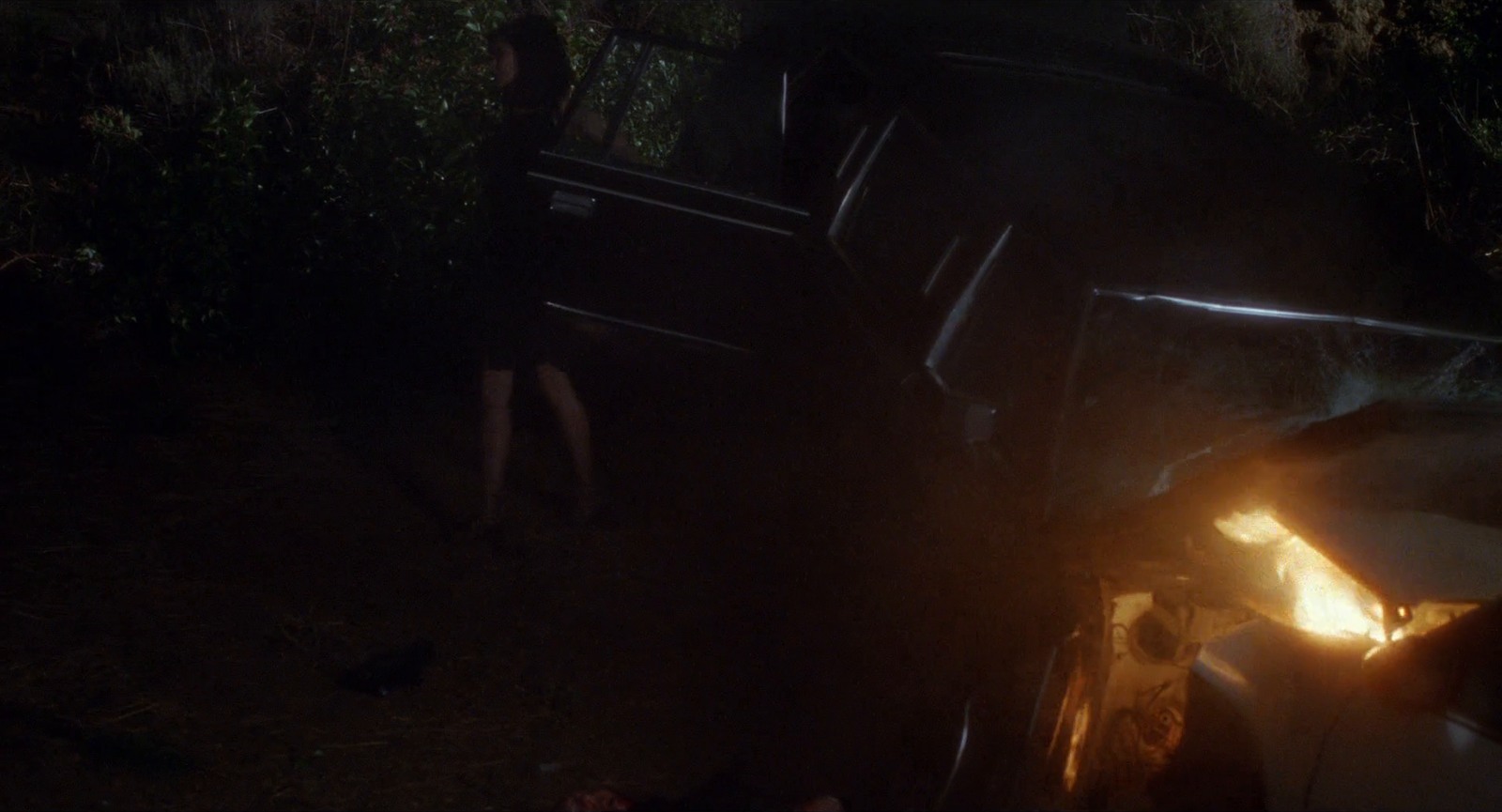
Survival begins with disorientation
06:45The damaged car and fire give the hillside a broken geography. Emerging alive does not restore a destination or a usable history. The journey into the city begins as movement away from danger. This is different from Betty’s confident arrival, although both women will eventually occupy the same apartment.
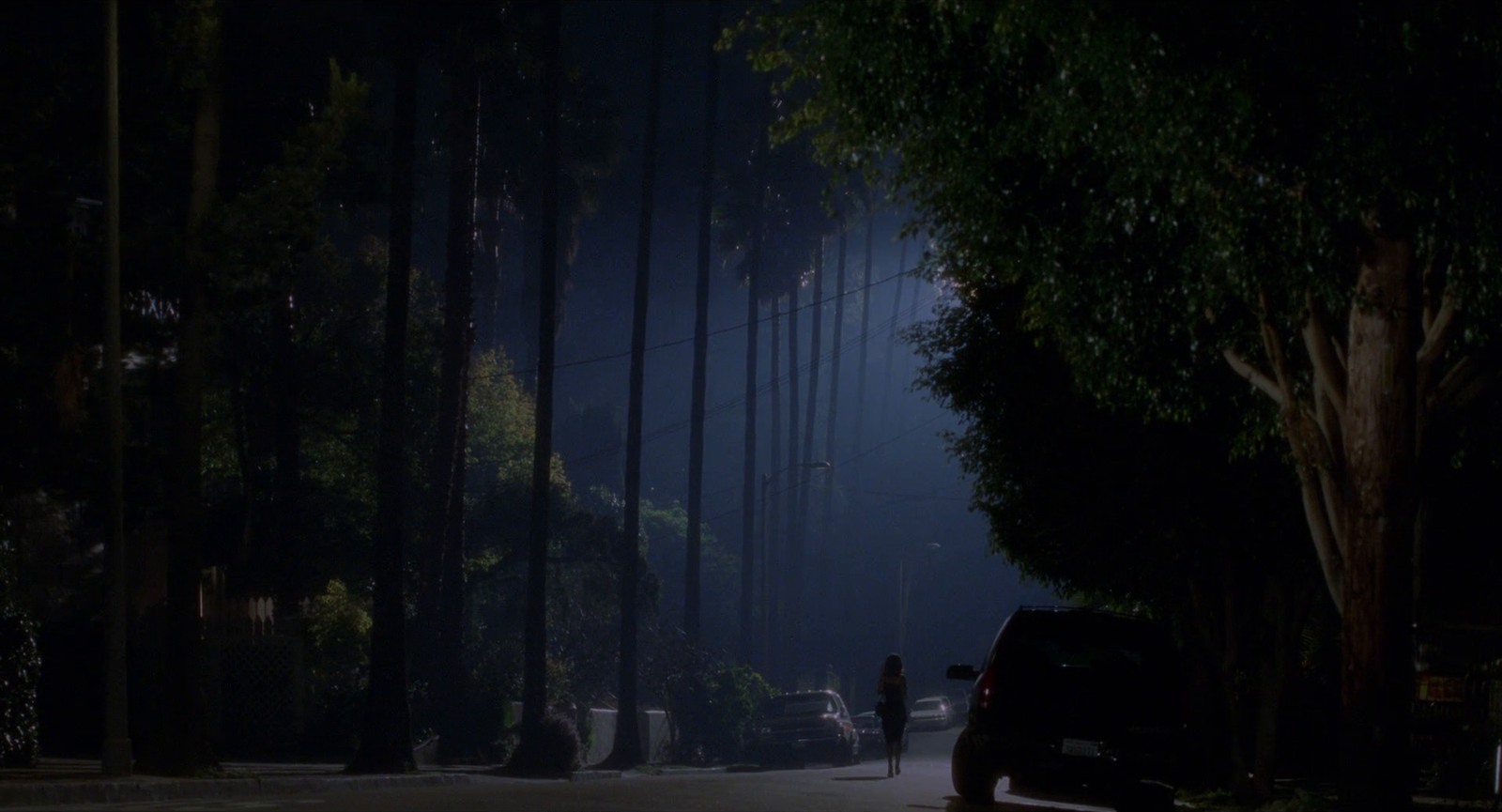
The city offers cover before it offers a home
08:15Trees, parked cars and pools of light divide the street into areas of exposure and concealment. The person moving through them has no welcoming guide. The scene makes Los Angeles a place to negotiate at ground level, beneath the distant view of city lights associated with the hillside.
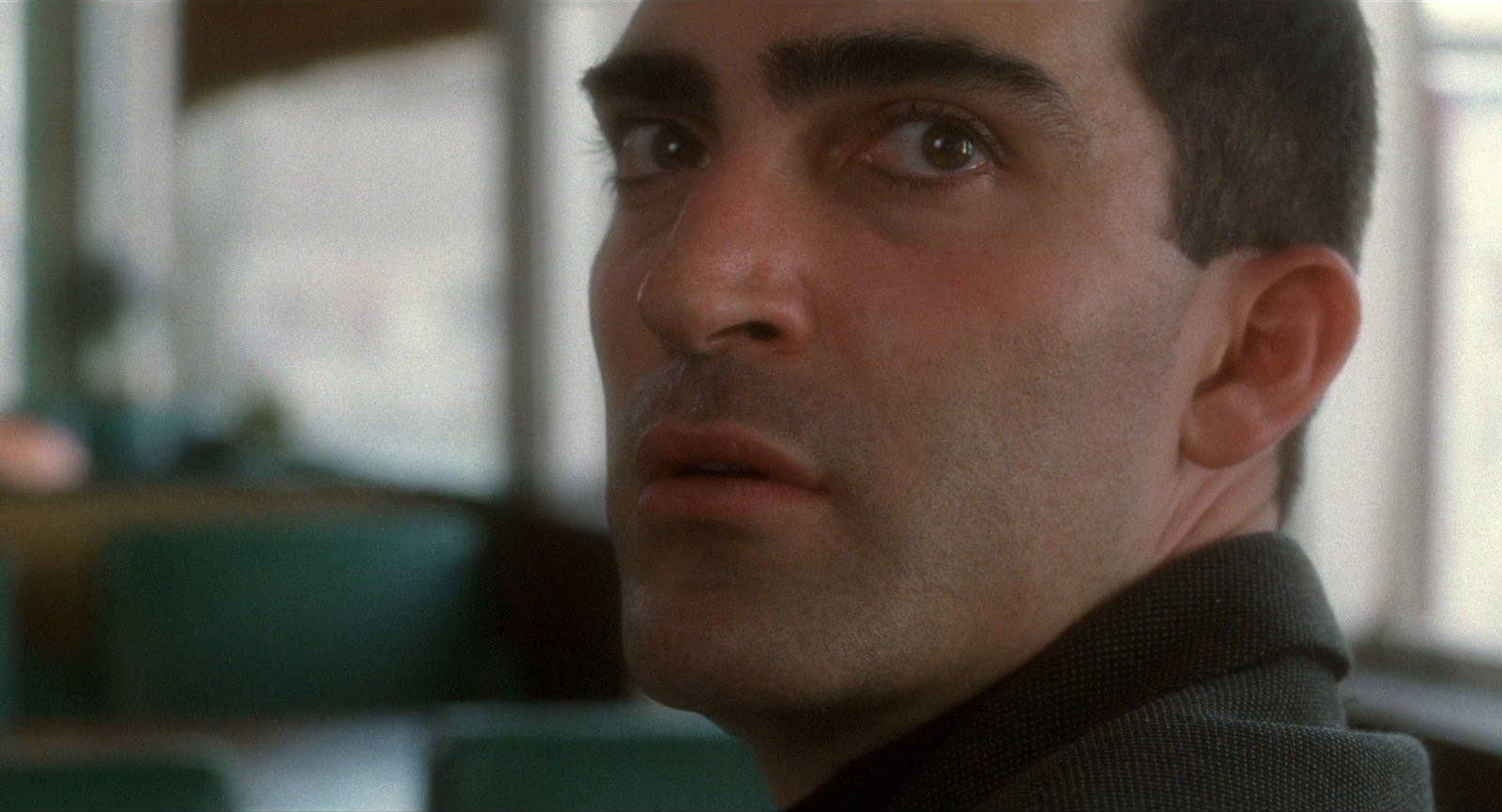
A story changes the room around its teller
15:15The close view makes Dan’s attention part of the diner’s geography. His account gives ordinary tables, a counter and the space behind the building an increasingly threatening relationship. The existing camera discussion compares Deming’s and Sweeney’s recollections; the image alone cannot settle their differing descriptions of how the sequence was photographed.
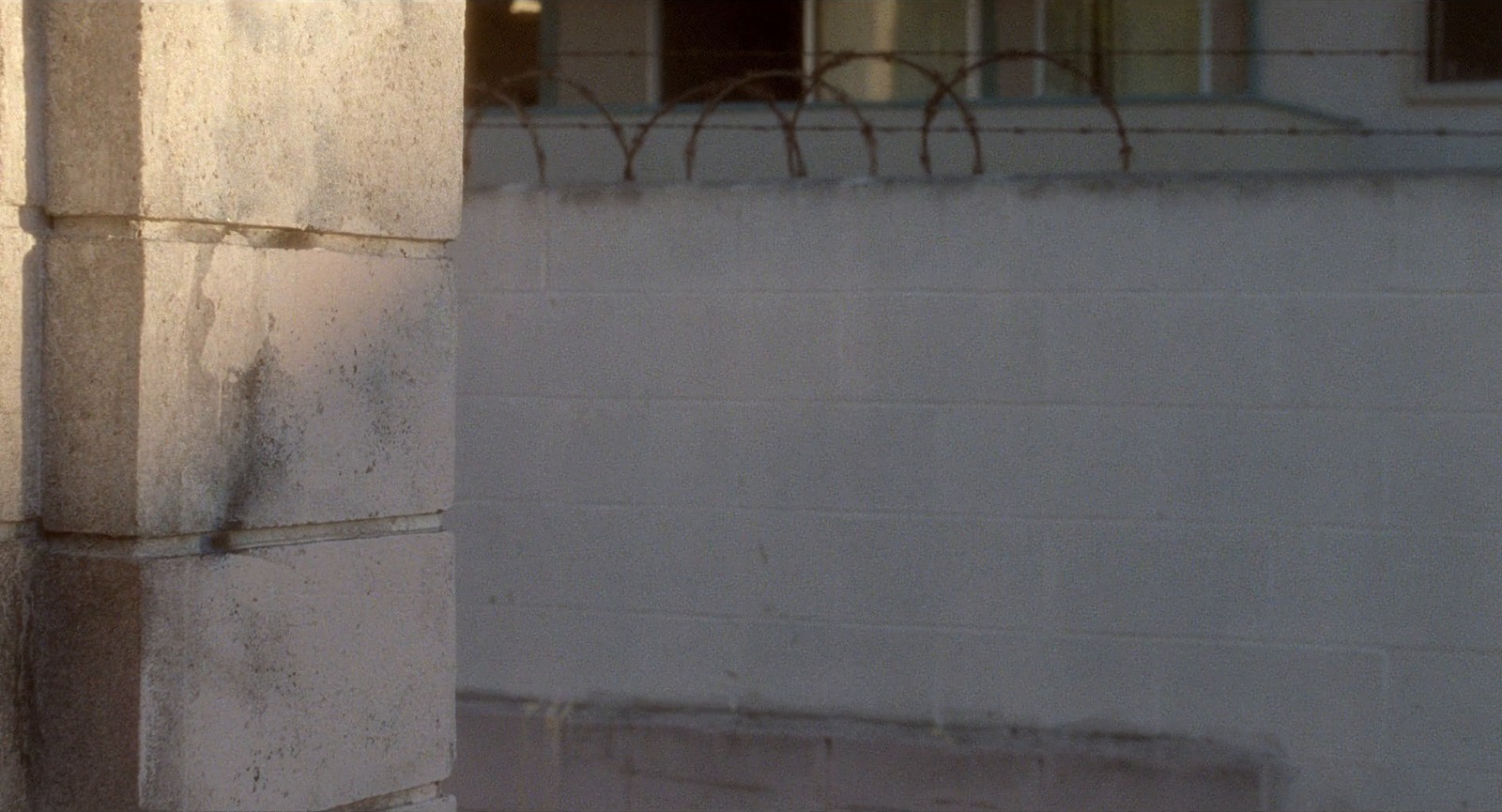
A corner holds back the next image
16:55The blank wall is a practical obstruction before it becomes a place of dread. Approaching it means surrendering the reassuring field of view inside the restaurant. The scene gives anticipation an architectural form: the spectator knows that something can remain just outside the visible plane.
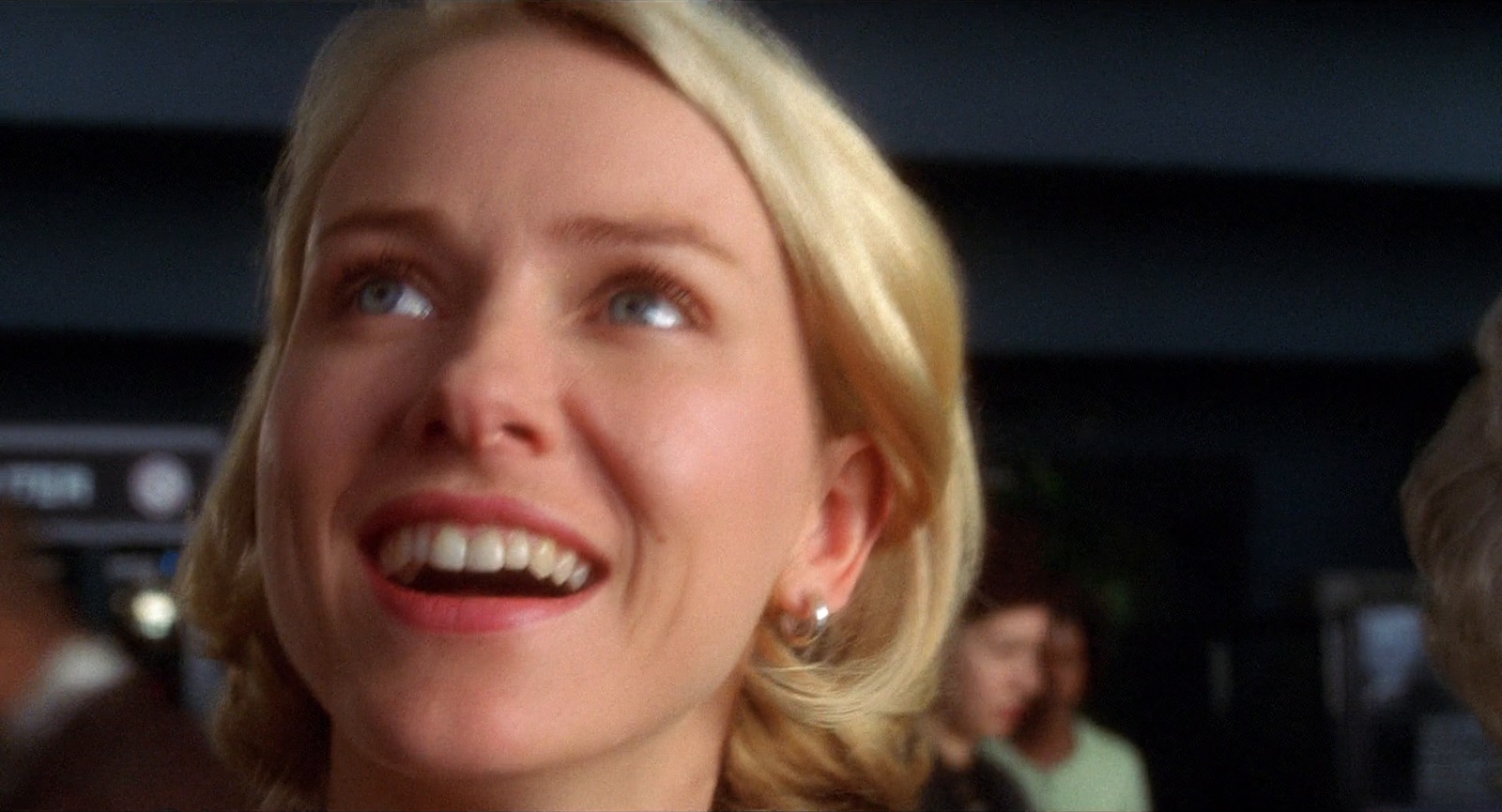
Hollywood begins as a welcome
18:45Betty’s open expression and the brightness around her contrast with the earlier arrival by night. The welcome offers a version of Los Angeles in which strangers can be kind and opportunity seems close. The film will return to faces associated with this beginning, changing what their familiarity can mean.
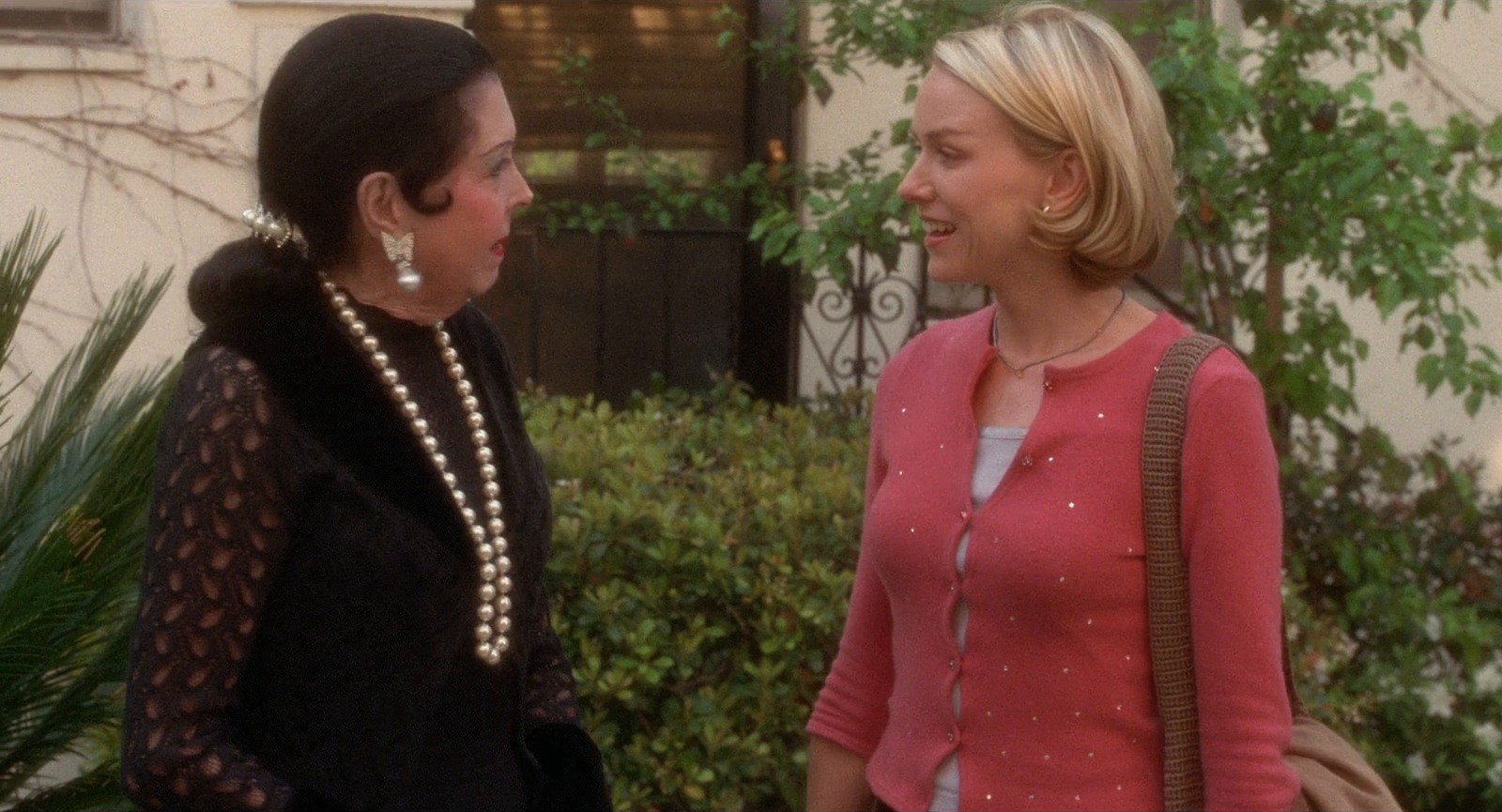
An entrance comes with a gatekeeper
22:15The planted courtyard and face-to-face greeting make the apartment complex feel inhabitable. Coco’s authority is personal and immediate: she introduces Betty to a place, rather than merely handing over an address. Her later appearance at Adam’s gathering lets the film reuse a familiar face within a different social arrangement.
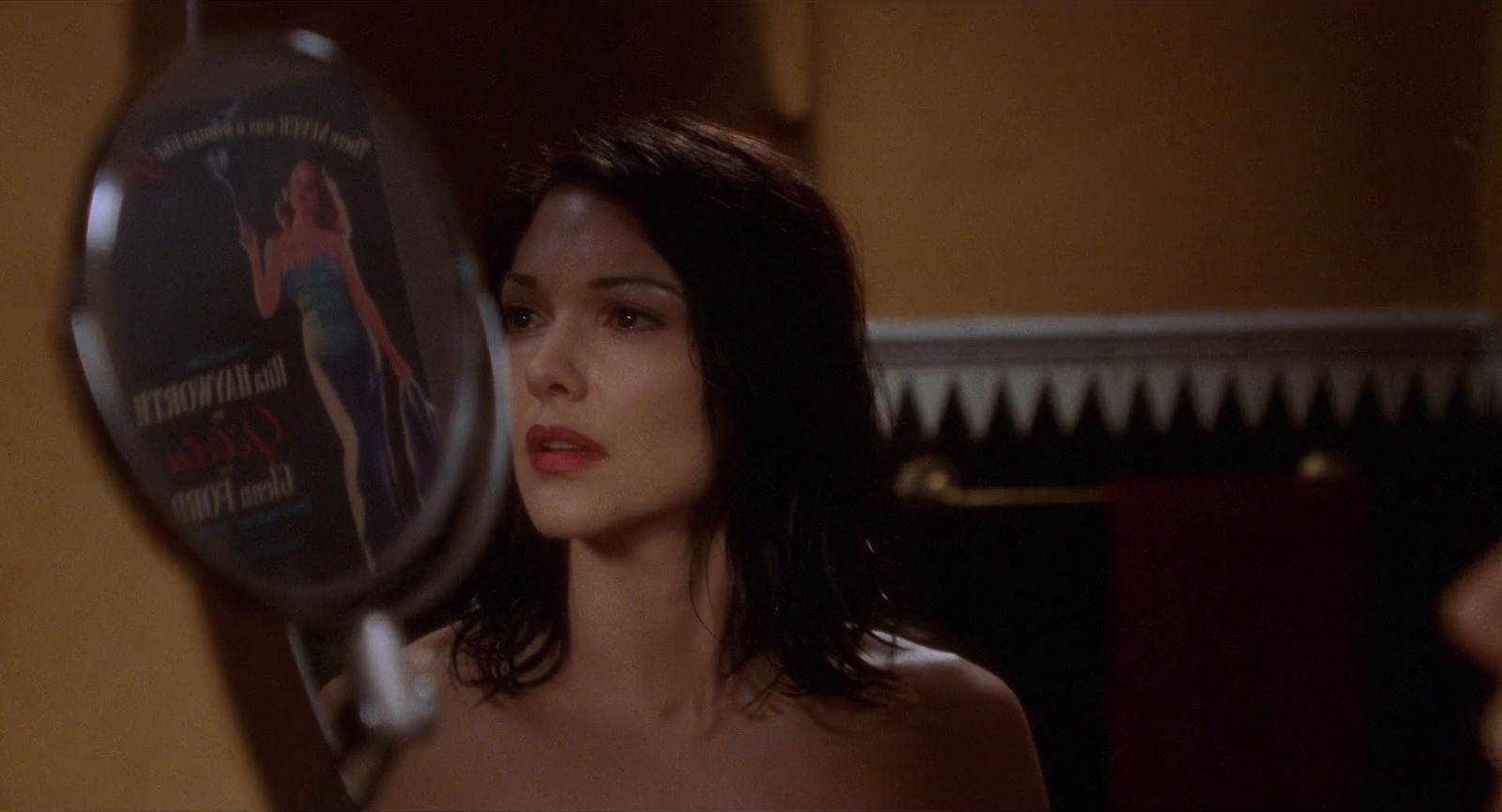
A name borrowed from another film
25:45The borrowed name is inseparable from looking. A poster supplies a recognizable Hollywood identity when the woman cannot supply her own history. Mirror, face and film image occupy the same small space. The scene turns an everyday decorative object into a resource for constructing a provisional self.
Scene studies / 02
Who gets to choose?
A director, a hired killer and two amateur investigators encounter systems of selection, money and concealed authority.
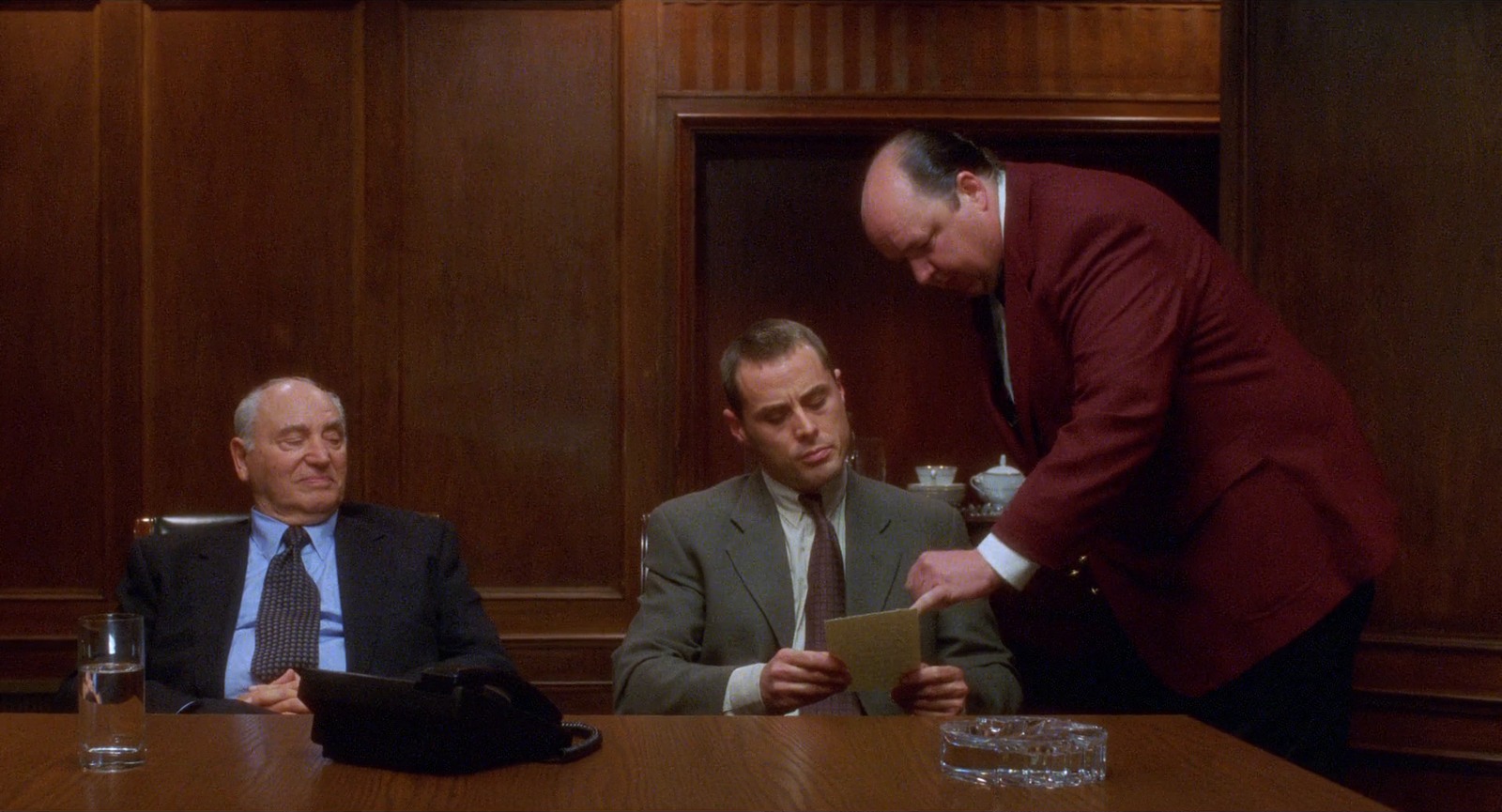
The director is seated inside someone else’s decision
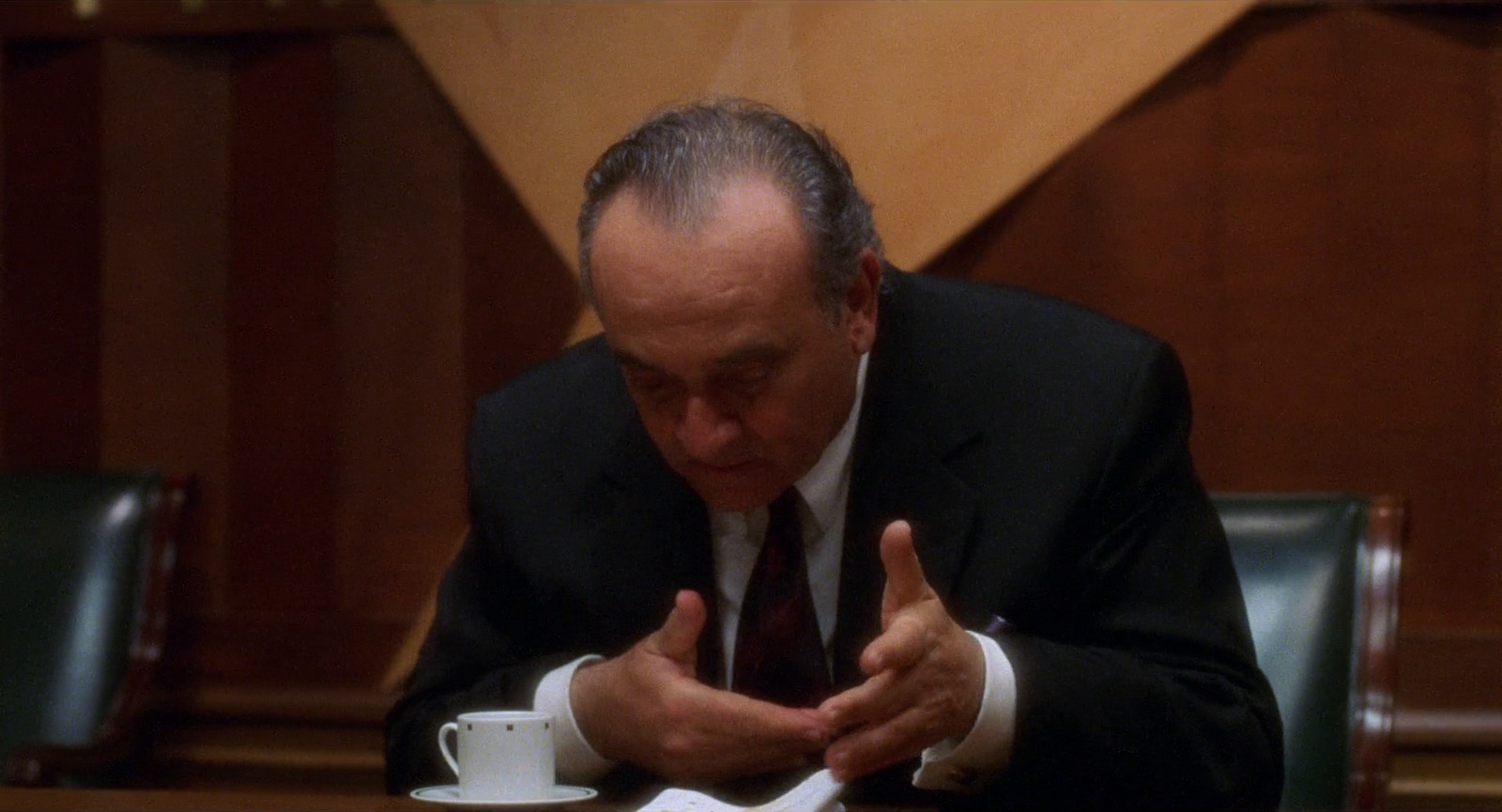
29:15The formal table promises a professional discussion, yet its ritual of service delays any ordinary exchange of creative choices. Adam’s place in the room does not guarantee authority over it. The meeting’s arrangement makes power visible through who waits, who speaks and whose preferences organize everyone else’s attention.
A small judgment dominates the room
33:15The coffee ritual grows large enough to interrupt the supposed business of making a film. A minor preference becomes a public test that everyone must endure. Its disproportion is part of the scene’s comedy and menace: the director cannot recover control simply by recognizing how absurd the encounter has become.
Authority is placed at a distance
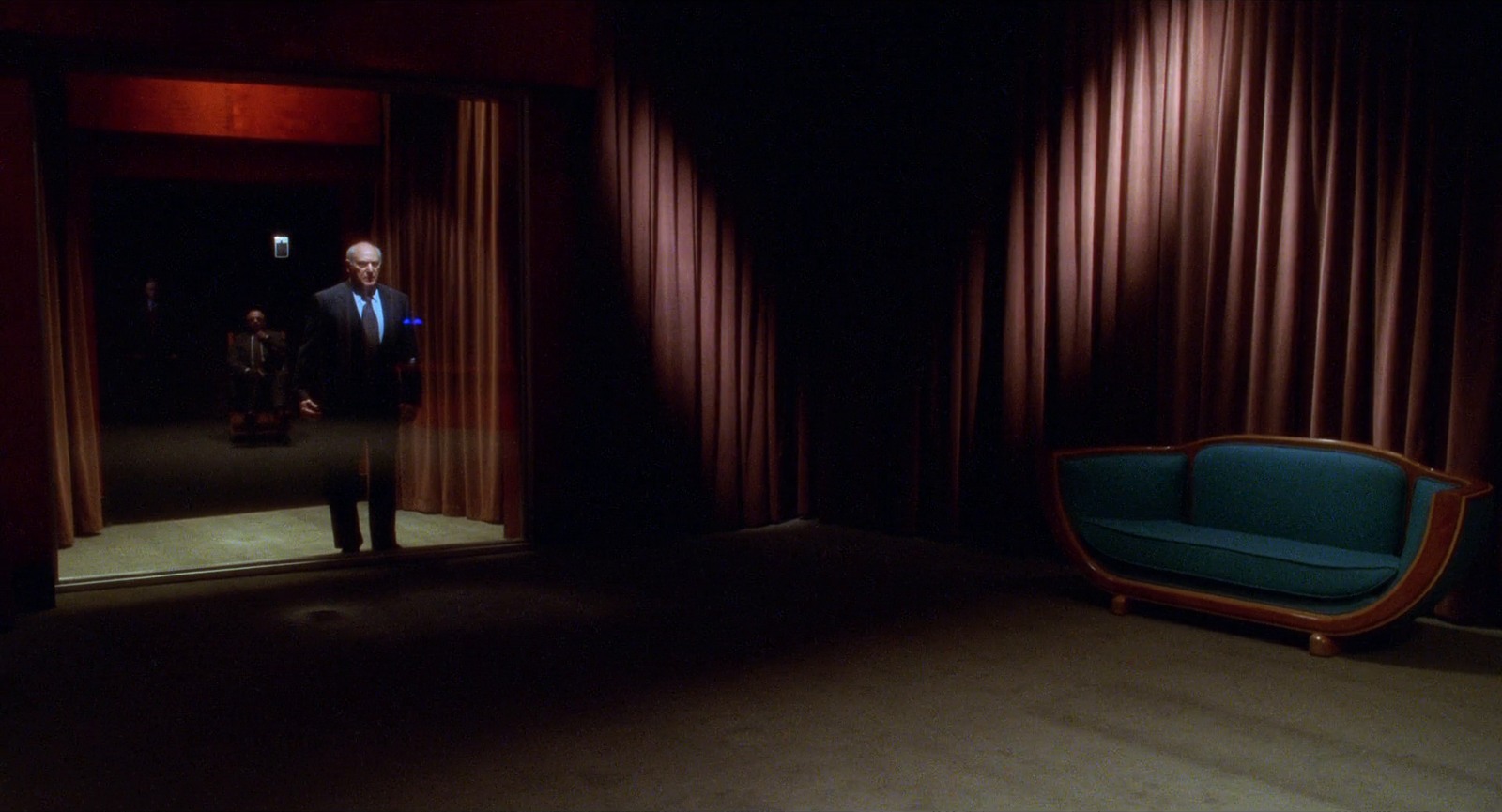
36:15Curtains and the unusual distribution of space make this office unlike the meeting room. Access to the seated figure feels staged and restricted. The production research identifies practical work behind Mr. Roque’s appearance; that evidence belongs alongside the image without pretending that construction details explain the character’s position in the story.
A planned act loses its clean outline
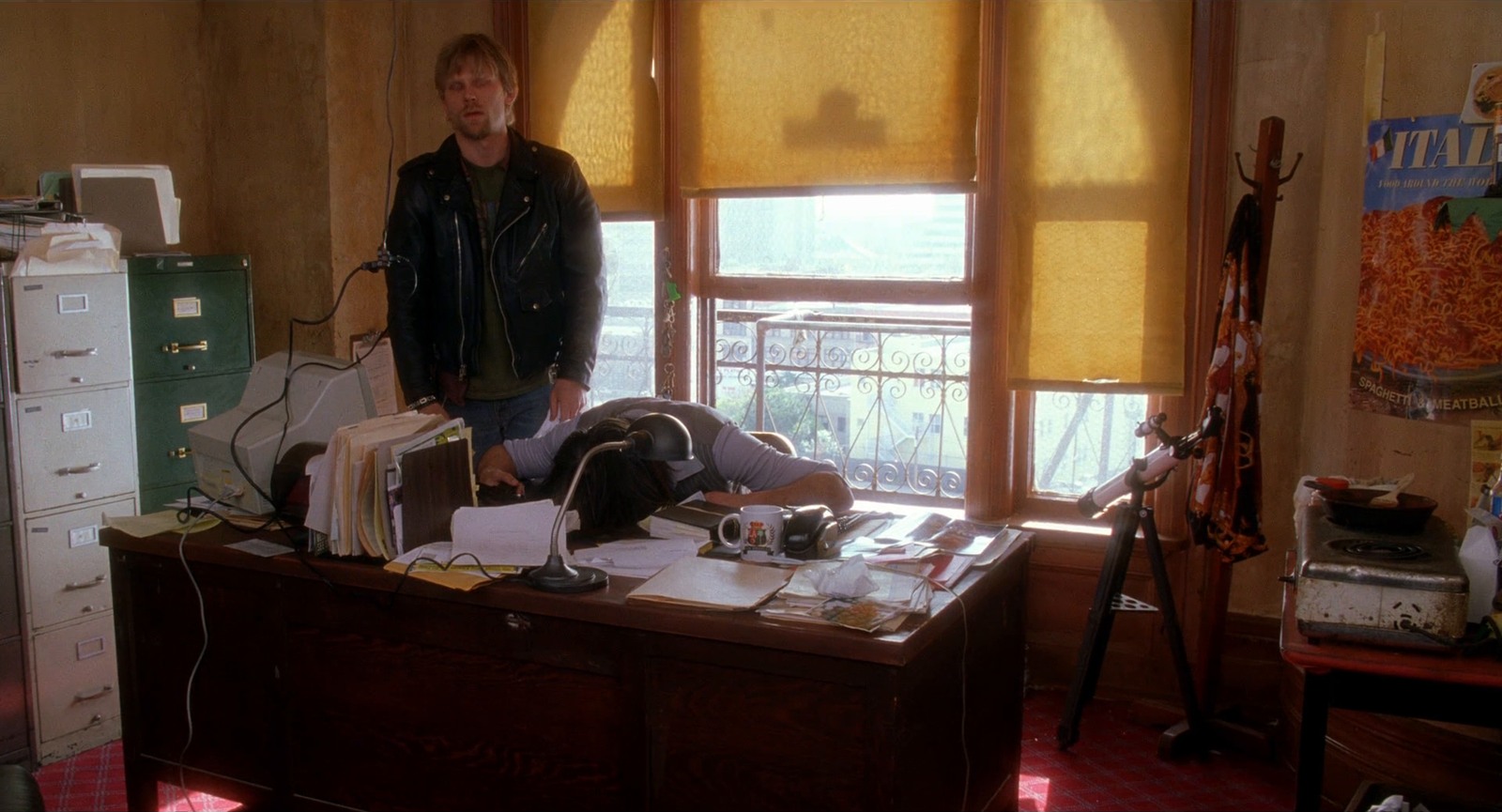
38:45The cramped office collects furniture, paperwork and bodies within a space that cannot contain the consequences of the killing. The sequence expands into further interruptions rather than ending with a single efficient action. Read with Neff’s recollections of the comic effects, it shows how violence can be organized around failed control instead of mastery.
An object supplies another question
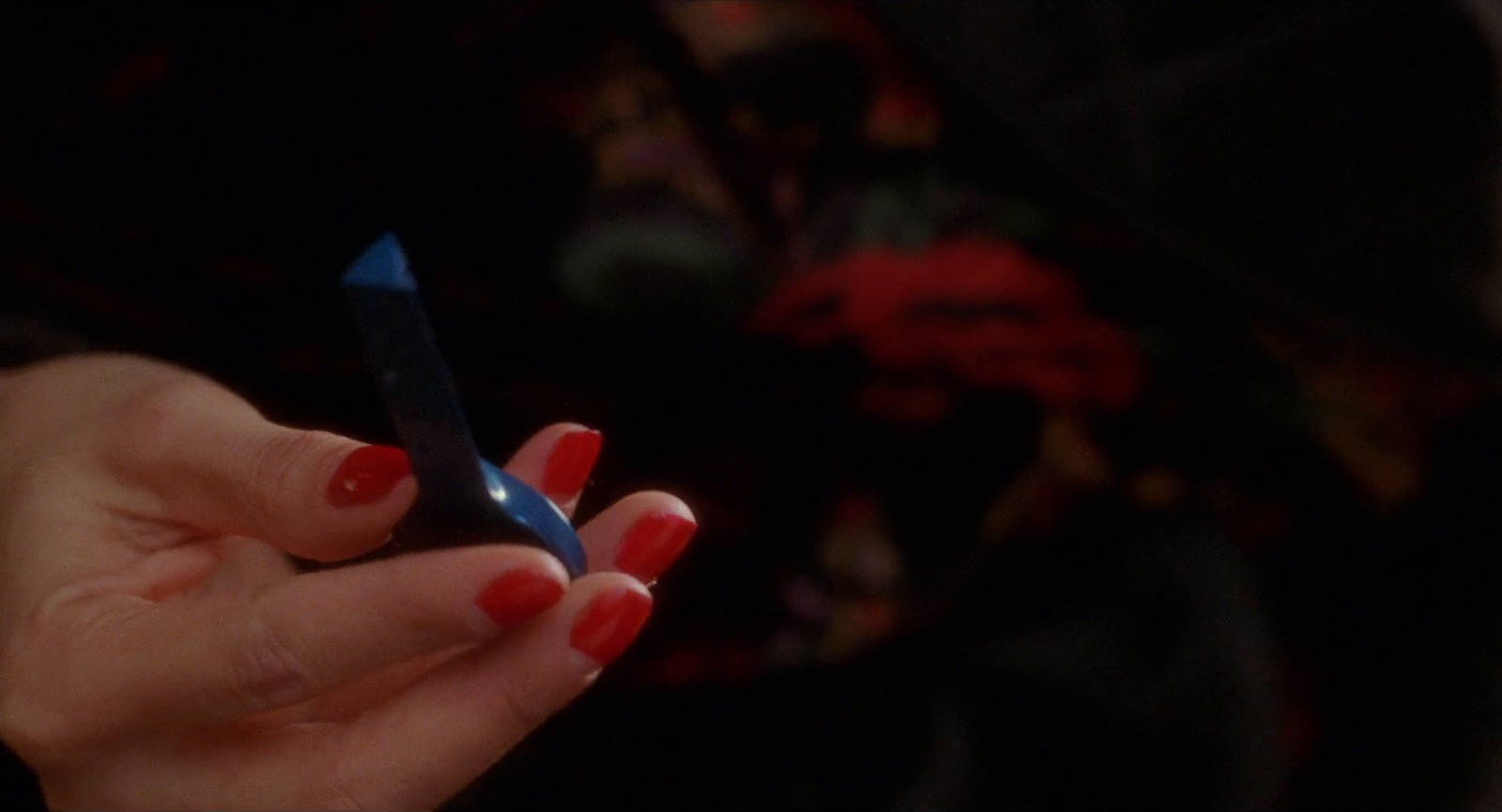
45:05Searching the purse does not produce a name that can resolve Rita’s uncertainty. The key is visually emphatic but initially lacks a known lock. Its unusual shape matters when it is compared with the ordinary blue key later associated with Diane. Color returns; form and narrative function do not simply stay the same.
A name becomes a lead
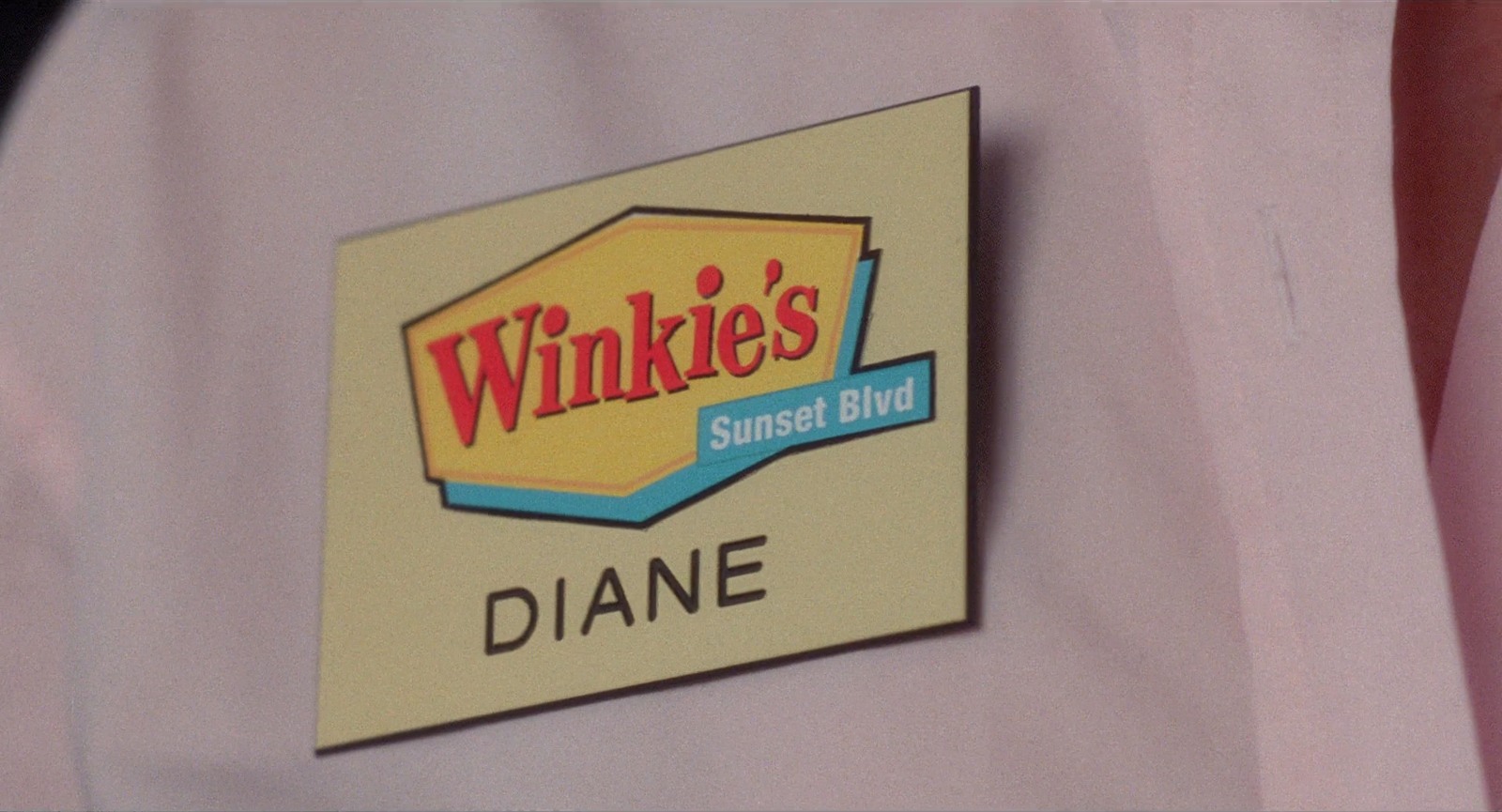
55:15The close view isolates a printed name from the person wearing it. A restaurant uniform becomes an investigative clue, just as a film poster earlier supplied Rita’s assumed identity. The women’s search is built from acts of reading the surrounding world, but a recognizable word is not yet a complete explanation.
Two people listen through one instrument
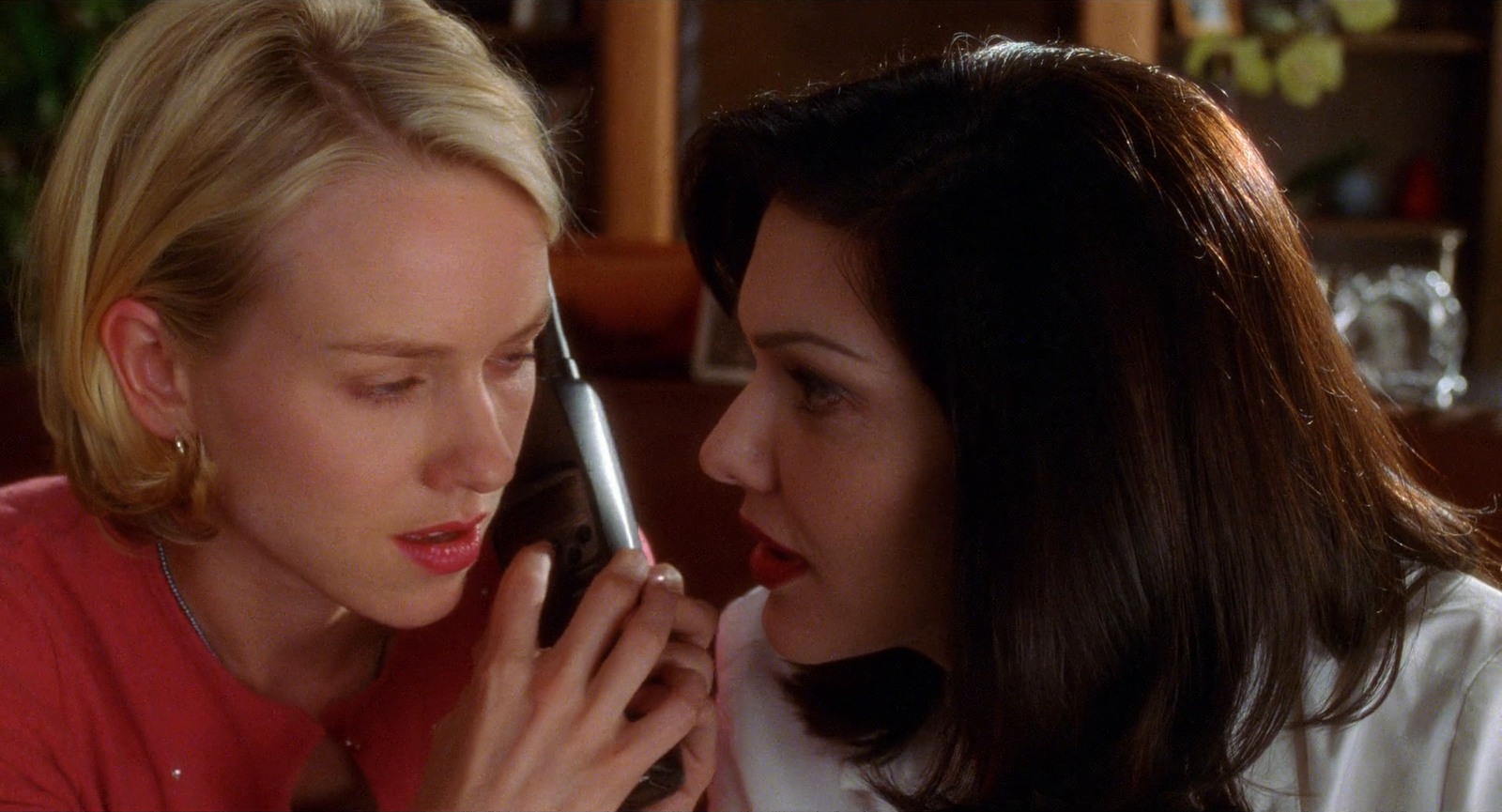
56:45The women share the receiver and the task of interpretation. Their physical closeness makes the investigation collaborative, even though Betty usually supplies its forward momentum. The telephone brings a distant voice into an intimate space; contact with a name in a directory still leaves the person behind it uncertain.
A casting decision is restaged as a lesson
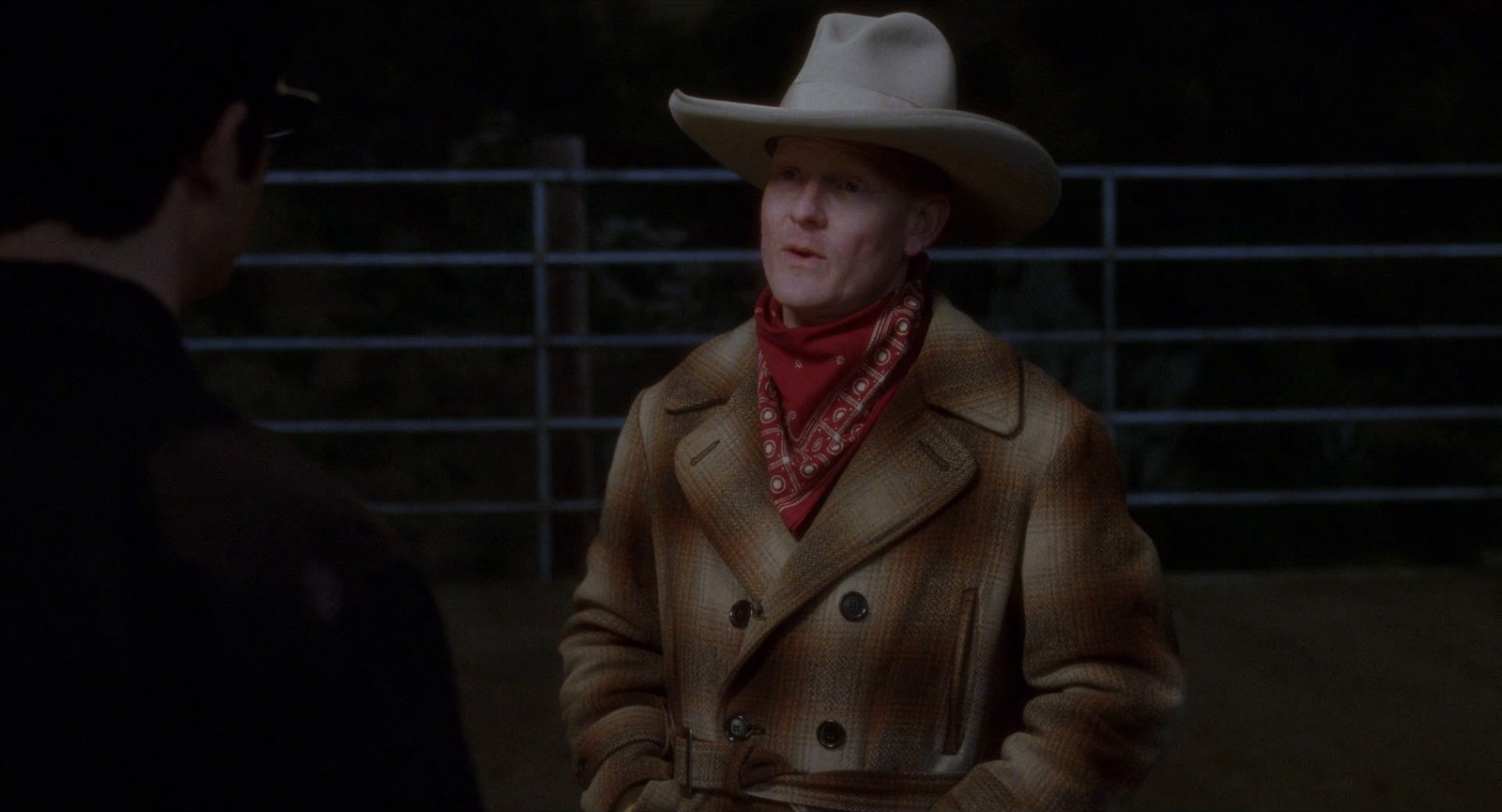
1:07:15The isolated encounter removes Adam from the studio’s familiar professional setting. Costume, darkness and the controlled exchange turn an industrial demand into something resembling a private instruction. The scene’s strangeness does not erase its practical subject: another person is telling a director whom to choose.
A scene can be tried on and put aside
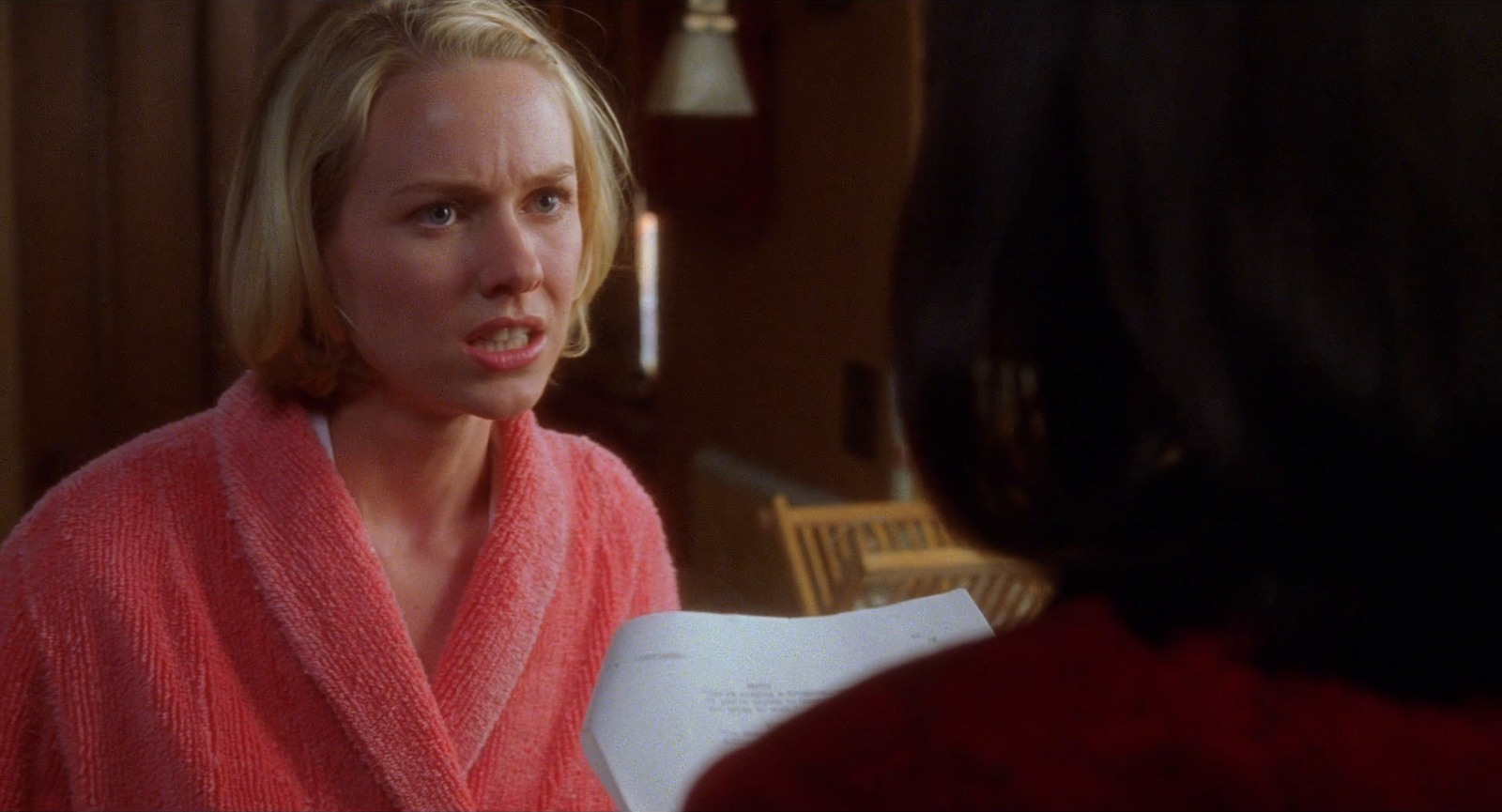
1:10:45The visible script and domestic setting keep the exercise recognizable as preparation. Betty and Rita can move between the fictional confrontation and their own companionship. The later audition repeats the material under different conditions. Comparing the two encounters shows how framing and proximity can transform a scene before any theory of identity is applied.
Scene studies / 03
Performing and looking
Rehearsal becomes an audition; a studio performance gives way to a search through another set of rooms.
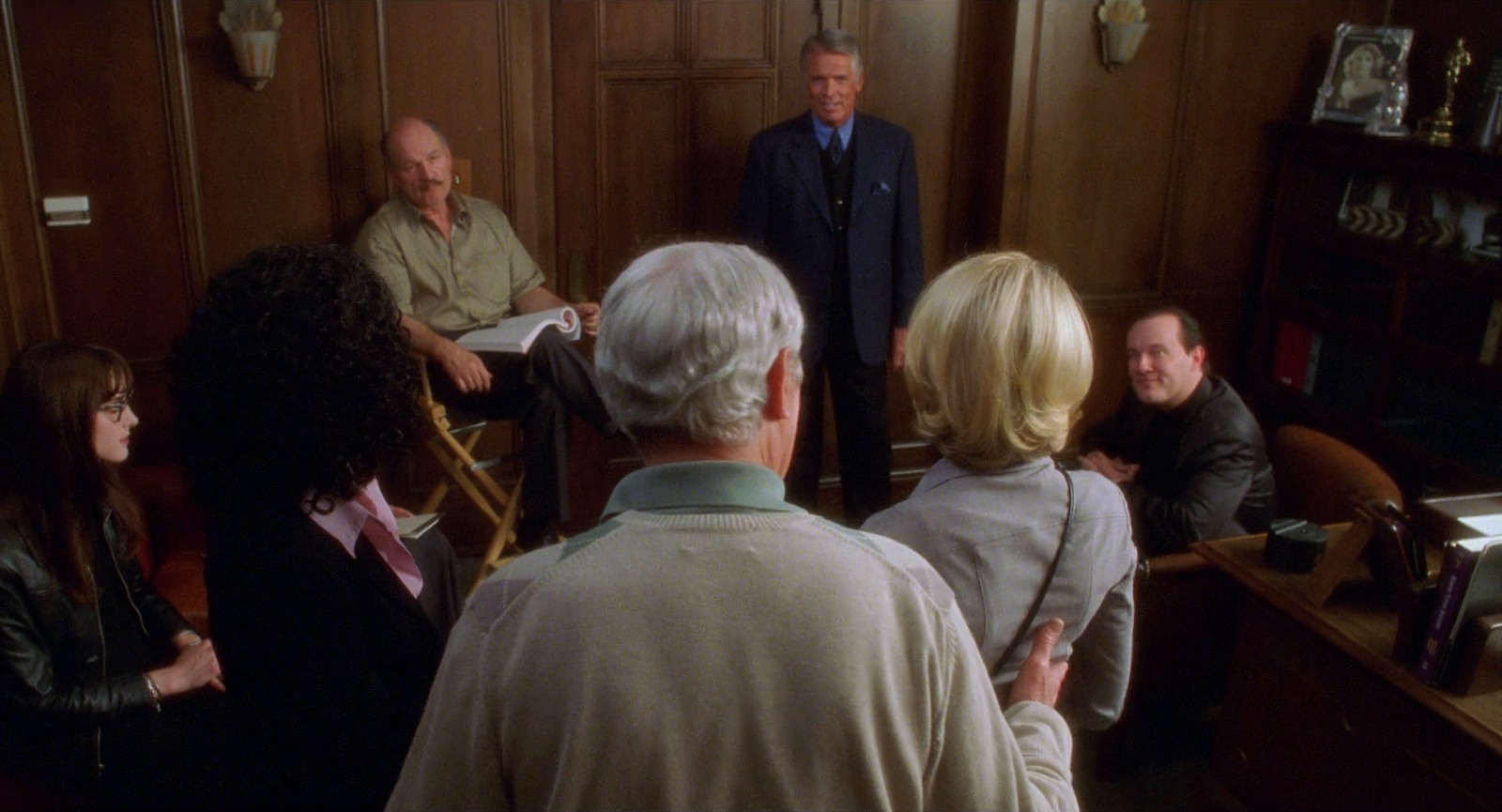
An ordinary office becomes a stage
1:15:15Chairs, wood paneling and the observers’ sightlines establish a modest workplace. Betty’s performance will unfold inside this arrangement rather than on a separate theatrical stage. The room’s scale matters: she is asked to create an encounter while remaining close to the people who can judge and employ her.
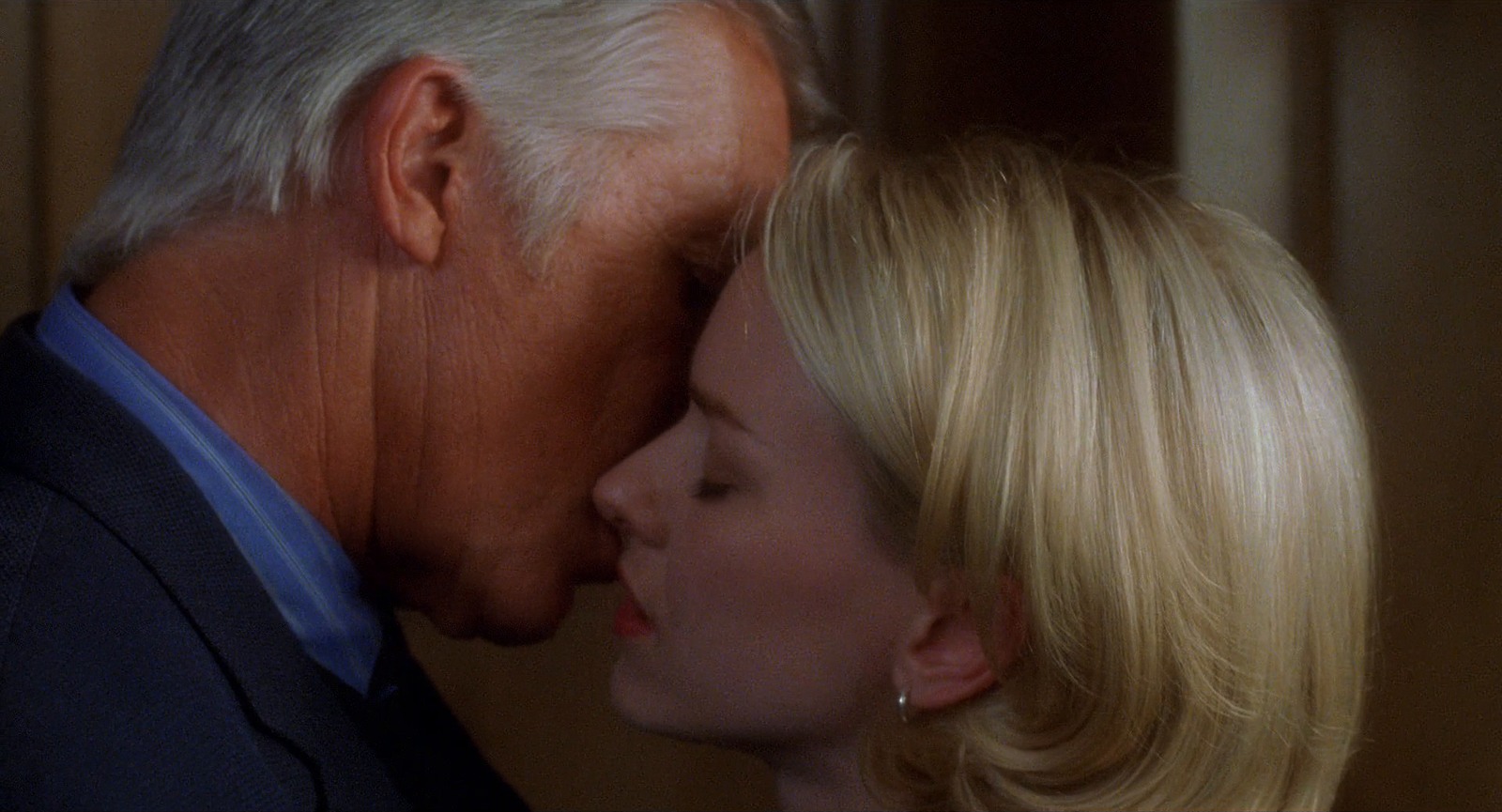
The distance between performers changes everything
1:18:45The rehearsal’s visible pages and casual distance give way to an encounter framed around faces, breath and proximity. Sweeney recalls wanting to preserve this close two-shot as long as continuity allowed. The comparison makes the collaboration visible: Watts’s performance is presented through a partner, a framing choice and an editor’s decision to remain with them.
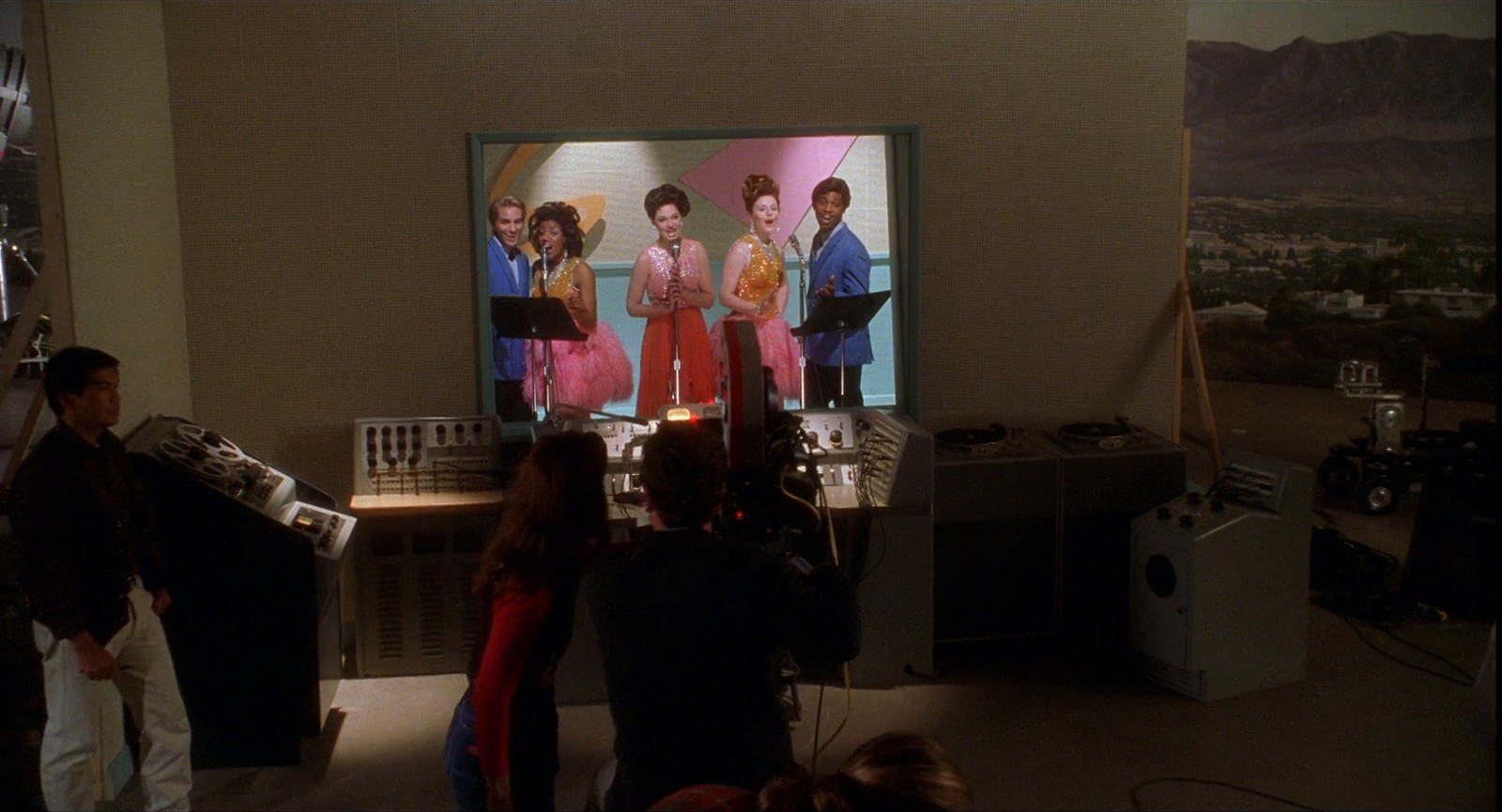
A finished image reveals its workplace
1:23:45The broader view exposes the equipment and working space around the bright performance. The picture can become a polished period image without ceasing to be something produced by a crew. Betty enters a world where appearances are deliberately manufactured, and where access to the set is different from being chosen for its central role.
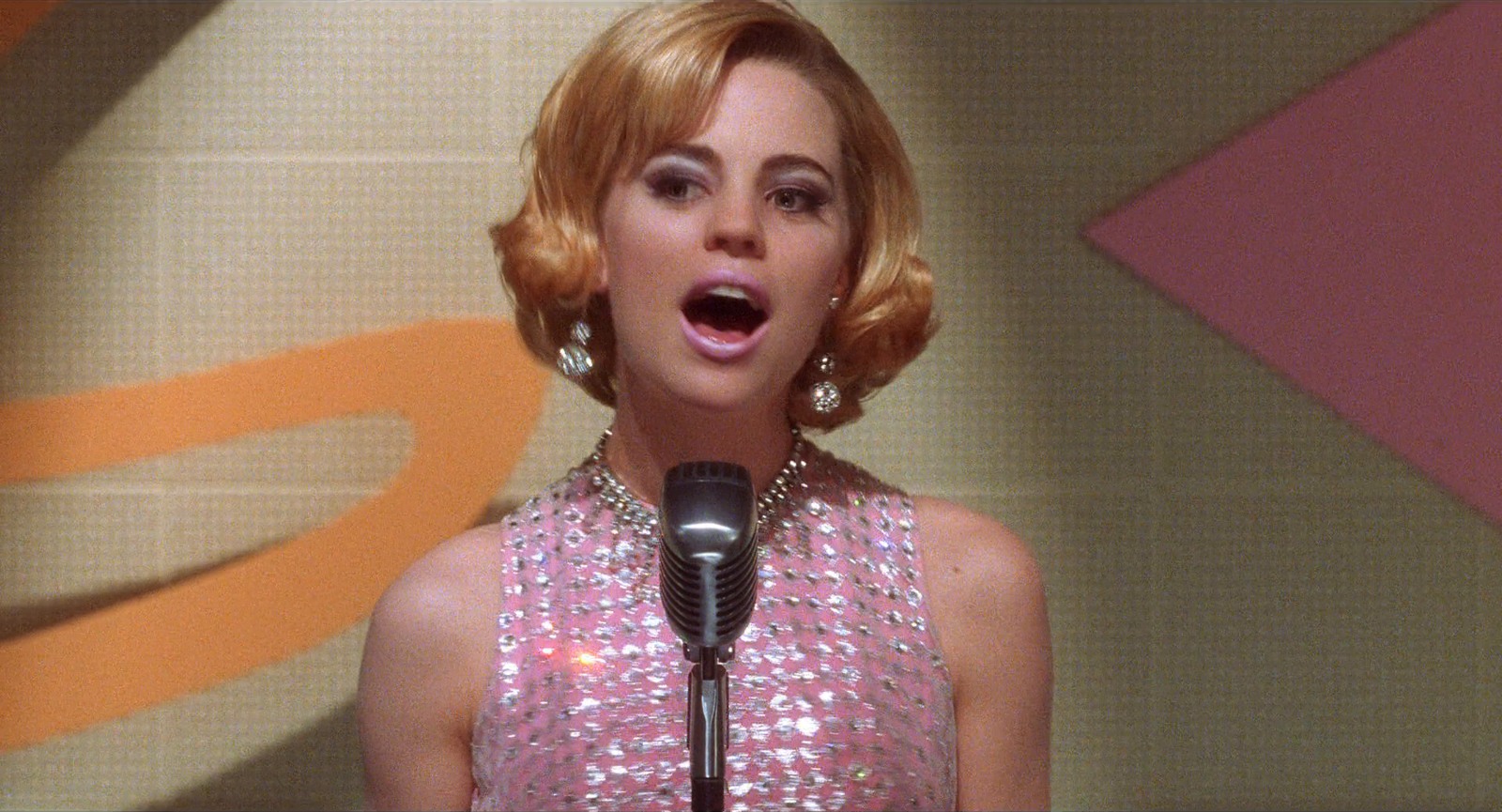
A candidate is already marked for selection
1:26:15The staged singer is evaluated within a decision that the earlier meeting has tried to settle in advance. Performance and selection no longer look like equivalent measures of merit. The returning photograph and repeated casting demand make the scene a study of institutional power as well as an alluring spectacle.
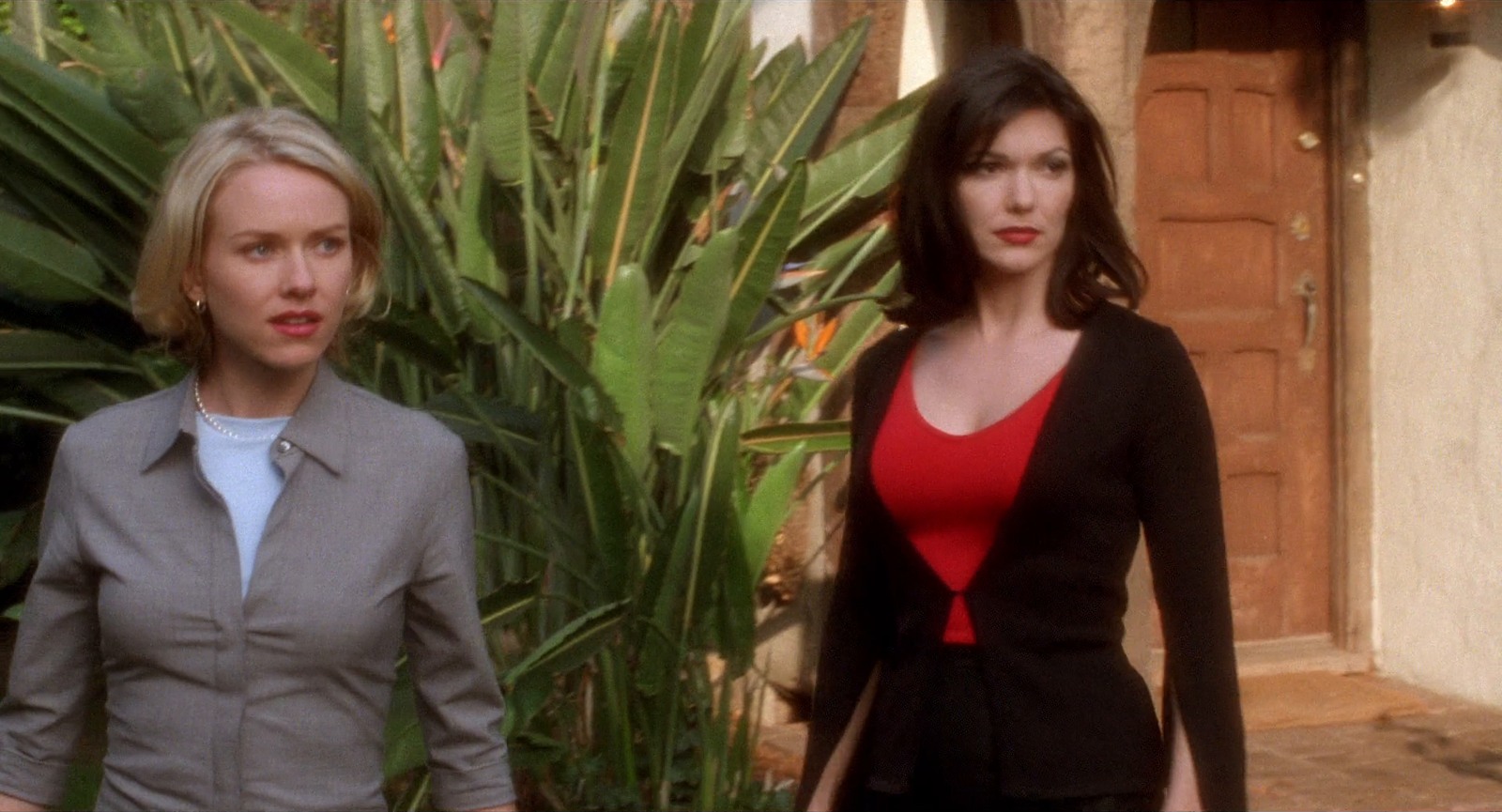
An address does not guarantee recognition
1:31:15The women stand together among plants and doorways, reading a place for signs that might connect an address to a person. The apartment search repeats Betty’s earlier arrival in a less reassuring register. Familiar domestic architecture now offers uncertain occupants, exchanged rooms and incomplete testimony.
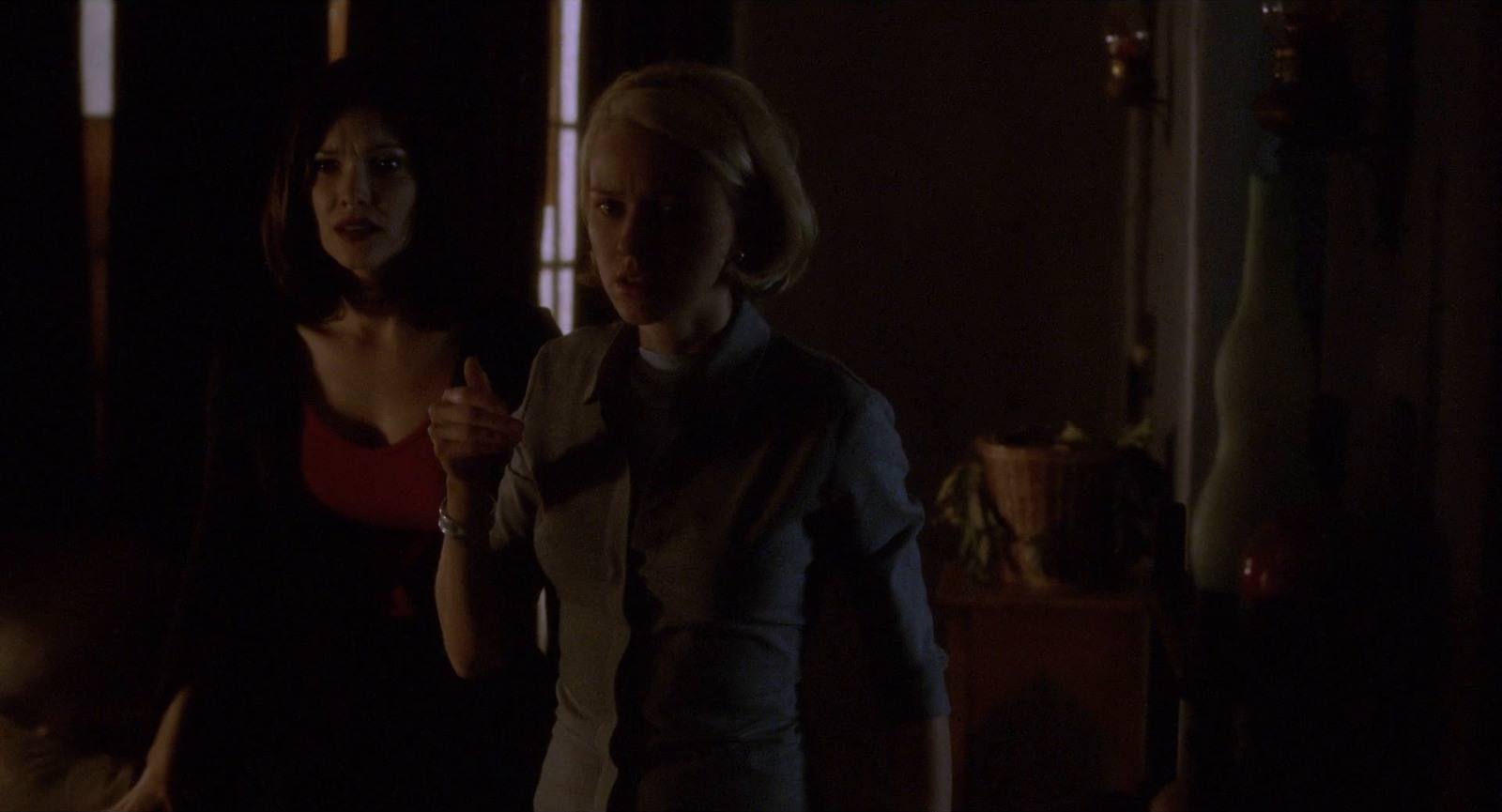
The investigation enters a room it cannot master
1:35:45After the courtyard’s daylight, the interior restricts what can be seen and how safely the women can move. Their shared investigation reaches a discovery that cannot be handled like a name in a directory. The guide keeps the emphasis on the encounter and its aftermath rather than presenting the body as a spectacle.
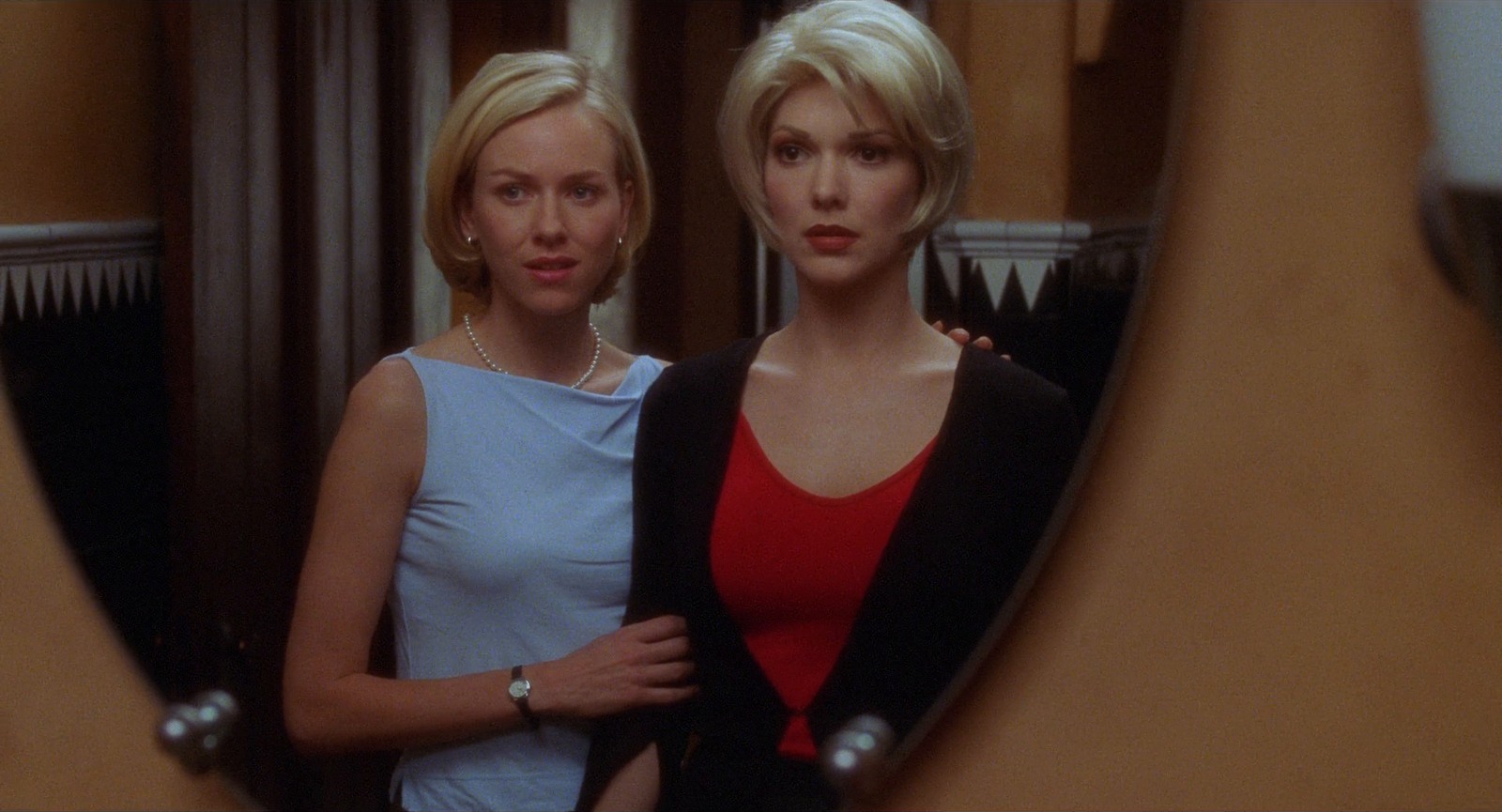
Resemblance is made in front of a mirror
1:38:15The wig makes a visible change without supplying a secure history. Betty stands beside the person she has helped alter, and the mirror presents their resemblance as a joint image. A practical disguise becomes a way to see how intimacy, care and the wish to remake another person can occupy the same gesture.
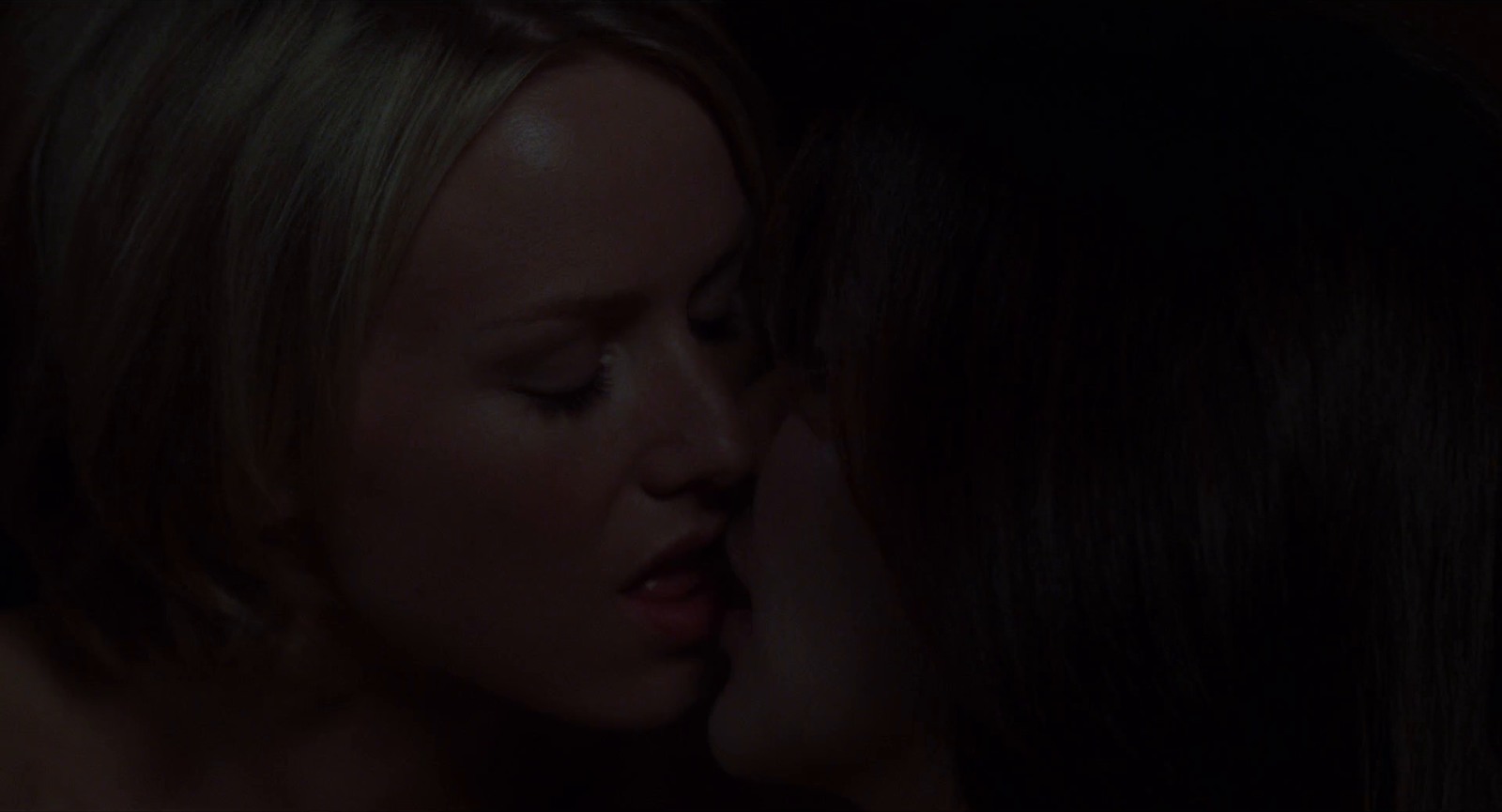
The relationship exceeds the investigation
1:41:45The close framing gives the women’s relationship a physical and emotional presence beyond their work as investigators. Whatever interpretation one brings to the film’s later structure, this intimacy is not merely a clue to be decoded. Desire and dependence create stakes that the discovery of a name cannot resolve.
Scene studies / 04
Silencio and the blue box
The women become spectators. A demonstration, a performance and a small object unsettle the world they have shared.
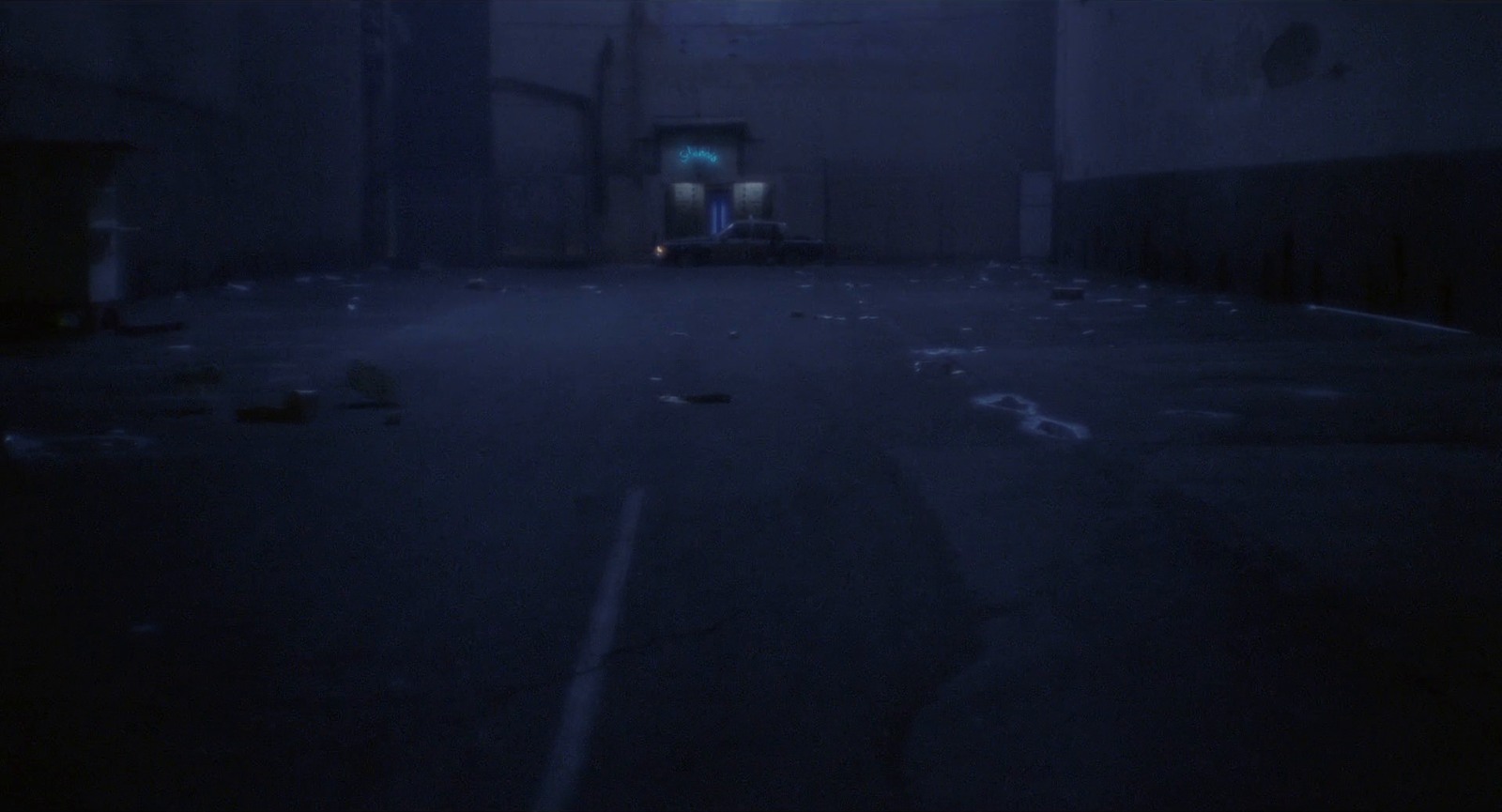
A destination replaces the search for an address
1:45:15The approach gives the club a sharply different atmosphere from the daylight courtyards and studio rooms. The women are arriving as spectators, about to encounter a performance they did not arrange. Blue light and the deep route into the building make entry itself part of the sequence’s transition.
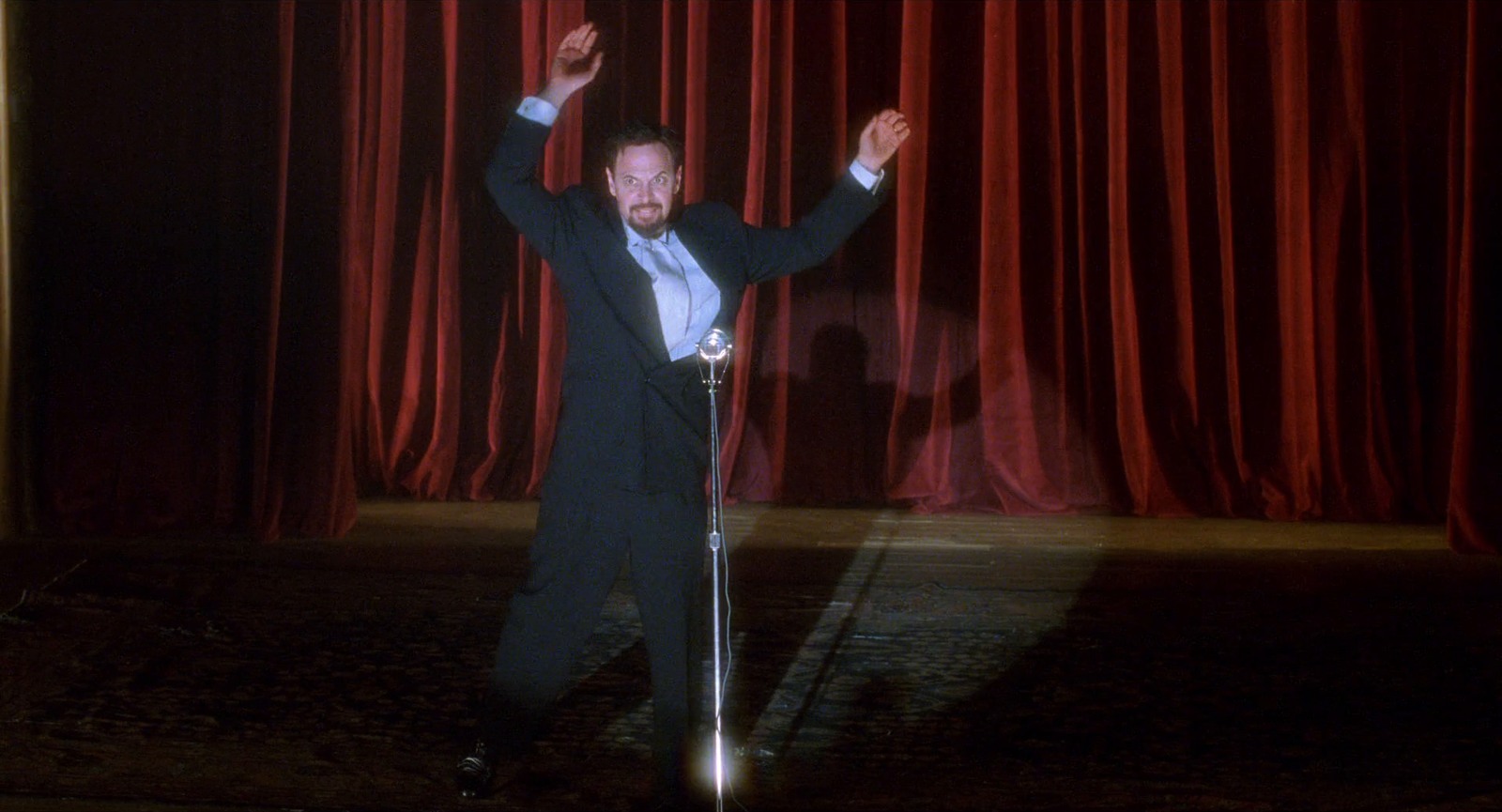
An explanation becomes another performance
1:46:45The declaration that the sound is recorded is delivered through theatrical gesture, curtains and controlled light. Explaining the mechanism does not remove the spectacle. The scene asks the spectator to hold two ideas together: the performance is constructed, and that knowledge does not prevent it from producing a powerful response.
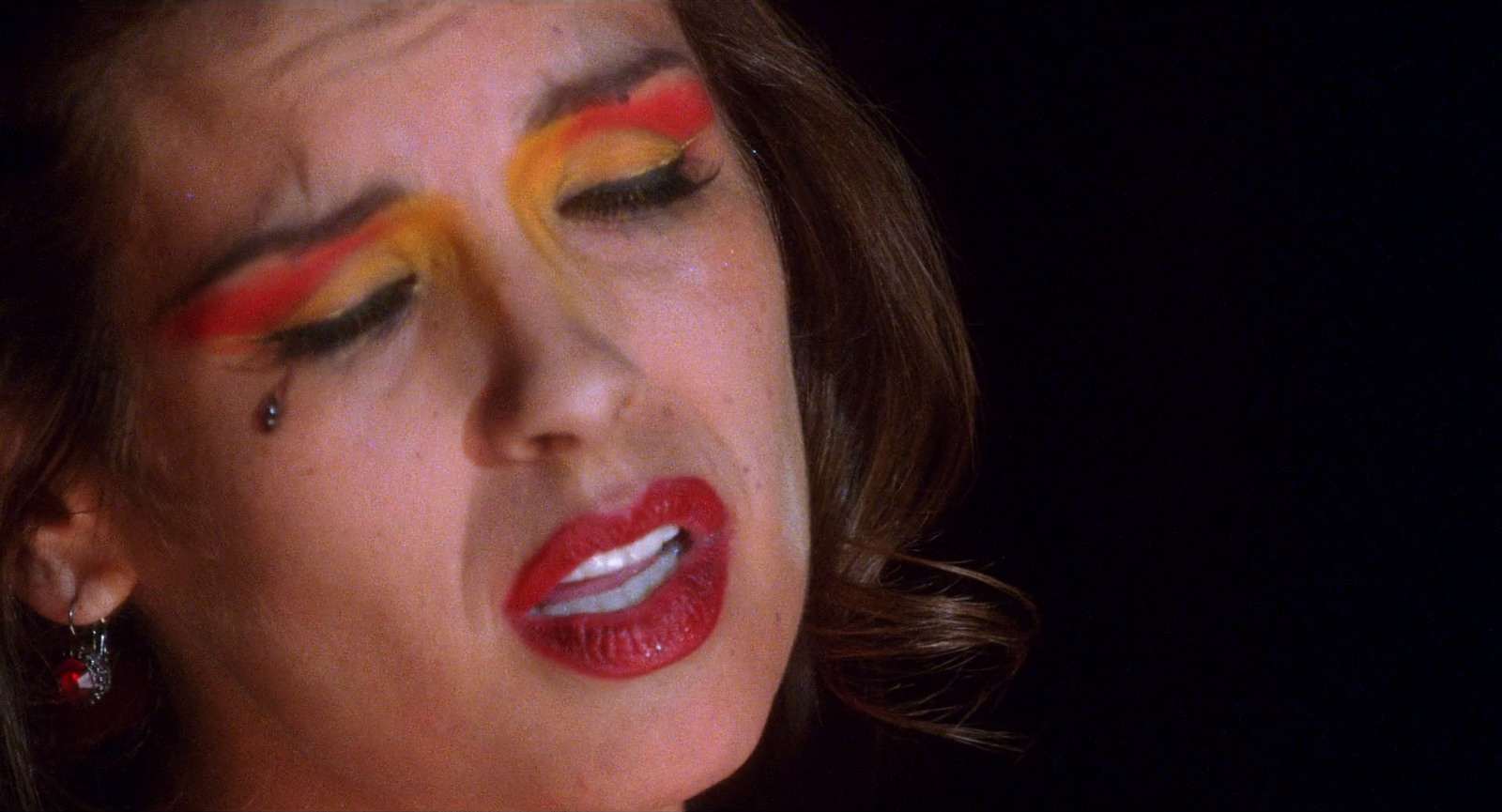
A face gives the recording a present tense
1:50:45The close image attends to a performing face rather than offering an abstract lesson about playback. Del Rio’s account, discussed in the sound section, distinguishes her full-voice performance during filming from the earlier recording used in the finished film. The visible body belongs to that history of work, not simply to an illusion the film exposes.
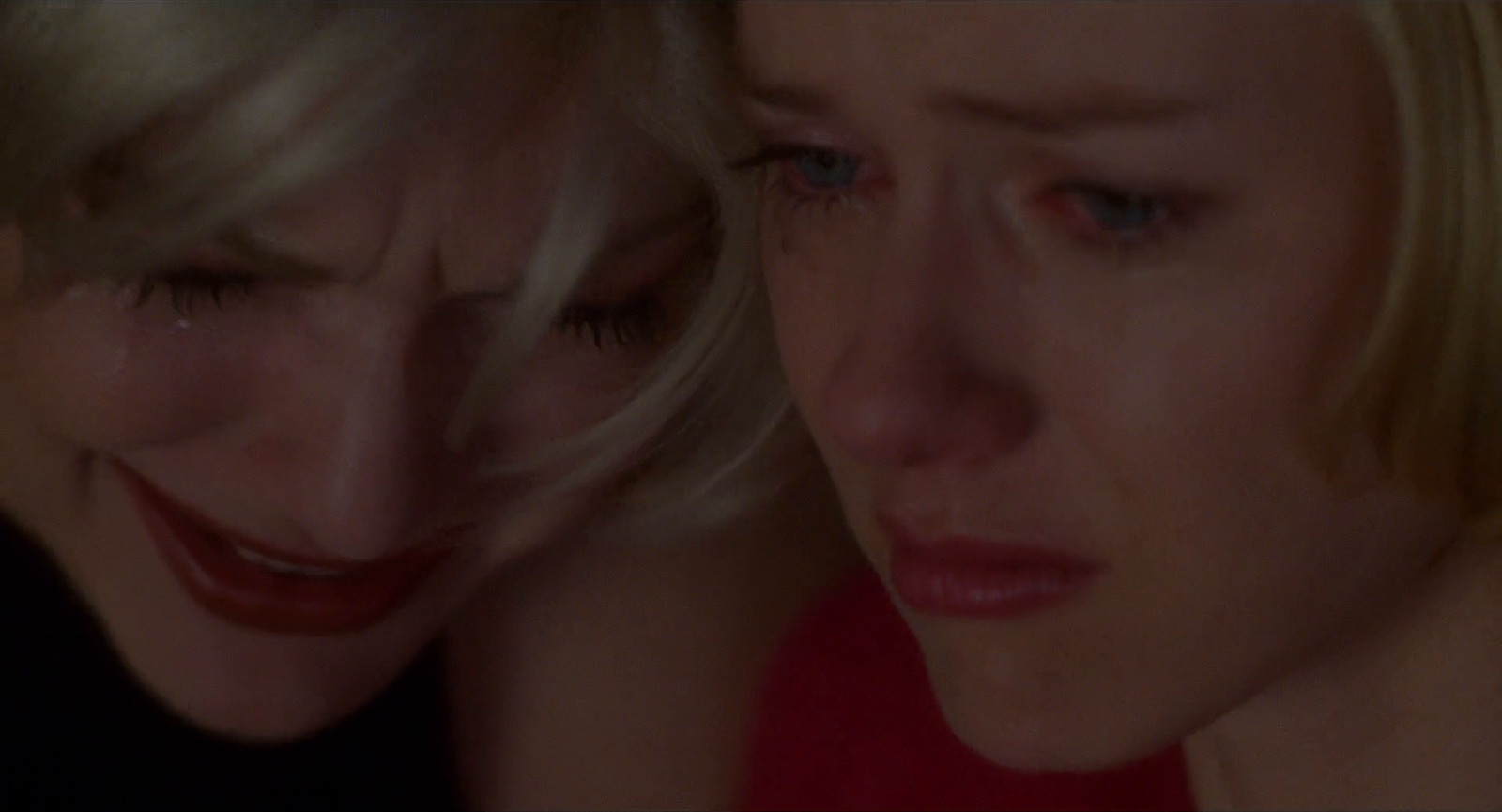
Understanding the trick does not end the feeling
1:51:45Their joined bodies and tearful faces become the sequence’s other performance. The spectator is asked to watch people who have already been told that what they hear is reproduced. The image makes emotional response persist beside technical knowledge; explanation and feeling do not cancel one another.
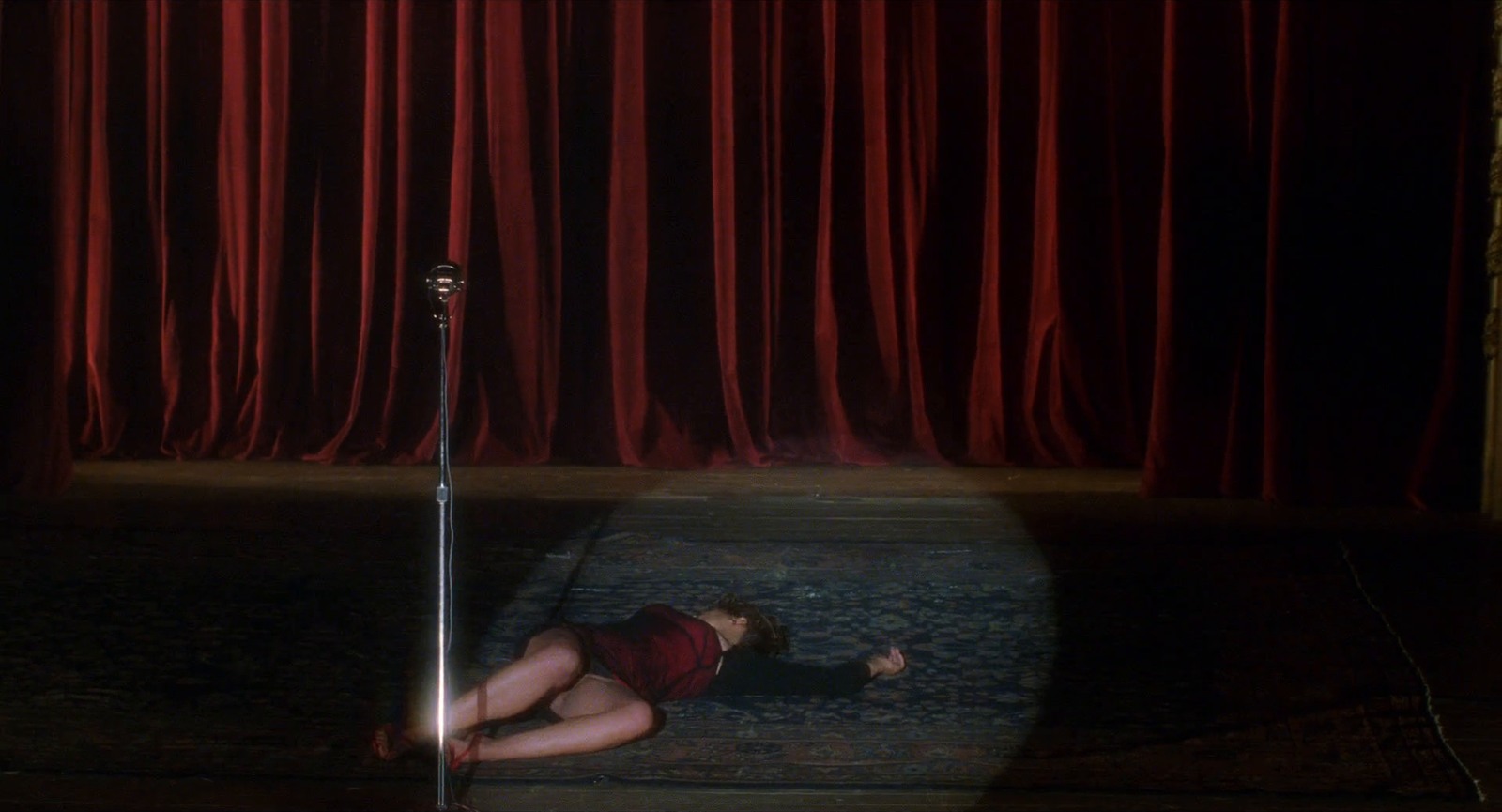
The microphone remains after the performer falls
1:52:15The upright microphone and fallen body make the separation between person and presentation visible. The subtitle track marks the continued recorded vocal, and the published sound testimony supplies its production context. The scene’s force comes from the relationship between those elements, rather than from treating the fall as an effects display.
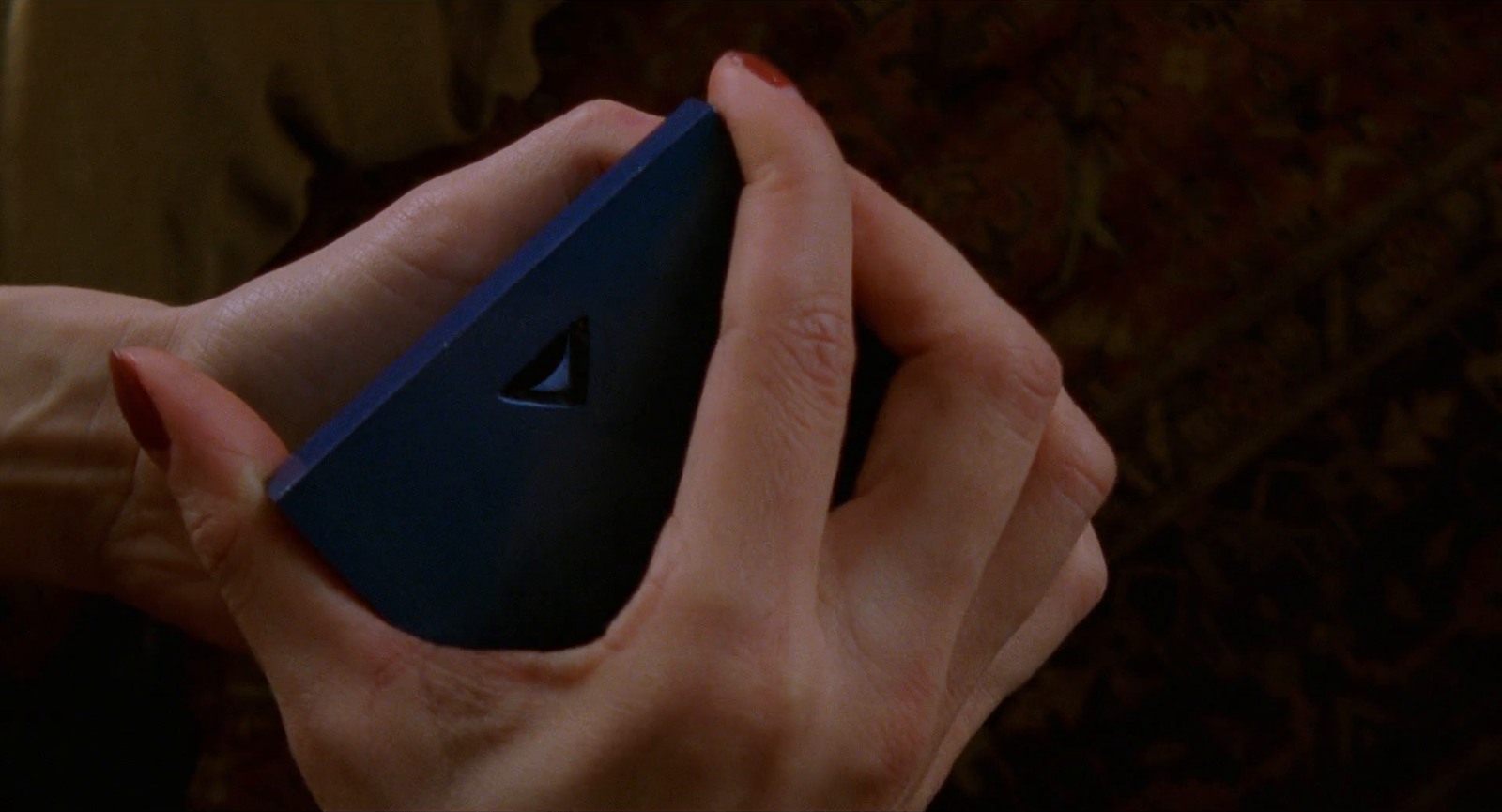
The key finally meets a visible opening
1:55:45The triangular opening gives the earlier key a possible destination. Yet the act of opening does not provide the ordinary satisfaction of recovering an identity or solving an investigation. The object becomes a threshold within the film’s organization, changing the relation between the room, its occupants and the images that follow.
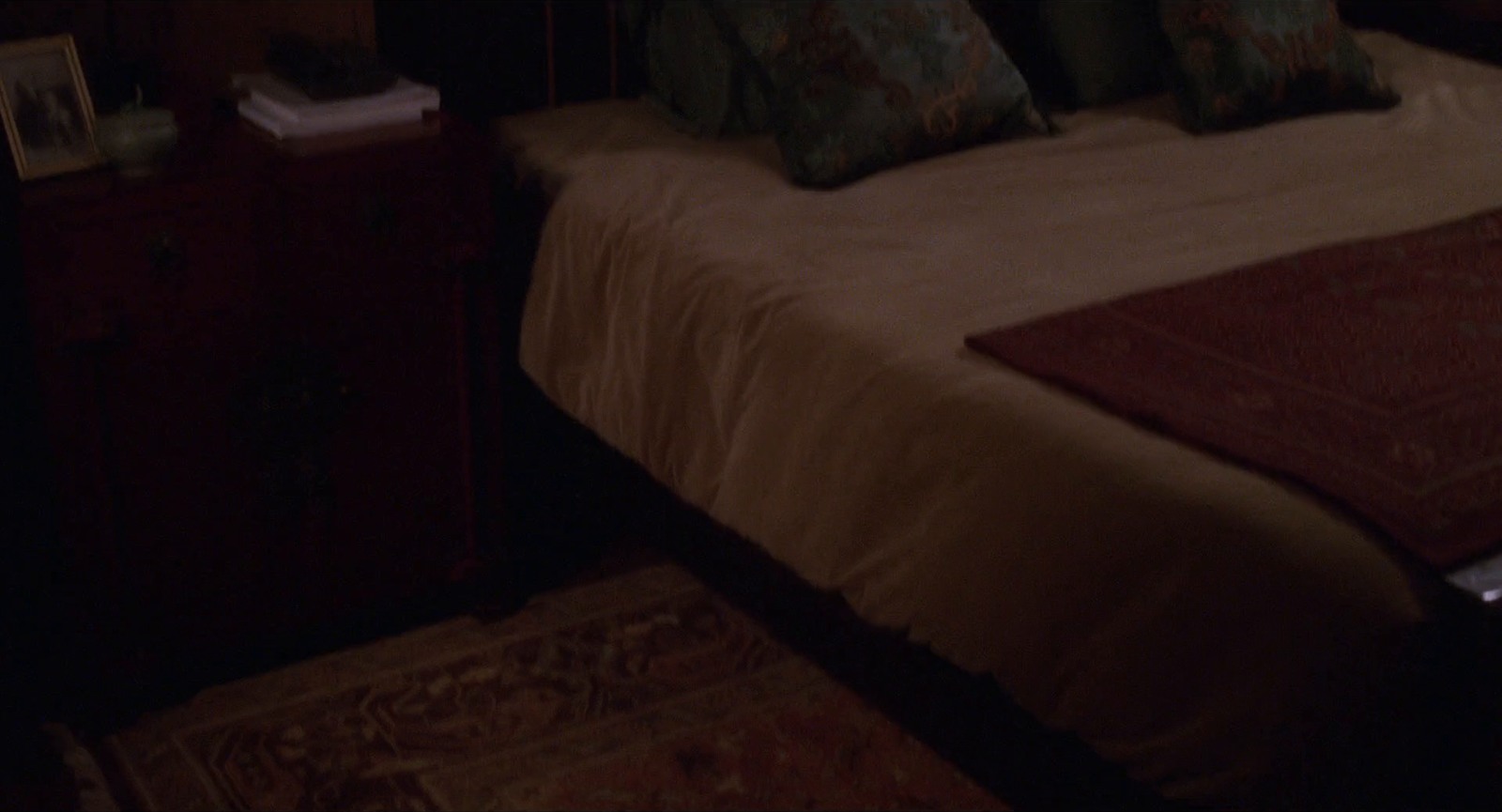
A familiar room remains without its companions
1:56:30The furnishings outlast the encounter that made them familiar. An emptied room is more unsettling here than a new location would be: the viewer recognizes the space while losing the people who organized its meaning. The subsequent return to a bed brings back an early visual motif without supplying an uncomplicated reset.
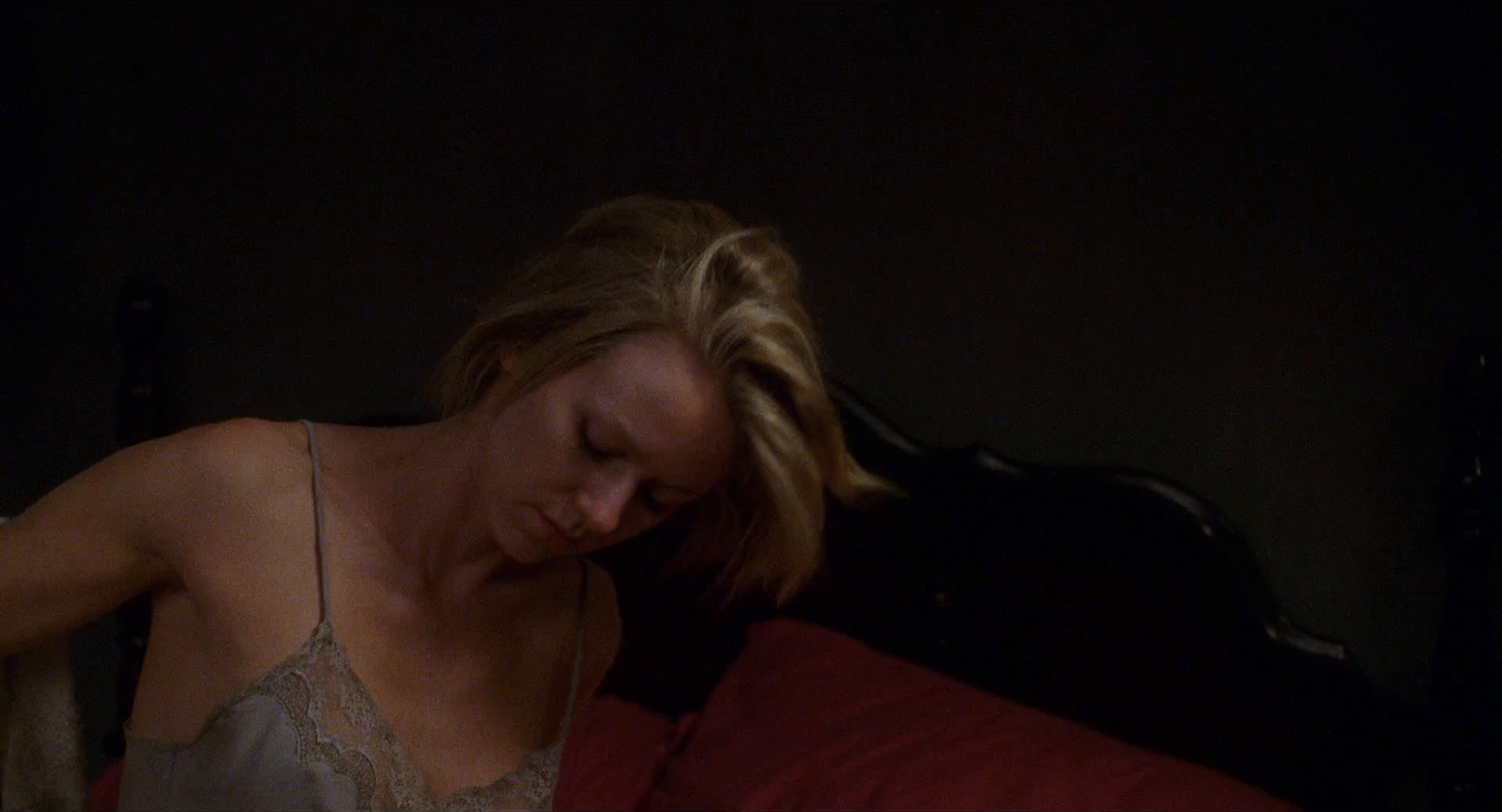
The body returns with another set of circumstances
1:58:15Bed, pillow and face resume the film’s attention to sleep and waking, now around a woman whose circumstances differ from Betty’s arrival. The sequence invites a change of reading without making every later image stable or chronological. A recognizable performer returns inside an altered arrangement of objects and relationships.
Scene studies / 05
Diane and the returning images
Familiar faces and objects return in changed relationships. The guide follows those changes without turning them into a single compulsory solution.
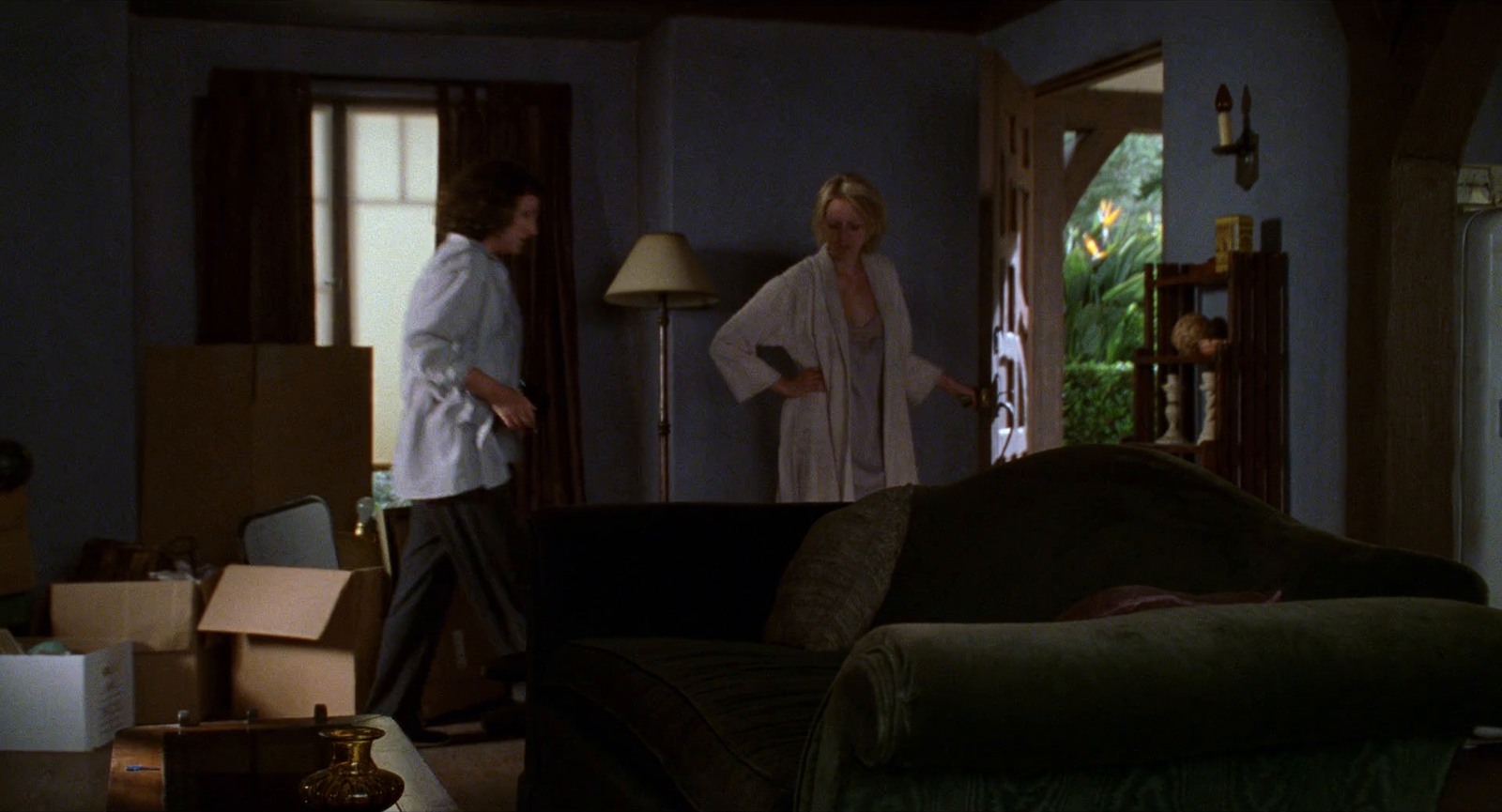
Another apartment carries another social history
1:59:45This room lacks the earlier apartment’s spacious welcome. Objects are being reclaimed, and a visitor brings a history of shared space that the viewer must infer from the encounter. The setting gives Diane a daily life of strained relations and unfinished business before any larger explanation of the film is settled.
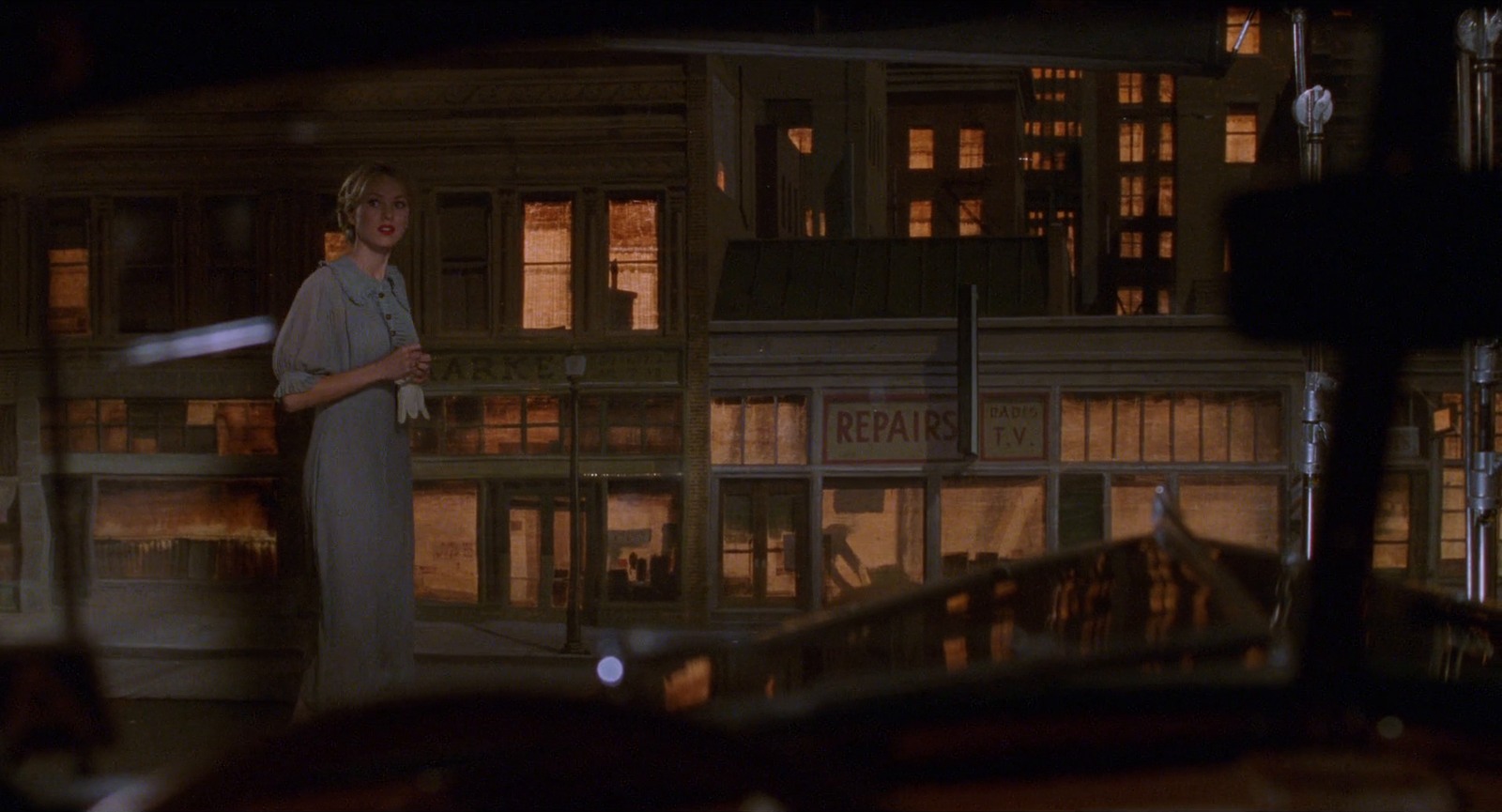
The aspiring performer watches from the edge
2:04:45The studio now places the familiar face in the position of an observer. A professional scene and a personal attachment become difficult to separate. Read beside Betty’s earlier entrance onto Adam’s set, the image changes the meaning of proximity to filmmaking: being present does not necessarily mean being included or desired.
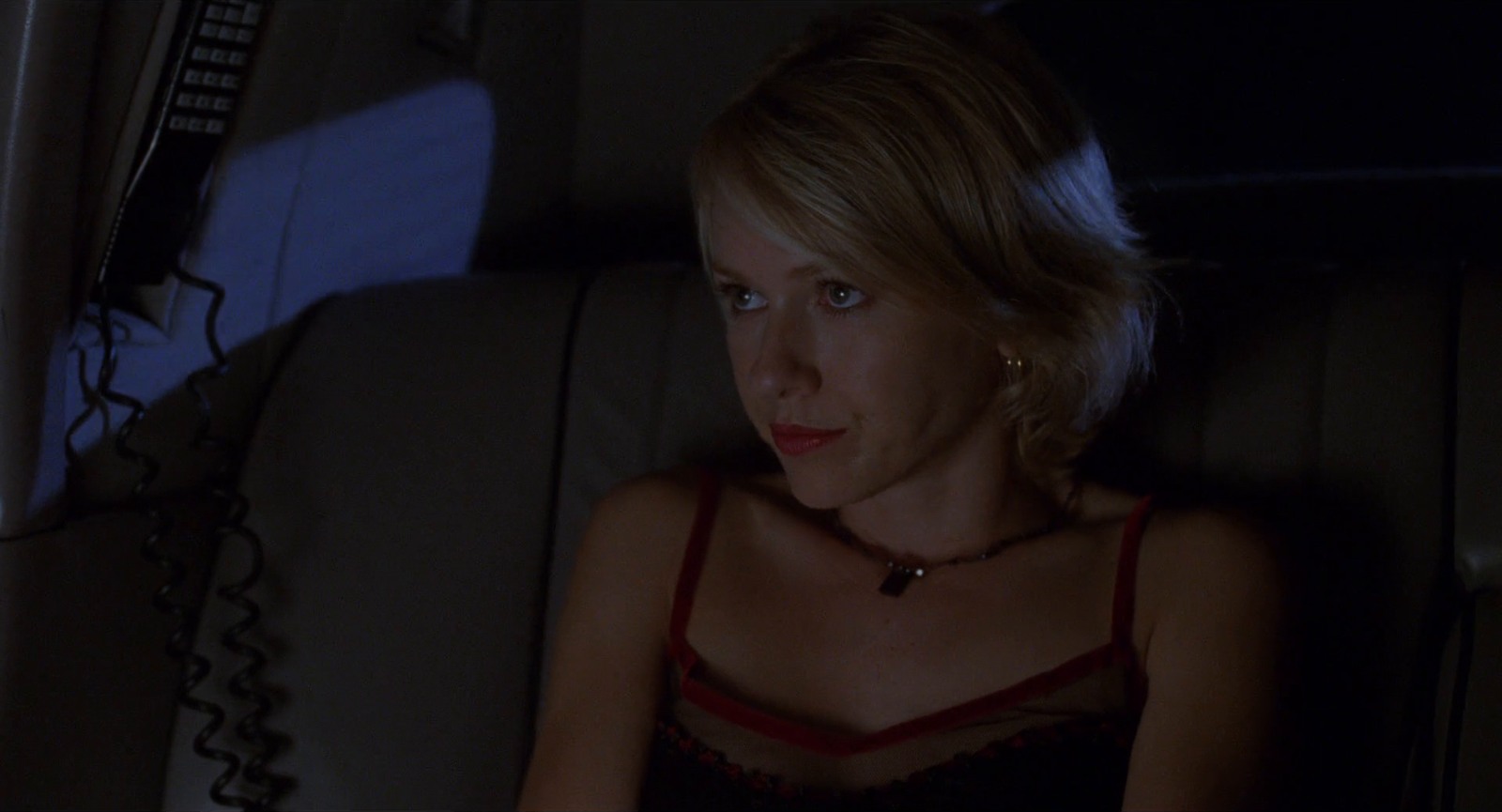
The passenger changes; the route returns
2:09:15The dark car and hillside journey recall Rita’s opening ride, but Diane carries a different expectation into the stop. Repeating the arrangement asks the viewer to remember an earlier threat while following a new invitation. The comparison is exact enough to study without assuming that every detail of the two journeys is interchangeable.
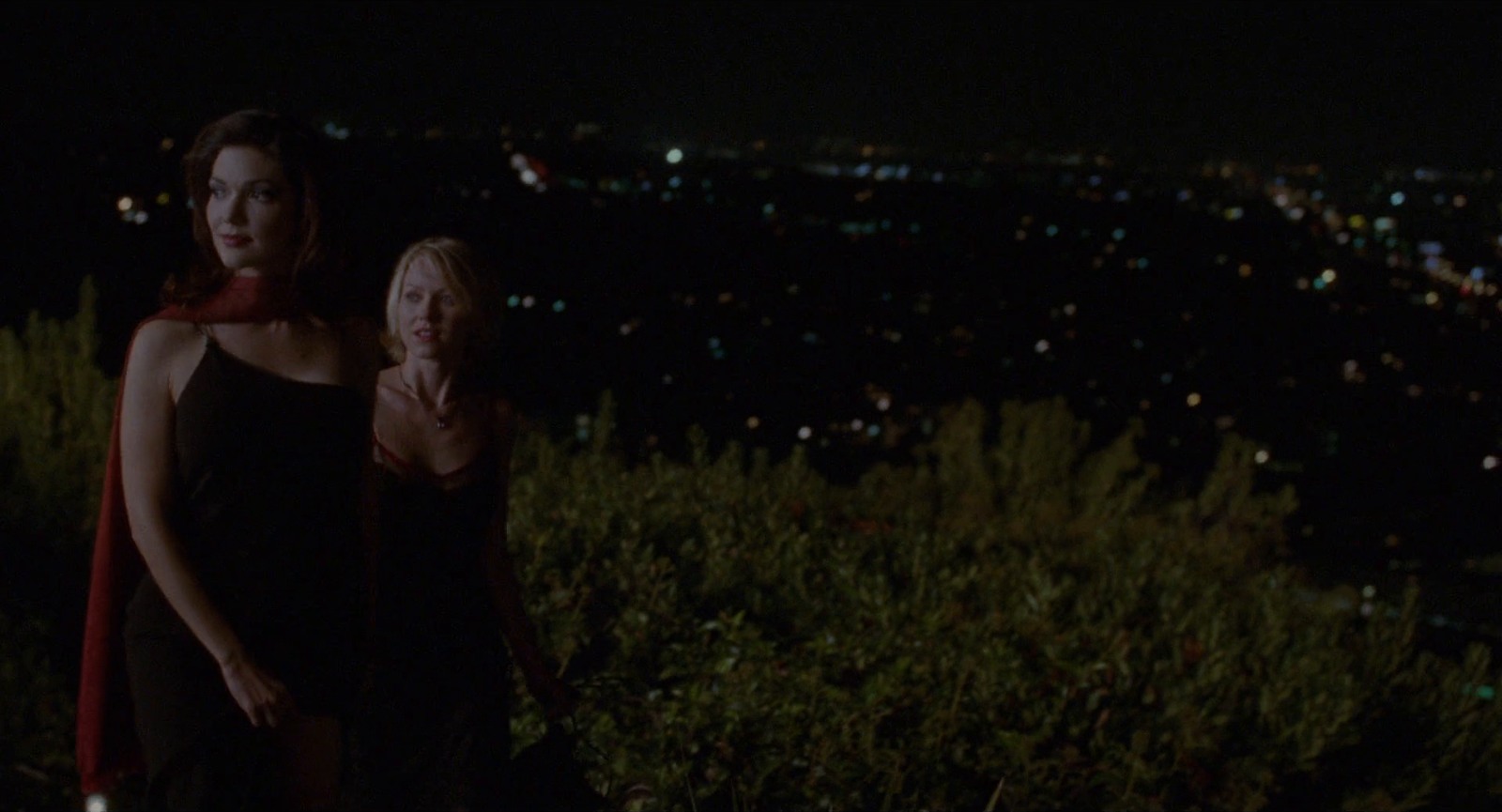
An invitation has its own imbalance
2:11:15Camilla controls the route and extends the welcome. The city glitters behind the women, yet the intimacy of the gesture does not guarantee equal standing at the gathering ahead. The path turns access into an emotional event: being led closer can make exclusion more painful rather than less possible.
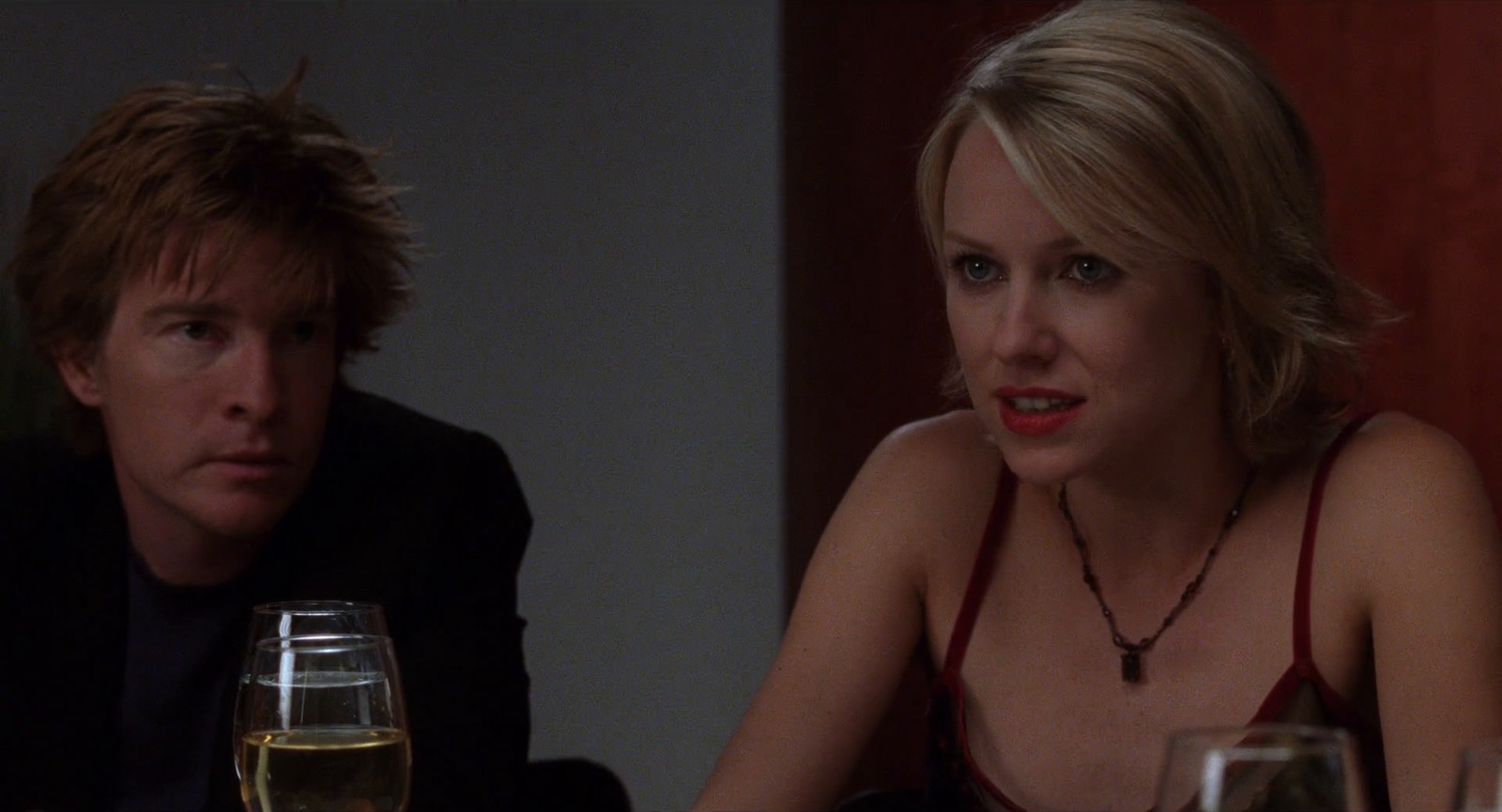
A life story becomes a public performance
2:13:15Diane is asked to account for herself among people whose attention she cannot control. Familiar faces occupy changed positions around the table. The scene makes recognition social as well as visual: viewers remember earlier encounters while Diane tries to find a place within this one.
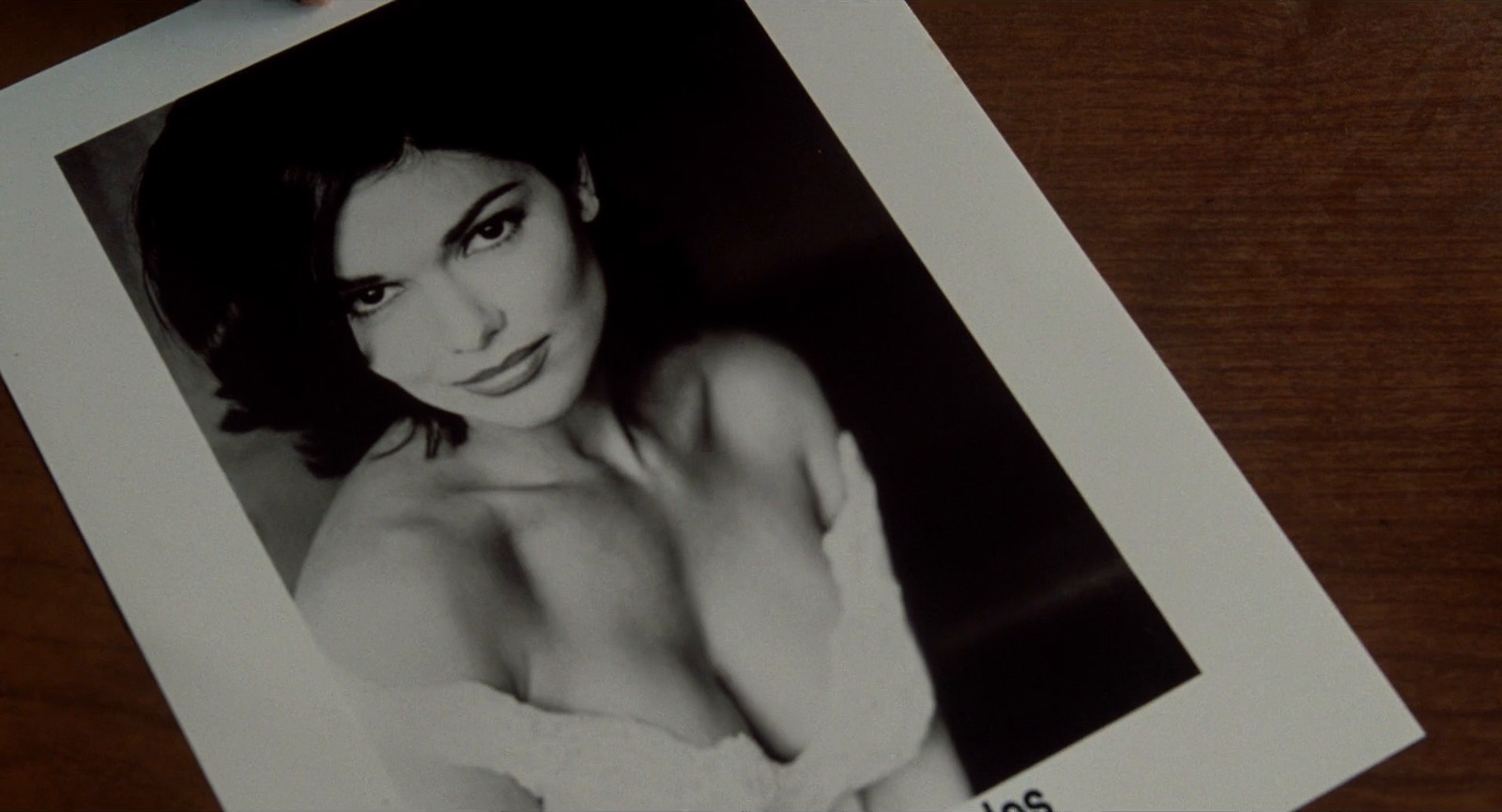
A photograph becomes an instruction
2:17:10The actor’s photograph changes function from a professional representation to the object of a violent commission. A familiar phrase of selection returns in a different transaction. The earlier casting scenes and this exchange are connected by the image of choosing a woman, while their immediate actions remain morally and materially distinct.
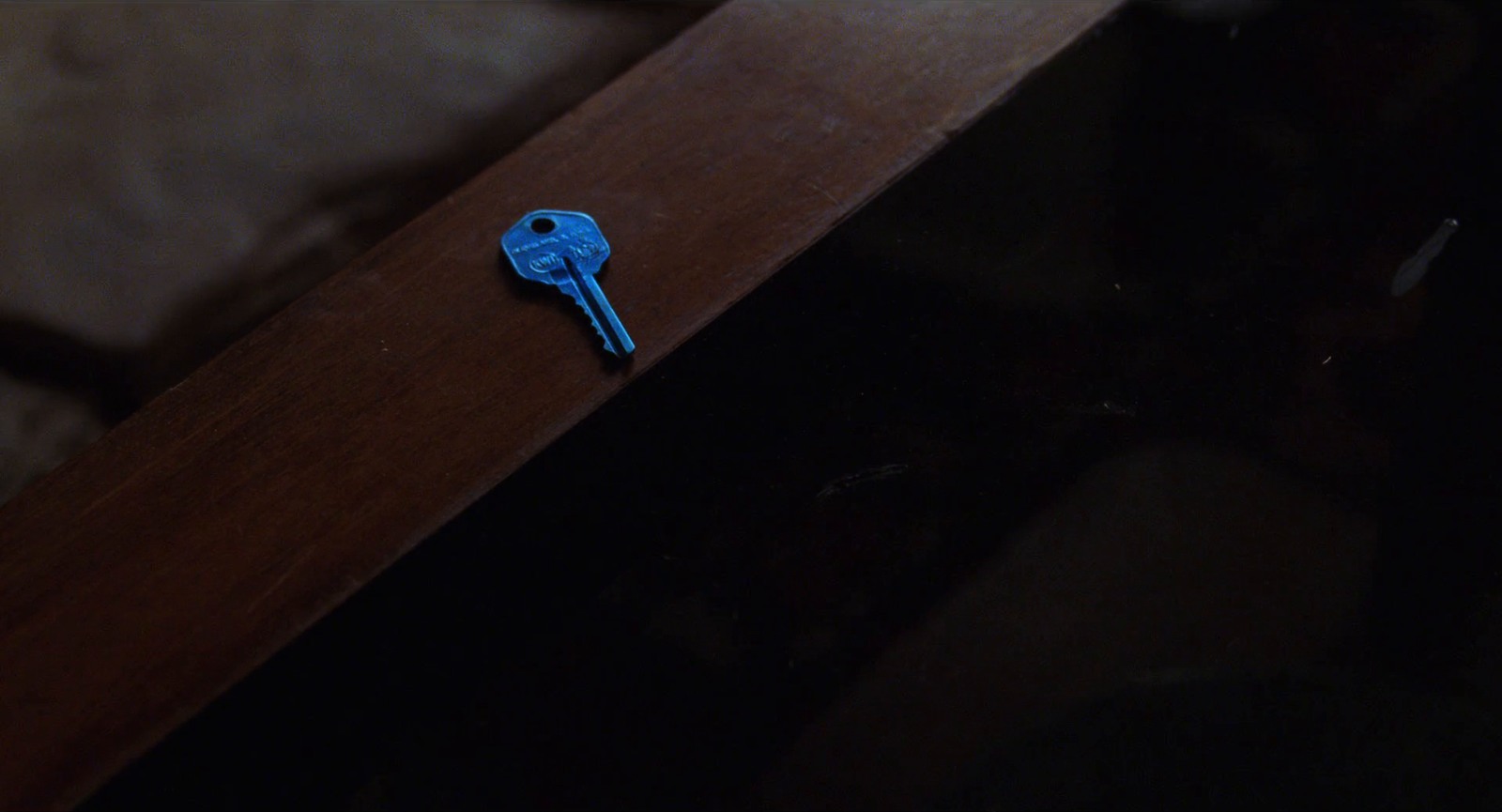
The returning color belongs to a different object
2:19:40Unlike the angular key associated with Rita and the box, this key has a familiar cut metal shape. The preceding exchange gives it a role as a sign that an action has been completed. Comparing the two objects prevents their shared color from erasing the difference between a mysterious opening and a confirmation Diane fears.
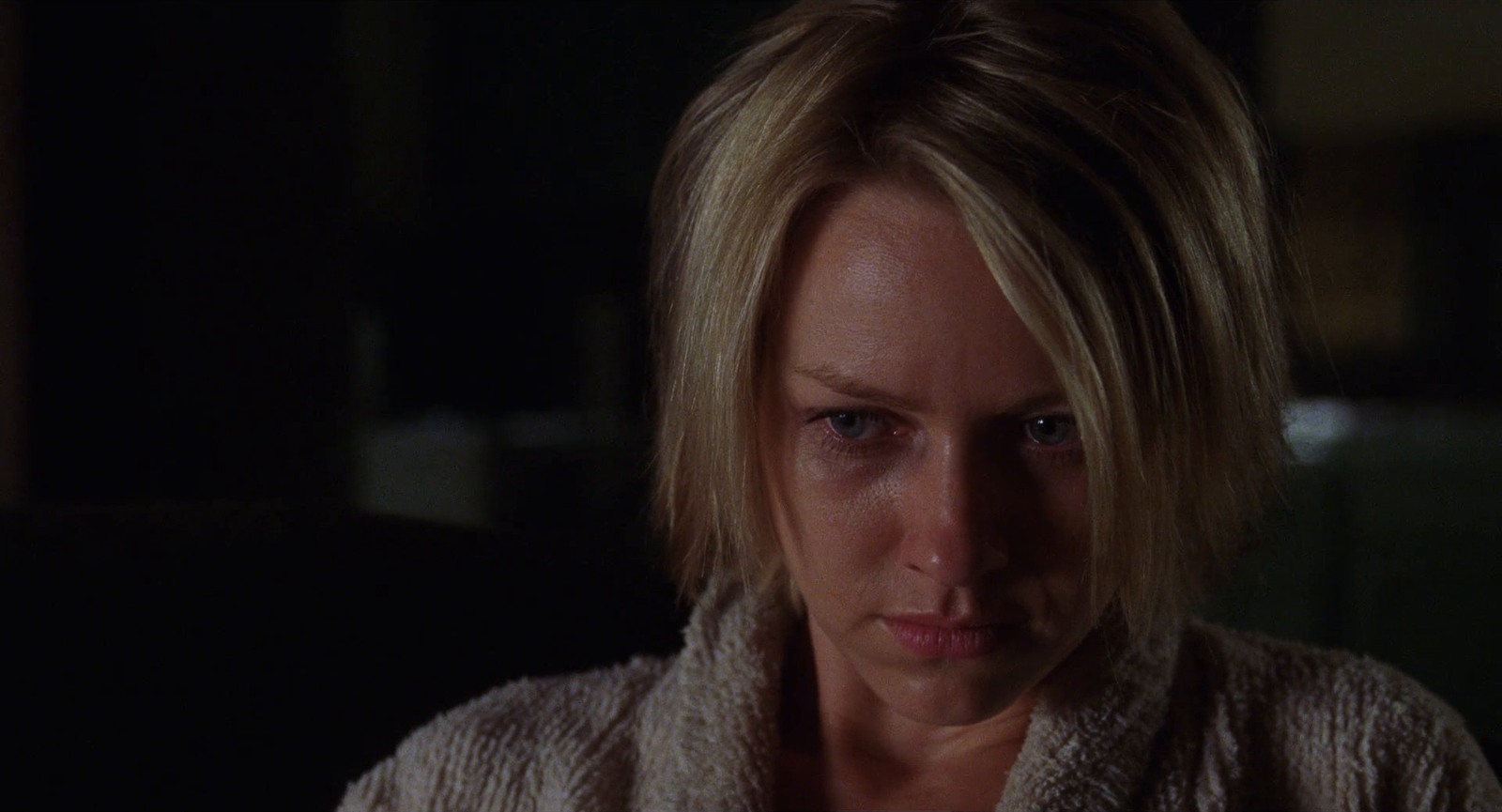
The room offers no secure refuge
2:20:00The close view makes distress legible without resolving everything that has returned around her. Domestic space no longer shelters the person inside it. The sequence’s movement toward violence belongs to the film’s account of desire, responsibility and terror; a diagnostic label would not explain the particular images through which it is presented.
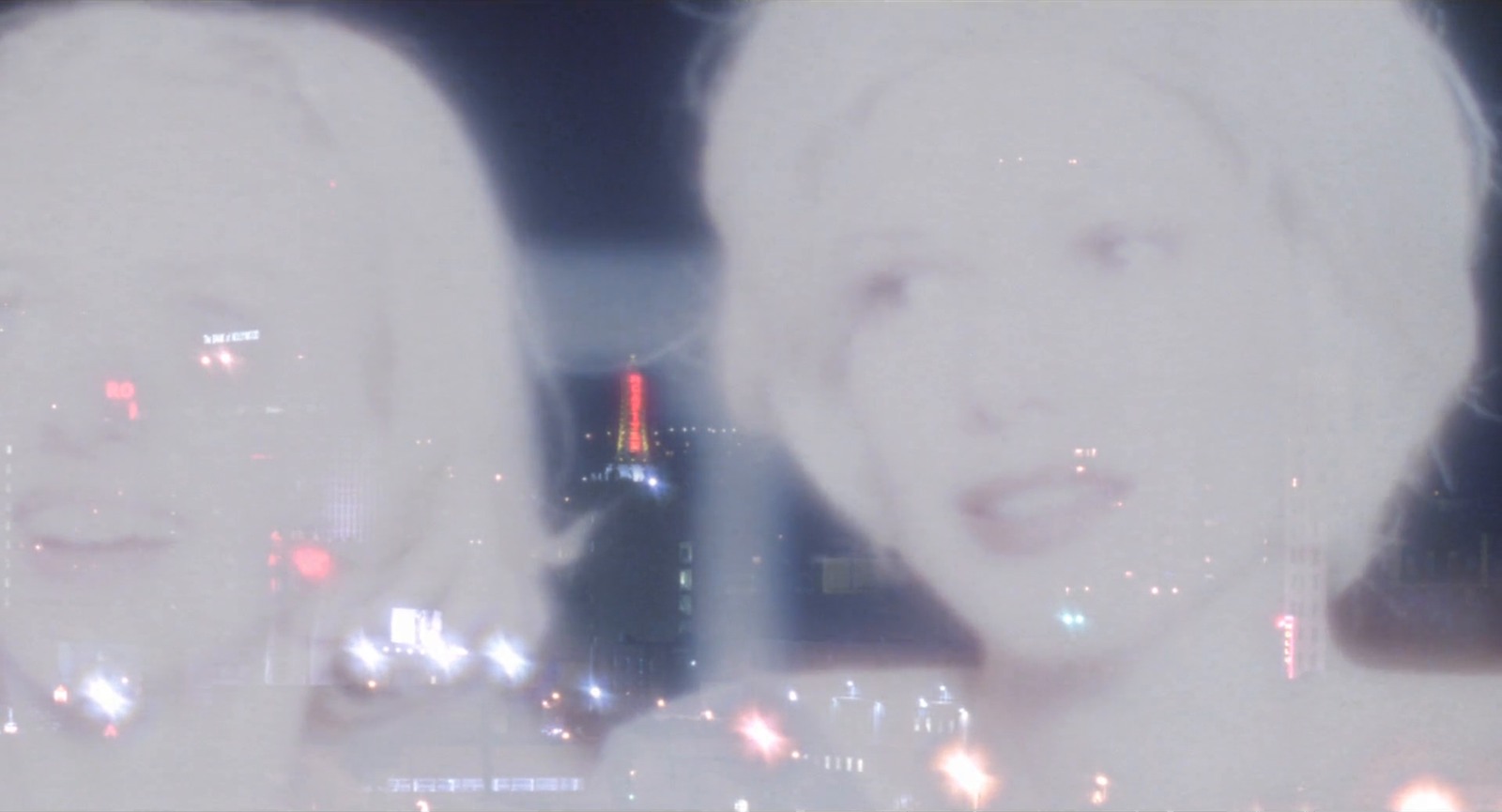
The city returns through the women’s faces
2:22:20The layered image recalls the opening’s superimpositions while bringing the relationship back into view. Faces and city no longer occupy separate spaces. After the narrative’s violence, the montage offers neither a simple restoration nor a practical account of where the women now are. It returns to cinema’s ability to make incompatible images coexist.
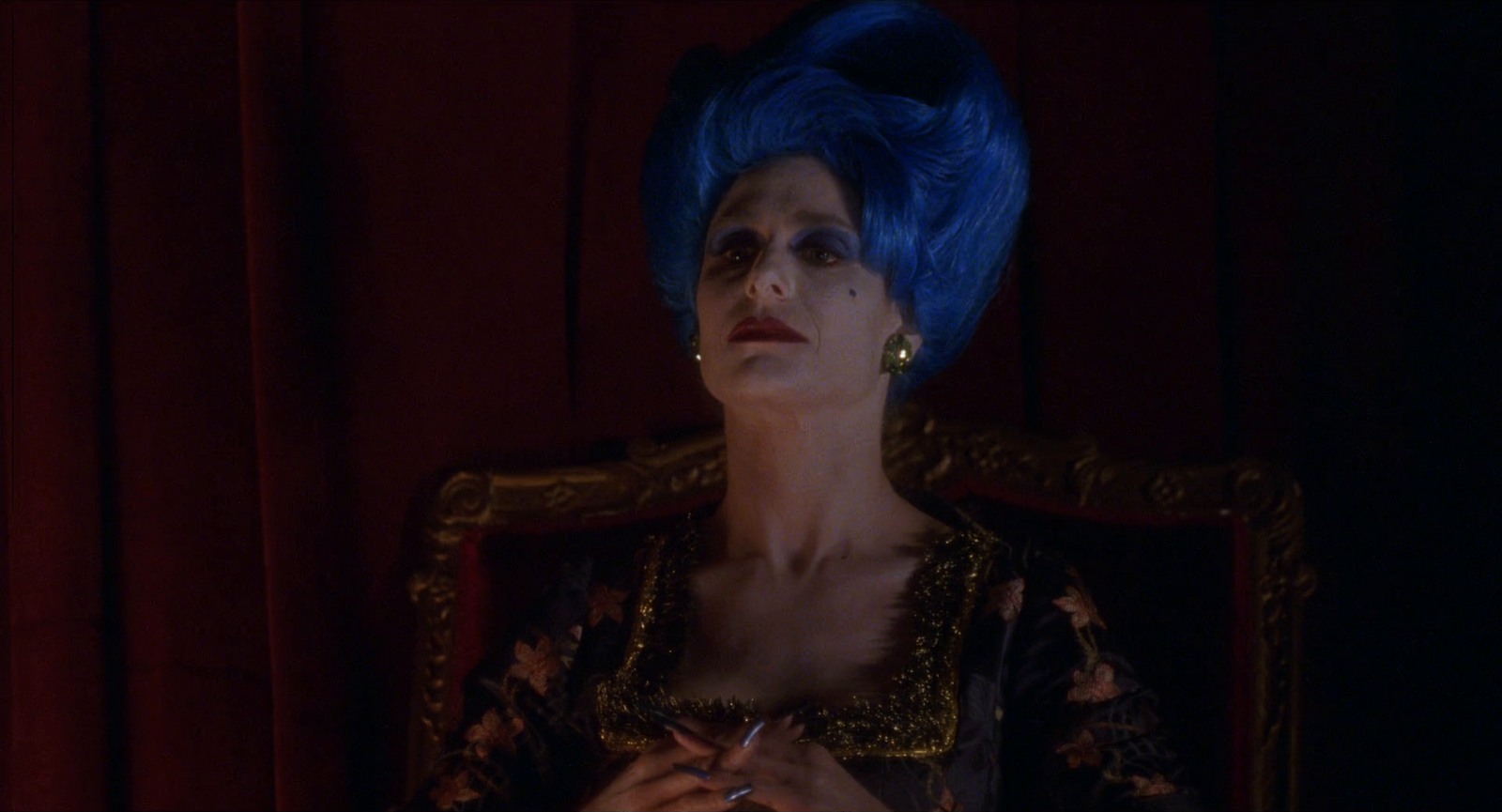
A final spectator remains
2:22:50The closing return to the theater places another watcher above the stage. Her stillness contrasts with the preceding sequence of distress and layered city images. The film leaves the spectator within the architecture of performance, with a face looking outward rather than a diagram that closes every route through the story.
Look again
Three images, three returns
Repeating situations invite comparison without requiring identical meanings. Open each pair to examine what changes.
Rehearsal and audition
Pages in the apartment give way to a close encounter before the casting group. Sweeney describes the earlier rehearsal as crucial to the audition’s effect, and recalls holding the close two-shot for as long as continuity allowed. Read the performance research.
Two passengers on Mulholland Drive
Rita’s opening journey and Diane’s later ride share a dark car and an interrupted route. The second scene carries the memory of the first while changing the passenger and the meaning of the invitation.
Two blue keys
The first key has an unusual angular form associated with the box. The later key has a familiar cut metal shape and a different function in the story. Their color connects them; it does not make them the same prop or the same kind of sign.
Viewing this edition
The copy behind the scene guide
The illustrated moments come from a widescreen presentation running 2 hours 27 minutes 13 seconds, including logos and closing credits, with an image approximately 1.85:1. Times locate these selected images; another edition may place the same moment differently.
The edition guide separately documents the published restoration and release records.
About the scene studies and images
Selected frames were examined across the complete running time, with closer checks of the keys, blue box, Winkie’s approach and ending. These are scene readings, not a cut-by-cut inventory. The dialogue studies extend this with full-track speech processing and a complete subtitle review. The review scope distinguishes that work from direct listening and supplement verification.
Film images: Mulholland Drive (2001). Captions describe the selected moments; the research below identifies the film’s collaborators and documentary sources.
About this research edition
Follow the film from development to release through collaborators’ testimony, production history, visual analysis and critical responses.
Voices, instructions and returning phrases
Words that change the picture
A remembered voice, a rehearsed threat, an instruction disguised as a choice: dialogue gives Mulholland Drive another network of returning forms. Fourteen studies connect those exchanges with the illustrated scenes. Open a study to follow the words through their changing circumstances.
A description teaches us where to look12:23–17:05
Dan does more than announce that he is afraid. He describes the counter, his companion’s fear, the uncertain light and a face beyond the wall. His speech gives the following walk a set of anticipated landmarks. The scene moves from an account of repeated dreams into a test of that account: looking is meant to relieve the feeling, yet carries him toward its source. This is a precise model for the film’s larger use of remembered situations without making Dan’s story an explanation of everything that follows.
Information travels farther than its explanation17:22–18:20; 35:38–36:27
The early telephone chain passes along the missing woman’s status without supplying the listener with a complete organization or a clear account of responsibility. Later, the messenger at Mr. Roque’s office proposes the decisions himself, reading authority from a very restricted exchange. Between them, these scenes make communication effective and incomplete: instructions travel, but their origin and purpose remain difficult to locate. The film lets a small amount of speech imply a much larger system.
A recommendation becomes an order28:35–33:46
The casting meeting begins in the language of openness, suggestions and consideration. That vocabulary collapses when the photograph is presented as a settled decision. Adam’s insistence that the project belongs to him meets an explicit denial of that ownership. The scene separates the courtesy of a professional meeting from the power exercised inside it. Follow the same identifying phrase through the Cowboy’s instructions, Adam’s later acceptance and Diane’s commission near the end.
A name is not yet an identity41:46–43:55; 55:11–56:58
Betty initially supplies a reassuring story for the stranger in her aunt’s apartment. The telephone call to Ruth breaks that assumption, and Rita admits that neither her name nor her identity is secure. At Winkie’s, a waitress’s name tag produces another possibility: Diane Selwyn. The answering-machine greeting then complicates it. Rita rejects the voice as her own while recognizing its owner; Betty offers a roommate as an alternative explanation. Recognition opens the investigation instead of concluding it.
The director is given a line to perform1:06:37–1:09:35
The Cowboy does not simply deliver a casting demand. He requires Adam to agree, repeat an argument about attitude, and accept the image of a vehicle with one driver. Only then does he prescribe the words Adam must say when the candidate appears. Other casting decisions are left to Adam, making the restriction on the leading woman more exact. The conversation turns obedience into an apparent exercise of judgment; the later compliment on Adam’s choice completes that fiction.
The same scene, rearranged1:10:01–1:11:18; 1:17:14–1:20:03
The apartment rehearsal and the audition share the same situation, threats and references to the father upstairs, but they are not identical repetitions. In the rehearsal, the blackmail accusation precedes the warning about a dangerous game; in the audition, that order reverses. Betty also describes the crying as a stage direction during rehearsal, then performs the scene through to its final declaration in the audition. Reading the two versions together makes the transformation more specific than a simple contrast between bad acting and good acting.
Who gets to define a successful performance?1:15:46–1:17:06; 1:20:39–1:22:47
Before the scene, Bob Brooker offers an elusive instruction about when the acting should become real. Woody presses for physical closeness and presents himself as reacting to whoever reads opposite him. Afterward, approval is hardly a single verdict: Brooker qualifies his praise, while the casting agents admire Betty and dismiss the viability of Wally’s project. Her performance produces an opportunity, but the conversation around it shows that professional recognition depends on relationships and access as well as what happens in the room.
The studio openly calls for playback1:22:51–1:27:30
The soundstage sequence places two polished song performances inside a working production. A call to check the gate closes the first; the slate names the fictional project and Camilla Rhodes before the next, and the crew explicitly calls for playback. Adam’s declaration that this is the required girl arrives within that already managed performance. The song’s recorded voice and the director’s prescribed words belong to different kinds of control, brought together in the same scene. Club Silencio will turn the separation of body and recording into the subject of the performance itself.
The explanation arrives before the demonstration1:42:55–1:52:53
Rita repeats the language of Silencio in bed before she and Betty enter the theater. Onstage, the Magician’s English, Spanish and French statements insist on recorded sound, and the trumpet demonstration makes the claim visible. Del Rio’s collapse then repeats the proposition at a different emotional scale: the performing body leaves the center of the scene while the song continues. Betty and Rita’s reactions are essential. Knowledge of the mechanism does not erase their response. This is an interpretation of the sequence’s construction, not a claim that its spoken explanation solves the film.
Calling a name no longer brings a person back1:53:55–2:00:54
After the club, Rita calls for Betty and receives no reply. The empty apartment is followed by a command to wake and another woman’s insistence on the name Diane. Practical details—borrowed possessions, an elapsed three weeks, detectives who have called again—establish a social history without giving us a narrator to settle the change. Diane’s subsequent address to Camilla briefly offers the language of return, but the room does not provide the reunion that the words propose.
Diane is allowed to stay as a spectator2:03:52–2:05:40
On the later film set, Adam explains ease and intimacy by demonstrating a movement with Camilla. The set is cleared, yet Diane is specifically permitted to remain. Compare this with Betty’s earlier audition: one woman is the performer at the center of a charged encounter, while the other watches an encounter directed around someone else. The instructions about bodies and comfort make the exclusion concrete. The scene’s professional vocabulary cannot insulate Diane from its personal implications.
A familiar greeting leads to a different journey56:33; 2:07:30–2:10:26
The answering-machine greeting first encountered during the search returns at Diane’s home before Camilla’s invitation. Its wording now has a visible personal context. The later limousine ride also repeats Rita’s earlier protest about stopping on Mulholland Drive, but answers it with a promised surprise rather than the opening threat. These verbal returns strengthen the image comparisons: the spectator recognizes a pattern while the character, situation and immediate outcome change. They need not be treated as proof that the two journeys are literally the same event.
A life story is retold under pressure2:12:22–2:16:40
Diane’s account at the party returns to Deep River, acting ambitions and an aunt connected to the movies. It adds the jitterbug contest, the aunt’s death and inheritance, and a failed attempt to secure the lead in The Sylvia North Story. Bob Brooker, remembered from Betty’s audition, is named as the director who did not value Diane’s work. Camilla’s help obtaining smaller parts makes their inequality explicit. At the end of the exchange, Adam and Camilla begin an announcement, but the sentence is interrupted by the transition; the film does not supply a completed verbal declaration there.
The casting phrase becomes a commission2:17:09–2:18:25; 2:22:50
Diane identifies the photograph with “This is the girl.” The phrase that organized a casting decision now identifies the target of a killing. Joe makes the exchange irreversible in words before explaining the blue key as a completion signal. Diane’s question about what it opens asks for an ordinary function that his answer does not provide. Compare that practical token with the earlier key and box, which do visibly fit together. The final “Silencio” closes a film in which speech has repeatedly named, instructed and misidentified without restoring certainty.
Dialogue analysis follows the English feature track and its embedded subtitles. Read the review scope.
The recording and the performer
Music, voices and the people behind them
The closing credits distinguish the singers on the records from the performers pictured on the studio set: Connie Stevens is credited for Sixteen Reasons, and Linda Scott for I’ve Told Every Little Star. Keeping those identities separate matters in a film that repeatedly places an image around an existing voice.
For Club Silencio, the production account adds another distinction. John Neff describes preparing a theatrical space around the scene while retaining the treatment already present on Del Rio’s earlier recording. His account of the filmed trumpet performance also shows why the Magician’s declaration should be read as part of the fiction, not as a literal report of every production method. Read Neff’s interview ↗
The existing sound and Silencio research follows the recording session, Del Rio’s account of singing during filming, and the difference between Mountains Falling in the film and on the soundtrack album.
Recordings named in the closing credits
Sixteen Reasons
- Written by
- Doree Post and Bill Post
- Performed by
- Connie Stevens
I’ve Told Every Little Star
- Written by
- Oscar Hammerstein II and Jerome Kern
- Performed by
- Linda Scott
Crying (Llorando)
- Written by
- Roy Orbison and Joe Melson
- Performed by
- Rebekah Del Rio
Pretty 50s
- Written by
- David Lynch and John Neff
- Performed by
- David Lynch and John Neff
Bring It on Home
- Written by
- Willie Dixon
- Performed by
- Sonny Boy Williamson
Go Get Some
- Written by
- David Lynch and John Neff
- Performed by
- David Lynch and John Neff
Mountains Falling
- Written by
- David Lynch and John Neff
- Performed by
- David Lynch and John Neff
The Beast
- Written by
- Dave Cavanaugh
- Performed by
- Milt Buckner
Score, dialogue editing and the final mix
Angelo Badalamenti receives the music credit; David Lynch the sound-design credit. The City of Prague Philharmonic is the credited orchestra.
Ron Eng is credited as supervising sound editor and FX editor. Mark Gordon and Daniel Irwin are the dialogue editors; Paul Carden the ADR supervisor and Foley editor; John Neff the music editor.
The re-recording mixers are Ron Eng, David Lynch and John Neff. Patrick Giraudi receives the dialogue predub mixer credit, and re-recording is credited to Asymmetrical Studio. These are distinct contributions to the finished soundtrack; a general sound-design attribution should not erase the editing and mixing work.
About the audio and dialogue review
The complete English 5.1 track in the 2:27:13 copy was processed with local speech recognition, and the embedded English subtitles were reviewed throughout. Fourteen selected passages were checked with a second speech-recognition pass on the center channel. The dialogue readings use agreement between those records, the subtitles and the existing visual study; recognition errors and unsupported fragments were excluded.
This is a transcript-assisted dialogue review, not a continuous listening assessment. Precise vocal delivery, musical identification by ear, surround placement and mix comparisons remain unverified. Music and sound personnel above were read directly from the closing credits; production methods are attributed to the cited interviews. No commentary track is present in this copy.
The feature did not simply begin where the pilot ended
The television origin matters, but it can become an explanation that stops us looking. In Rodley’s interview, Lynch recalls a compact ABC pitch joining an aspiring performer to a detective story. He describes the eventual feature as a form discovered through the material, with earlier possibilities acquiring new relationships. The pitch and the transformation ↗
The most useful contemporary correction comes from Andy Klein’s October 2001 interview. When Klein proposes that the feature is essentially the pilot followed by a new ending, Lynch explicitly rejects that model: material was removed and added across the beginning, middle and end. He credits Pierre Edelman with helping secure Canal Plus’s acquisition of the rights. The creative solution followed that opportunity; it was not a complete feature plan waiting unchanged since the pitch. Lynch on reworking the film ↗
This distinction makes recurrence more interesting than leftovers. A character’s first appearance can acquire a different force because of a later scene, even if the original footage has barely changed. Editing can alter the meaning of a performance without asking the actor to perform it again. Conversely, an unresolved encounter is not automatically proof that Lynch forgot a television subplot. That judgment needs an identified version and a specific comparison.
A chronology worth checking. Tad Friend’s 1999 production report places the pilot shoot in late February and March of that year. AFI’s history instead gives 1998. This dossier follows the contemporary report for the working chronology while retaining the discrepancy for documentary checking. Friend’s production report ↗ · AFI history ↗
Lynch told Klein that continuing stories were precisely what drew him back to television. That desire helps explain the density of entrances and possible connections; it does not authorize us to reconstruct episodes that were never made. The attraction of a continuing story ↗
Writing evidence: Daily Script’s index advertises a draft dated 5 January 1999, but the linked screenplay page states that the work has been removed. A date in an index is a lead, not authentication. The remaining comparison must distinguish a script, an assembly, a network delivery and the theatrical feature—four different objects that can otherwise get called “the pilot.” Draft listing ↗
A later comparison from another production. In LYNCH (one) (2007), Lynch discusses the unfinished shape of Inland Empire in a telephone conversation with Jeremy Irons. He recalls Mulholland Drive as an earlier project that had forced him toward a similarly unfamiliar way of finding the whole. This is a retrospective comparison of creative processes, rather than a replacement for the contemporary account of the pilot’s transformation. LYNCH (one), 58:58–60:35 →
Acting before the film offers an explanation
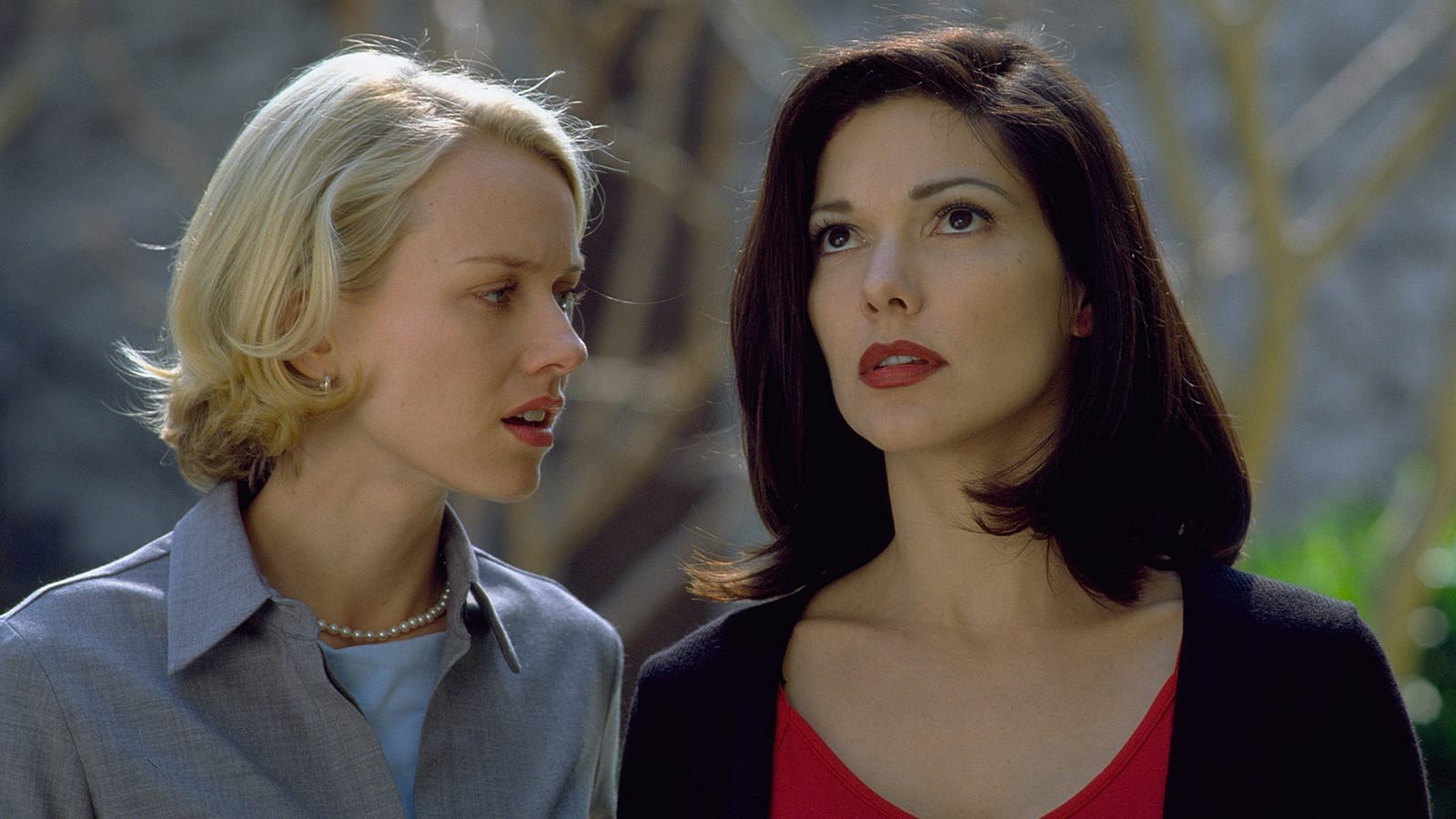
Harring’s recollections give Rita a physical vocabulary. She says Lynch directed her post-crash movement through the image of a broken doll and her sustained fear through an imagined threatening cloud. These are playable instructions about movement and apprehension, rather than a diagram of the plot. She also remembers being told that the identity mystery would unfold gradually across a television series. Harring on movement, fear and the pilot ↗
Rita’s uncertainty is work performed by an actor, not merely missing information. A person who cannot establish her own history must read other people for signs of safety. Betty’s eagerness can therefore register both as kindness and as a kind of authority: she has a story about who she is, and is able to help invent one for someone else. This gives their investigation an emotional imbalance before any later interpretation is imposed.
The audition: repetition becomes discovery
Mary Sweeney recalls initially trying cuts in Betty’s audition, then deciding to hold the close two-shot as long as possible. A continuity problem limited how much she could preserve. She emphasizes the earlier kitchen rehearsal as essential preparation for the scene’s impact. The revelation is built jointly by Watts’s performance, the scene partner, the framing and the editor’s decision to stay. Sweeney on the audition ↗
Rehearsal gives us an expectation to carry into the room. The audition tests how quickly that expectation can be overturned. We are watching an actor play an aspiring actor who suddenly seems capable of commanding an encounter. This is more revealing than simply asking whether Betty is innocent: the same person can be inexperienced in an industry and startlingly powerful within a performance.
Harring also recalls Johanna Ray’s casting process and Lynch’s decisive response to a photograph and meeting. The casting recollection ↗ That account belongs beside, rather than inside, the fiction of Adam’s coerced casting. Casting in the actual production and casting as a nightmare of industrial control illuminate each other; they are not interchangeable records.
A camera that seems to know something
Peter Deming describes 35mm photography with a Panavision Panaflex, Primo primes, filtration and rear nets to soften the image. Preparation involved agreeing shots and then finding the lighting mood. He identifies Sunset Boulevard as a private reference, explicitly not a discussion he and Lynch had. Deming’s camera and preparation account ↗
Softness need not mean reassurance. It can make an image inviting while leaving its surroundings difficult to read. The viewer may be drawn toward a face without being given secure knowledge of the space around it.
Winkie’s: an unresolved camera credit within a shared memory
Deming remembers rejecting conspicuous handheld movement and operating a small six-foot jib to produce a gentle drift. Sweeney credits Steadicam operator Dan Kneece when describing the floating camera in the diner sequence. These may concern different setups, but the available accounts do not establish that reconciliation. Deming’s Winkie’s passage ↗ · Sweeney’s Winkie’s passage ↗
What the accounts share is the importance of slight instability. Sweeney connects the camera, Patrick Fischler’s anxious performance and the time allowed by the edit. The scene’s collaborative construction ↗ A slow approach can make the audience anticipate an event without knowing precisely where it will occur. The scene’s effect should therefore be studied across movement, duration and sound; assigning it to a single device would lose the collaboration that makes the device matter.
What we hear when the picture stops reassuring us
The principal credits distinguish Angelo Badalamenti’s score, Lynch’s sound design, Ron Eng’s supervising sound editing and additional music by Lynch and John Neff. Music and sound credits ↗ These roles overlap in the listening experience. Music can behave like an atmosphere, while a noise can carry the expectation usually assigned to a musical cue.
Neff recalls spending three days on the Winkie’s mix, combining numerous elements and using cues originally made for, but absent from, Lost Highway. He also describes the very different work of creating the hitman sequence’s comic impacts by dropping melons with Lynch. The same collaboration could shape dread or an escalating joke. These are recollections of the work, not timings or sound levels measured from a disc. Winkie’s and the hitman effects ↗
Club Silencio: a recorded voice, a performed body
Del Rio’s account corrects two details often compressed into the story of “Llorando.” She credits Thania Sanz with the Spanish translation, describing her own subsequent adjustments for singing. She also says she sang at full voice along with playback during filming, rather than silently miming. The finished film uses the earlier studio recording. Del Rio’s translation and performance account ↗
Rodley’s published Lynch interview gives a different translation attribution and describes the performance as lip sync. The earlier account ↗ Keeping Del Rio’s correction visible changes the history: the scene involves the labor of a translator and a singer recreating her performance, not simply a director discovering a disembodied voice.
Neff says he built the theater’s acoustic illusion around reverberation while retaining the recorded vocal’s existing treatment, and strengthened the low end of Richard Green’s magician voice. Building the theater’s sound ↗ The sequence makes the authority of a voice an audible construction. Knowing that a sound is reproduced does not prevent it from moving us. Its emotional force and its technological source can both be real.
A performance removed — scene spoilers
Del Rio remembers a filmed dressing-room scene with Scott Coffey as an abusive manager. She welcomed its removal because it avoided a limiting explanation for her singer. The deleted-scene recollection ↗
The distinction matters: a remembered explanation from a deleted scene should not be silently reinstated as a fact of the released film. An absence can preserve an ambiguity that the production once planned to close.
Neff further distinguishes the instrumental use of “Mountains Falling” in the film from the vocal version on the soundtrack album. Film and album versions ↗ An album track list is consequently a starting point for music research, not a complete record of what the theatrical mix contains.
Hollywood as rooms, thresholds and borrowed images
Jack Fisk describes designing for a director who already imagines a world with unusual specificity. His account identifies Winkie’s as an existing location. His tentative story about the diner’s inspiration does not identify the filming address. Fisk on the film ↗ In a separate interview, he stresses the interdependence of design and photography: a set supplies possibilities that the camera must make work. Design in collaboration ↗
A Hollywood story need not announce its industry through studio spectacle alone. An apartment can offer temporary refuge; an audition room can concentrate enormous power in a small encounter; an ordinary restaurant can become a place where someone fears his own account of an event. These are social spaces before they are symbols. A useful location study must ask what the room lets people do, as well as where it stood.
Friend’s on-set reporting describes Jason Collins working on prosthetic limbs for Michael J. Anderson’s Mr. Roque. The opening production account ↗ This is a concrete effects contribution behind an apparently inexplicable figure. The construction can be investigated without claiming that its physical mechanics explain the character’s meaning.
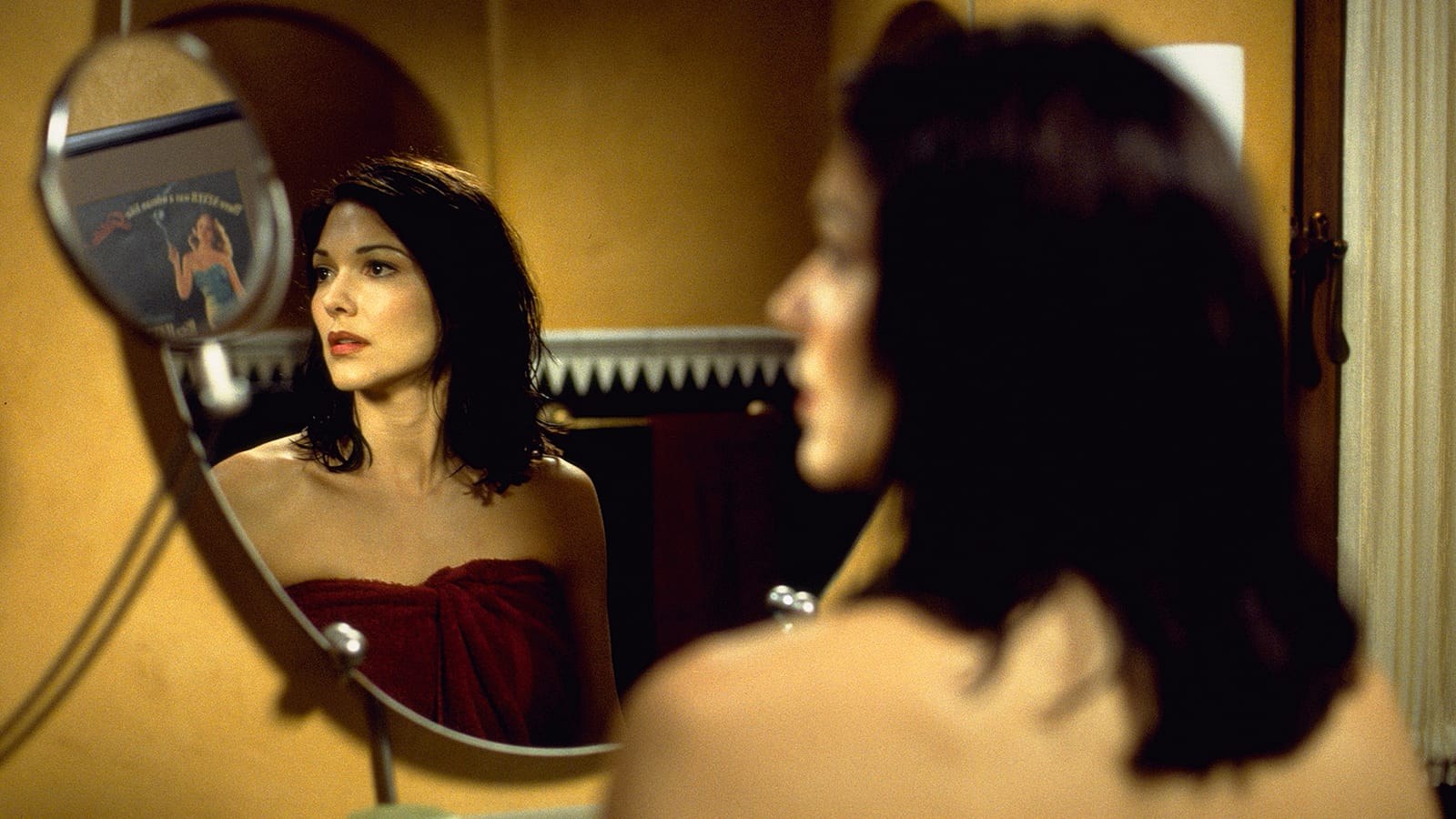
A name taken from an image
Ebert’s contemporary review identifies the Gilda poster as Rita’s source for her assumed name. The poster and the name ↗ In Criterion’s reproduced image, mirrors divide Harring into differently focused views. The composition offers recognition as an arrangement of surfaces. A face is present, but possession of that face does not amount to possession of a biography.
The poster moves between two worlds: a Hollywood film object in Rita’s room and a name through which she begins to construct an identity.
Costume: who contributed the thing we see?
Amy Stofsky is credited as costume designer. Department credit ↗ Del Rio says she supplied her own Club Silencio dress and that Stofsky approved it; she reported still having it in 2021. The costume recollection ↗ That is a specific contribution alongside the departmental credit, not evidence of the garment’s present location.
The Betty–Rita image above places restrained blue-gray clothing and a pale necklace beside a deeper red neckline and black outer layer. Those visible contrasts give the two figures different emphases within one frame. Assigning a fixed moral meaning to each color would require more than an isolated still. The next costume study should track changes across scenes and separate clothing from lighting and color grading.
Interpretation that keeps the film open
Lynch discusses Diane through blocked opportunity and desire, while defending the viewer’s ability to arrive at a personally meaningful understanding. Diane and the viewer ↗ That stance permits analysis; it does not certify every confident answer. A theory should help us notice more of the film rather than persuade us that an awkward image no longer matters.
Read the competing interpretations — major structural and ending spoilers
Fantasy, guilt and a second chance
Dennis Lim outlines the influential reading in which Betty is Diane’s wishful reconstruction, shaped by desire, jealousy and guilt. He complicates the neat division: the apparent fantasy has considerable continuity, while the supposed reality arrives in fractured, nightmarish form. In his argument, the need to construct meaning is itself the film’s subject. Lim’s fantasy and reality discussion ↗
The experience of a dream
Ebert’s 2001 review takes a different emphasis. He values scenes as an emotionally coherent dream experience rather than steps toward a final logical solution. His account does not provide the same stable boundary between waking and dreaming that a simple two-part explanation would require. Ebert’s contemporary reading ↗
These positions can generate different, useful questions. The reconstruction model asks whose wishes and injuries organize the images. The dream-experience model asks how the images work on us before we can organize them. Neither question makes the women’s relationship expendable. Desire, dependency and rejection remain experiences between people even when identity or chronology becomes uncertain.
Likewise, Hollywood’s power is not exhausted by identifying one villain. Being chosen for a role, desired by another person, or recognized as talented are different forms of selection. The film invites us to feel how easily they become confused. An account of Diane that reduces her to a diagnostic label would miss that social and emotional structure.
A productive rewatch: compare the audition with the earlier rehearsal; listen for changes in the authority of voices at Silencio; track names and objects separately from assumptions about who is dreaming. Record what changes and what remains the same before deciding what the pattern means.
From an uncertain television future to a film people return to
The official Cannes record places the feature in competition in 2001 and records Lynch’s shared directing award. Cannes record ↗ AFI lists a U.S. release date of 12 October 2001. Release entry ↗ These records distinguish the film’s public career from the story of its rejected television beginning.
Ebert’s release review is especially revealing beside his hostility to some earlier Lynch films: he treats this film’s dream logic as an achievement. October 2001 review ↗ Lim’s later reception history describes how viewers also built collective explanations online. The film’s interpretive afterlife ↗ The public life of the work therefore includes both surrender to an experience and a strong urge to analyze it.
Mary Sweeney won BAFTA’s 2002 Editing award for the film. Official award record ↗ In the 2022 Sight and Sound critics’ poll, the film reached eighth place, rising from twenty-eighth in 2012. The dated poll results ↗ An award recognizes a contribution, while a poll records a particular electorate. Neither turns one interpretation into the correct one.
A publicity document with more than one historical layer
Cinéart’s 13-page press kit announces a Dutch reissue on 22 December 2022 on PDF page 2, yet later biographies retain language from the original production period. For example, the Polaire biography on page 11 describes additional photography as current work. This is useful evidence of publicity being reused, not proof that the PDF itself is an untouched 2001 pressbook. Inspect the distributor’s PDF ↗
Restoration history without inventing a definitive edition
In Cannes’s 2021 interview, StudioCanal’s Jean-Pierre Boiget describes returning to the original negative for a new 4K scan, drawing on previously approved grading and involving Lynch in the new presentation. He dates the earlier process to 2015–16. Deming’s retrospective article calls his remaster work 2014. These accounts may refer to different phases, but the exact sequence needs production documentation. Boiget on the 2021 restoration ↗ · Deming’s recollection ↗
Boiget also identifies video as the source of the opening sequence. That is a useful caution when judging texture: not every change in image character is a restoration fault. The source materials ↗ The current Criterion UHD lists Dolby Vision HDR and a 5.1 DTS-HD Master Audio soundtrack, alongside 2015 interviews and other supplements. The listing has been checked; the complete discs have not. Current edition contents ↗
The BBFC records a cinema submission of 146 minutes 26 seconds classified on 26 July 2001 and one of 146 minutes 36 seconds classified on 16 January 2017. Its 2002 home-video entries include 140 minutes 32 seconds and 140 minutes 44 seconds. These are recorded durations, not proof of missing scenes. Frame rate, logos, credits and actual content need comparison before any cut claim is made. Cinema and home-video records ↗
The most useful next edition study will pair those records with actual media: identify the release and playback speed, document the opening and final frames, compare image framing, and listen to the same passages on matched equipment. Until then, this page makes no claim that every release contains identical material or that one soundtrack is demonstrably superior.
The film reimagined in print
Three artist-edition records currently accompany the film: Grzegorz “Gabz” Domaradzki’s regular and variant prints, and Ise Ananphada’s regular edition. They belong to the history of the film’s later visual interpretation. None is presented as a poster used in the original 2001 release campaign.

Explore further
Follow the sources below, explore the museum collection, or continue through the Reading Room. New archival discoveries and contributions enrich the record of Lynch’s work.
Sources and the research record
- Mulholland Drive: English track, embedded subtitles and closing creditsComplete feature-track speech processing and subtitle review; fourteen selected center-channel speech checks. Closing sound and song credits inspected at 2:26:19–2:26:49. Reviewed 8 November 2026. This supports dialogue comparisons and credited attribution, not a continuous listening or release-to-release mix assessment.
- Mulholland Drive: the copy examined for the scene guideSelected-frame visual study across the complete 2:27:13 presentation, with closer checks of key recurring objects and transitions. Selected embedded English subtitles consulted. Reviewed 8 November 2026. A separate transcript-assisted dialogue review now accompanies the visual guide; direct listening and commentary verification are not claimed.
- Criterion Collection: Mulholland Dr. ↗Edition record, cast and craft credits, supplement inventory and gallery inspected. Current UHD specifications describe this release; complete film, booklet and supplement viewing not undertaken.
- Chris Rodley: Lynch on Mulholland Dr. ↗30 October 2015 web excerpt from the 2005 Lynch on Lynch. Pitch, transformation, Diane, interpretation and Del Rio passages inspected. The excerpt is not the complete book chapter.
- Tad Friend: Creative Differences ↗30 August 1999; 6 September issue. Production and opening Mr. Roque passages inspected. Website headline differs from article title.
- Andy Klein interviews Lynch: David Lynch’s Hollywood nightmares ↗12 October 2001. Direct interview: rights acquisition, continuing-story appeal and new material across beginning, middle and end. The introductory chronology is not adopted as a production log.
- AFI Catalog: Mulholland Dr., record 53917 ↗History, cast, departmental credits, release and source bibliography inspected. Pilot chronology conflicts with contemporary reporting; catalogue synopsis is not used as an authoritative explanation of the plot.
- Sam Wigley interviews Laura Harring ↗BFI, 13 April 2017. Retrospective testimony on casting, physical direction and the intended television mystery. Distinguish Harring’s words from the interviewer’s interpretation.
- Matt Fagerholm interviews Mary Sweeney: You Want People to Enter the Dream ↗26 July 2022. Full browser text preserved in the research record. Mulholland audition, pilot editing and Winkie’s passages inspected; unrelated introductory credit generalizations not adopted.
- Adrian Pennington interviews Peter Deming: The Road to Ruin ↗Retrospective account; publication date not established from visible article. Preparation, Panaflex/Primo, filtration, Winkie’s jib and remaster passages inspected. Camera recollection requires reconciliation with Sweeney.
- Matt Fagerholm interviews John Neff ↗2 May 2022. Recording, Winkie’s mix, BlueBOB, hitman effects and Club Silencio passages inspected. Later recollection, not original mix documentation or a measured listening audit.
- Matt Fagerholm interviews Rebekah Del Rio: That Space Between Awake and Asleep ↗21 September 2021; full browser interview inspected and preserved. Translation authorship, singing to playback, costume and deleted dressing-room sequence. Recollection does not establish present object custody.
- The Playlist interviews Jack Fisk ↗The Playlist Staff byline, 14 January 2016. The Straight Story / Mulholland Drive subsection inspected. Fisk’s tentative inspiration anecdote is not treated as a verified filming address.
- Hillary Weston: Designing for the Screen — Jack Fisk ↗4 March 2016. Design and cinematography collaboration passages inspected. Comments about Knight of Cups are not transferred to Mulholland Drive.
- Roger Ebert: Mulholland Drive ↗12 October 2001 review, complete browser text inspected. Contemporary critical position and Gilda association; review paraphrases do not substitute for direct film inspection.
- Dennis Lim: Mulholland Dr. ↗Criterion, 3 November 2015; excerpt from The Man from Another Place. Reception, online interpretation and fantasy/reality argument inspected. Not a complete book review.
- Festival de Cannes: 2001 competition record ↗Official competition and shared directing-award record, credits and 146-minute listing inspected.
- BAFTA: 2002 Film Awards ↗Official Editing category: Mary Sweeney’s win checked. Automated download blocked; award text available through web research.
- BFI: Results of the 2022 Sight and Sound poll ↗1 December 2022. Critics’ poll ranking and 2012 comparison inspected. Rankings represent this electorate and date, not universal consensus.
- Benoit Pavan interviews Jean-Pierre Boiget on the restoration ↗Festival de Cannes, 11 July 2021. Firsthand operations account of scanning, retained grading and Lynch’s participation. Earlier restoration dates differ from Deming’s recollection.
- BBFC: Mulholland Drive release and version records ↗Cinema entries classified 26 July 2001 and 16 January 2017; physical-media entries from 2002 inspected. Classification dates are not necessarily public release dates; runtimes alone do not prove cuts.
- Cinéart Nederland: Mulholland Drive 4K press kit ↗13-page distributor PDF inspected selectively: PDF p. 2 release data, p. 5 synopsis, pp. 6 and 11–12 older biographies. Page 2 visually checked. A 2022 reissue document, not authenticated original 2001 publicity.
- Daily Script: screenplay index, Mulholland Drive entry ↗Index labels a 5 January 1999 draft; its linked screenplay page states that the work has been removed. Catalogue lead only: no screenplay authentication or full-script reading claimed.
Another doorway
Continue exploring
Films
Lost Highway
Explore Lost Highway (1997) through 36 illustrated scenes, dialogue and song studies, sound credits, Tim Lucas’s commentary and edition research.
Films
Inland Empire
Explore David Lynch’s Inland Empire through Laura Dern’s performance, its evolving production, digital photography, sound, restoration and critical reception.
Art
Art
Explore David Lynch’s paintings, lithographs, sculpture and photography through close readings, exhibition histories, credited images and documented sources.
Image credits and sources accompany each linked guide.