Dune
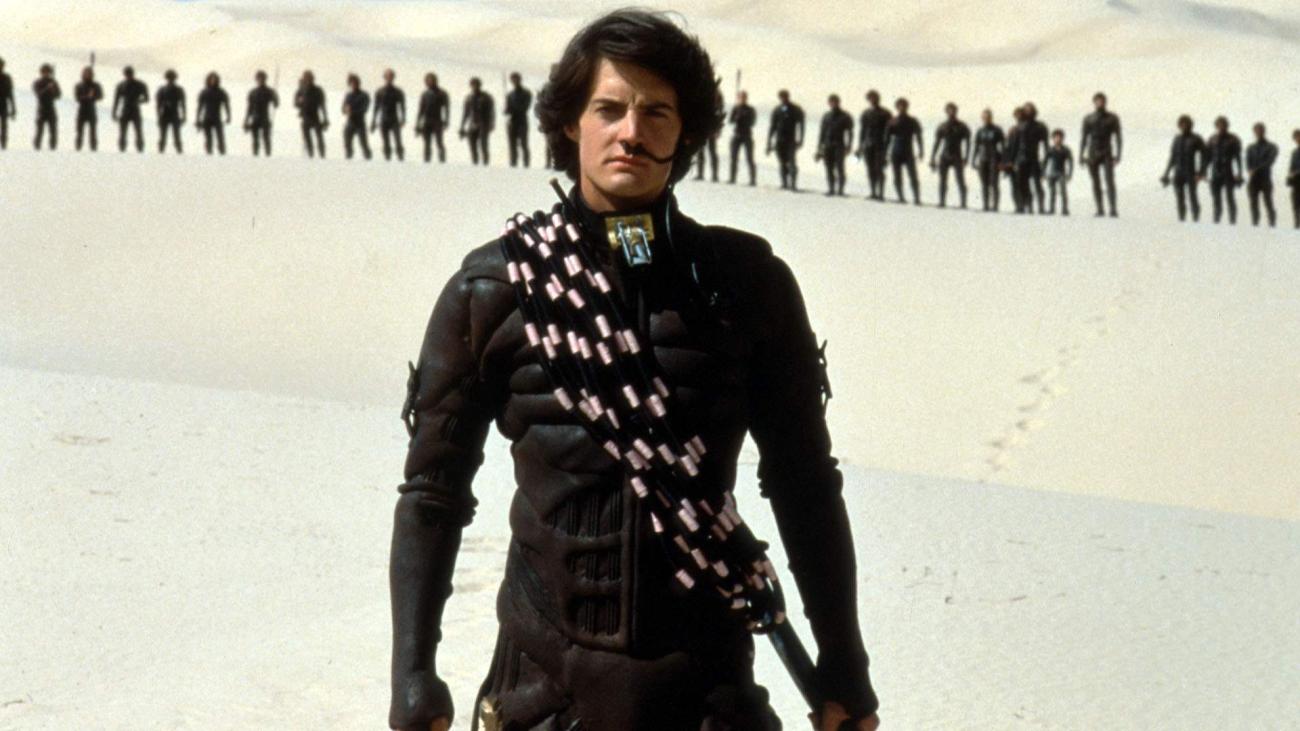
The feature films / 1984 / Scenes & research
An empire made tangible: bodies, machines, and a world too large to contain.
David Lynch’s Dune makes power material. It has to pass through vulnerable bodies, protective clothing, elaborate rooms and enormous machines. Following those things gives us a way into a film whose narrative is often remembered chiefly for its difficulty.
This dossier concerns the 1984 adaptation of Frank Herbert’s novel, with Kyle MacLachlan as Paul Atreides. It brings production testimony, screenplay evidence and release records together without treating every circulating version as the same film. Official film record ↗
- Film year
- 1984
- Theatrical listing
- 137 min
- Image
- Color
- Listed ratio
- 2.35:1
Choose a route: new to the film, start with the story. For its making, go to design and photography. For release questions, use the version table. Plot developments and the ending are discussed below.
Inside the extended version
Follow the film, image by image
From the painted history of an empire to rain on Arrakis: explore how bodies, rooms and landscapes tell the story. Select any still to enlarge it. The times identify the illustrated moment in the extended copy reviewed here.
The guide discusses the complete story and ending.
Scene studies / 01
Power, bodies and prophecy
The illustrated history gives way to rooms in which bodies are trained, inspected and altered.
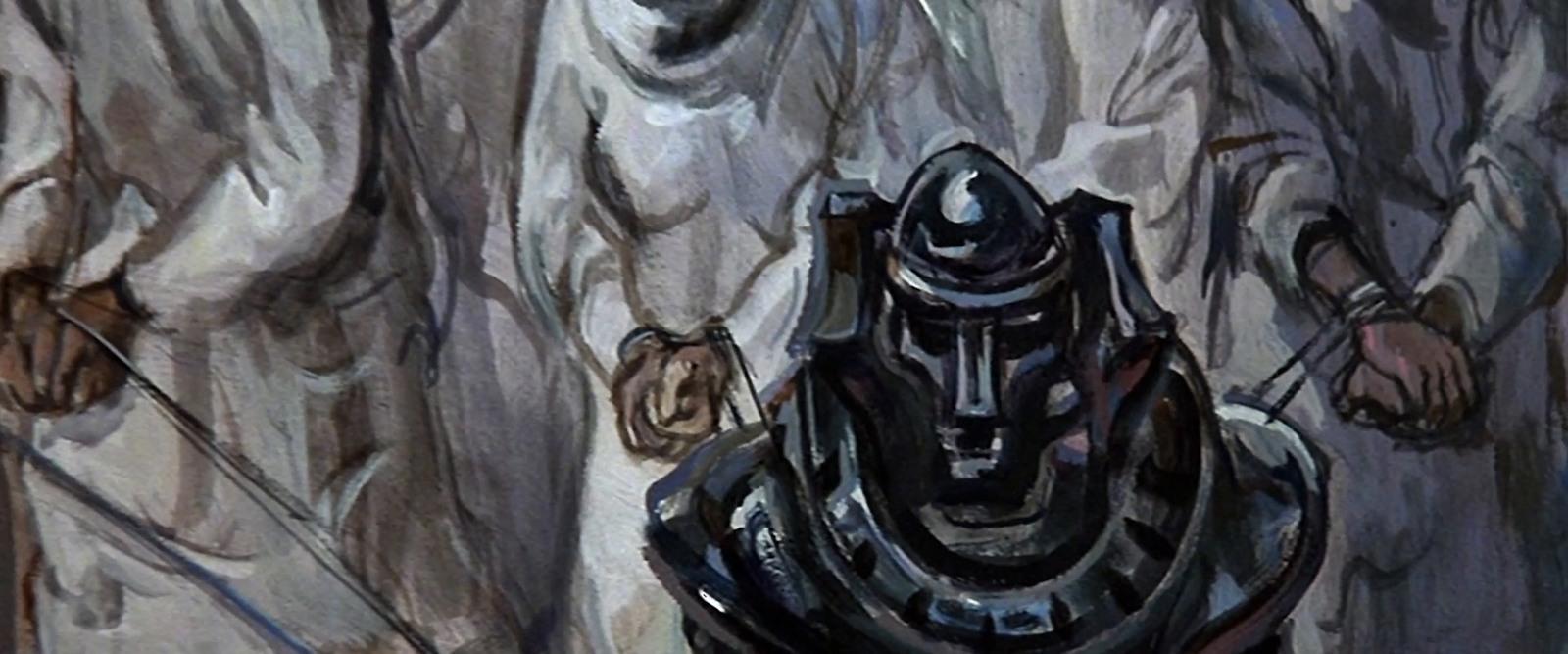
An empire introduced in paintings
03:45Before the characters occupy physical sets, the extended version offers a succession of painted histories, planets and portraits. The images organize the universe as something already explained and catalogued. This is a distinctive entrance to the material: the eventual transition into the Emperor’s richly furnished court replaces an illustrated account of power with its rooms, bodies and ceremonies.
Link to this study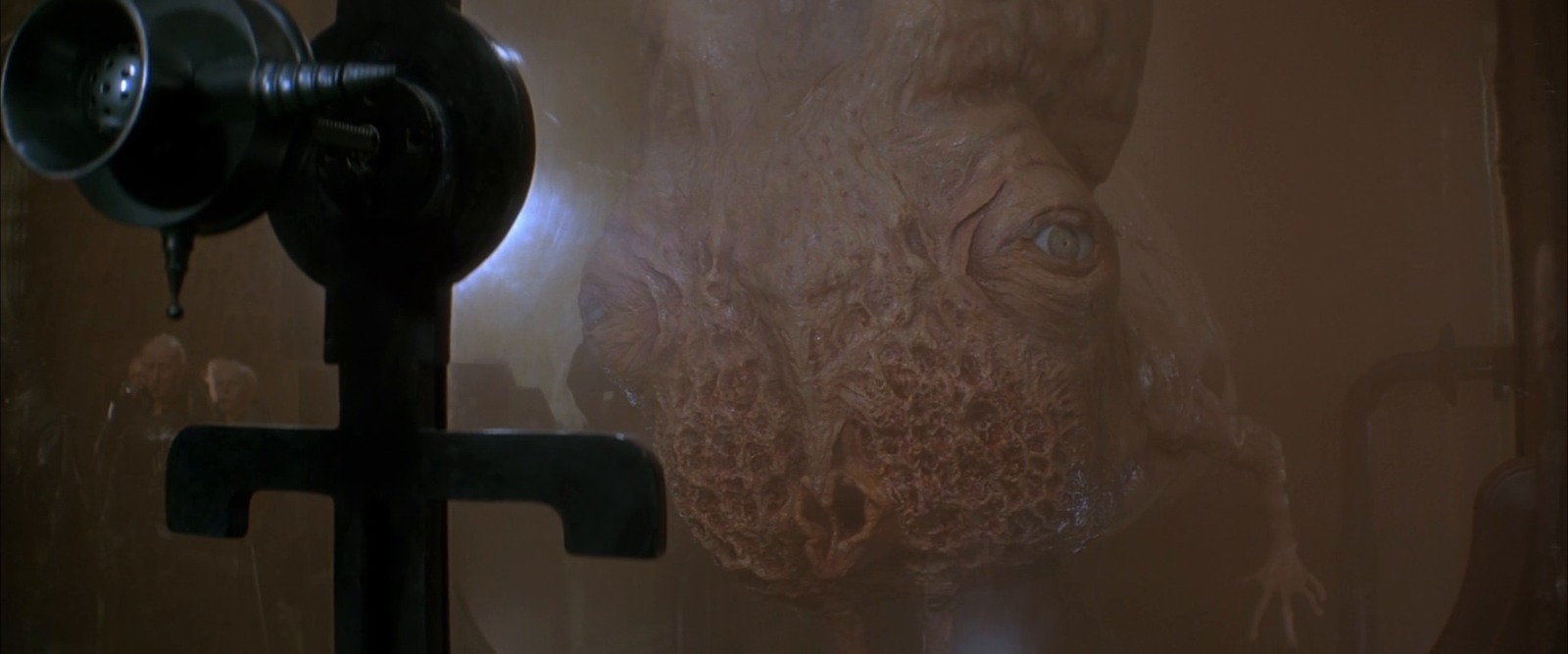
The visitor who brings his own atmosphere
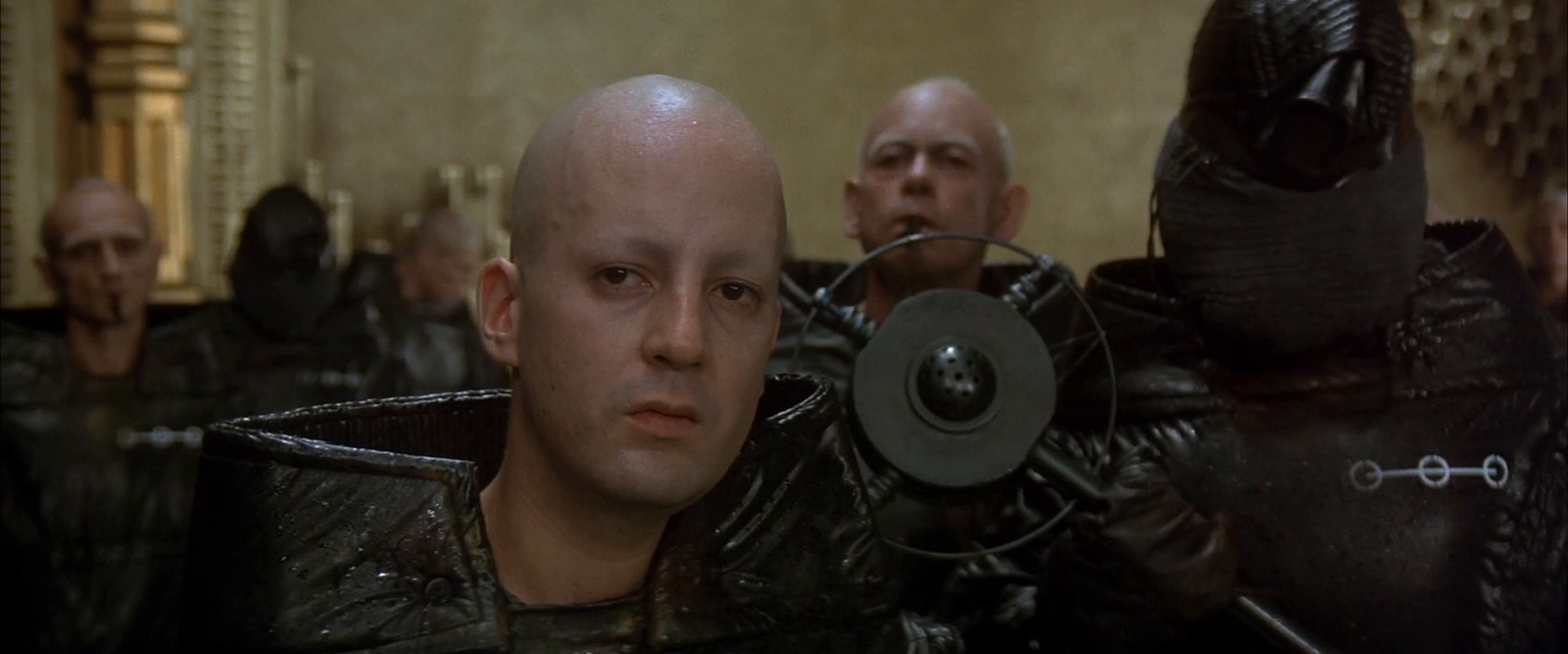
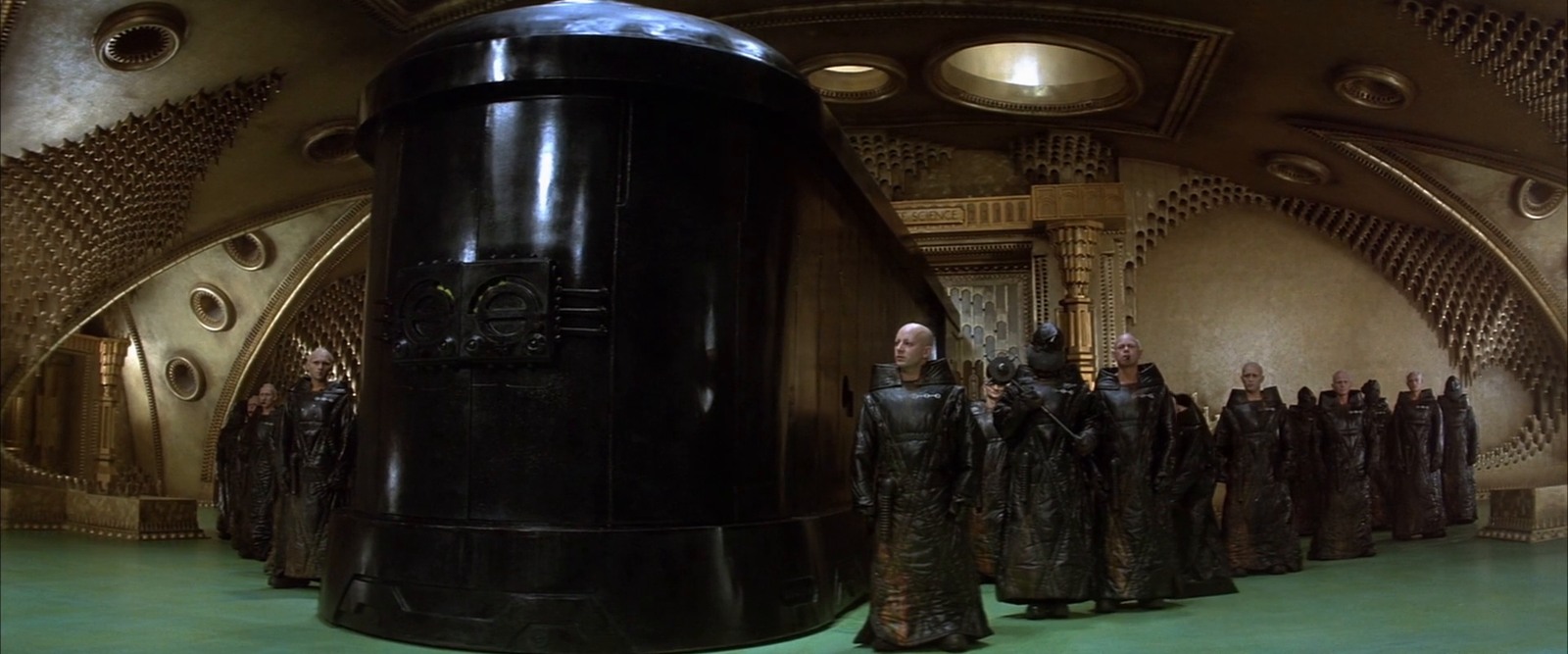
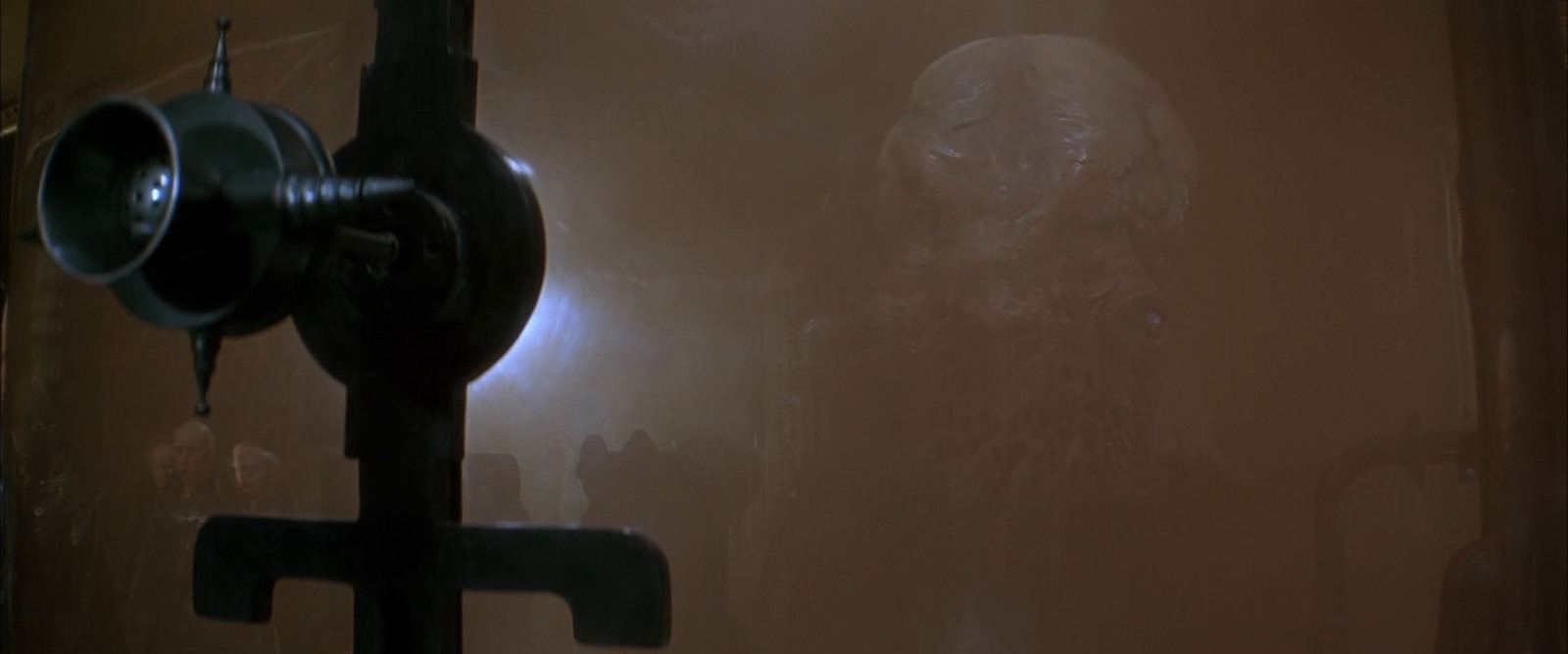
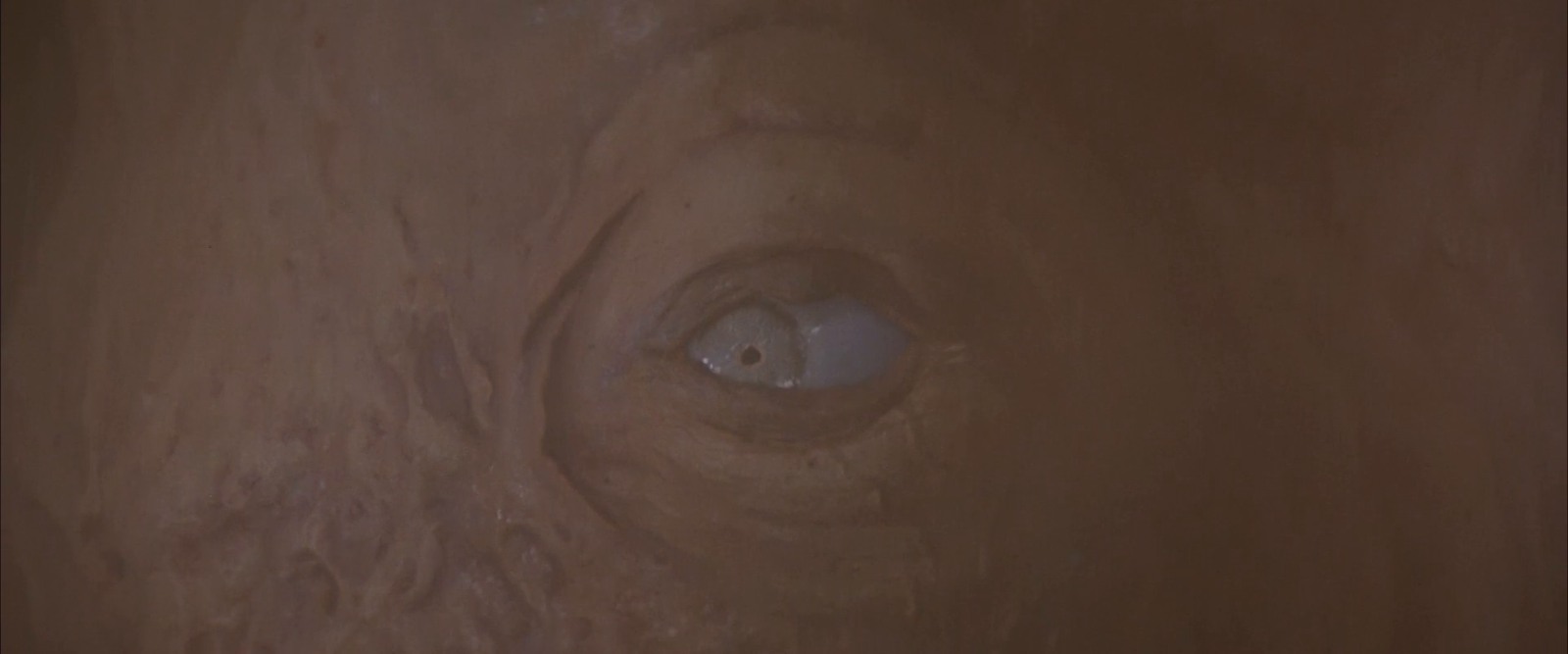
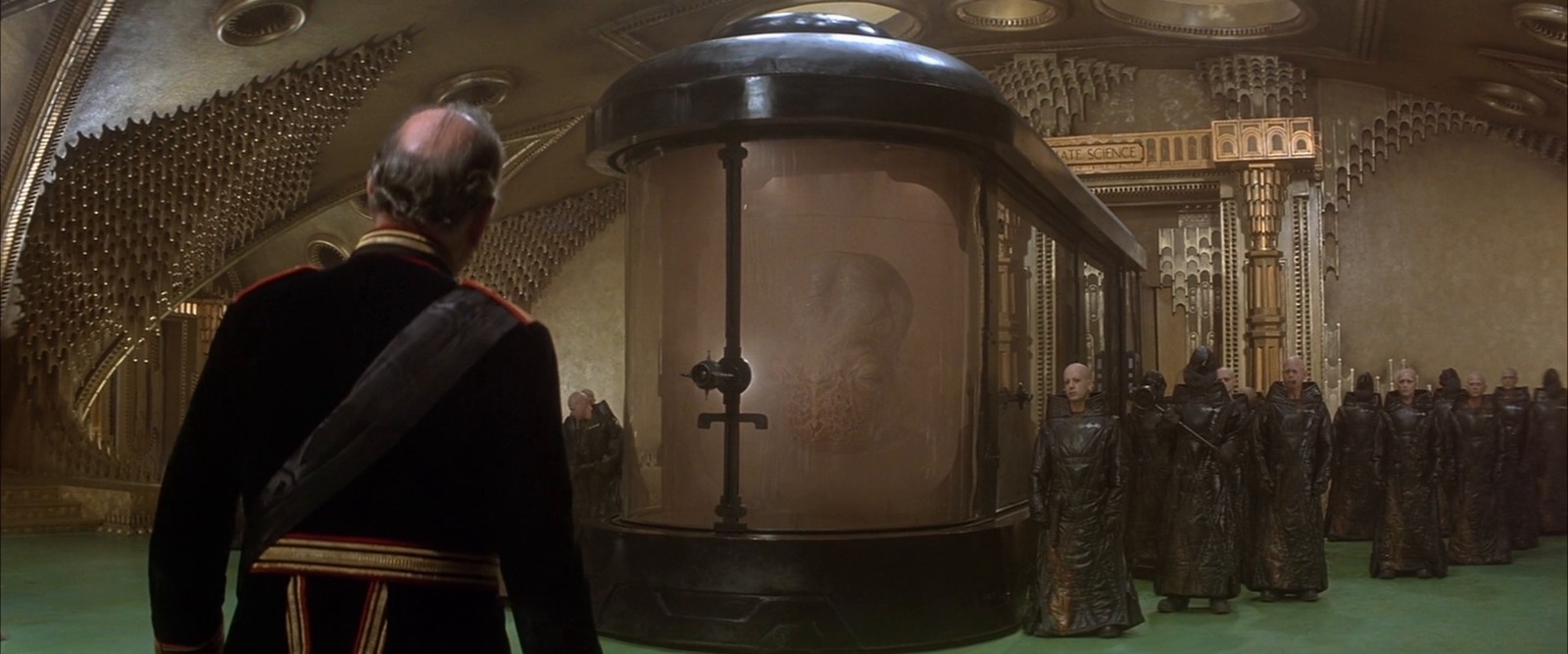
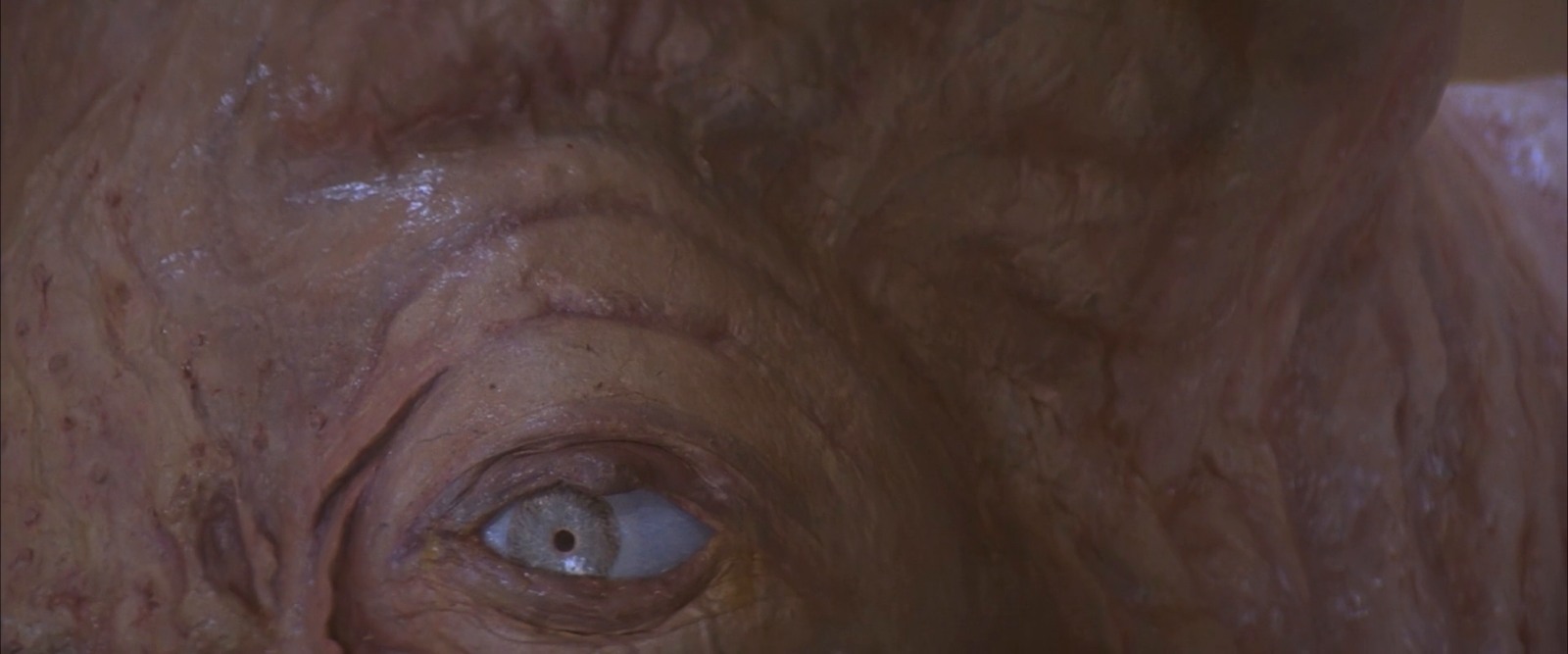
13:50The Navigator does not simply enter the Emperor’s room: a large container and a group of attendants must enter with him. Wider views establish the tank’s scale; closer views break the visitor into wet skin, an eye and an opening in the face. The Emperor can command an empire, but this encounter makes his dependence on another body immediately visible. Follow the changing viewpoints in the gallery below.
Link to this study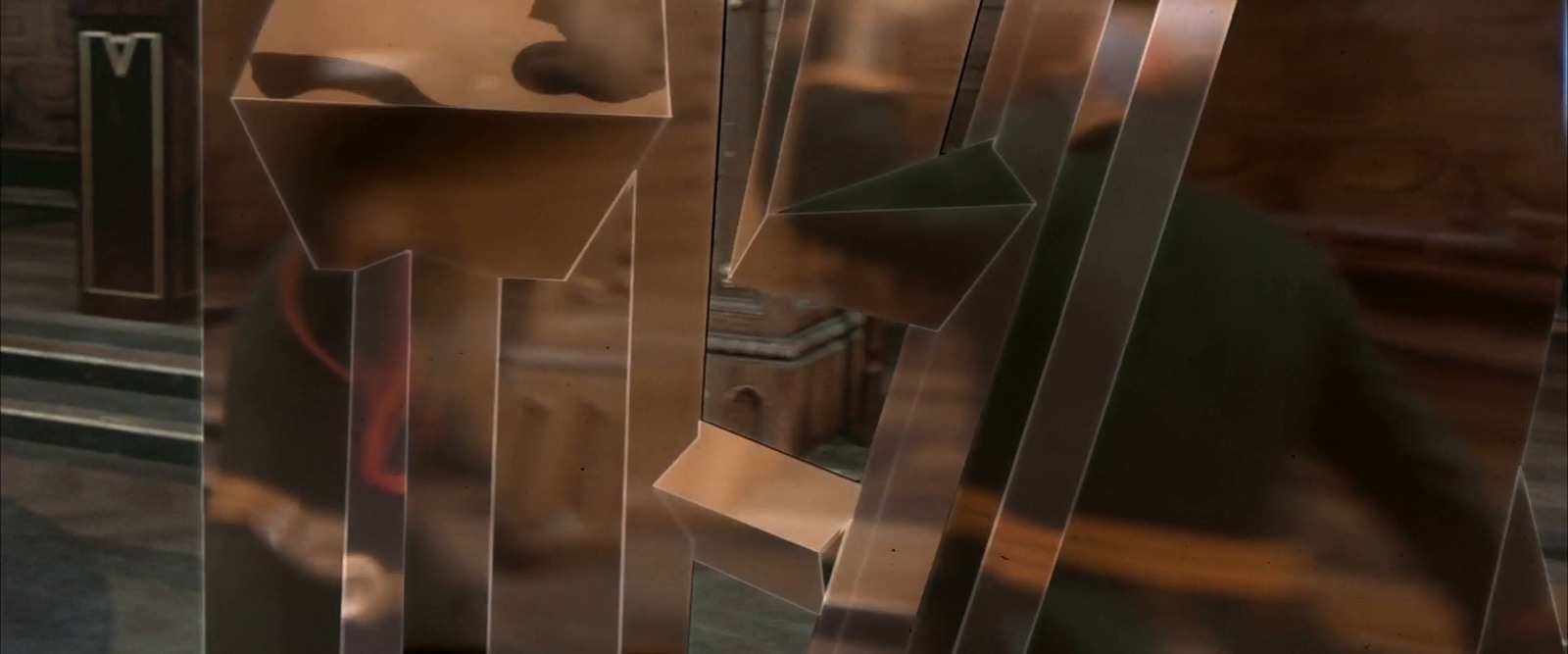
The body becomes geometry
22:45Paul’s training turns a familiar exchange between teacher and pupil into a contest between angular, translucent surfaces. The shields interrupt the outline of the body without erasing it entirely. These geometric layers make protection visible, while the physical reach of an arm and the proximity of a blade remain central. The lesson gives a technological form to the film’s recurring concern with how a vulnerable body can be approached.
Link to this study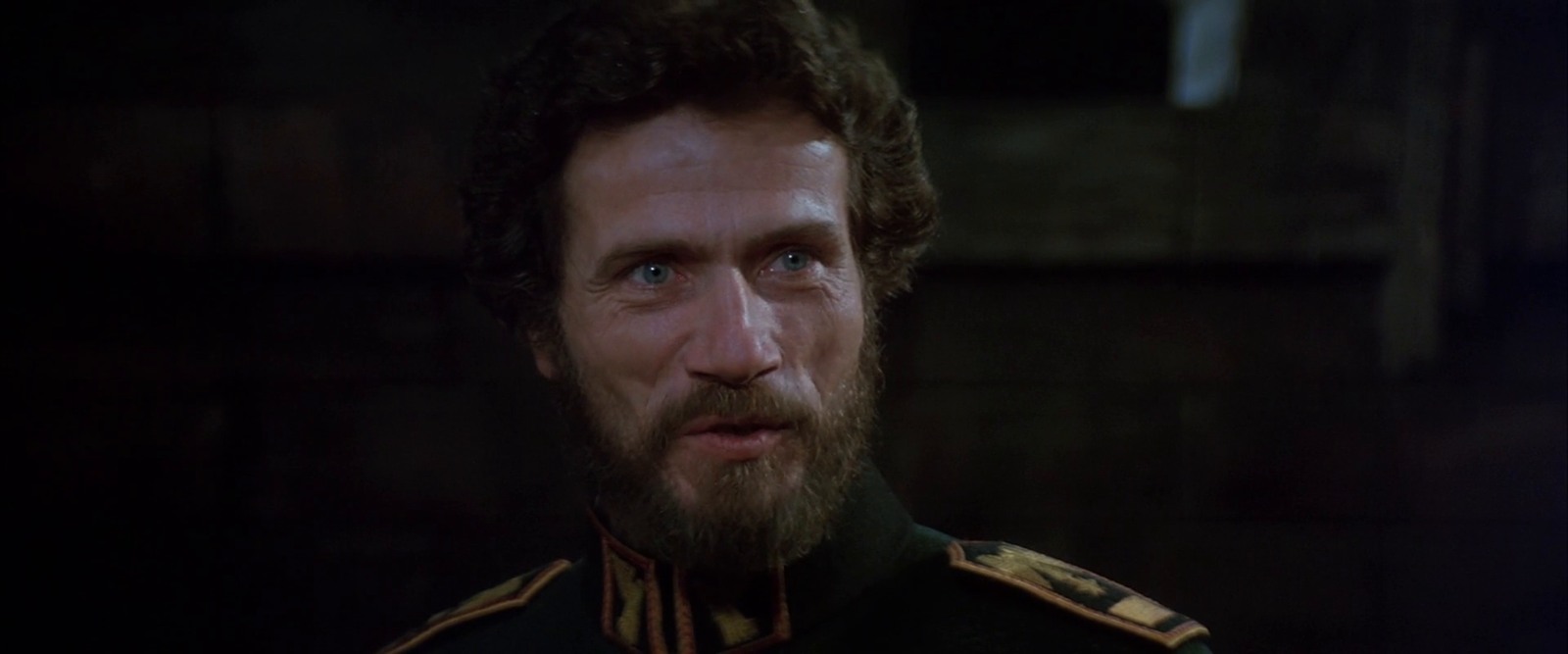
A father speaks inside a system
29:45Leto’s conversation with Paul is held within the dark, heavy interiors of Caladan. The close view allows paternal attention to interrupt the ceremonial bearing of a ruler. This intimacy matters when the film moves into more spectacular displays of authority: family feeling and political obligation occupy the same person, and the move to Arrakis puts both at risk.
Link to this study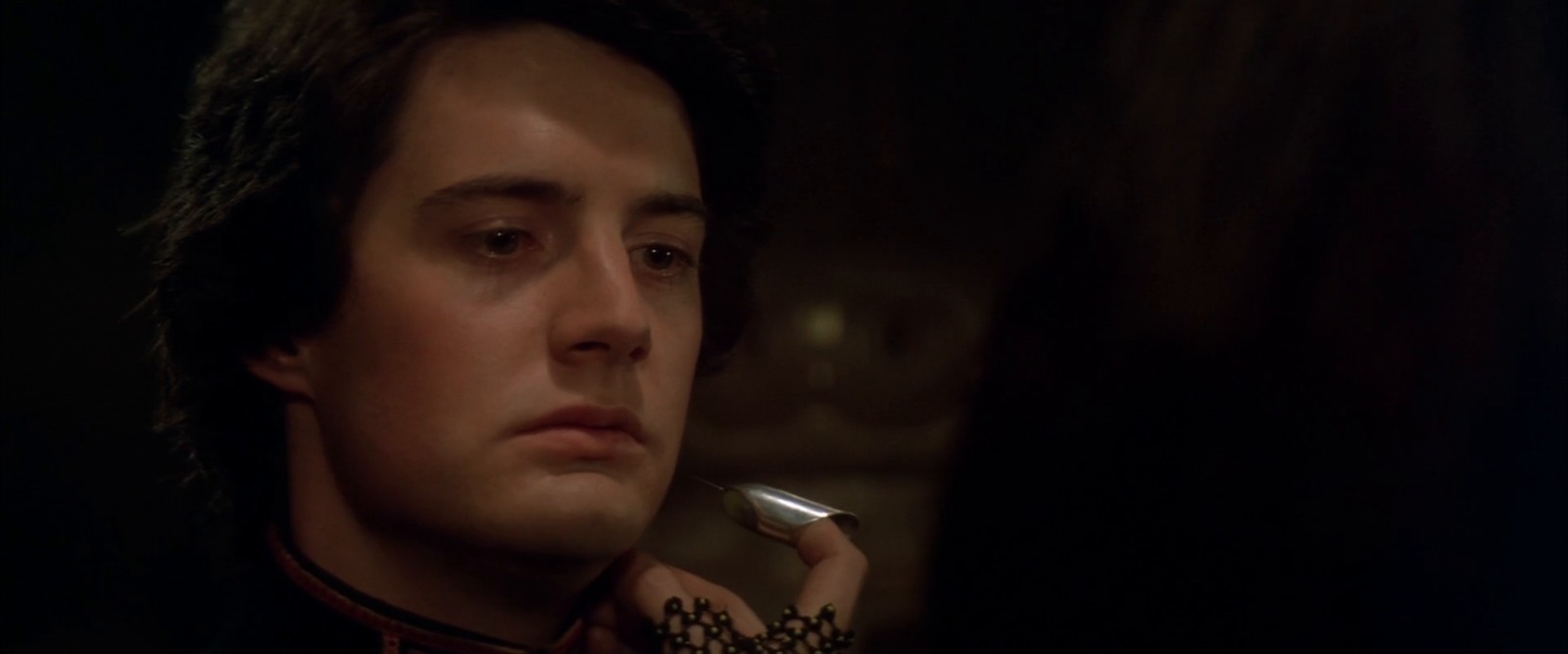
Pain without a wound
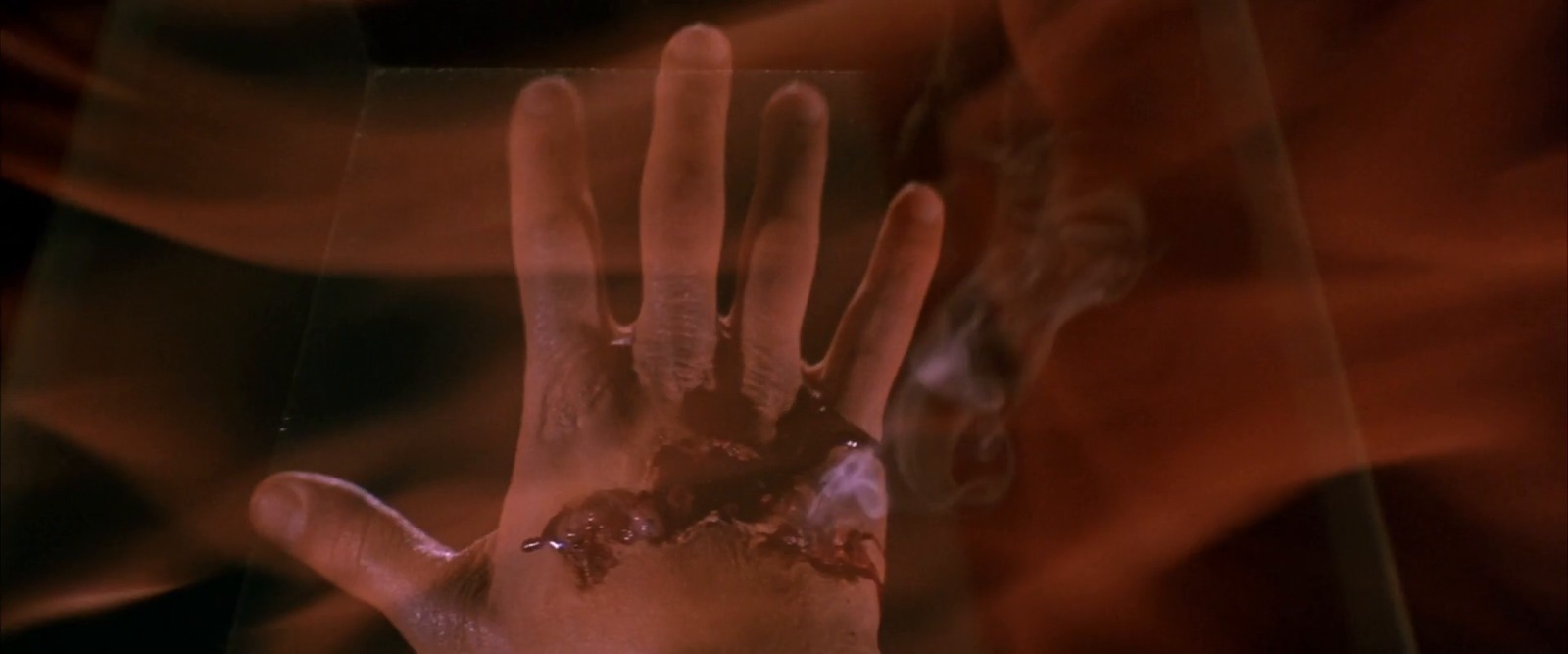
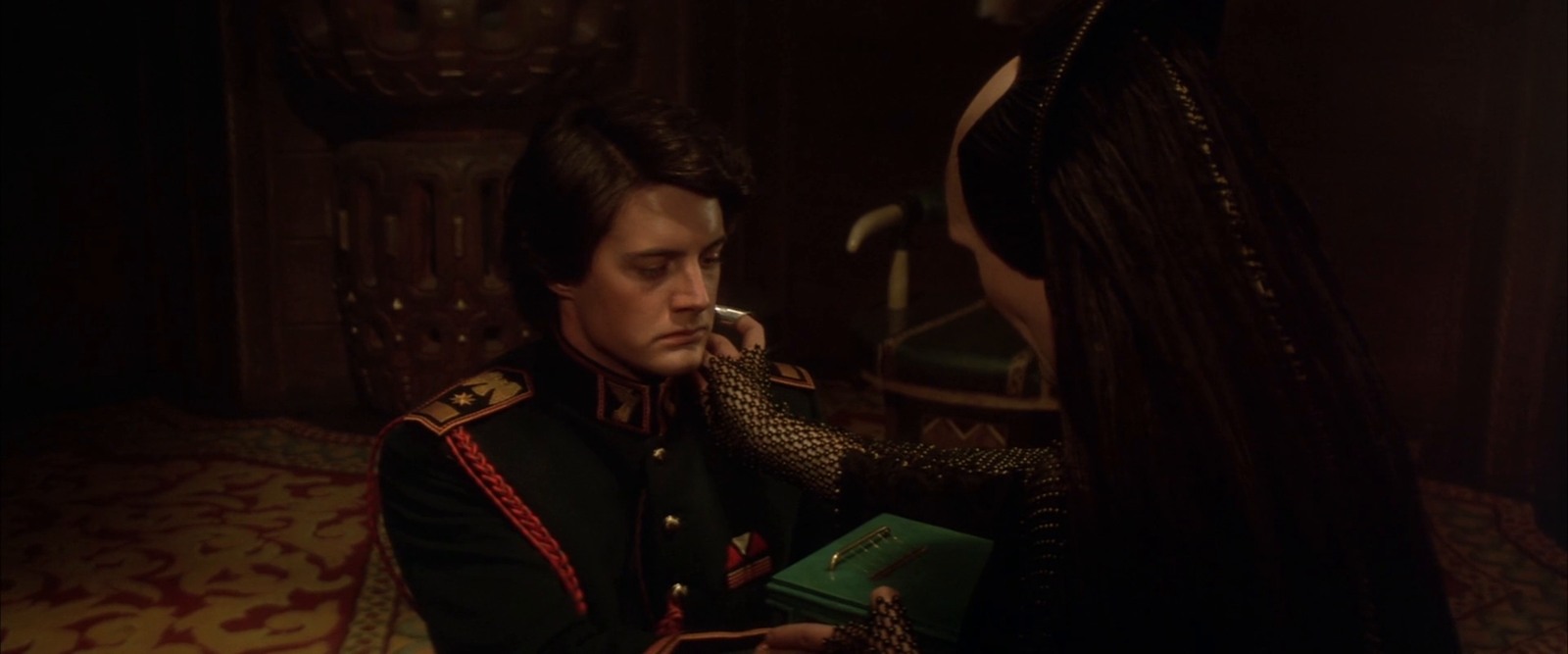
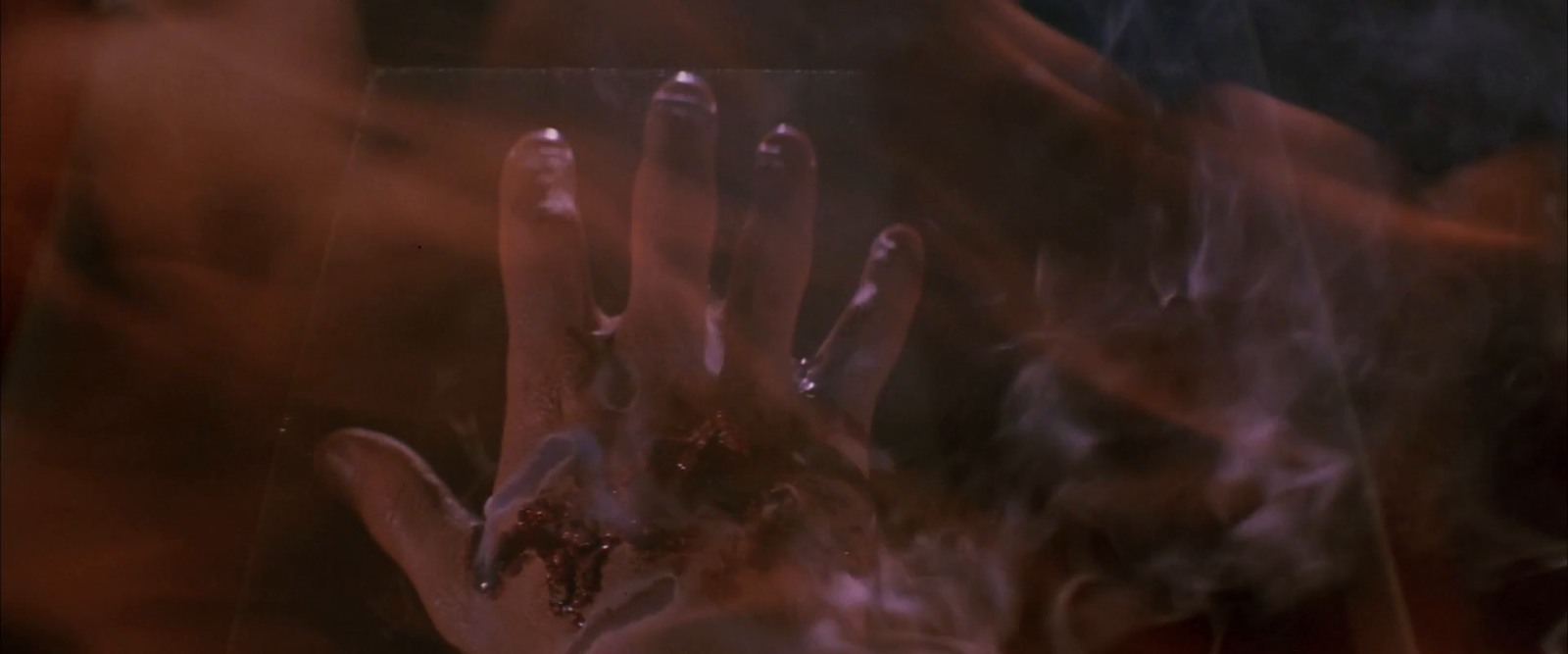
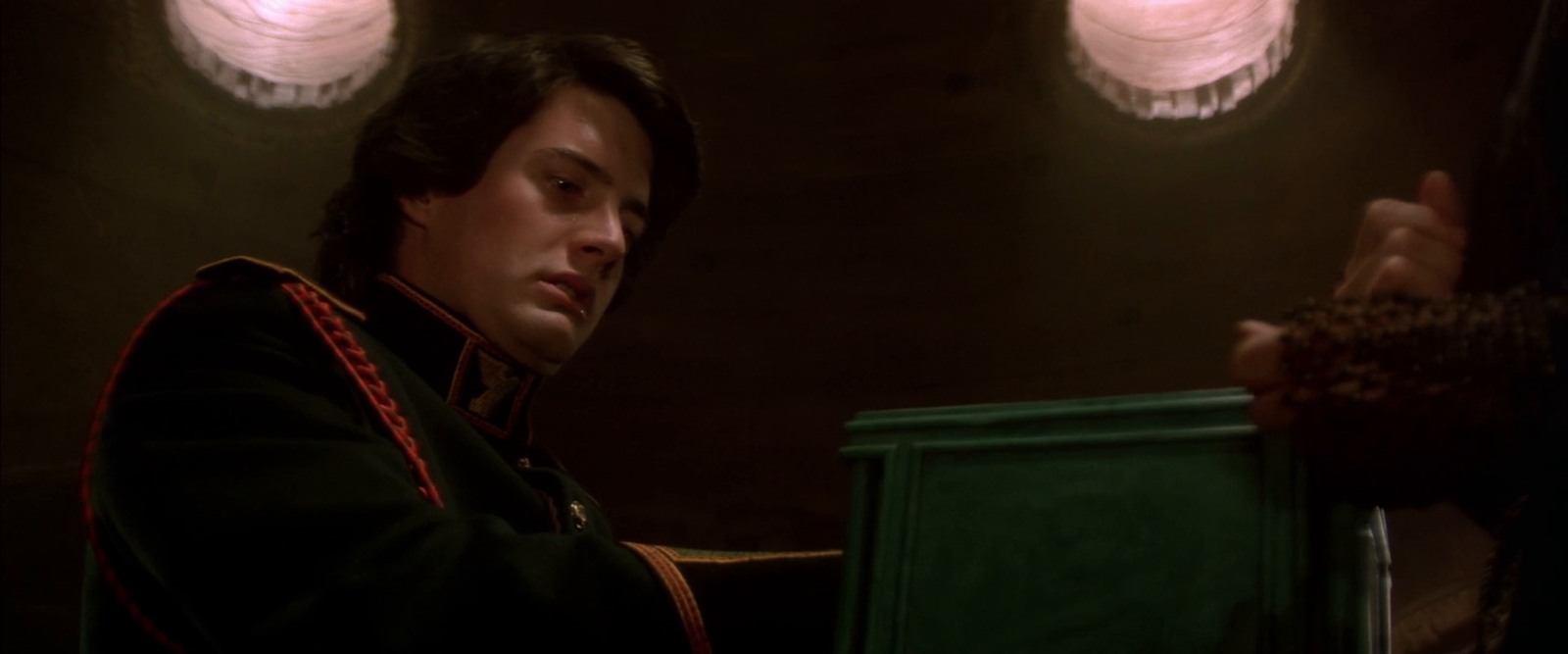
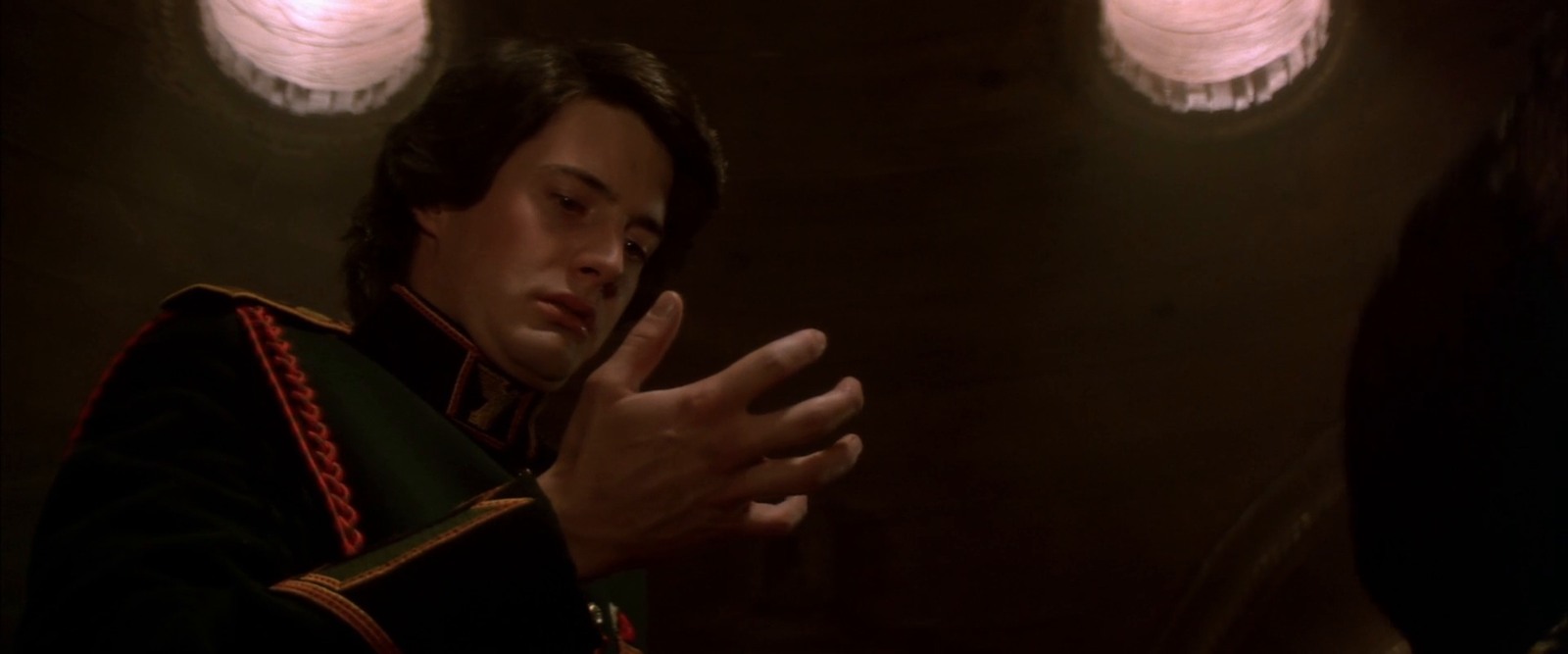
37:36The test concentrates its threat in two places: an unseen hand inside a box and a tiny point against the neck. Paul’s face carries the effort of remaining still. The burning-hand images then supply a terrible image for a sensation that the room itself cannot show. When the hand is withdrawn intact, the sequence separates what the spectator has seen from what has physically happened to the body.
Link to this study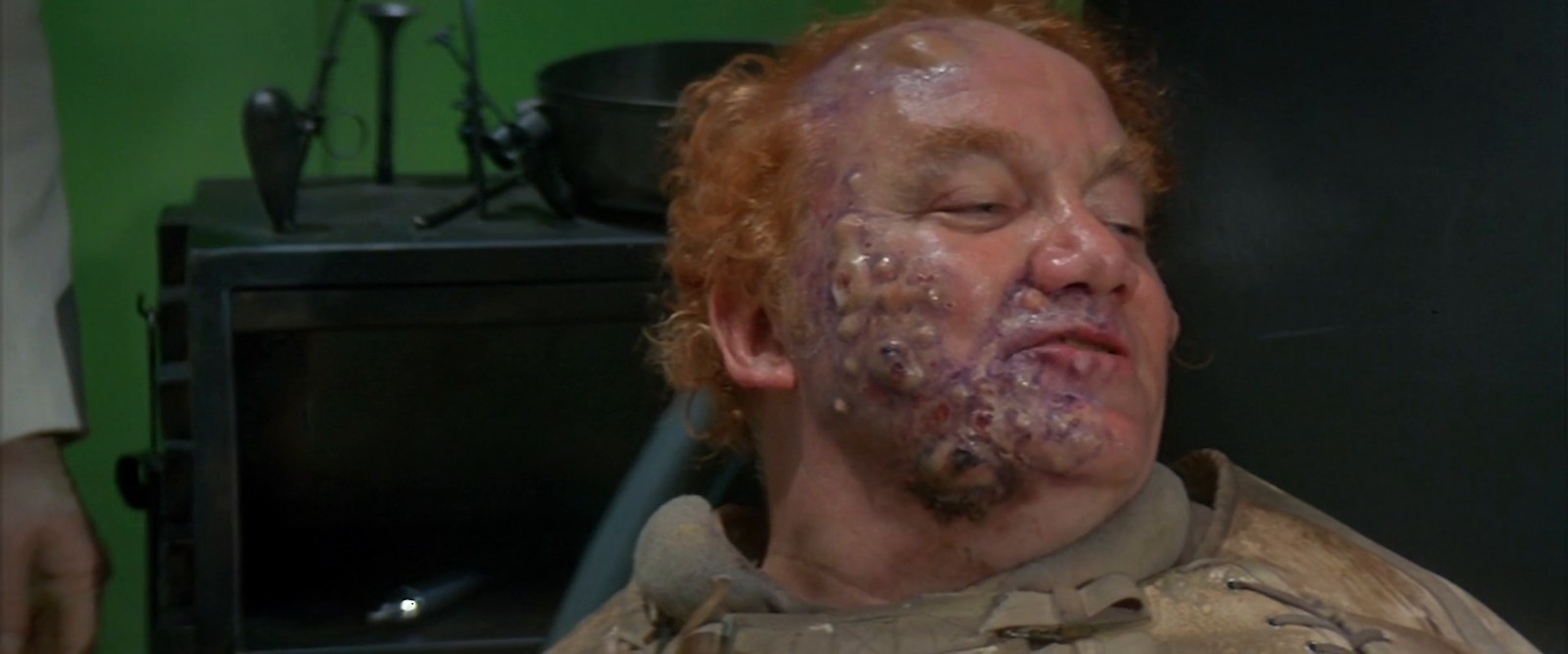
The Baron as a maintained body
47:36Giedi Prime’s green room presents the Baron through exposed skin, attendants and machinery. The close view of his face makes texture impossible to ignore; his later rise into the air turns bodily weight into a strange display of privilege. Compare this dependence on apparatus with the Navigator’s tank. Both rulers possess exceptional power while requiring an environment arranged around their bodies.
Link to this studyScene studies / 02
Entering Arrakis
Travel and ceremony give way to the practical problems of surviving a hostile environment.

Travel becomes a vision
53:45The movement between planets passes through images of light, stars and a transformed space rather than a continuous, mechanically legible journey. Seated passengers and vast vessels provide points of orientation, but the intervening imagery loosens those coordinates. The film can explain the importance of travel while still presenting the experience as a passage through an unfamiliar state of perception.
Link to this study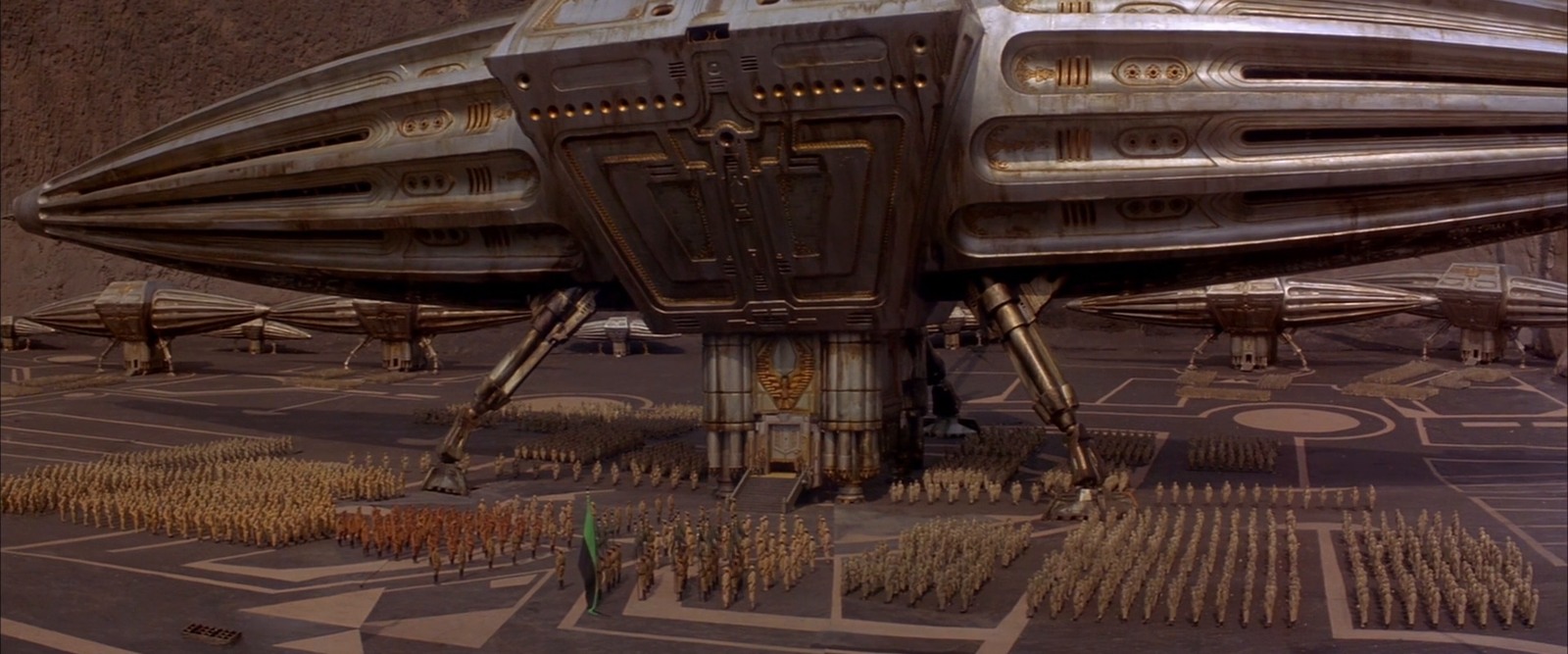
The arrival as a scale study
55:45The grounded transport and the ranks beneath it turn arrival into an image of organized power. Human figures become a measure of the vessel’s enormous size. Arrakeen’s architecture then gives that arrival a permanent setting: monumental surfaces and a cliff-bound palace appear to secure the incoming rulers. The later attack will transform those same impressive spaces into places of exposure.
Link to this study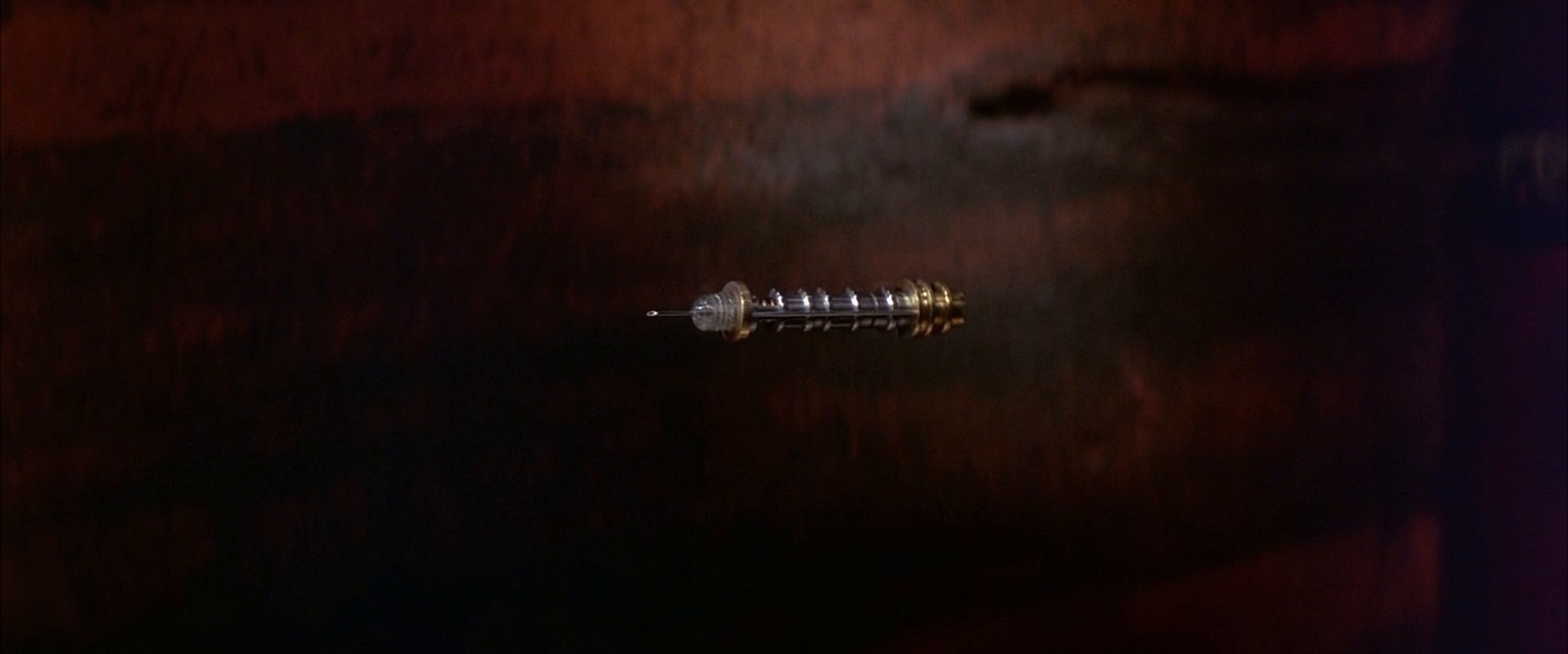
A room becomes a hunting ground
1:04:45The hunter-seeker reverses the scale of the arrival sequence. Danger is now small enough to move among furnishings and to demand extreme attention from Paul. Close views of the device and of his watchful face make the room’s empty spaces threatening. The scene depends on the relation between movement and stillness, giving a private chamber the suspense of an exposed landscape.
Link to this study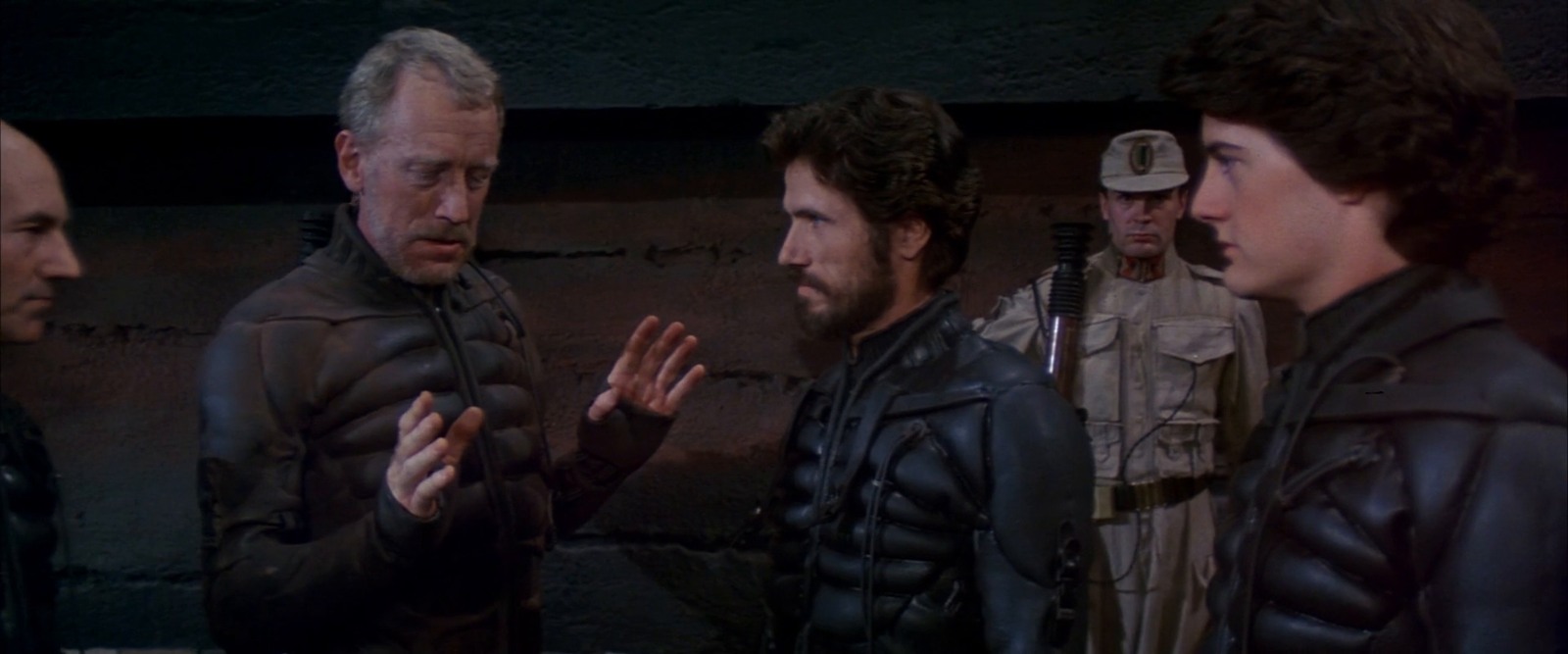
Clothing as an argument for survival
1:14:15Kynes’s inspection puts hands, tubing and the fit of a garment at the centre of the scene. The stillsuit is an object whose meaning comes from use, not merely from its silhouette. This practical encounter changes the terms on which the newcomers can claim competence: rank is insufficient in the desert. The body has to learn the planet’s requirements, and its clothing makes that lesson visible.
Link to this study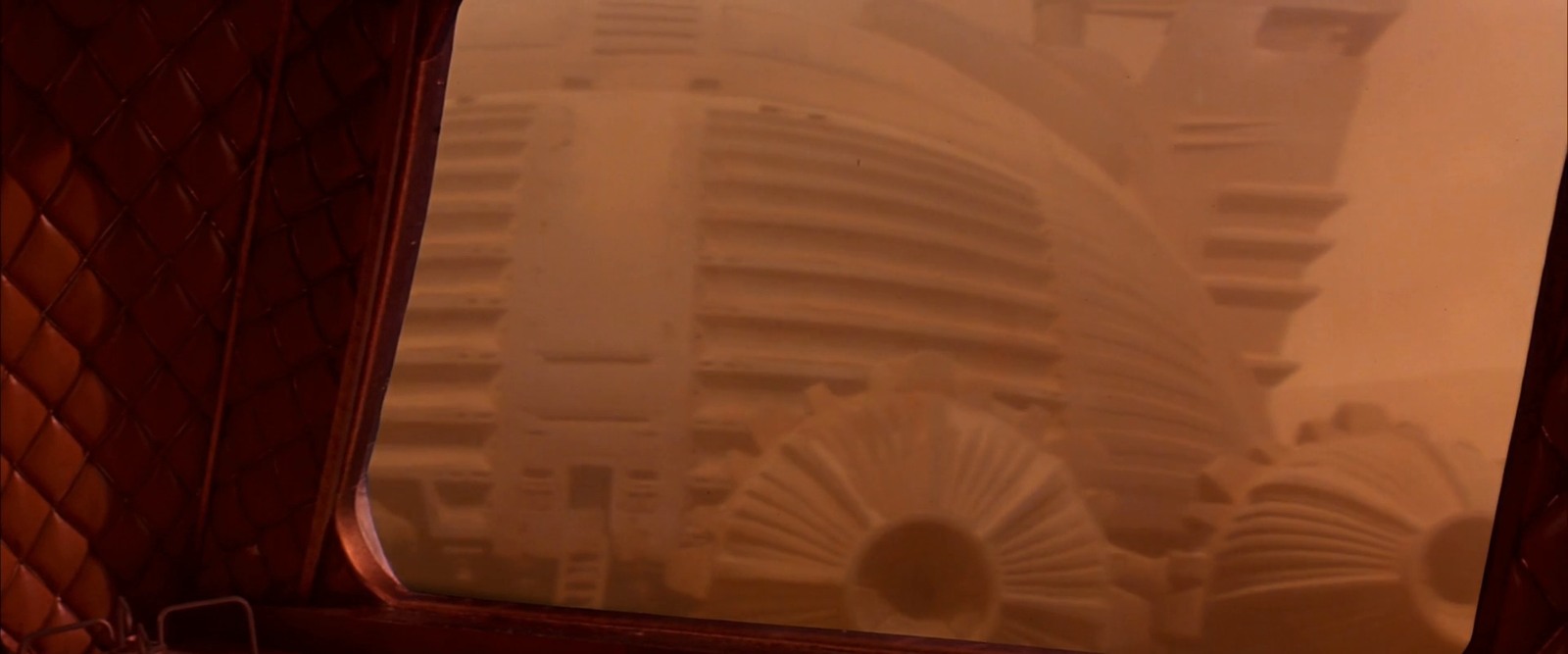
The machine and what lies beneath it
1:20:45The aircraft window repeatedly frames the desert as an observed surface. Worm sign and the threatened harvester unsettle that apparently manageable view. The sequence moves between the cockpit, the machine and the immense field of sand, joining a decision about people to a problem of scale. The desert cannot be reduced to a resource seen from above: something beneath its surface can swallow the machinery.
Link to this study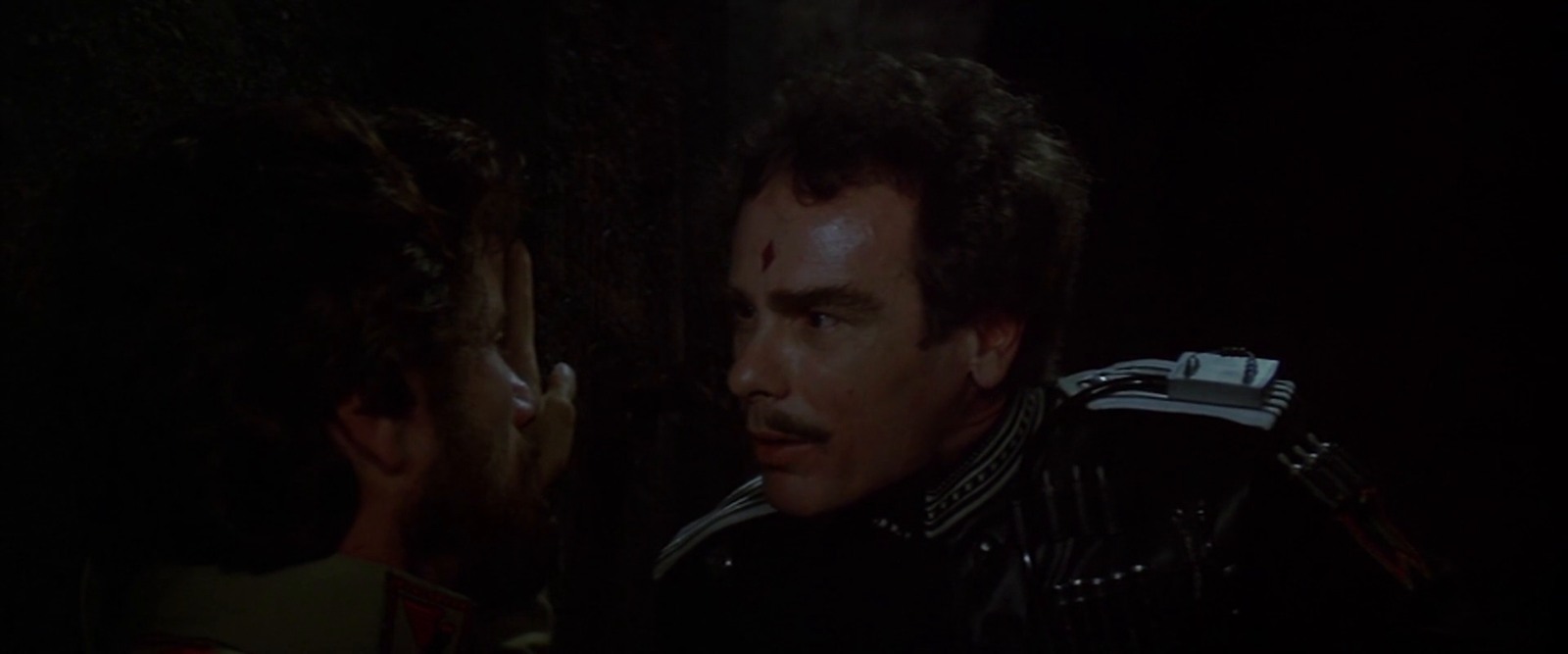
Trust becomes bodily vulnerability
1:29:00The betrayal is given a physical form through Leto’s collapse and Yueh’s intervention at close range. A physician’s access to the body becomes inseparable from the destruction of the household. The tooth links this small, intimate encounter to a later attempt at revenge. Across these scenes, political calculation is carried by a minute object inside a helpless man’s mouth.
Link to this studyScene studies / 03
The fall of a house
The palace becomes a trap. Survival means learning to inhabit the spaces beyond it.
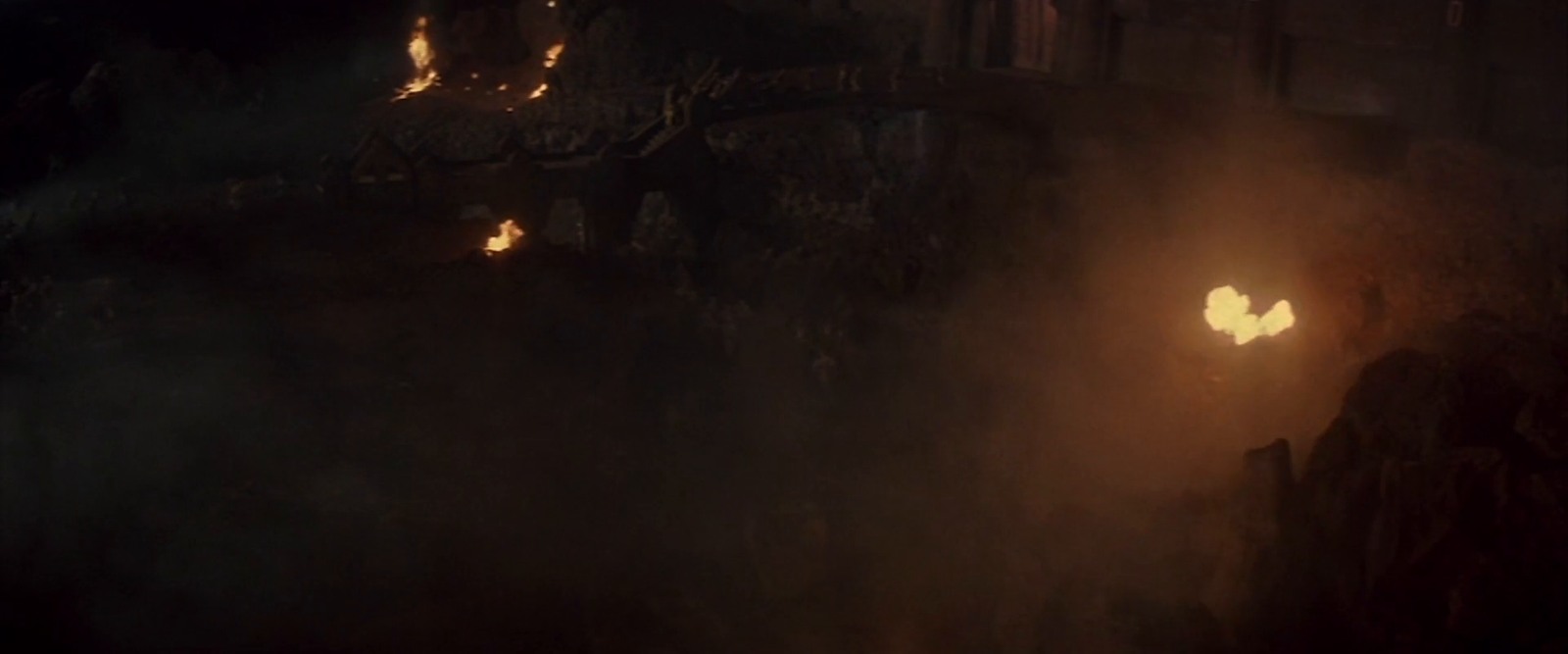
The palace opens to fire
1:31:45The attack breaks the visual confidence of the arrival. Night, flames and moving troops replace the ordered parade, while interiors and exteriors become parts of the same breached space. The family is separated within the building that was meant to establish its rule. Architecture continues to dominate the image, but its meaning changes from authority to entrapment.
Link to this study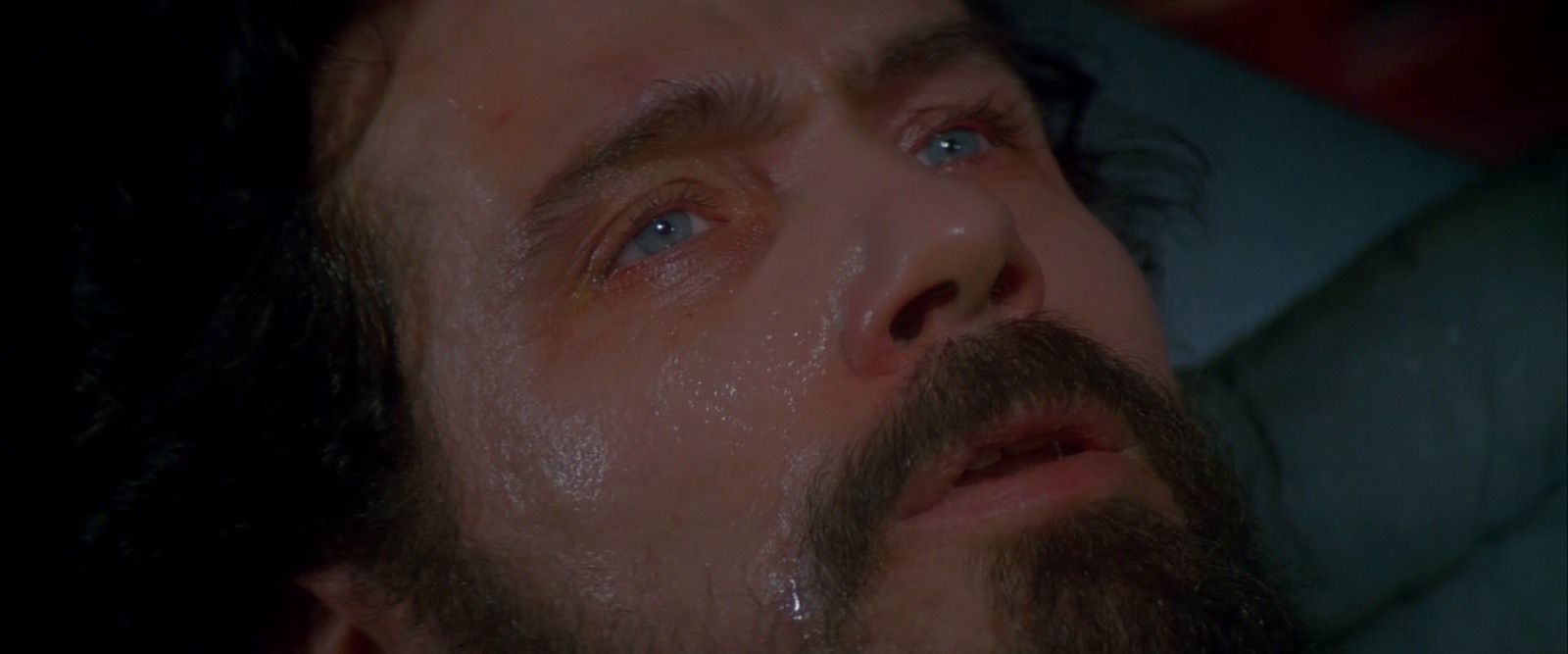
The last gesture of the Duke
1:44:05Leto’s immobilized body is surrounded by enemies who move and speak over him. The scene gives his face and mouth a disproportionate importance: what remains possible for him is concentrated there. Returning to this close view after the large-scale assault changes the measure of the struggle. The last act of resistance depends on a bodily gesture rather than an army.
Link to this study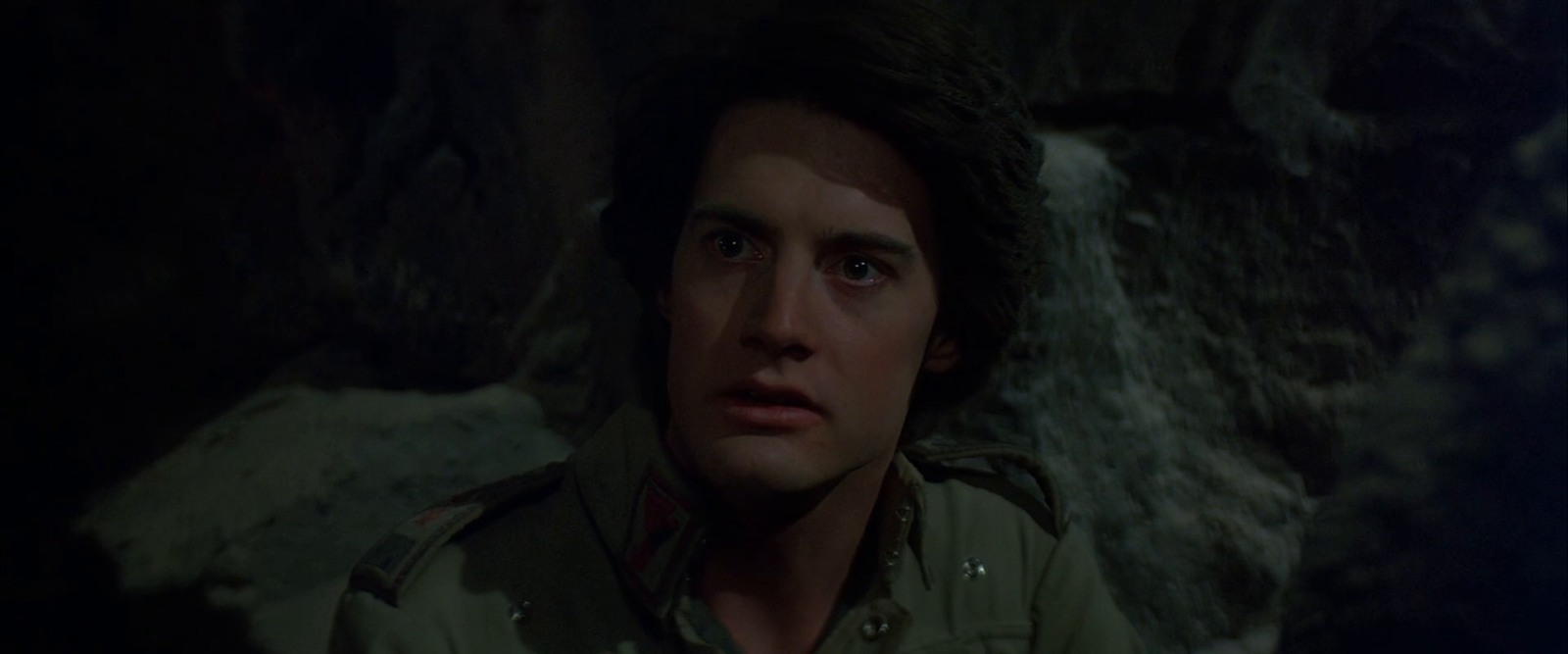
A future inside a confined space
1:49:00The desert shelter reduces the scale of the film to Paul and Jessica in darkness. The loss of the household is followed by an unsettling enlargement of Paul’s possible future. His face becomes the central landscape, replacing the palace’s monumental rooms. This pause is essential to the transition: the fugitive’s physical vulnerability and his growing sense of destiny exist together.
Link to this study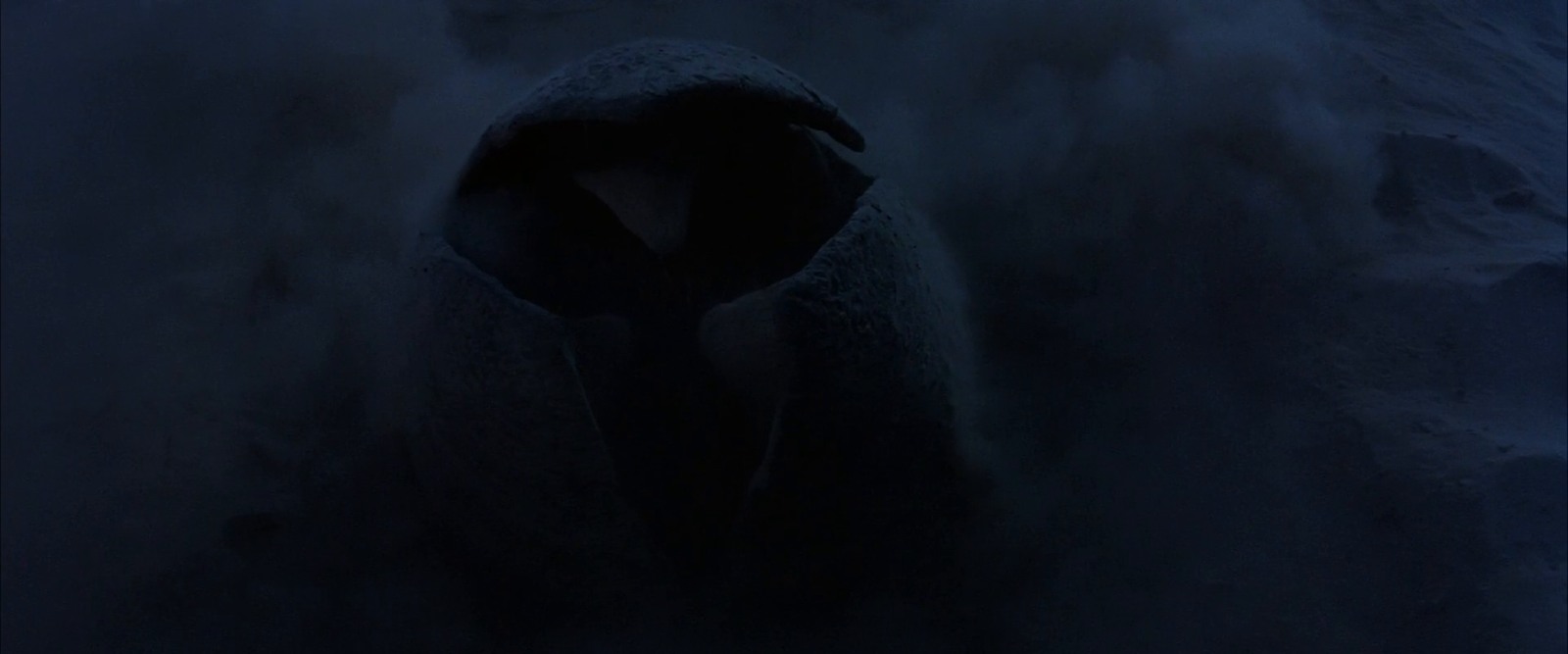
The ground refuses to remain still
1:53:15In the escape across the desert, distance offers no simple promise of safety. The worm turns the ground beneath the fugitives into an active force, and its mouth makes their scale brutally clear. Rock and sand become different kinds of space rather than a uniform backdrop. The later riding sequence will return to this terrifying relationship and reorganize it as a learned skill.
Link to this study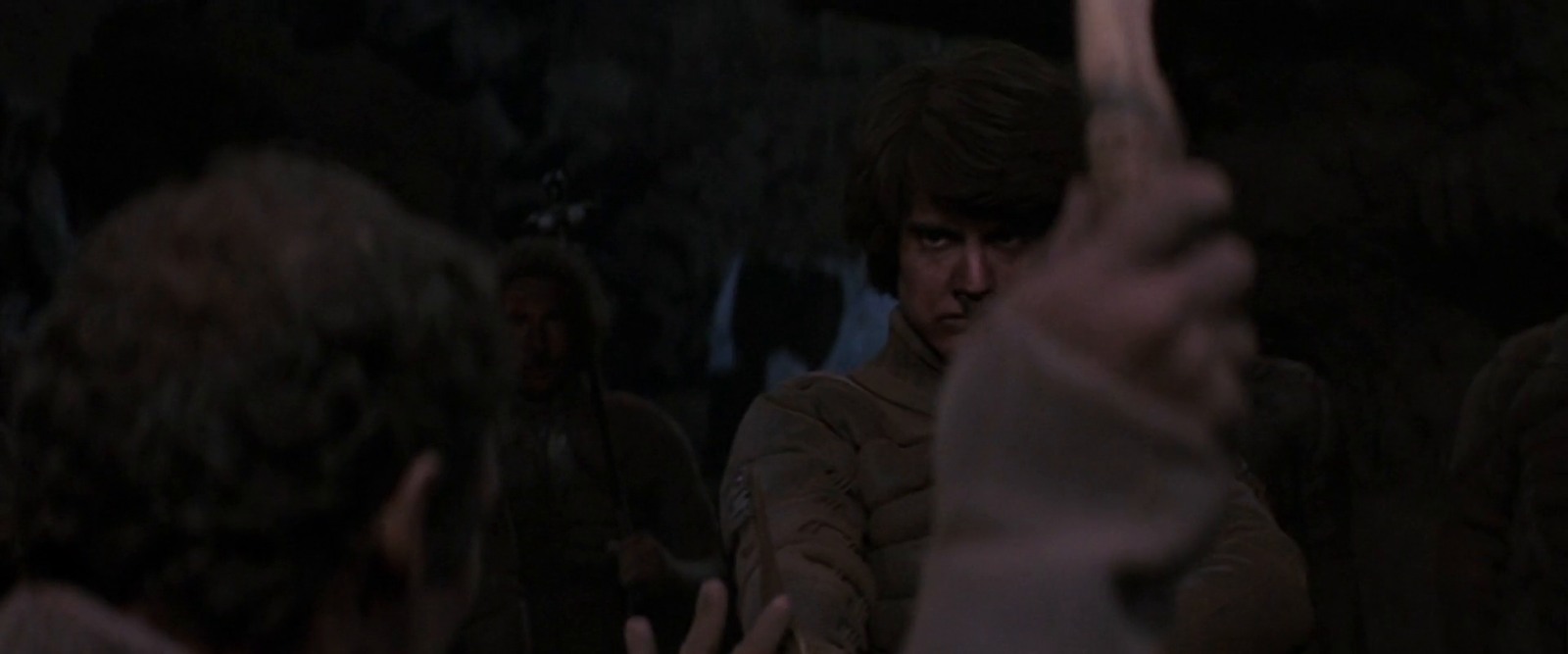
Training meets an unfamiliar rule
1:58:36The encounter with Jamis relocates Paul’s training from an equipped room to a circle of observers in the rocks. A knife must now be handled under different conditions and with irreversible consequences. Close views of the watchers make this more than a test of reflexes. Paul’s admission to the group passes through an act witnessed and judged by a community.
Link to this study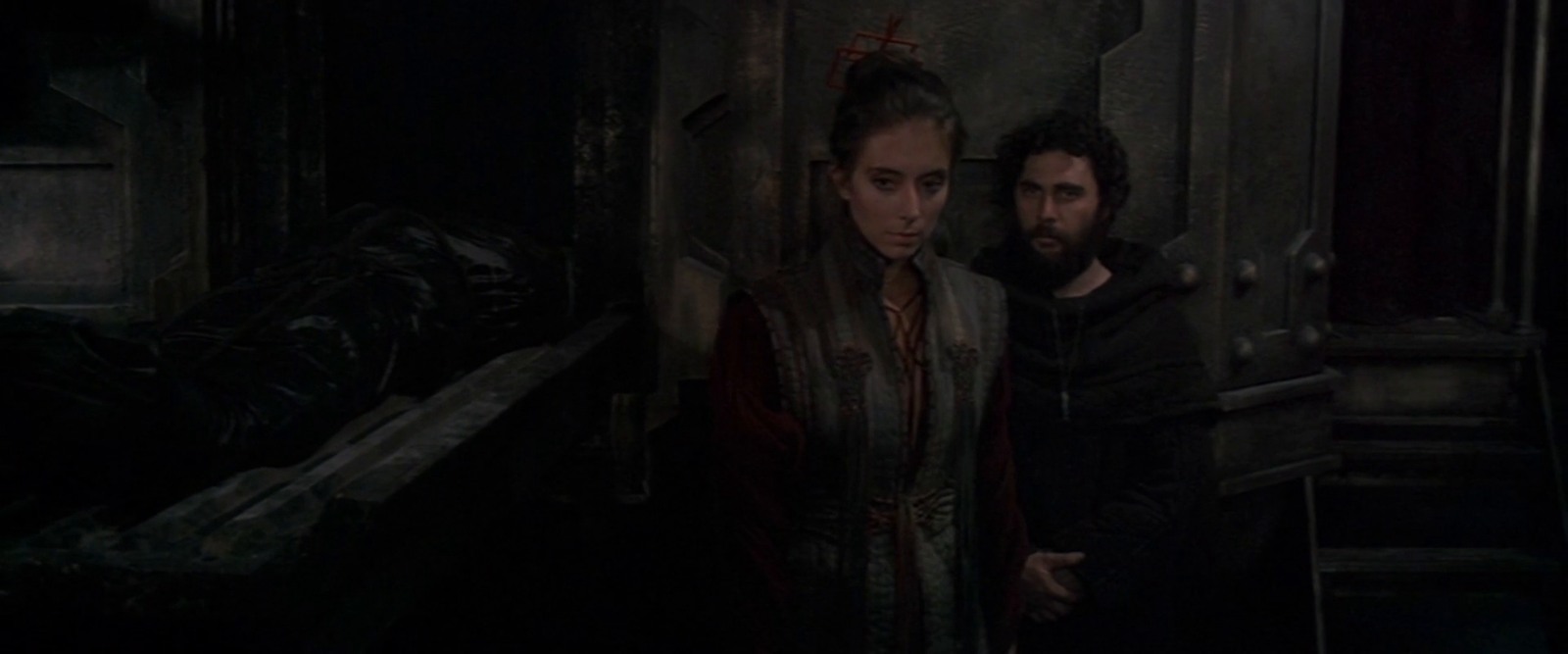
A death enters the community’s memory
2:01:45The passage after the fight gives space to the community left behind by Jamis. Family, possessions and the accounting of water prevent the duel from ending at the instant of victory. These scenes are especially valuable within this extended assembly: they ask the viewer to remain with the social consequences of Paul’s arrival, rather than treating entry into the Fremen world as a simple change of allegiance.
Link to this studyScene studies / 04
From fugitive to ruler
Ritual, collective training and a changing relationship with the desert make Paul’s authority visible.
A ritual reaches inside the body
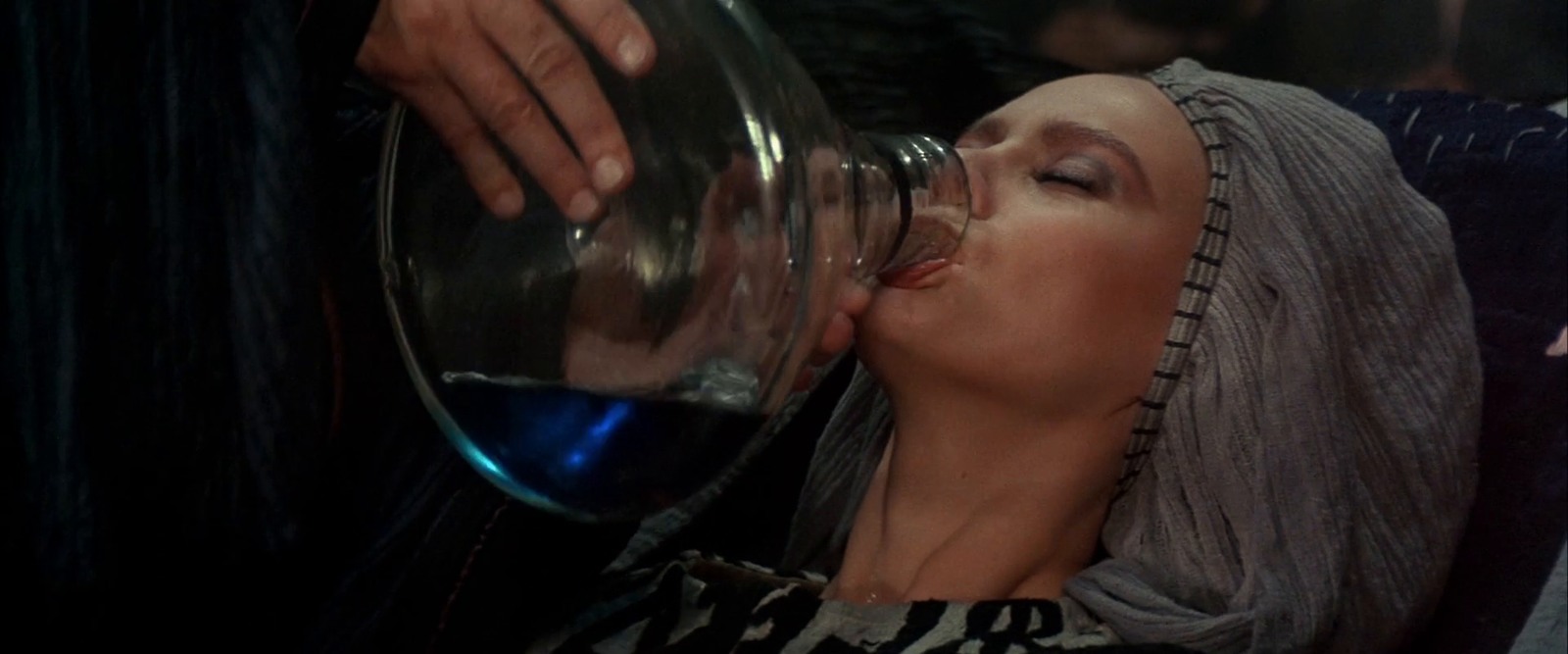
2:08:30The ceremony connects public observation to an event inside Jessica’s body. Faces gathered around her establish a shared ritual; the imagery of the unborn child gives it another, inaccessible scale. The film crosses from the social room to a red interior world. Transformation is therefore both an event witnessed by others and an image that ordinary spectators within the scene could not see.
Link to this study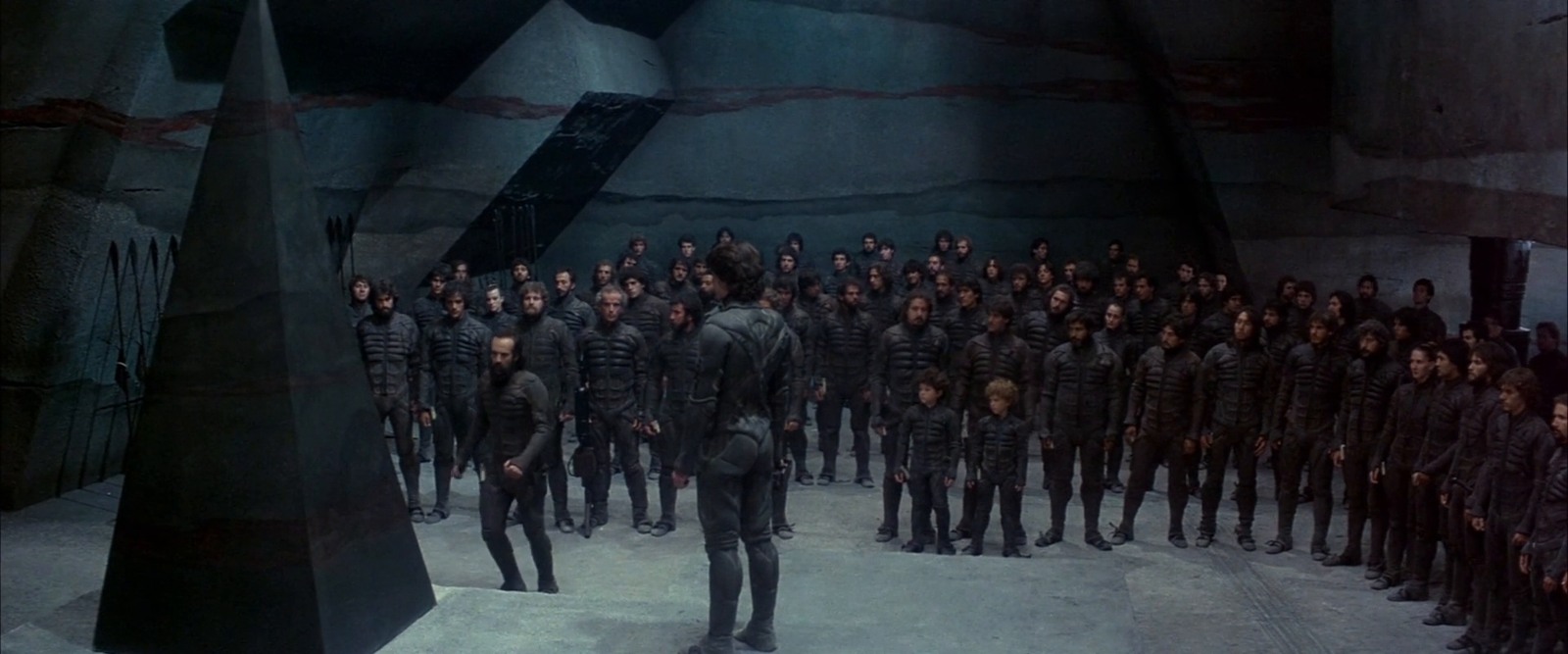
An army learns to project itself
2:14:00The training scenes replace the earlier duel between two shielded individuals with a group learning a collective practice. Lines of bodies, demonstrations and directed attention organize the space around Paul. The weapons visibly join voice and bodily action. Even before the final battle, the staging shows authority being reproduced through instruction, repetition and the conversion of spectators into participants.
Link to this study
Learning to inhabit the monster’s scale
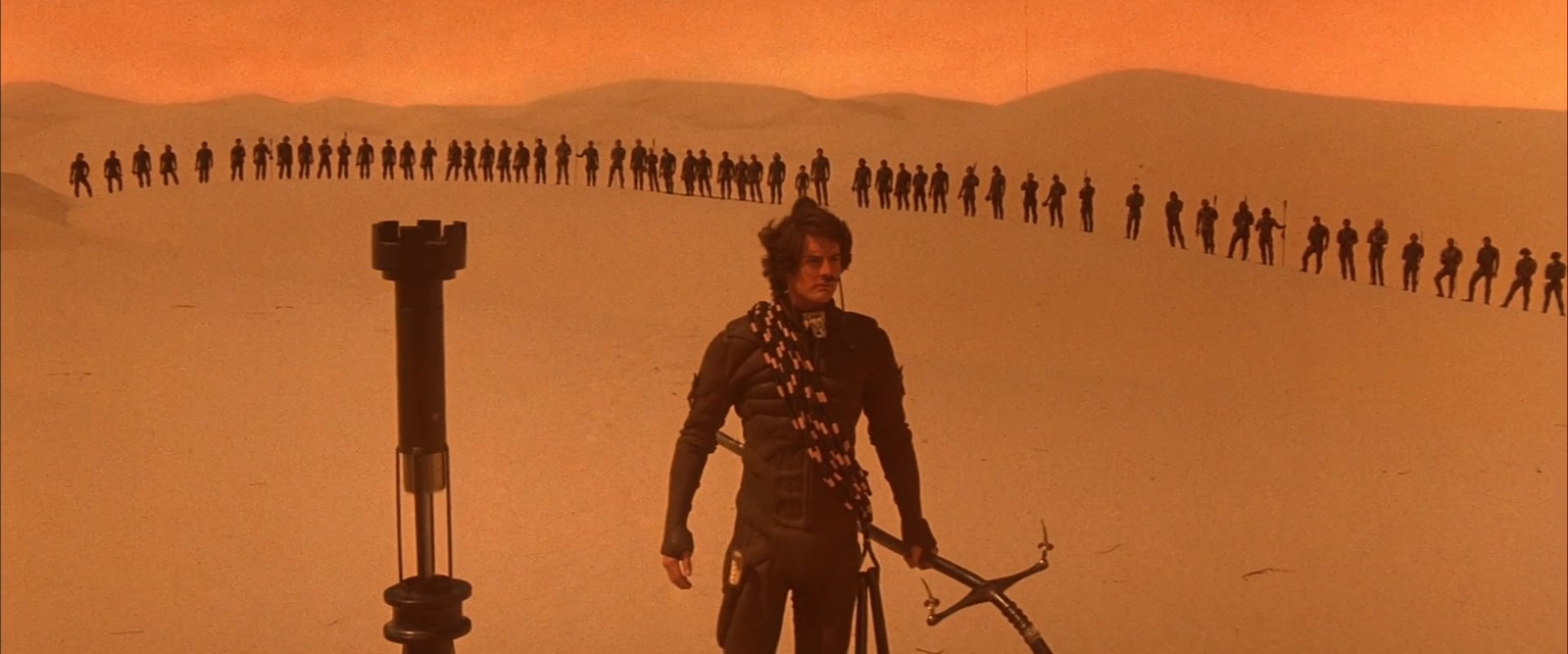
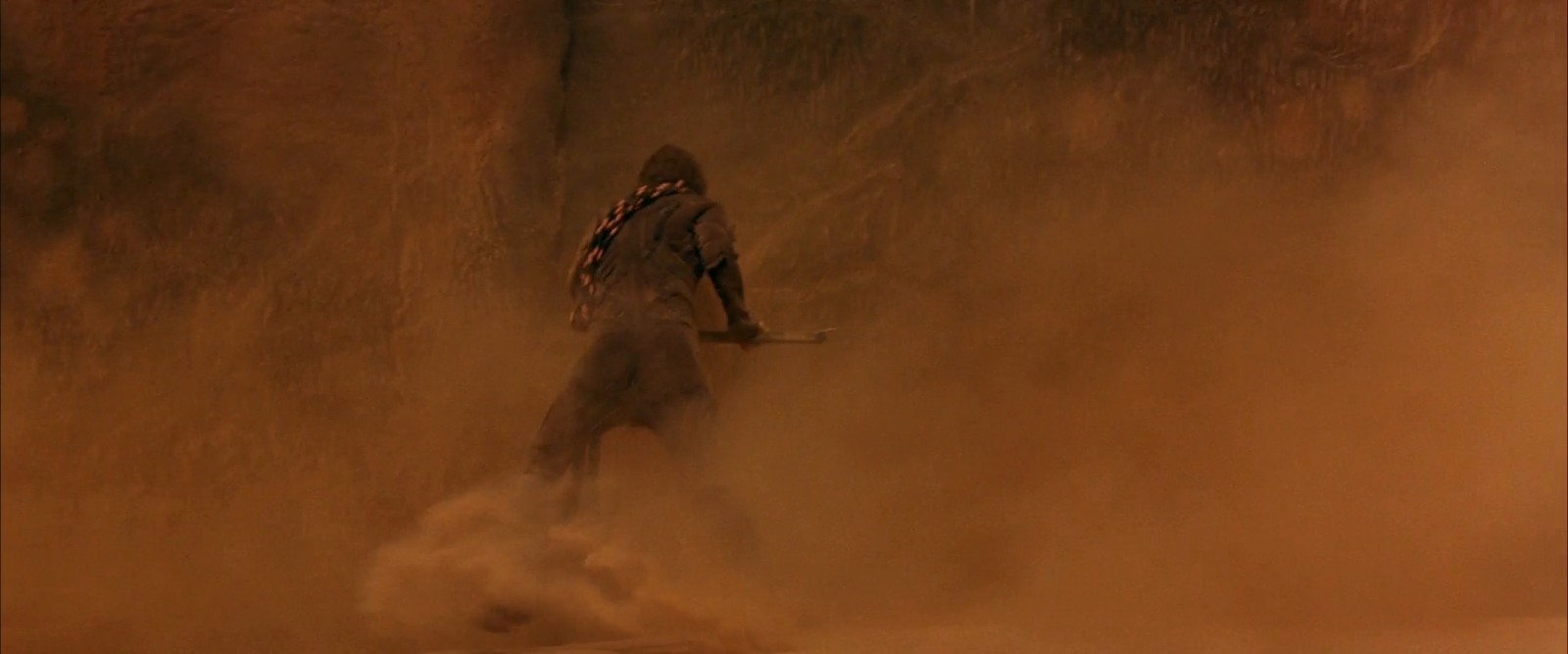
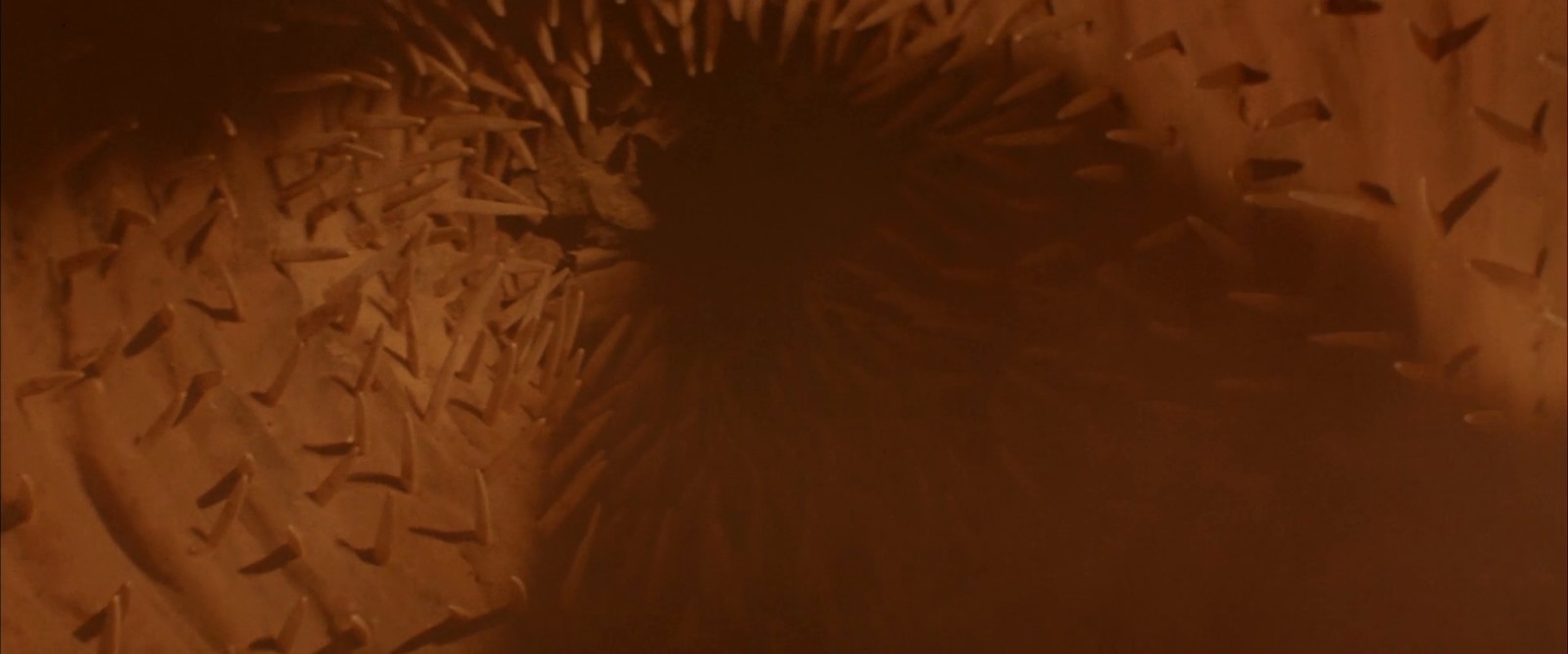
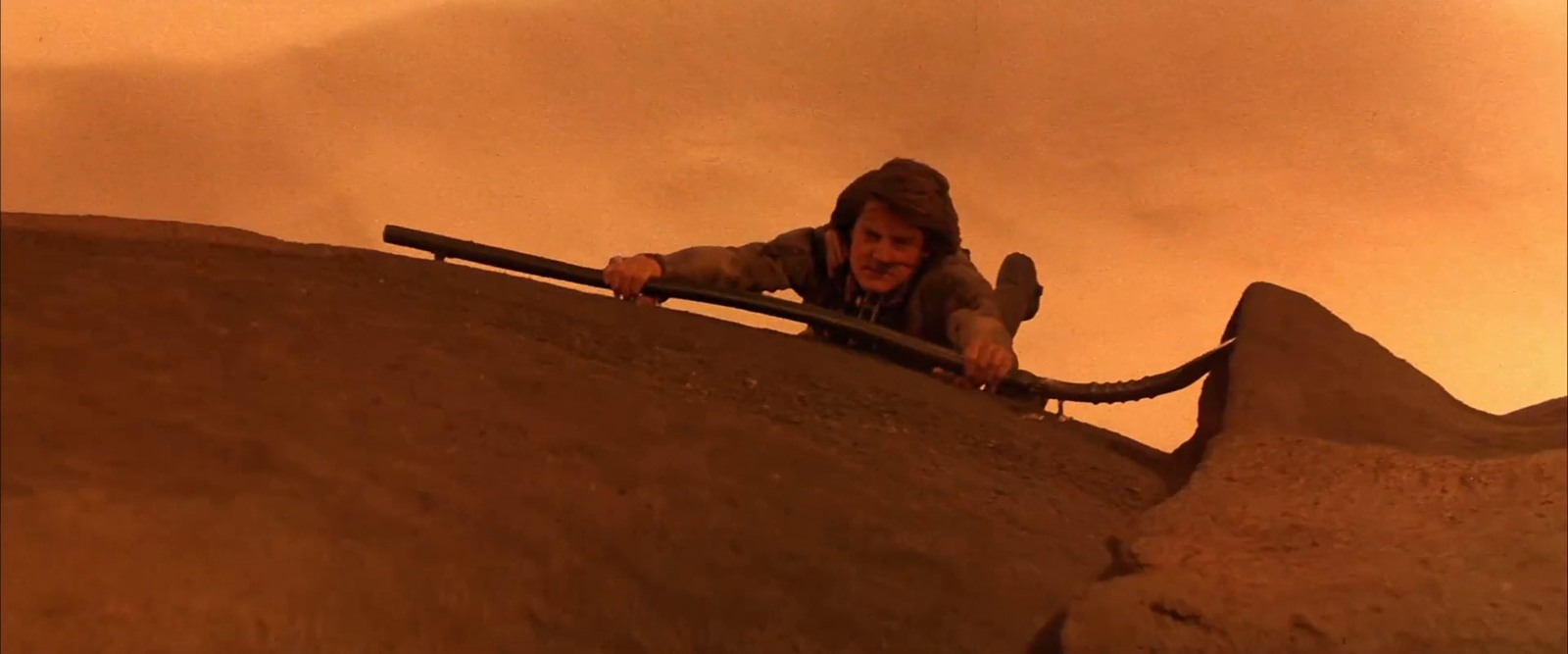
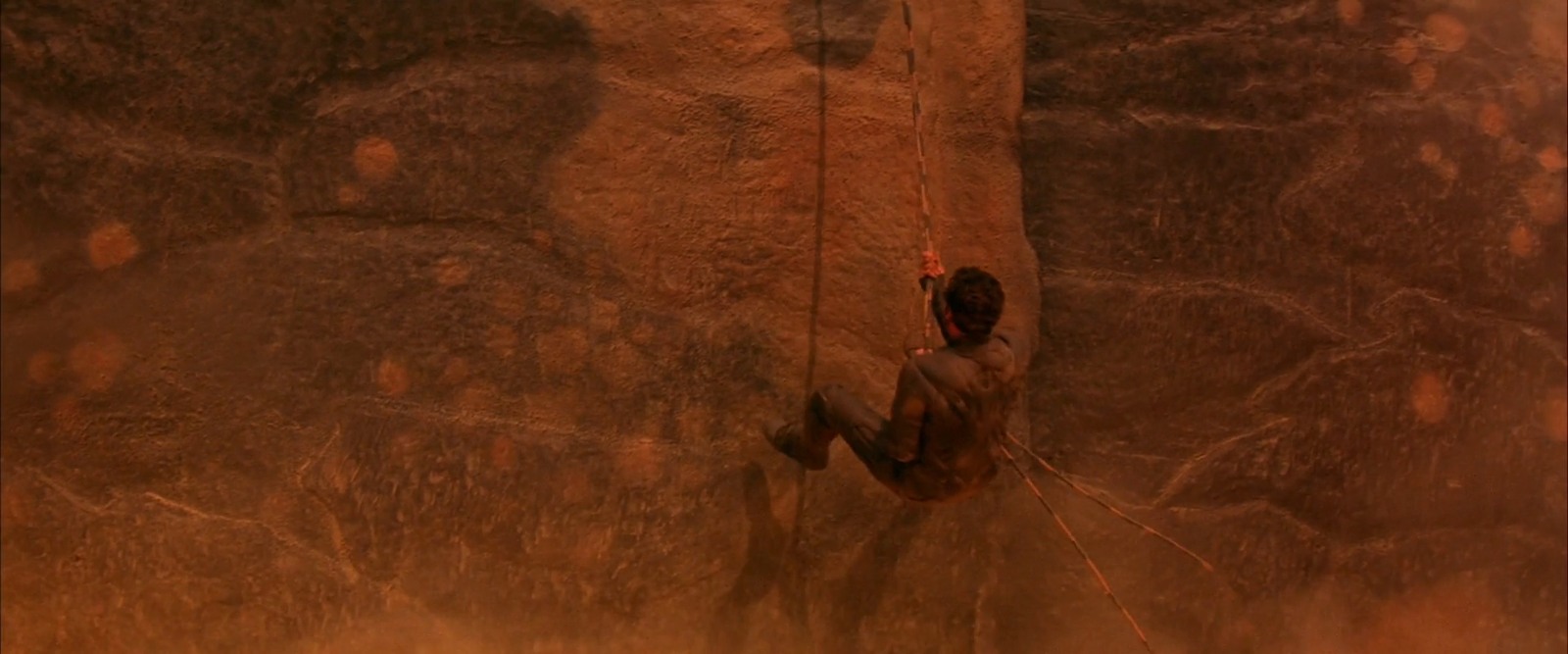
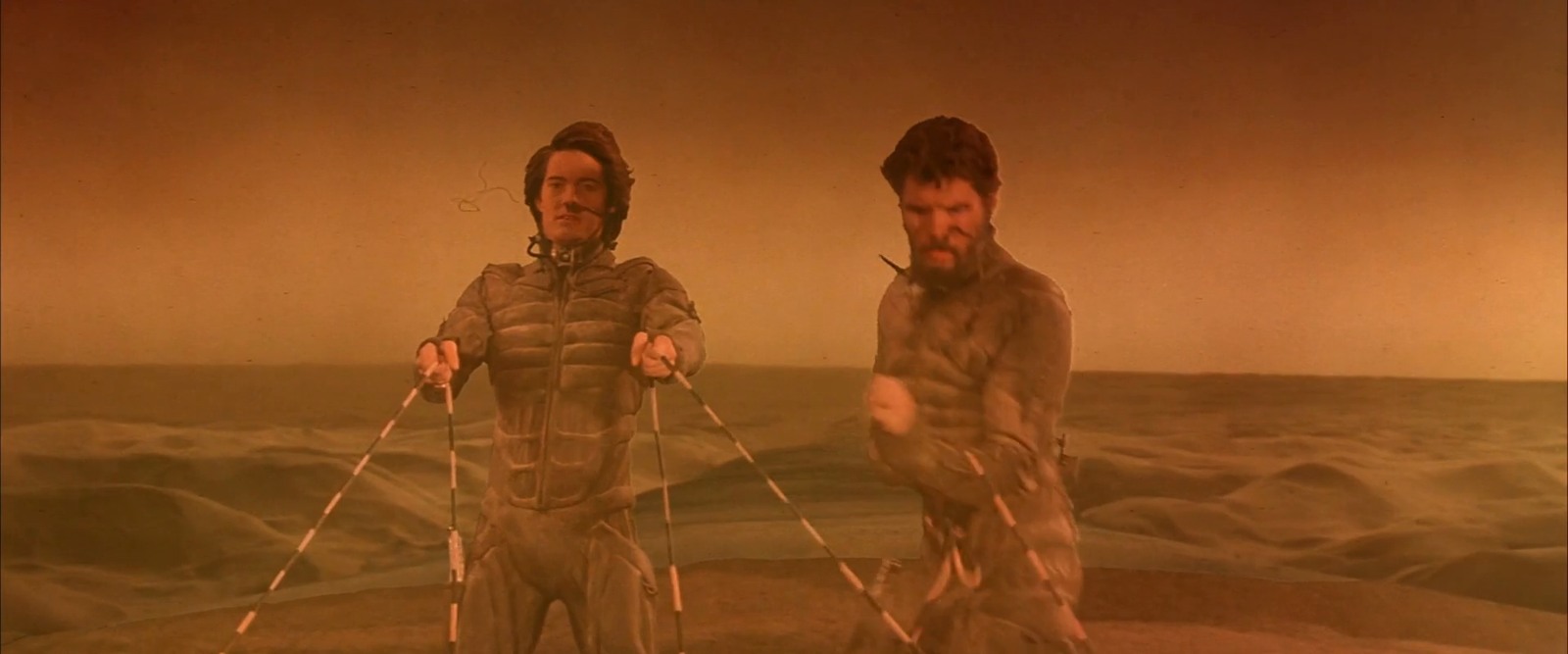
2:20:48The riding sequence begins with Paul exposed before a distant line of witnesses. Hooks and ropes offer a practical answer to the worm’s enormous body, but the film keeps changing the spectator’s distance: teeth, moving sand, a grasping figure and a long view of the creature. The achievement is not simply defeating a monster. It is a change in how a person can occupy its world.
Link to this study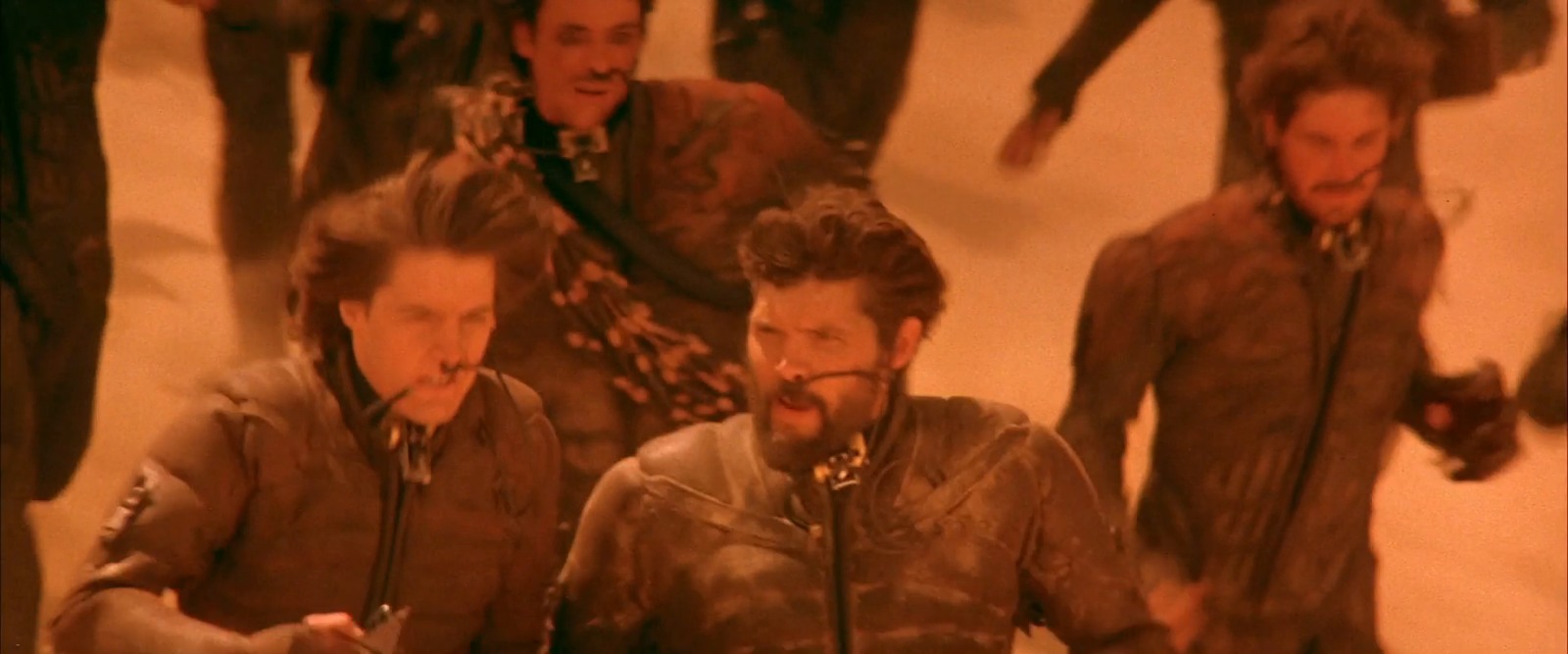
An old relationship in a changed world
2:24:15Gurney’s return reconnects Paul’s new position with the household that trained him. The desert encounter puts familiar faces among different clothing, surroundings and allegiances. After the sequences of ritual and collective instruction, recognition brings the story back to a personal scale. Paul’s transformation can be measured through another person’s response rather than through spectacle alone.
Link to this study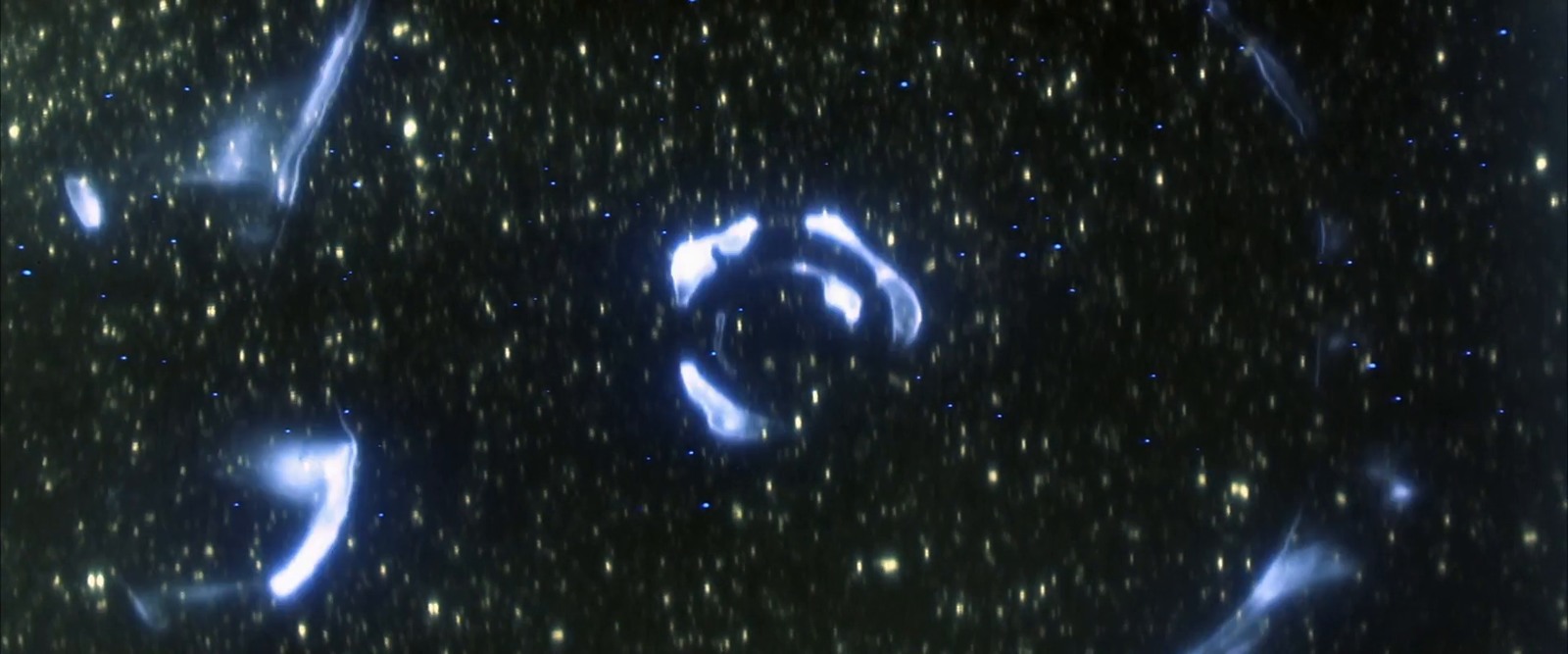
The vision becomes a cosmos
2:31:50Paul’s Water of Life passage moves between a vulnerable body, people attending him and imagery that appears to exceed any ordinary viewpoint. The return to faces gives those cosmic images a human consequence. Read beside Jessica’s ceremony, the sequence develops a repeated structure: a dangerous bodily passage becomes the means of visualizing knowledge that cannot be contained in a room.
Link to this study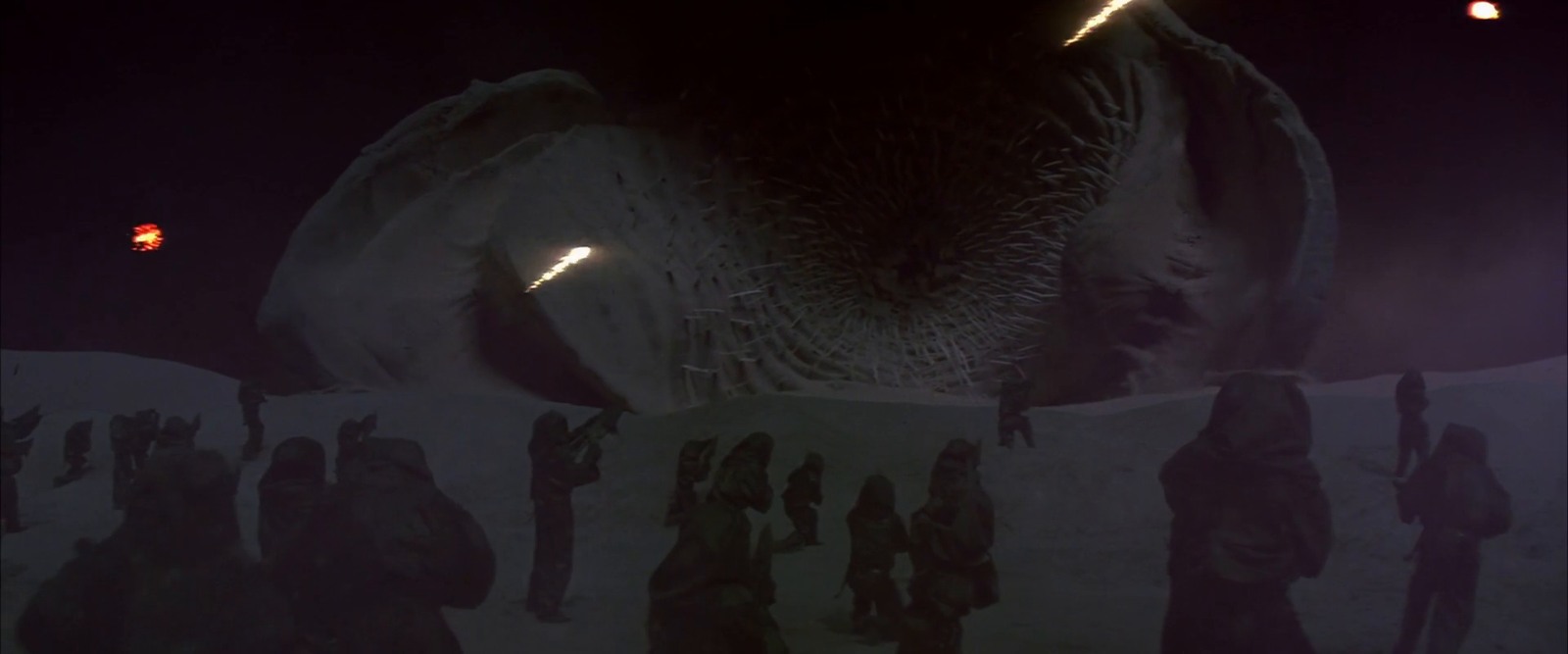
The desert enters the seat of power
2:43:45The final assault reverses the earlier view of the desert from the aircraft. What had been watched from above now moves towards the structures of imperial authority. The worms carry the scale of the landscape into the battle, while explosions and collapsing barriers make architecture permeable. The film’s conflict between constructed interiors and the living desert becomes a direct collision.
Link to this study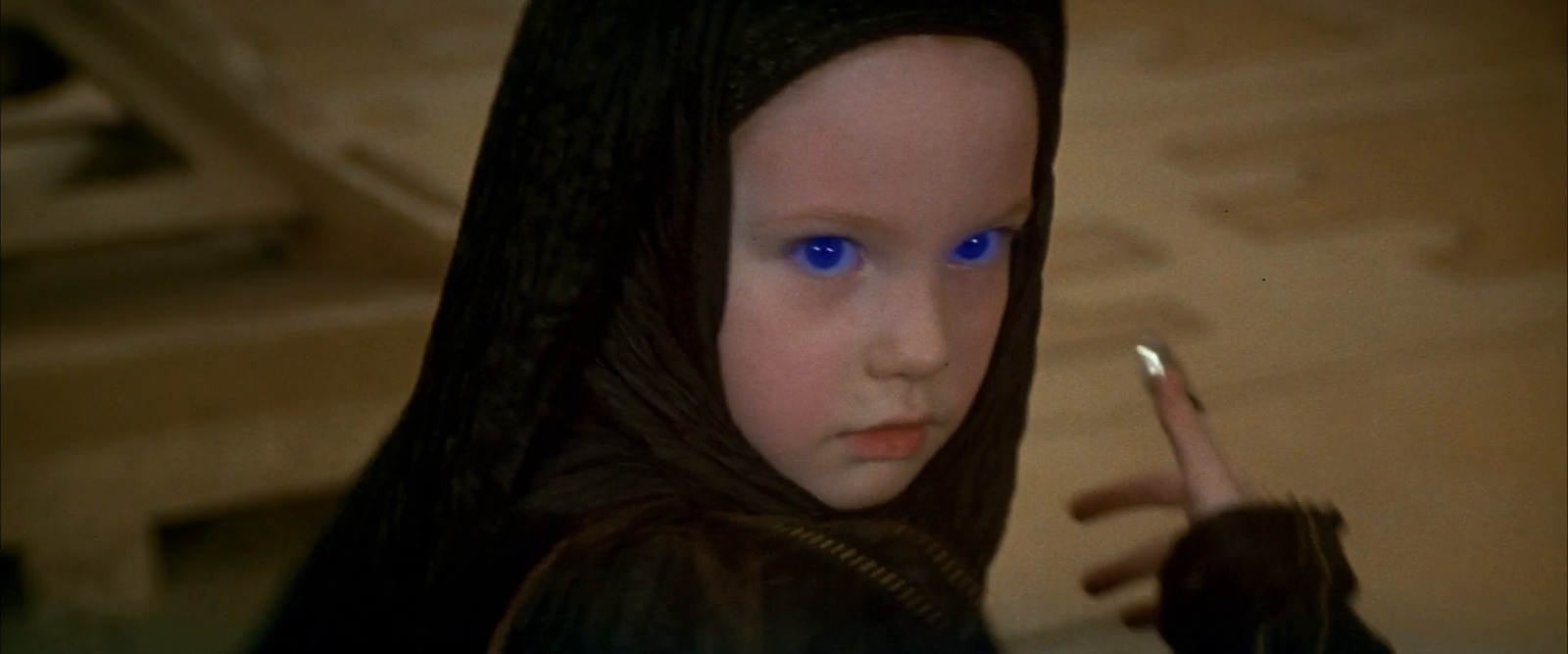
A small figure overturns the room
2:46:15Alia’s confrontation with the Baron makes size an unreliable guide to power. A small child and a tiny needle redirect the movement of a much larger body. The Baron’s flight, earlier presented as a controlled privilege, becomes uncontrollable displacement. The sequence folds the film’s recurring images of bodily dependence and penetration into a sudden reversal inside the imperial room.
Link to this study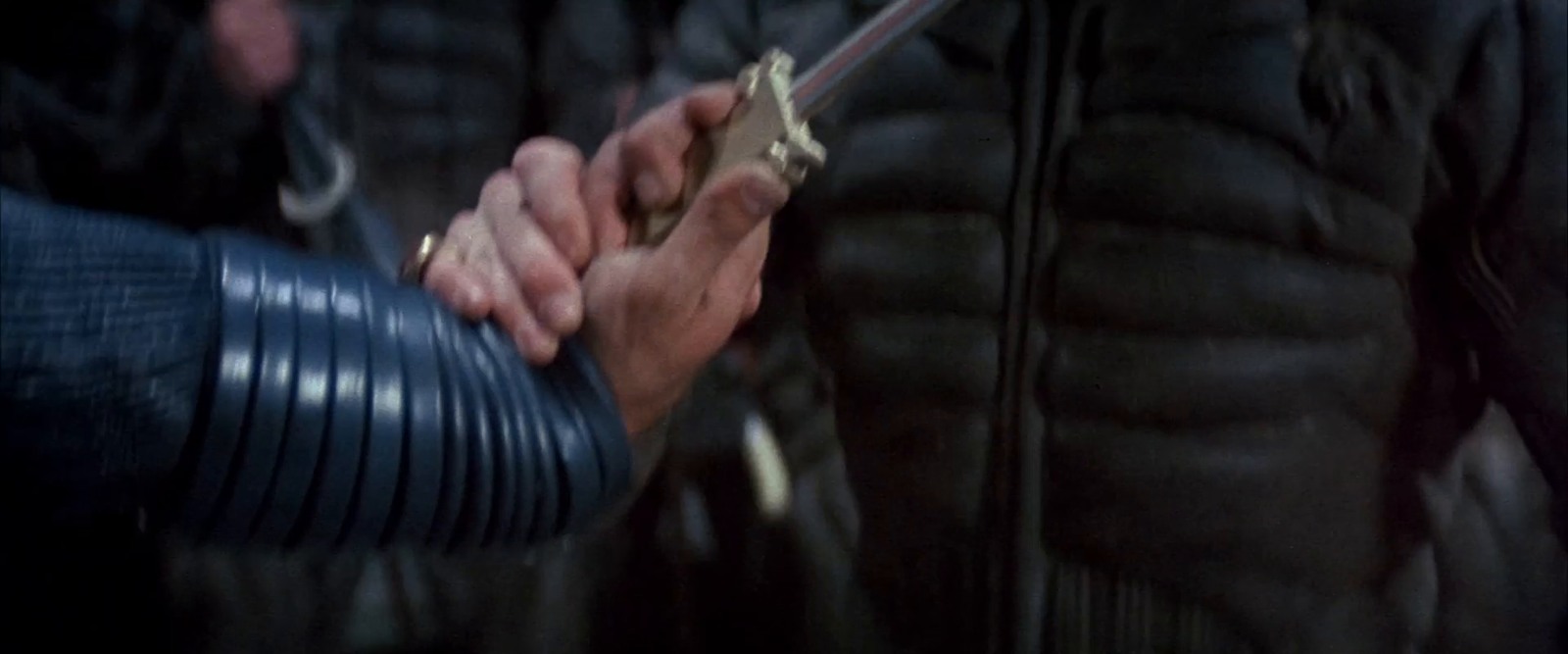
The public fight returns to the hand
2:50:15After the battle’s immense scale, the contest contracts to two bodies in a circle of spectators. The high view establishes the arena; closer views isolate hands, the blade and the concealed spur. The earlier training and the encounter with Jamis give this action a history. Authority is settled in a public space, but its immediate stakes remain concentrated at the surface of the body.
Link to this study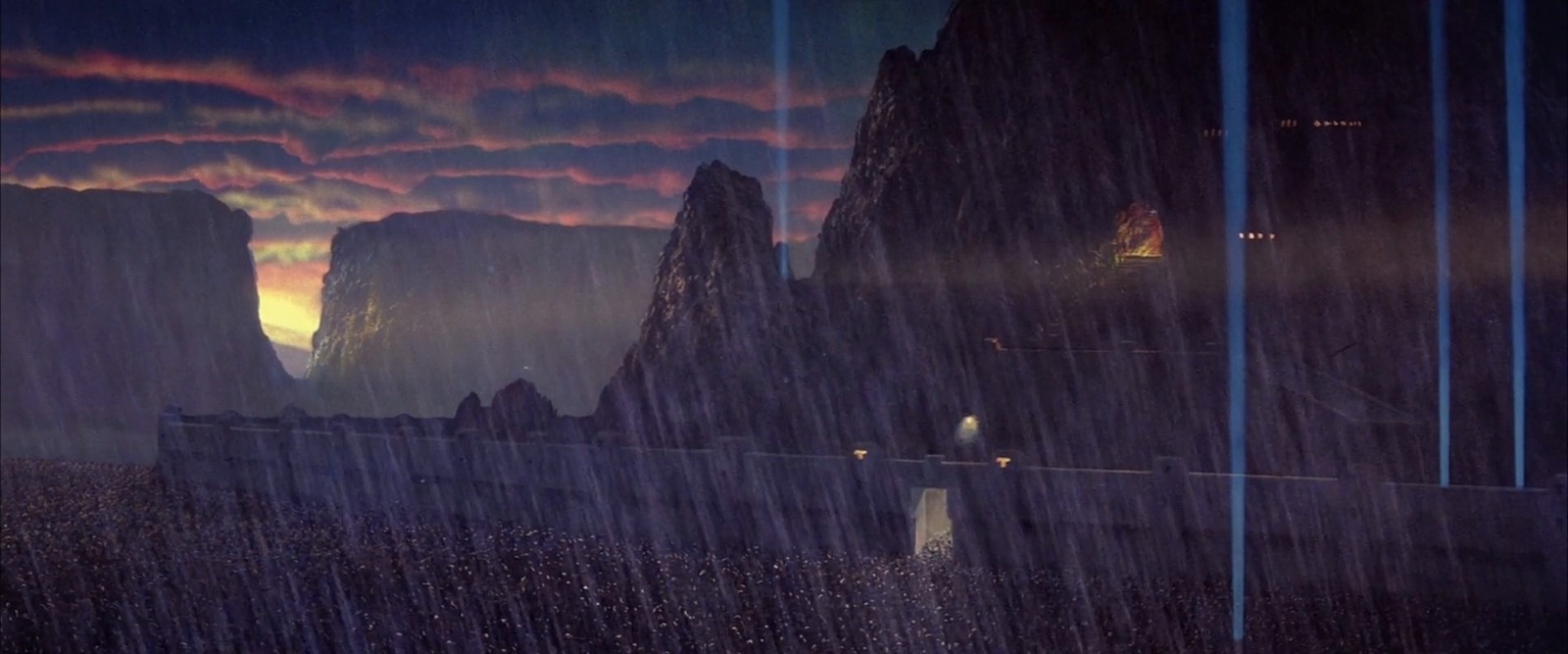
The landscape supplies the final image
2:53:45The ending moves beyond the room of defeated rulers to a transformation of the landscape itself. Rain makes the outcome visible across the surfaces that have defined the desert world. The image supplies a spectacular confirmation of Paul’s arrival at power. Set against the practical care for water earlier in the film, it is also an emphatic change in the scale at which the story asks us to imagine that resource.
Link to this studyThree close looks
When the image needs a second look
Three sequences reward a closer examination of scale, viewpoint and bodily transformation. Open a sequence to follow its stages, then select a still for a larger view.
The Navigator: a body revealed in fragments
The arrival establishes a complete apparatus before the closer views disclose the creature. Glass, haze and the speaking device keep the encounter mediated. These seven views show how the sequence makes the body both an object of scrutiny and a source of authority.
Explore the sequence · 7 stills
The pain box: an image the body survives
The sequence alternates the controlled room with an image of bodily destruction, then returns to an intact hand. Its force lies in that contradiction. The gallery follows the threat, imagined damage and release without treating the damaged hand as a literal wound within the story.
Explore the sequence · 6 stills
Riding the worm: distance, contact and scale
The effect is built across changes of viewpoint. The distant line of Fremen measures Paul’s isolation; the mouth overwhelms the frame; hands, hooks and ropes give the immense surface a usable scale. The final view of two riders completes the movement from isolated exposure to shared command.
Explore the sequence · 7 stills
Viewing this version
The extended Dune
The copy examined here runs 2 hours 57 minutes 15 seconds and opens with the credits Judas Booth for the screenplay and Alan Smithee for direction, followed by an illustrated prologue. These are the replacement names associated with the extended television re-edit, not evidence of a Lynch-approved director’s cut.
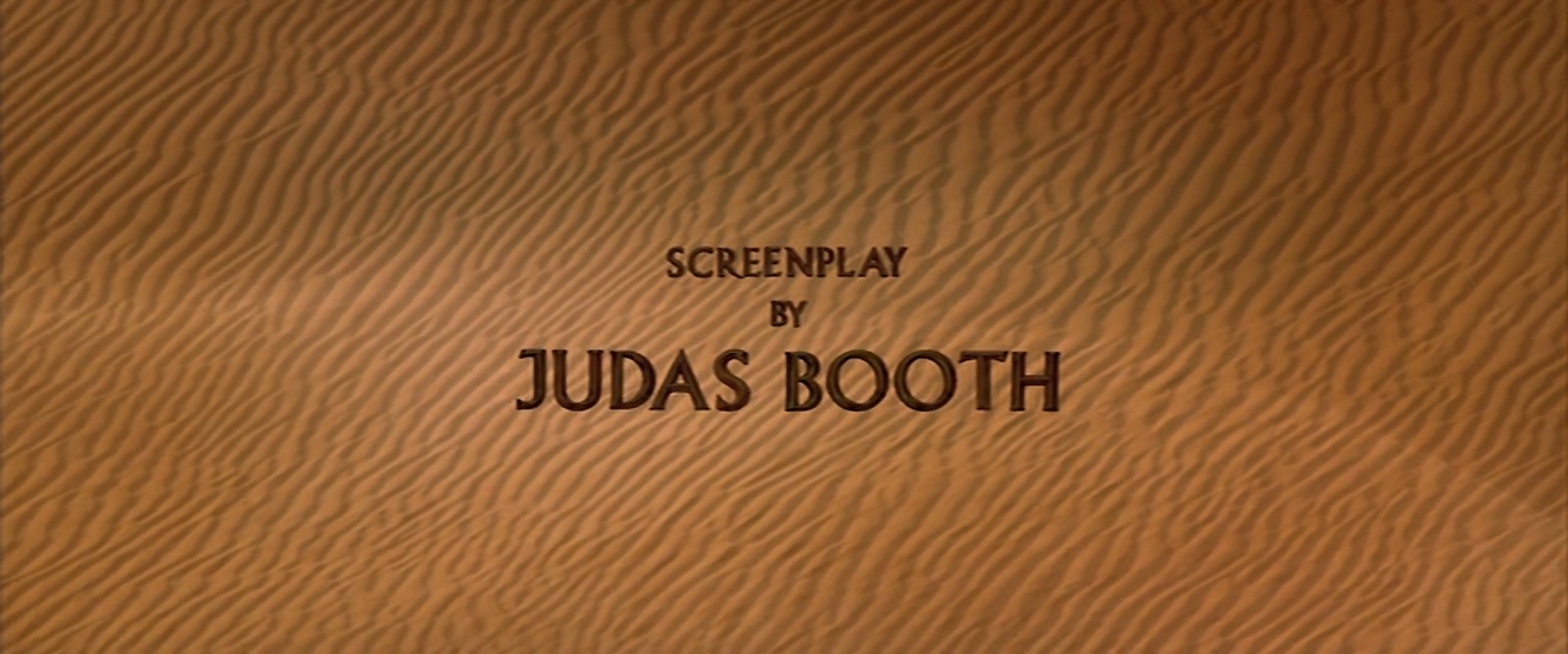
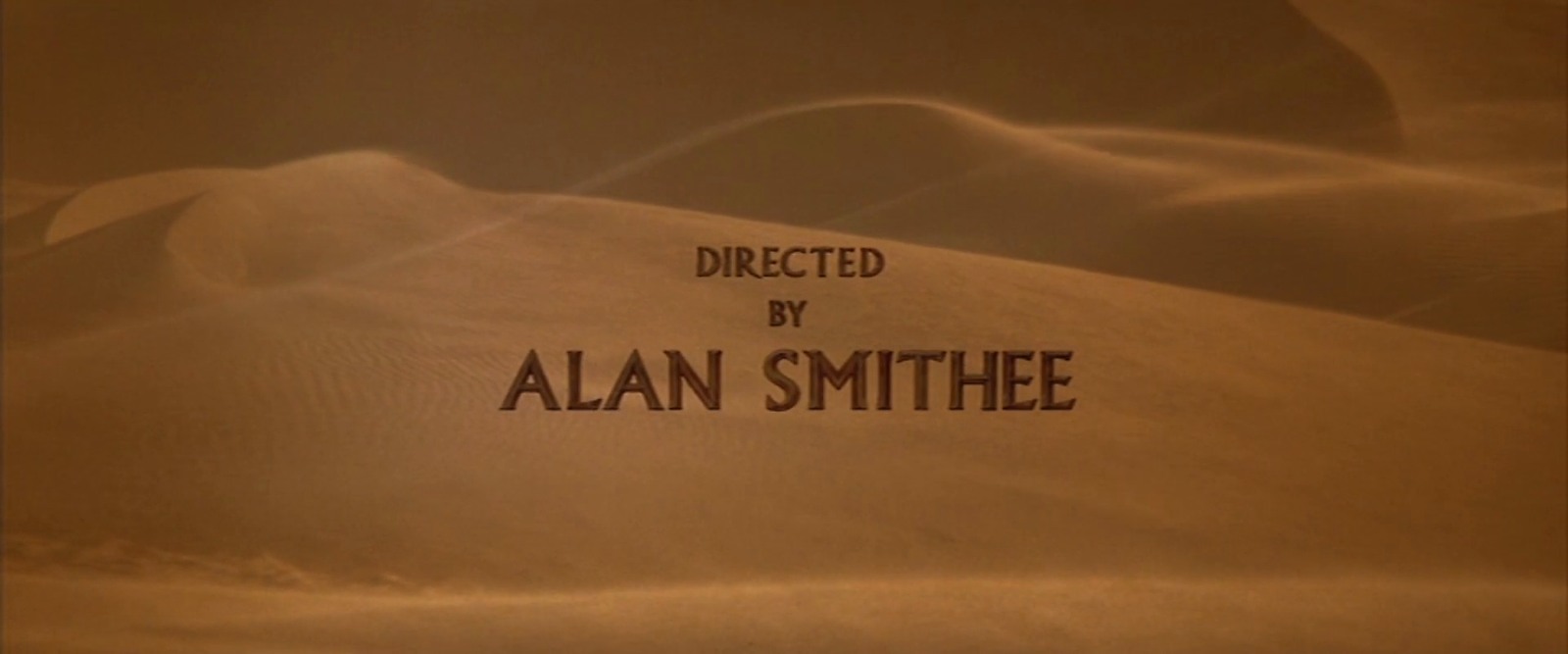
The AFI Catalog records that the television re-edit combined cuts and previously excluded footage with new voice-over narration written by Francesca Turner. Lynch declined association with that version. For the wider release history, see the version table.
About the scene studies and images
The visual guide draws on selected frames checked throughout this copy, with denser examination of the three close-look sequences. It is a set of scene readings, not a frame-accurate inventory of every cut. Embedded English subtitles support narrative identification. The separate audio and dialogue study explains its machine-assisted method; neither pass establishes a comparison with a theatrical print.
Film images: Dune (1984), from the extended version examined here. Captions describe the image; the production research below supplies the historical credits and testimony.
Arrakis: a guide to the struggle
Arrakis is the desert world where the valuable spice is found. House Atreides is sent to govern it, but the transfer conceals a trap. Paul’s survival and rise among the Fremen turn a dynastic struggle into a claim to extraordinary authority. The dramatic question is not simply who wins a battle: it is who controls the substance on which the larger order depends. Synopsis ↗
Paul and the Atreides
MacLachlan’s Paul stands at the center; Jürgen Prochnow plays Duke Leto and Francesca Annis Lady Jessica. Family allegiance is also an education in power.
The competing powers
Kenneth McMillan’s Baron Harkonnen, José Ferrer’s Emperor and the Guild embody different forms of control. The Fremen inhabit the planet being contested; their future cannot be reduced to the rival houses’ succession.
Keep three strands in view: the struggle for a resource, the control of a person’s body, and the manufacture of belief in a leader. They meet in Paul, but they are not interchangeable. Cast and story record ↗
From a proposed epic to a Mexican production
The BFI credits Lynch as writer and director and Raffaella De Laurentiis as producer. Dino De Laurentiis presents the film. Separating those roles matters when a production is too casually described as one man’s failed ambition. BFI record ↗ · AFI credits ↗
- AFI traces Lynch’s appointment to a Daily Variety announcement of 21 May, after earlier development under other directors.A reported appointment, not the beginning of all Dune film development.
- Principal photography was scheduled for 30 March at Churubusco. AFI records a 23 September trade report that filming had ended, followed by continuing effects work.The source distinguishes principal photography from later work.
- AFI records further postproduction plans in January and a U.S. opening on 14 December.Production, premiere and general release need separate dates.
AFI history and its dated trade citations ↗
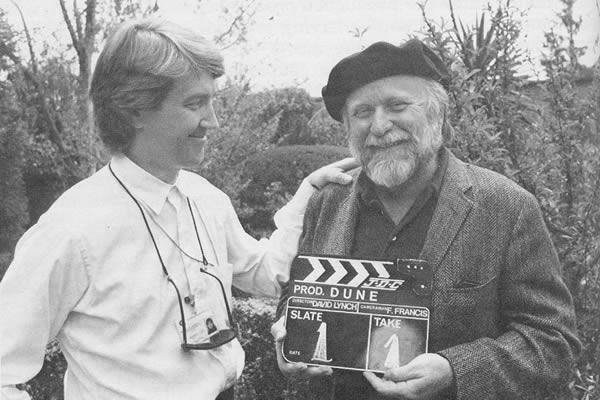
Ruiz’s later account places the work at Churubusco Studios and the Samalayuca desert, near Juárez. He describes a multinational group of specialists alongside Mexican workers. Arrakis is a fictional setting; Mexico supplied actual landscapes, workshops and labor. Those categories should remain visible in the record. Memoir, opening production account ↗
The scale of the undertaking is best approached through decisions that can be traced: what was built full size, what was modeled, what was added optically, and what was created in sound. An expensive image can be the result of several departments solving different parts of one problem. A single budget headline tells us much less about that process.
Dune before the finished images
During his 1981 American Film Institute discussion, Lynch was already answering questions about the project. Asked for a visual starting point, he names insects; he also describes the attraction of a story that can contain dreams and unusually varied images while still obeying its own internal rules. The remarks catch the adaptation in prospect, before the finished designs and the later argument about the released film. They establish an interest, not the provenance of every organic shape that eventually appeared on screen. AFI discussion, 7:00–8:30 · Explore the complete discussion’s subjects →
Who gets to explain the universe?
Herbert’s opening, available in the publisher’s excerpt, sets an epigraph attributed to Princess Irulan before a scene of Paul on Caladan. His observations, memories and questions give information a personal route into the story. The reader learns while inhabiting a mind that is still learning. Chapter One, opening passages ↗
The circulating seventh-draft transcription bears the date 9 December 1983. Its editor notes corrected spelling and mixed pagination. The text preserves a detailed written version of the film’s opening, major sequences and ending. Cover and foreword, PDF pp. 1–2 ↗
Scroll across for the full comparison →
| Evidence | What it presents | What the change asks us to notice |
|---|---|---|
| Novel opening | Irulan’s written historical framing, then Paul’s encounter with the visiting Reverend Mother. | The authority of a later history sits beside a boy’s limited immediate understanding. |
| Circulating seventh draft | Ramallo speaks to a collective Fremen response before the action moves to the Emperor’s world. | Explanation becomes ceremony and collective expectation. |
| Theatrical film, as described by AFI and Strick | Irulan addresses the audience before the opening credits. | Information is delivered directly to the spectator; its burden can be judged separately from the imagery that follows. |
Publisher excerpt ↗ · Scenes 1–1B, PDF pp. 3–4 ↗ · Opening-credit note ↗ · Contemporary response ↗
The transcription’s final pages also matter: Paul promises both water and retained desert, then brings rain, followed by luminous imagery. The document therefore places the rain conception in written material; it cannot establish when that conception first appeared, what was filmed, or who approved the released ending. Scenes 283–285; printed pp. 113–114 / PDF pp. 120–121 ↗
An adaptation changes the location of authority as much as it changes events. A historical epigraph, a ritual voice and a direct address each ask the audience to believe differently. The comparison above is deliberately local: it establishes a question from inspected passages and published descriptions, not a completed novel-to-film concordance.
DuneInfo’s draft index traces earlier versions, including the initial collaboration with Christopher De Vore and Eric Bergren. Cal State Fullerton’s Herbert collection adds manuscripts, notes and research files to the adaptation’s archival history. Draft index ↗ Repository description ↗
Making four worlds feel physically different
Freddie Francis returned after The Elephant Man. In his 1998 American Cinematographer interview he recalls low-key color photography with Lynch and Todd-AO 35 anamorphic shooting. Lightflex added controlled light through the lens, opening shadows and reducing saturation; filters could tint that light. This let him preserve background detail without relying on conventional fill lighting alone. Dune and Lightflex passages ↗
Looking at the image: distinguish darkness from missing information. A face, a glint of metal or an opening in a wall can organize a crowded frame without making the entire room equally legible. Francis’s account gives a technical basis for investigating that hierarchy. It does not establish the exposure or treatment of any individual shot without further records.
Sets, matte paintings and the camera’s viewpoint
Anthony Masters led production design. DuneInfo’s captioned design collection describes the Hall of Rites as a partial exterior set extended by Albert Whitlock’s matte unit, with Syd Dutton and Mark Whitlock contributing paintings. Hall of Rites captions ↗
Ruiz’s memoir translation explains another method. For the Atreides arrival, a foreground model completed the ship around a full-size doorway and stairs, with miniature troops extending the landing ground. His Arrakeen Palace account similarly joins a model to a built section at the Aztec stadium parking area. Perspective, matching surfaces and the chosen camera position made differently scaled elements read together. Atreides Ship and Arrakeen Palace ↗
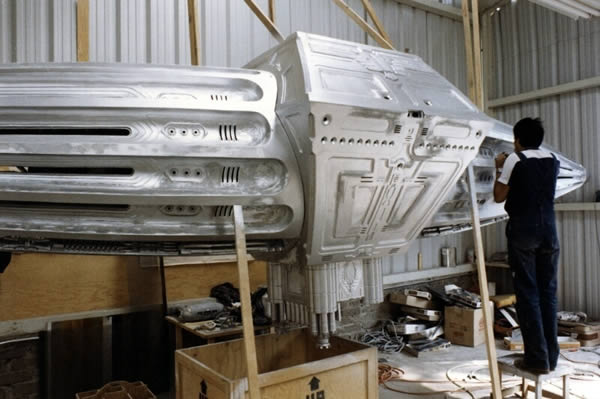
The workshop photograph changes the question from “does this look real?” to “what must the camera see for these pieces to become one space?” The model’s surface has to join the built set convincingly; its actual size is only one part of the illusion. Matte work and foreground miniatures should be recorded as distinct techniques, even when a finished sequence combines methods.
The stillsuit as an engineered costume
The construction account quoting Mark Siegel describes translating Bob Ringwood’s organic stillsuit design into pieces of foam built over a leotard. Siegel and Bill Bryan demonstrated a prototype rather than casting the entire suit in one piece. Movement, dressing the performer and surface creasing were practical constraints. A latex coating required further experimentation. Prototype and coating passages ↗
This account connects design to fabrication rather than crediting either in isolation. Its original interview date is not supplied by the host, so its attribution is provisional. Even so, it supplies a precise investigation: compare prototype photographs, surviving suits and the finished image to see how an apparently continuous skin was assembled from parts.
Universal credits Carlo Rambaldi with monster creation. The Guild creature, sandworms and prosthetic effects give the film several distinct kinds of physical spectacle. Craft credits ↗ Supplement inventory ↗
A new screen actor among established performers
MacLachlan’s Bullseye recollection makes the scale of production personal. He knew Herbert’s book, but screen marks, lenses and continuity were new to him. He remembers Lynch as a patient mentor and recalls being kept from watching dailies so that seeing himself would not reshape the performance. These are retrospective observations, not an independently established rule for the entire cast. Transcript pp. 3–5; 00:11:43–00:17:02 ↗
Paul’s emergence can be studied through posture, stillness and the way other people respond to him. Spoken explanation is only one component of authority. The comparison is especially useful across the move from family and instruction to public leadership: does the body change, or does the surrounding scene change how we read it?
The supporting cast offers distinct avenues. Annis’s Jessica places familial attachment beside Bene Gesserit discipline; Prochnow’s Leto gives dynastic power a parental face. McMillan’s Baron makes bodily excess conspicuous, while Sting’s Feyd gives rivalry another physical register. Cast identification follows the distributor record. Cast ↗
MacLachlan’s interview continues into his return as Jeffrey Beaumont in Blue Velvet. Reading those roles together can make Dune a beginning in Lynch’s collaborative history, rather than an isolated detour. A future performance pass should also give Annis, the Fremen ensemble and the smaller roles space beyond Paul’s perspective.
MacLachlan’s first meeting with Lynch
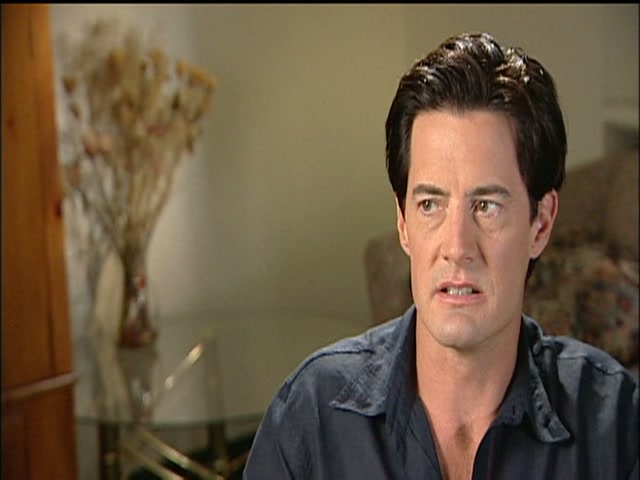
In his Postcards from the Cast interview, MacLachlan traces the Dune opportunity back to a play at Seattle’s Empty Space Theatre. A casting visit led to an invitation to Los Angeles, where he met Lynch and Raffaella De Laurentiis at Universal. He remembers the encounter as surprisingly conversational: their Washington connections, wine and everyday interests occupied much of it.
Lynch then gave him the script and five scenes to prepare for a screen test. MacLachlan recalls a separate, very brief meeting with Dino De Laurentiis before returning to Seattle and coming back for the test several days later. The anecdote complements his later account of learning screen technique: the relationship began with curiosity about the person before the unfamiliar mechanics of a large film production. MacLachlan, 00:05–03:31
Everett McGill’s interview remembers a different continuity from Dune to Twin Peaks: conversations about Lynch’s car helped establish the practical, mechanical association he later connected with Big Ed Hurley. That is McGill’s account of a collaboration developing across projects, rather than a claim that the two characters are equivalent.
Stockwell remembers the invitation
In Pretty as a Picture, Dean Stockwell recalls encountering Lynch at Churubusco Studios while working on a different production in Mexico. He asked about joining Dune and was told that the film had been cast; a later call offered him a part after another performer withdrew. His recollection supplies a personal route into the company alongside the dossier’s account of Kyle MacLachlan’s arrival.
Stockwell also remembers learning that he had met Lynch much earlier at a screening of The Grandmother in his Topanga Canyon home. The anecdote connects Lynch’s early independent film circulation with a later large-scale production through the same actor. Pretty as a Picture, 63:21–65:53 · source guide →
The universe begins in recorded matter
Ric Gentry’s December 1984 interview reports that Alan Splet developed sounds before seeing footage and worked with recordings made with Ann Kroeber. At a Richmond oil refinery, she recorded an empty tank with contact and air microphones; impacts on it contributed to battle weapons. This makes her recording work part of the production account, not an anonymous supply of raw material. Printed p. 64, third scan ↗
For the palace’s exterior shield, Splet described slowing a vibrating cable recording to create a roar. His method takes something recognizably physical and transforms its scale. The article also distinguishes production dialogue from the extensively constructed effects track. Printed pp. 64, 66, third and fourth scans ↗
The sound world has a useful counterpart in the miniature workshop. Both can turn a manageable object into an immense one through a changed relationship to the recording apparatus. The important test is not whether a sound is “real,” but what physical sensation it brings to the fiction. That argument must eventually be tested against an identified mix and cue-by-cue listening.
Splet describes the working exchange
In a conversation recorded during the production of Blue Velvet, Alan Splet describes trying sounds with Lynch, responding to each other’s reactions and returning to the laboratory to develop the material. He explicitly recalls doing a great deal of this on Dune. He also describes voicing his reservations when a result did not satisfy him. The passage adds the exchange between collaborators to the technical account of recordings, processing and mixing above. Splet in Peter Braatz’s Blue Velvet Revisited, 39:39–40:20 →
Toto, orchestra and the Prophecy Theme
Toto’s official album page preserves a seventeen-track sequence. Steve Lukather’s site credits the score to Toto while identifying Brian Eno, Daniel Lanois and Roger Eno for Prophecy Theme; it names Marty Paich and Allyn Ferguson as conductors of the Vienna orchestra and Volksoper choir. This is a more precise starting point than treating every musical element as a single band credit. Album sequence ↗ · Personnel and composition credits ↗
In Billboard on 3 November 1984, Jeff Porcaro described the score as an opportunity to work beyond the band’s pop identity and recalled resisting pressure for vocals. David Paich and Porcaro also discussed the choice of Vienna rather than London in relation to reuse fees. The report captures decisions and frustrations before release, rather than only later recollections. Paul Grein, p. 54 ↗
For listening, keep the album, the music as edited into the film, dialogue processing and sound effects separate. A track title does not prove a cue’s exact placement. Likewise, an award does not identify every sound’s maker: the Academy’s Sound nominees were Bill Varney, Steve Maslow, Kevin O’Connell and Nelson Stoll. 1985 Sound nomination ↗
Building a worm from other sounds
On printed p. 68, Splet identifies horse, baboon, puma and pig recordings as components of the worms. Slowing and combining them, with further processing, produced the creature’s voice. For underground movement, he describes slowed explosions combined with Ann Kroeber’s recordings of sand rubbed, scraped and dragged over contact-miked plexiglass. Animal cries and small surface textures could acquire an enormous scale. Read p. 68 ↗
A sound also has a release history
On p. 70, Splet describes distributing the training robot’s sounds across the screen and using surround to enclose the audience. He also distinguishes the power available in the 70mm magnetic presentation from optical stereo and mono versions. The same page identifies Bill Varney as supervising mixer, Kevin O’Connell as effects mixer, Steve Maslow as music mixer and Leslie Shatz as dialogue editor. Read p. 70 ↗
Those production details explain why a modern file’s channel count cannot by itself certify an original presentation. They provide historical context for the training scene and the worm sequence, rather than a claim that every element has been isolated in this copy.
Audio & dialogue
Voices that shape a world
In Dune, speech can teach, conceal, command and kill. Follow the words that move between private thought and public power.
These eight studies follow the English dialogue of the extended version, connecting the opening explanations to the final declaration of Paul’s authority.
Narrating an empire
The illustrated prologue introduces institutions before it introduces a protagonist: the revolt against thinking machines, mental training, the Guild, the great houses and the economics of spice. Later narration continues this teaching role by identifying members of the Atreides household and explaining Leto’s written refusal of the Baron’s peace offer. It supplies not only names but the rules under which a gesture or a letter matters.
This is a defining feature of the extended version’s storytelling. Explanations often precede the encounter they prepare us to understand. The viewer consequently knows the shape of the trap before the Atreides arrive on Arrakis. Keep this added explanatory voice distinct from a character’s private thought and from the account of authorship in the edition guide.
Listening is a test
Paul claims to have identified his visitors by their approach down the hall. Thufir’s objection is that those sounds could be imitated. The exchange turns a small lesson in alertness into a problem that runs through the film: recognizing a signal is not the same as knowing whether to trust it. Paul’s confidence is already being tested against deception.
During the hunter-seeker attack, his inner speech becomes a sequence of practical decisions. He considers movement, darkness, grip and the danger of calling for help. A nearly motionless body is accompanied by active reasoning. The device is therefore more than an interruption to the plot: it gives Paul’s training an immediate, intelligible task, while the suspected operator remains somewhere outside his sight.
The Voice changes hands
Three encounters give the Voice a clear dramatic progression. Mohiam first commands Paul to approach; his recognition of the technique does not free him from being its subject. In the escape flight, he tries to protect Jessica, then commands the guard to remove her gag. That action lets Jessica take over. The rescue depends on restoring her capacity to speak, rather than simply freeing her hands.
In the final audience Paul stops the Emperor’s speech and silences Mohiam. His reference to her gom jabbar makes the reversal explicit: the person once tested now declares the terms. These scenes distinguish the Voice’s coercion of a listener from the weirding module’s conversion of vocal sound into physical force. The film connects those powers, but they are not interchangeable demonstrations.
Words against pain
Mohiam names what Paul is to experience: itching, burning and the imagined destruction of flesh. Against those instructions, the fear litany supplies another verbal sequence. Its repetition makes endurance an action of the mind, while the threat at his neck keeps that mental exercise tied to bodily danger.
The important turn comes when the hand is withdrawn and examined. The apparent injury and the intact hand do not tell the same story. Mohiam then explains the test as nerve induction and observation. The litany returns before Paul mounts the worm, carrying the earlier discipline into a different ordeal. Read the two passages together: the repeated words connect the child under examination with the would-be leader who must demonstrate control before the Fremen.
The father’s words return
Leto’s farewell to the sea turns into advice about change: unfamiliar experience can awaken something that would otherwise remain dormant. His phrase about the sleeper begins as a father’s account of growth, rather than a public declaration of messianic authority.
Paul carries it into uncertainty on Arrakis, then into the promise to avenge Leto after the family’s destruction. Following the Water of Life, he addresses his dead father and announces that the awakening has happened. The change from an obligation to an accomplished event is small in wording and large in consequence. Repetition binds the political story to grief: Paul’s transformation is also an answer to a conversation he can no longer continue with Leto.
Water gives speech its value
The harvester rescue exposes a conflict between the value of spice and the value of people. Leto orders the crew off the machine; Kynes’s private assessment recognizes his concern for the men. The later exchange about water makes that emerging trust into a bond. Dialogue translates a rescue into the possibility of an alliance.
Among the Fremen, water also measures a stranger’s value, establishes sanctuary and carries an obligation to the community. After Jamis’s death, the allocation of his water comes with instructions about guarding and sharing it. The reservoir conversation enlarges this ethic into a collective future for Arrakis. These exchanges give the water imagery a social vocabulary: survival, debt, belonging and the work of changing a world.
A name becomes a weapon
Stilgar distinguishes the private name Usul from the name by which Paul will be known openly. Paul’s choice of Muad’Dib links a remembered image of the second moon to a public identity. The naming scene is therefore an act of belonging before it becomes an instrument of power.
During training, the film makes that transformation literal. Paul explains a relationship between thought, sound and form; the warriors repeat his name, and he recognizes it as a killing word. Later a traumatized survivor repeats the same name to the Harkonnens. What begins as a chosen identity becomes a rallying cry, a weapon and a report of fear. Following those uses is more revealing than treating every repetition as another announcement of the hero.
The ending tells us what to believe
At the final audience, control of speech becomes control of the room. Paul interrupts imperial authority, recalls Mohiam’s test and declares that a word can kill. Feyd’s challenge briefly replaces that claim with a contest of bodies and blades, before the film returns to the power of Paul’s voice.
The extended version’s concluding narration then interprets the victory for us, presenting Muad’Dib as an agent of peace, love and freedom. Stilgar’s religious explanation and Alia’s final identification of Paul reinforce the miracle of rain. The result is not simply an image left open to interpretation: words actively settle its meaning. That explicit reassurance belongs in an account of this version’s ending and should not be silently generalized into a claim about every version of the film or Herbert’s novel.
Edition, timings and review method
The complete 2:57:15 English soundtrack was decoded and processed with local speech recognition, then compared with the embedded English captions. Fourteen selected passages received a second transcription from the centre channel. This is a machine-assisted dialogue review, not a direct auditory assessment of every musical cue, vocal texture or surround effect. The studies use corroborated words and scene context; uncertain recognition is not treated as a quotation.
Times locate passages in the extended copy examined here and may differ in another release. Its English 5.1 track does not establish the source or fidelity of the original theatrical mix. The historical account in Sound & music is attributed to the published production interview.
Which Dune are we discussing?
In 2022, Lynch said he had not had final cut. Interview ↗
The versions below connect each presentation to its release history, editorial origins and format.
Scroll across for the full comparison →
| Version or object | Documented evidence | Limit of the claim |
|---|---|---|
| Theatrical release | Universal lists 137 minutes. AFI records the 14 December 1984 U.S. opening. | Use an identified release for timings; a rounded catalogue runtime is not a frame count. |
| Television re-edit | AFI cites a 26 May 1988 report: cuts, restored footage and new narration written by Francesca Turner; the names Alan Smithee and Judas Booth replaced Lynch’s directing and writing credits. | A distinct television assembly. |
| UK classified releases | BBFC lists a 136-minute cinema entry on 20 November 1984 and a 176m 39s Castle Music physical-media entry on 4 August 2000. | Consult the edition’s scene order, framing and audio alongside its listed runtime. |
| Restoration and supplements | Arrow advertises a 4K restoration from the camera negative, stereo and 5.1 audio, and thirteen deleted scenes. | Image restoration, an alternate edit and deleted material are different objects. Inspect the actual edition before making disc-specific claims. |
Theatrical listing ↗ · Release and television history ↗ · Classification entries ↗ · Edition inventory ↗
BBFC’s 2021 cinema entry explicitly says its required alteration concerned a misleading non-BBFC classification symbol. That explanation must not be carried backward onto the 1984 entry, which only records cuts or alterations without specifying them on this page. Different classification events need their own evidence. 1984 and 2021 entries ↗
Arrow’s current page also contains an internal mismatch: the title says UHD while a feature bullet says 1080p Blu-ray, and its extras retain a subject-to-change note. This is why the page is used as an inventory of leads, not proof of the contents of a particular disc in hand.
Fan reconstructions belong to reception history and should carry their editor, version number and assembly date. More footage does not confer director approval. A reliable comparison will log opening narration, scene order, credits, missing material, framing and audio separately.
Failure, fascination and changing expectations
The useful critical history is a disagreement, not a simple march from rejection to vindication. These three responses ask different things of the same film.
Philip Strick · 1985
Strick objects to the density of explanation and the awkwardness of audible thought, yet values the brooding sets and grotesque invention. His review allows visual fascination and narrative frustration to coexist.
Roger Ebert · release-era review
Ebert finds the screenplay confusing and the effects unconvincing despite occasional striking images. His impression that the production lacked a usable script is a critical judgment, not evidence that no screenplay existed.
Jonathan Ross’s 2021 reassessment describes his own movement from disappointment to affection for the film’s cruelty, strangeness and visual design. It records a change in one viewer’s priorities, not a unanimous rehabilitation. Later reassessment ↗
“faithful adaptation,” “coherent adventure” and “singular sensory world” are different standards. A film can reward one while frustrating another. Preserving that disagreement makes a stronger archive than recruiting every source into a defense or a prosecution.
AFI records that the initial cinema audience did not hold, even as the novel remained prominent in bookstores. The contrast captures two different public lives of Dune: the film’s troubled theatrical run and the continuing appeal of Herbert’s world. Reception history ↗
Theatrical objects and later visions
The museum’s ten Dune records include a U.S. one-sheet, seven individual Spanish lobby cards and two later artist editions. The cards preserve the gallery’s listing numbers; gaps in that sequence are not proof of a complete campaign set. Theatrical dates remain attributed to the source listings.

The later works have their own histories: Kilian Eng’s 2012 edition and Karl Fitzgerald’s 2019 variant belong to the film’s continuing visual reception. They should be compared with theatrical publicity without being mistaken for it.
Explore all Dune objects → Images and acquisition records come from our sister sites, Rare Prints and Posters and Rare VHS and LaserDiscs; Lyncharium provides the research context.
Explore further
Follow the sources below, explore the museum collection, or continue through the Reading Room. New archival discoveries and contributions enrich the record of Lynch’s work.
Sources and further reading
The sources below trace the film’s production, release and reception, alongside the extended copy used for the scene studies. Primary publications and testimony, institutional records, publisher inventories and specialist transcriptions are labeled separately.
Kyle MacLachlan, Postcards from the Cast, in Twin Peaks: From Z to A, 00:05–03:31: Seattle casting, first meetings with Lynch and the De Laurentiis producers, and preparation for the screen test. Everett McGill’s interview in the same collection, 00:05–01:25, supplies the later connection with Big Ed. Retrospective first-person recollections.
- Alan Splet in Blue Velvet RevisitedPeter Braatz’s documentary, production conversation at 39:39–40:20. Splet describes his iterative working exchange with Lynch and explicitly refers to Dune. Included on Criterion’s Blue Velvet Blu-ray.
- David Lynch at the American Film Institute (1981), included on Criterion’s The Elephant Man Blu-ray.7:00–8:30: prospective remarks on Dune, insects, dreams and the story’s internal rules. An early statement of interests, distinguished from a later explanation of the completed film. Edition listing ↗
- Dune: the extended version examined hereDirect visual study of the 2:57:15 widescreen copy, with the Alan Smithee and Judas Booth opening credits. Selected-frame coverage across the film and detailed sequence galleries, supplemented by a full-track machine-assisted English dialogue pass and fourteen centre-channel checks.
- Universal Pictures: Dune ↗Official synopsis, cast/craft credits and 137-minute listing. Catalogue checked; film not played.
- AFI Catalog: Dune ↗History, credits and release record read. Dated trade reports are cited through AFI, not claimed as originals inspected. Particularly Daily Variety, 21 May 1981; 23 September 1983, pp. 3, 10; 26 May 1988, pp. 3, 22.
- BFI: Dune film record ↗Writer/director and producer catalogue fields checked.
- Frank Herbert: Dune, Chapter One ↗Publisher’s unpaginated excerpt: Irulan epigraph, Caladan opening and Paul’s perceptions. This is not a complete novel inspection or a print-edition collation.
- David Lynch: circulated seventh-draft transcription ↗Cover dated 9 December 1983. Foreword, opening and final sequence inspected; PDF pp. 1–4 and 118–121, printed pp. 1–2 and 111–114. Opening and ending page images checked. Retyped, spelling-corrected document, not an authenticated production facsimile; mixed pagination acknowledged by its editor.
- DuneInfo: screenplay index ↗Draft listings and provenance descriptions checked. Earlier drafts identified here have not been collated.
- David E. Williams: Cinematic Glory — Freddie Francis, BSC ↗American Cinematographer, March 1998; web reprint 27 August 2019. Dune and Lightflex passages read. Later technical testimony, not a contemporaneous camera log.
- Emilio Ruiz del Río: Dune memoir and photographs ↗DuneInfo’s English translation of the Dune chapter in Rodando por el mundo (1996), especially Arrakeen Palace and Atreides Ship, Arrakeen. Photographs attributed to Ruiz’s personal collection.
- DuneInfo: The Design of Dune ↗Captioned design/production images inspected, including Hall of Rites and matte-painting attributions. Captioned specialist compilation.
- DuneInfo: Stillsuits / Mark Siegel testimony ↗Published account of foam construction, prototypes and coatings read. The page quotes Siegel but does not provide a clear original interview date/publication; treat as attributed testimony pending provenance.
- DuneInfo: David Lynch and Frank Herbert ↗Captioned production photographs inspected; Lynch/Herbert image identified by the host as 30 March 1983. Original negative and photographer attribution not supplied for that image.
- Kyle MacLachlan: Bullseye interview, 25 August 2020 ↗Published transcript pp. 3–5, 00:11:43–00:17:02, inspected in the first edition and retained. Audio not audited; retrospective testimony.
- Ric Gentry: Alan Splet and Sound Effects for Dune ↗American Cinematographer, December 1984. Magazine scans hosted by Tim Prebble. All seven scans visually examined: printed pp. 62, 63, 64, 66, 68, 70 and 72. Cited for Kroeber’s recordings, the shields, worm construction, mixing roles and presentation formats. Production testimony is distinguished from analysis of the reviewed copy.
- Toto: Dune soundtrack ↗Official 1984 album track list read; album sequence is not a film cue sheet.
- Steve Lukather: Dune album credits ↗Official personnel, orchestra/conductor and Prophecy Theme credits read.
- Paul Grein: Double Play Due from Toto ↗Billboard, 3 November 1984, p. 54 (PDF p. 54): text extracted and page visually checked. Contemporary interviews with Jeff Porcaro and David Paich; their accounts, not recording-session paperwork.
- Academy: 57th Academy Awards, 1985 ↗Sound nomination and named nominees checked. Nomination is distinct from the sound-effects-editing category.
- Brent Simon: David Lynch interview, 2022 ↗Final-cut statement only.
- BBFC: Dune classification history ↗Cinema and home-entertainment entries inspected, particularly 20 November 1984, 4 August 2000 and 15 September 2021. Classification durations do not by themselves identify every edit.
- Arrow Video: Dune limited edition ↗Publisher’s specifications, restoration claim, audio and supplements inventory read. The UHD-titled page also says 1080p Blu-ray and retains a subject-to-change notice; actual disc/packaging must resolve those inconsistencies. No disc, booklet or complete supplement viewed.
- Philip Strick: Dune reviewed in 1985 ↗Contemporary Sight and Sound review, BFI web reprint 6 February 2024. Critical judgments attributed; the reviewer’s creature terminology is not adopted as a production credit.
- Roger Ebert: Dune ↗Review text read. The website displays 1 January 1984; the original newspaper issue/date has not been checked, so that date is not used as a release or publication milestone.
- Jonathan Ross: Off the shelf — The sands of time ↗Sight and Sound, November 2021; web 4 October 2021. Later personal reassessment, not a survey of critical consensus.
- Cal State Fullerton: Explore Frank Herbert’s Notes ↗Institutional collection description, 26 March 2024, updated 2 April. The separately discovered Calisphere finding-aid PDF could not be retrieved in this pass.
Another doorway
Continue exploring
Films
The Elephant Man
Explore The Elephant Man through Joseph Merrick’s history, David Lynch’s production, John Hurt’s performance, London locations and museum objects.
Films
Inland Empire
Explore David Lynch’s Inland Empire through Laura Dern’s performance, its evolving production, digital photography, sound, restoration and critical reception.


Museum
Museum — The Objects Remain
Explore David Lynch posters, artist editions and LaserDiscs through 35 illustrated records, edition comparisons, object histories and documented research.
Image credits and sources accompany each linked guide.