Twin Peaks: The Return — Part 15
2017 · Twin Peaks: The Return · Episode dossier
A hand on a shoulder. A voice on the telephone. A building that disappears. Part 15 finds radically different forms for letting go.
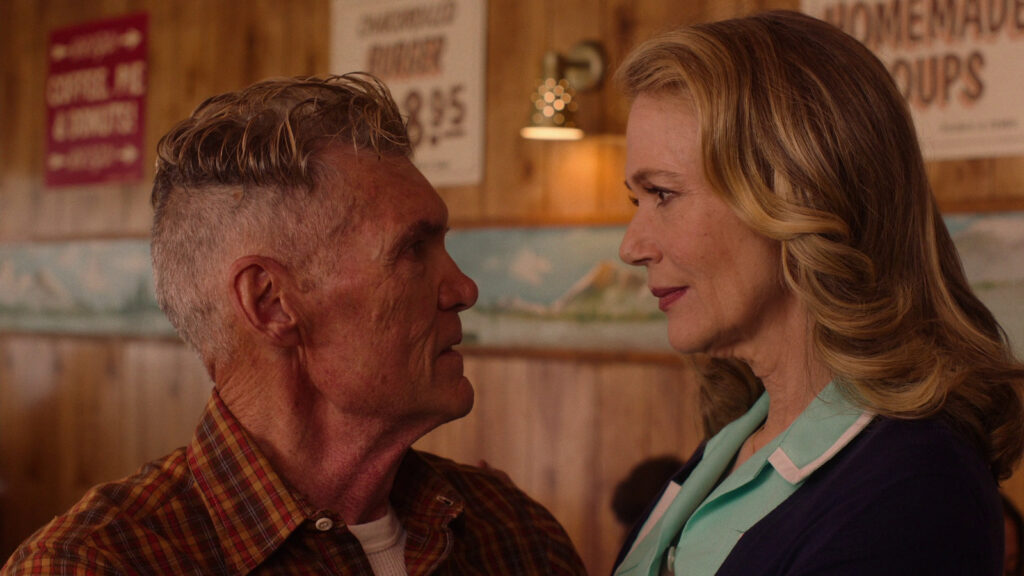
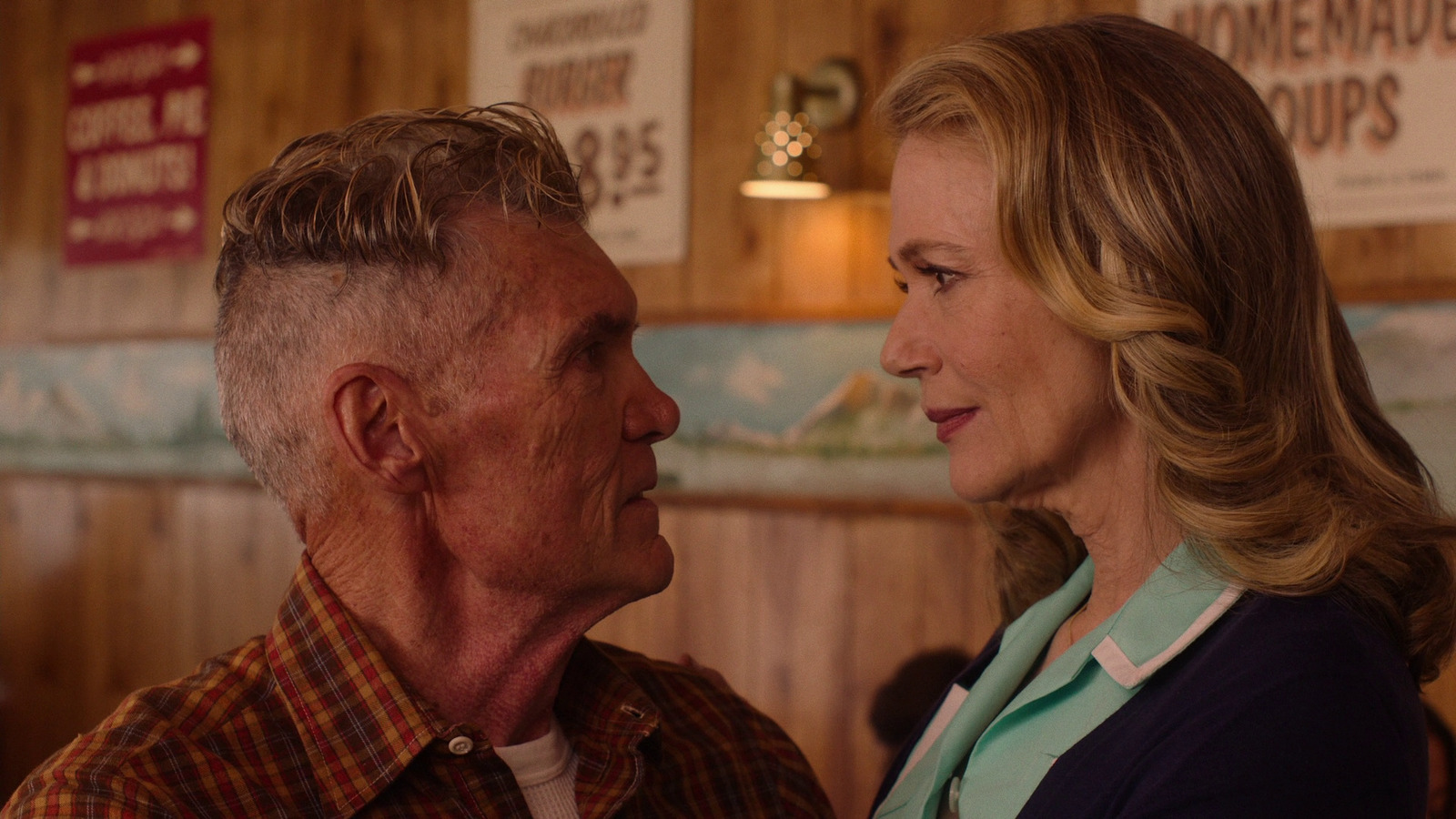
Ed and Norma reach a long-delayed reunion while Margaret prepares Hawk for her death. Between them, Jeffries becomes a voice without a human face, the green glove acquires consequences and a name spoken by an old movie changes Cooper’s attention.
- Part 15
- There’s Some Fear in Letting Go
- Directed by
- David Lynch
- Written by
- Mark Frost & David Lynch
- Standalone presentation
- 00:55:09
The Return overview · Twin Peaks research hub. Timings follow the standalone part and include its opening titles. Presentation and credit notes.
Explore this dossier
Departures, permissions and interrupted returns
The episode repeatedly asks what must change before someone can leave an old arrangement. Nadine’s release of Ed and Norma’s refusal of expansion open possibilities; Audrey’s argument returns her to the same threshold. Margaret does not promise that departure will be painless. Her farewell gives the title an emotional meaning that neither the romantic resolution nor the supernatural machinery can exhaust.
These studies follow the whole part, with closer galleries for the diner reunion, the convenience store, Freddie’s intervention, the electrical shock and Margaret’s final call. Interpretive links are separated from production testimony: an effect’s visible behavior is not proof of how it was manufactured. Sources and viewing notes identify the distinction.
Illustrated scene studies
- Nadine makes release an action
- The diner holds Ed at a distance
- Norma chooses the place she has made
- A hand arrives before the happy ending
- From warm interiors to the convenience store
- A corridor that will not stay indoors
- The threshold of room eight
- Jeffries: an interview without a human face
- Richard recognizes a photograph
- The building becomes an absence
- Steven and Gersten beneath the tree
- A passerby becomes a messenger
- The green glove interrupts the record
- An office network ends abruptly
- The jail gathers incompatible voices
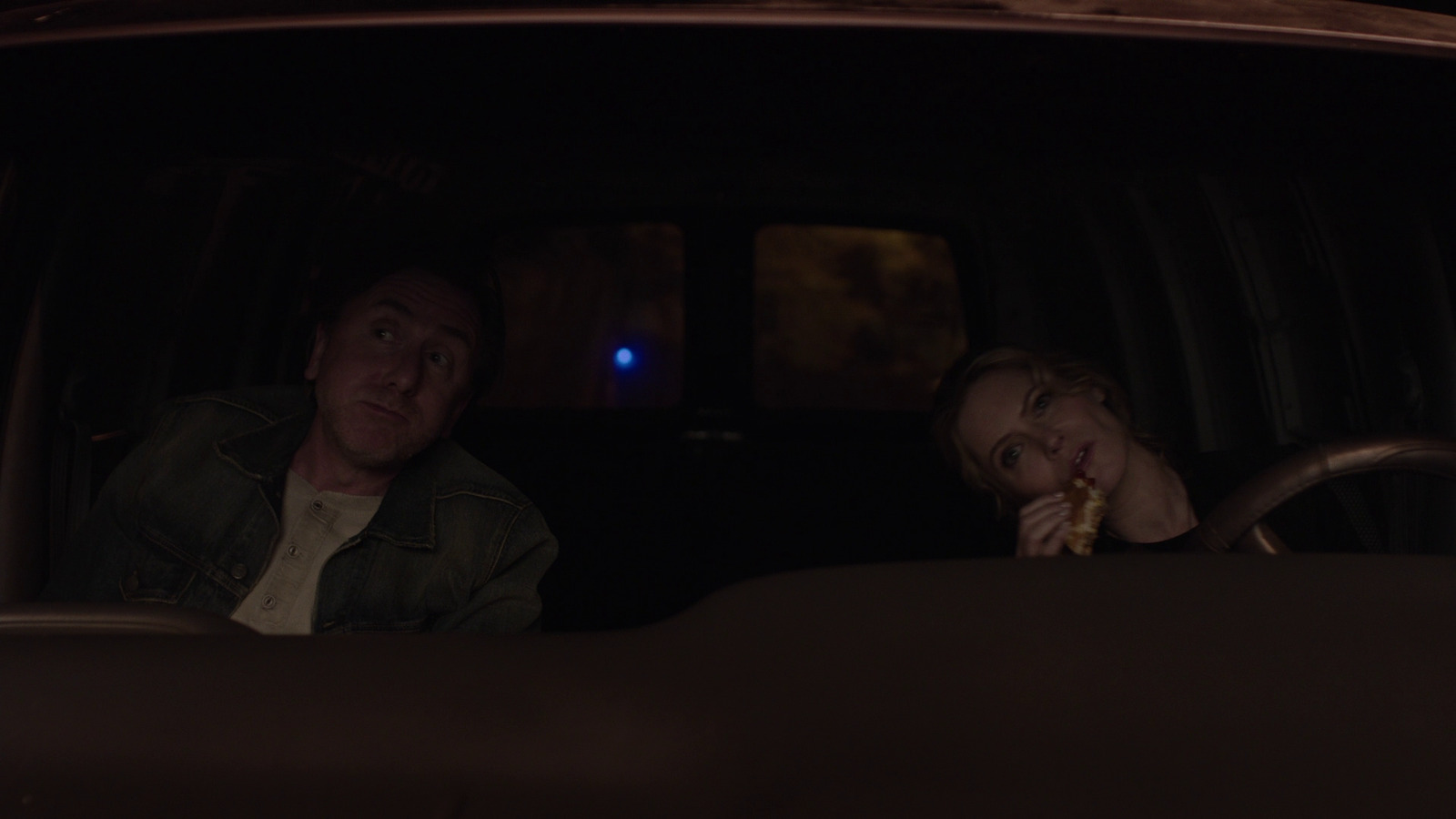
- Affection and self-excuse in the van
- An old movie says a familiar name
- Recognition seeks the socket
- Margaret gives Hawk time to hear her
- The news passes into a room
- Coats on, coats off, nowhere reached
- A place to sit becomes a place to scream
Nadine makes release an action
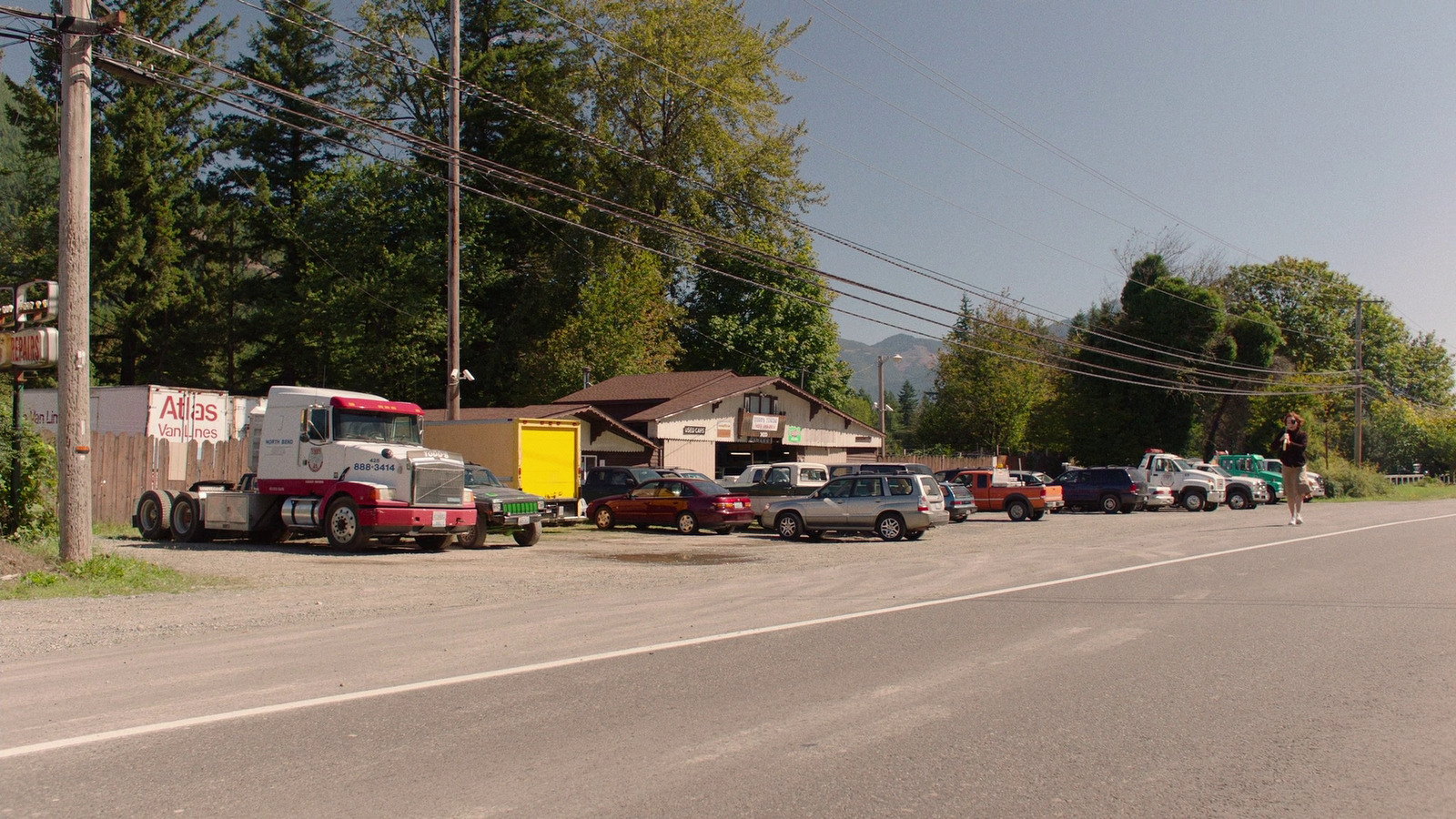
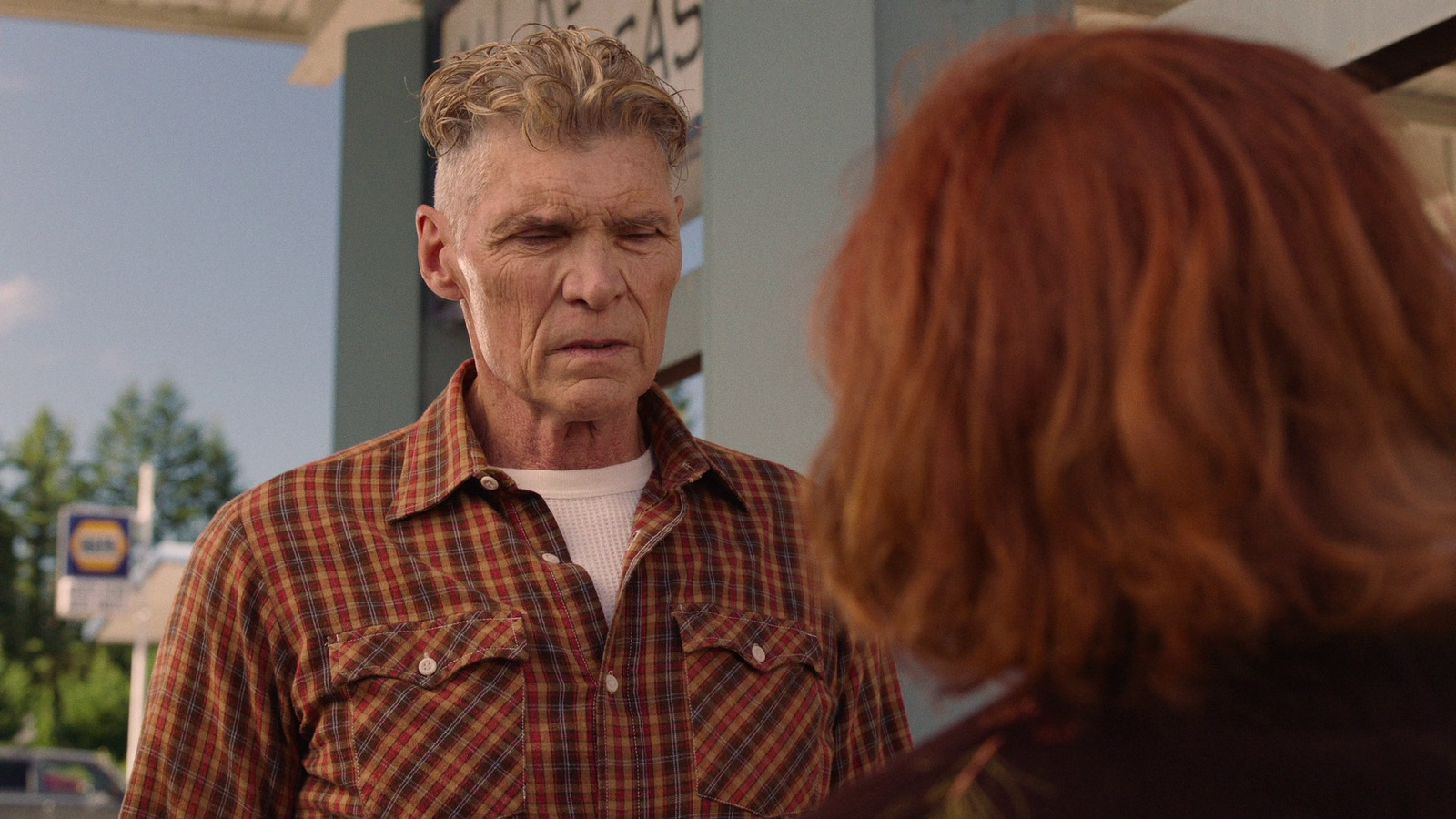
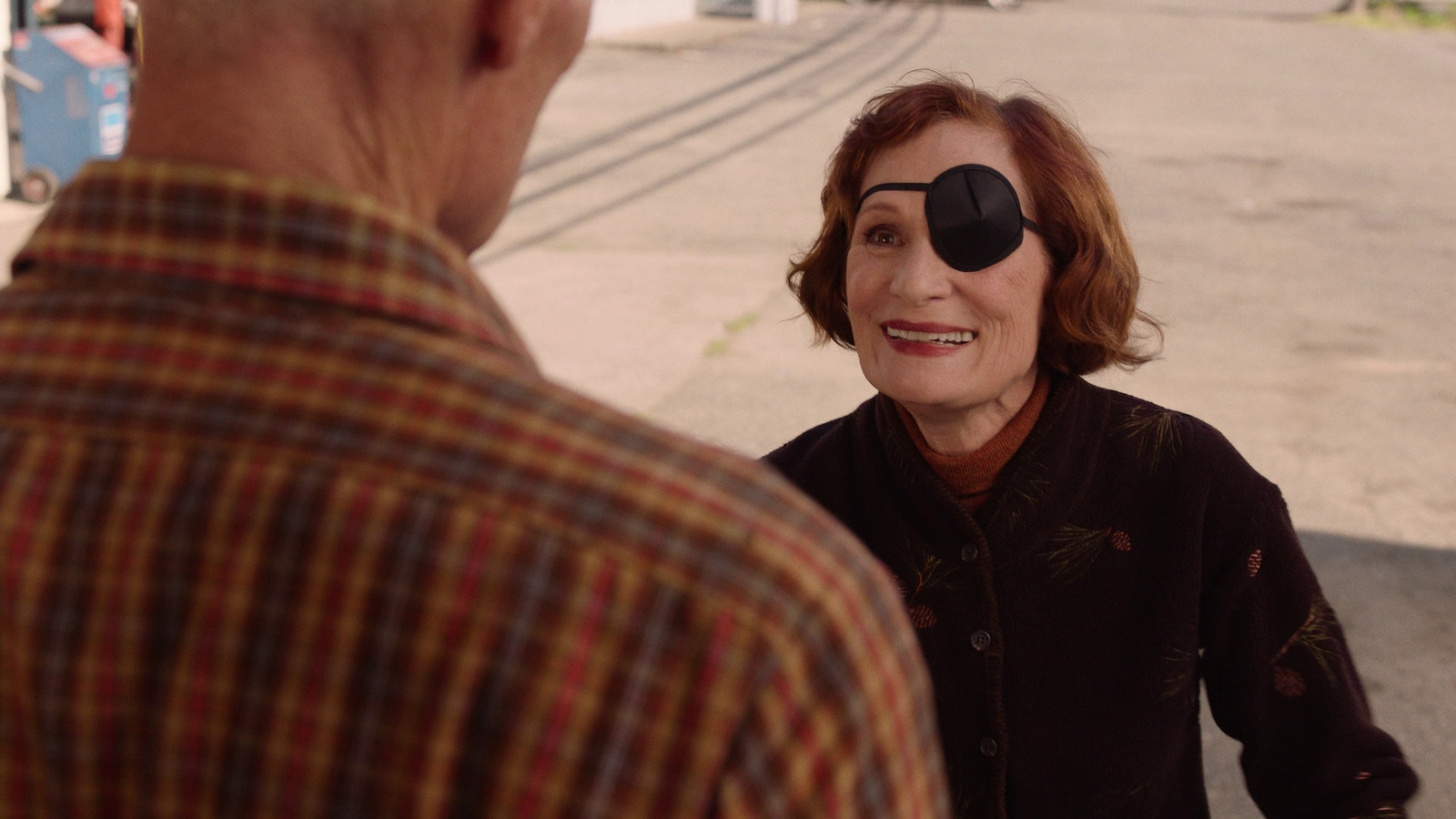
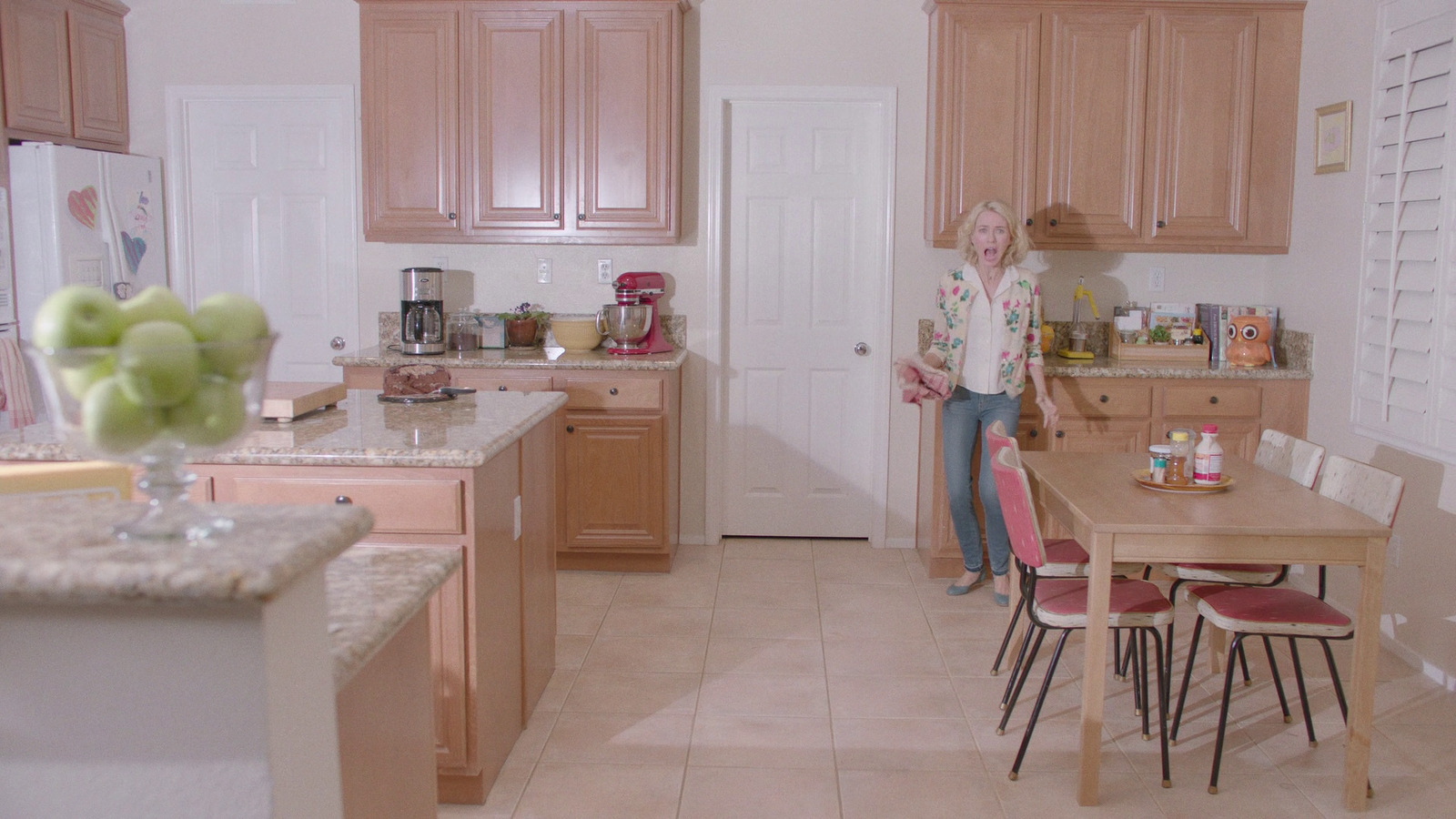
The gold shovel has left Dr. Amp’s broadcast and entered the road. Nadine carries it to Ed’s workplace, where her account of their marriage changes the distribution of responsibility: she names her jealousy and manipulation instead of asking Ed to reassure her. Ed’s hesitation matters. He has heard changes of mood before, and his concern prevents the scene from becoming a simple instruction to pursue Norma. Nadine answers that she has thought during the walk. The physical journey gives her decision duration; Wendy Robie’s smile makes relinquishment look like something she has achieved for herself.
Open the scene sequence · 3 frames
The diner holds Ed at a distance
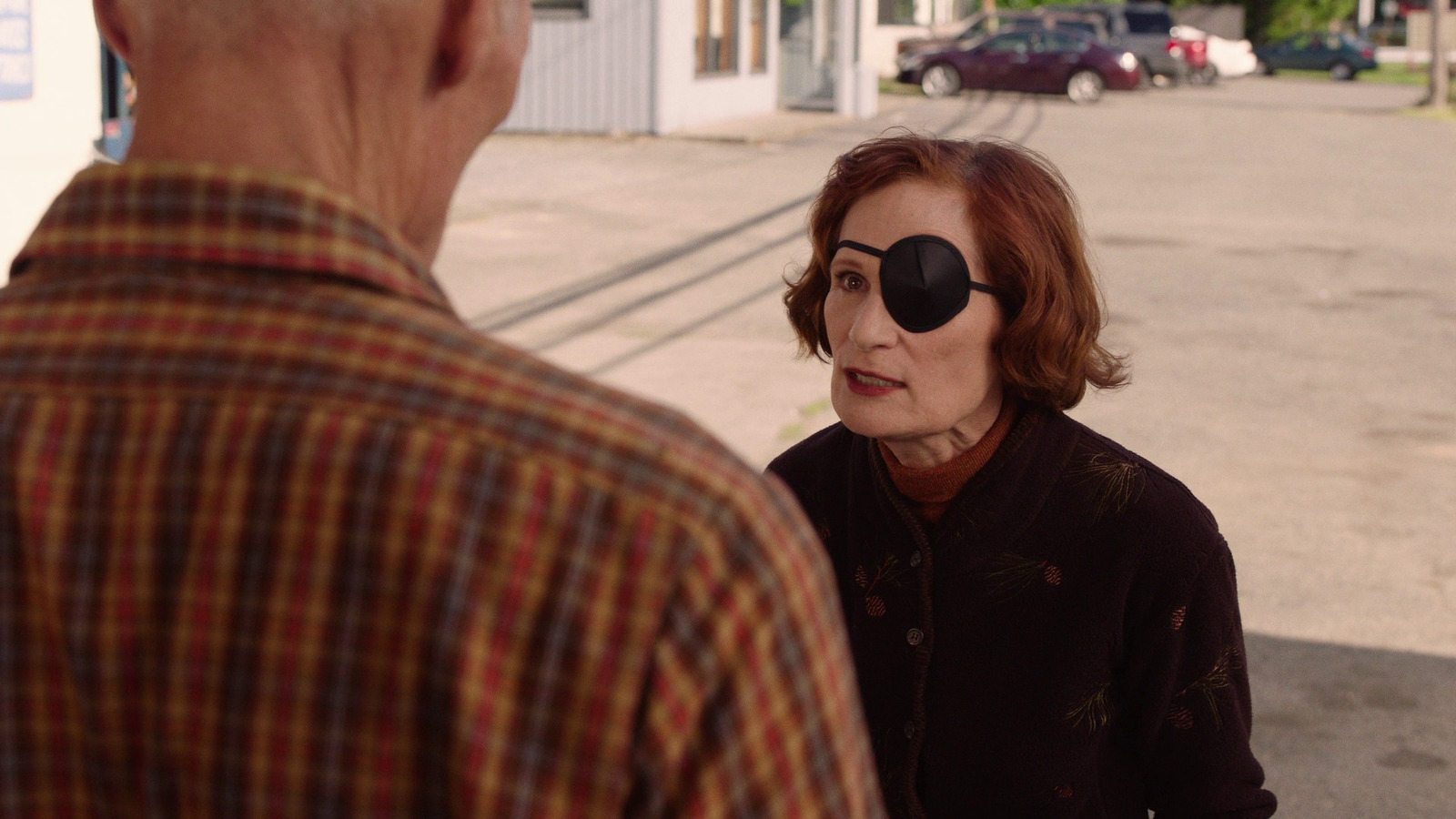
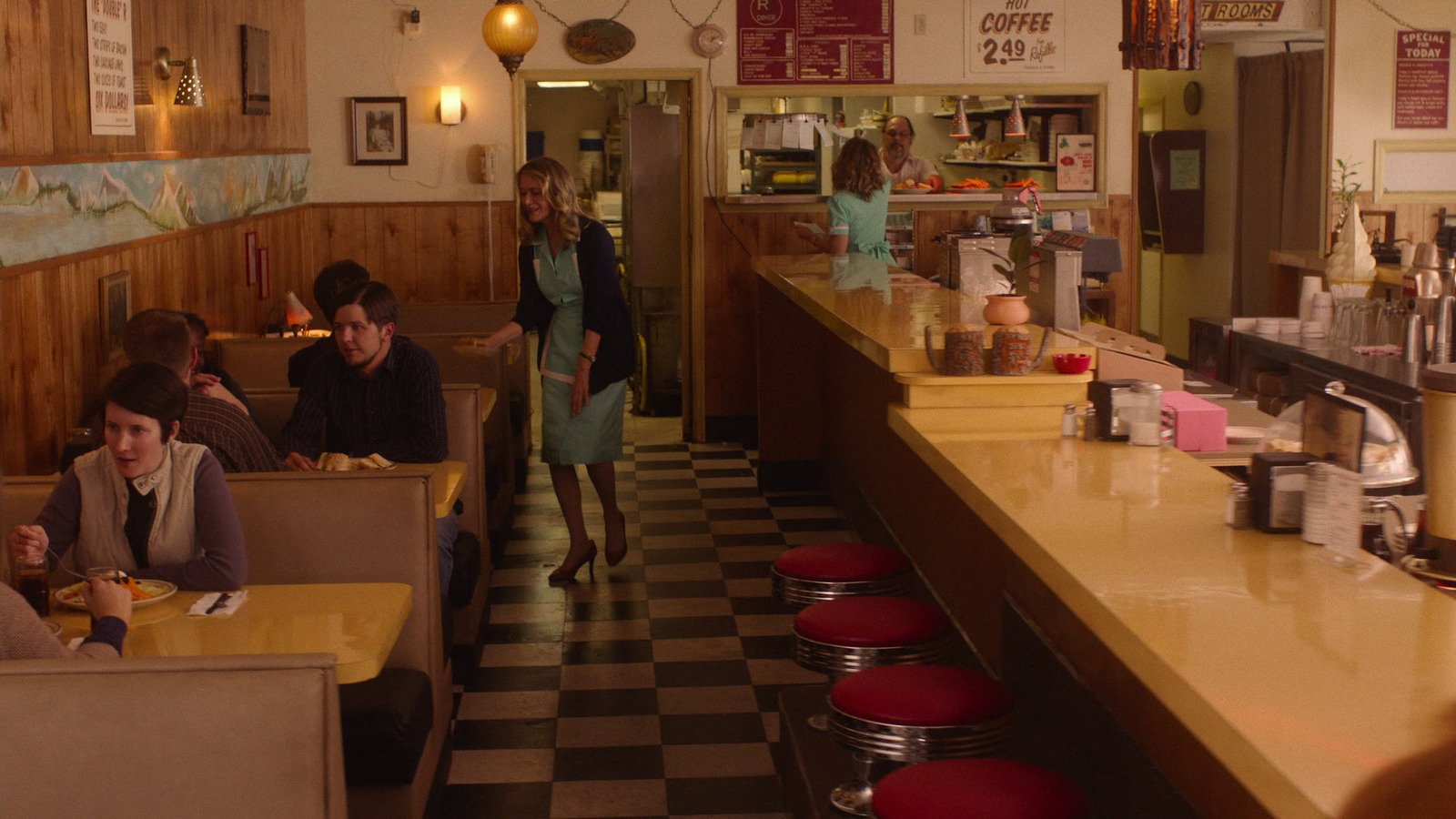
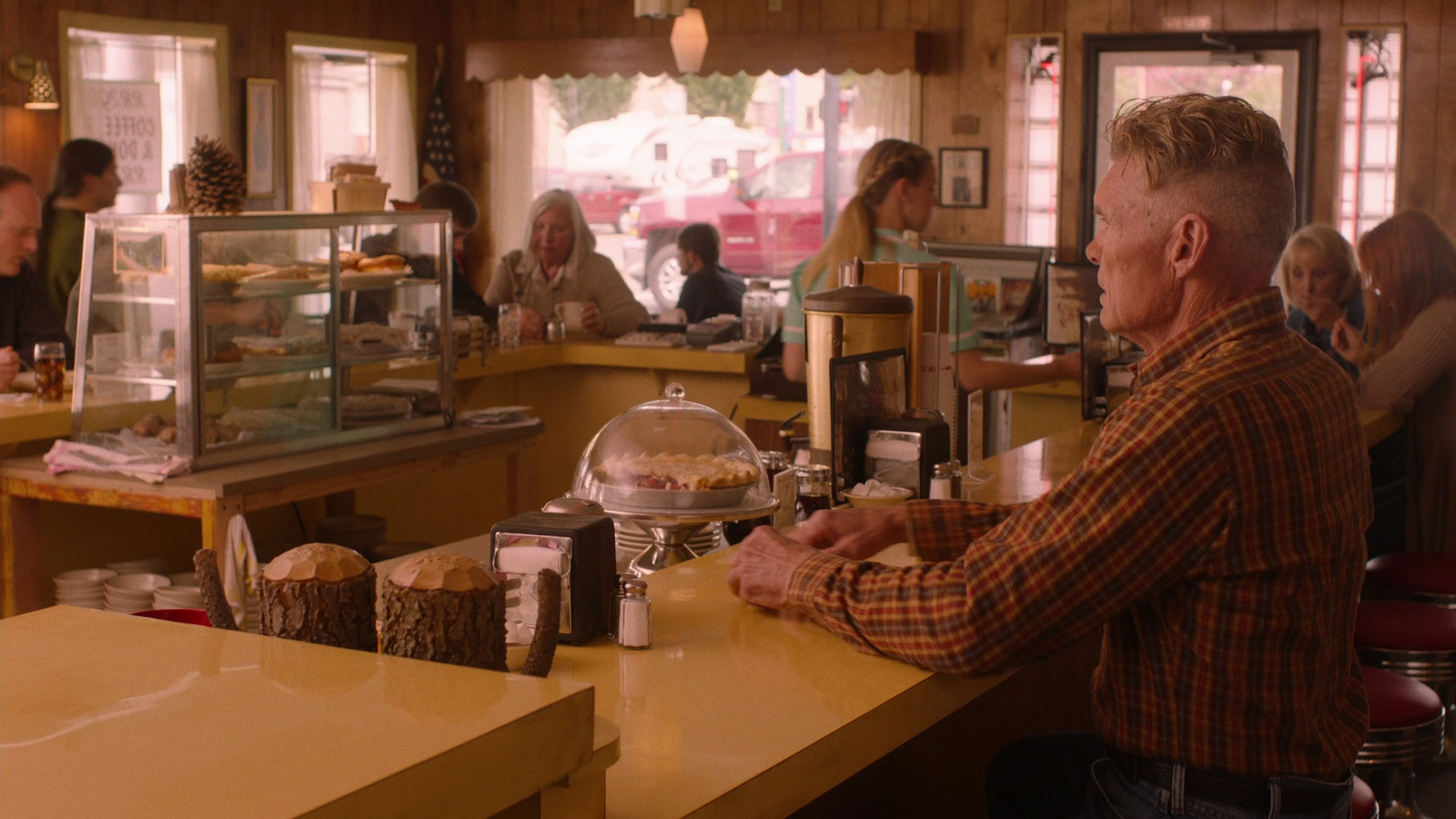
The Double R’s long counter and open floor promise a public reunion. Ed reaches Norma, but Walter arrives before that promise can be fulfilled. The staging separates the hoped-for couple without sending Ed out of the room: he remains at the counter while another conversation takes place. His bleak joke about his coffee order is a miniature return to the old situation, in which longing can be voiced only sideways. The live Otis Redding performance gives the passage emotional continuity while the blocking temporarily denies Ed the answer he came for.
Open the scene sequence · 2 frames
Norma chooses the place she has made
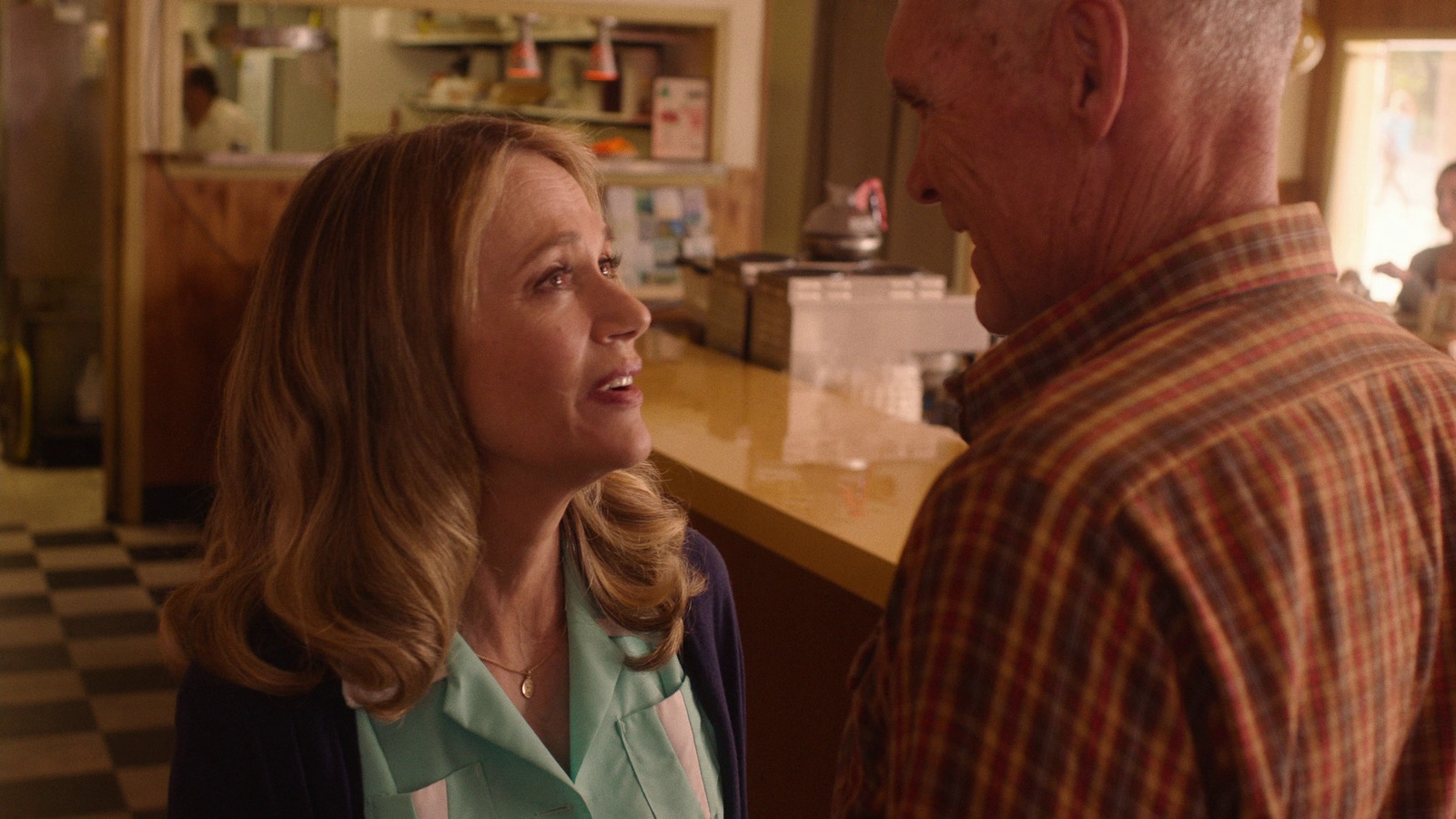
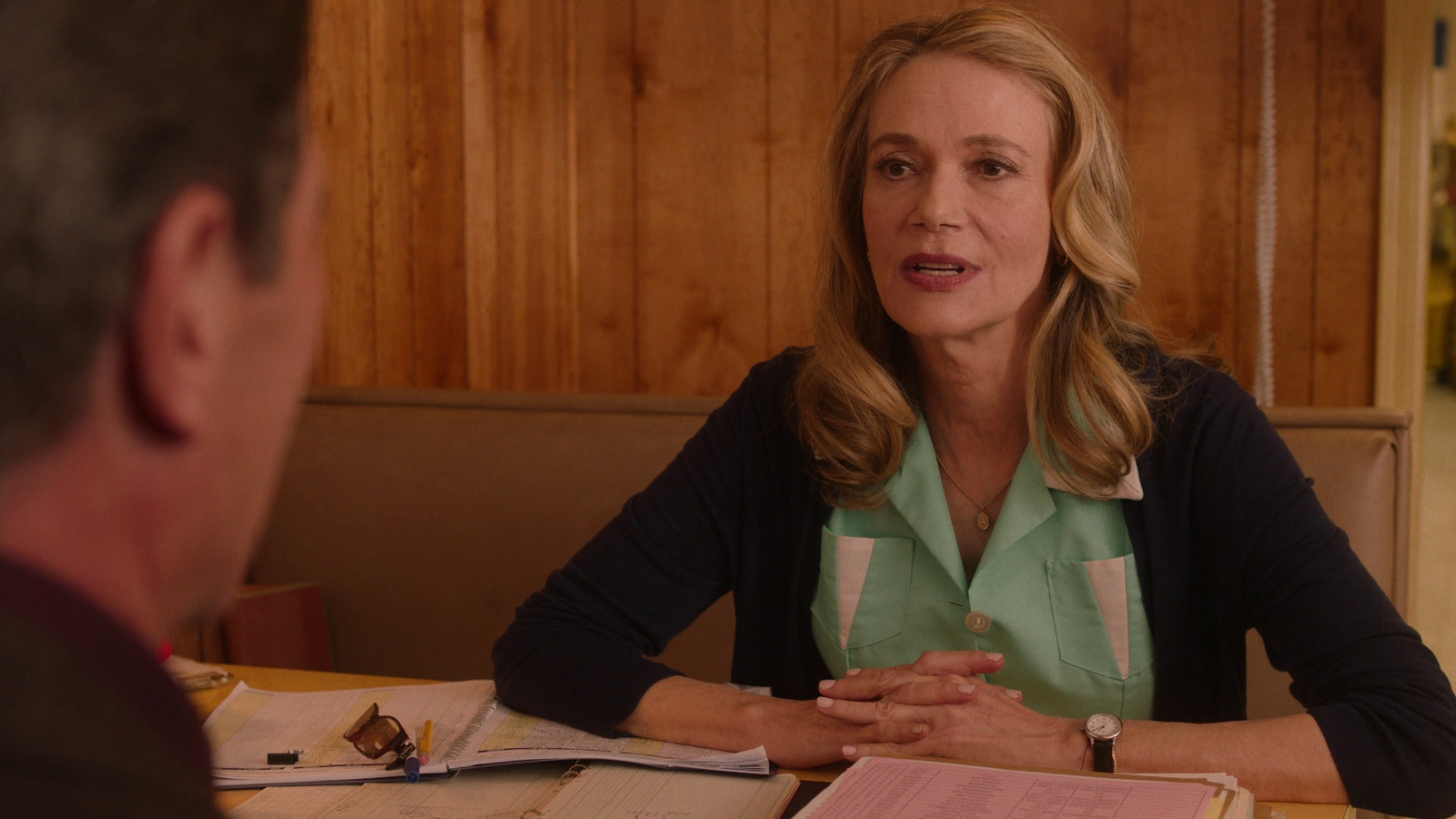
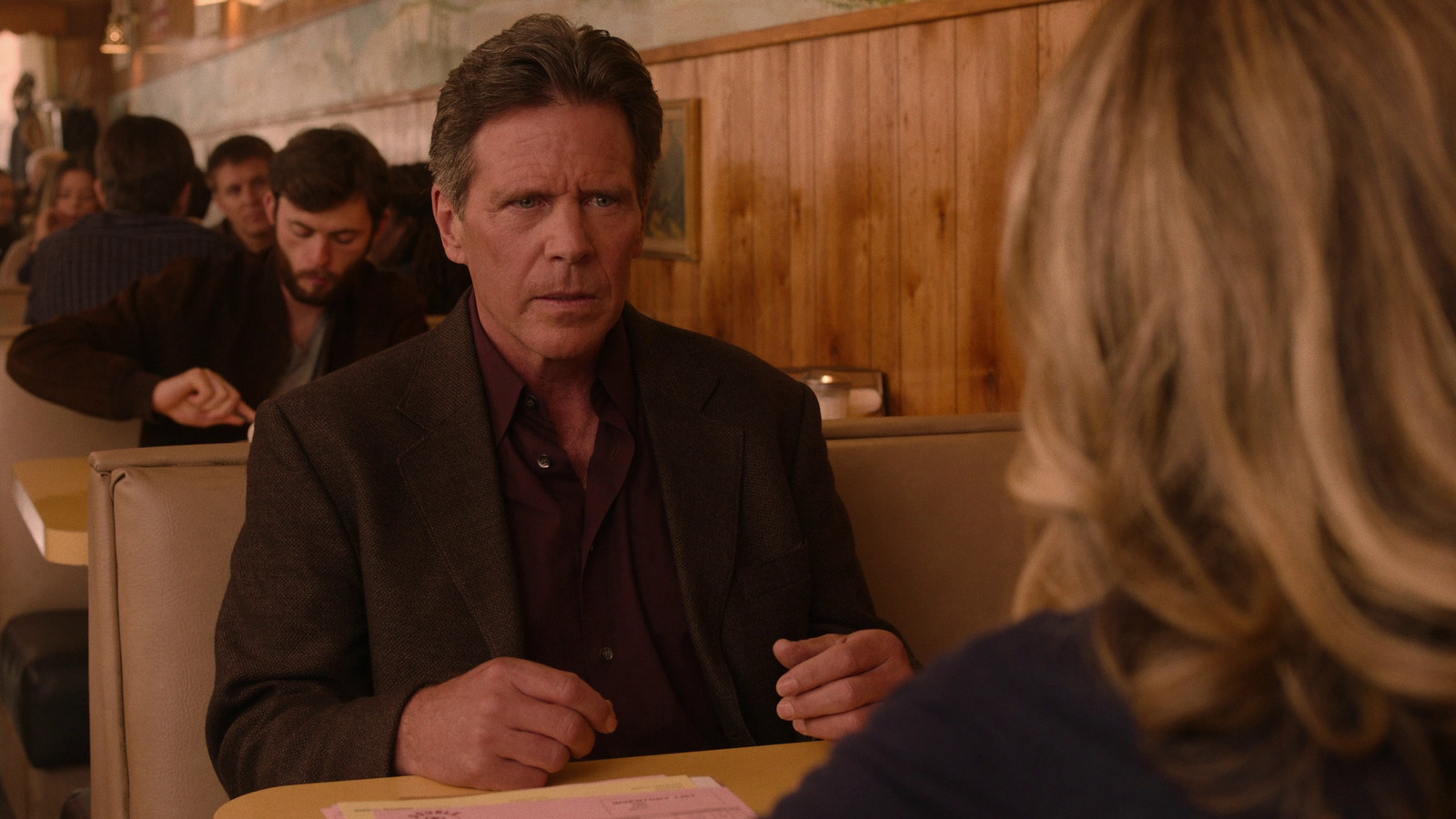
Norma’s business decision is given its own conversation. She wants to retain the Double R while giving up her interests in the other franchises; Walter hears a failure to capitalize on success. Her definition of success is different: family, home and responsibility for this particular diner. The papers on the table and Walter’s professional composure keep the issue concrete. Norma is not simply made available by Nadine’s permission. She independently rejects an arrangement that asks her to value expansion over the life she wants to inhabit.
Open the scene sequence · 1 frame
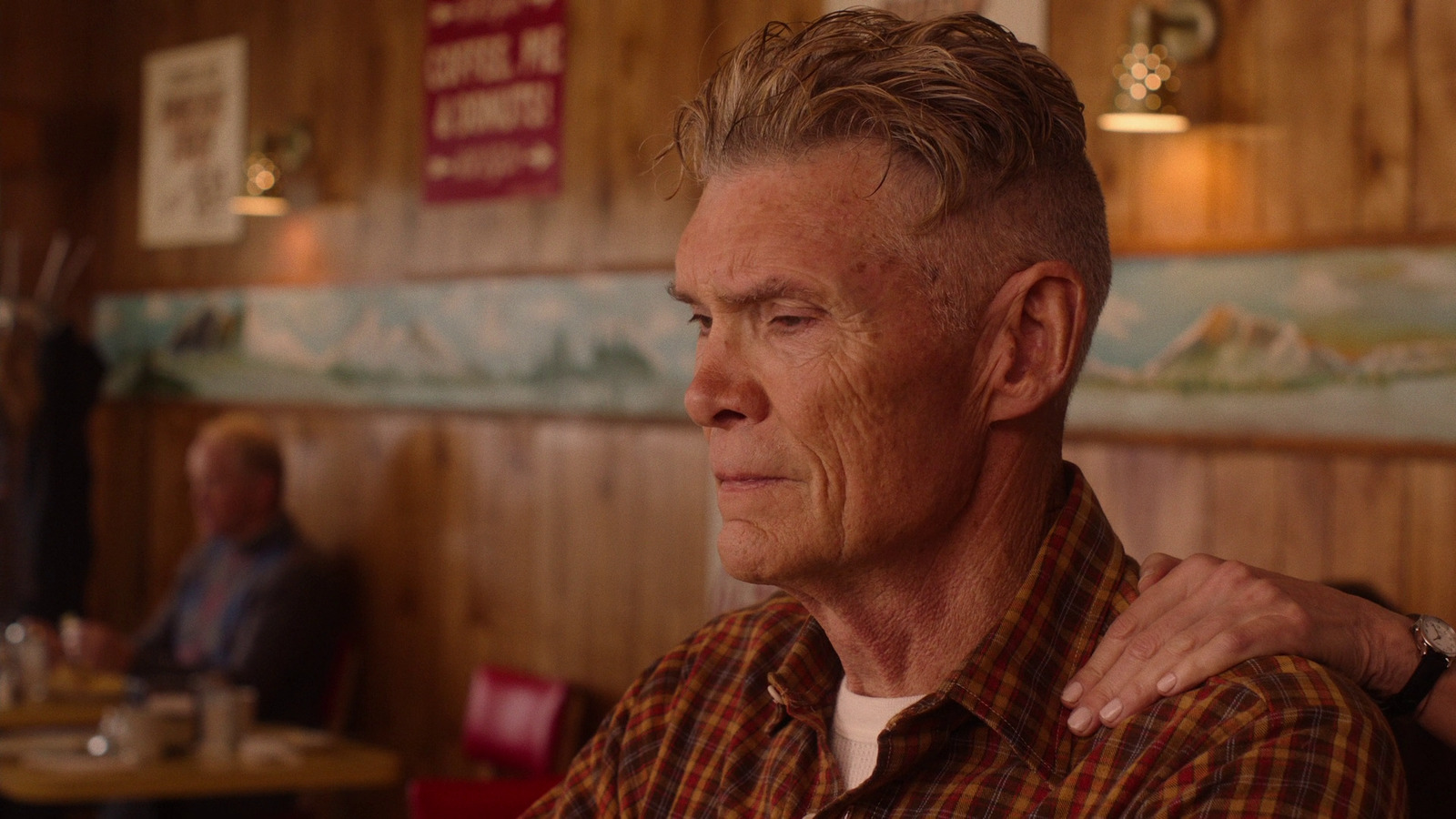
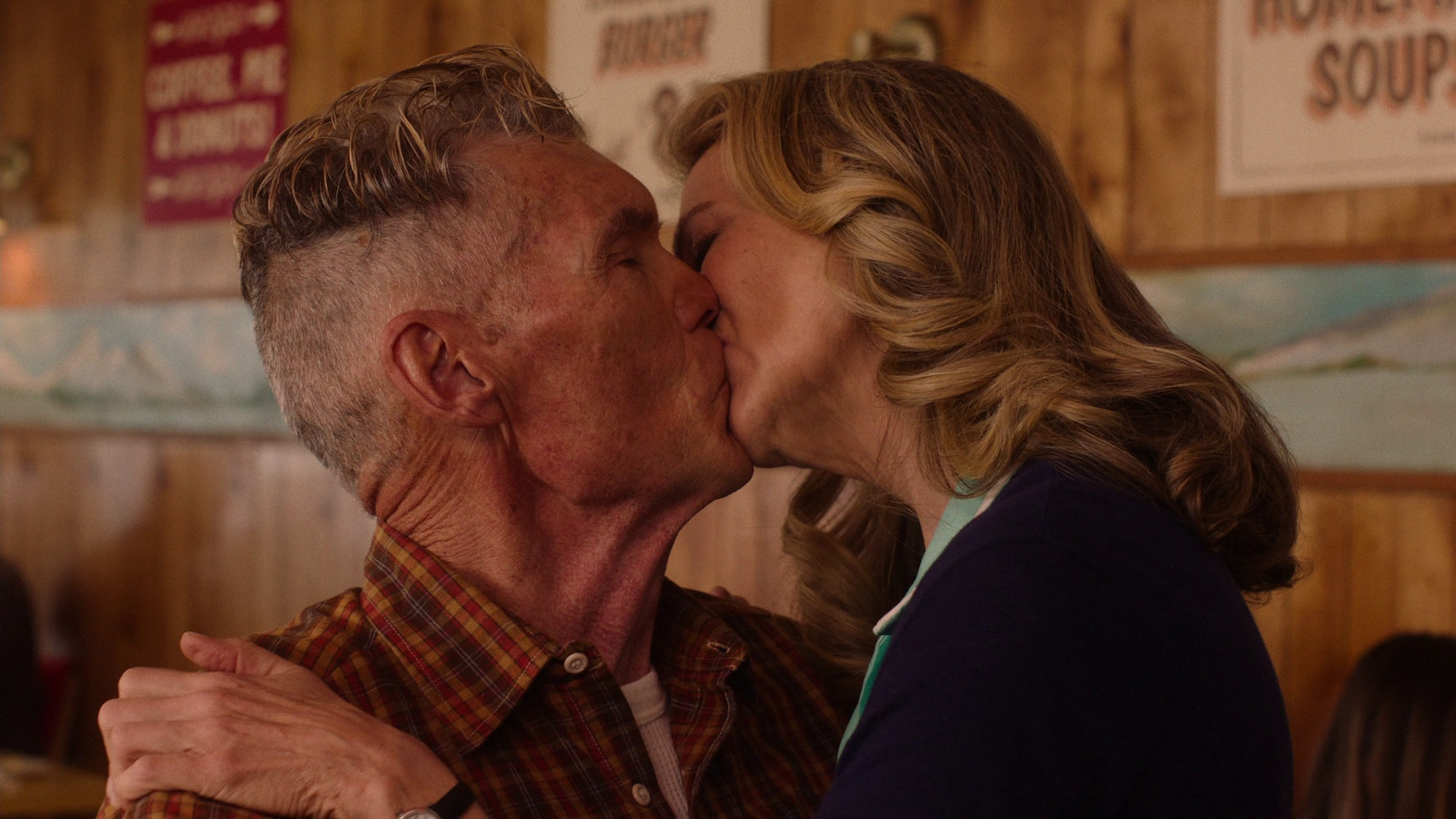
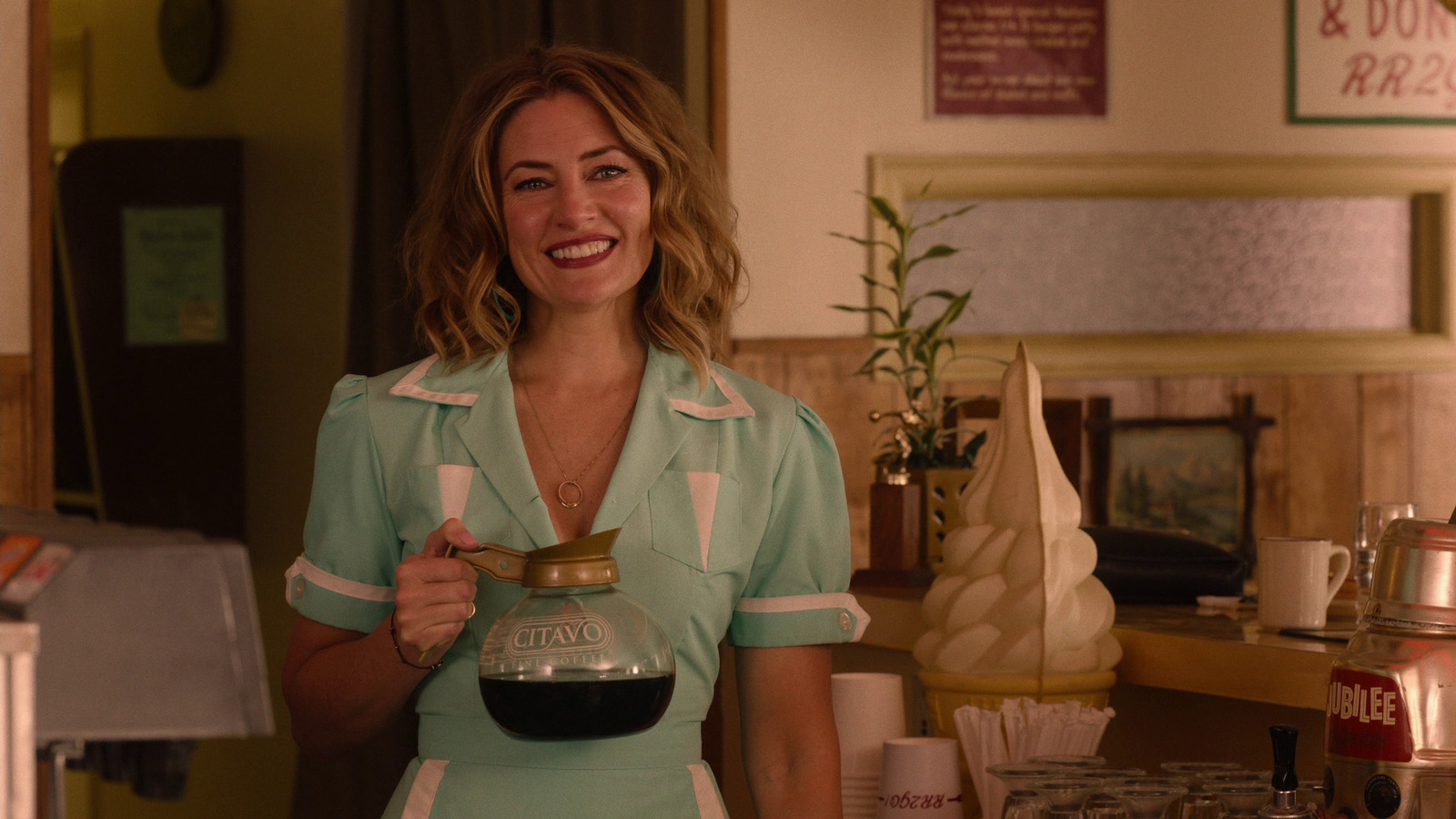
A hand arrives before the happy ending
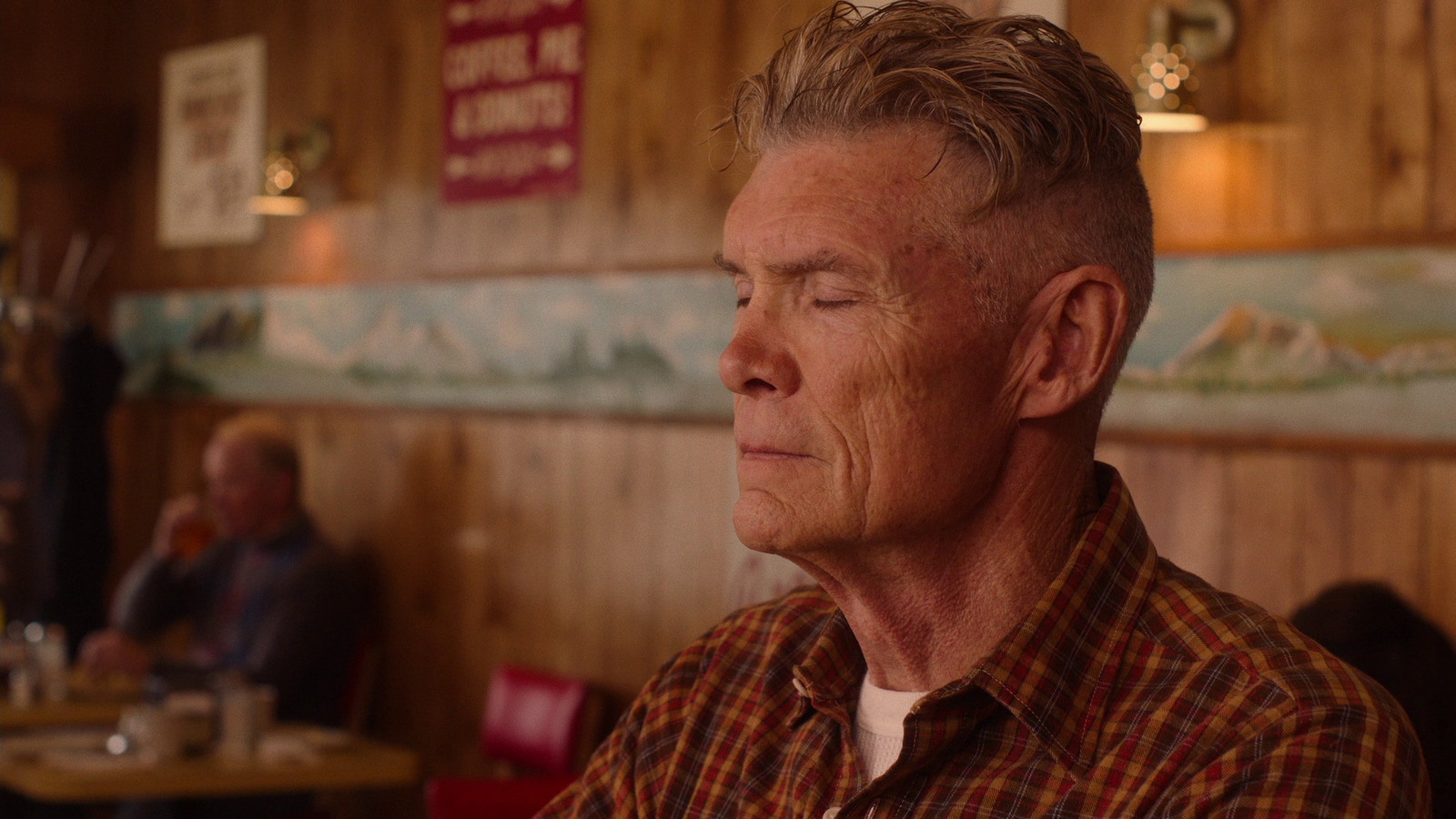
Ed closes his eyes at the counter. Norma’s hand enters his solitude before the reverse angle confirms her presence, so touch precedes explanation. The sequence then spends its time on recognition, a proposal, the kiss and Norma’s acceptance. Shelly’s smile supplies a witness rather than a punchline. Everett McGill’s stillness and Peggy Lipton’s directness make this resolution feel earned without a speech recounting the intervening years. Mountains and sky follow the diner: the release briefly seems large enough to alter the whole town’s atmosphere.
Open the scene sequence · 4 frames
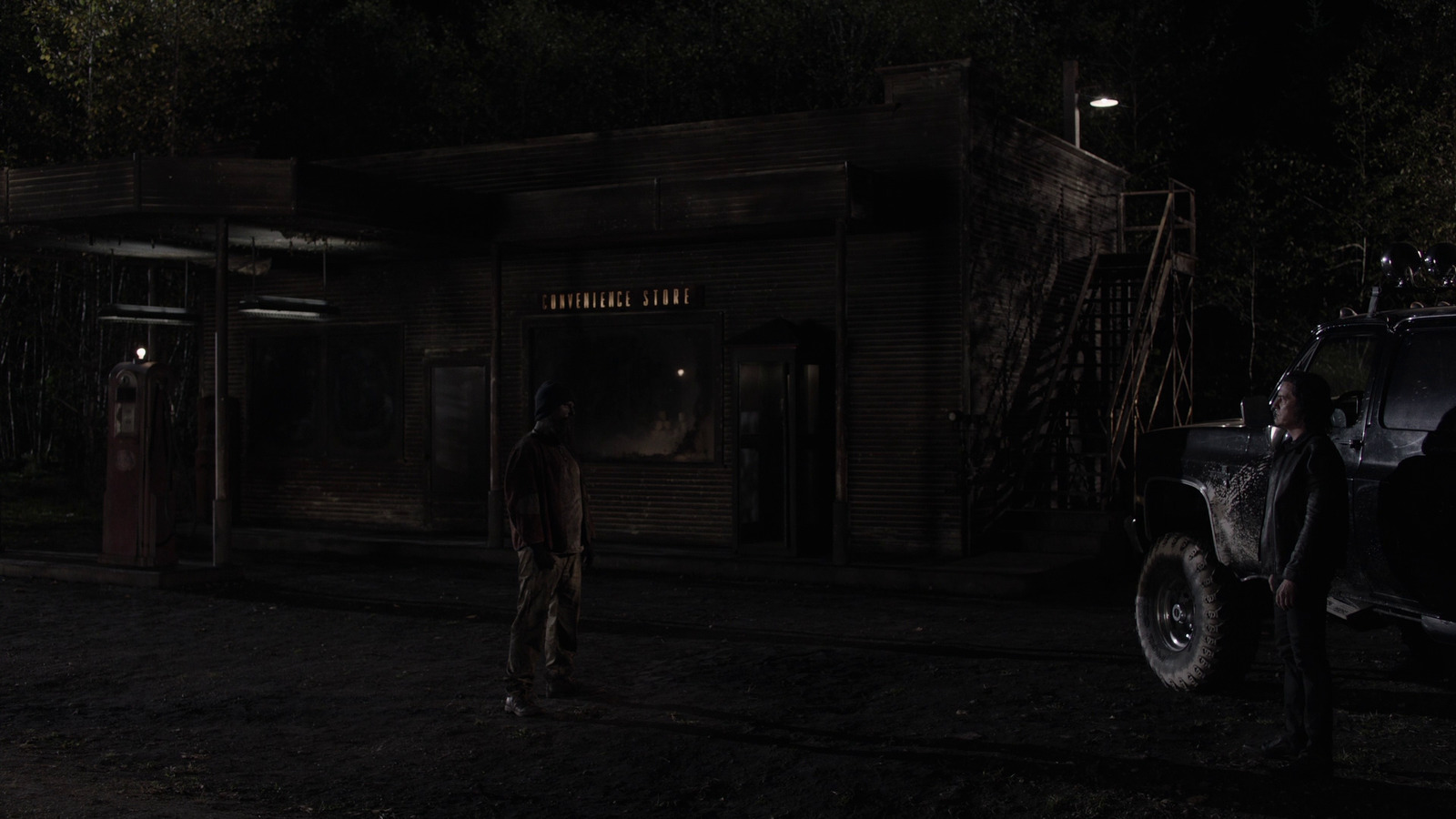
From warm interiors to the convenience store
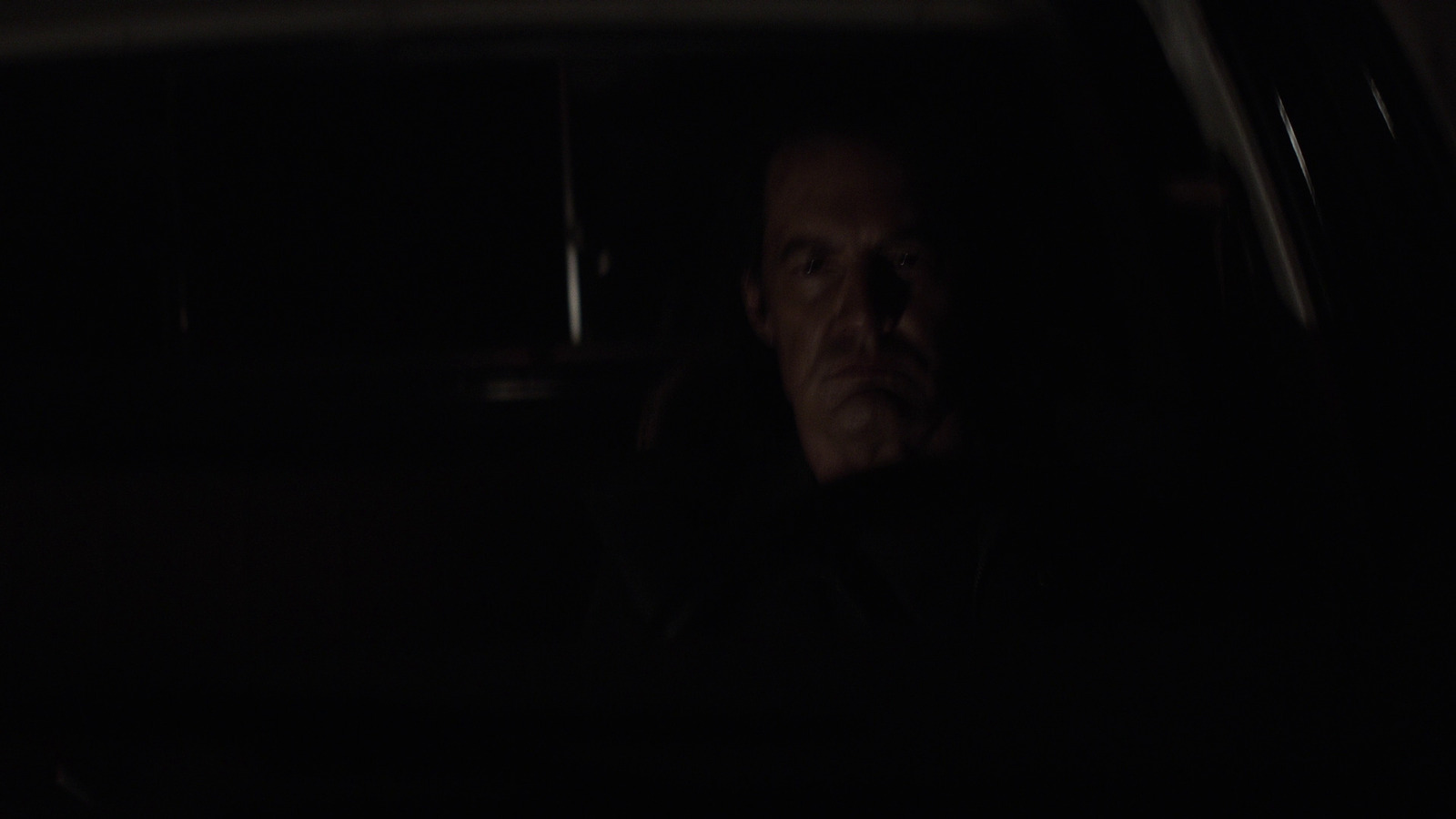
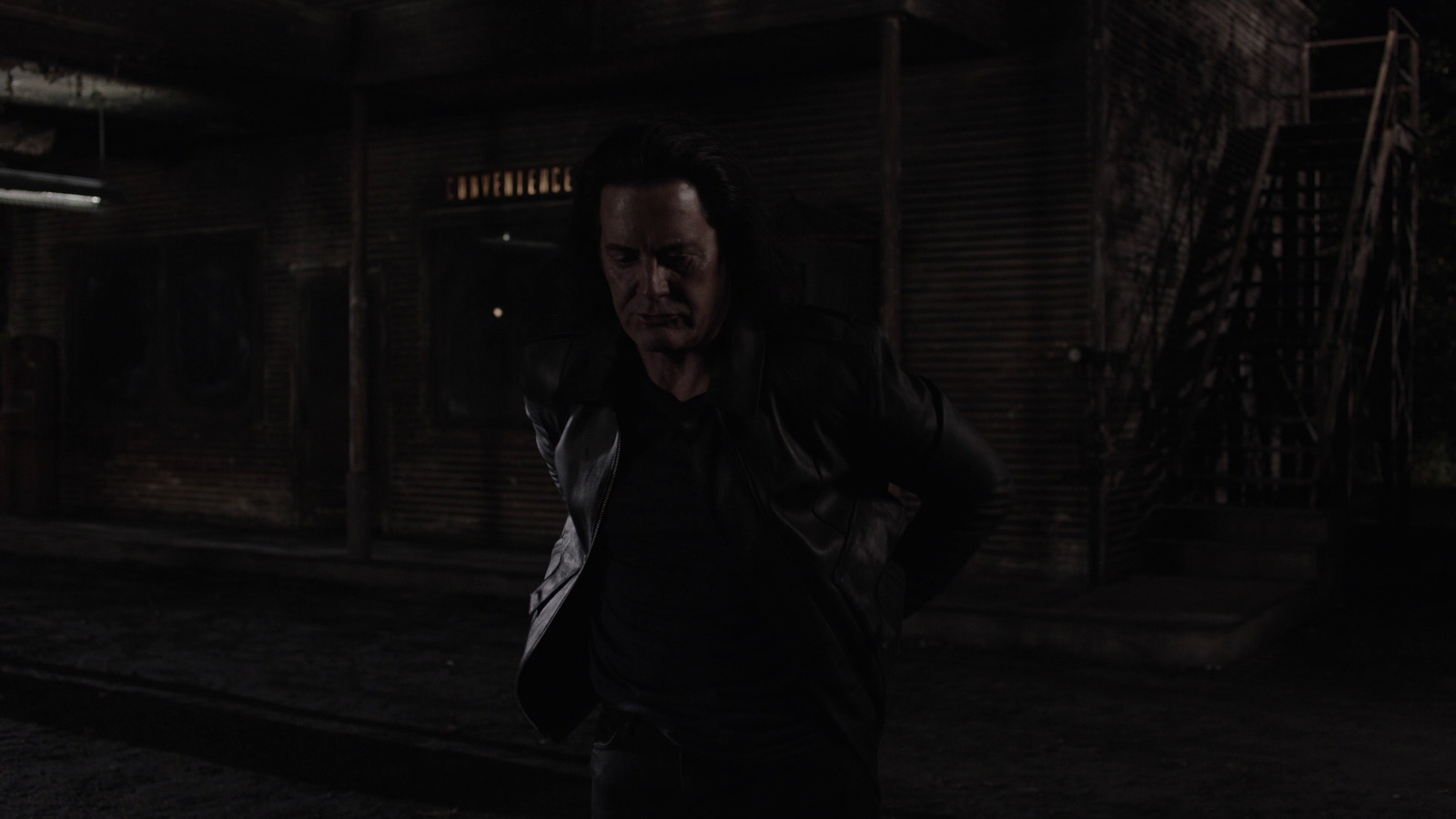
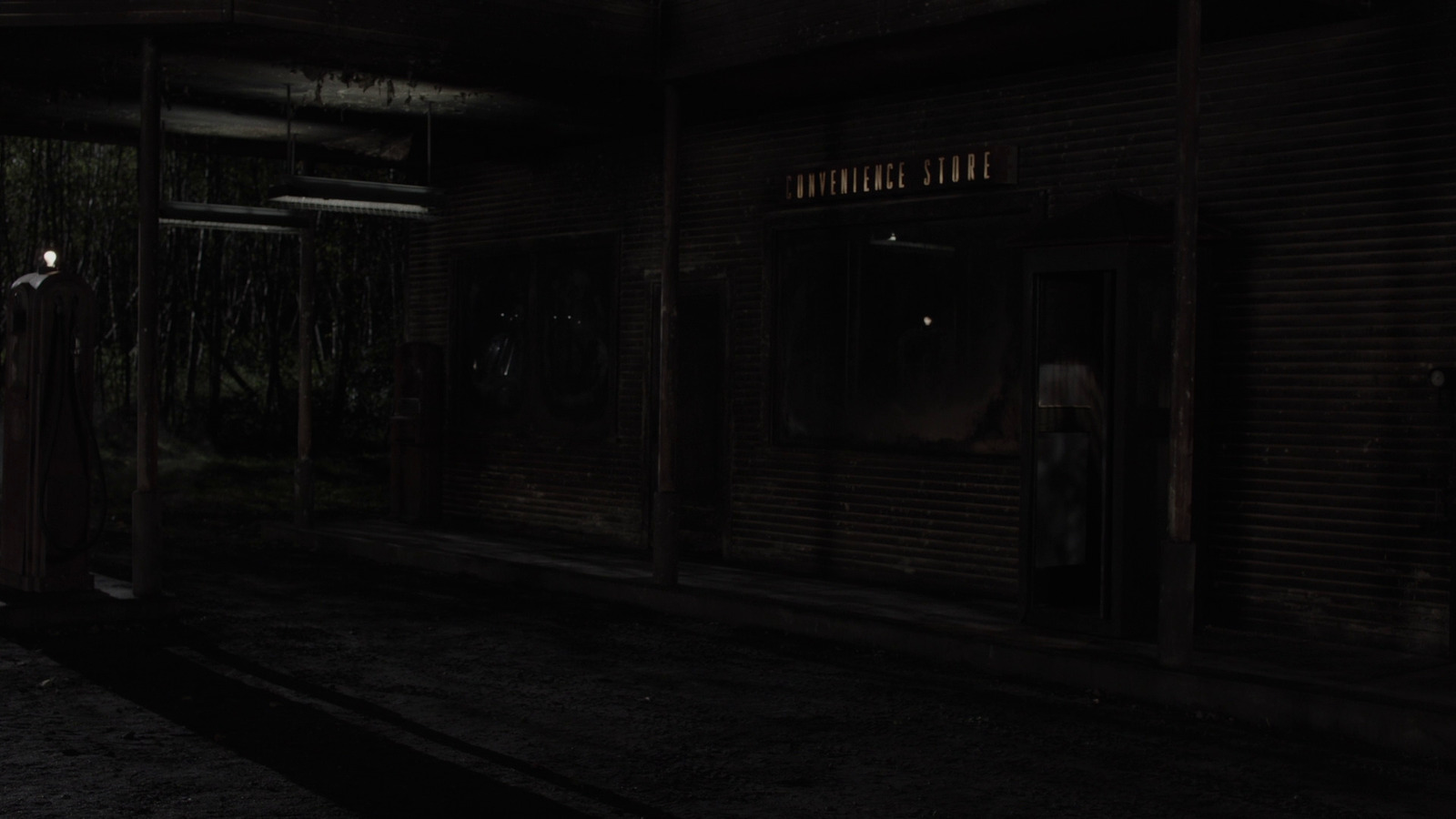
The transition to Mr. C’s night drive is a change in sensory regime. The face in the car is barely detached from darkness; the convenience store is readable through isolated practical lights and its exterior staircase. Where the diner scene allowed ordinary people to close a long separation, this journey requires a guide and a request for access. The abrasive musical texture and electrical disturbances make the approach feel less like arrival at an address than entry into a space governed by different rules.
Open the scene sequence · 1 frame
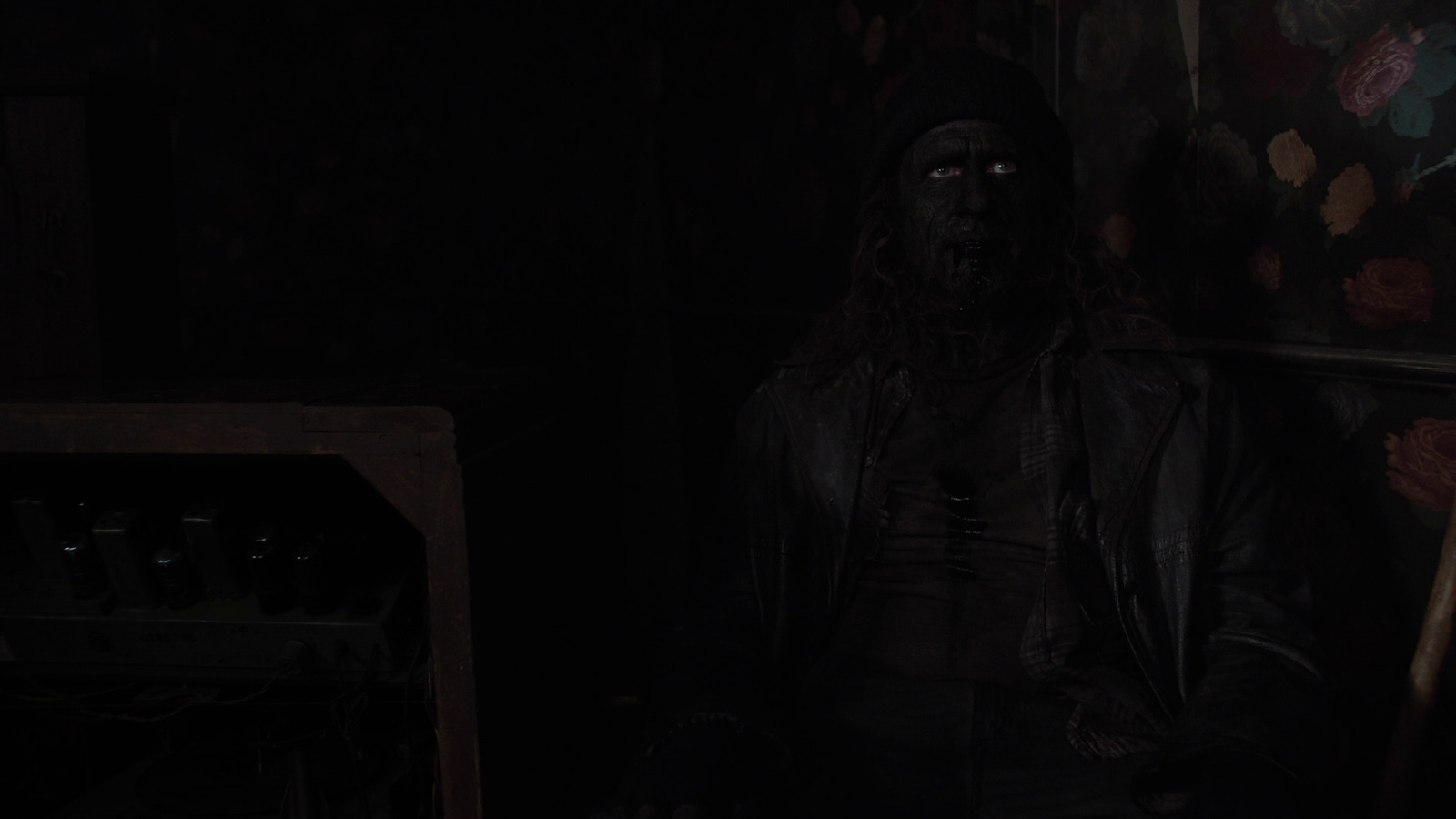
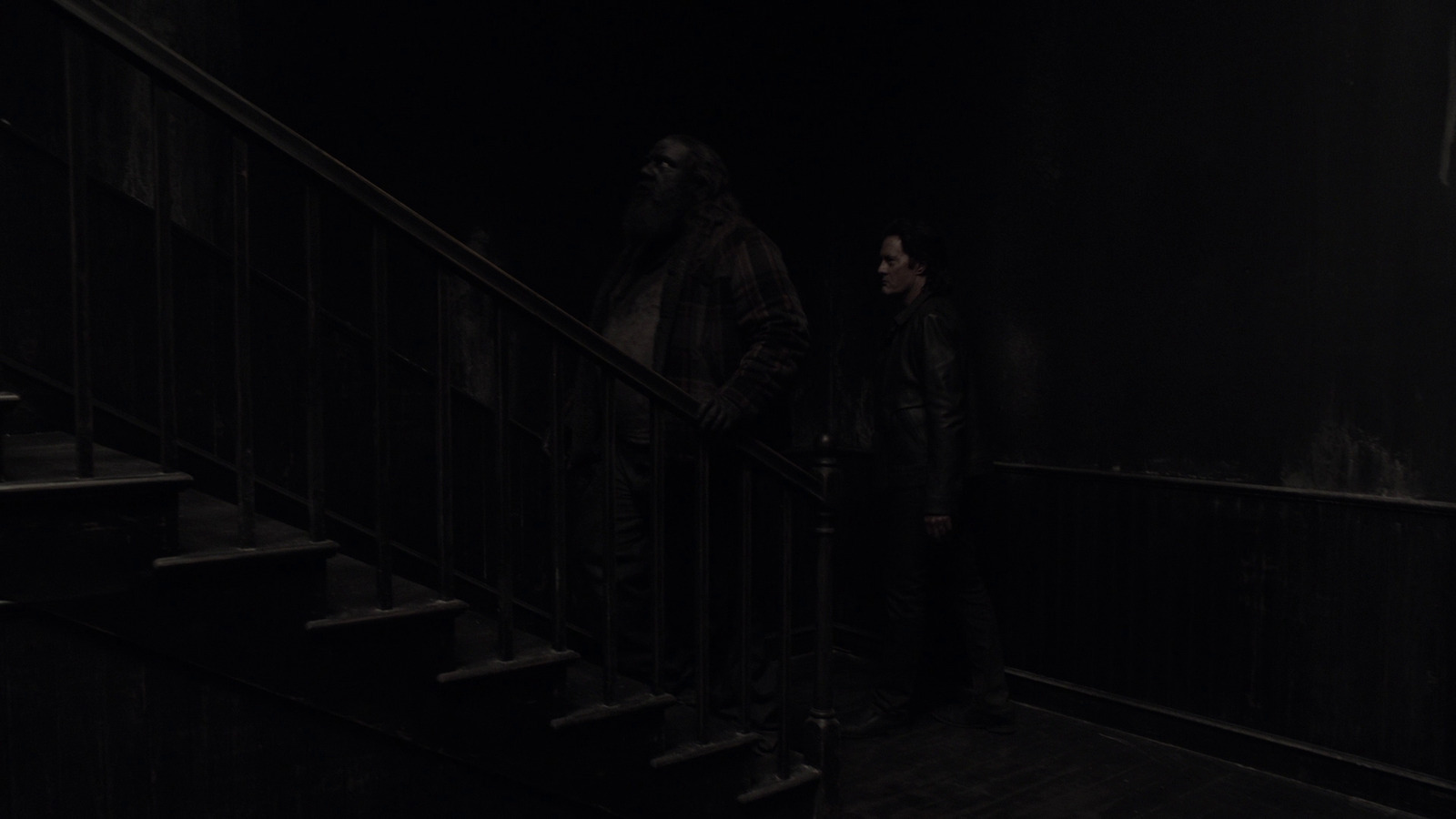
A corridor that will not stay indoors
The Woodsman, equipment, passage and staircase form a route, but the route refuses stable geography. Forest imagery appears within the interior journey; interrupted movement and electrical sounds prevent the cuts from behaving like neutral links between rooms. Mr. C follows with little visible surprise. His practical determination is a useful counterweight to the viewer’s uncertainty: someone can know what he wants from a place without the place becoming explainable. The images establish crossings and superimpositions; they do not supply a reliable architectural plan.
Open the scene sequence · 2 frames
The threshold of room eight
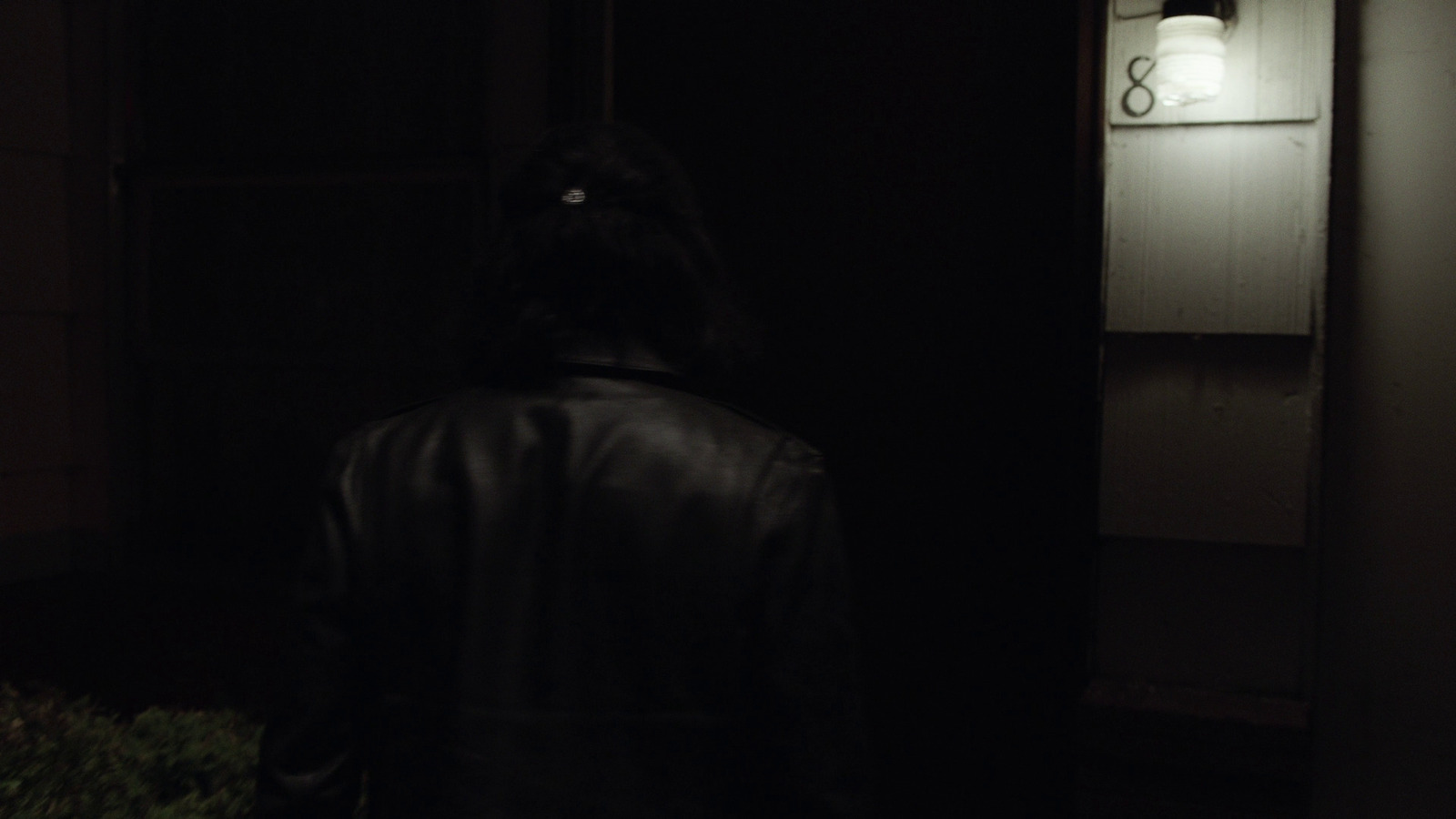
The motel courtyard offers an apparently familiar destination: a door with a number, approached across an exterior walkway. The woman who opens it makes access a small performance, and the altered voice prevents the exchange from settling into everyday hospitality. The lit number remains a clear landmark amid extremely dark space. Following the doorway does not resolve how this courtyard relates to the convenience store. The scene uses the legibility of a motel entrance to make the next displacement more disturbing, rather than to certify an ordinary journey.
Open the scene sequence · 2 frames
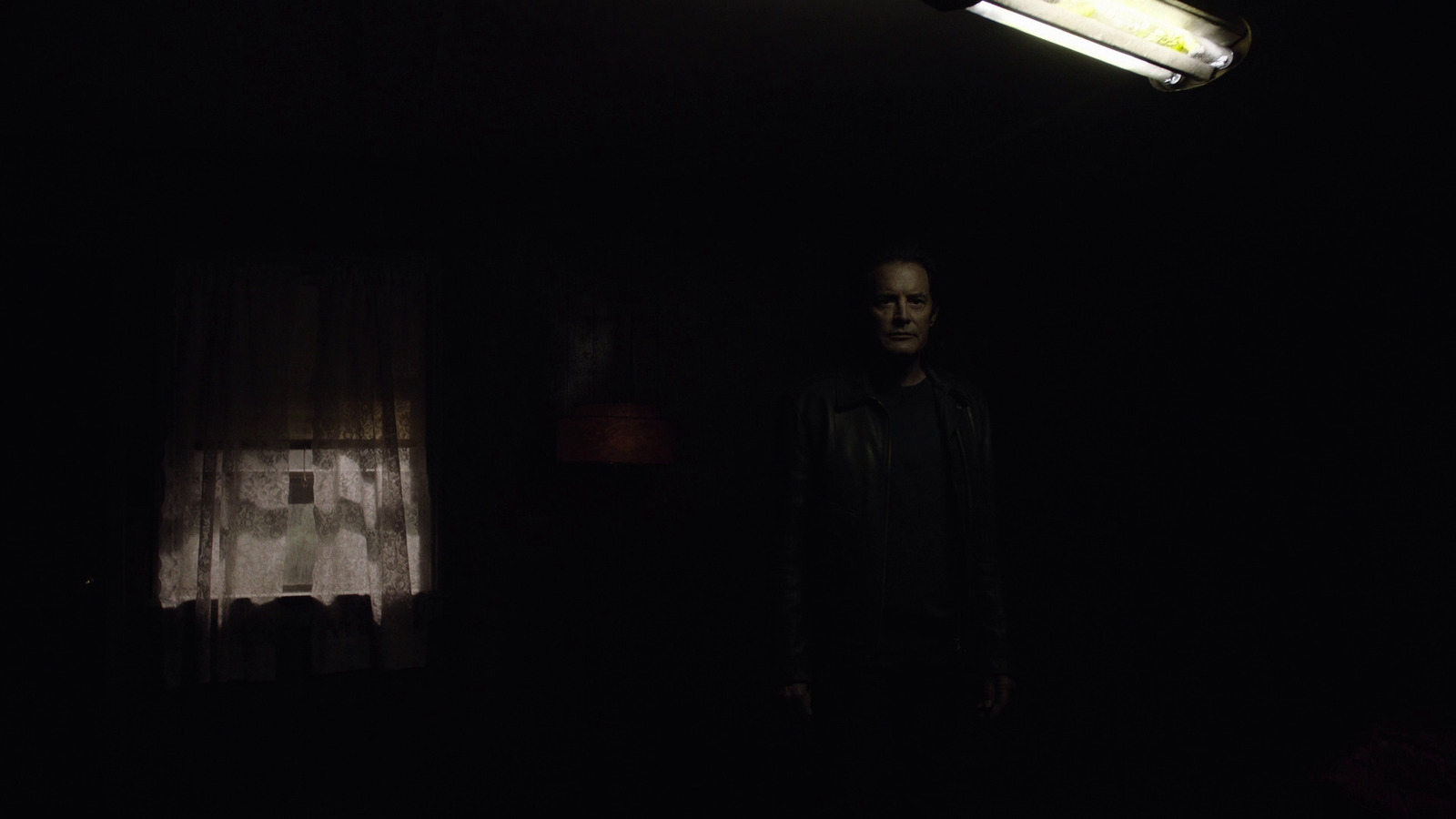
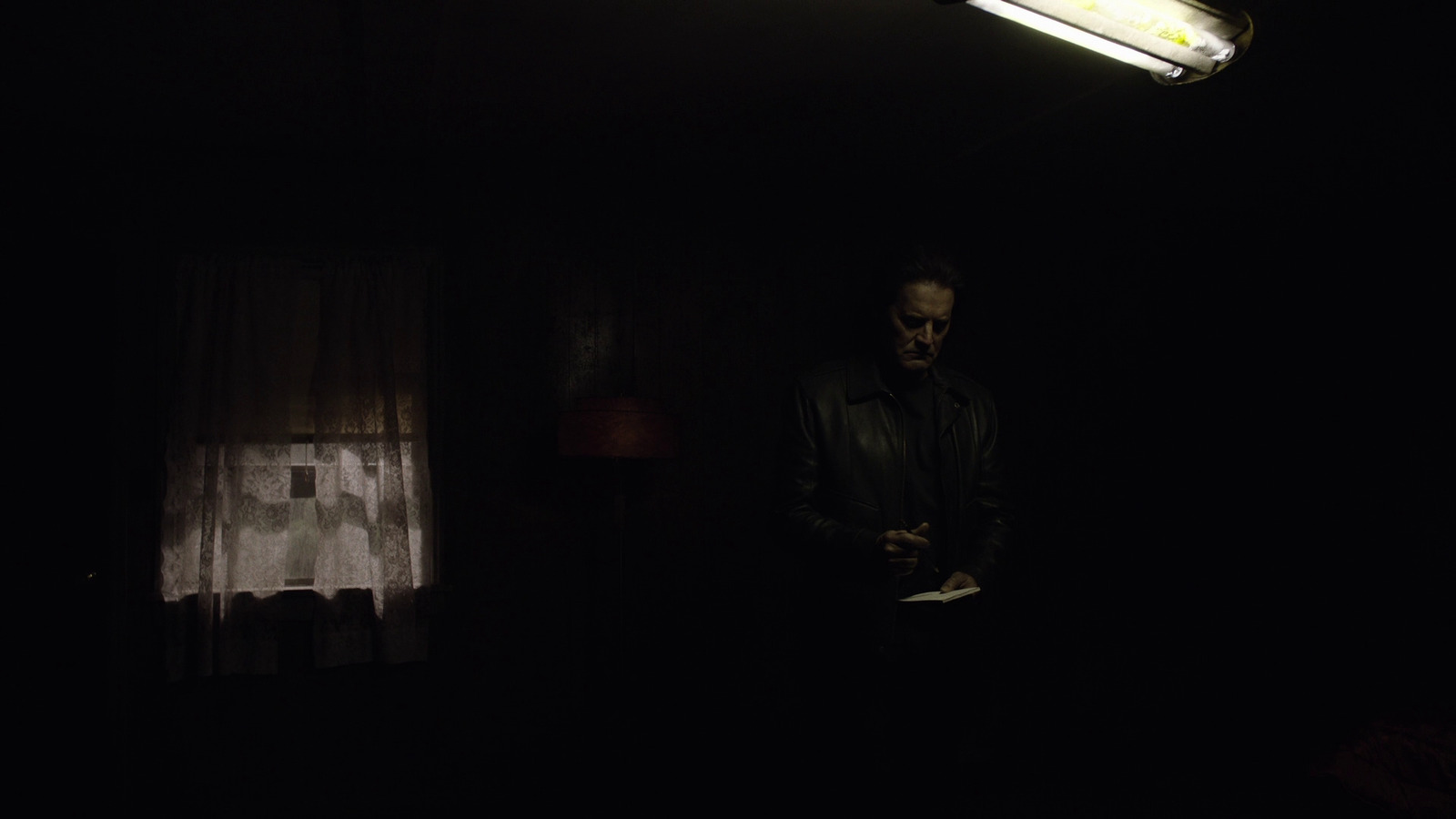
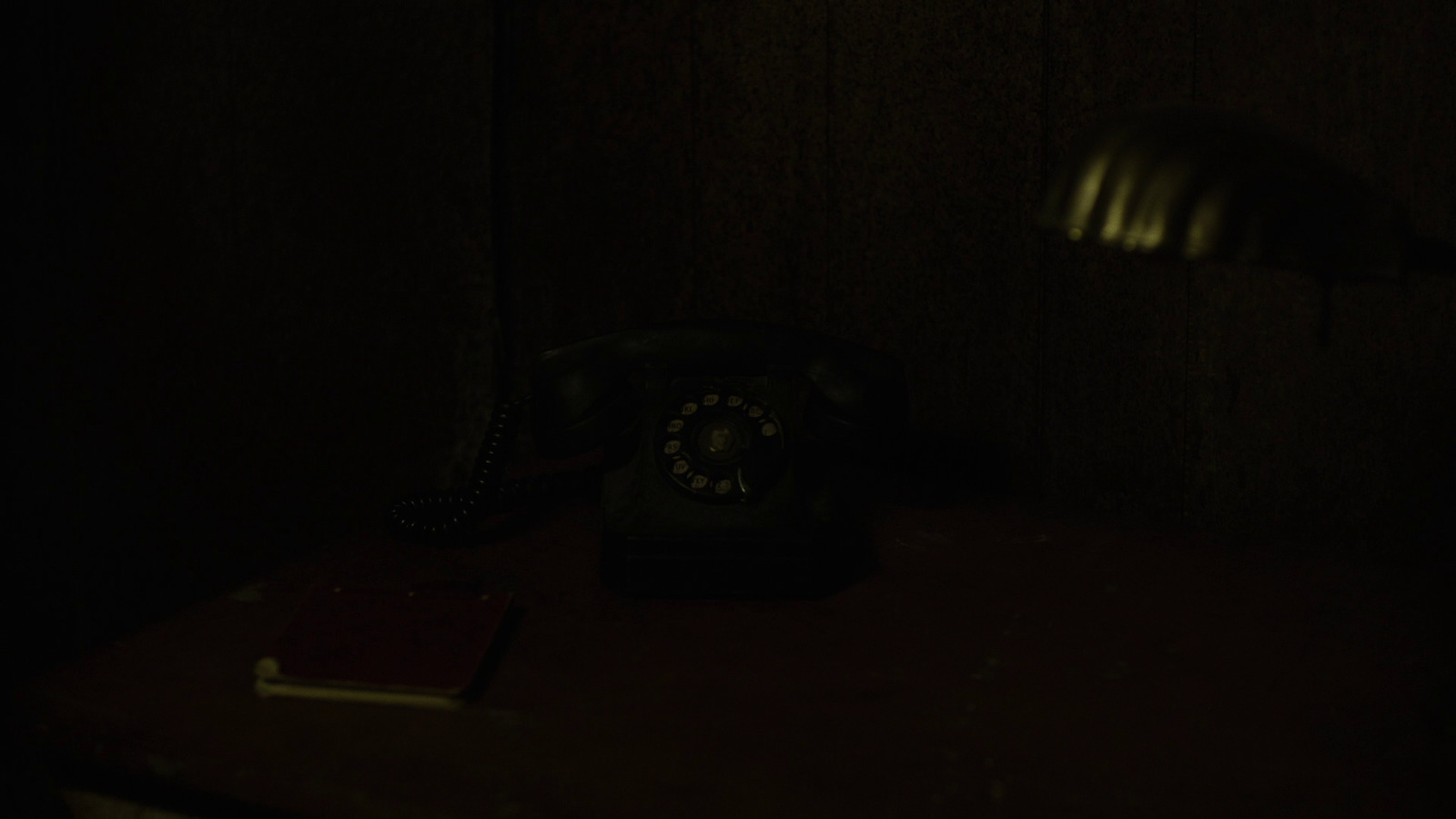
Jeffries: an interview without a human face
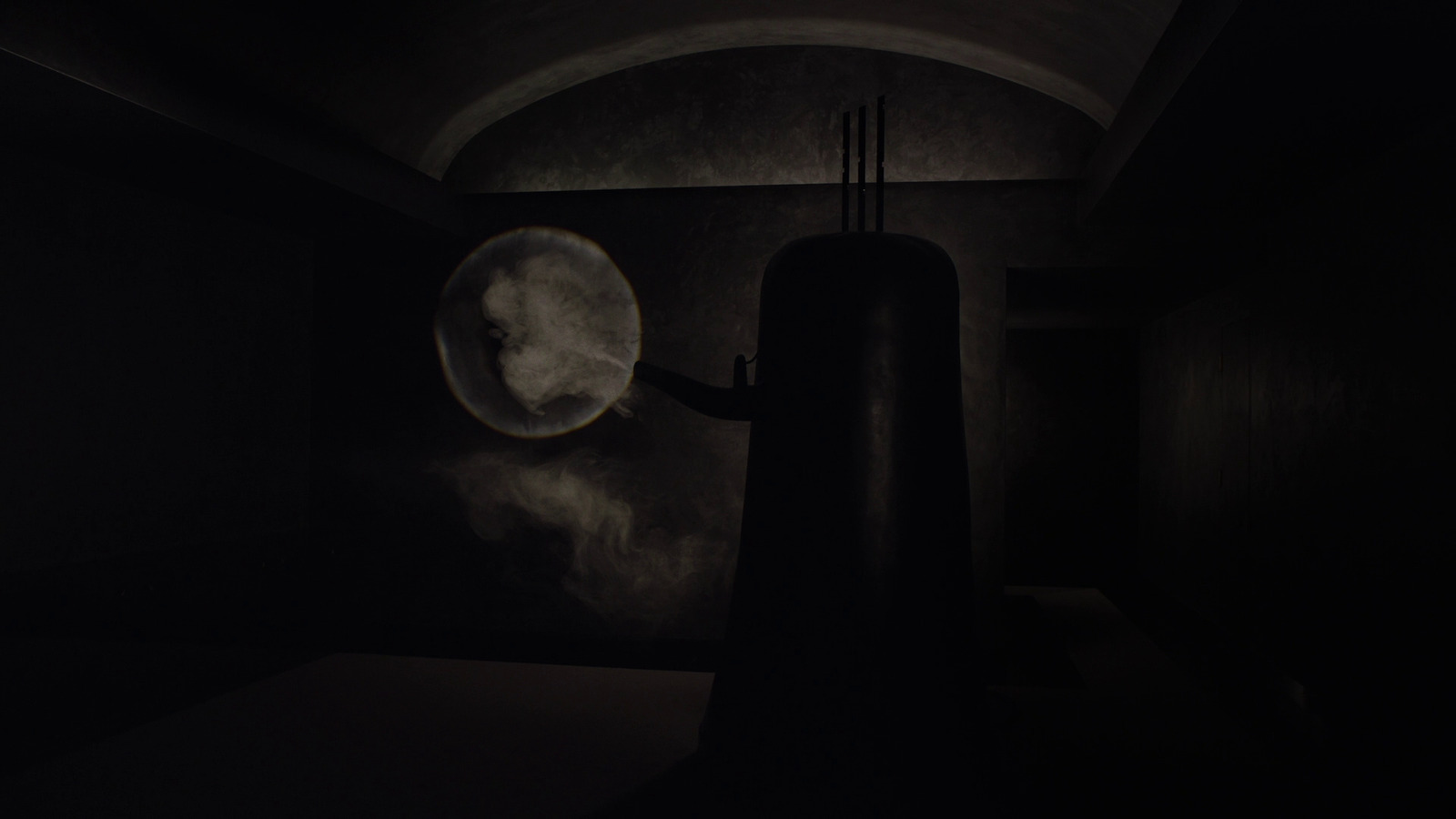
Mr. C stands beneath a fluorescent light opposite an apparatus with a projecting opening and drifting vapor. The exchange revisits Jeffries’s appearance in Fire Walk with Me, but the questions are not answered on Mr. C’s terms. Jeffries denies having his telephone number; the repeated demand to identify Judy produces the unsettling assertion that they have already met. Mr. C writes down coordinates. A ringing telephone interrupts the encounter and moves him out of it. The machine, voice and interruptions make information arrive in fragments while withholding the ordinary assurance of face-to-face testimony.
Open the scene sequence · 3 frames
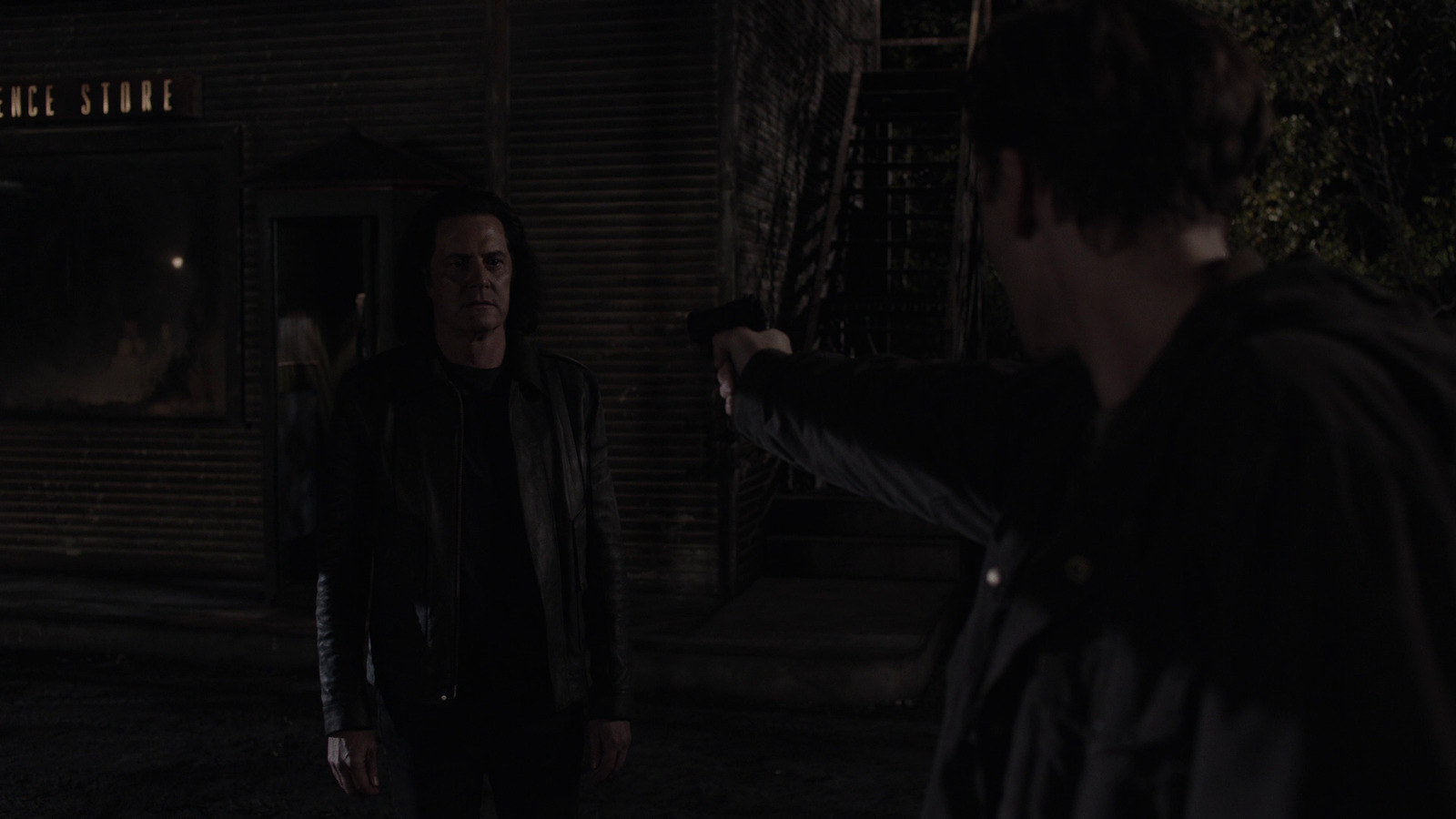
Richard recognizes a photograph
Richard approaches with a weapon and a claim to recognition. He knows the face from a photograph owned by his mother, Audrey Horne. Mr. C’s response is physical and economical: he overpowers Richard and takes control of their next movement. The exchange gives the photograph narrative force without showing it here. Recognition does not create intimacy or trust; it exposes Richard to someone who can use him. Mr. C’s subsequent message continues a separate network of contacts, leaving Richard outside the information that determines the journey.
Open the scene sequence · 1 frame
The building becomes an absence
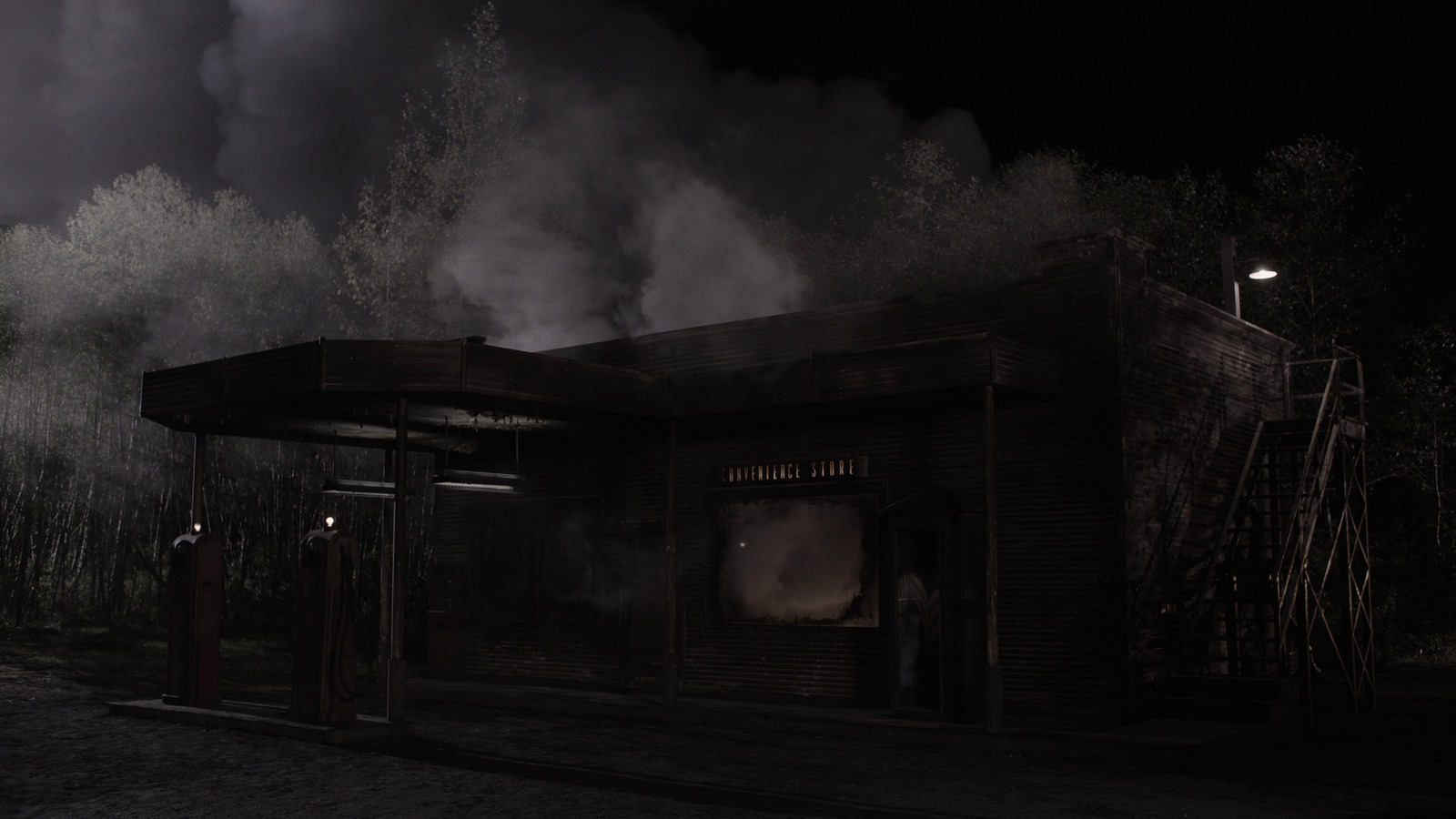
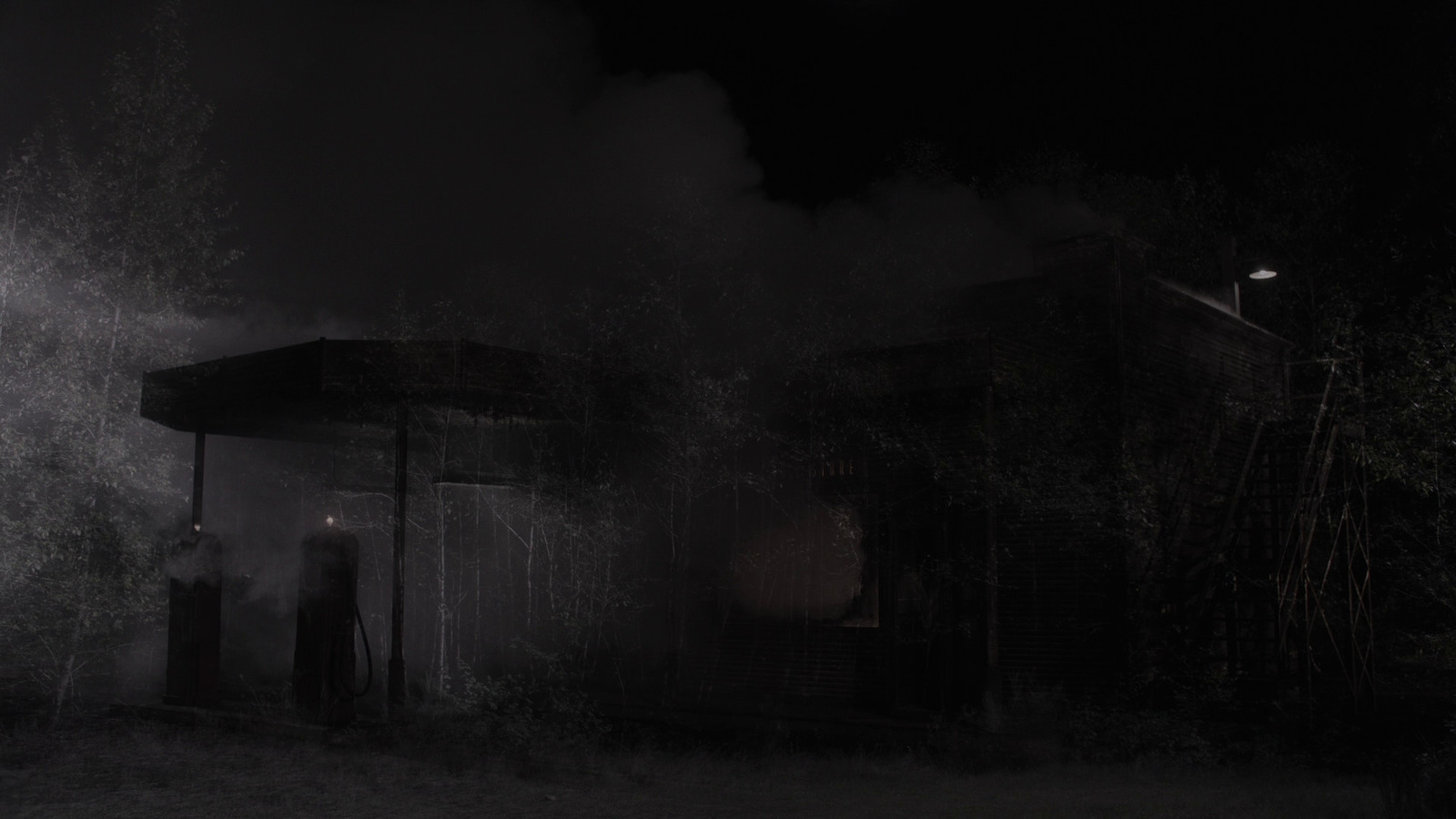
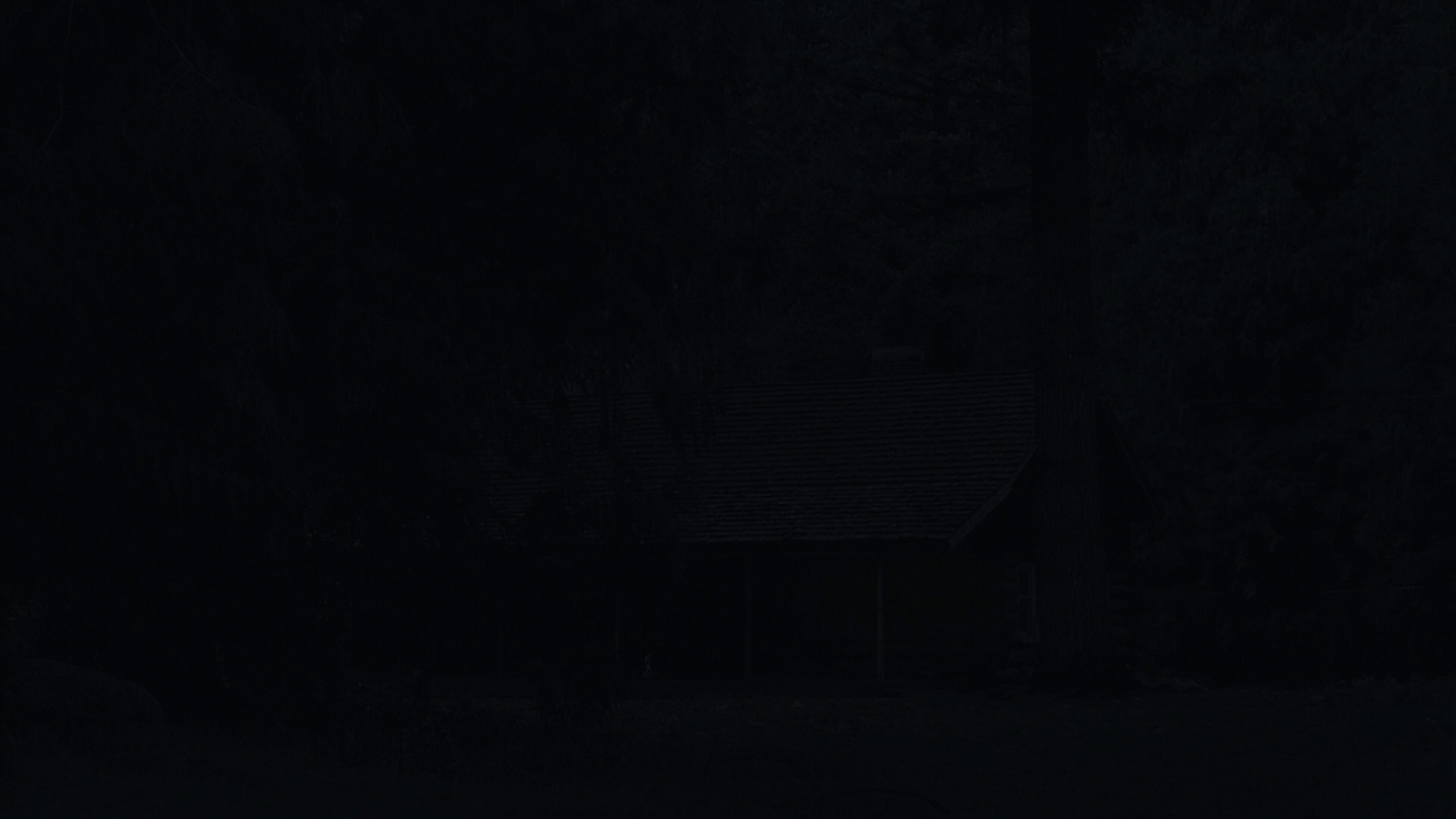
The convenience store’s disappearance is held in a wide view. Smoke, flicker and changing visibility work against the stability of the road and trees, allowing the viewer to register a structure coming apart rather than merely accept a cut to another location. The last empty view matters as much as the disturbance: there is now an ordinary-looking stretch of forest where an impossible address had been. The focused gallery below follows that visible progression without assigning an undocumented production technique to every layer.
Open the scene sequence · 3 frames
Steven and Gersten beneath the tree
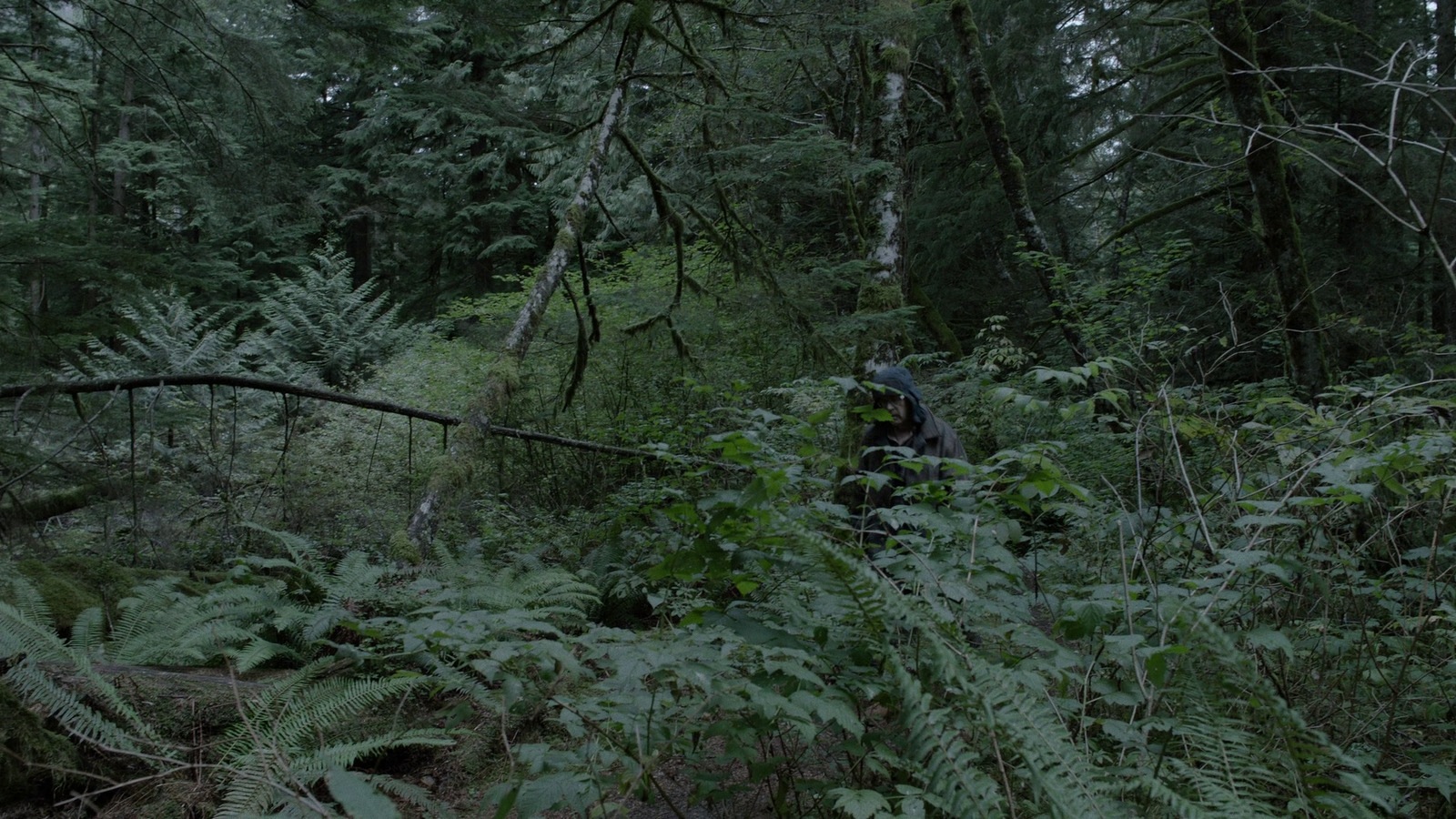
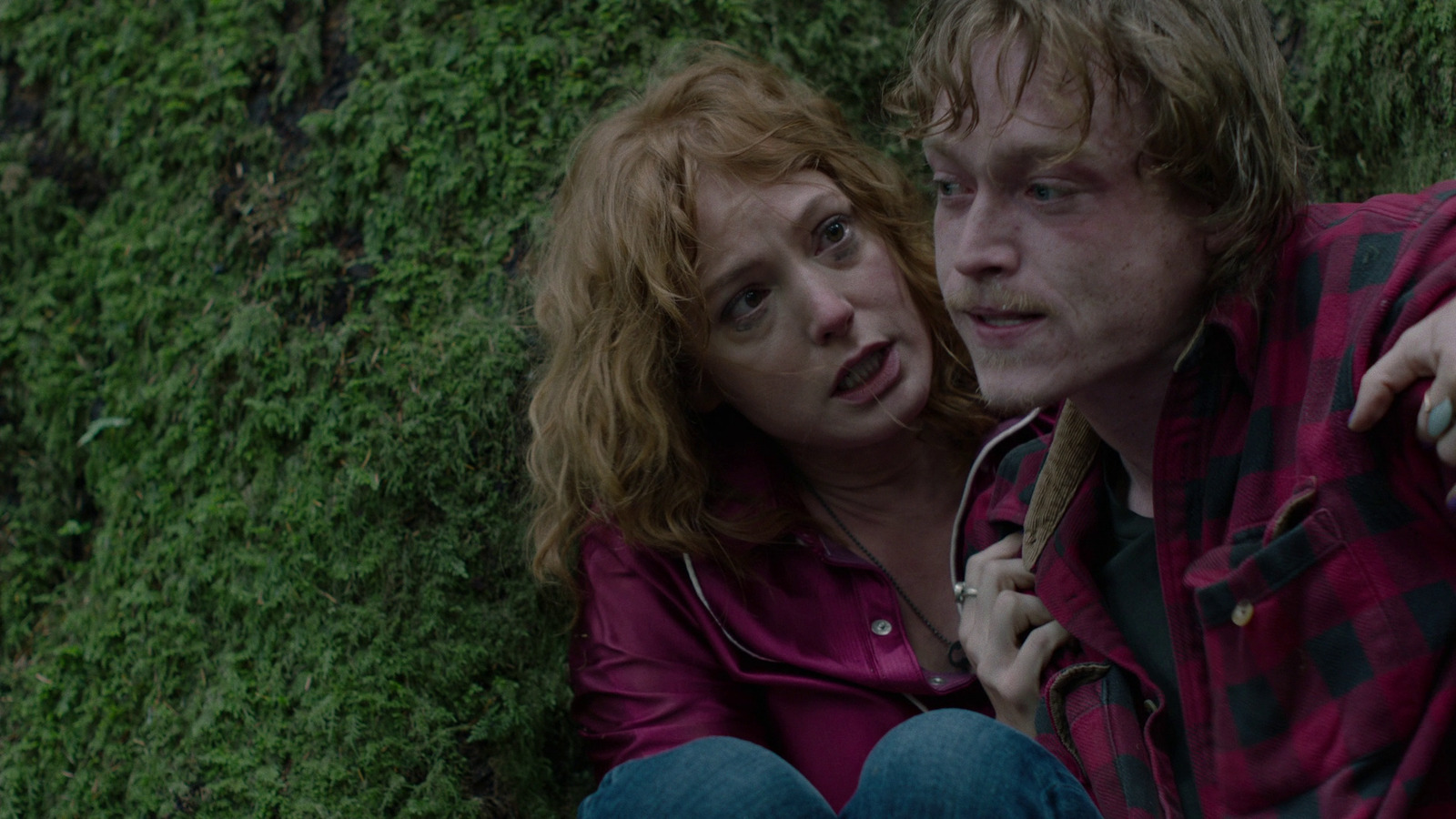
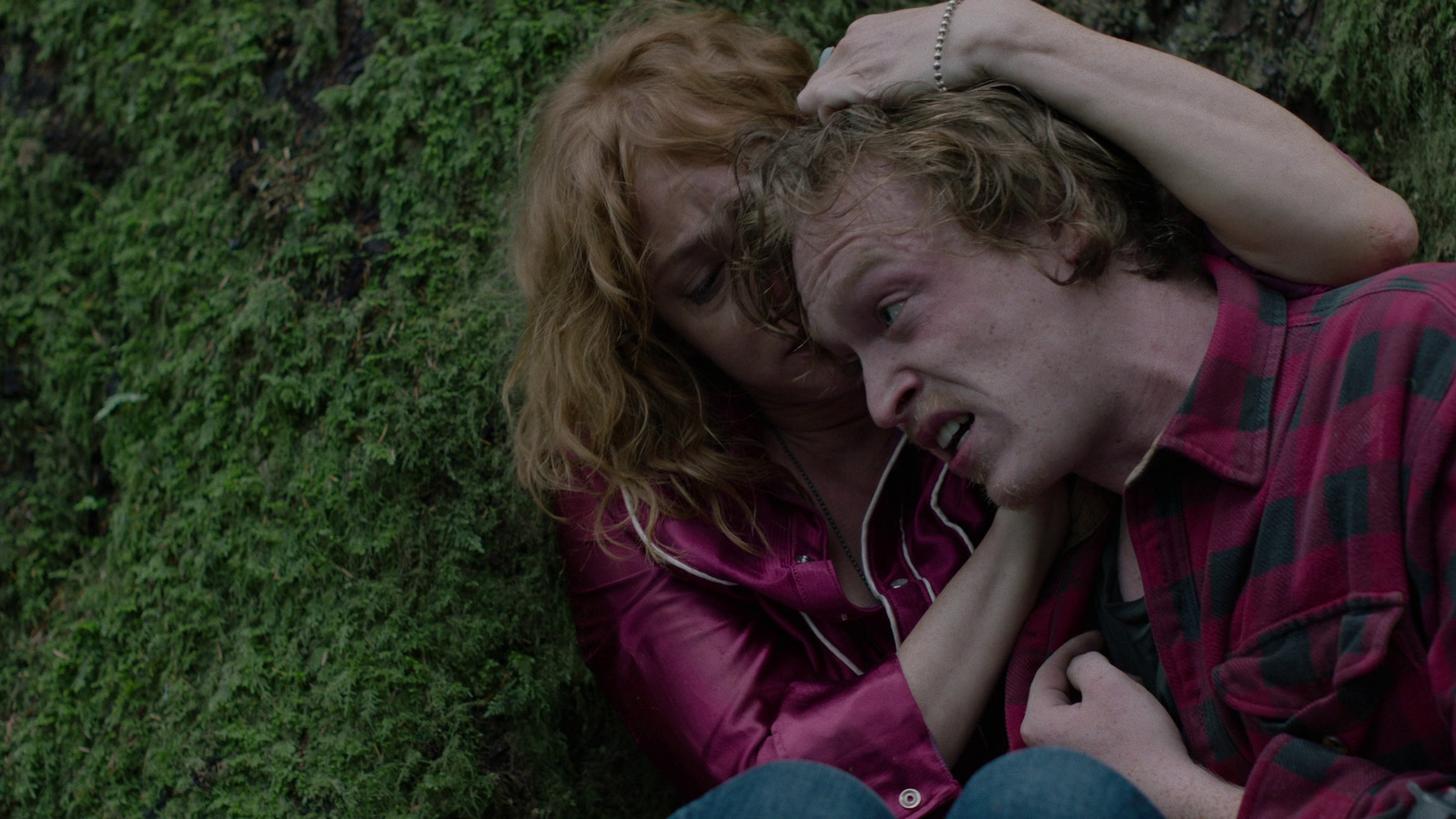
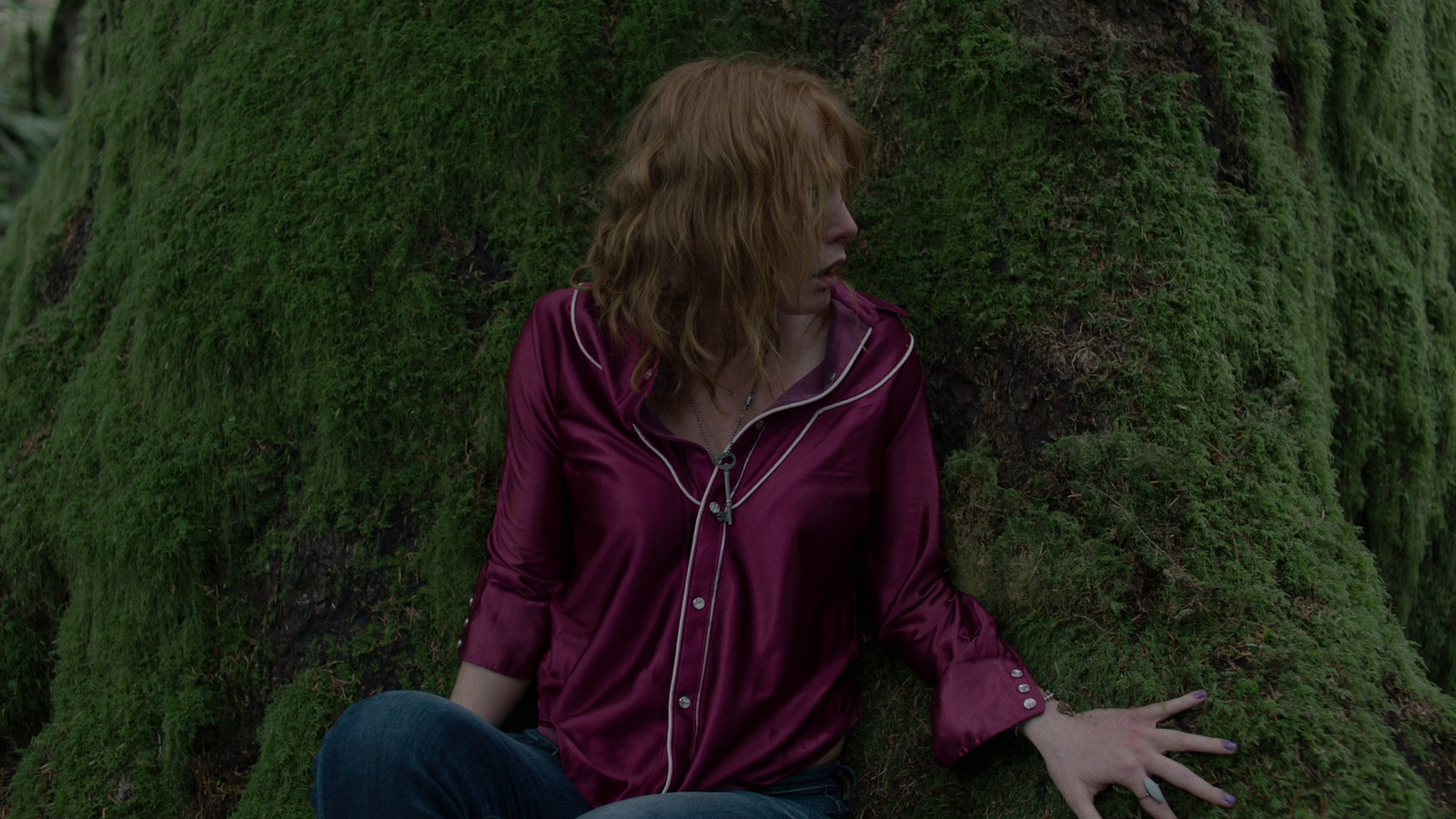
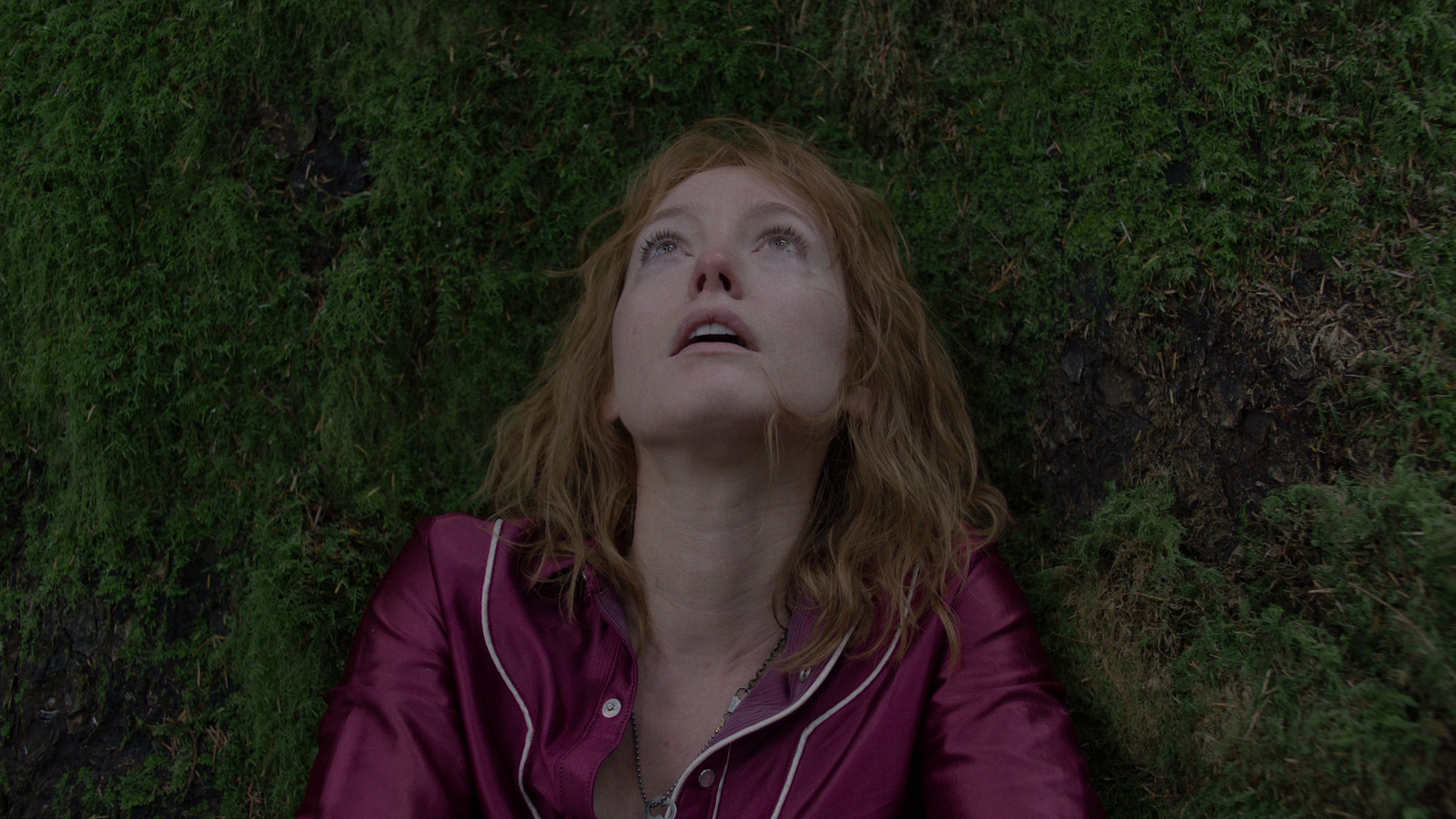
The camera finds two people low against an enormous tree. Steven’s speech moves through accusation, exhaustion and unstable associations; Gersten tries to answer him and keep contact. The scene offers no secure statement of what has happened to Becky. When a dog walker appears, Gersten moves around the trunk. A gunshot is heard while Steven is outside the view, and the camera stays with her response and upward look. That separation between sound and visible evidence is essential: the sequence gives a crisis and its witness, not an explanatory reconstruction of an unseen act.
Open the scene sequence · 4 frames
A passerby becomes a messenger
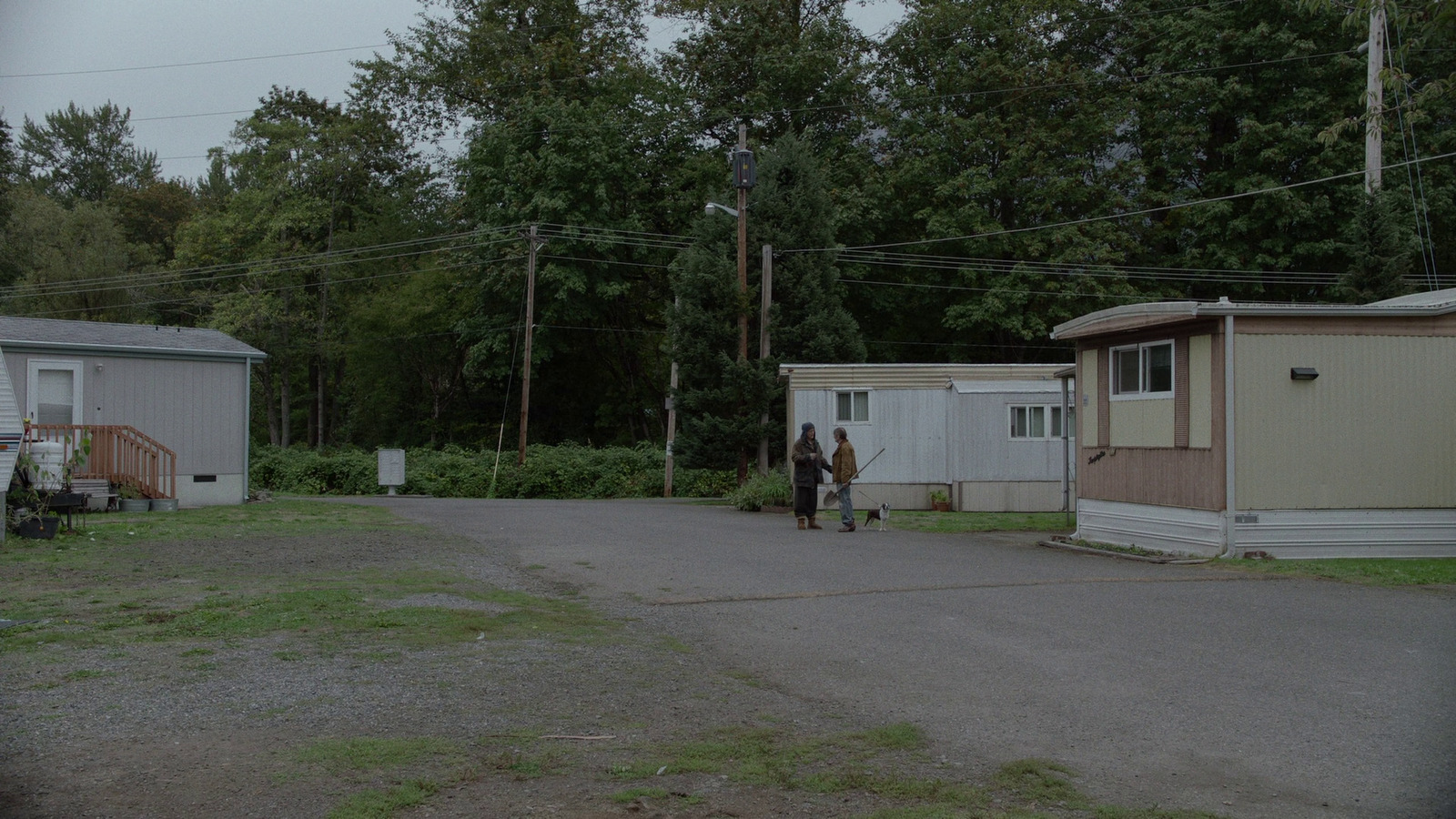
At the trailer park, the walker points Carl toward Steven’s trailer. The passage is brief, but it changes the status of the woods scene: an isolated encounter has begun to enter the town’s network of observation and care. Mark Frost is credited as Cyril Pons. His presence can be enjoyed as a cameo, yet the character’s function is precise—someone notices, remembers where a person belongs and tells another person who may be able to act.
The green glove interrupts the record
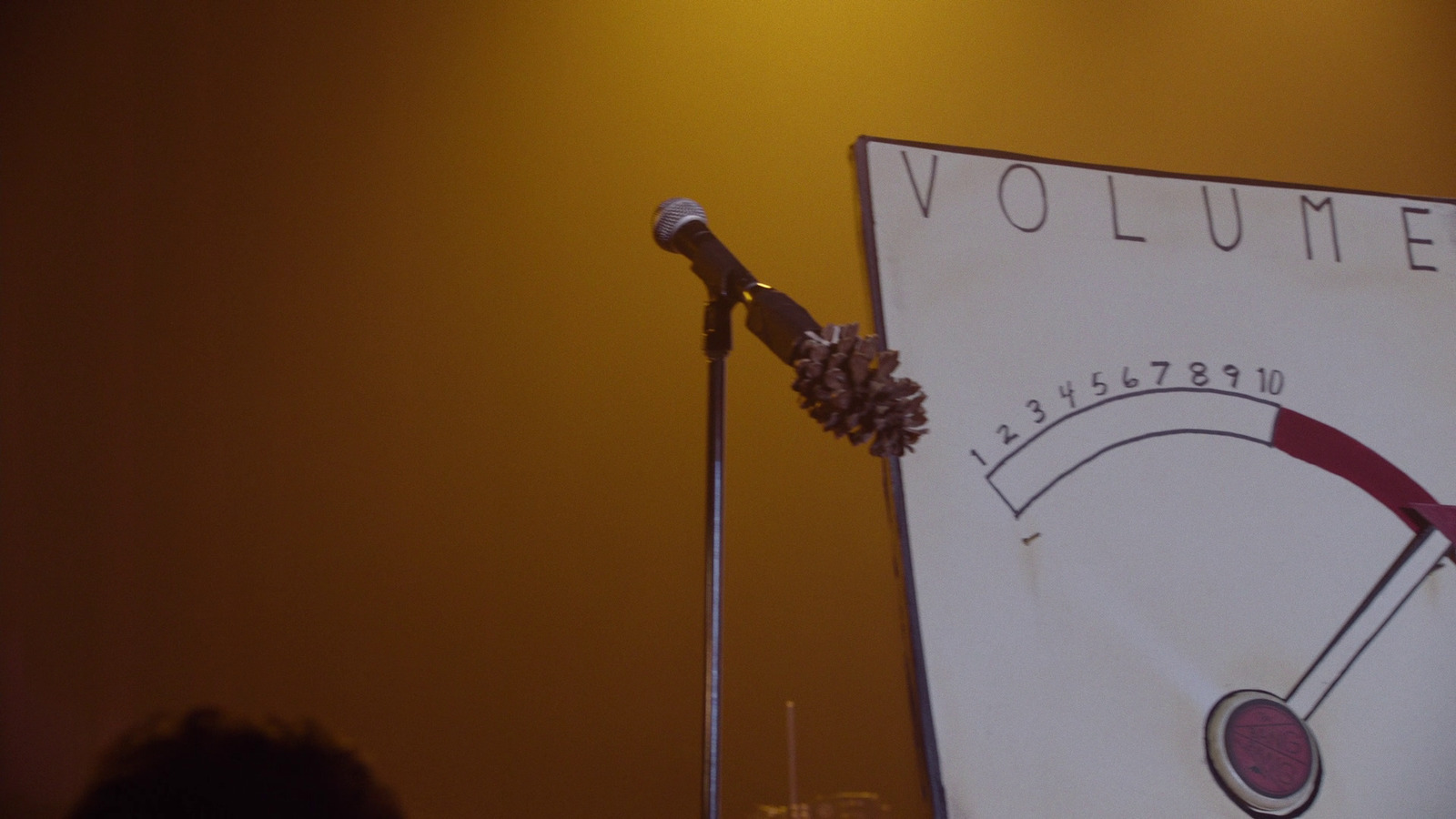
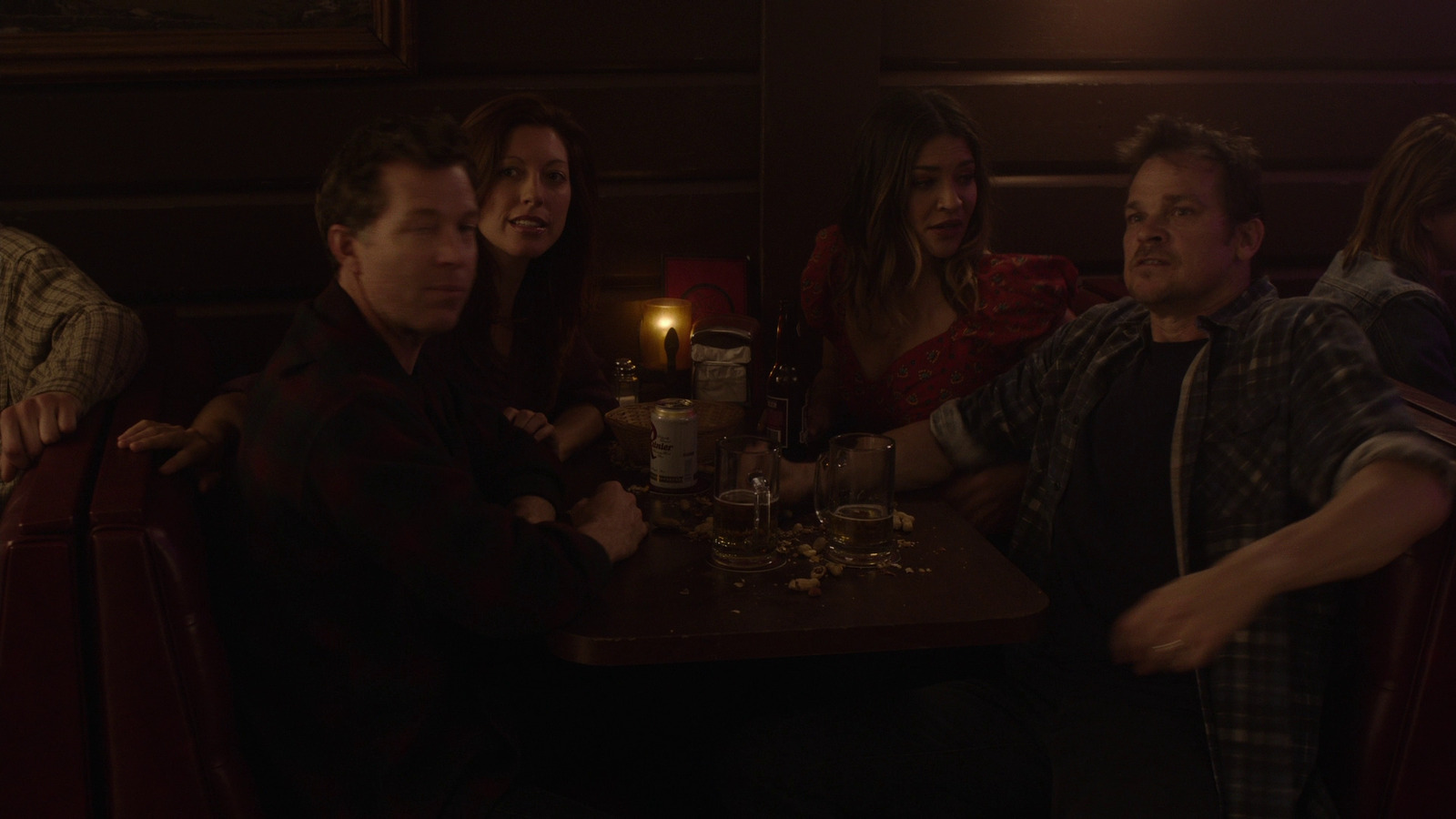
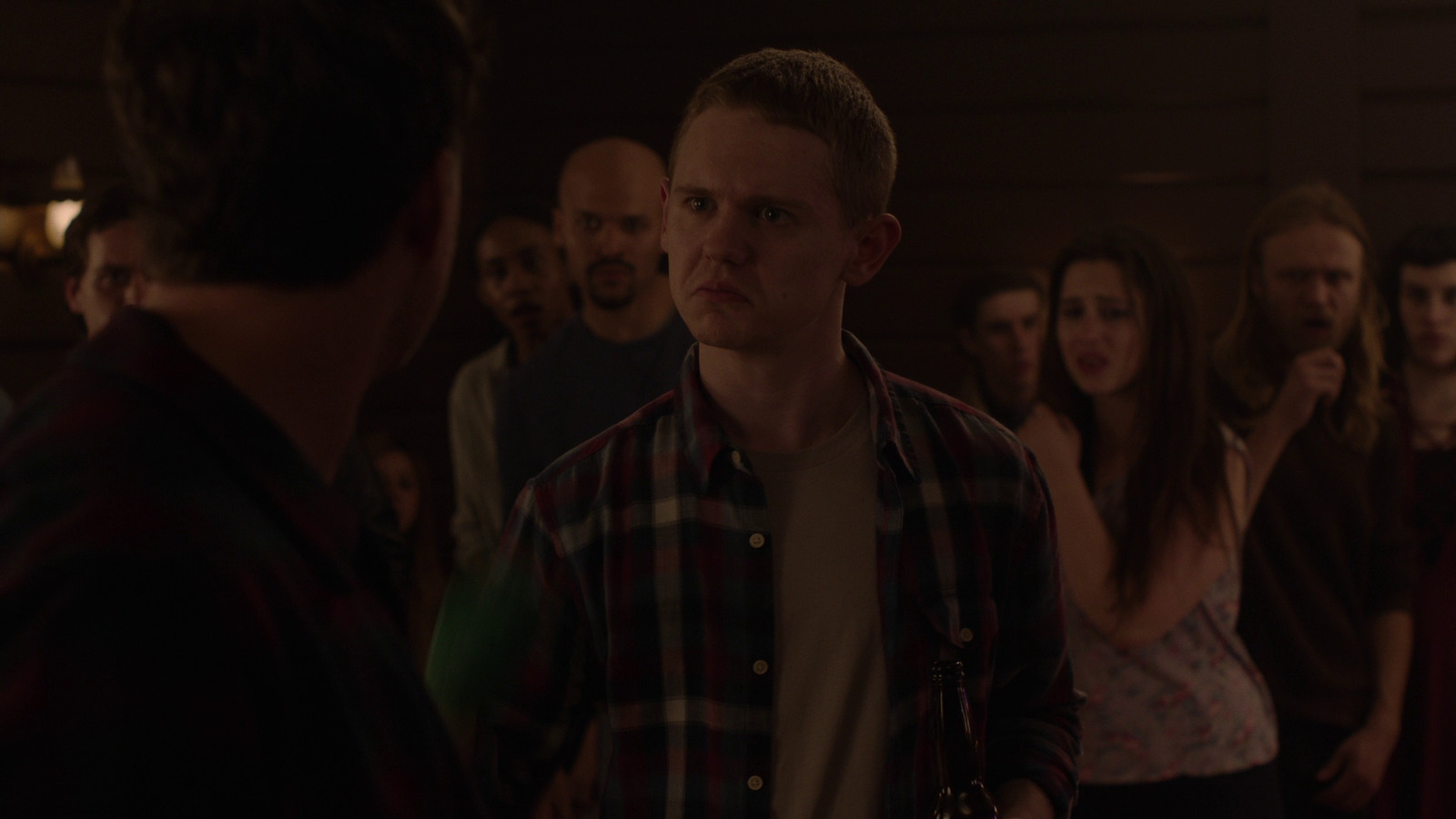
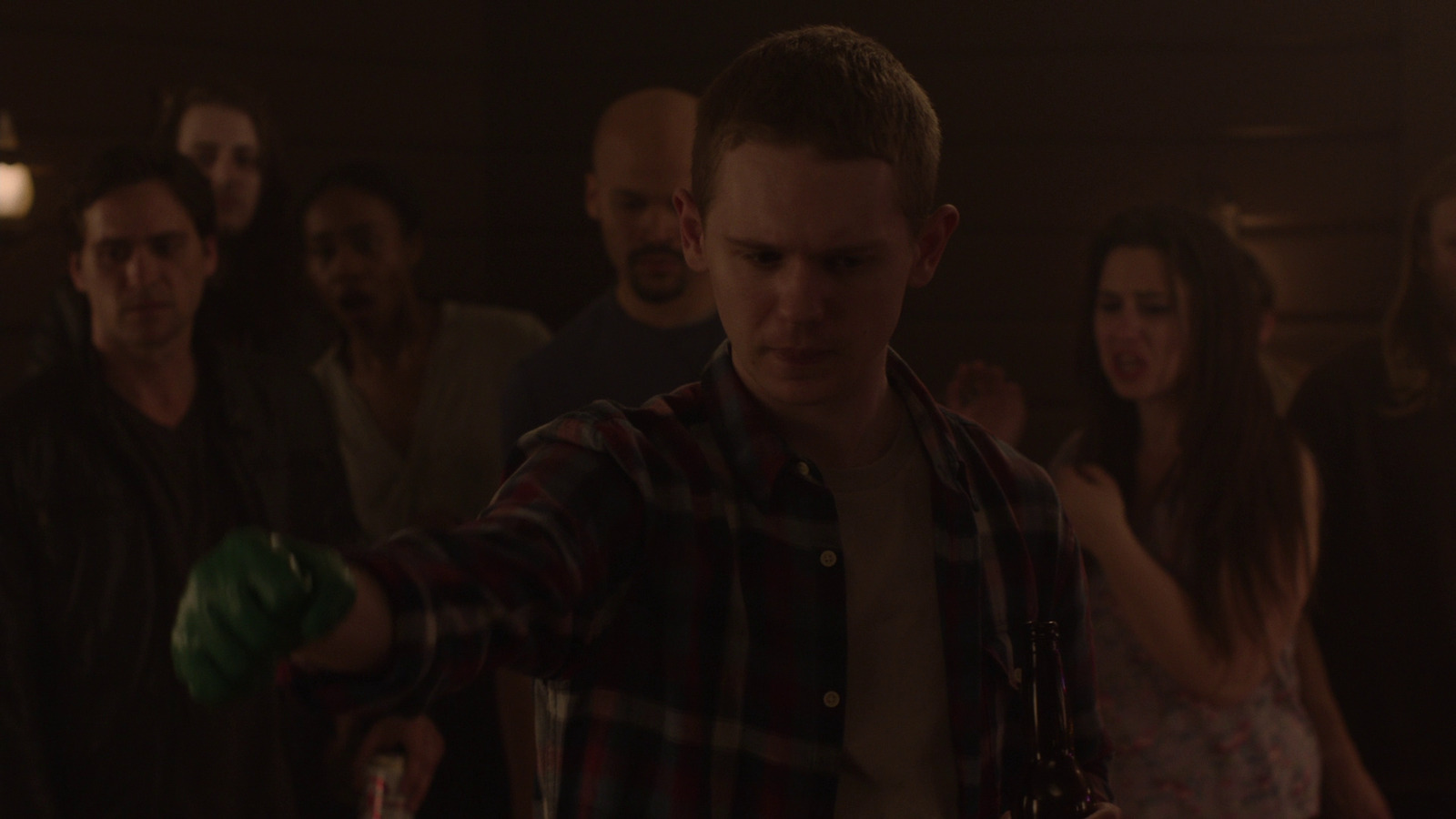
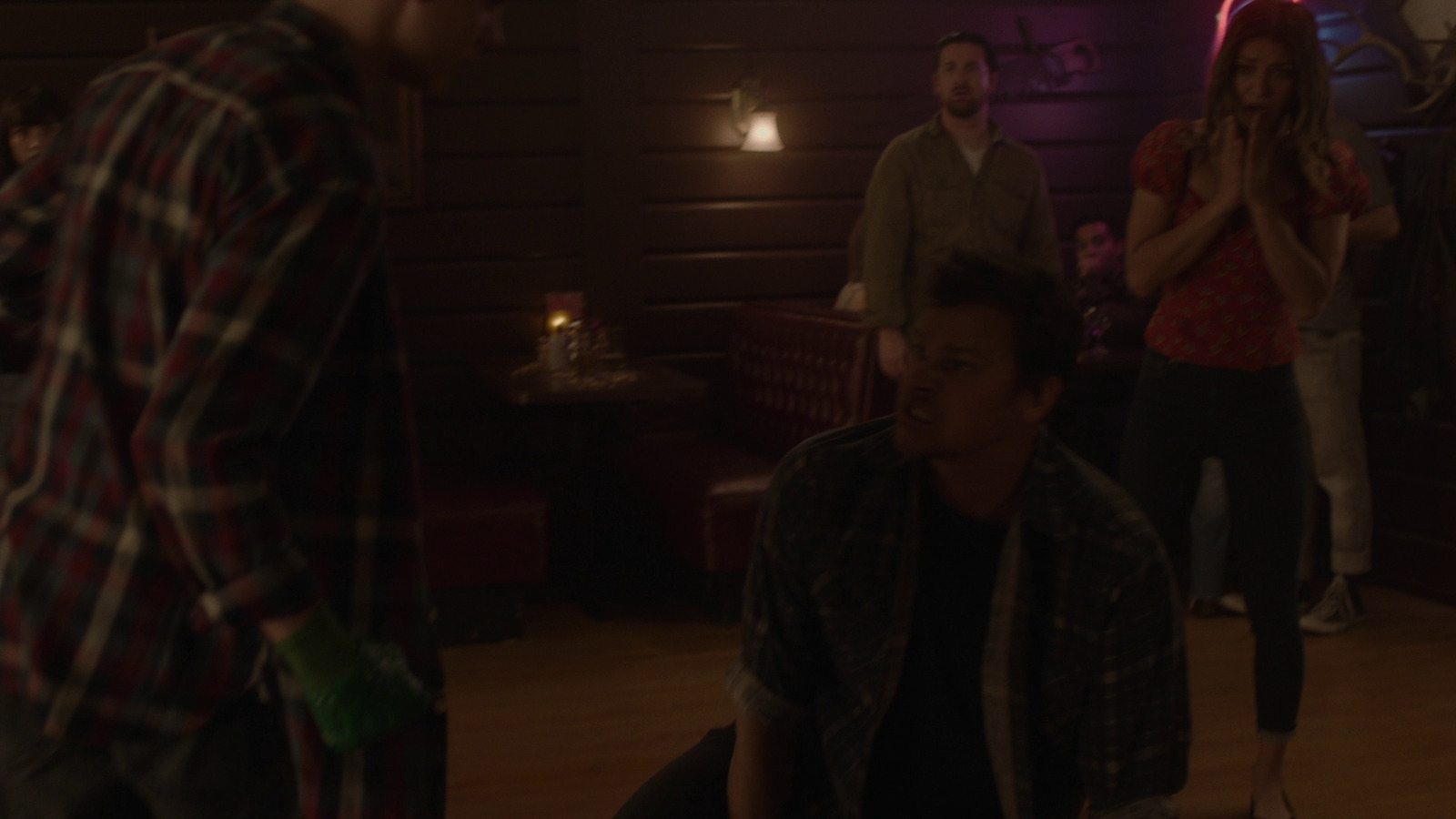
The Roadhouse announcement introduces ZZ Top’s recorded song, even presenting its volume as a joke. James approaches Renee, and Chuck’s attack converts social discomfort into a fight. Freddie’s intervention produces an effect larger than the modest movement suggests: the impacts coincide with the playback catching or jumping, so the room’s entertainment seems to suffer the blow too. The aftermath resists uncomplicated superhero pleasure. Renee is frightened by Chuck’s condition, James seeks help and Freddie apologizes. The glove’s power, described in Part 14, now has visible human consequences.
Open the scene sequence · 5 frames
An office network ends abruptly
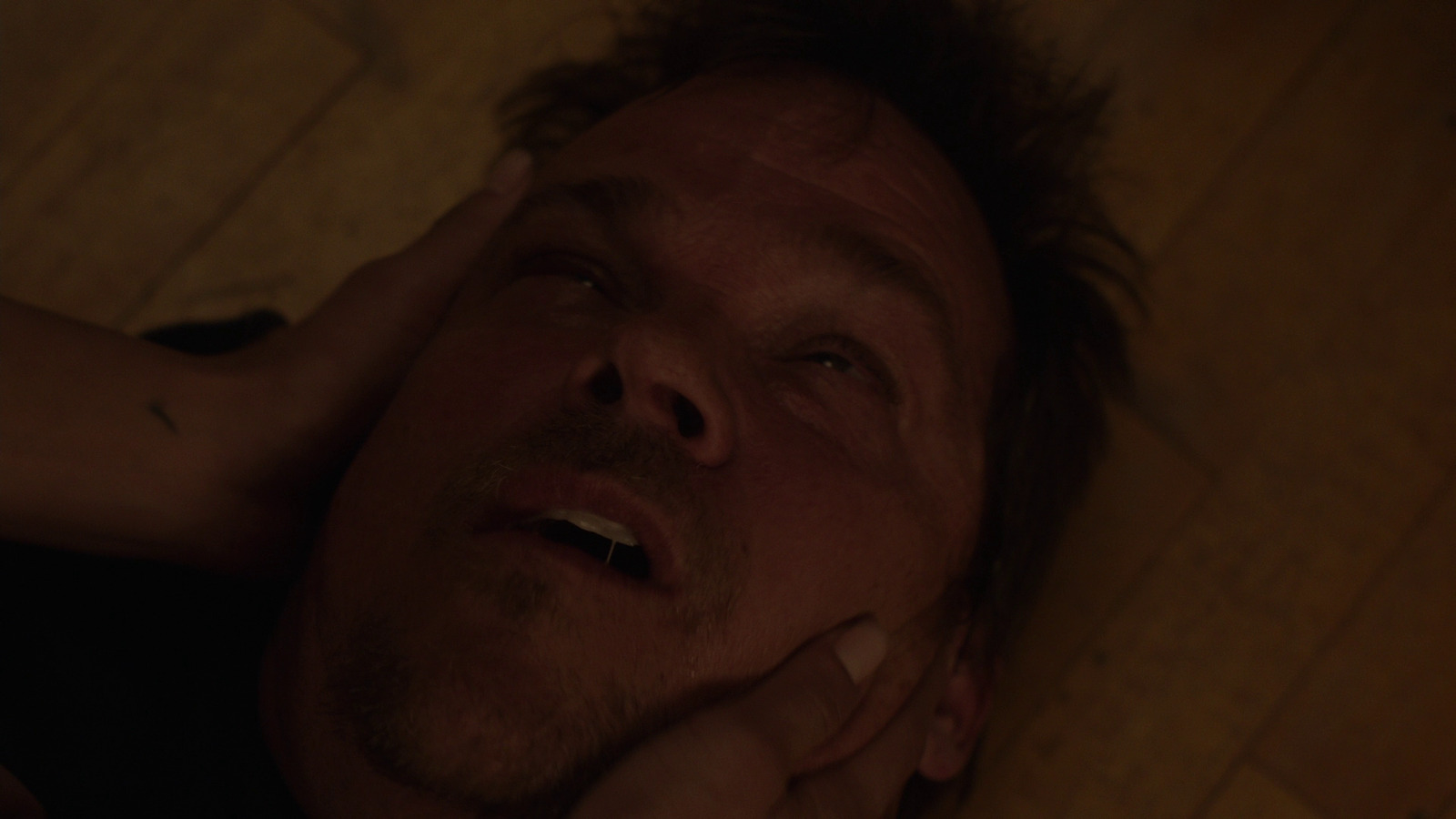
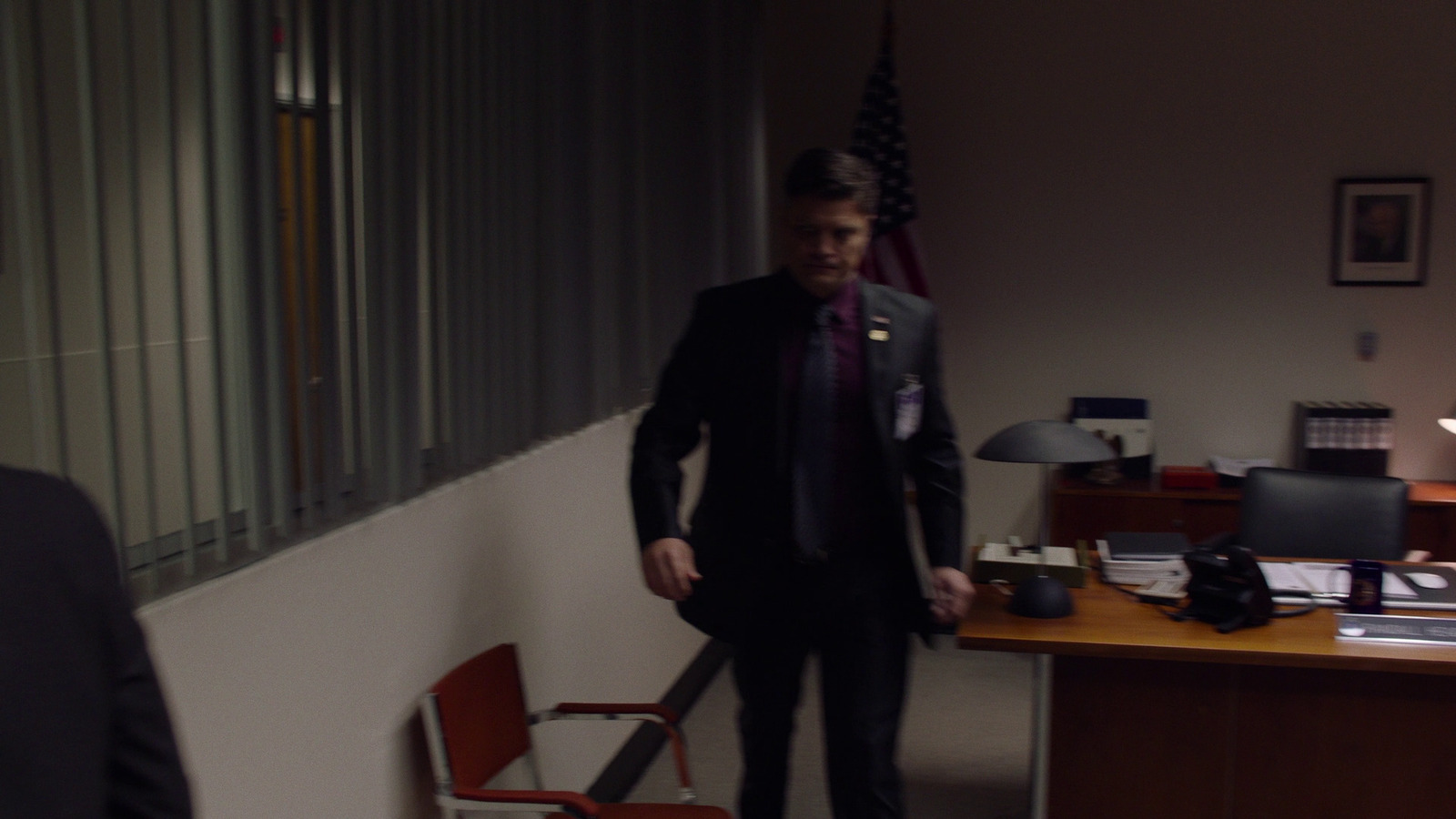
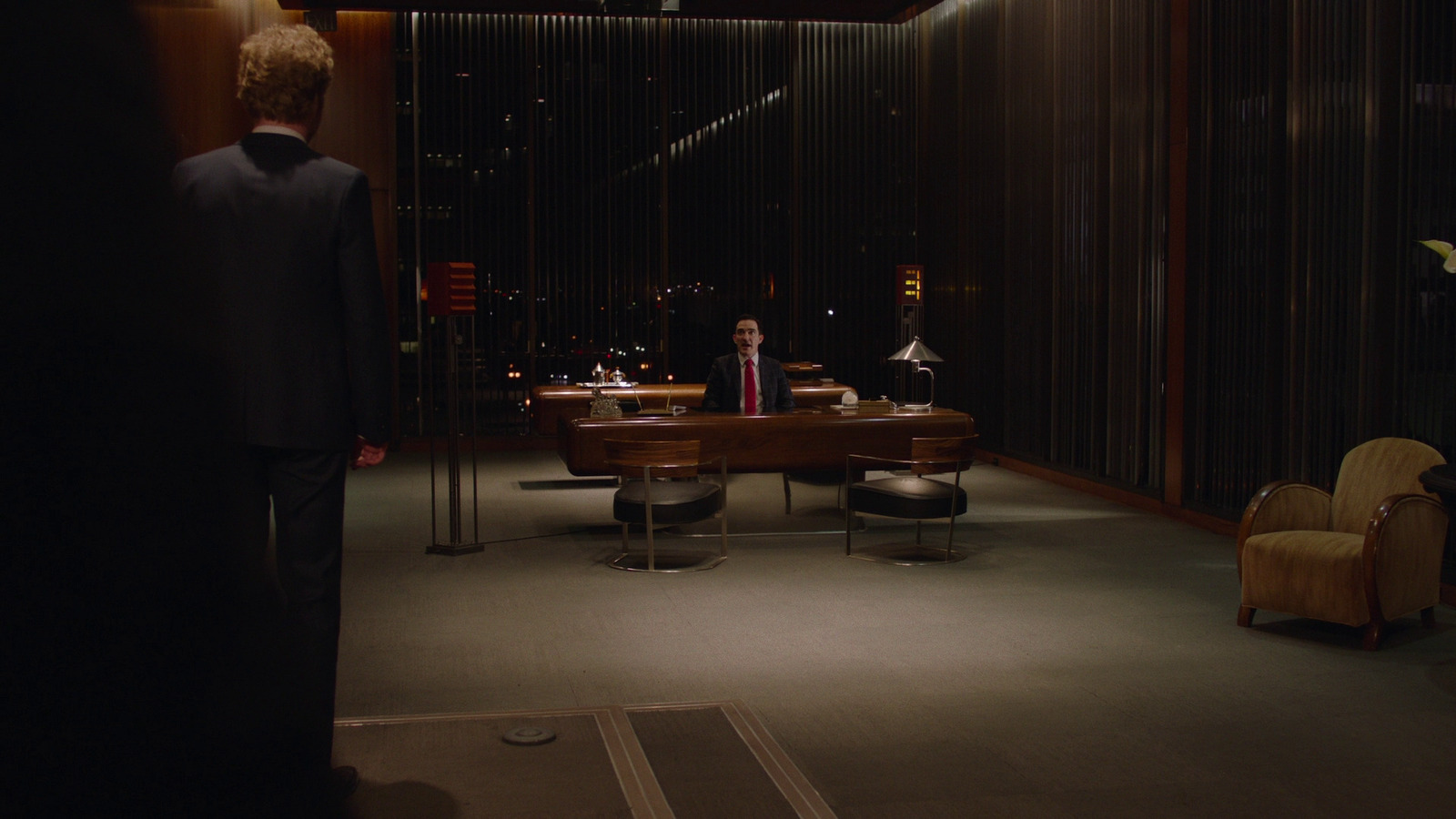
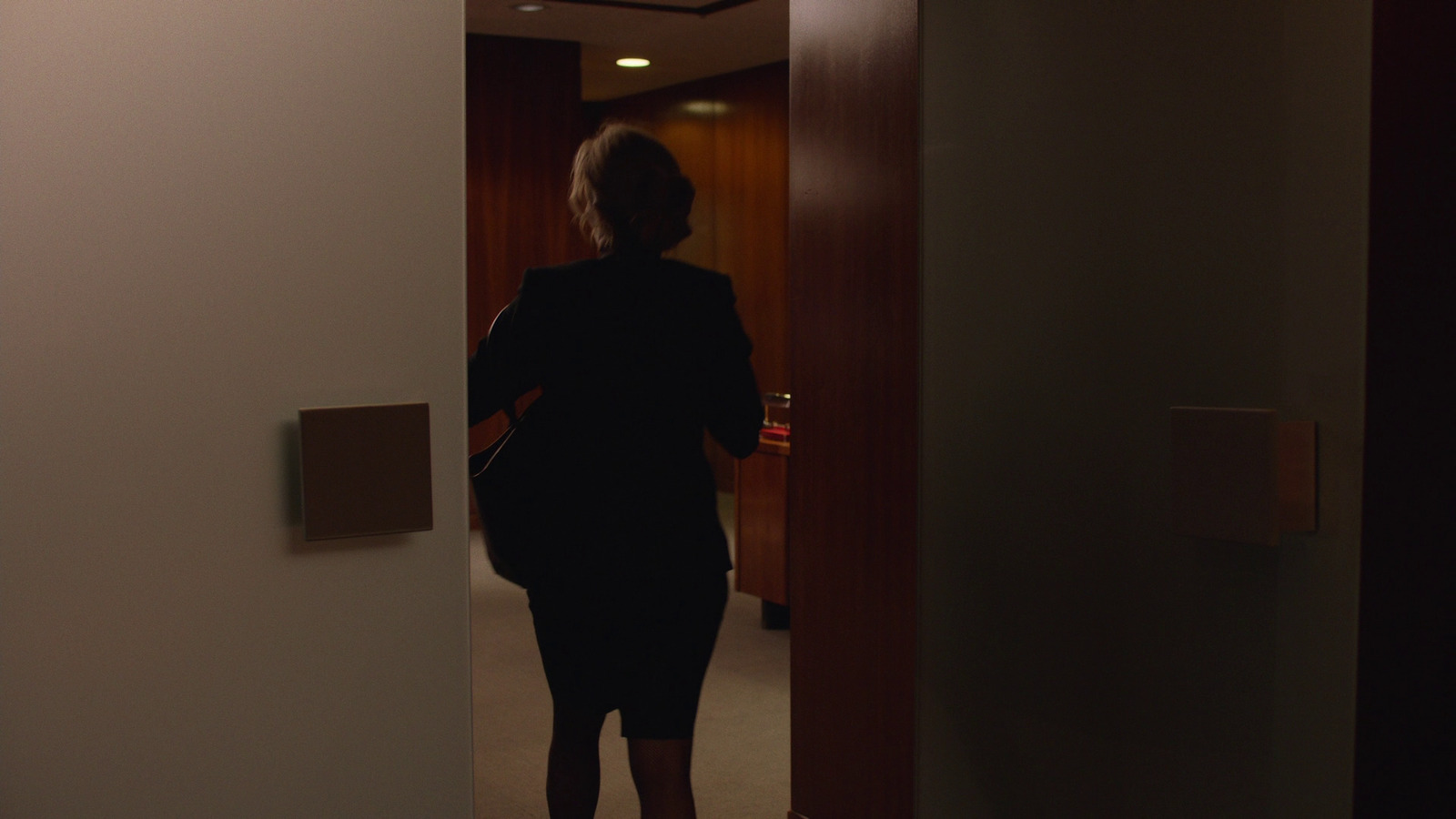
The FBI’s visit to another Douglas Jones household briefly demonstrates the limits of a name as an identifying clue. The next Las Vegas passage gives Duncan Todd another attempt to reach Anthony, then cuts that chain short when Chantal enters and shoots Todd and Roger. The large office and orderly desk provide little protection. Her subsequent telephone report treats murder as a completed errand, with food and the remaining assignment occupying the same conversational space. This compression is the opposite of the patient attention given to Ed, Norma and Margaret.
Open the scene sequence · 2 frames
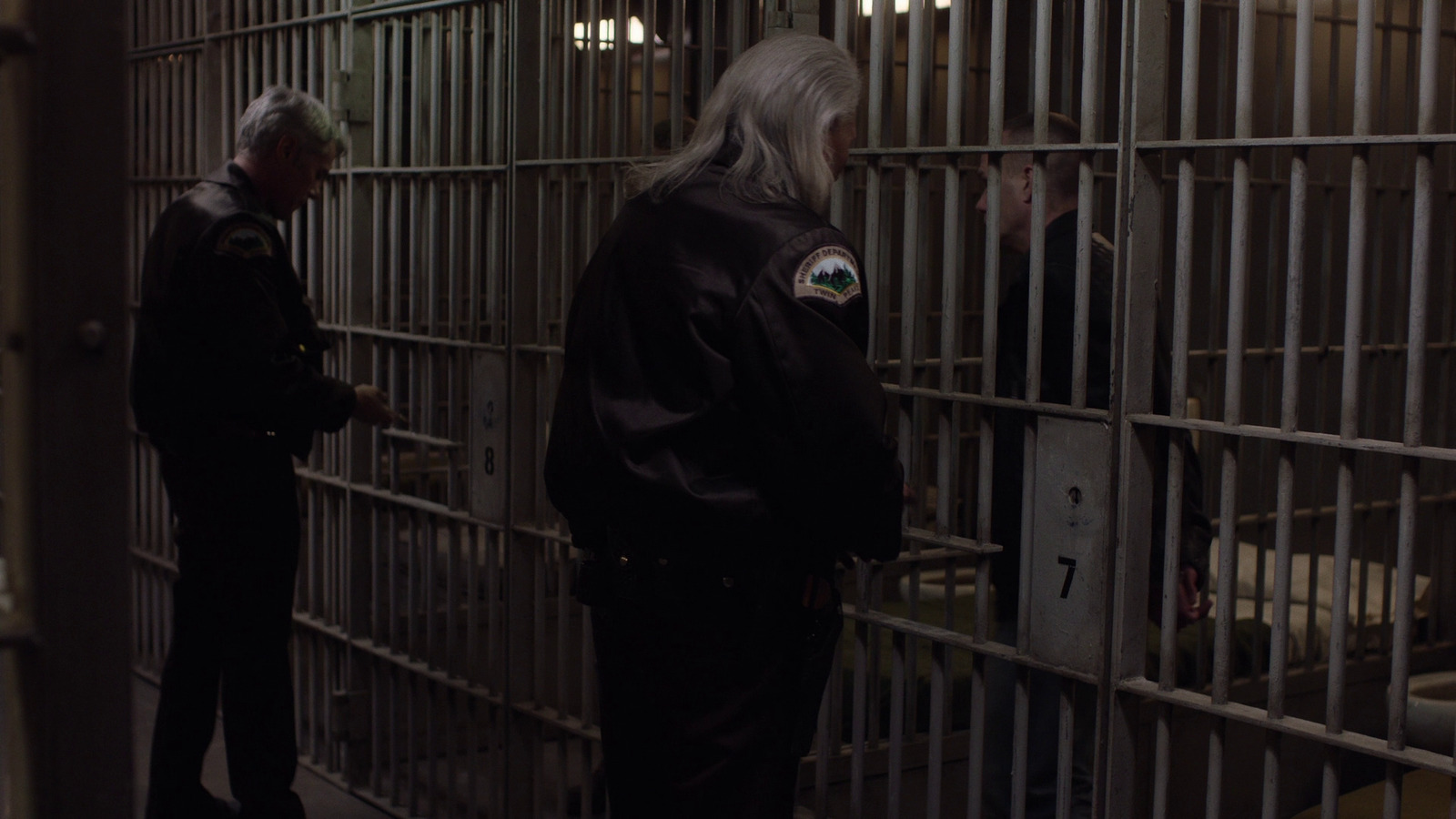
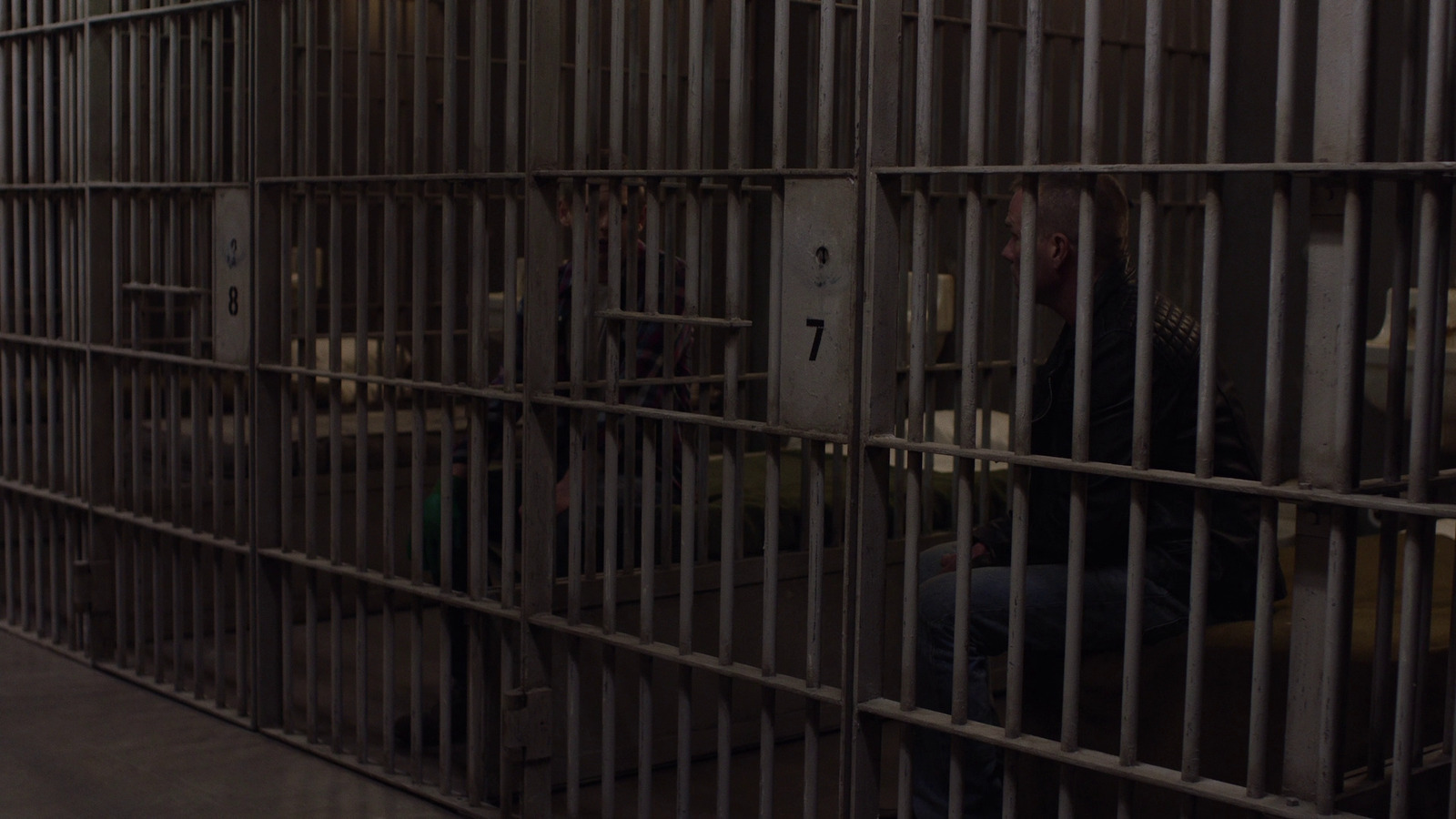
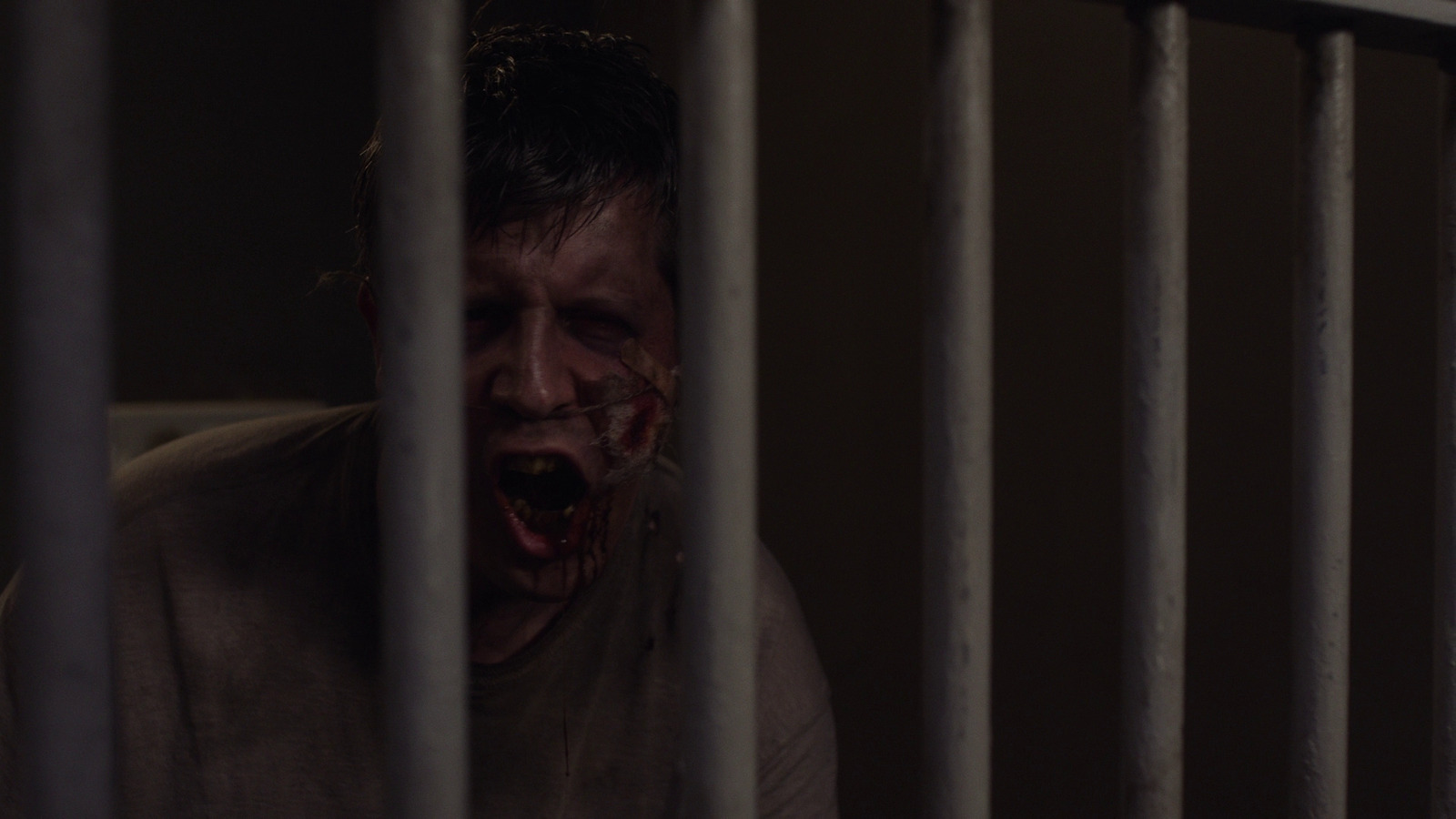
The jail gathers incompatible voices
James and Freddie enter cells near Chad, the wounded prisoner and Naido. The arrangement makes several previously separate stories audible to one another before their relations become clear. Naido’s vocalizations do not turn into a convenient explanation; the injured man’s imitation and Chad’s irritation make the shared space abrasive. News that the men from the Roadhouse are in intensive care carries the cost of Freddie’s intervention into the room. The bars organize distinct bodies while the sounds refuse those neat divisions.
Open the scene sequence · 2 frames
Affection and self-excuse in the van
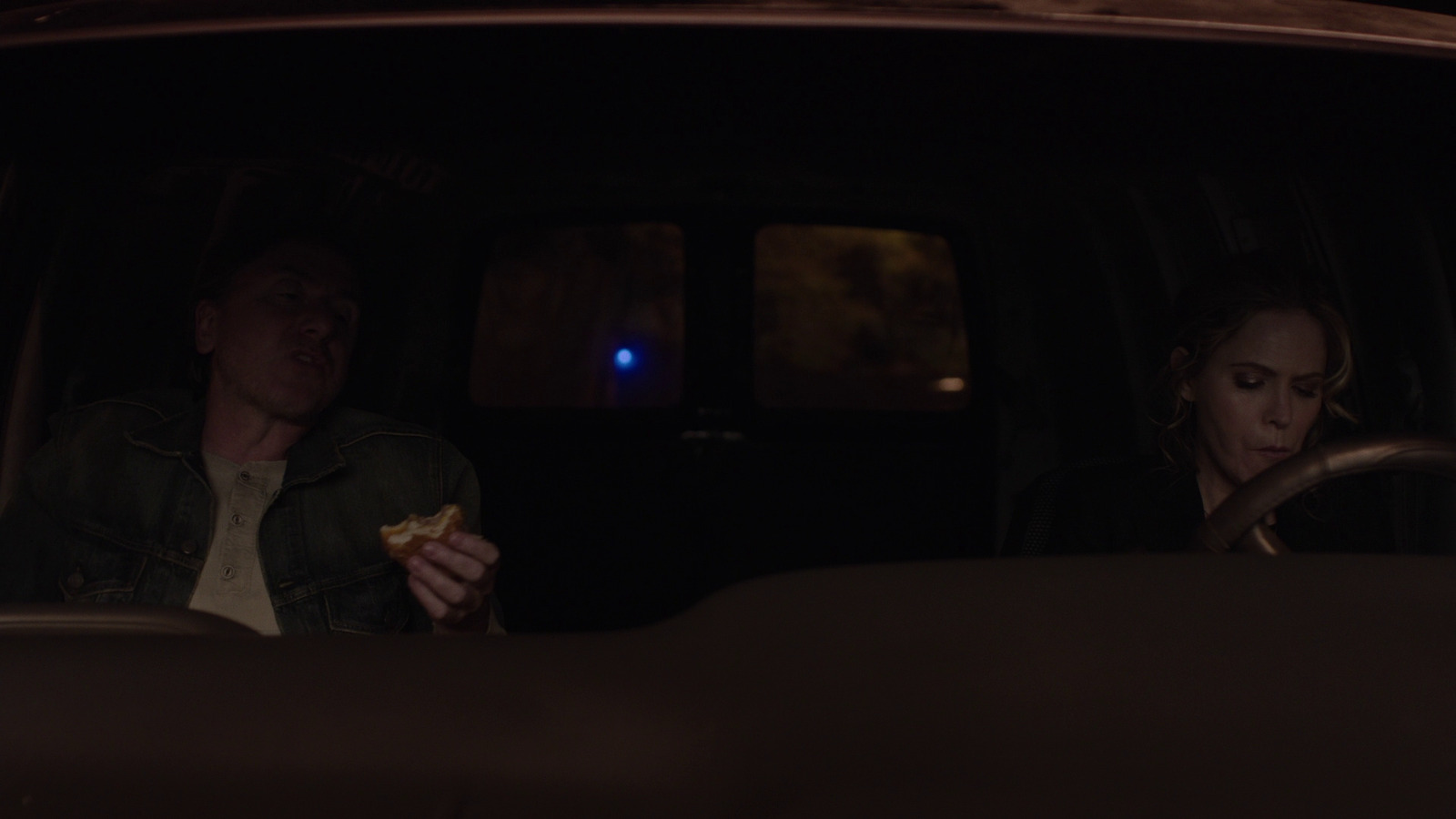
Hutch and Chantal discuss violence while eating. Their historical and political comparisons are acts of self-justification, not a reliable moral account supplied by the programme. Chantal’s frustration that she did not get to prolong her victim’s suffering makes the distance between their casual delivery and their actions especially clear. Yet the scene also gives them an ordinary affectionate rhythm. Lynch lets companionship coexist with cruelty; food and tenderness do not function as evidence that the pair are secretly harmless.
Open the scene sequence · 1 frame
An old movie says a familiar name
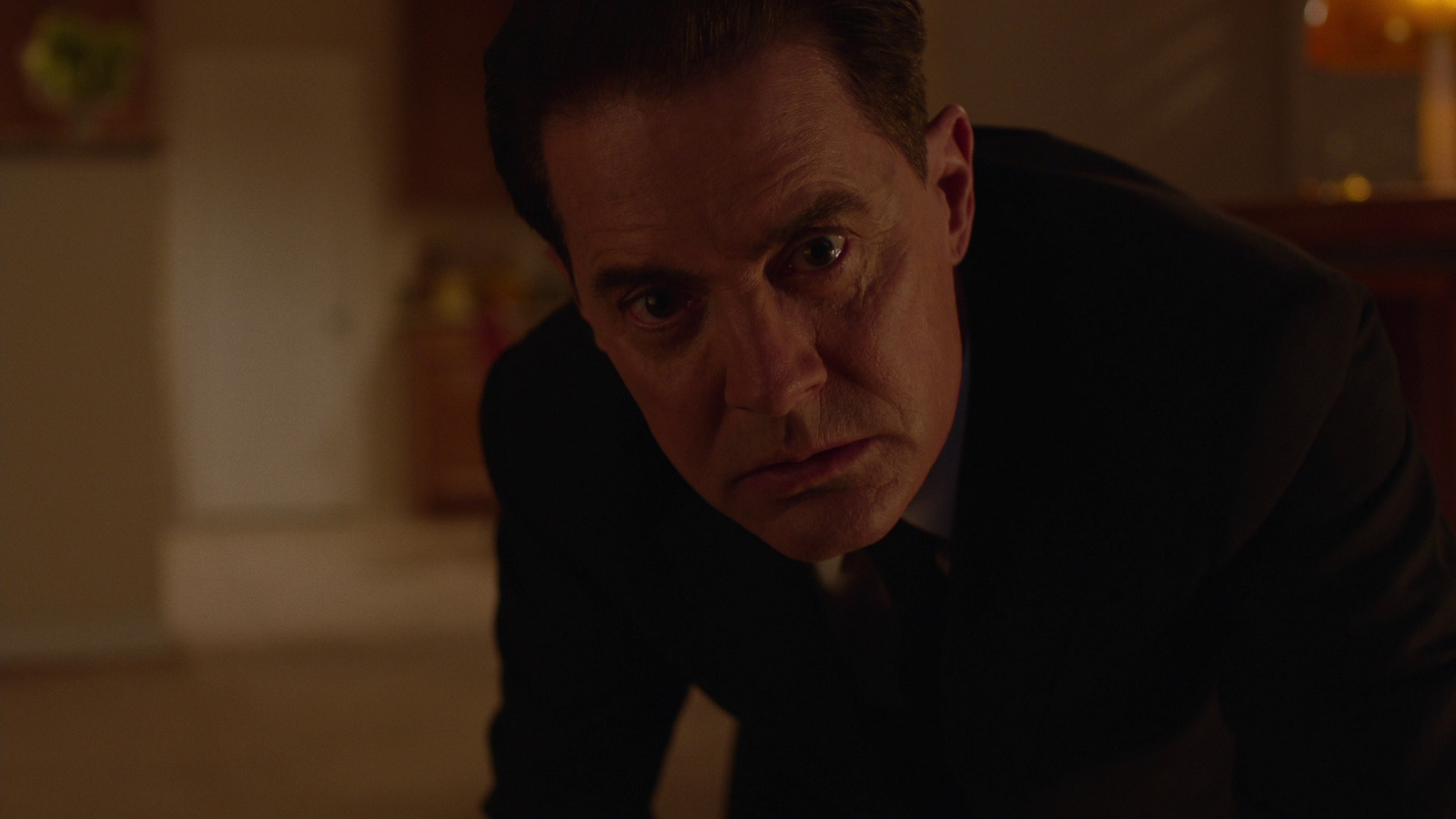
Janey-E leaves Cooper with cake and the television. His attention changes when Sunset Boulevard speaks the name Gordon Cole. The first response is small enough to be missed if the sequence is reduced to its electrical climax: his look fixes on the set, and the passive domestic tableau acquires direction. The film clip enters the story through a name, not a visual likeness. Cinema becomes a carrier of recognition across decades, while Janey-E’s contentment immediately beforehand gives the coming disruption a household to disturb.
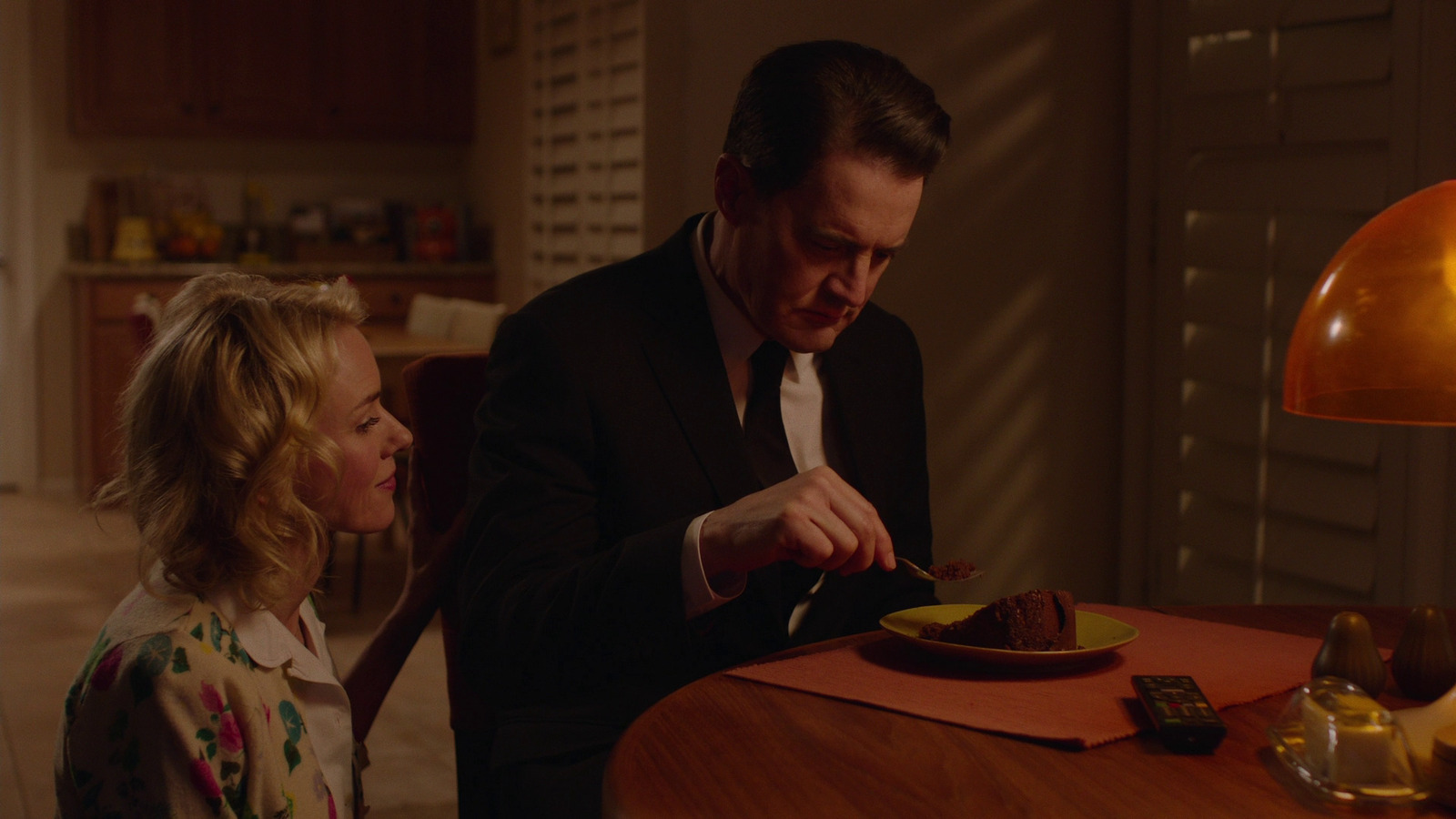
Open the scene sequence · 2 frames
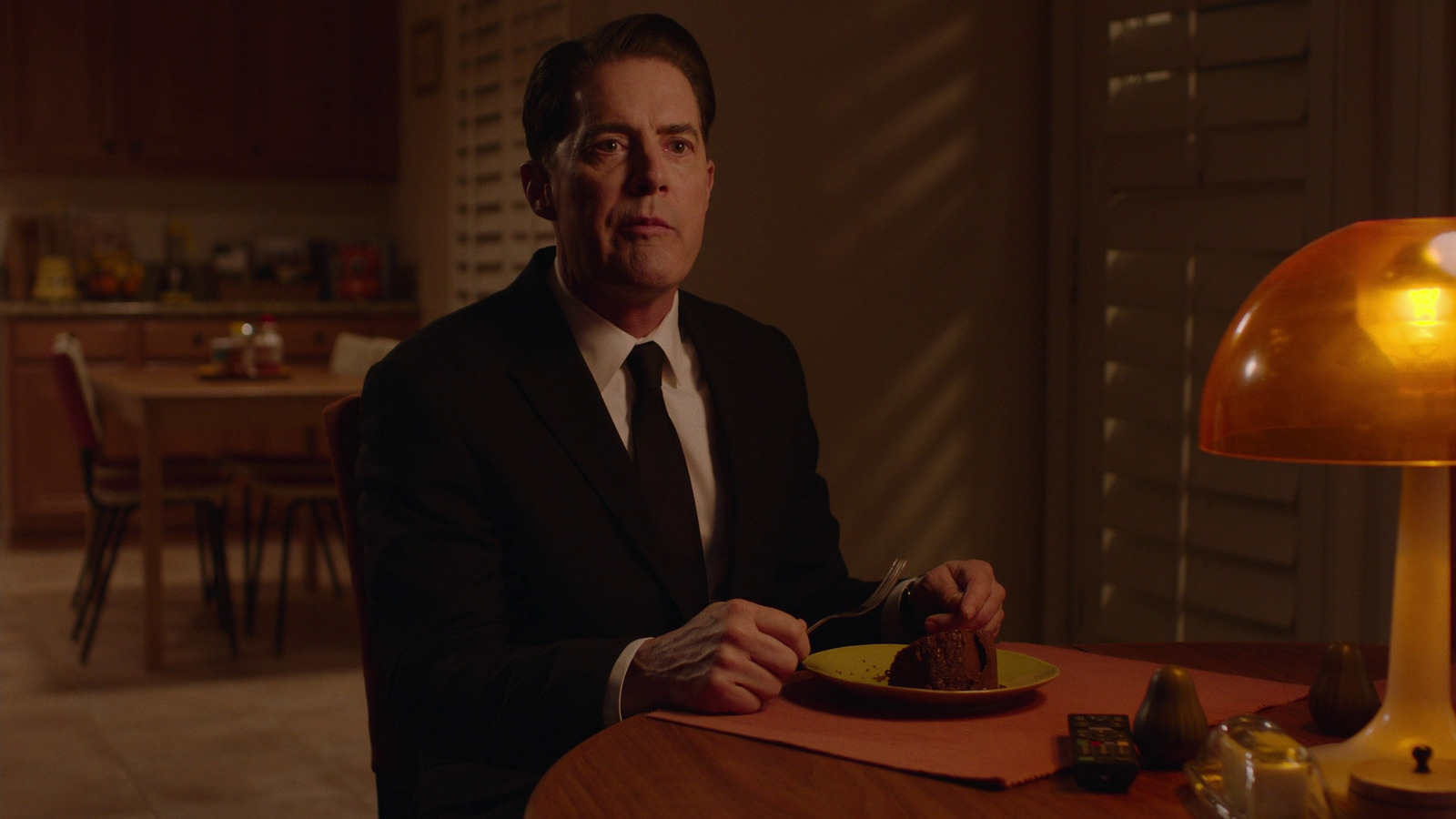
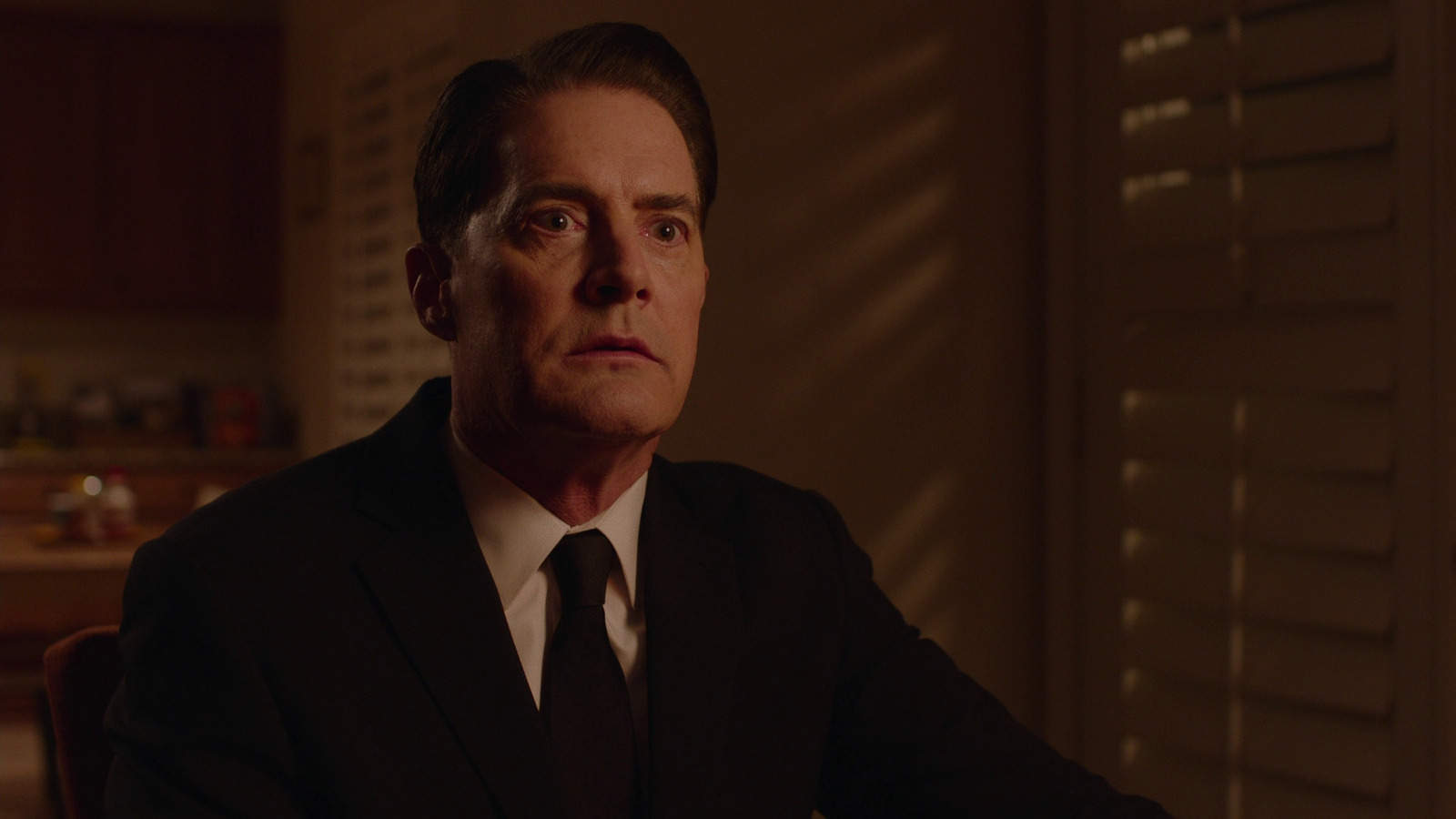
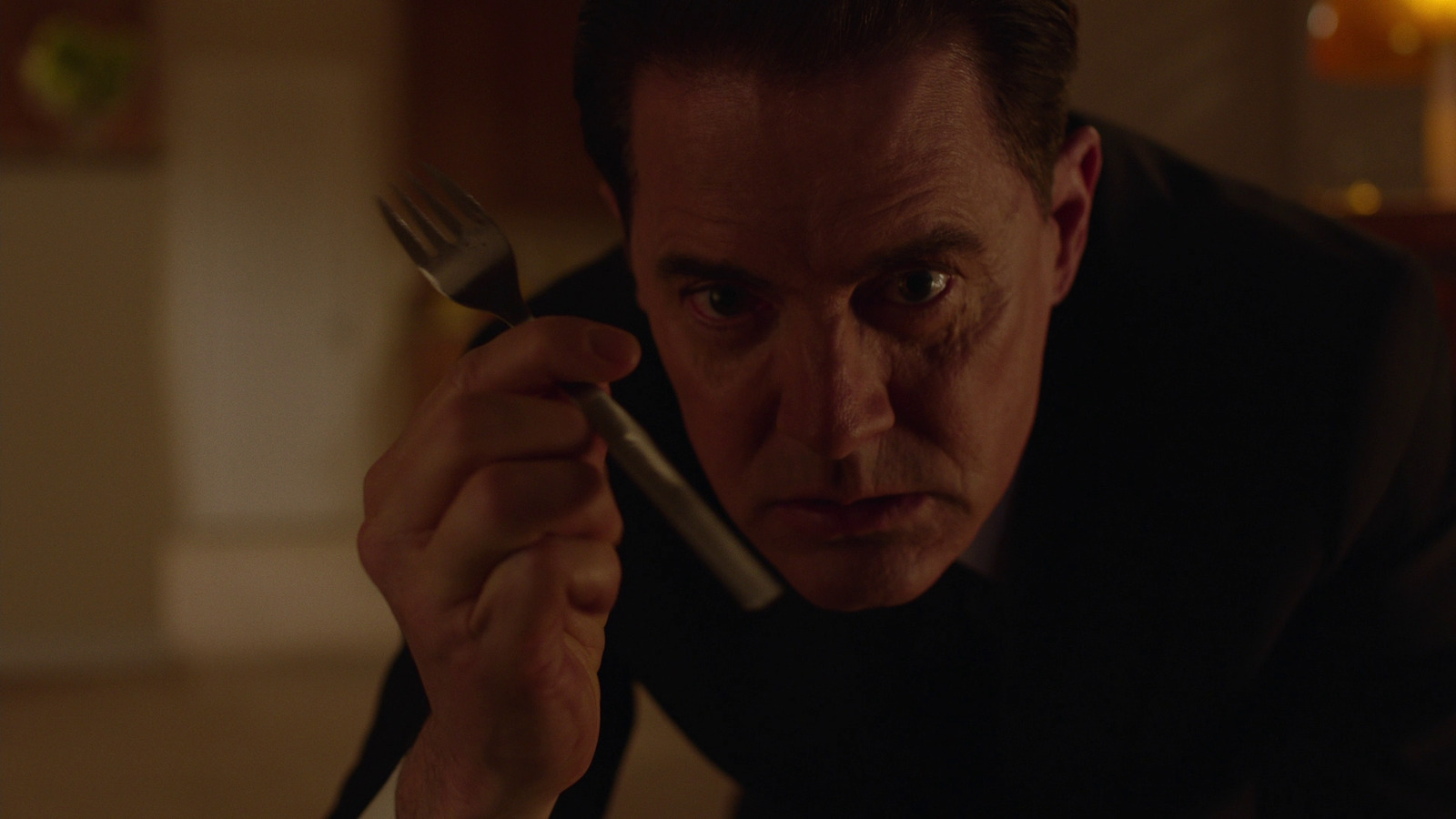
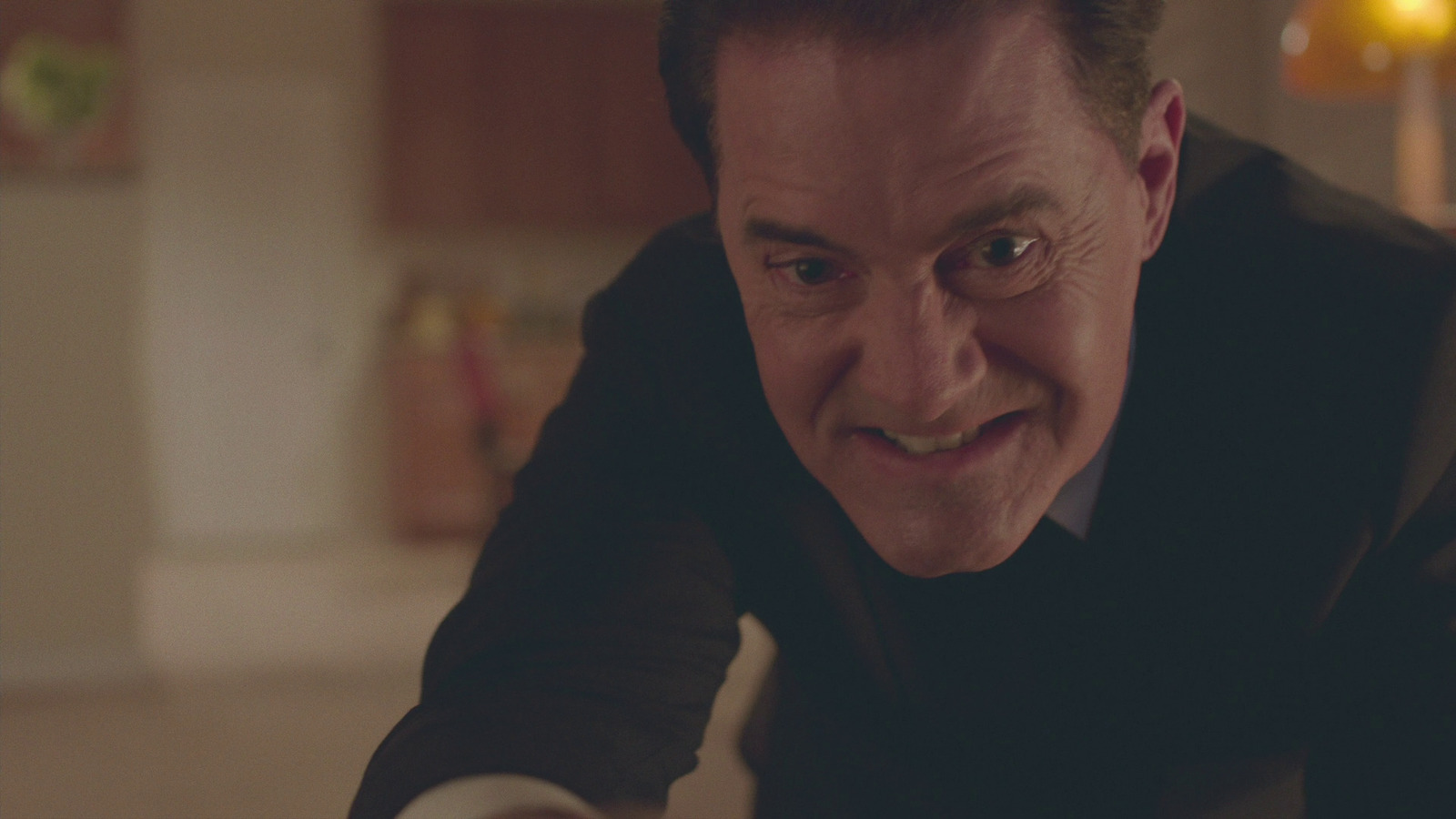
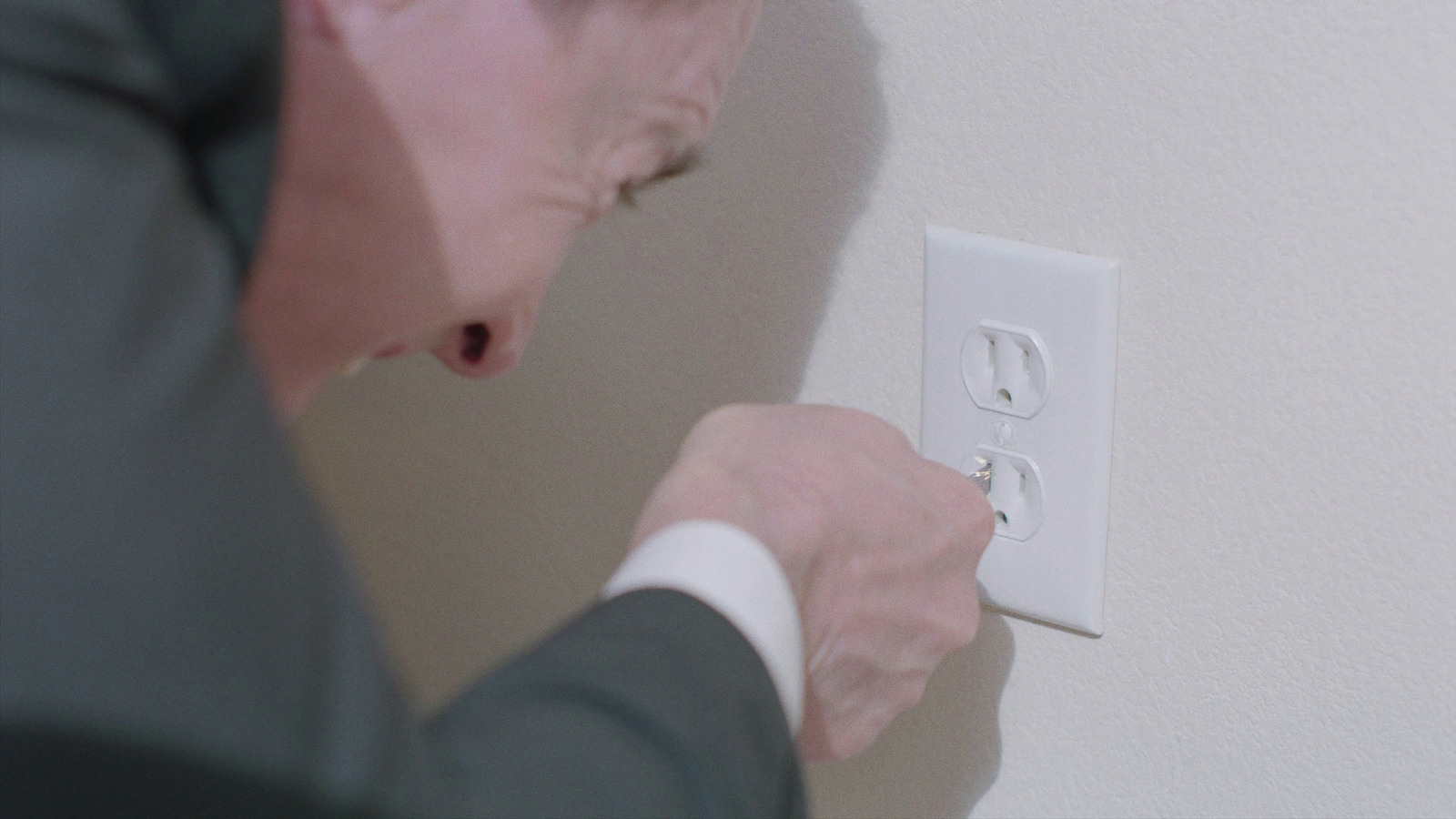
Recognition seeks the socket
Cooper moves from television to electrical outlet, carrying the fork from his meal. Close views of his face and the object stretch the interval between an apparently purposeful idea and its dangerous result. A flash changes the light across the room; the cut to Janey-E makes the event more than a private breakthrough. The scene links recognition, physical action and electrical violence without explaining the process in dialogue. Its immediate consequence remains a shock to the family, even for a viewer who hopes that Cooper is approaching a return to himself.
Open the scene sequence · 4 frames
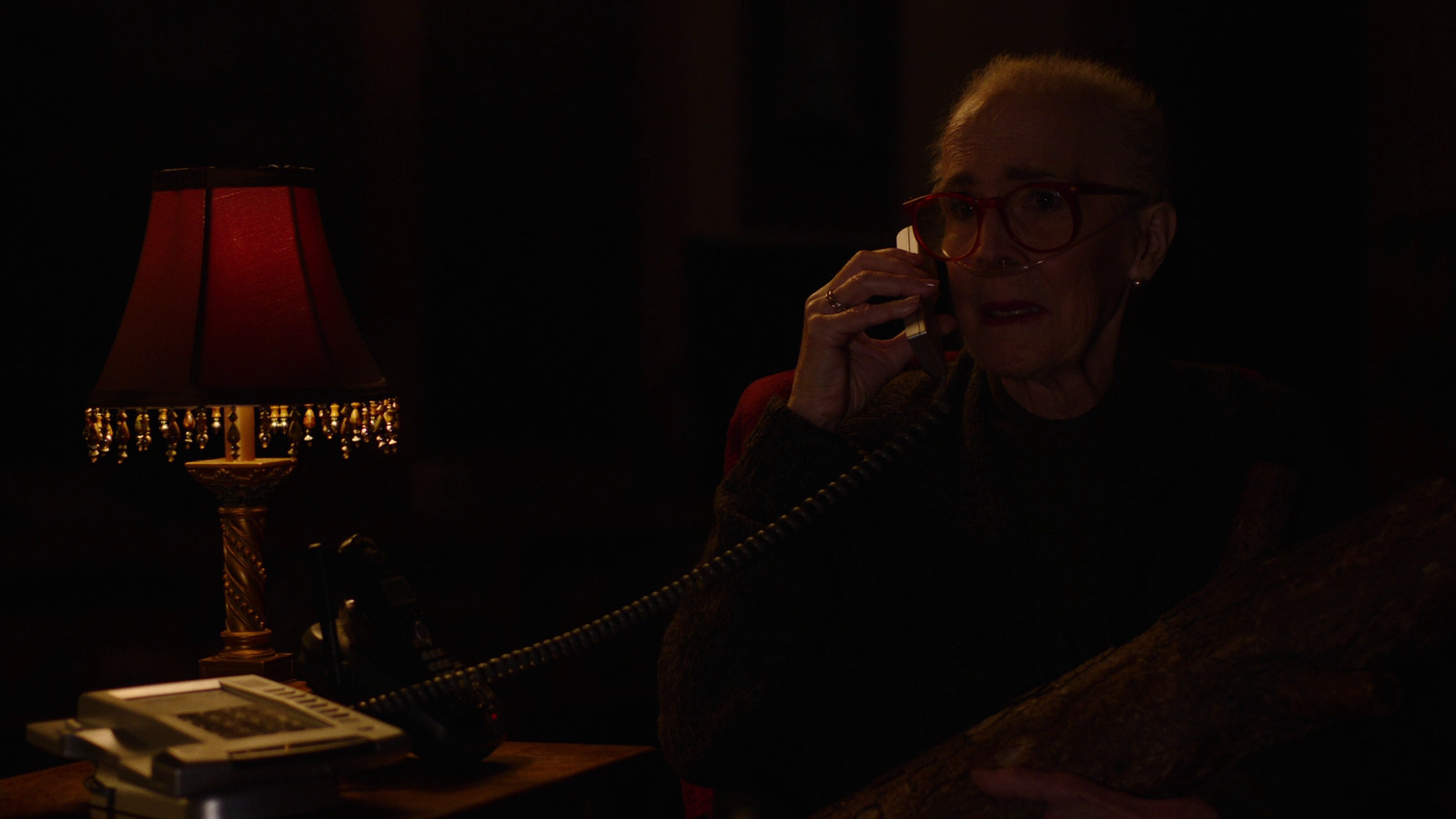
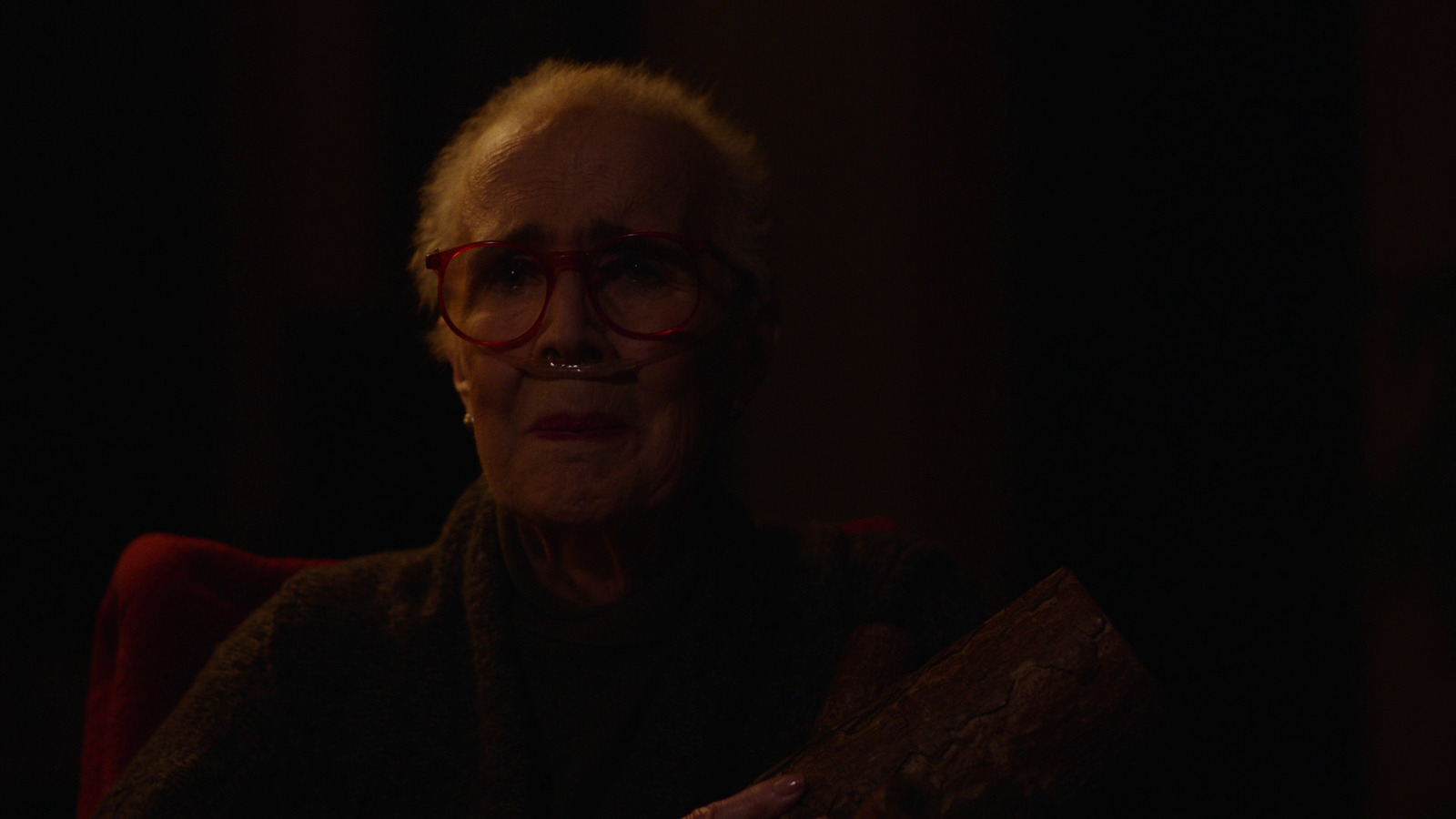
Margaret gives Hawk time to hear her
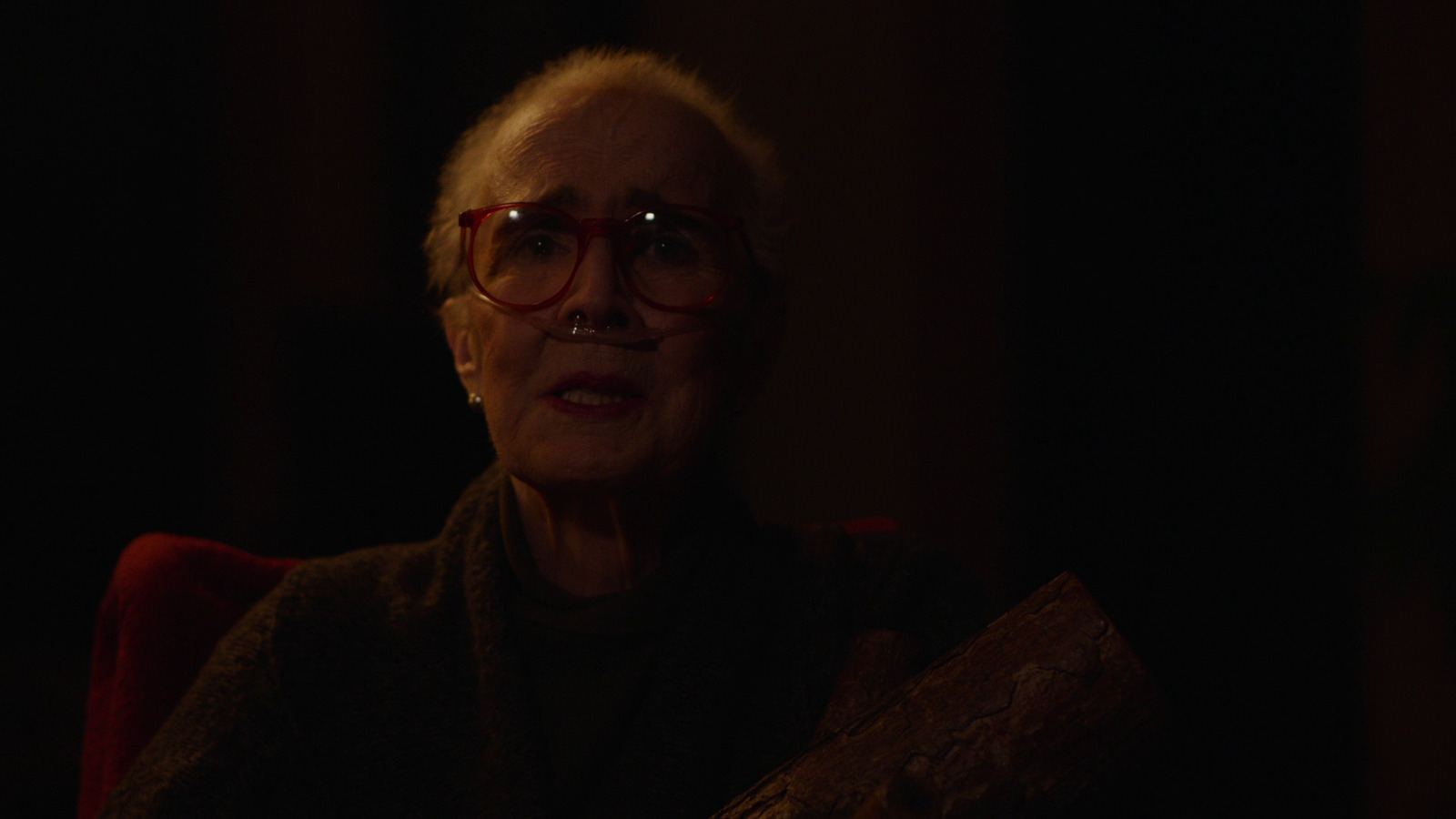
Margaret announces that she is dying. The conversation contains guidance, fear and farewell, but its form depends equally on the intervals between sentences. Hawk does not interrogate her as a source of clues. His listening lets her thoughts about death as change remain personal speech, even when Blue Pine Mountain and the log enter the conversation. Catherine Coulson’s limited movement and Michael Horse’s restrained replies make the telephone feel like an instrument of attention. After the last exchange, the image remains with Hawk, giving the absence at the other end of the line a duration.
Open the scene sequence · 4 frames
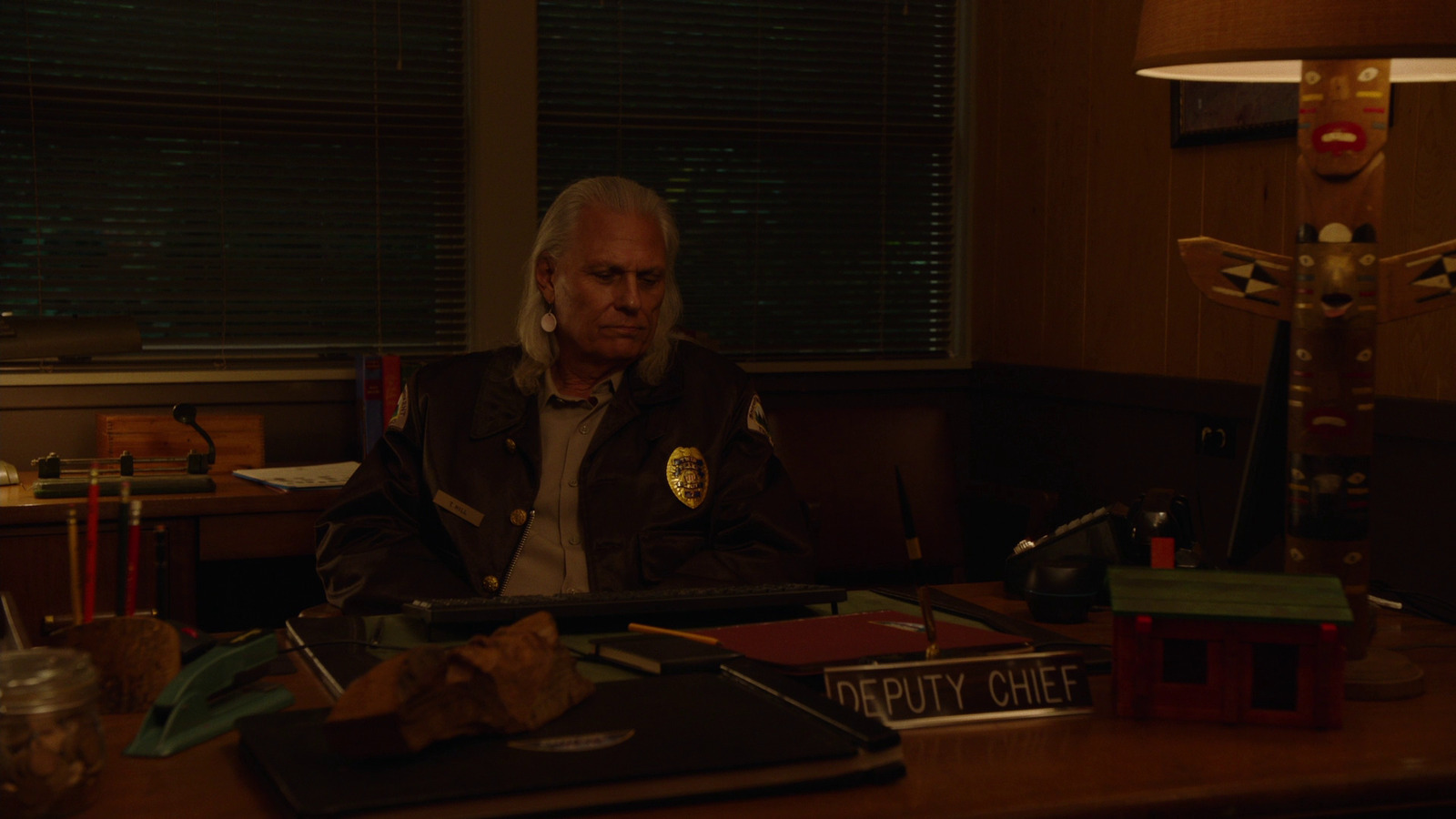
The news passes into a room
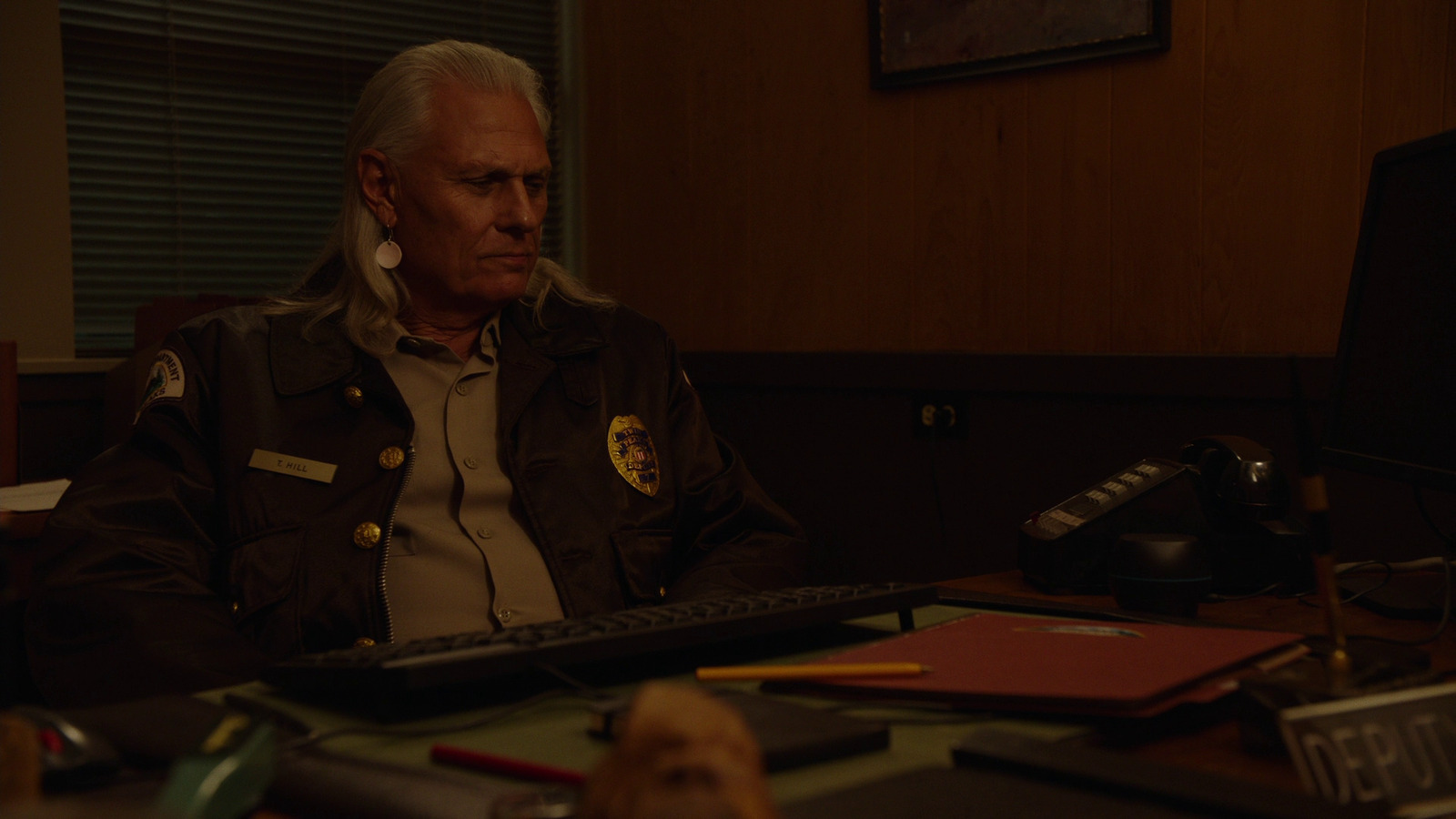
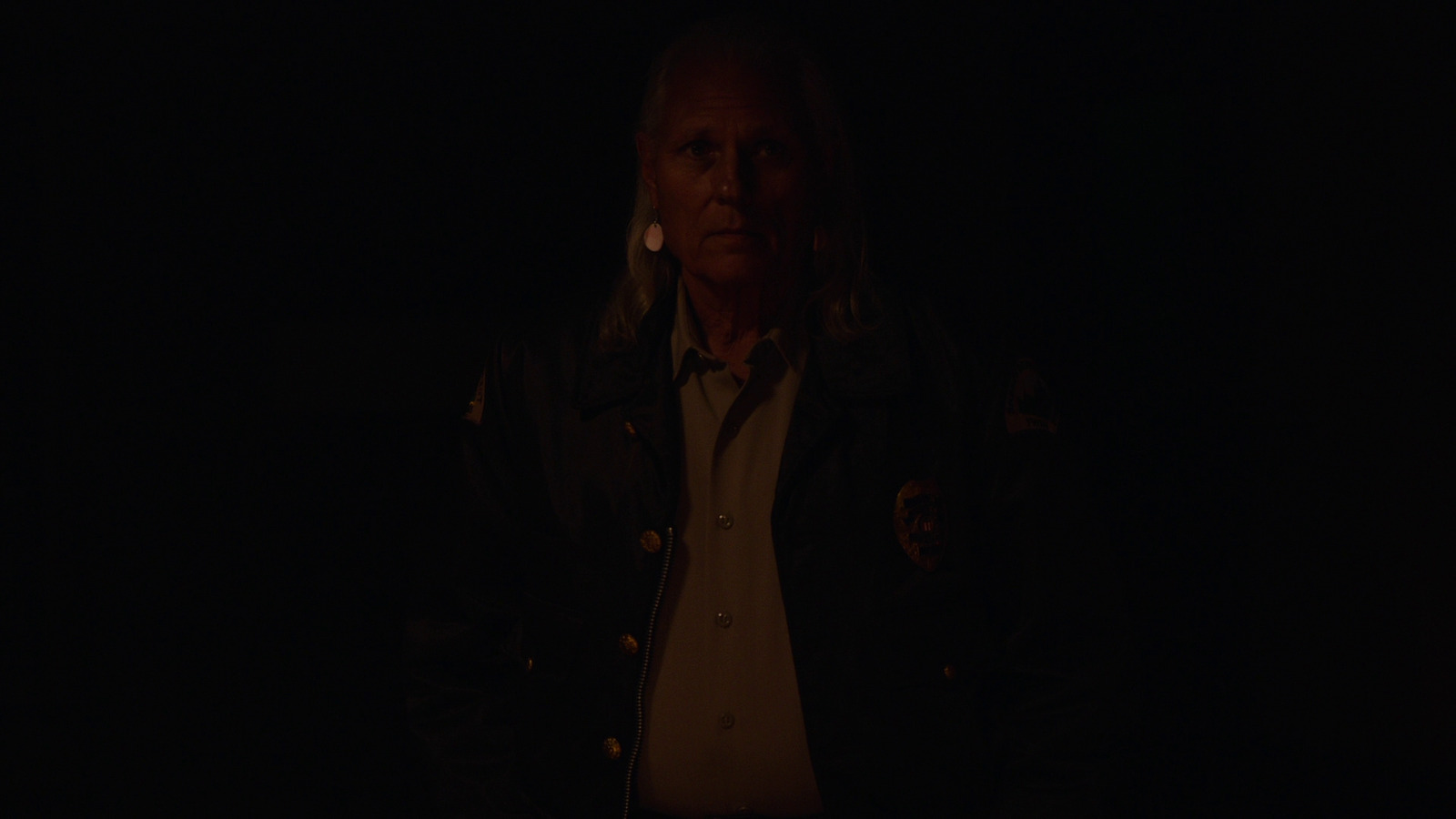
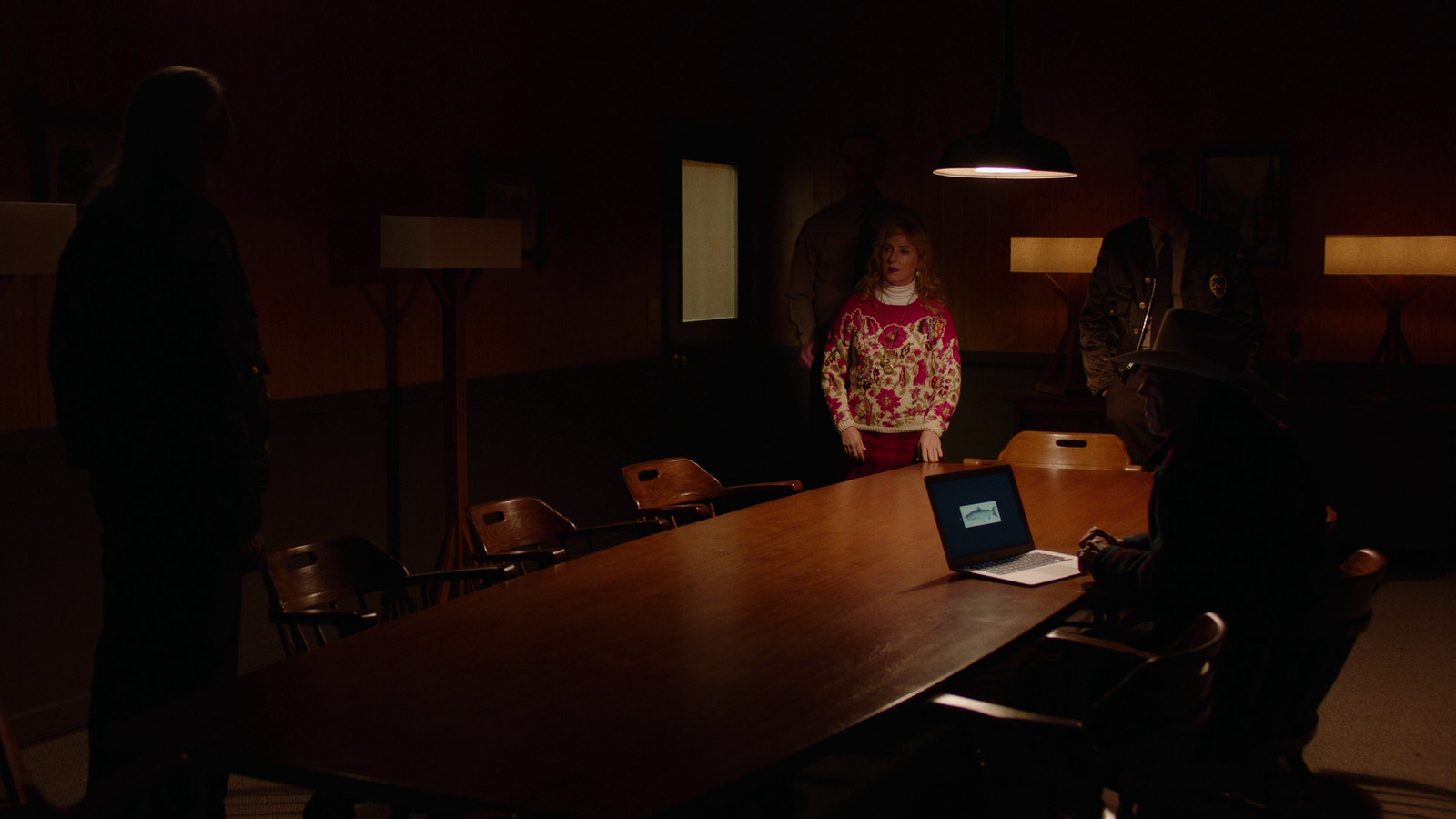
Hawk’s announcement brings Margaret’s death into the sheriff’s station. The conference table is no longer a place for assembling evidence; the pauses and separated reactions let each person receive the same loss. The later view of the cabin turns the extinguishing of an interior light into a public image of absence. This is not interchangeable with the convenience store’s disappearance. One place vanishes through spectacle; the other stays physically present while its familiar life is gone. The episode allows both images of departure to coexist without equating them.
Open the scene sequence · 2 frames
Coats on, coats off, nowhere reached
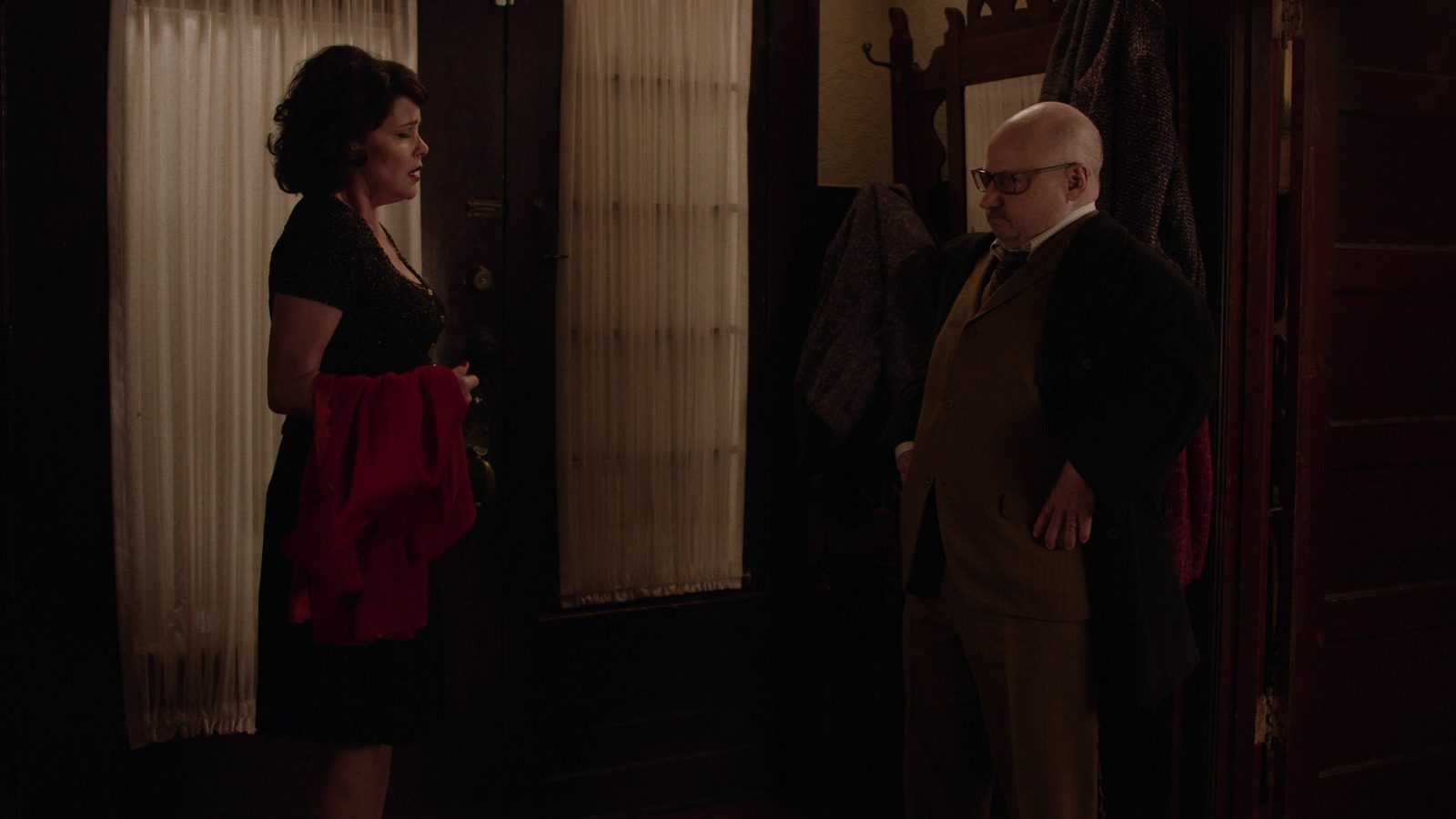
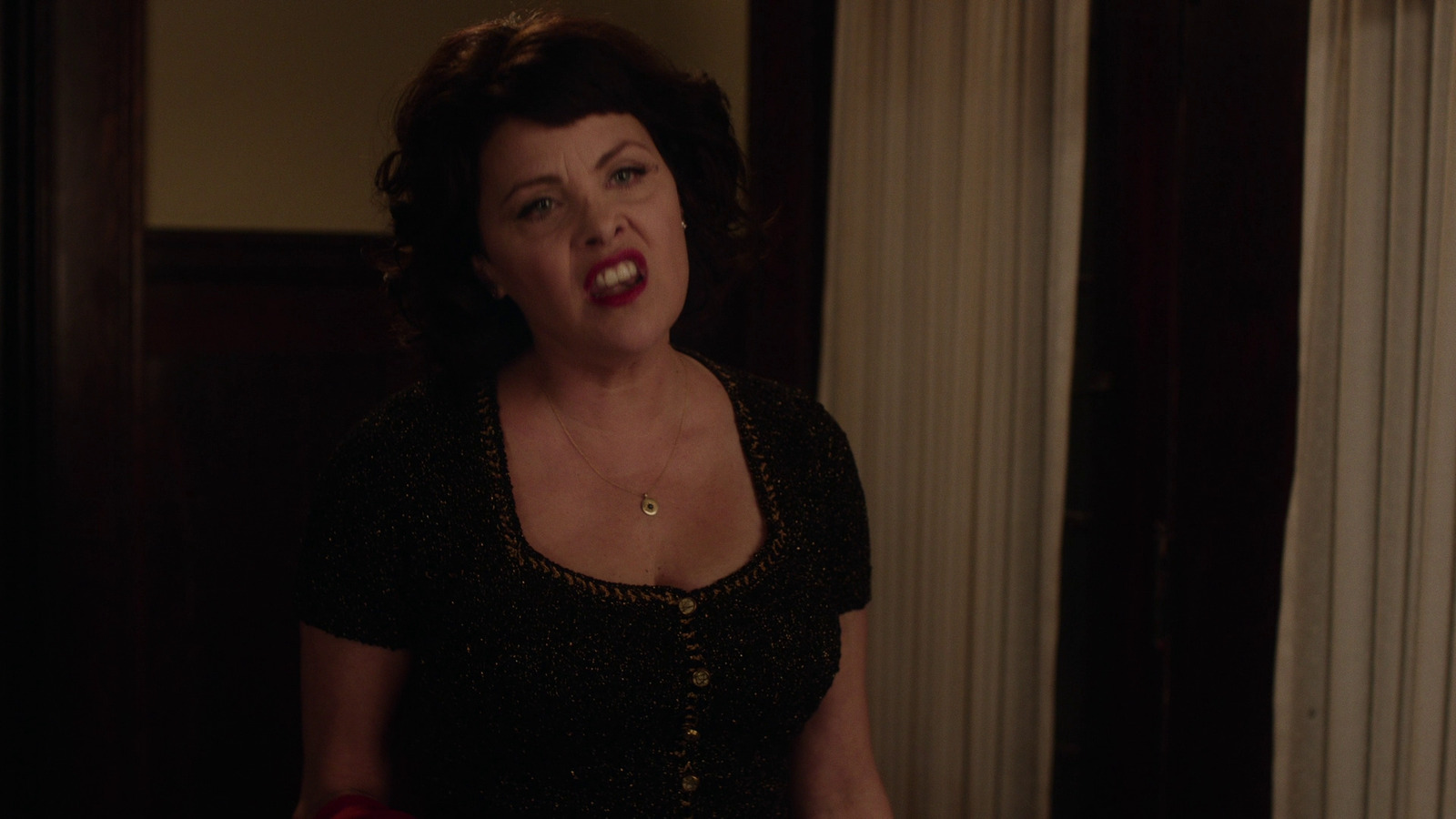
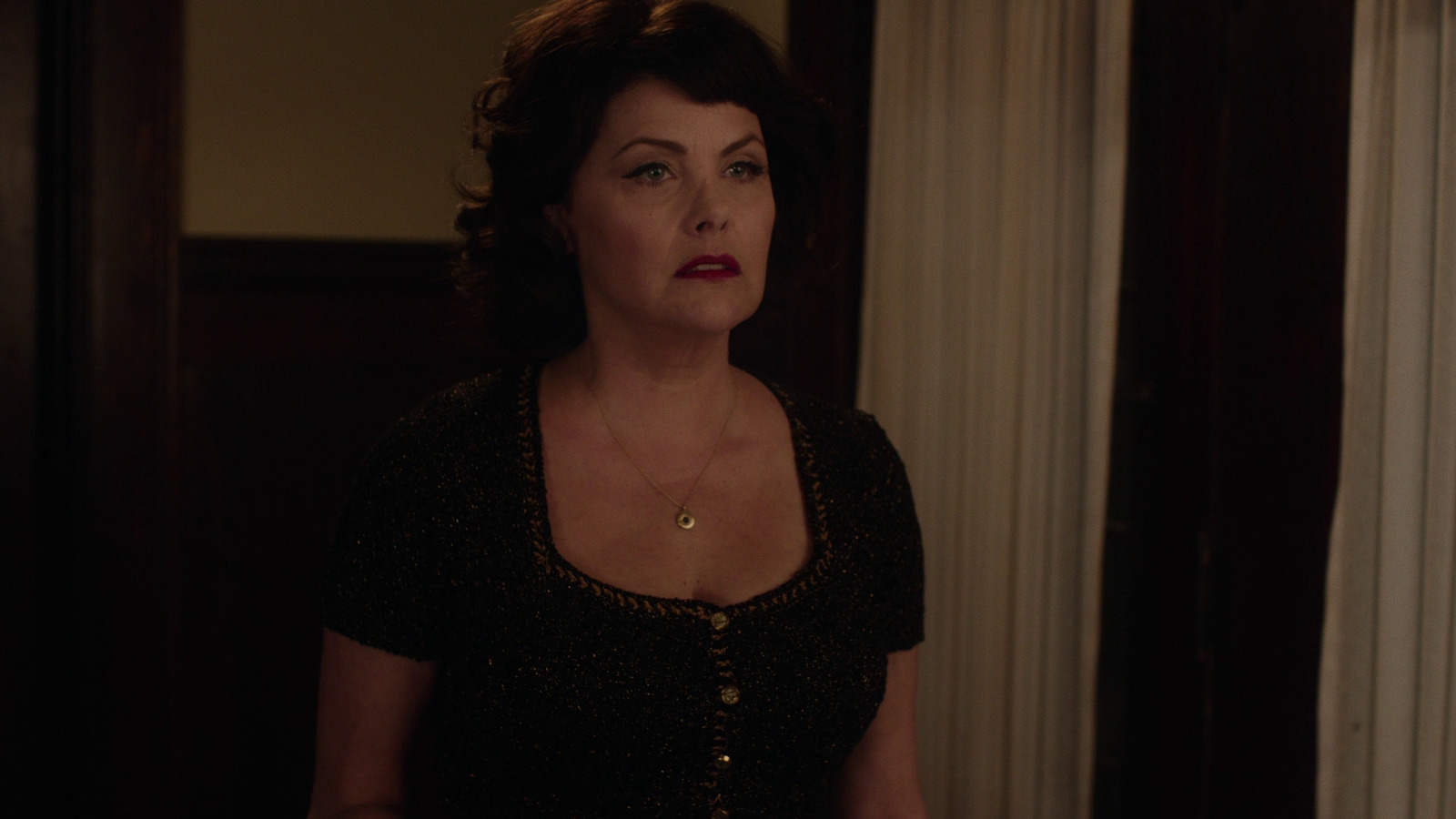
Audrey and Charlie are dressed to leave, yet departure again becomes an argument about the person beside her. The threshold is both spatial and verbal: each attempt to move forward exposes another dispute about identity, intention or control. Removing a coat becomes consequential because it cancels the action supposedly agreed upon. Audrey’s anger finally becomes physical. The scene’s repetitions sustain confinement without proving exactly where she is or what explains it. Her account should remain in tension with Charlie’s rather than be converted into a diagnosis.
Open the scene sequence · 2 frames
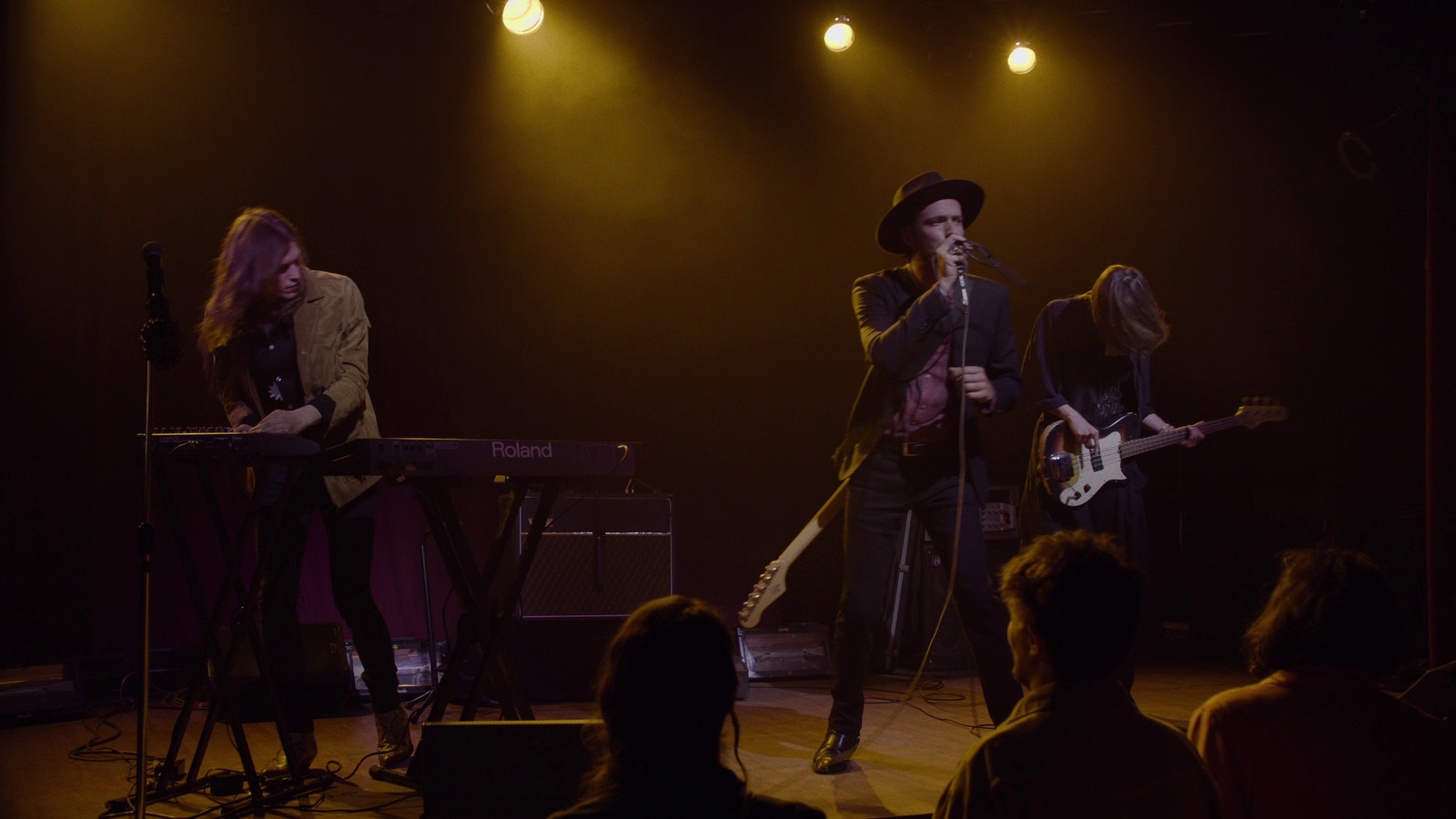
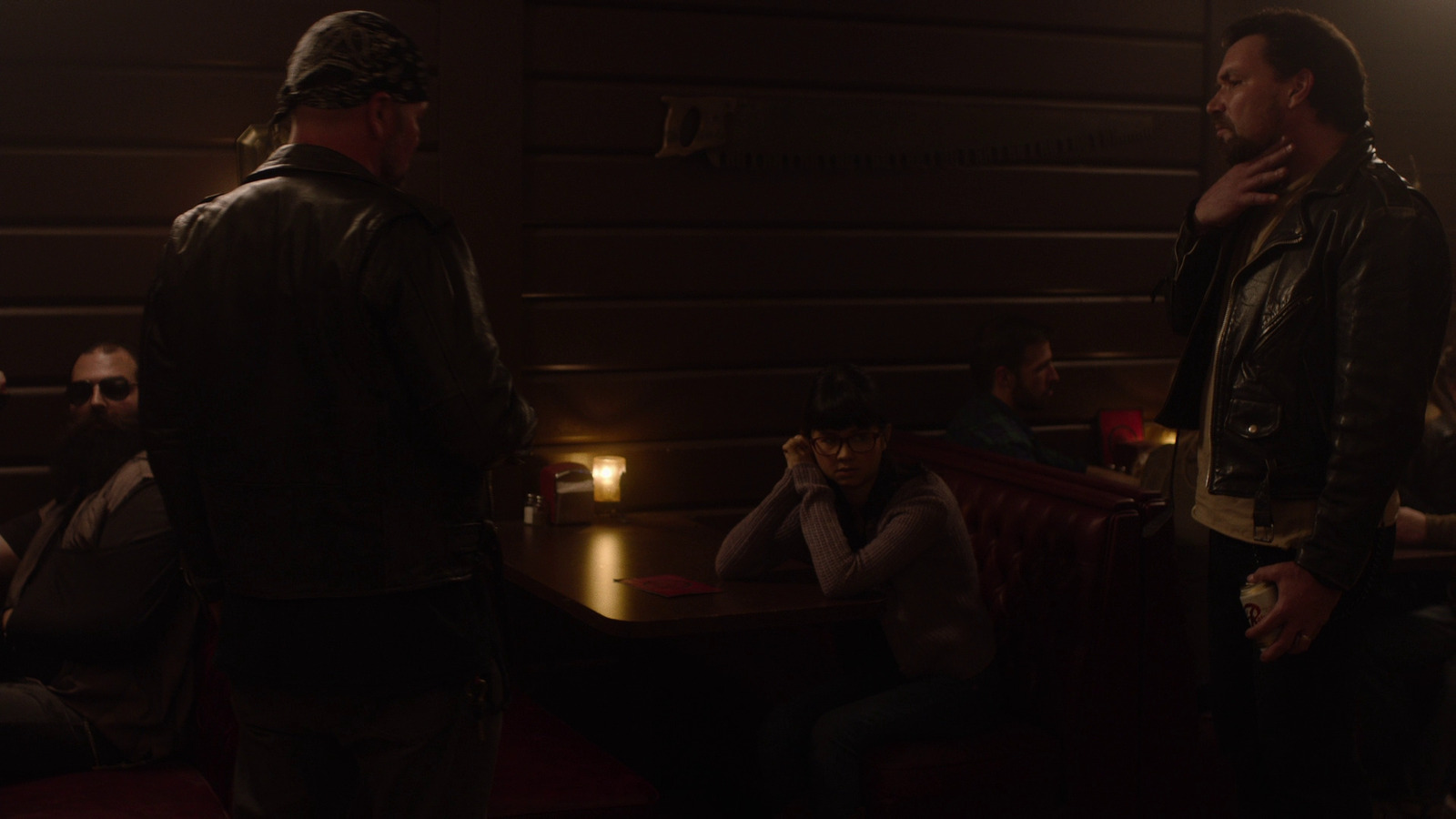
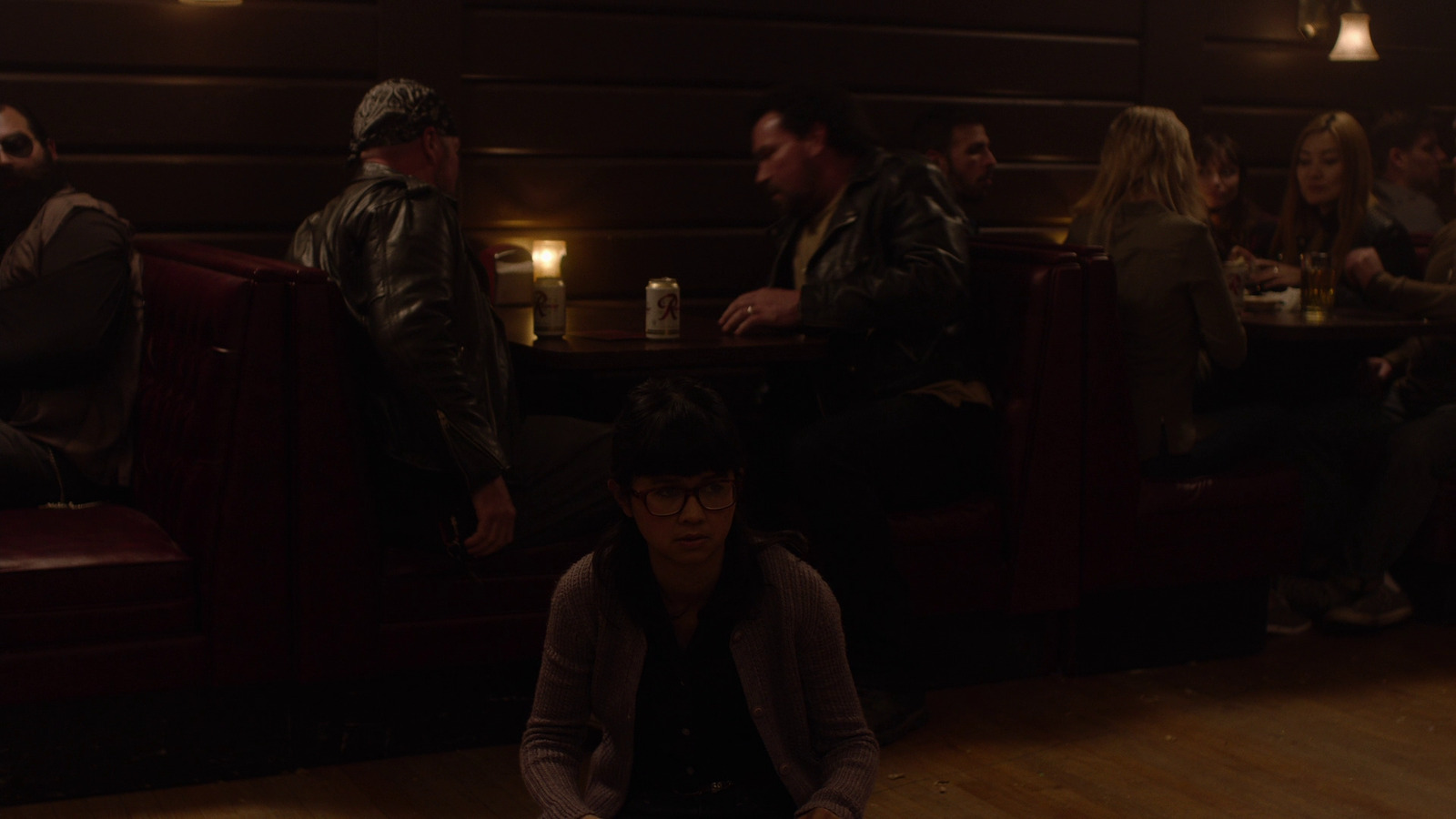
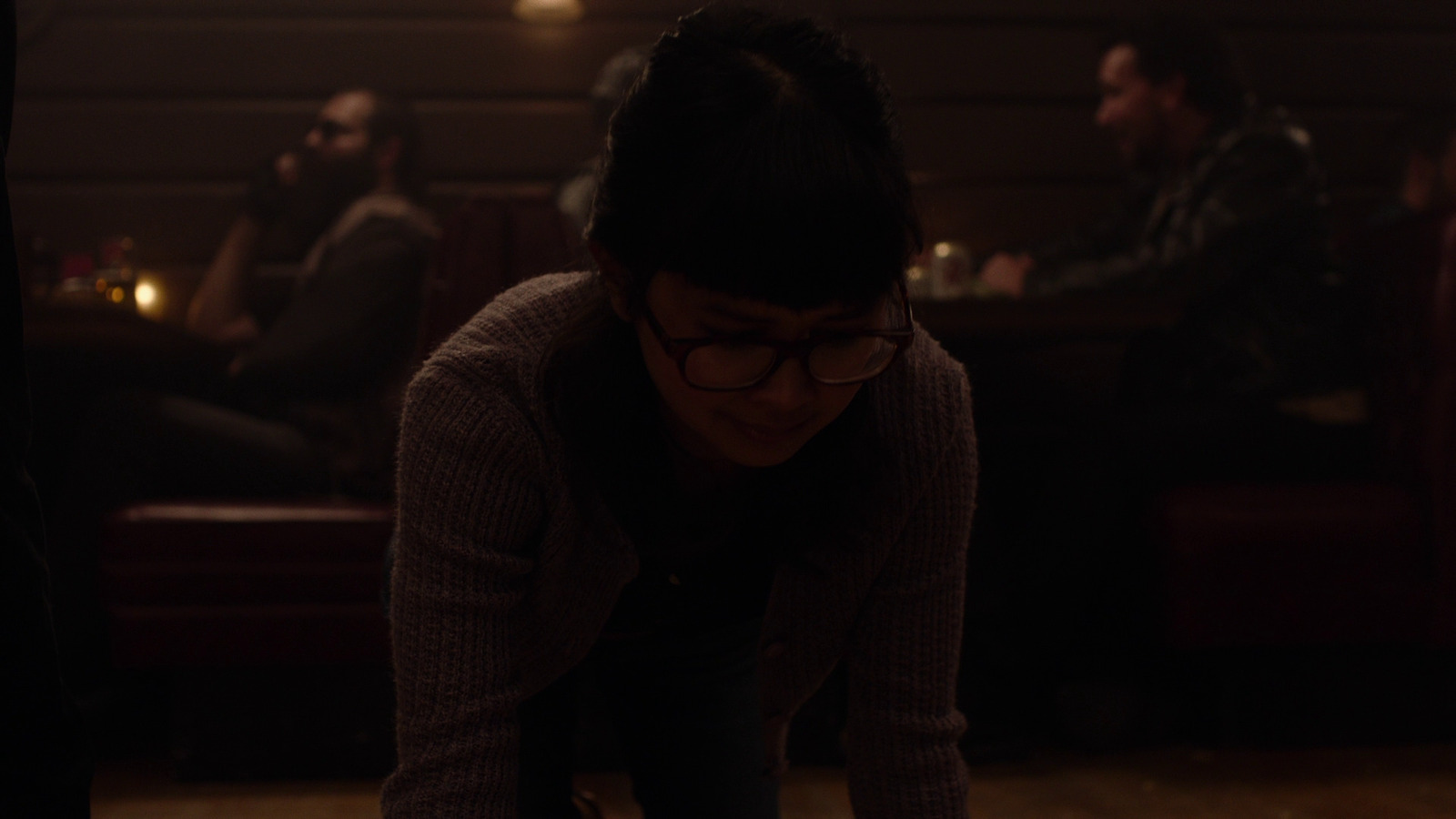
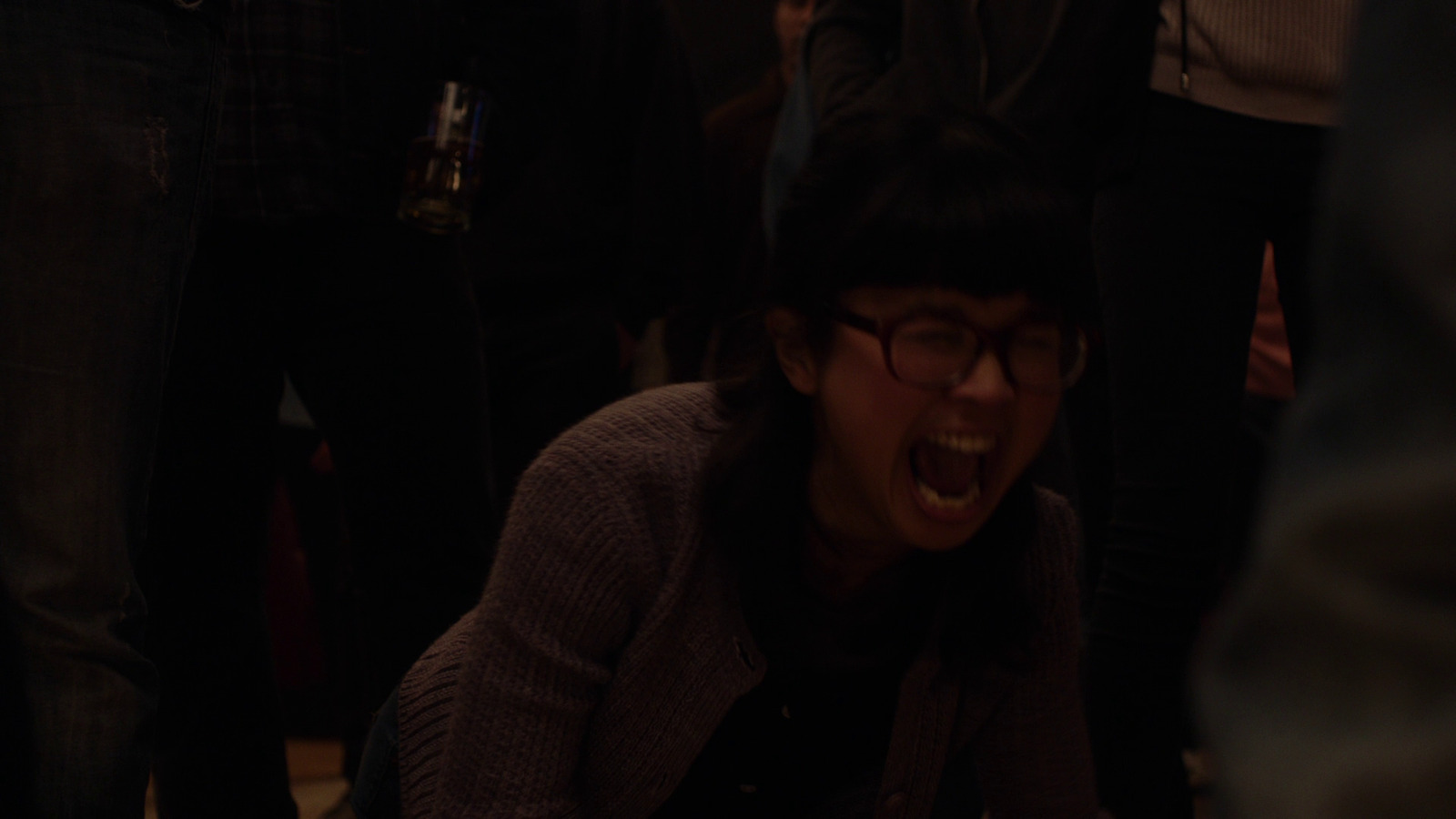
A place to sit becomes a place to scream
The Veils perform while Ruby waits alone. Two men take her seat by lifting her and placing her on the floor; the action is casual enough to be treated by the room as a minor rearrangement. Her movement under and between the surrounding bodies then changes the scale of the scene. A person dismissed from the social picture becomes its emotional center. The scream cuts through the performance and refuses the reassurance of an ordinary Roadhouse ending. The closing credits return to the empty convenience-store view, extending the episode’s concern with spaces emptied of belonging.
Open the scene sequence · 4 frames
Songs, interrupted playback and the work of listening
Redding carries feeling across blocked action. The live performance of “I’ve Been Loving You Too Long” accompanies the Double R sequence, holding emotional continuity through Walter’s interruption and Norma’s decision. The song does not simply certify a happy ending: it sustains waiting before the reunion becomes visible. Lynch identified the Monterey performance as a piece he had wanted from the beginning and described its overwhelming emotional force. That testimony supports the particular recording’s importance without reducing the sequence to a private anecdote. [2]
Jeffries is heard through an environment. Electrical disturbance, vapor, altered space and telephone interruption qualify the conversation before any answer can be trusted. Preserve the negation in Jeffries’s reply about the telephone number: changing it would falsely settle who called Mr. C. The voice belongs in the analysis alongside the earlier film image, but the performance attribution is Nathan Frizzell, as the end titles specify. [1]
The Roadhouse record participates in the fight. The ZZ Top cue is openly introduced as playback. Its disruptions around the punches exaggerate Freddie’s force while briefly exposing the mechanical basis of the entertainment. His apology and the later intensive-care report complicate the comic timing. A soundtrack event is doing narrative work that still photographs alone cannot preserve.
A name can be a trigger. The Sunset Boulevard passage makes Gordon Cole audible before Cooper acts. The sharp change in his attention is the hinge; the crackling electrical climax follows it. At the other end of the episode, the offscreen gunshot in the woods leaves visual evidence incomplete. Sound sometimes initiates action and sometimes prevents a reassuringly complete account of it.
Margaret’s pauses belong to the scene. The farewell is not a stream of cryptic clues awaiting extraction. Short statements, breaths, Hawk’s responses and the intervals after them organize a shared experience of fear and acceptance. The station announcement then changes private listening into communal mourning. Ruby’s final scream offers another kind of voice that the surrounding room can no longer ignore.
Credit the collaboration. The end titles credit Lynch for sound design, Ron Eng and Dean Hurley in supervising/re-recording roles, Hurley for sound-effects editing, and David A. Cohen and Kerry Dean Williams for dialogue editing. These credits describe a team; they do not establish which individual made a particular impact or electrical sound. [1]
A closer view of the Roadhouse performance
The Veils — Axolotl
Finn Andrews leans into the microphone, bends toward the audience and changes position within the amber-lit stage. The surrounding keyboard and guitar players remain visible in wider views. Close images sometimes isolate the singer against darkness, then return him to the group and the moving crowd.
Open the Axolotl performance study · 2 frames
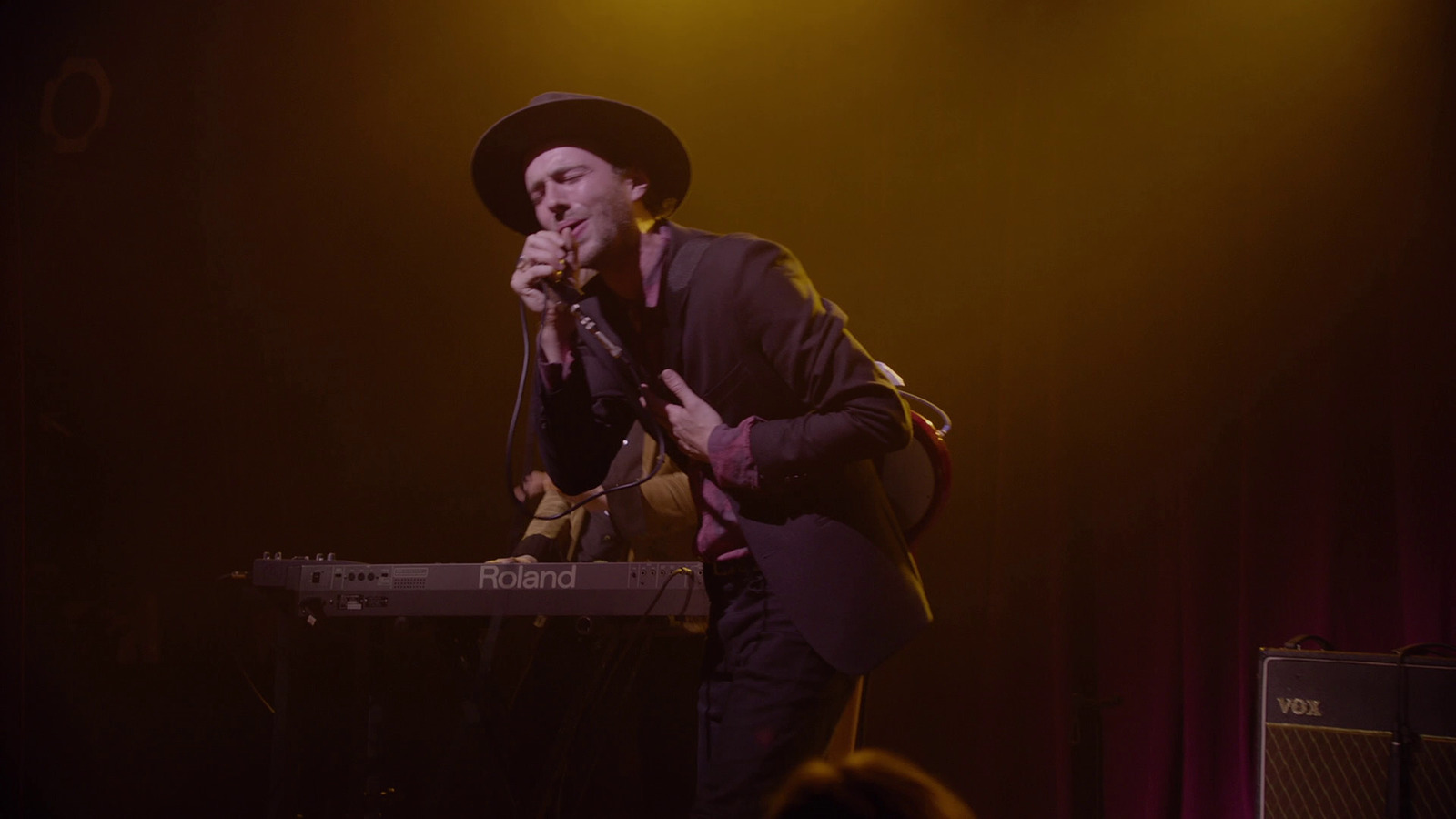
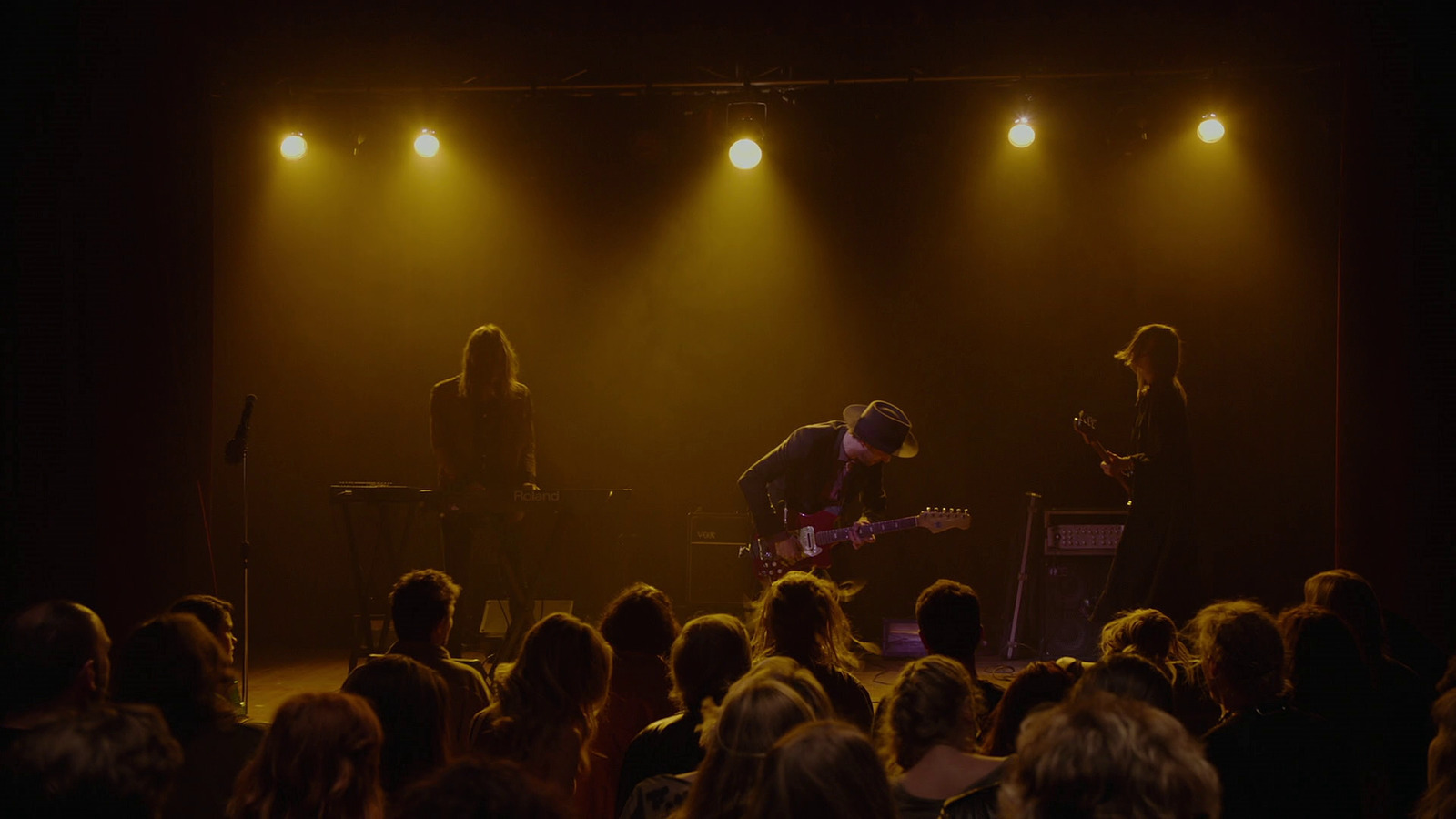
Read the full performance comparison →
Source: Roadhouse Music — The Veils — Axolotl, 00:00–03:03, in Twin Peaks: From Z to A. These timings identify the separate performance edit; the episode context is examined above.
Focused FX and performance galleries
The reunion: anticipation, touch, recognition
Compare Ed’s closed eyes, the arriving hand, the turn toward Norma and Shelly’s response. The transformation comes from staging, performance and cutting; no visual-effects claim is needed.
Open the reunion sequence · 5 frames
Smoke and the vanishing convenience store
Use the roadside and trees as stable references while the structure loses solidity. The final empty view completes the effect. This is a study of the finished composite, not an undocumented reconstruction of the effects pipeline.
Open the disappearance sequence · 4 frames
A small gesture with an excessive result
The green glove is visually modest. Blocking, the recipient’s response, interrupted playback and the distressed aftermath establish its extraordinary force. The stills isolate the physical beats; the scene study above records the sound’s contribution.
Open the green-glove sequence · 6 frames
The room changes with the electrical flash
The sequence moves from a tightly framed intention to a change in light and a wider domestic reaction. The gallery follows the visible event without claiming a specific practical-versus-digital division that the inspected sources do not establish.
Open the electrical sequence · 5 frames
Two faces and the space between replies
Coulson’s close-ups and Horse’s listening are the central materials. Compare the framing before the farewell with Hawk’s remaining image after it. This performance gallery preserves restraint rather than treating the scene as an effects demonstration.
Open Margaret and Hawk’s farewell · 5 frames
Making the images, shaping the performances
Nadine’s dignity. Wendy Robie described Nadine through pain, courage, loneliness and yearning, resisting the idea that the character should simply be mocked. She understood the shovel walk as Nadine’s own redemption. That is an actor’s interpretation, and it helps explain why the opening can release Ed while still giving Nadine a meaningful achievement of her own. [3]
A machine, not a household object. Lynch told Daniel Dylan Wray that he sculpted the part of Jeffries’s apparatus with the projecting spout. He rejected its popular identification as a kettle, calling it a machine. In the same interview he said permission had been obtained to reuse Bowie’s earlier footage, but Bowie wanted the voice replaced by a Louisiana actor; Nathan Frizzell supplied that performance. These are specific production statements, not a general explanation of what Jeffries has become. [2]
Coulson’s determination. In Vinnie Guidera’s eyewitness report of a 2025 panel, Mark Frost recalled Coulson’s determination to complete her work while seriously ill. Ron Eng also recalled the emotional difficulty for Lynch when working on a Coulson scene in postproduction, without identifying that scene as this farewell. The report is testimony about the production, not evidence that the accompanying documentary was consulted here. The Return overview separately records Sabrina Sutherland’s account of arranging Coulson’s remote filming. [4]
Place the roles precisely. The end titles credit Mark Frost as Cyril Pons, Charlyne Yi as Ruby and Nathan Frizzell as the voice of Phillip Jeffries. Bowie’s screen presence and Frizzell’s vocal work therefore need distinct attribution. BUF is credited for visual effects, with Gary D’Amico and Philip Bartko in special-effects roles; those general credits should not be expanded into unsupported shot-by-shot assignments. [1]
Finding a route through the impossible building
Behind the Red Curtain reveals the floral-wallpapered interior as a practical set filled with cameras, light and working space. MacLachlan’s path, the door movements and the timing of a cue are rehearsed before the completed sequence turns those actions into an unstable passage. 05:00–08:30.
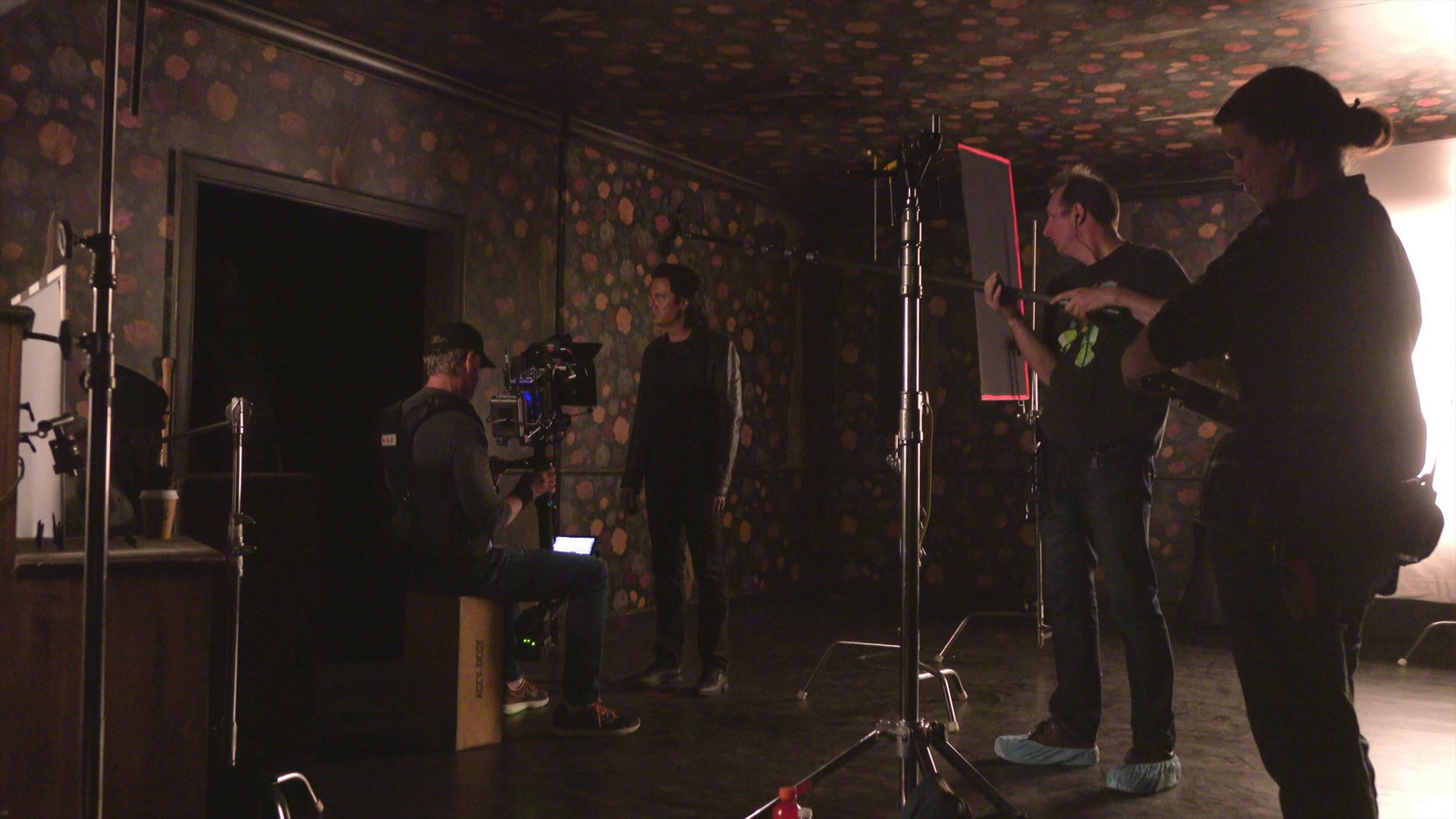
This view is especially useful beside the sequence’s light changes and discontinuous travel. The strangeness depends on precise physical placements. It does not mean the entire journey is practical: the documentary establishes particular photographed rooms and actions, while the finished episode and effects accounts establish how those elements were transformed and connected.
Performance, sound and the working image
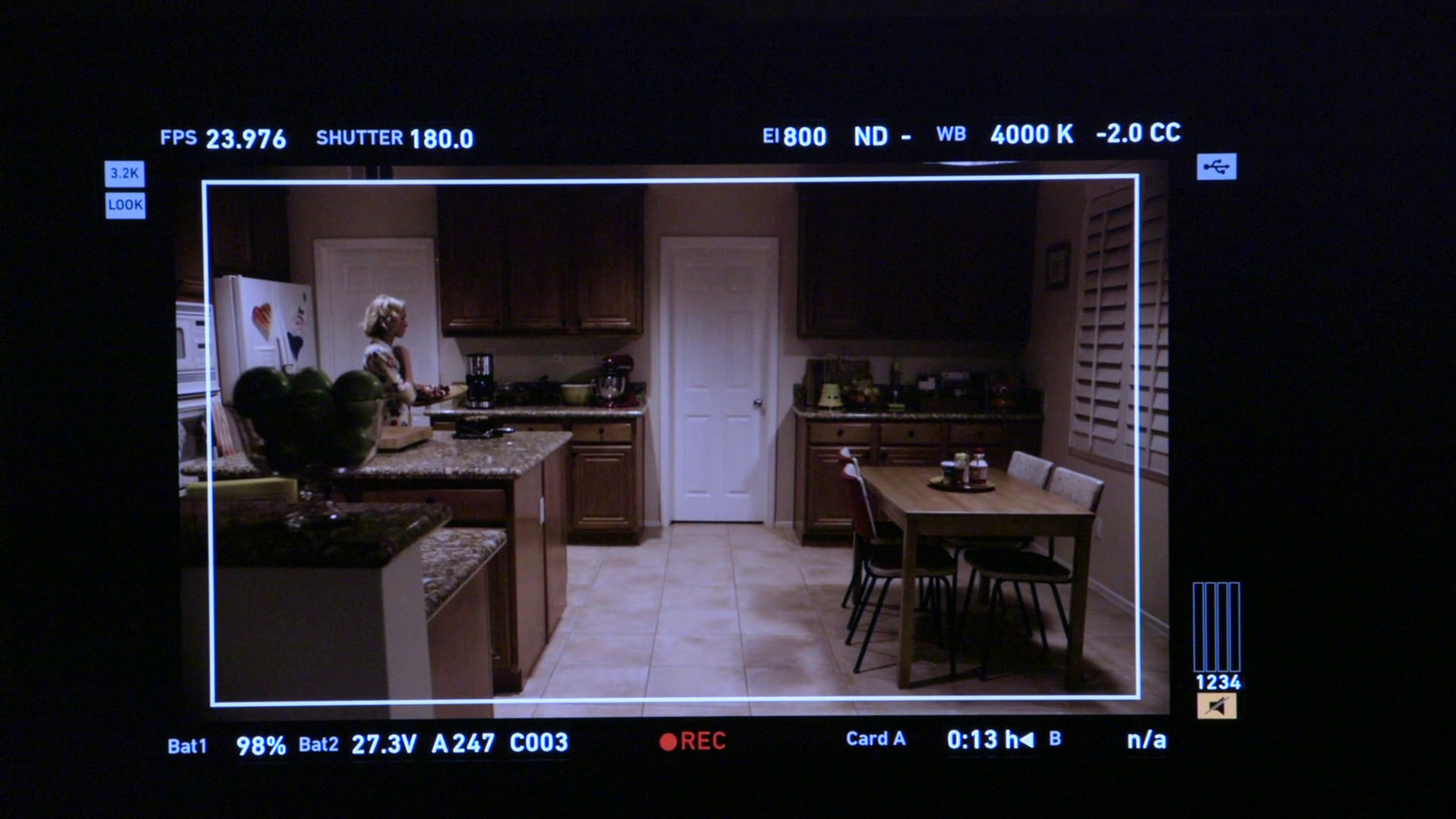
The production footage in Jason S.’s Impressions: A Journey Behind the Scenes of Twin Peaks adds another view of the scenes: directions spoken on set, rehearsals, material experiments and choices still being worked out.
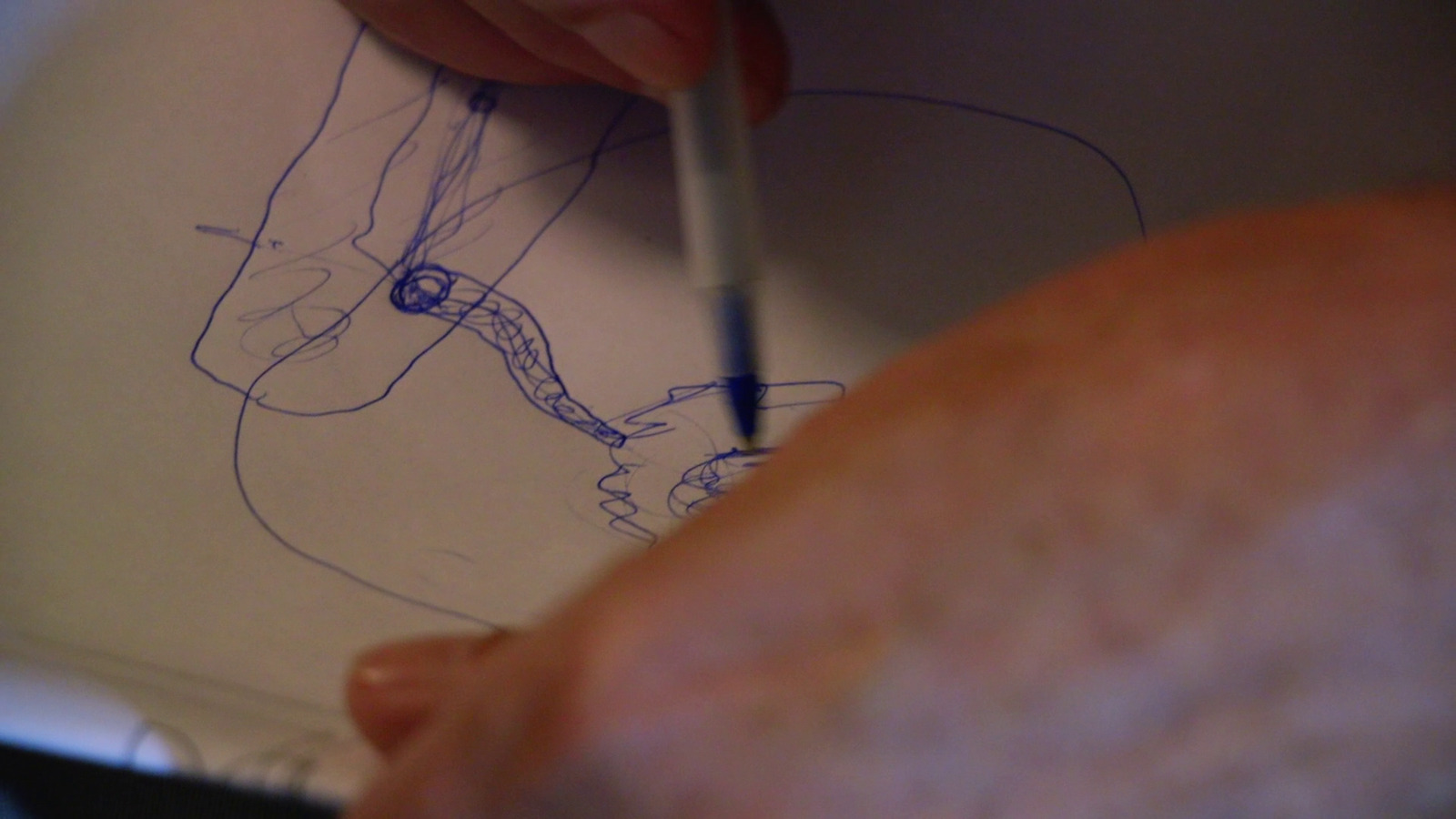
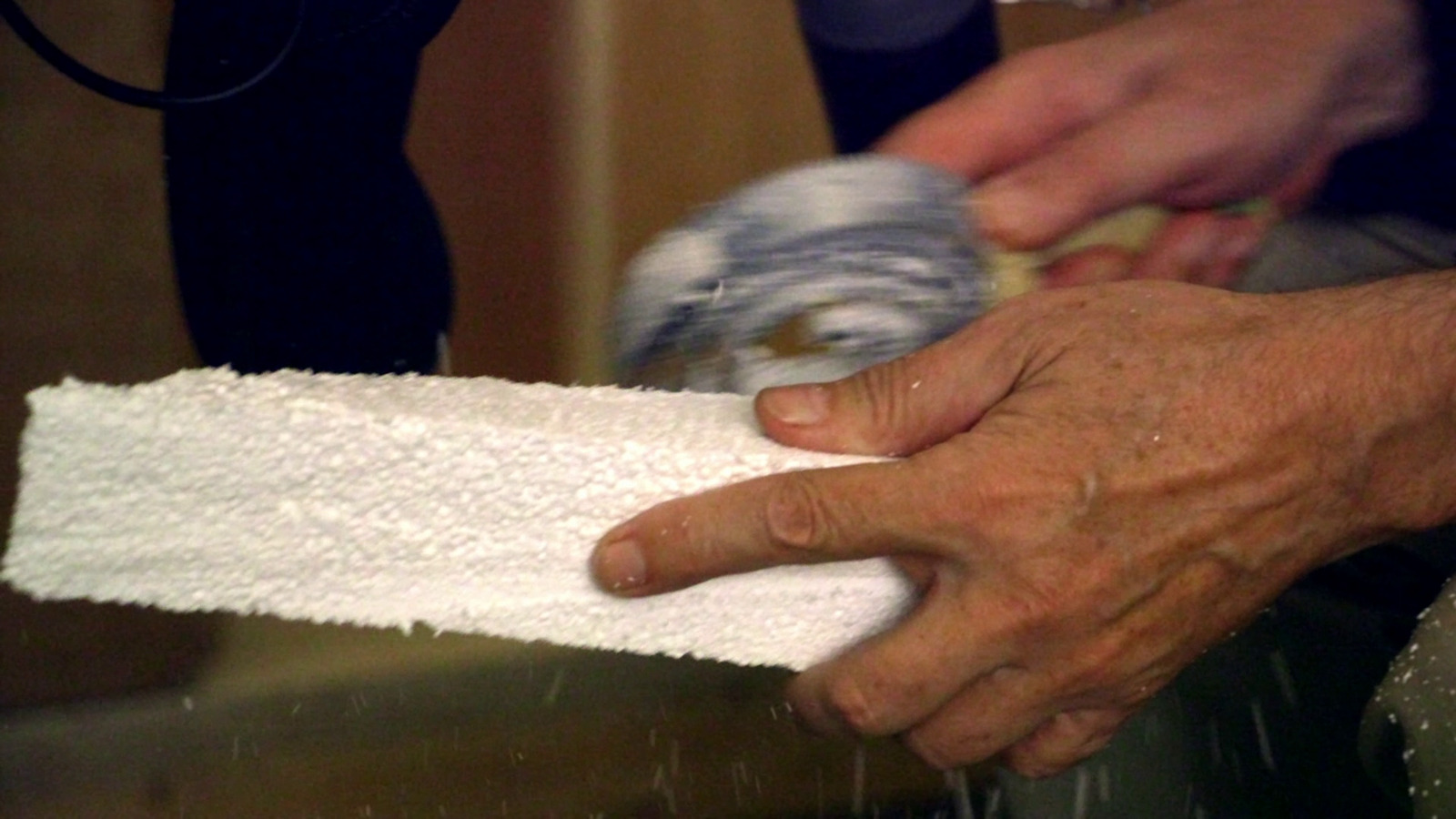
Jeffries’s apparatus begins as a material problem
The early design discussion considers a projecting spout, dials and illuminated smoke against a dark background. Lynch draws the arrangement and works a foam component by hand. The footage gives a concrete companion to his later statement that the object is a machine and that he sculpted its projecting section.
The significance is not that an early sketch explains Jeffries. It shows an impossible encounter being approached through shape, light, shadow and the placement of a component. Those material decisions give the conversation a place to happen while preserving its uncertainty.
Open the apparatus design study · 2 frames
A mistaken identity, composed as a crowded room
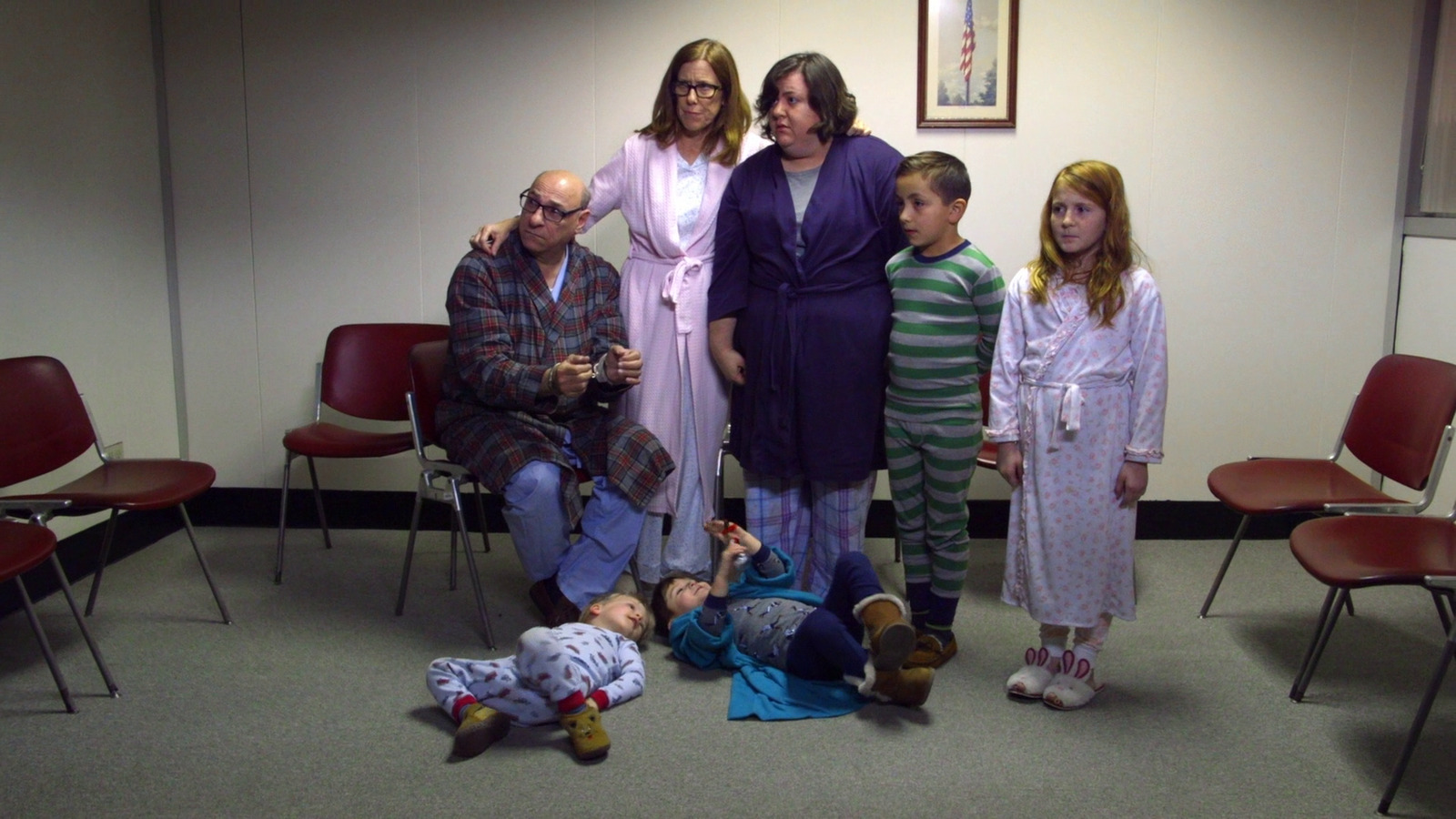
The other Douglas Jones family is arranged for the brief view that appears when the office door opens. Lynch places the adults and children, asks the adults to look toward the person at the doorway and works repeatedly on the children’s unhappy noise. The apparent disorder is constructed within a very exact frame.
The result turns a database match into a human mismatch. The institution has found the right name and assembled the wrong lives around it. Its efficiency is punctured by the crowded room and the sound escaping from it.
The argument’s pace is separate from its eruption
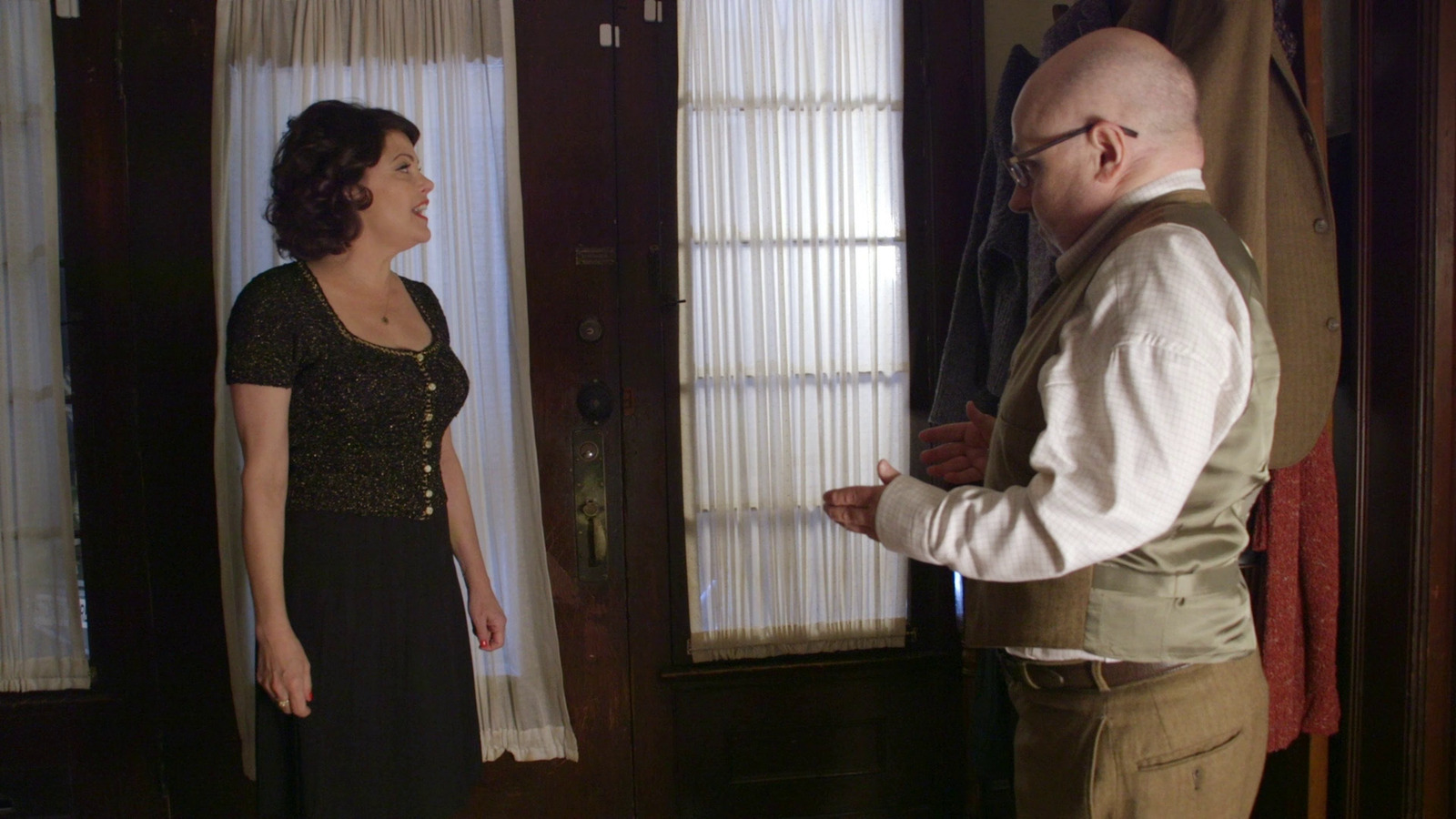
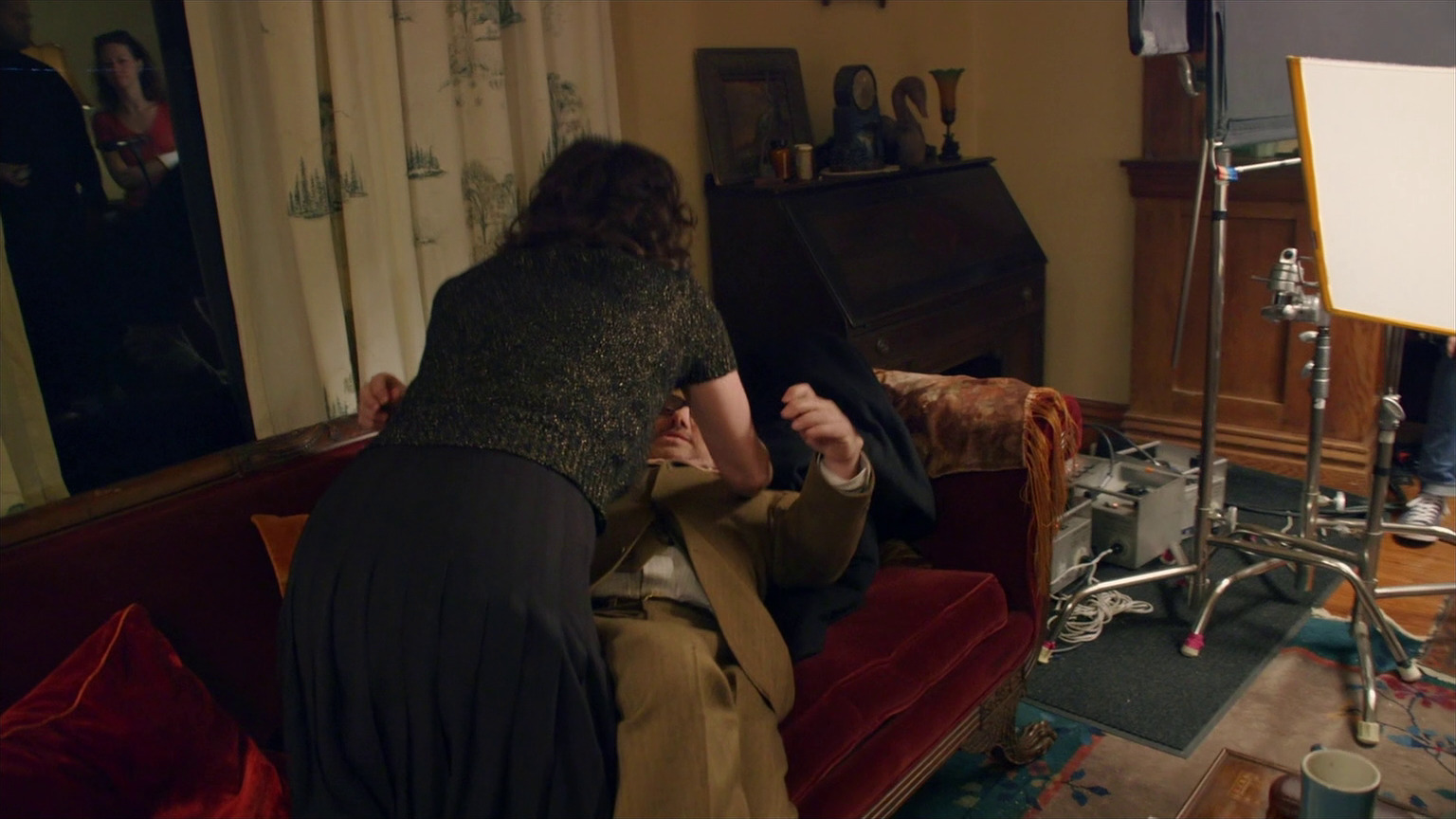
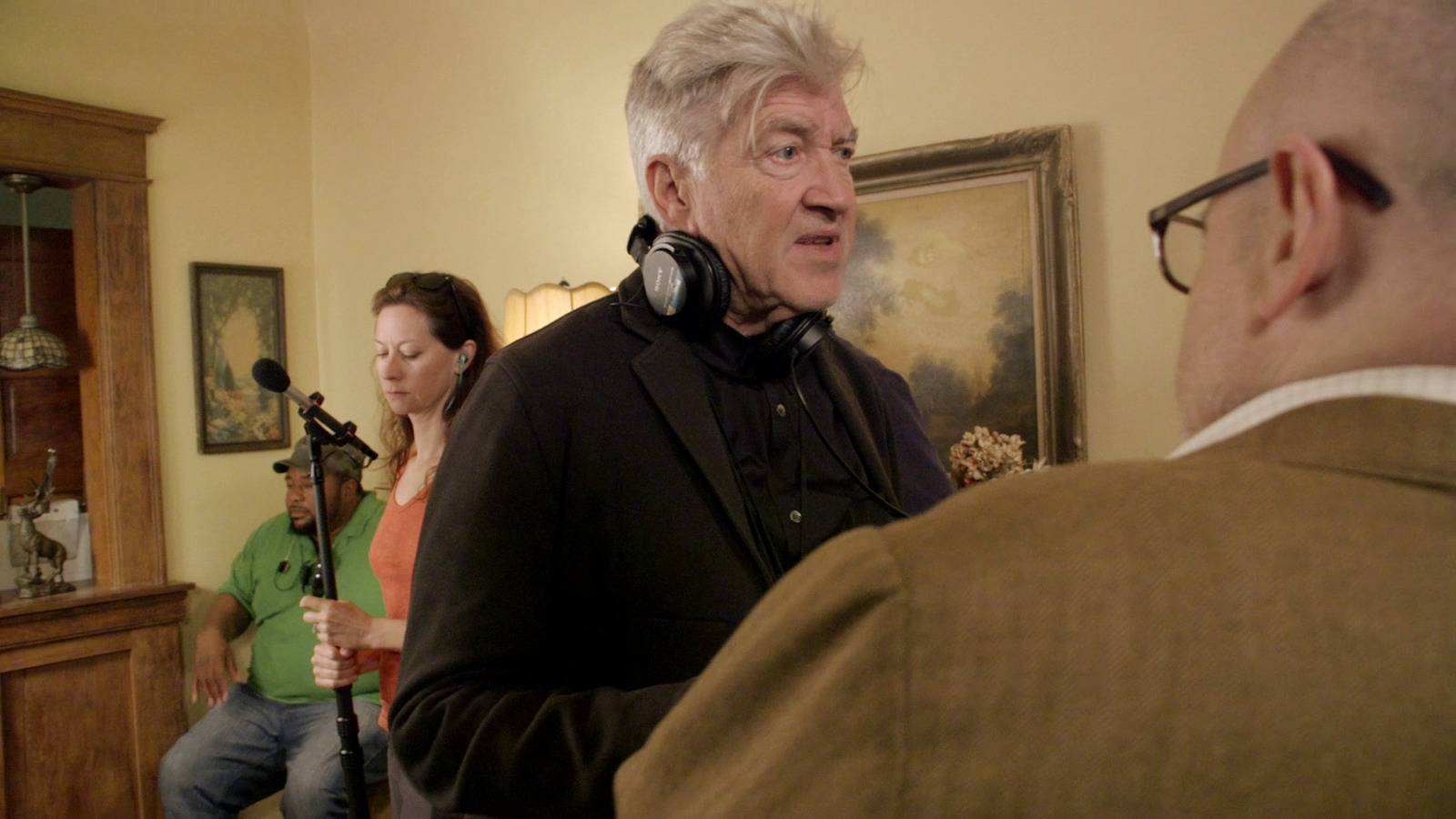
The rehearsal carefully arranges the coats, the front door and Charlie’s return to the couch. Audrey’s long look precedes the accusation that she is seeing a different person. When Charlie sits, her movement toward him must be immediate. The documentary places the violent action inside a sequence of small decisions about whether the pair will leave at all.
Lynch also asks Clark Middleton not to rush his lines as though trying to finish before Audrey interrupts. Charlie must take his time. That adjustment preserves the tension between his measured replies and Sherilyn Fenn’s mounting distress; the physical eruption is prepared separately, with the performers working through the staged contact.
Open the threshold and confrontation study · 3 frames
Inside the final movements: performance and production
Making the telephone booth strange
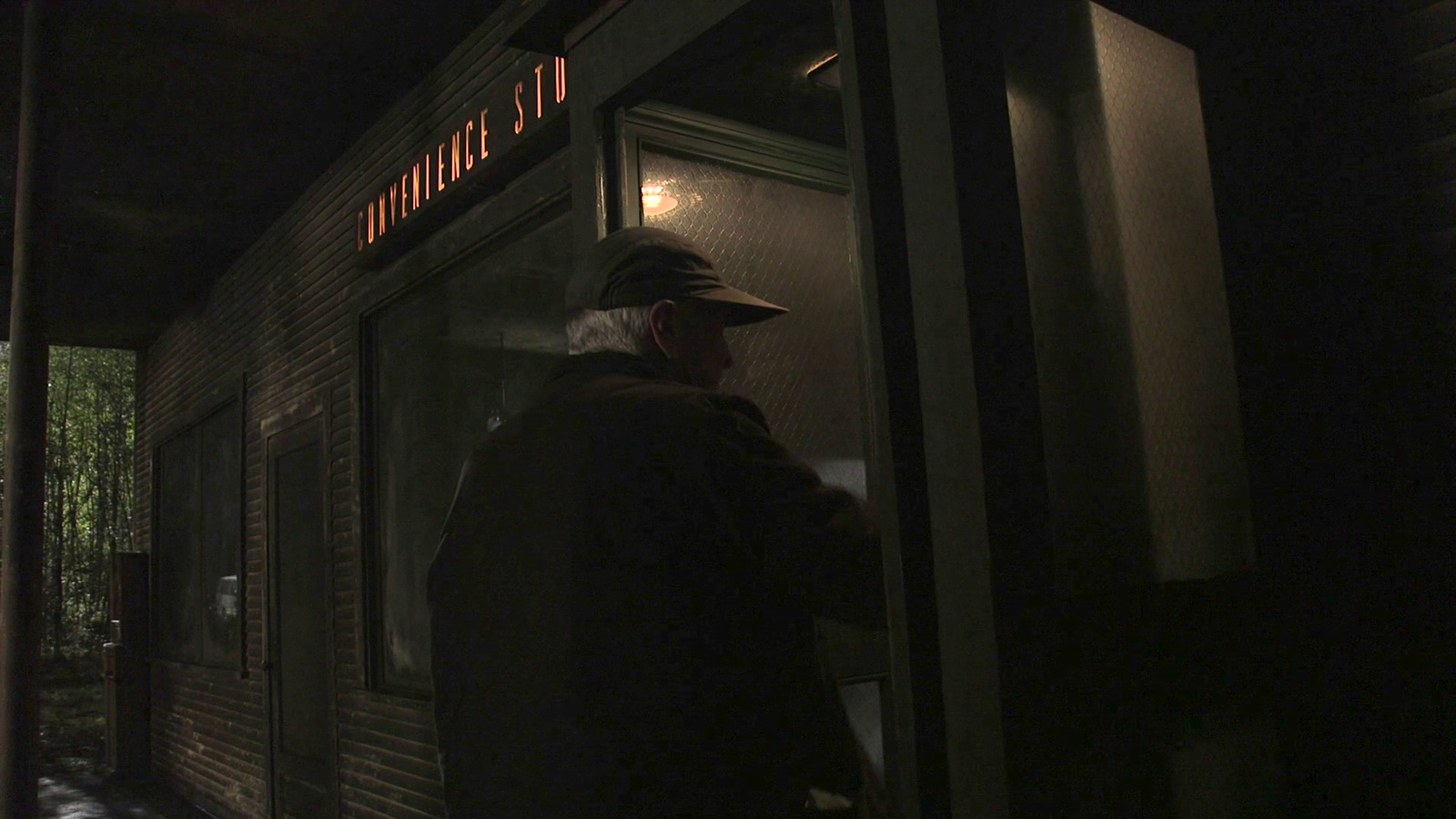
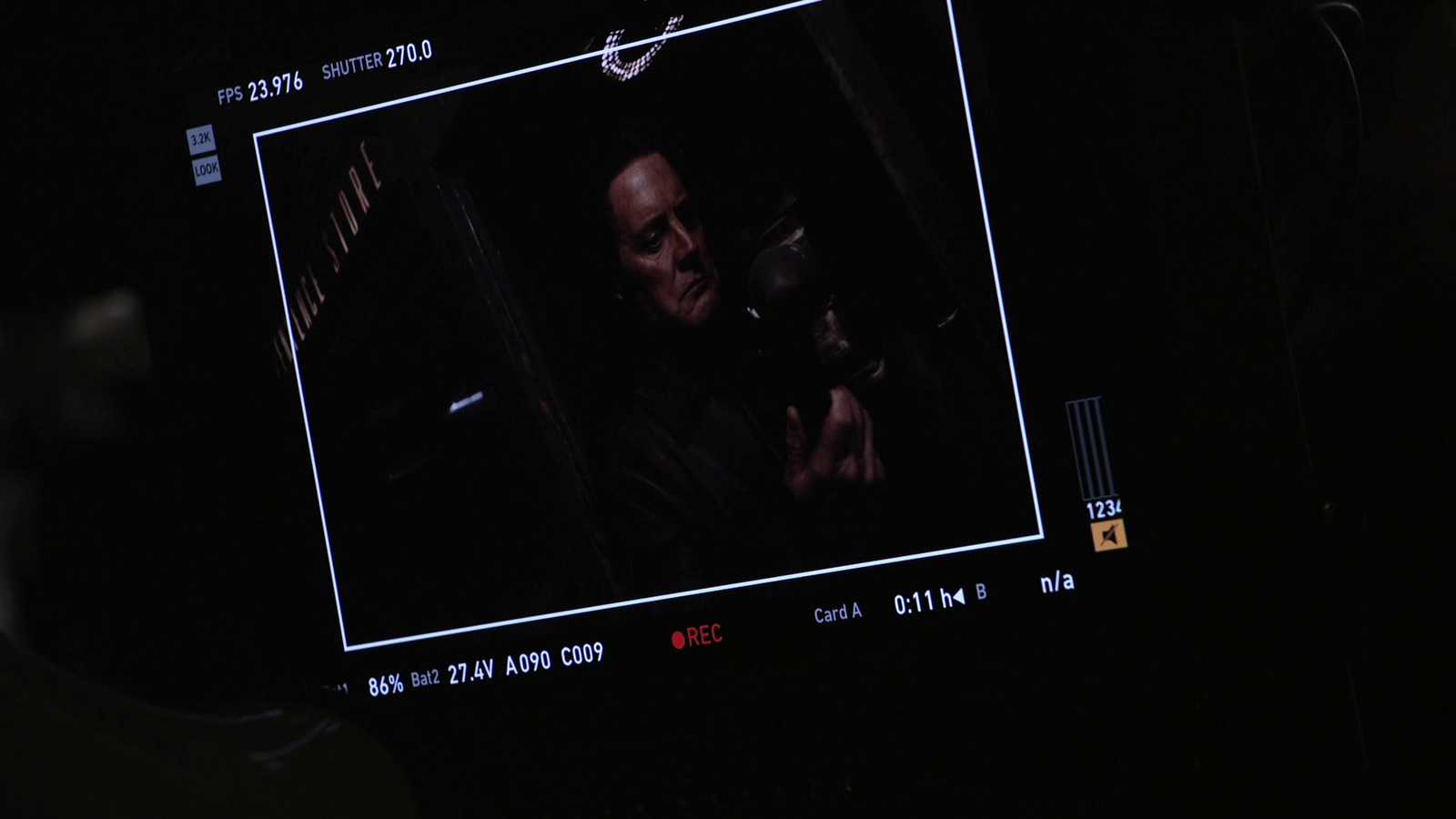
Lynch rejects the initial telephone-booth setup as too ordinary. He asks for alternating bright and shadowed areas, strong streaks of shadow and a very wide lens to distort the space. MacLachlan is given a separate listening action: hear the noise, notice something changing in the receiver, look at it and only then hang up.
The location’s disorientation is thus pursued through lighting, lens choice and the delay between hearing and looking. On stepping outside, Mr. C is directed to be surprised by where he is and by Richard’s presence. The footage supplies a practical account of the transition without resolving how the motel, machine and telephone are connected.
Lighting the booth and watching the receiver · 2 frames
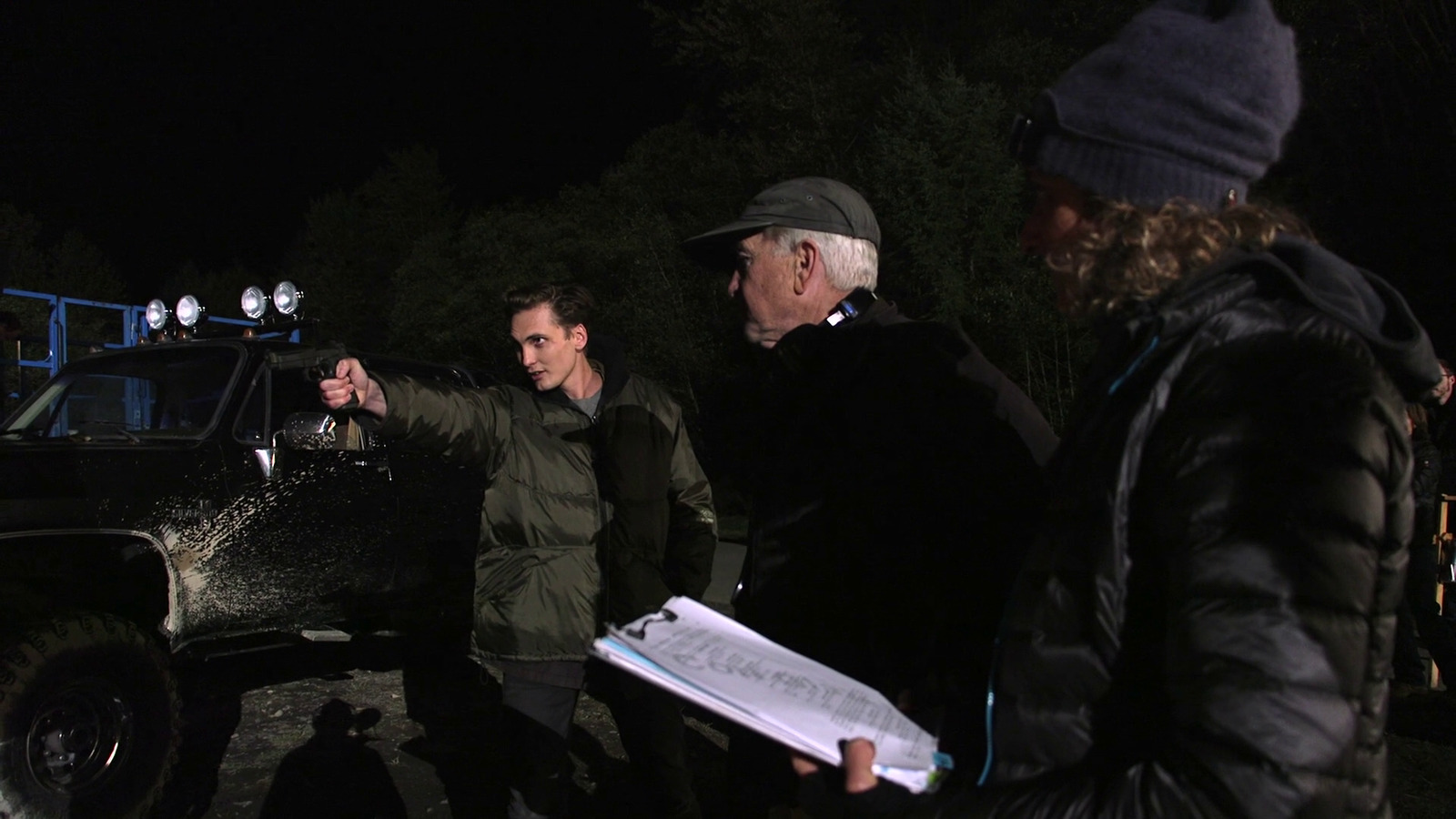
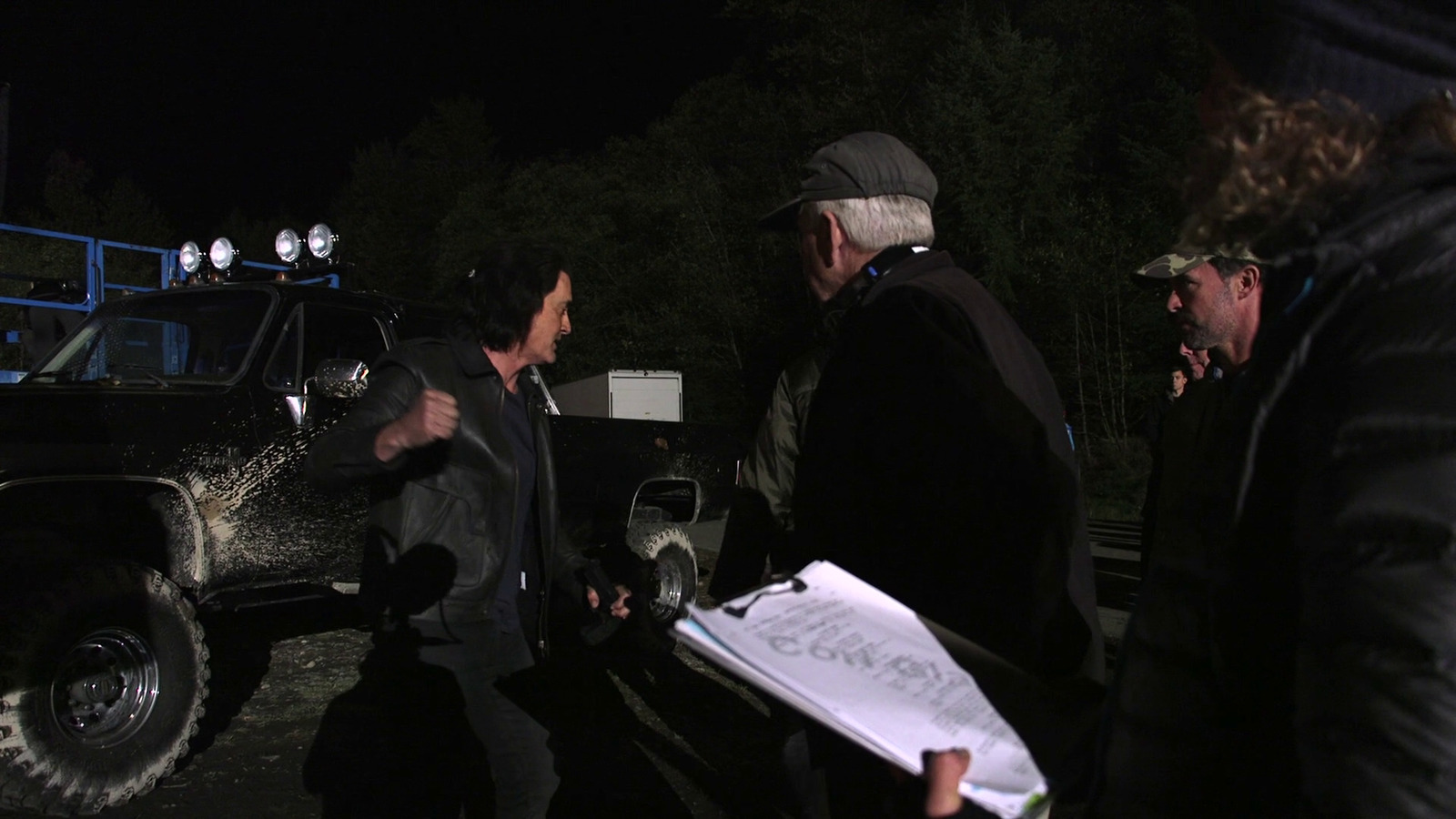
Richard’s threat becomes a controlled physical reversal
The confrontation is rehearsed around unequal confidence. Richard has the gun ready, while Mr. C continues walking towards him. Lynch, MacLachlan and Eamon Farren then compare ways of turning that approach into the takedown; one possibility is rejected because it would unnecessarily bloody Richard’s face.
The later kick is discussed in relation to padding and the performer’s comfort before it is repeated. That exchange is a useful counterpoint to the finished scene’s apparent indifference to injury: its violence depends on cooperation and controlled contact. The rehearsal ends by joining the threat, the move into the truck and the text to Diane into a continuous piece of action.
Rehearsing the change of control · 2 frames
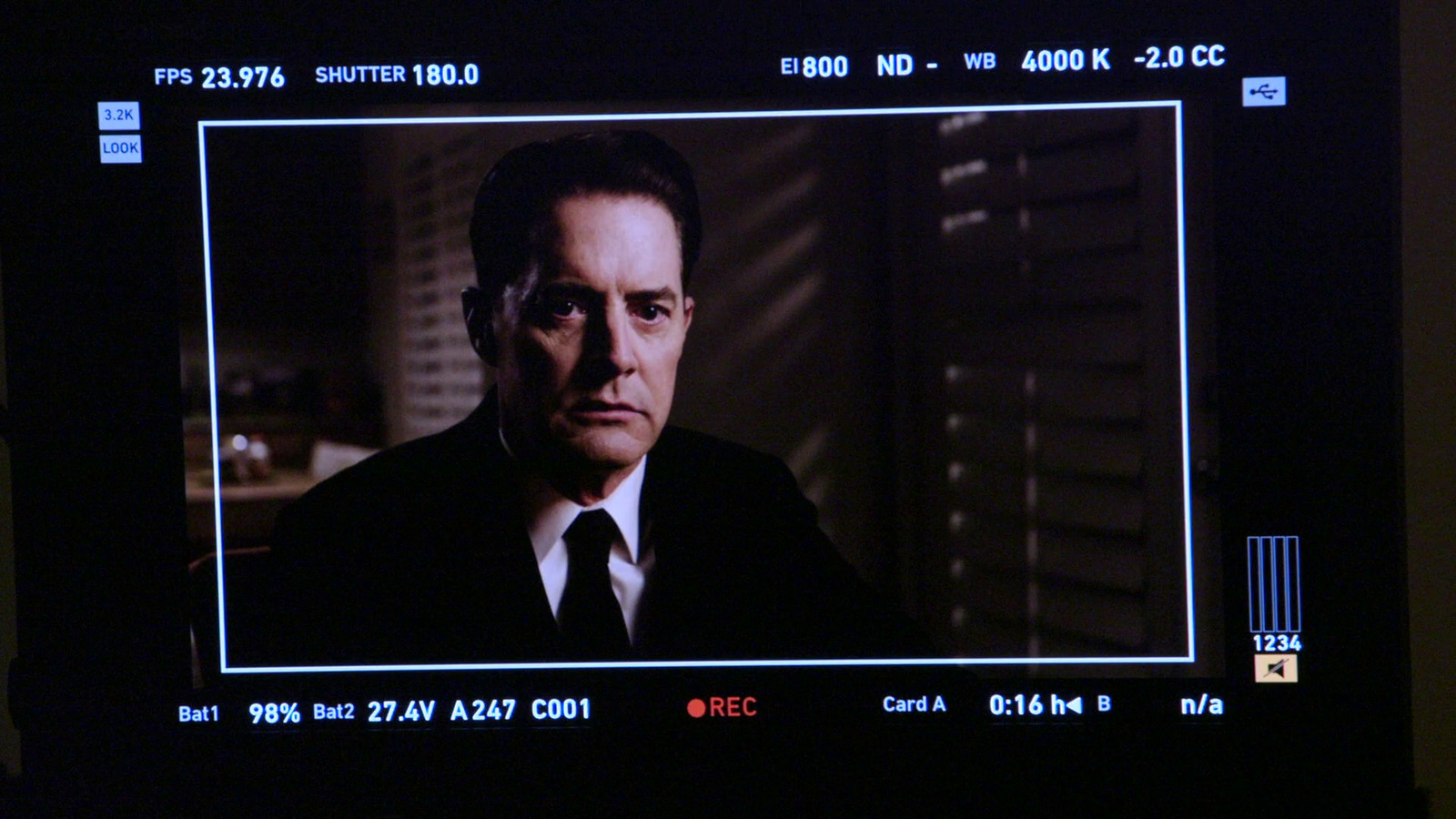
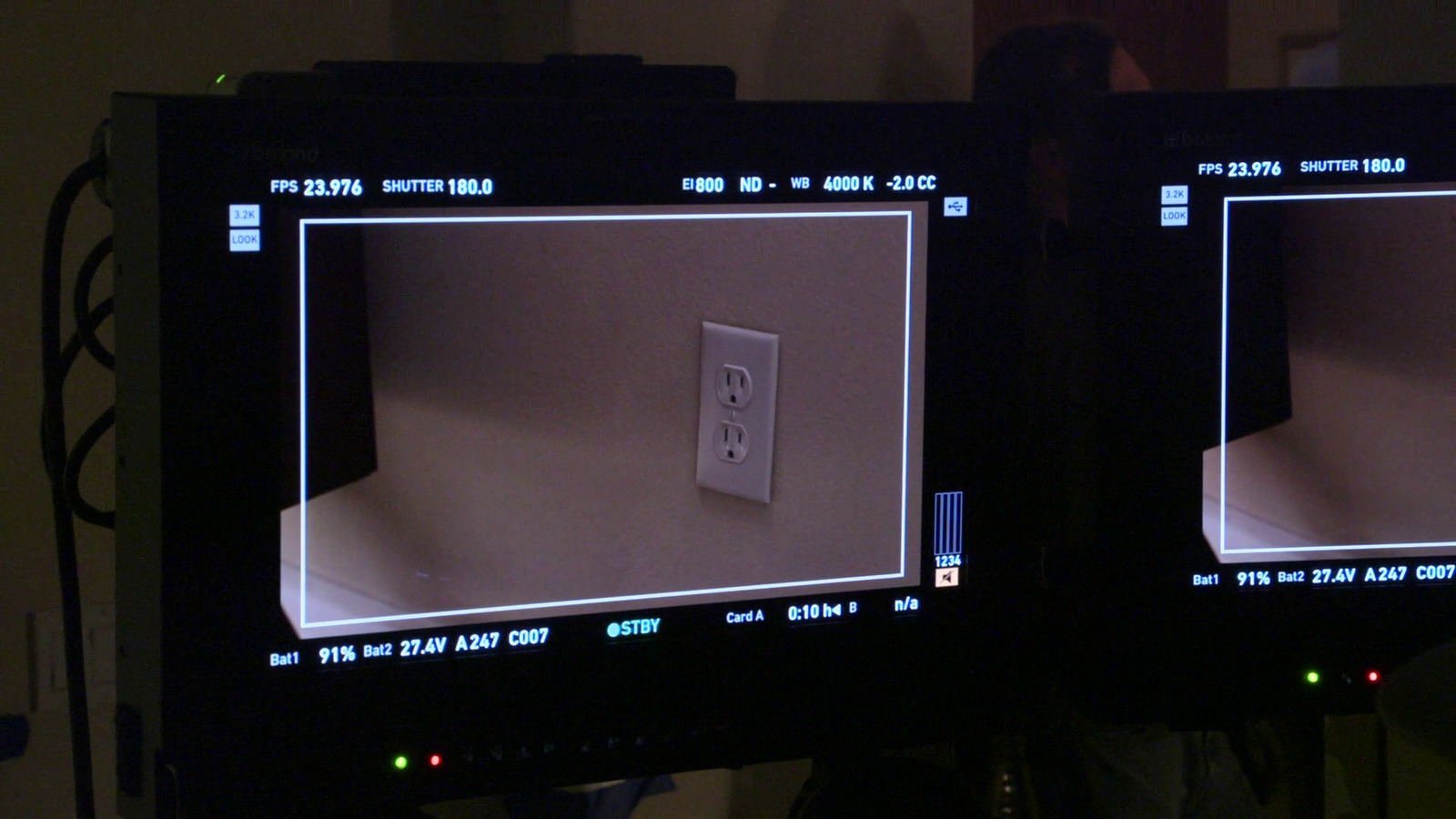
A name, a camera move and an electrical blackout
The domestic sequence is rehearsed from cake and the remote control into the television’s mention of Gordon Cole. Lynch coordinates MacLachlan’s reaction with the camera’s move closer, then slows his gaze down the screen and wall towards the socket. The crawl and electrical insert are prepared as separate views; the crew explicitly confirms that the prop outlet is not live.
Janey-E’s reaction has its own timing. A small kitchen task places her at the right spot; the electrical event turns her towards Dougie, freezes her and provokes the scream. Lynch asks for the lights to fail during that scream, followed by Sonny Jim’s offscreen question after it ends. The scene’s rupture is therefore organized as a sequence of sound, reaction, darkness and a child’s voice, not merely the instant of contact with the socket.
The reaction, the insert and the kitchen cue · 3 frames
Presentation, music and credits
The standalone presentation runs approximately 55:09, including titles. Timings and image locators follow the English-language presentation in Twin Peaks: From Z to A. The reviewed English feature mix and its compatibility track contain the same programme; neither is a commentary. The main and popup menus were checked for additional material. No separate commentary or interview accompanies this part in that presentation.
Music named in the closing credits includes Otis Redding’s “I’ve Been Loving You Too Long,” ZZ Top’s “Sharp Dressed Man,” the Veils’ “Axolotl,” “Summer Night” by Angelo Badalamenti and David Lynch, and Penderecki’s Threnody to the Victims of Hiroshima, with the Warsaw National Philharmonic Orchestra conducted by Witold Rowicki. The final dedication reads “In Memory of Margaret Lanterman”: it names the character. The distinction matters alongside discussion of Catherine Coulson’s own death. [1]
Sources and viewing notes
- Twin Peaks: The Return, Part 15, “There’s Some Fear in Letting Go” (2017), directed by David Lynch; written by Mark Frost and David Lynch. Primary programme, English captions, opening and closing credits; Twin Peaks: From Z to A. Research combines a full-duration caption and image survey with closer checks of selected dialogue, sound transitions, performances and effects. It does not claim uninterrupted critical listening to every channel. Frame locators include the opening titles. Stills retain intentional darkness and the composed image; encoded black bars are excluded where present.
- Daniel Dylan Wray, David Lynch on Bowie and the music that inspired the new Twin Peaks, Pitchfork, 19 September 2017. Lynch’s firsthand account of the Jeffries machine, permissions and replacement voice, and the Otis Redding recording. Interview text consulted.
- Ron Trembath III, Wendy Robie [Interview], Trainwreck’d Society, 7 June 2021. Robie’s interpretation of Nadine and the shovel walk; not an independent statement of fictional canon.
- Vinnie Guidera, I Know Catherine: Mark Frost & Co. Reflect on the Log Lady and David Lynch, Twin Peaks Blog, 20 March 2025. First-person report of the 15 March Ojai panel, including recollections by Frost and Ron Eng. Panel report consulted; the documentary itself is not claimed as viewed.
- Behind the Red Curtain, a film by Richard Beymer; production footage viewed in Twin Peaks: From Z to A, 05:00–08:30. Images and English captions inspected; key speech passages cross-checked where needed. Production observations are distinguished from interpretation of the finished scene.
- Two Blue Balls, directed and photographed by Jason S., in Impressions: A Journey Behind the Scenes of Twin Peaks (2017), viewed in Twin Peaks: From Z to A. Passages: 18:58–20:51. Picture and English captions examined, with targeted speech checks. Rehearsal proposals and production observations are distinguished from interpretation of the finished episodes. Documentary narration and its music are not treated as unscripted statements by Lynch.
- The Polish Accountant, directed and photographed by Jason S., in Impressions: A Journey Behind the Scenes of Twin Peaks (2017), viewed in Twin Peaks: From Z to A. Passages: 04:14–07:24. Picture and English captions examined, with targeted speech checks. Rehearsal proposals and production observations are distinguished from interpretation of the finished episodes. Documentary narration and its music are not treated as unscripted statements by Lynch.
- A Pot of Boiling Oil, directed and photographed by Jason S., in Impressions: A Journey Behind the Scenes of Twin Peaks (2017), viewed in Twin Peaks: From Z to A. Passages: 13:20–20:32. Picture and English captions examined, with targeted speech checks. Rehearsal proposals and production observations are distinguished from interpretation of the finished episodes. Documentary narration and its music are not treated as unscripted statements by Lynch.
- Behind the Curtain: Part 15. Photographed by Jason S.; edited by Jonathan Angus, with editorial assistance by Robert Lay (2019). Viewed in Twin Peaks: From Z to A. Timed passages: 02:02–04:40; 04:43–08:05; 08:15–19:16. Timings refer to the documentary, not the episode. On-set directions and retrospective recollections are distinguished from Lyncharium’s interpretation of the finished scenes.