Lynch as an Actor
Performance / Film, television and voice
A familiar face. A different person in the room.
David Lynch’s acting invites an unusual double attention. We may recognize the filmmaker before the character speaks, yet the scene still needs a specific person: a shy admirer, an FBI superior, a demanding coach, a grieving friend. His presence can carry an entire artistic reputation into another director’s film. It can also become quiet enough to let a scene partner take the centre.
Explore that range through collaborator testimony, performance history, criticism and close studies of the images. From Gordon Cole to Howard and John Ford, Lynch’s roles reveal an actor attuned to the people—and directors—around him.
What changes when we already know the face?
A recognizable actor brings earlier roles into a new performance. Lynch also brings films he directed, interviews we have heard, and an unusually familiar public voice. Recognition can supply warmth or unease before a screenplay has established either. But it is a starting condition, not a complete account of what the actor does.
Paige M. Piper’s television scholarship asks how recognizing Lynch in Louie can lead viewers to project an expected “Lynchian” quality onto the scene. Casting itself changes what we notice. [1]
Ask two questions together. What does knowing that this is David Lynch contribute? And what remains if we describe only the character’s task, attention and relationship to another person? The second question is especially valuable in Lucky, where a famous director’s appearance supports a film organized around someone else.
Zelly and Me: tenderness, testing and trust
Tina Rathborne’s Zelly and Me gives Lynch the role of Willie opposite Isabella Rossellini. The AFI catalogue records Rossellini’s suggestion of Lynch and contemporary reporting about his anxiety at auditioning. It also situates the production in Virginia in 1987, before the film’s 1988 release. This is an early substantial acting role, rather than a claim that Lynch had never appeared on screen before. [2]
In the MUBI Podcast’s 2025 conversation, Rossellini explains the casting in terms of the relationship the film needed. More conventionally forceful actors did not seem right for Zelly’s hesitant romantic life. She recalls proposing Lynch’s sweetness, shyness and insecurity as a better fit, and remembers his nervousness at being tested. She connects that experience with a greater appreciation of actors’ vulnerability in auditions. [3]
Rossellini also describes acting as responding to another person. Their existing trust gave them something usable in the scene. This is her retrospective account of the collaboration, not a transparent record of every rehearsal or of Rathborne’s decisions. [3]
The casting history complicates an image of Lynch as automatically intimidating. Here the desired quality was a form of gentleness. It also reveals a reversal of professional position: the director who evaluates performers becomes a performer being evaluated. That reversal offers a more precise way to discuss his work than simply celebrating a director’s willingness to make a cameo.
How much of Willie’s hesitancy comes through posture and pauses, how much through Rossellini’s responses, and how much through Rathborne’s framing? The casting testimony identifies the intention; a timed scene study must test how that intention becomes screen form.
Gordon Cole: authority that has to listen
Gordon Cole is the principal continuing character in Lynch’s acting career, crossing the original Twin Peaks, Fire Walk with Me and The Return. The role combines institutional authority with difficulties of hearing and communication. A critical guide in Dazed emphasizes the comic force of Lynch’s volume and presence; its older episode totals should not be treated as a final career count. [4]
An FBI superior ought to command reliable information. Cole makes the passage of information itself conspicuous. Repetition, the effort to be heard, and other people’s responses can turn an official exchange into a negotiation over attention. His loudness does not make him all-knowing. That is a more productive starting point than treating every line as the filmmaker speaking directly to the audience.
The character also belongs to an ensemble and a production shared with Mark Frost and many other collaborators. Lynch’s presence within the fiction does not erase the writers, scene partners or directors of individual original-series episodes. Acting and authorship overlap without becoming identical.
Each major phase has its own research route: Season 1, Season 2, Fire Walk with Me and The Return. It will also distinguish the theatrical film from material presented in The Missing Pieces.
Louie: the director becomes the demanding teacher
In the 2012 late-night television storyline of Louie, Lynch plays Jack, the coach preparing the central character for a possible hosting opportunity. Piper’s article examines the larger “Late Show” triptych and names the character Jack Dall; other accounts use Dahl. We retain that spelling discrepancy in the credit investigation rather than pretending the original end titles have been checked. [1]
This is a useful place to distinguish two questions: whether a scene quotes an identifiable earlier work, and whether a viewer simply feels that its atmosphere resembles one. A timed comparison can establish the first; the second remains an interpretation of the viewing experience.
Louis C.K.’s January 2013 ShortList interview supplies a different kind of evidence: the director’s account of Lynch as an exacting, consistent and committed performer. That recollection concerns the work of making the scenes, rather than a theory of their effect on an audience. [5]
The casting establishes a productive imbalance. A performer seeking approval faces someone whose presence already signifies exacting artistic judgement. The character’s task makes that imbalance concrete: teach another person to appear convincing before a camera. The joke can therefore concern performance itself, not simply the novelty of recognizing a guest star.
The role’s place within the wider storyline is part of its meaning.
Lucky: making room for another actor
John Carroll Lynch’s Lucky casts David Lynch as Howard beside Harry Dean Stanton. In his 4:3 interview, the director describes Lynch arriving with prepared choices, asking questions, taking direction and understanding the practical demands of frame, focus and cutting. He also says Lynch came for Stanton. This is an account of an actor collaborating within someone else’s film. [6]
The director’s example concerns Howard’s distress over his missing tortoise, President Roosevelt. He describes forgetting the celebrity and becoming absorbed in the character’s predicament. That is his judgement of the performance, but it makes a useful counterpoint to the assumption that Lynch can only play “David Lynch.” [6]
In a separate BFI interview, John Carroll Lynch credits writers Logan Sparks and Drago Sumonja’s long acquaintance with Stanton and discusses allowing scenes time to breathe. Lucky draws on a person’s world while remaining a constructed fiction. Its apparent ease belongs to writing, direction and an ensemble as well as to the star. [7]
Image study: two people at the bar
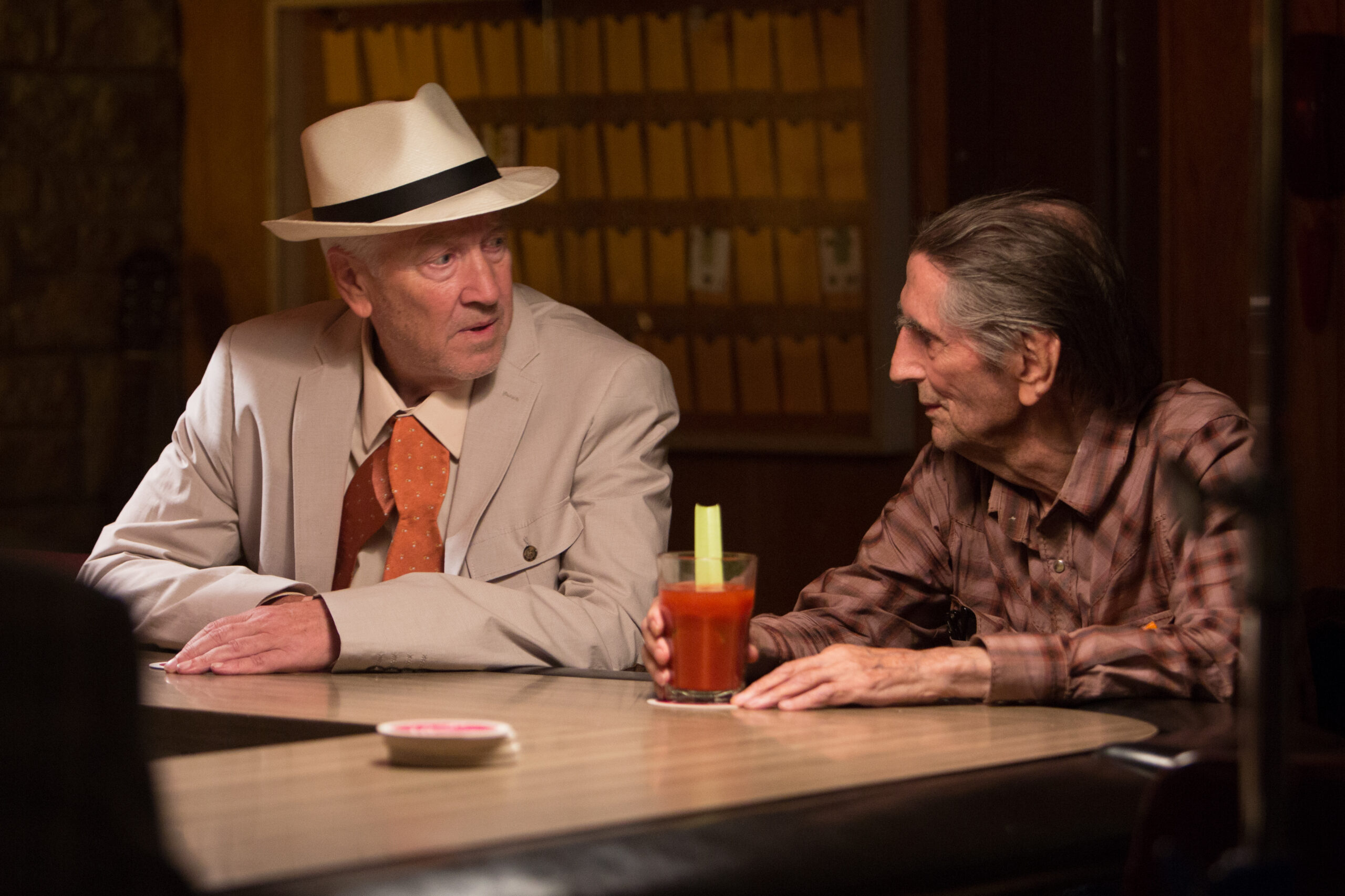
Lynch’s pale suit, hat and orange tie separate Howard from the darker shelves behind him. Stanton’s patterned shirt is closer to the surrounding browns. Their heads turn toward one another, and their hands share the horizontal surface of the bar. The composition makes the exchange between them the principal event.
Howard’s costume makes him conspicuous, yet the image is relational. His face is directed toward his companion; Stanton’s returned attention completes the encounter. The bar top provides a common plane for their bodies and the small objects between them. We can describe this arrangement without claiming to know the timing of the finished scene from one photograph.
The distinction between publicity still and film frame matters. Rosini’s photograph is a credited production image supplied by Magnolia Pictures. It gives us a strong record of performers, costume and setting, while the released film remains the evidence for movement, speech, reaction and cutting. Both deserve their own description.
The Fabelmans: playing a director’s director
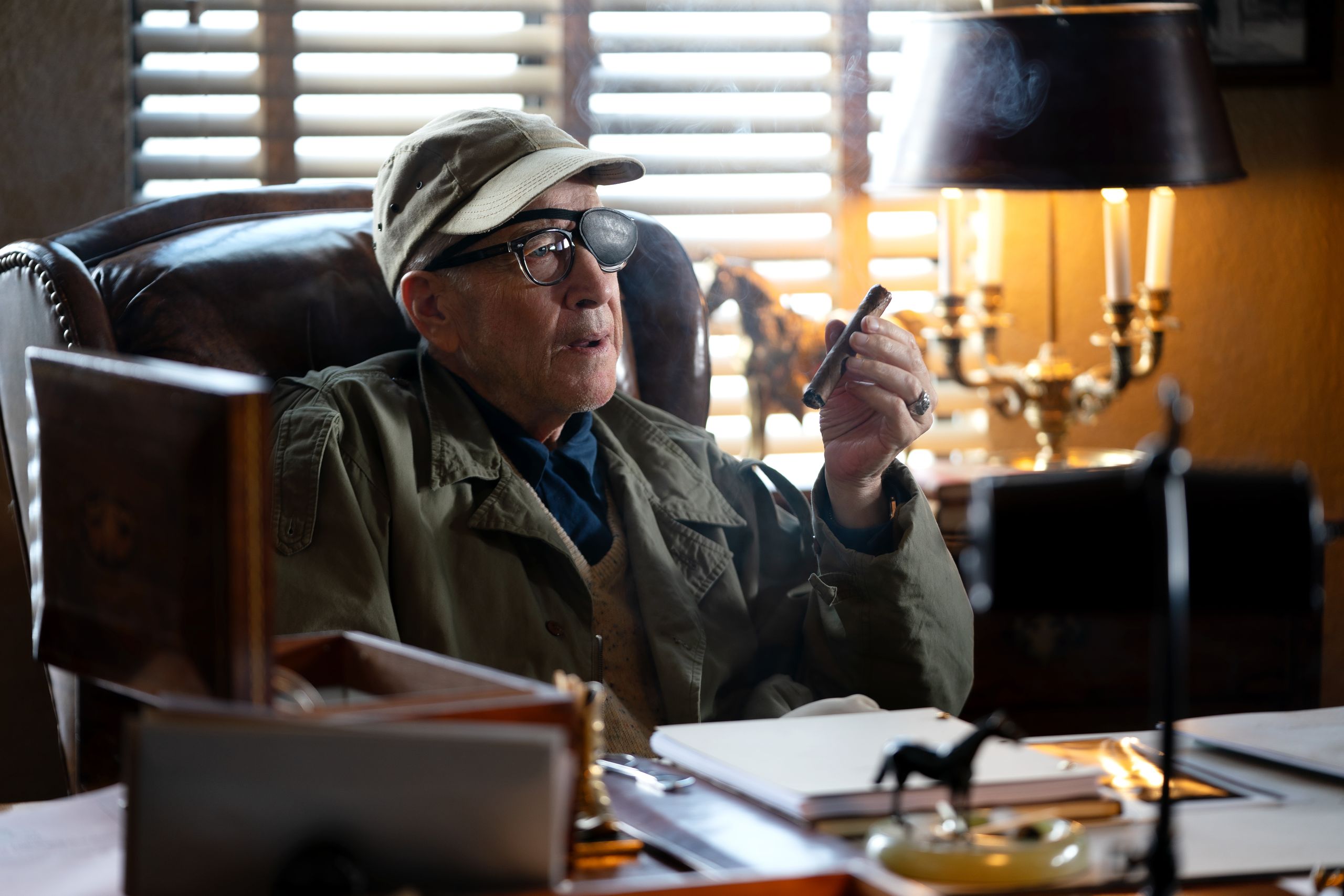
Lynch plays John Ford in The Fabelmans. Anthony Breznican’s report credits Mark Harris with the casting suggestion and Laura Dern with helping persuade Lynch. Spielberg identifies the encounter as drawn from his own experience. [9]
The large desk, worn cap, eye patch and cigar make a compact arrangement of authority. Lynch sits behind objects that separate him from the visitor’s implied position. The bright window behind him exposes the room while the hat and glasses complicate access to his face. The raised cigar places emphasis in the hand as well as in the expression.
Compared with the Lucky photograph, this is a different relation to another person. The bar image offers a shared surface and reciprocal attention. The Ford image places a barrier in the foreground and gives Lynch the dominant seat. Costume alone does not account for that change; setting, camera position and the scene’s social situation participate.
Casting a celebrated filmmaker as another celebrated filmmaker also creates a historical relay. Spielberg’s recollection becomes a written scene, an actor’s interpretation and a photographed performance. Recognition of Lynch can intensify the encounter, but Ford remains a character made for this particular film.
Voice, small roles and the public persona
Voice acting removes the familiar face while retaining other signals of identity. In a 2010 interview, The Cleveland Show co-creator Mike Henry identifies Lynch as the voice of Gus. That direct production testimony is a firmer foundation for the credit than a compilation of impressions. [10]
DumbLand offers a different situation: Lynch’s vocal performance belongs to a work he also made. The contrast between author-performer and invited voice actor is more useful than placing every disembodied appearance in one undifferentiated cameo list. The Short Films and Online Works dossiers provide the production and platform contexts.
Roger Luckhurst’s review of What Did Jack Do? describes Lynch as a detective conducting an interrogation and reads the film through absurdist dialogue and literary precedents. He also discusses the voiced monkey and the relation between the two figures. Those critical connections are arguments to test against the short, not proof of a single intended allegory. The review distinguishes its earlier festival life from the January 2020 Netflix release. [11]
Appearances as himself need another category again. The weather reports, interviews and introductions construct a public mode of address; they are not automatically fictional acting roles. See Online Works for that continuing relationship with an audience. Keeping the categories separate helps us notice when a film deliberately invites them to overlap.
A selected role guide
Twelve roles trace Lynch’s work across film, television and animation. Dates distinguish a work’s first presentation from later releases.
| Work | Performance | Research route |
|---|---|---|
| The Amputee (1974) | Nurse | Early shorts; compare the two filmed versions. [4] |
| Dune (1984) | Spice worker | Dune dossier; brief embodied cameo. [4] |
| Zelly and Me (1988) | Willie | Rathborne’s film; AFI catalogue and Rossellini’s account. [2] |
| Twin Peaks (1990–91; 2017) | Gordon Cole | Series dossiers; continuing role across distinct productions. |
| Fire Walk with Me (1992) | Gordon Cole | Film and supplementary material. |
| Nadja (1994) | Morgue receptionist | Michael Almereyda’s film; cameo distinct from Lynch’s producing association. [4] |
| DumbLand (2002) | Character voices | Animation and voice work. [4] |
| The Cleveland Show (from 2010) | Gus, voice | Henry’s contemporary interview; episode-level audit pending. [10] |
| Louie (2012) | Jack Dall / Dahl | Late-night television storyline; spelling to be checked against credits. [1] |
| Lucky (2017) | Howard | Director testimony and distributor’s credited imagery. [6] |
| What Did Jack Do? (2017; Netflix 2020) | Detective | Short-film dossier; distinguish presentation dates. [11] |
| The Fabelmans (2022) | John Ford | Spielberg’s recollection, dramatized through Lynch’s performance. [9] |
Between recognition and disappearance
The sources suggest a useful disagreement. The Dazed guide foregrounds Lynch’s recognizable persona. Piper examines how that recognition changes a viewer’s interpretation. John Carroll Lynch instead recalls the moment when a viewer can stop seeing the celebrity and attend to Howard. These positions need not cancel one another: they describe different ways a performance can work. [4] [1] [6]
Lynch’s acting is best approached as a set of relationships. Rossellini describes trust and shyness; Louis C.K. describes disciplined work; John Carroll Lynch describes preparation and responsiveness. The photographs show how costume, a shared surface or a desk can organize those relationships before a line is heard.
Lynch’s performances reward attention to listening as much as speaking, uncertainty as much as authority, and the person on the other side of the exchange. A performance is larger than the recognisable face that first attracts us to it.
Explore further
Follow the sources below, explore the museum collection, or continue through the Reading Room. New archival discoveries and contributions enrich the record of Lynch’s work.
Sources and further reading
Interviews, production records, criticism and image sources behind this dossier.
- Paige M. Piper, Synchronic Seriality (SERIES 1.2, 2015, pp. 159–168) ↗Abstract, Lynch/Louie discussion on p. 165 and implications passage inspected in the journal PDF. The article’s triptych discussion is not an episode-by-episode cast audit. It spells the character Dall.
- AFI Catalog: Zelly and Me (1988) ↗Willie credit and historical notes read, including cited 1987–88 production/casting reports.
- MUBI Podcast: Isabella Rossellini Wears Blue Velvet (2025) ↗Published transcript’s Zelly and Me casting, audition and scene-partner exchange read. Audio recording not independently checked; recollection distinguished from contemporary records.
- Nick Chen and Halima Jibril, A Guide to David Lynch’s Acting Career (Dazed) ↗Relevant role entries and persona argument read. Page dated 17 January 2025 revises a 2016 article and retains outdated future tense and totals. Used selectively, not as a definitive filmography; its spelling is Dahl.
- Louis C.K. interview (ShortList, 15 January 2013) ↗Passage on directing Lynch read. Creator testimony about working practice; complete episodes and on-set material not reviewed in this pass.
- Jeremy Elphick, Lucky: an interview with John Carroll Lynch (4:3, 1 October 2017) ↗Published Locarno roundtable read, especially the David Lynch preparation/direction exchange. Other journalists’ questions are marked by the publication; statements remain the director’s assessment.
- Lou Thomas interviews John Carroll Lynch (BFI, 12 September 2018) ↗Writers/Stanton relationship and directing/rhythm passages read. Fictional Lucky is not treated as an unmediated Stanton autobiography.
- Magnolia Pictures: Lucky press kit ↗Official publicity photograph 4 and its caption inspected: David Lynch and Harry Dean Stanton; © Stefania Rosini, courtesy Magnolia Pictures. A production photograph, publicity photography.
- Anthony Breznican, Lynch’s cameo in The Fabelmans (Vanity Fair, 14 February 2023) ↗Casting testimony and publicity still inspected; complete film/script comparison pending.
- Mike Henry interview (Chortle, 7 October 2010) ↗Gus casting passage read. Provides a contemporary participant credit; does not establish a complete appearance count.
- Roger Luckhurst, In What Did Jack Do?, David Lynch debriefs a monkey (Sight and Sound) ↗Review read; originally 21 January 2020, updated 7 January 2021. Literary comparisons and vocal identification remain attributed criticism. Festival/Netflix dates kept distinct; speculation about future projects not adopted.
Another doorway
Continue exploring
Television
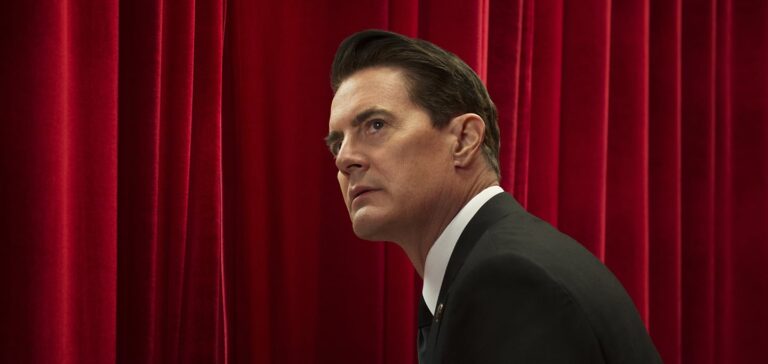
Twin Peaks
Explore Twin Peaks: viewing order, Lynch and Frost, Laura Palmer, music, photography, The Return, pilot versions and companion books.
Short films
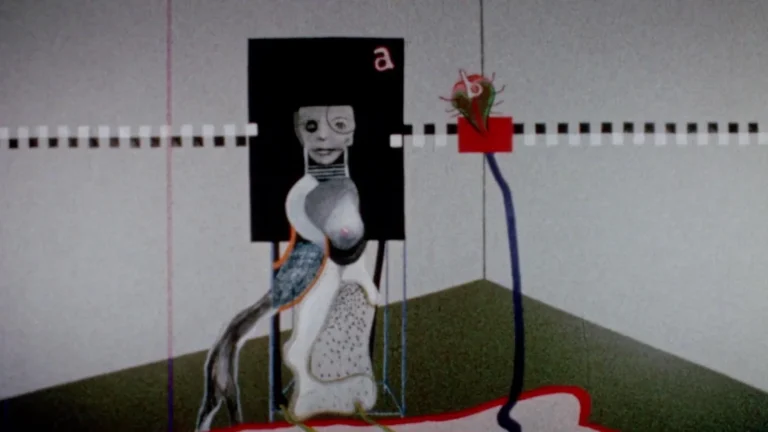
Short Films
Explore David Lynch’s short films, from The Alphabet to Rabbits and Fire, with production histories, collaborators, sound studies and viewing guides.
Research guides
Unmade & Unfinished Projects
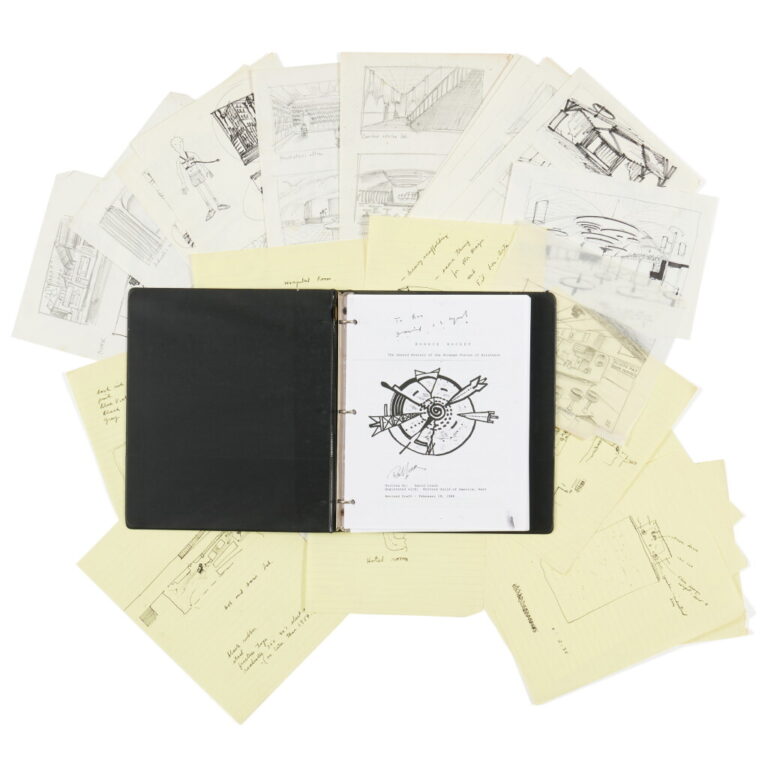
Explore David Lynch’s unmade projects: Ronnie Rocket, One Saliva Bubble, Dune II, Snootworld and Unrecorded Night, through scripts, drawings and collaborators.
Image credits and sources accompany each linked guide.