Music
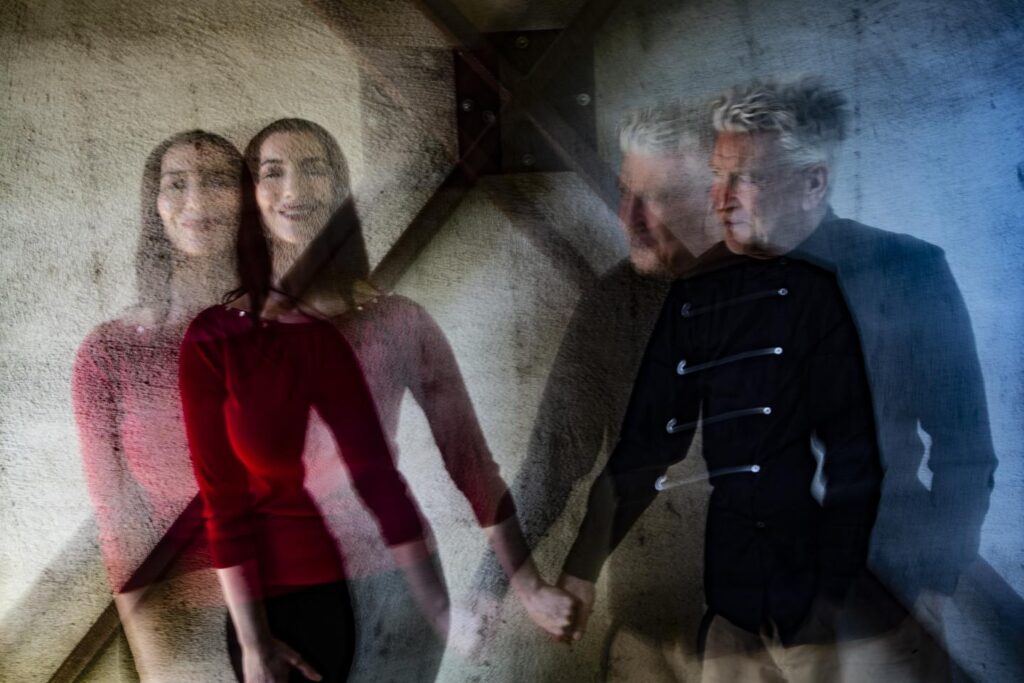
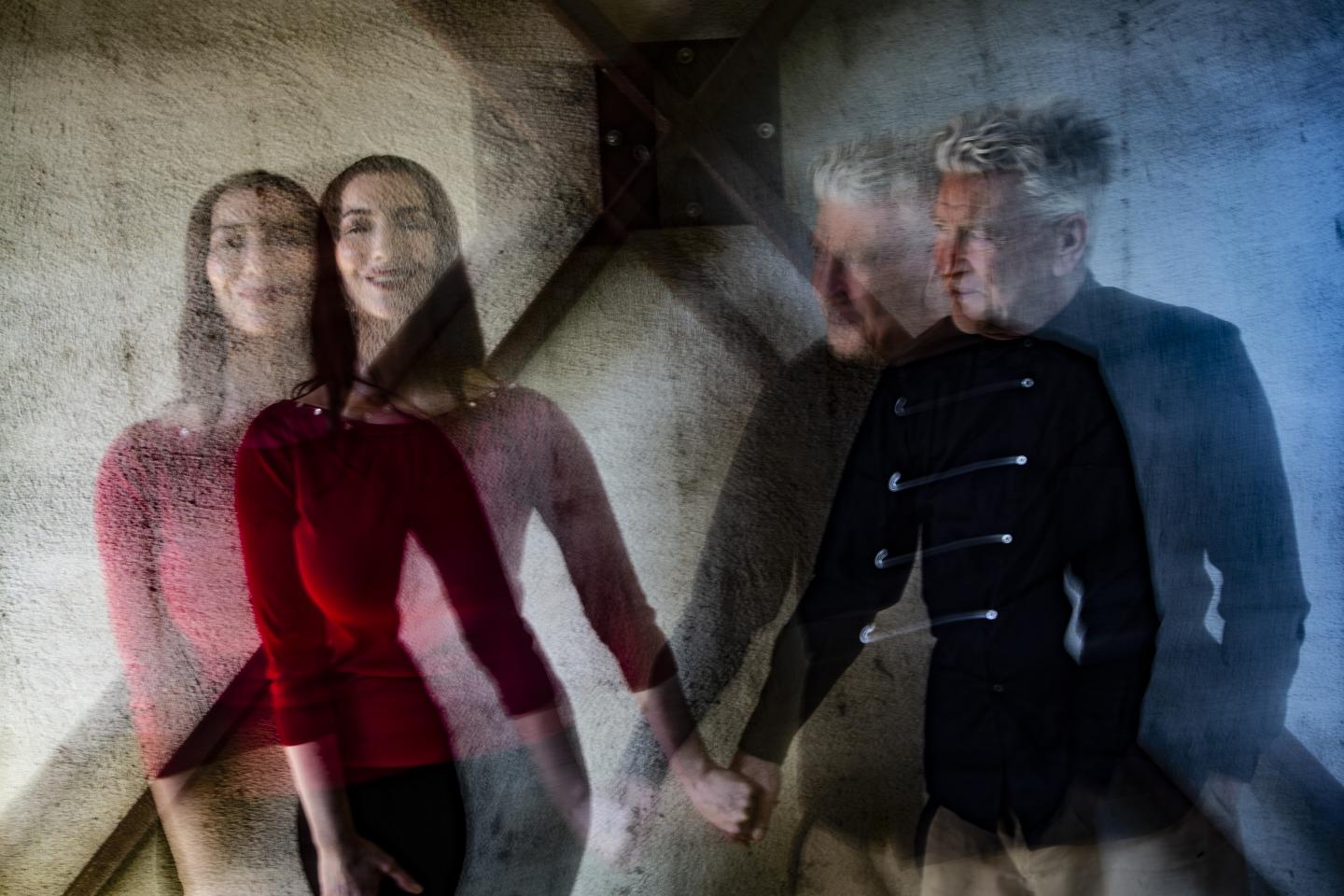
Beyond the frame / Records, voices and collaboration
Follow the voice. Then listen to the space around it.
Lynch’s music is a history of people working together: a singer finding a melody, a composer responding to an image, an engineer building a sound, an editor discovering a new shape inside a performance. This dossier follows those relationships across albums, theatre, film and the recording studio.
A guide to the records and their making. Label records, participant interviews and period documents support the histories below. Listening prompts are invitations, not reports of a complete listening audit.
Choose a listening route
The song
Voice, words and melody
Start with Julee Cruise’s Floating Into the Night, then follow the later studio partnership with Chrystabell. Ask how a performance changes when a voice becomes part of an arrangement, an edit or a remembered film scene.
Begin with Julee Cruise →The experiment
A studio as a place to discover
Begin with Polish Night Music and Thought Gang. Move into the sound of The Air Is on Fire and the accounts of John Neff and Dean Hurley. Follow what happens to a sound after it is recorded.
Begin with the collaborations →The official pages linked below provide release information and available listening options. Some are stores; the research remains here. A label’s account is valuable evidence of how a record was presented, but its praise is not a substitute for an independent history of reception.
Julee Cruise: give the singer and the album their own space
In his 2017 Criterion interview, Badalamenti recalls that Cruise initially suggested other singers for “Mysteries of Love”: her own established style was more forceful. Their work developed the quieter register that the song required. The account makes her sound an achieved performance, not an innate effect waiting to be discovered. He also describes composing to Lynch’s unusual lyric and requests for an expansive, floating mood. The Blue Velvet interview study connects this recollection with his earlier account in Mysteries of Love.
Floating Into the Night appeared in 1989. Sacred Bones identifies Angelo Badalamenti and Lynch as producers and Badalamenti as the composer behind its music. Its ten-song sequence begins with “Floating” and ends with “The World Spins”; “Falling” and “Mysteries of Love” sit within that larger album. The linked Sacred Bones release is a 2023 reissue, not the album’s birth date. Album record and track list
A listening route: begin with the sequence rather than a collection of familiar television moments. Notice the entrance of a voice, what surrounds it and what the following song does to the mood. Then return to a scene you associate with one song. A screen image fixes a situation around a performance; listening away from the screen can loosen that association. Neither encounter cancels the other.
The Voice of Love followed in 1993. Its label history places Cruise, Badalamenti and Lynch back in the studio in 1992, combining new compositions with instrumental material from Fire Walk with Me and Wild at Heart developed into songs. The 2018 edition is a later release. The published sequence includes “Questions in a World of Blue” and “The Voice of Love.” The Voice of Love
That history makes the direction of adaptation important. A piece does not always begin as a song waiting for a film. An existing instrumental can become the setting for a new vocal performance. Establishing exactly what changed requires the relevant score recording, song version and credits—not just a shared title.
Three Demos: a comparison with a concrete question
The 2018 Three Demos release contains early versions of “Floating,” “Falling” and “The World Spins.” Its label describes a spoken opening to “Floating” that was omitted from the finished album. This supplies a specific comparison to make rather than a vague claim that the demo is more “raw.” Demo record
First establish the editions and compare the introductions. Then listen for arrangement, pacing and the relation between voice and accompaniment. A simpler arrangement need not reveal a more authentic performance; it reveals a different stage of work. The introduction’s omission is currently reported from the label, pending a synchronized listening check.
Industrial Symphony No. 1: stage event, then video object
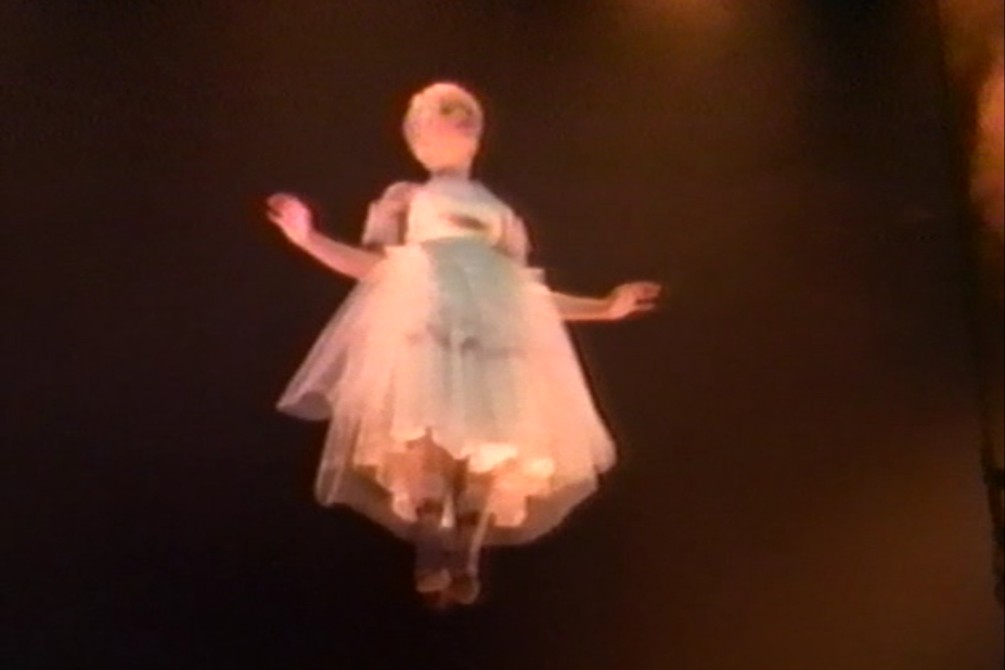
A period document. A BAM advertisement in the September 1989 Down Beat issue places Industrial Symphony No. 1 in the New Music America opening-night programme for Friday 10 November. It credits Lynch and A. Badalamenti as producers and Julee Cruise’s vocals, within a three-theatre music-theatre round robin. This records the announced programme, not every detail of the performance as realized. Advertisement, scan page 7
A second document follows the work into domestic circulation: Billboard’s chart for the week ending 20 October 1990 lists David Lynch—Industrial Symphony No. 1 as a new entry at number 31 in videocassette sales, with Warner Reprise Video catalogue number 3-38179 and Cruise as principal performer. The chart documents an available video and its position that week; it does not establish the exact first sale date, lifetime sales or a critical consensus. Billboard, printed p. 50
Why the distinction matters: a live event distributes attention across a stage and auditorium. A video directs attention through framing, cutting and a recorded soundtrack. Studying the video can reveal that version, but cannot on its own reconstruct every sightline, acoustic balance or moment experienced by the audience.
BAM’s Hamm Archives provides a route into the performance’s stage history and institutional record. BAM Hamm Archives
Asymmetrical: John Neff and the work behind the atmosphere
In Matt Fagerholm’s 2022 interview, John Neff recalls designing the technical system for Lynch’s studio and moving into recording and mixing there. He identifies Jocelyn Montgomery’s Lux Vivens as an early project. In his account, Lynch’s guitar initially supplied sound textures, while the studio encouraged further musical experiments. Neff interview, opening exchanges
For BlueBOB, Neff describes recording drums, playing along with them, selecting useful passages from longer improvisations and shaping those into songs. Lynch then supplied lyrics which Neff set to a melody and sang. This is a participant’s later account of the process, not a session log. The shared 2001 record should remain distinct from the later albums billed as Lynch’s solo work. Neff on BlueBOB · BFI discography context
The studio is doing more than documenting a finished composition. Recording creates material that can be replayed, selected and rebuilt. A musician’s contribution can therefore include a spontaneous phrase, the judgement to keep it, or an edit that creates its eventual place. “Collaboration” becomes useful when it names these different acts.
When an album recording enters a film
Neff says “Mountains Falling” appears in Mulholland Dr. without vocals, while the soundtrack CD includes them. That is a precise version claim to test against identified releases. It demonstrates why an album, a soundtrack disc and a film’s complete sound mix need separate records. Neff, Mulholland Dr. song discussion
Explore the Mulholland Drive dossier for the music’s place within the film’s sound world.
The solo records still have collaborators
Crazy Clown Time (2011) is identified by Sacred Bones as Lynch’s solo debut. The Big Dream followed on 16 July 2013. Its record credits Dean Hurley with engineering, production and instrumentation at Asymmetrical Studio. Lynch wrote eleven of the twelve main tracks; the exception is Bob Dylan’s “The Ballad of Hollis Brown.” The Big Dream release record
The described double-LP package adds a seven-inch of “I’m Waiting Here,” featuring Lykke Li, with an etched reverse. That is a physical edition detail. It should not be silently counted as part of every release’s main sequence. A catalogue number, format and track list help distinguish an album from one particular package. Edition details
A listening question: how close does a vocal sound, and what creates that impression? Separate the delivery from echo, doubling, distortion and its level against other sounds. A singer can seem vulnerable, comic or threatening without those qualities being direct biographical disclosures. The recording offers a performance; the technical choices help stage it.
A fuller account of Crazy Clown Time needs its own original credits and release documents. It is retained here as a chronological landmark, with that work explicitly carried forward rather than filled out from the later album’s publicity.
Two experiments with different histories
Polish Night Music: a collaboration, not a film soundtrack
Lynch and pianist-composer Marek Zebrowski’s Polish Night Music first appeared in 2007; the linked Sacred Bones edition is dated 13 November 2015. The label connects their meeting at Camerimage in Łódź with subsequent experiments in Lynch’s Los Angeles studio. Its four pieces are titled around a city back street, a factory landscape, interiors and a woman on a dark street corner. Label history and track list · Original-release context
A listening route: these titles supply locations before a listener hears a note. Read one, then listen for what makes you imagine distance, enclosure or movement. On a second pass, put the title aside. The comparison asks what the sound does and what the words have encouraged you to supply. The label’s imagery is a frame for the music, not evidence that a particular scene was recorded at a named factory.
Thought Gang: recorded earlier, released later
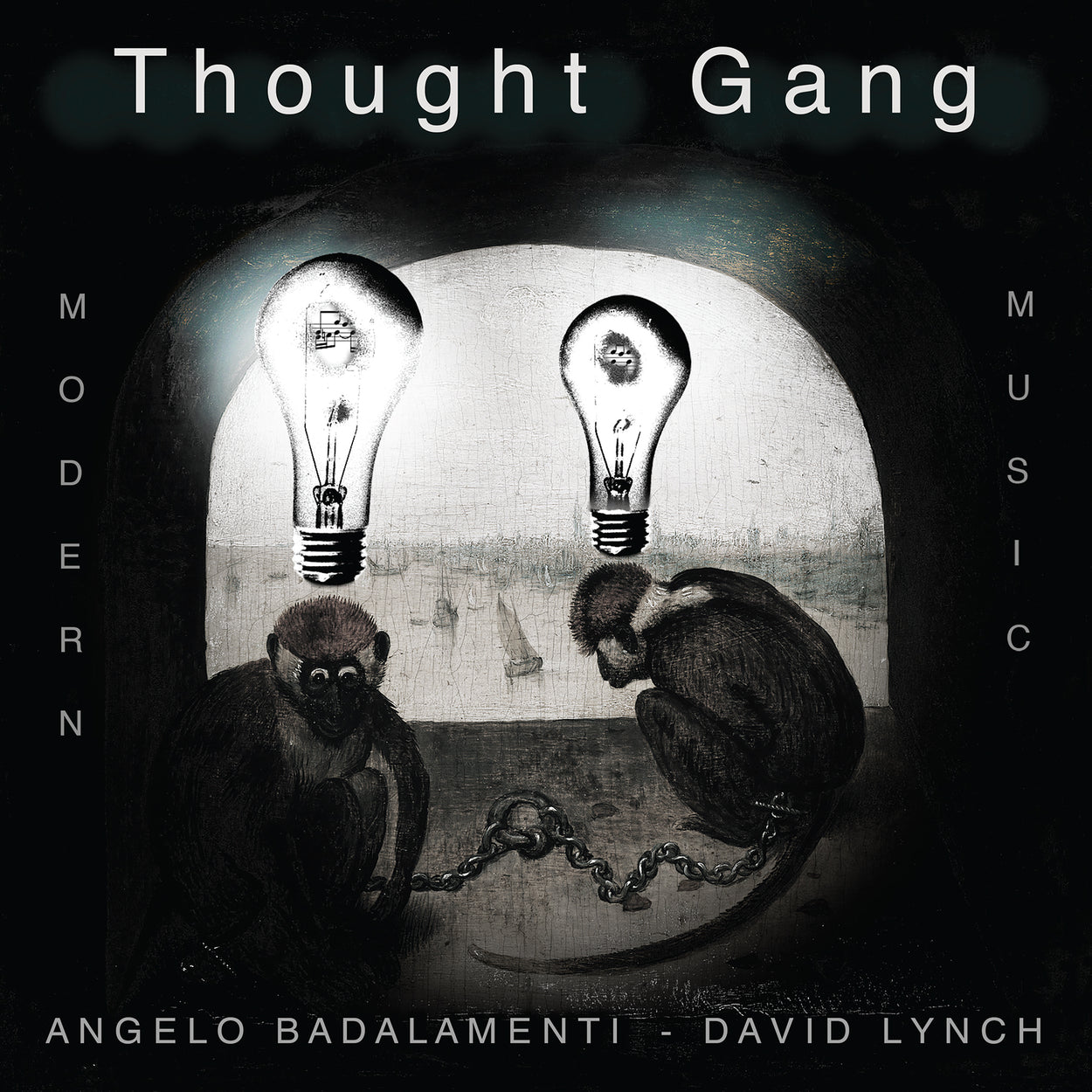
The Lynch–Badalamenti album was released on 2 November 2018. The label dates most of the remaining recording work to May 1992–1993 and identifies “A Real Indication” and “The Black Dog Runs at Night” as earlier pieces heard in Fire Walk with Me. A 2018 release date therefore does not make it a wholly new 2018 recording. Thought Gang production history
Lynch’s 2024 BFI interview describes giving the musicians imagined situations to play, then developing promising passages. His account locates direction in an image or event as well as in conventional musical instructions. Lynch on experimentation
Reading the sleeve: the chained figures, bulbs and musical signs stage an uneasy meeting of constraint and invention. The image is part of the album’s presentation; it does not document the musicians at a recording session.
Recording, assembly and release form distinct chapters in these albums’ histories. Their long gestation makes earlier experiments audible in later contexts.
The Air Is on Fire: music enters the exhibition
Sacred Bones identifies The Air Is on Fire as the sound accompaniment to Lynch’s Cartier retrospective. Its account names Hurley as a collaborator and describes a palette including machine fragments, altered industrial sounds and winds. The Art dossier follows the exhibition environment into which this work was placed. Recording description
A gallery sound can meet a visitor halfway through its duration, while that person is looking at something else. A home release lets the listener begin at a chosen point and follow a sequence. A record therefore preserves access to sound without automatically preserving its placement, level or relation to movement through the original room.
Zebrowski and Fire: another kind of image-to-music relationship
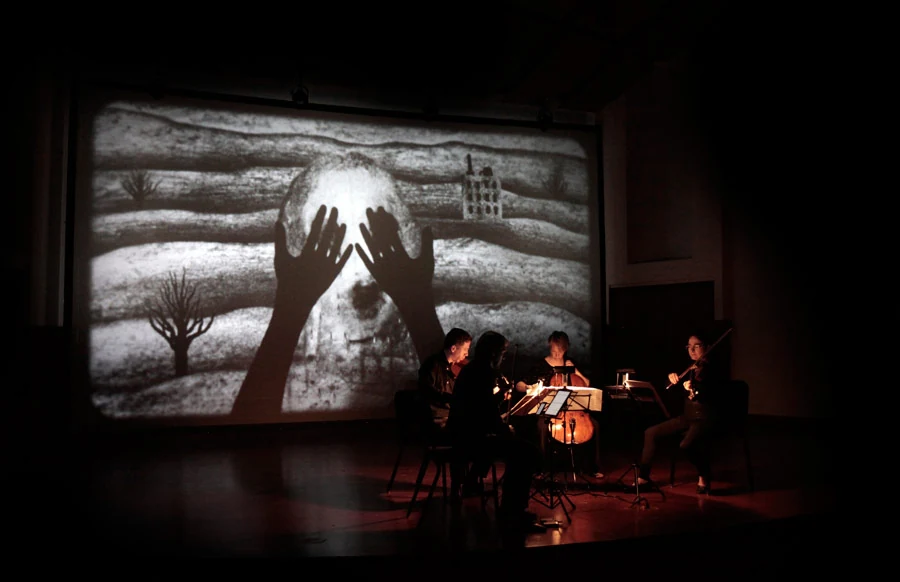
USC’s 2015 report describes a live quartet performance and Zebrowski composing in response to the film without an explanatory brief from Lynch. That gives the composer’s own interpretation room to act. A live event report does not establish that its performance and the subsequently released film soundtrack are identical. USC event report
Continue to the Fire study for the animation, release record and the remaining comparison between the event and the online edition.
Chrystabell: melody, editing and a shared musical memory
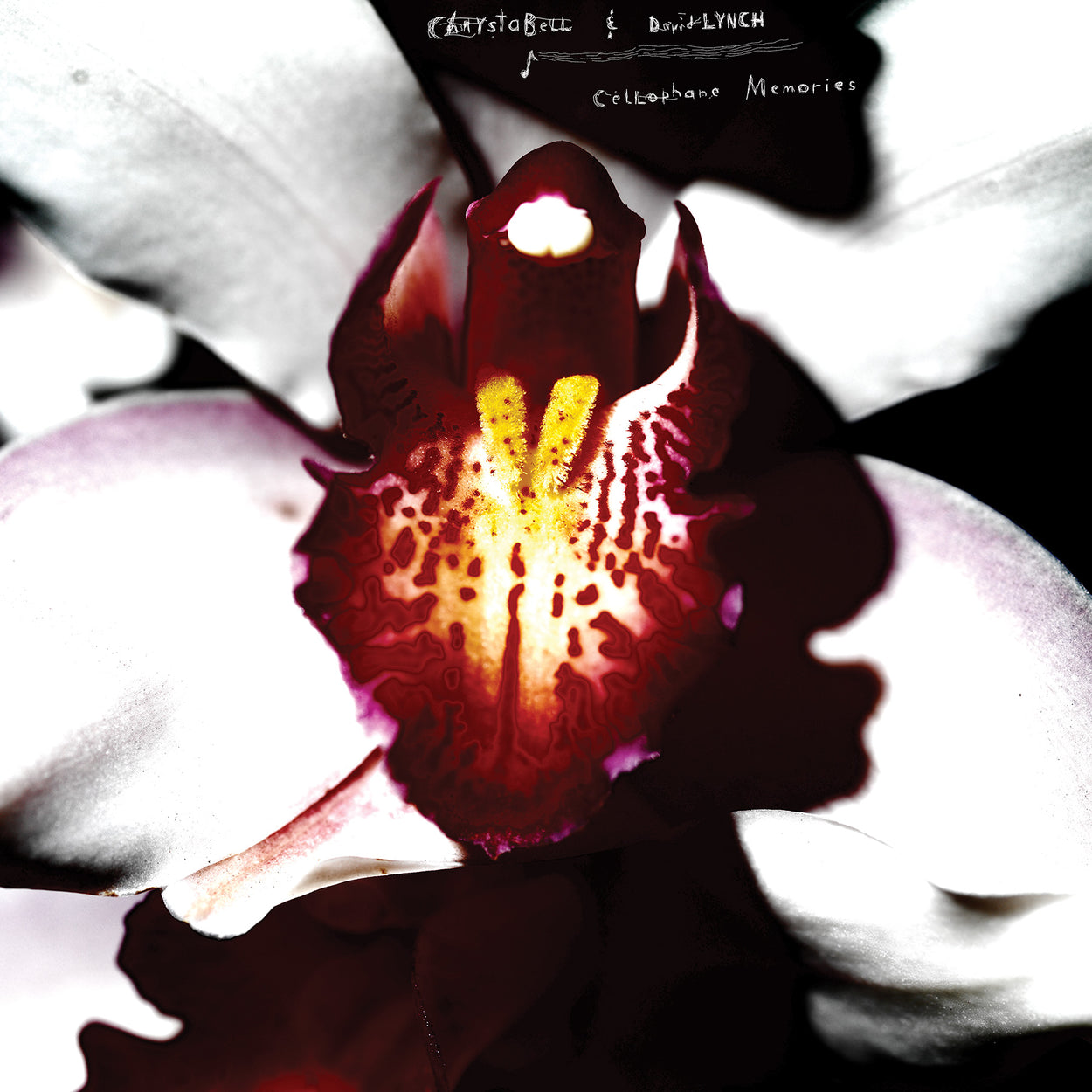
Cellophane Memories was released on 2 August 2024, catalogue SBR344. Its ten-song sequence includes “The Answers to the Questions,” “Reflections in a Blade” and “Sublime Eternal Love.” The release page provides the album’s official presentation and track list. Label record
In her separate BFI interview, Chrystabell describes singing several improvised melodic takes to Lynch’s lyrics, followed by his experimental editing. She places the emergence of the album’s character in that editing process. The account makes the singer’s invention and the later arrangement of her performances distinct creative acts. Chrystabell on making the record
She also describes drawing on Lynch’s library of experiments with Hurley and music supplied by Badalamenti, alongside new synthesizer compositions by Lynch. This history does not assign every audible sound to an individual track: that requires the detailed credits. Her own practical responsibilities included organizing the material and exporting it for mastering; she distinguishes those tasks from managing the entire studio. Library, composition and technical work
The voice here can be approached as both a performance unfolding and material available for recombination. Listen for where a phrase begins, whether another overlaps it and whether repeated words seem to occupy the same moment. Describe the effect first; proving precisely how it was made would require session evidence.
Publicity and testimony are different records. The label gives the album a visionary forest origin. In his BFI interview, Lynch treats that account playfully and emphasizes experiments in the studio instead. We preserve the distinction rather than present a publicity story as a verified biographical event. Label narrative · Lynch’s response
This Train (2011) and the EP Somewhere in the Nowhere (2016) form the earlier recorded partnership identified in the BFI account. They need individual edition studies in the next pass. The recordings should also be considered alongside Chrystabell’s wider work, rather than treating her presence here solely as an extension of Lynch’s career.
The first meeting in the studio
Chrystabell’s recollection in Room to Dream places the partnership’s beginning in a hands-on studio encounter. In the “Next Door to Dark” extract, McKenna reads her account of arriving with a demo, hearing tracks Lynch had made and receiving his lyrics. Her contribution was to bring melodies to those materials. They recorded together at that first meeting, although her existing record contract complicated the immediate prospect of a continuing collaboration. Next Door to Dark, 26:25–27:50 · source guide →
Read beside her later account of Cellophane Memories, the memory establishes an enduring division of creative labour: a prepared track and lyric meet a singer’s melodic invention, with the finished recording emerging from their exchange.
Sound, selection and the difference between a cue and a record
In a 2018 Screen Slate interview, Hurley describes sound as an opportunity to change a scene’s intention and emphasizes contrast: if everything occupies the available sonic space, there is little room for a change to register. Editing, silence and transitions are part of that construction. This is a practitioner’s account of method, not a universal explanation of every Lynch scene. Hurley, dynamics and the soundtrack
In his Rhino interview about The Return, Hurley describes supplying music for Lynch to try in the edit, with choices also developing at the mixing stage. He distinguishes the two companion soundtrack releases and their different material. A published soundtrack is consequently a selection shaped for a release, not a complete catalogue of every sound in the programme. Hurley on selection and soundtrack albums
That distinction extends to performance images. Seeing a band play on screen does not establish that the audible track was recorded live during filming. Hurley’s discussion includes a lip-synced Roadhouse performance. The Twin Peaks dossiers provide the screen context; exact performance and cue records remain separate checks. Roadhouse discussion
Listen for a decision
Choose a transition. Record what disappears, what arrives and whether the apparent space changes. Then ask how the transition directs attention. This produces a testable observation before an interpretation.
Keep the versions visible
Write down the album or film edition, track, timecode and playback format. Distinguish an audible difference from its possible cause. Different loudness alone does not establish a new performance or a better master.
What the critics heard
Marc Weidenbaum’s 6 August 2024 Pitchfork review foregrounds Chrystabell’s layered voice as the great strength of Cellophane Memories, while finding its persistent treatment at times too uniform. His attention to the singer is a useful counterweight to approaching the record solely through the filmmaker’s reputation. Weidenbaum’s review
Konstantinos Pappis, writing in Our Culture on 3 August 2024, also finds some arrangements too indistinct to sustain attention, but values the album’s tenderness and places its beauty ahead of its strangeness. These are two situated responses, not a verdict representing every listener. Pappis’s review
A comparison to try: is a recurring vocal treatment a coherent musical idea, or does it diminish contrast between songs? Listen to the whole sequence before deciding. A review can sharpen a question without supplying the answer in advance.
A compact guide to the editions
This is a selected map of the records discussed above, not a complete discography. Dates refer to the specific milestones indicated.
| Work | Keep these dates apart | Useful next check |
|---|---|---|
| Floating Into the Night | 1989 album / 2023 linked reissue | Original booklet and reissue credits |
| Industrial Symphony No. 1 | 1989 advertised event / 1990 video-chart record | Programme and complete video edition |
| The Voice of Love | 1992 sessions reported / 1993 album / 2018 reissue | Score-to-song comparison |
| BlueBOB | 2001 collaborative album | Original credits and film versions |
| Polish Night Music | 2007 original / 2015 linked edition | Complete listening and edition collation |
| The Big Dream | 2013 album and specified bonus package | Main sequence versus seven-inch extra |
| Thought Gang | Main sessions reported 1992–93 / 2018 album | Session and final assembly credits |
| Cellophane Memories | 2024 album | Track-level composition and performance credits |
Explore further
Follow the sources below, explore the museum collection, or continue through the Reading Room. New archival discoveries and contributions enrich the record of Lynch’s work.
Commissions and collaborations
Commercials ↗
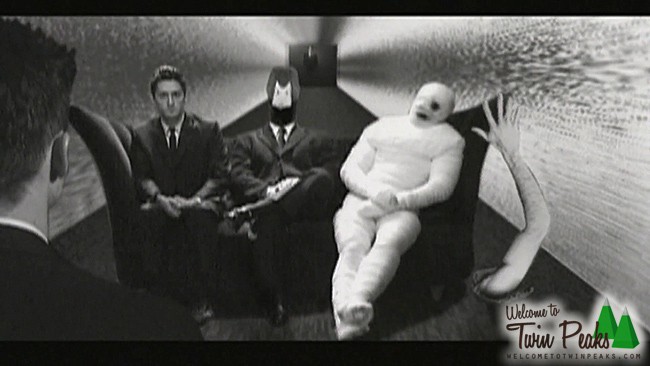
Explore the briefs, people and campaign histories behind Lynch’s advertising, with unresolved credits kept visible.
Music Videos ↗
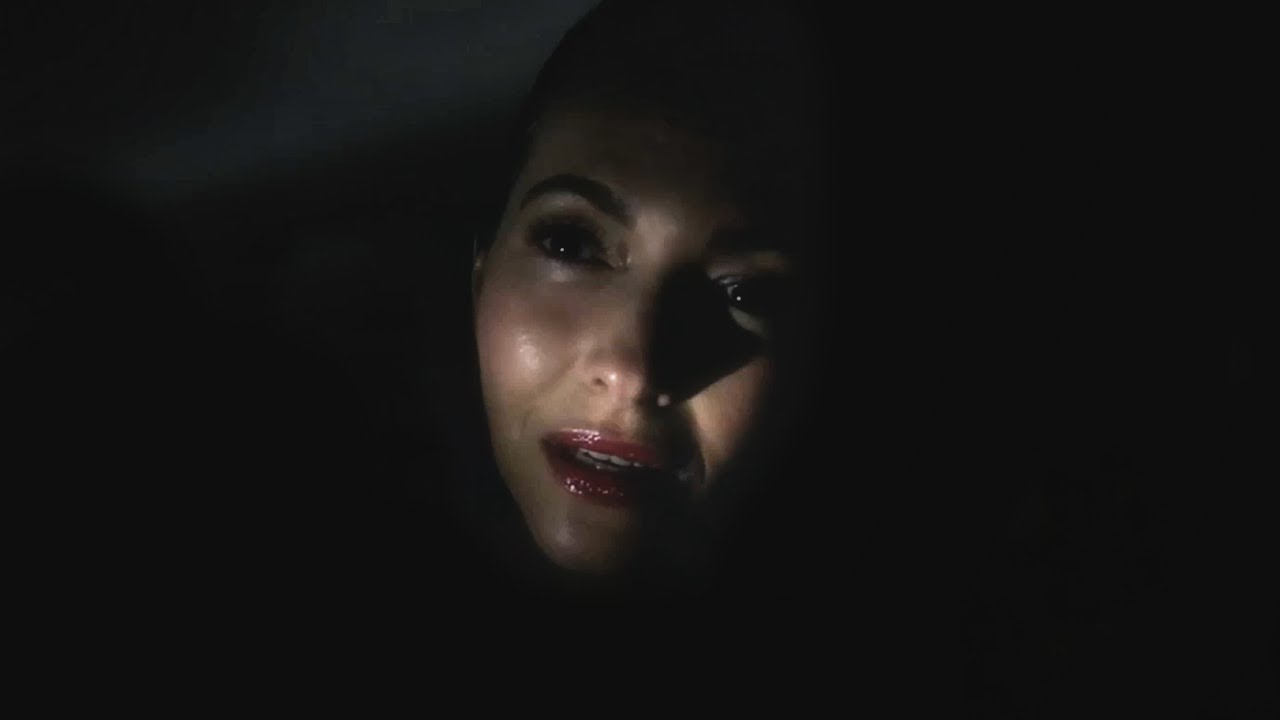
Directed videos and adjacent collaborations, from a film-linked performance to animation, concert projection and the illuminated face.
Online works and the performance stage
Online Works ↗
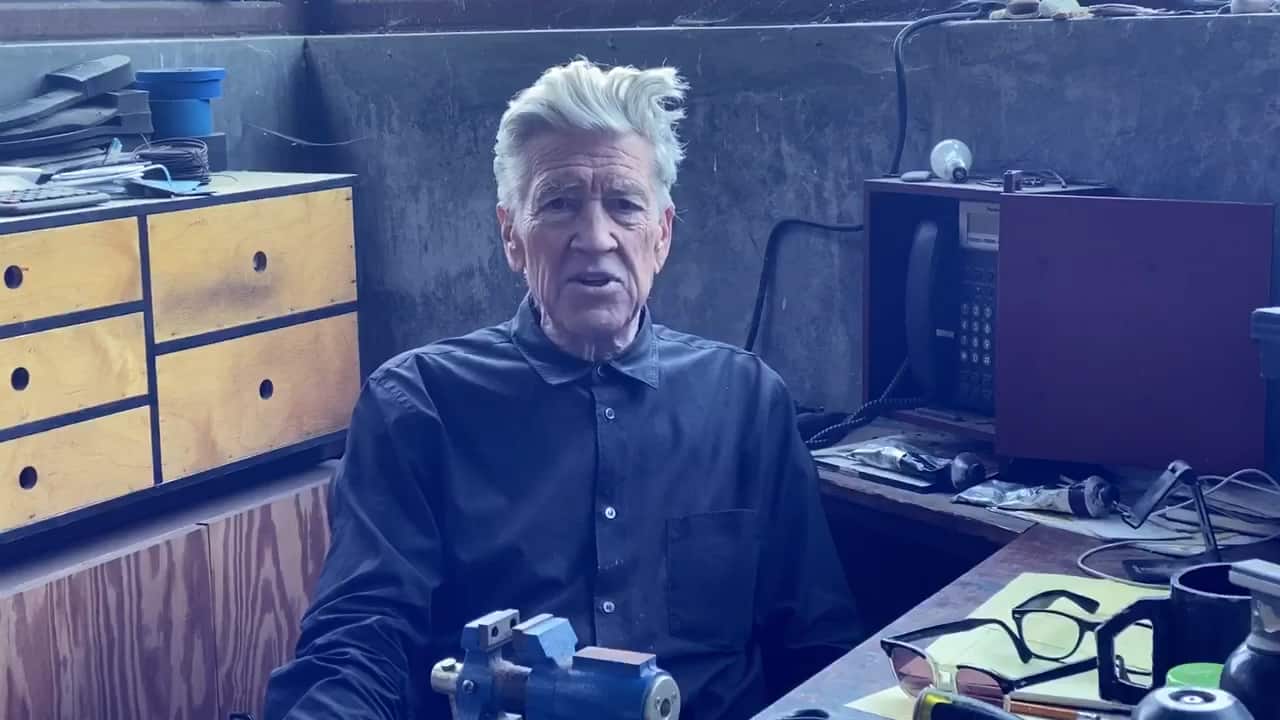
A website as a studio, a film released in fragments, a daily greeting: explore Lynch’s life online.
Industrial Symphony No. 1 ↗
Julee Cruise, Angelo Badalamenti and a dream built on stage: follow the event and the video it became.
Sources and image records
- Sacred Bones — Julee Cruise, Floating Into the Night ↗Original/reissue context and track list; SBR3041. Promotional evaluations are not adopted as critical consensus.
- Sacred Bones — Julee Cruise, The Voice of Love ↗Session and adaptation account; 1993 album and 2018 reissue. The listing’s broad “final studio album” wording is not adopted.
- Sacred Bones — Julee Cruise, Three Demos ↗2018 release and stated introduction difference.
- BAM advertisement — Down Beat, September 1989 ↗World Radio History scan, PDF page 7, top centre: opening-night programme. Text and rendered page checked. An announcement is not a performance report.
- Billboard — Top Videocassettes Sales, 20 October 1990 ↗Printed p. 50 / PDF p. 76, row 31. Chart row and column headings checked visually. No exact release-day or lifetime-sales inference.
- Matt Fagerholm with John Neff — Indie Outlook, 2 May 2022 ↗Opening exchanges on Asymmetrical, Lux Vivens and BlueBOB; later song-version discussion. Participant recollection, not contemporaneous session documentation.
- Sacred Bones — David Lynch, The Big Dream ↗SBR109, 16 July 2013; composition, Hurley’s contributions and specified bonus seven-inch.
- Sacred Bones — David Lynch and Marek Zebrowski, Polish Night Music ↗SBR3018, 13 November 2015 edition; meeting, studio collaboration and four-part sequence.
- Sacred Bones — Thought Gang ↗SBR214, 2 November 2018; 1992–93 recording account, soundtrack connection, track list and cover reproduction.
- Sacred Bones — The Air Is on Fire ↗CD listing, exhibition connection and Hurley’s account of the sound palette. Complete recording and installation version not compared.
- USC Thornton — New Music Shines in the Projector’s Beam ↗2015 event report; Zebrowski on composing for Fire and Mike Patterson’s performance photograph. Event and released soundtrack are not assumed identical.
- Sacred Bones — Chrystabell and David Lynch, Cellophane Memories ↗SBR344, 2 August 2024; track list, cover and publicity narrative. Distinguish that narrative from the participant interviews.
- Sam Wigley with Chrystabell — Sight and Sound, 21 August 2024 ↗Questions on melodic takes, editing, the music library and preparation for mastering. Does not supply complete track-level credits.
- Sam Wigley with David Lynch — Sight and Sound, 2024 ↗Musical chronology, the direction of Thought Gang and Lynch’s response to Cellophane publicity.
- Jon Dieringer with Dean Hurley — Screen Slate, 7 December 2018 ↗Questions on dynamic contrast, scene intention and soundtrack construction. Web reading succeeded despite anonymous direct-fetch denial.
- Rhino — An Interview with Music Director Dean Hurley ↗The Return: music selection, companion albums and Roadhouse production. Web reading succeeded despite anonymous direct-fetch denial.
- Marc Weidenbaum — Cellophane Memories, Pitchfork, 6 August 2024 ↗Opening discussion of vocal layering and concluding reservation about uniformity. Critical judgement attributed; no score or technical credit inferred.
- Konstantinos Pappis — Cellophane Memories, Our Culture, 3 August 2024 ↗Contemporary review, reservations about indistinct arrangements and concluding emphasis on beauty. Used as criticism, not session documentation.
Another doorway
Continue exploring
Music
Industrial Symphony No. 1
Explore David Lynch and Angelo Badalamenti’s Industrial Symphony No. 1: Julee Cruise’s performance, its BAM premiere, stage world and video editions.
Music
Music Videos
Explore David Lynch’s music videos, from Chris Isaak and Moby to Nine Inch Nails and Chrystabell, through the artists, images and collaborations.
Television
Twin Peaks
Explore Twin Peaks: viewing order, Lynch and Frost, Laura Palmer, music, photography, The Return, pilot versions and companion books.
Image credits and sources accompany each linked guide.