Twin Peaks: Season 1
1990 · Pilot + seven episodes · Research dossier
The death that opens a town. Eight episodes that teach us how to look.
- Broadcast year
- 1990
- Episodes
- 8, including pilot
- Created by
- David Lynch & Mark Frost
- Next
- Season 2
Enter the episodes
One town. Three beginnings.
Explore the pilot and the first two regular episodes as individual works: the spread of grief, the use of Laura’s images as evidence, and the dream that changes Cooper’s investigation. Each study has its own scene route and image galleries.
The pilot · both versions
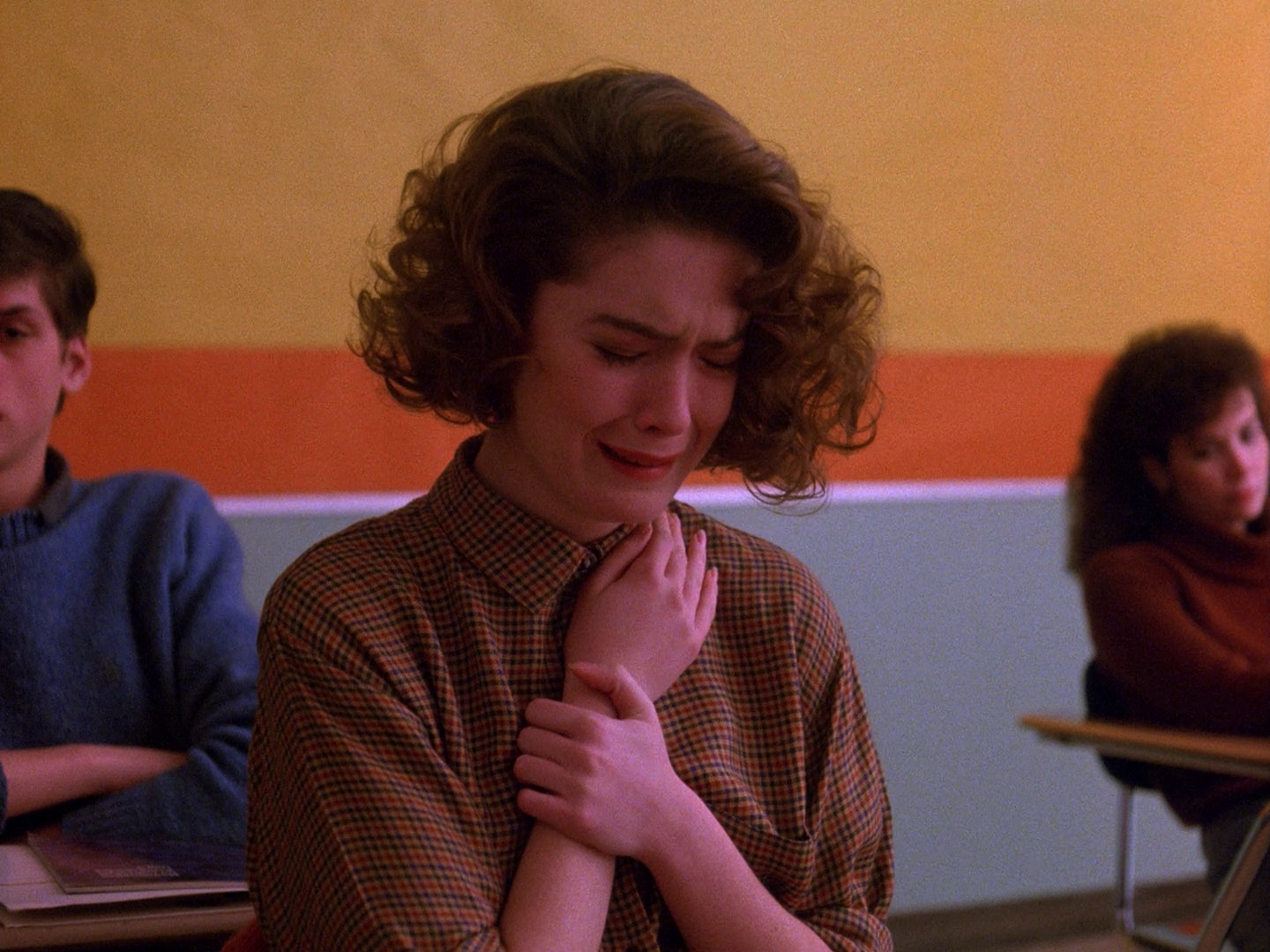
The first morning, the Roadhouse and a comparison of the US and international endings.
Episode 1 · Traces to Nowhere
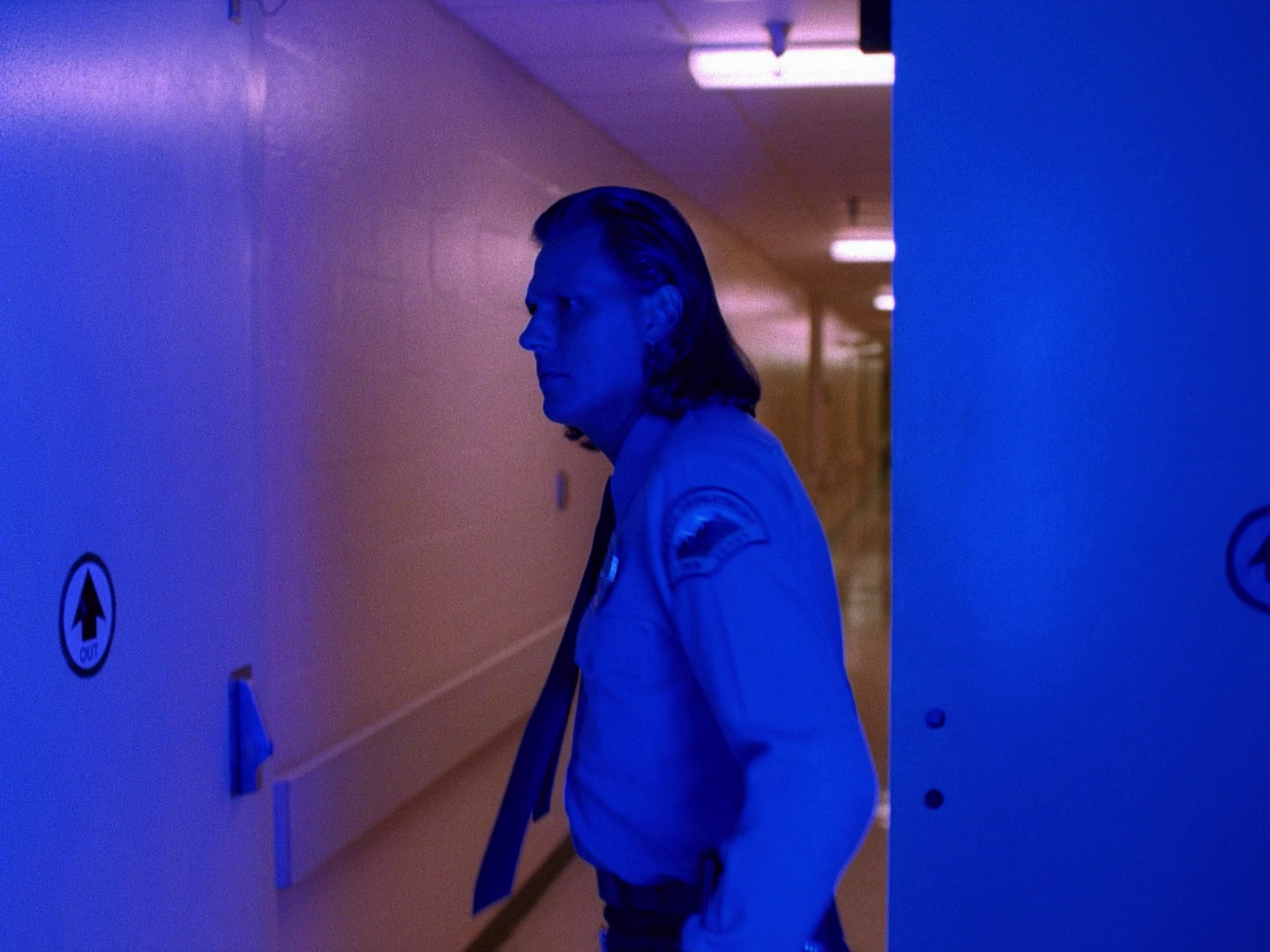
The home movie, the family interior, uncertain witnesses and Laura’s recorded voice.
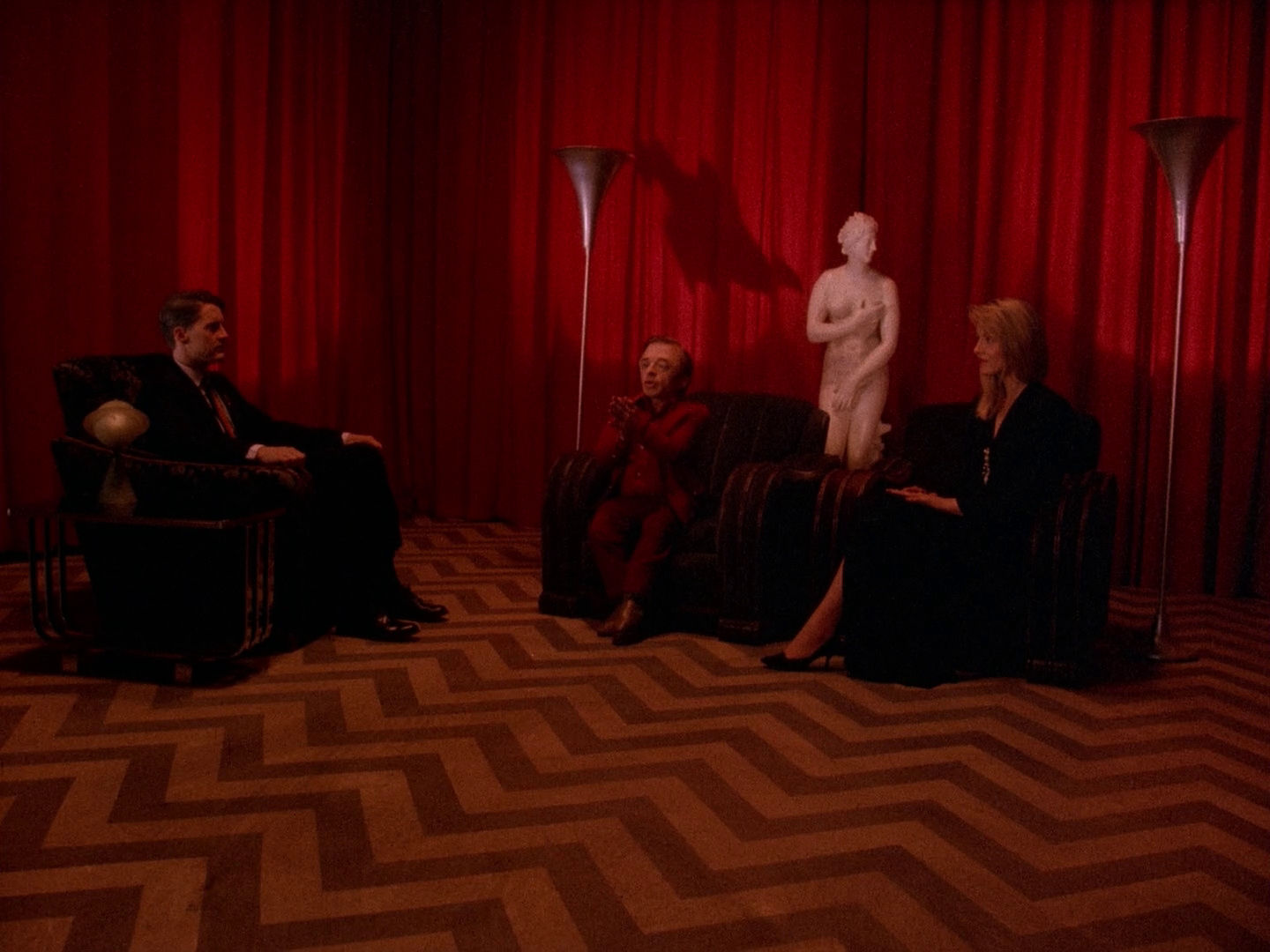
Episode 2 · Zen, or the Skill to Catch a Killer
The stone test, three dances and the transformation of the alternate pilot into a dream.
From the funeral to the finale
Five episodes. A town coming apart.
Continue through the rest of the first season with individual episode dossiers, illustrated scene studies, dialogue readings and focused galleries. The episode titles below use regular numbering, after the pilot.
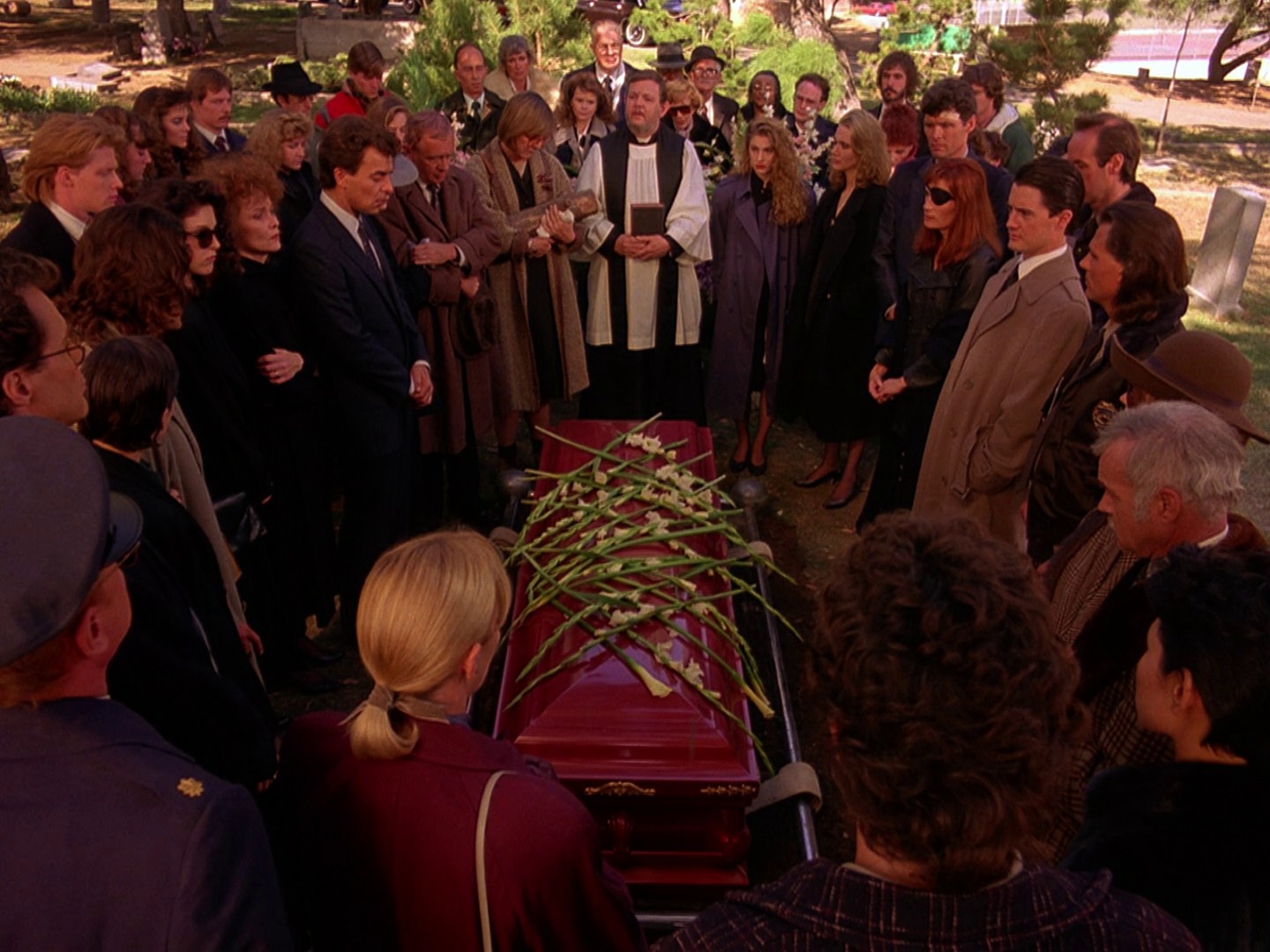
Episode 3 — Rest in Pain
Laura’s funeral, competing witnesses and the Bookhouse Boys.
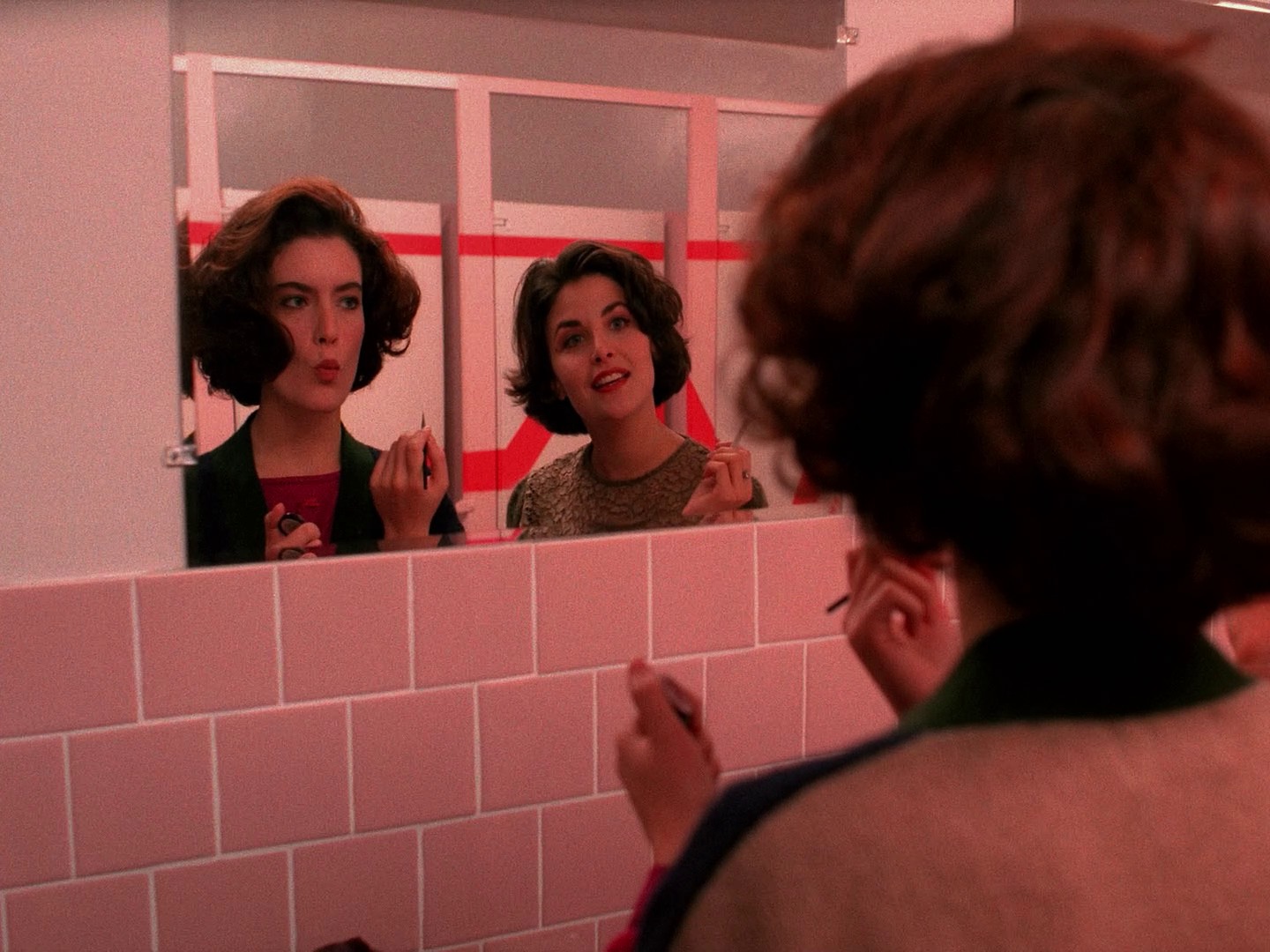
Episode 4 — The One-Armed Man
Sarah’s sketch, Audrey and Donna’s alliance, and the trail to Waldo.
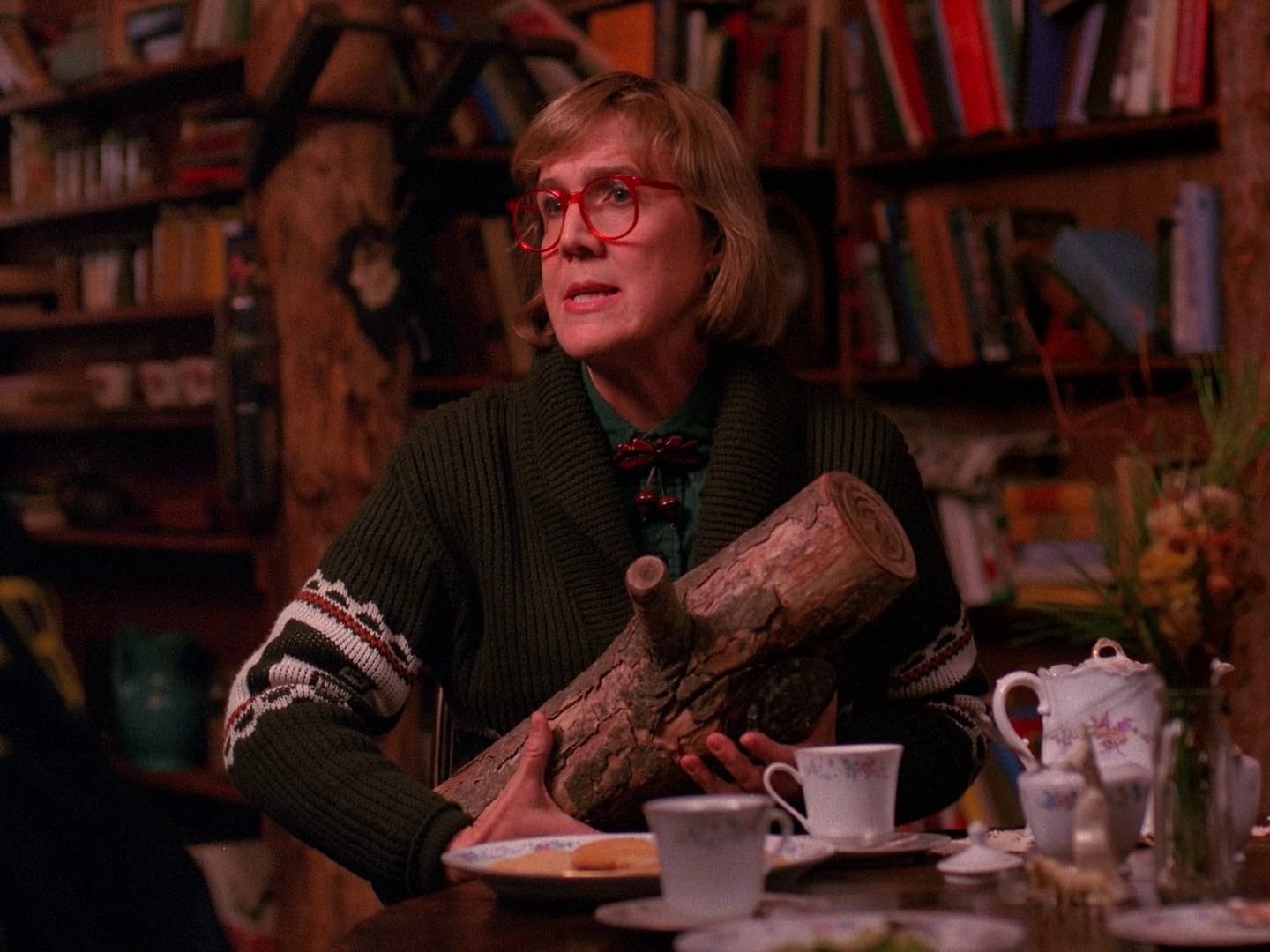
Episode 5 — Cooper’s Dreams
The Log Lady’s testimony, the cabin and Leland’s hotel dance.
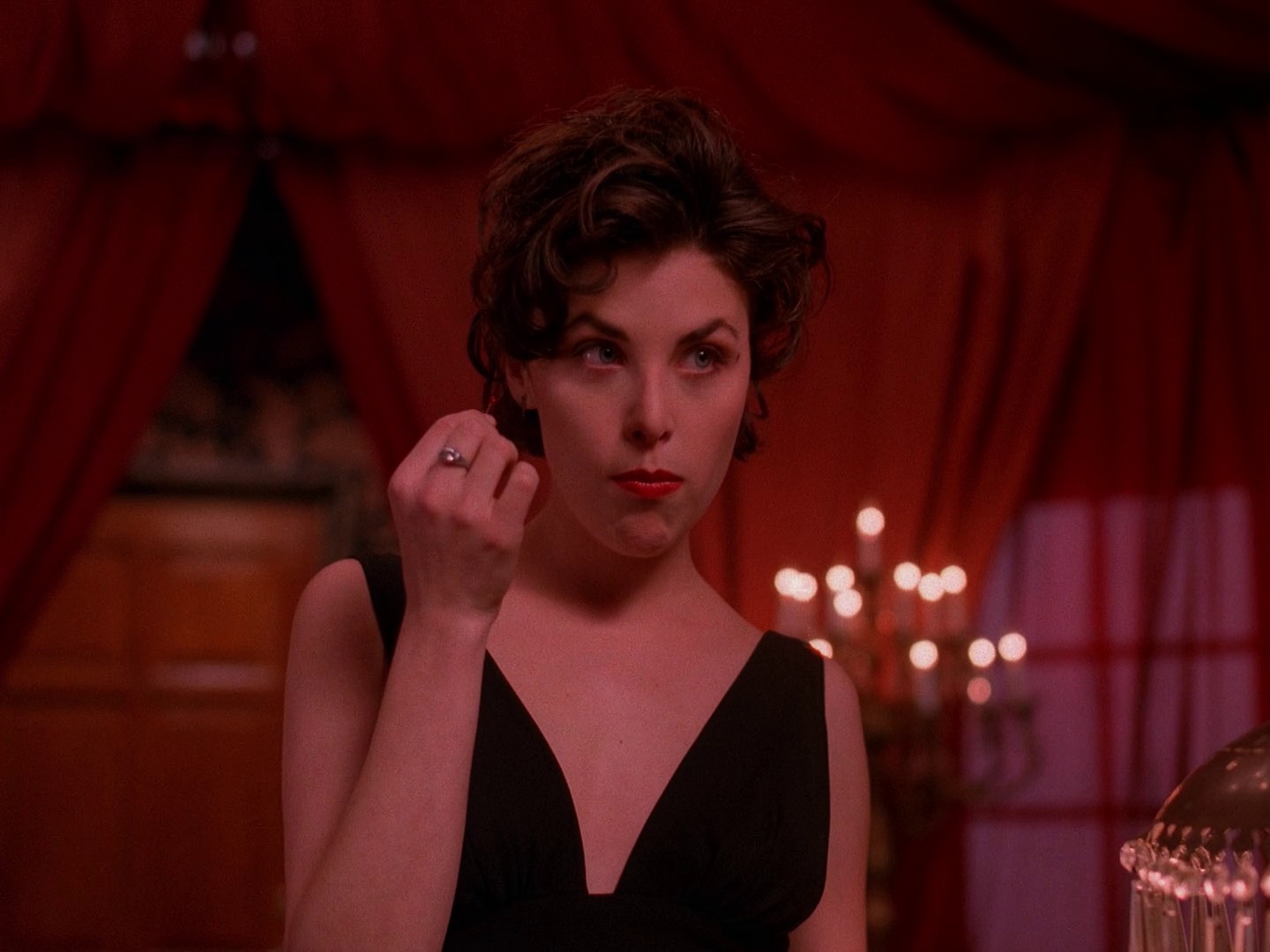
Episode 6 — Realization Time
Audrey’s concealed viewpoints, the cherry stem and Maddy’s impersonation.
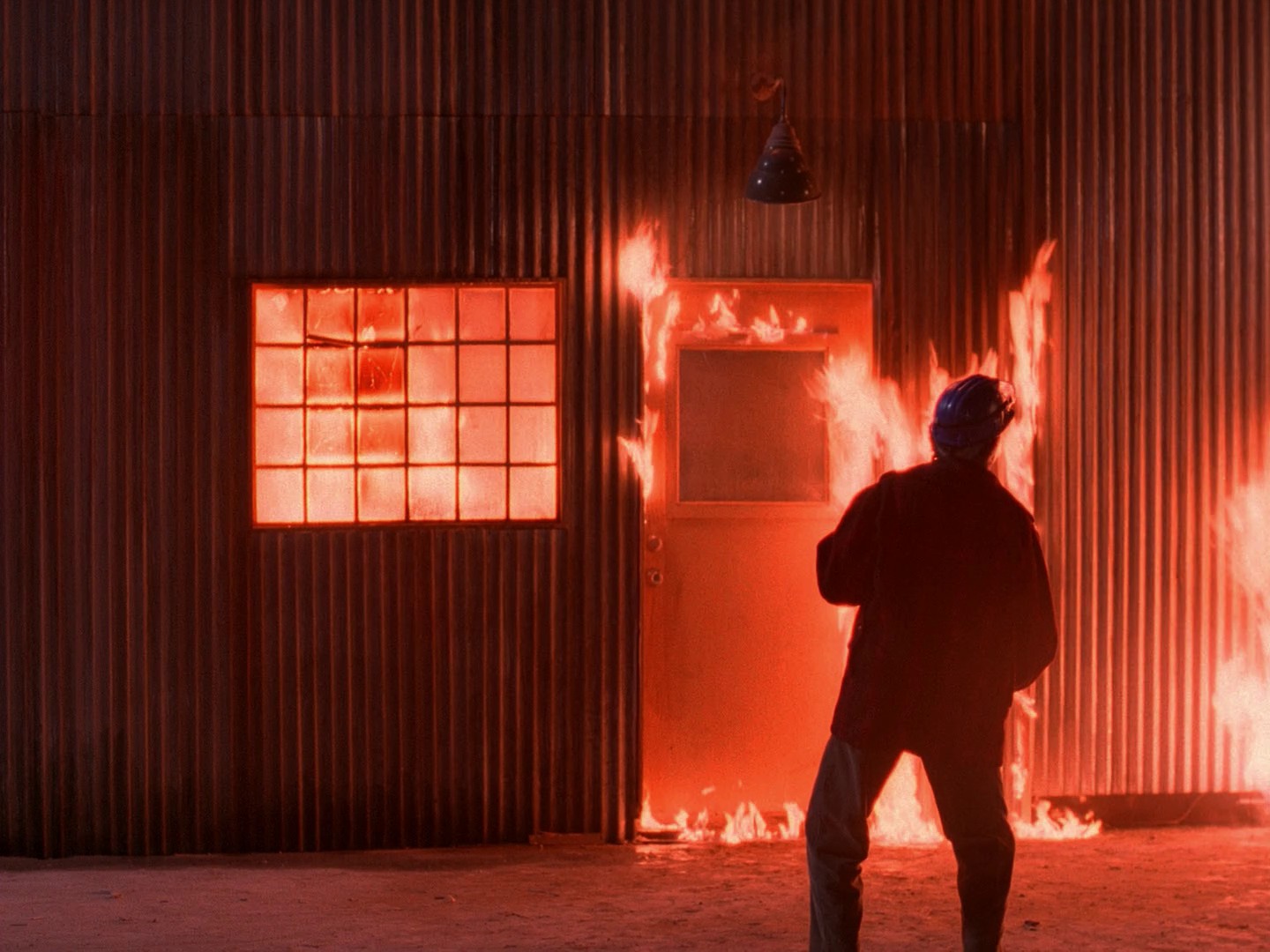
Episode 7 — The Last Evening
The first-season finale: false evidence, the mill fire and Cooper’s door.
Eight episodes that make a town
The first season of Twin Peaks is unusually compact: the pilot and seven subsequent episodes. Its achievement is not simply withholding the name of a murderer. It makes the investigation a way of entering workplaces, bedrooms, friendships and transactions that already have histories. Laura Palmer is absent, but the effort to describe her exposes the people doing the describing. Official eight-episode listing
This dossier follows that construction through the pilot, the ensemble, photography, sound and the season’s eight dramatic steps. It treats the town as more than the picturesque setting of a puzzle. Its apparent familiarity—school, diner, sheriff’s station, hotel—allows increasingly unfamiliar ways of knowing to take hold. A dream can become investigative material without making the police station disappear.
First viewing: begin with the U.S. television pilot, then continue through the seven episodes. The international pilot has a different concluding passage and is better approached afterward as an alternate object. Our complete viewing route continues through Season 2, the feature and The Return. Spoilers below: Season 1 developments and discussion of its later significance.
Creating the world, then learning how to sustain it
Mark Frost’s account of the beginning places a small-town murder at the centre of the pitch he and Lynch developed for ABC. He also connects the project to memories of a community and its older mysteries. The pairing matters: the series needed both the immediate force of a disturbing image and a population capable of carrying consequences across weeks. Frost’s published recollections give the writing and organisation of that population a place beside Lynch’s direction. Frost’s origin-story testimony
Duwayne Dunham supplies a different vantage point: he edited the pilot, then directed the first regular episode. The transition is consequential. An opening film can introduce a world once; a continuing series must return to it without reducing discovery to repetition. His account also places the early production alongside Wild at Heart. It is a useful correction to the loose story that Lynch’s work on that film simply explains Season 2’s problems. Dunham on the pilot and first regular episode
There is a factual trap in retrospective histories. The Television Academy oral history says in one passage that Lynch directed the first episode after the pilot, while Dunham identifies that assignment as his. Its introductory chronology also places Wild at Heart during the second season. We retain the participants’ useful testimony without carrying those statements into our chronology as settled facts. The next documentary check is a credit-and-production-date concordance, not a vote between anecdotes.
A collaboration visible in the finished world
The sheriff’s department provides a particularly clear example. Cooper can bring an eccentric method because Truman supplies local trust, Hawk experience and attention, Andy vulnerability, and Lucy a distinct vocal and administrative rhythm. The ensemble gives Cooper resistance and companionship. His curiosity would have less dramatic force in a town populated only by obstacles.
That distinction also makes room for directors beyond Lynch. Lesli Linka Glatter remembers asking about the animal head left on a table in an early scene. The lesson she took was openness to an accidental arrangement. Her account is testimony about a working attitude; Ron García’s separate recollection describes the object and circumstances differently. Neither recollection identifies every decision or technician responsible for the shot. Glatter’s directing lesson · García’s pilot recollections
The useful idea is practical: a recognisable style can be sustained by collaborators who understand when to leave an unexpected detail in place. This is a richer history than assigning every striking element to one person’s isolated inspiration.
Before the Log Lady entered Twin Peaks
In the Pretty as a Picture outtakes, Lynch and Catherine Coulson return to an earlier idea for a woman who would take her log to specialists. Lynch imagines a boarded-up fireplace, a husband lost in a forest fire, a taxi journey, a diner and a visit to a dentist. The comedy would grow from treating the log as a participant in ordinary institutions.
Lynch then recalls calling Coulson during the Twin Peaks pilot. What began as a brief appearance involving a light switch developed further because her presence with the log caught on. The recollection gives Margaret Lanterman a history before the series while keeping the unrealized earlier premise distinct from the character who inhabits Twin Peaks. Pretty as a Picture outtakes, 08:09–10:16 · source guide →
Two recollections that show an idea changing
The main documentary preserves Lynch’s account of a bar of soap accidentally left in Bushnell Keeler’s coffee percolator. When Lynch and Mark Frost wrote the episode following the pilot, the remembered soap became a fish. An ordinary mishap survives through a precise alteration. Pretty as a Picture, 11:27–13:12
The discussion of BOB is especially revealing because Lynch corrects Nayar’s version on camera. He distinguishes the first impulse to film Frank Silva in Laura’s bedroom from the later discovery of Silva’s reflection during Sarah Palmer’s scene. In his account, an intentional image and an accidental reflection are separate stages in the character’s emergence. Pretty as a Picture, 57:36–60:04
Directors remembering the work
The collaborators’ accounts illuminate different parts of a continuing production: footage reused in editing, room for an accident, changing scripts and the experience of returning to a familiar cast.
Duwayne Dunham: the pilot as an image resource
Dunham recalls returning to the pilot’s footage of James on his motorcycle for the opening of a later episode. His affection for the material and decision to reuse it reveal how the pilot continued to supply images for the developing series. Interview excerpt, approximately 00:07–00:32.
Lesli Linka Glatter: preparation and accident
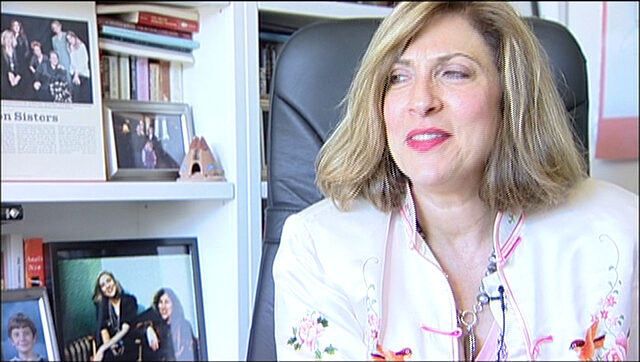
Glatter compares the conscious choices she observed around Clint Eastwood with Lynch’s openness to accidents. She presents the contrast as a valuable education, not as a rule that one director plans and the other does not. Her later DGA interview gives a concrete Twin Peaks example: the moose head waiting in the pilot’s bank vault became part of the scene. Interview excerpt, approximately 00:06–01:13; DGA Quarterly, Spring 2015.
Tina Rathborne: the scale of a production
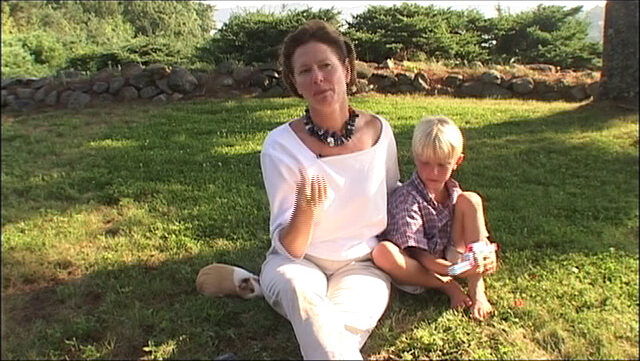
Rathborne remembers affection for the actors and her colleagues when she returned, while describing a loss of the first season’s imaginative intensity and working intimacy. She links the increased physical separation partly to a production with more money. Her recollection offers a director’s perspective on how the expanding production changed the working atmosphere. Interview excerpt, approximately 00:23–01:25.
Caleb Deschanel: an episode keeps changing
Deschanel recalls trying to direct an episode in which his wife, Mary, appeared. Advance arrangements could not guarantee that result because characters moved in and out as scripts changed. His account captures the uncertainty of serial production: an episode’s eventual cast could differ from what a director expected when accepting the assignment. Interview excerpt, approximately 00:23–01:09.
A hotel with life outside the main conversation
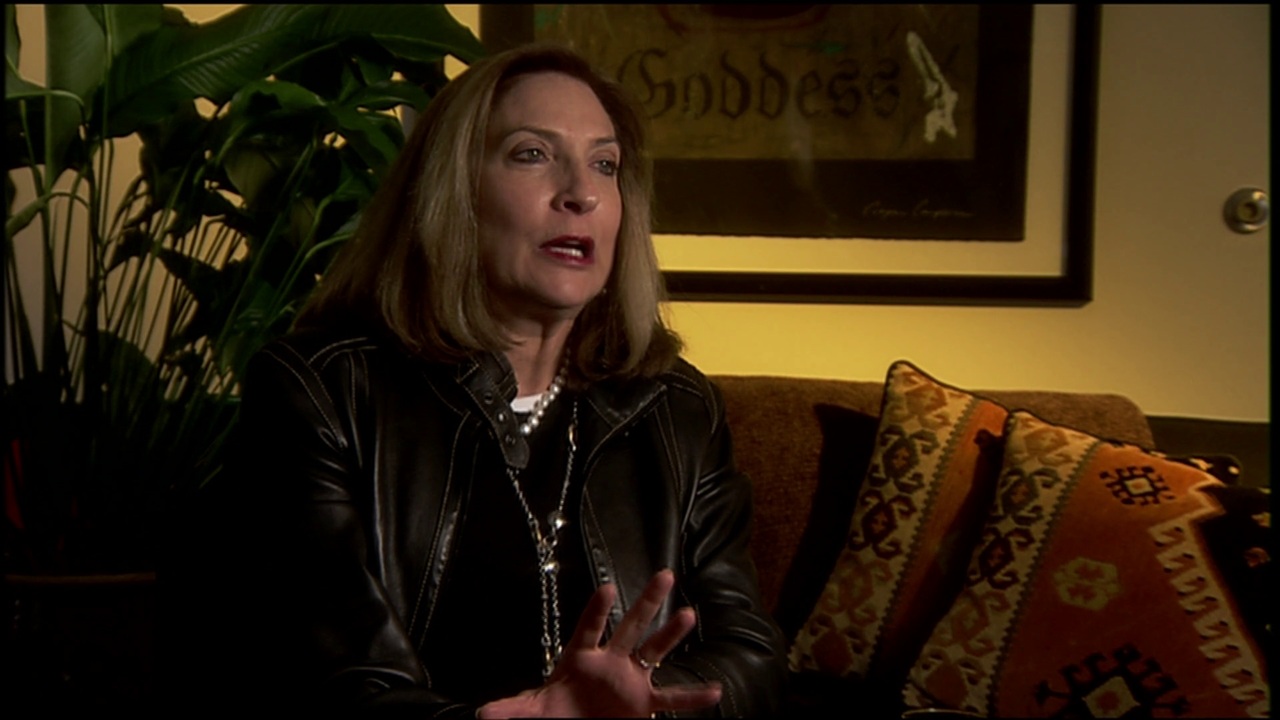
Lesli Linka Glatter gives a precise example of a director adding a second layer to a familiar setting. For Cooper and Audrey’s breakfast, she devised an American Indian Movement convention in the Great Northern dining room. For a later visit she chose a gathering of cheerleaders and band members, producing the crowded elevator encounter. In her account, the background could reward attention without requiring the foreground characters to explain it.
This is a useful way of reading the hotel across episodes. It does not exist solely to contain the current plot: visitors arrive with activities of their own. Glatter recalls the convention idea becoming something other directors could vary. The testimony illustrates how a shared location could remain recognisable while admitting individual invention.
Source: Freshly Squeezed: Creating Season One, 9:43–10:55. See “Rest in Pain” and the later hotel encounters.
Keeping the series moving after the camera stops
John Wentworth’s recollection of postproduction complements the directors’ accounts. He describes evening colour-correction work and a weekly routine of sound mixing, online finishing and delivery to the network. The familiar world of the town was maintained through this recurring labour as well as through writing and shooting. His account is retrospective testimony about the team’s working rhythm. A Slice of Lynch: Uncut, 38:28–41:53
A social map: who gets to tell Laura’s story?
The family
Leland and Sarah’s grief makes Laura’s absence immediate. Their home asks us to recognise distress before we can interpret it. A family’s public image offers no guarantee that its private life is legible.
The friends
Donna, James and Bobby possess partial, sometimes competing versions of Laura. Their attempts to investigate or defend her are also attempts to understand their own relationships with her.
The employers and owners
The mill and hotel connect household life to property, work and power. Following the money complicates the postcard version of the town: hospitality and ownership are different things.
The investigators
Cooper’s openness meets the habits of an existing community. Asking a question is never neutral when an answer can alter a friendship, business arrangement or household.
These are Lyncharium’s reading lenses, not official character categories. The episode listing traces the movement from discovery and investigation through funeral, woods and renewed uncertainty. Rather than treating each revelation as a step toward a final, complete Laura, we read them as demonstrations of how limited each observer is. Season sequence
The funeral: community as performance
The fourth broadcast instalment, “Rest in Pain,” makes public mourning an event in its own right. A funeral is supposed to give shared shape to loss. Here that expectation creates pressure: people who occupy incompatible positions in Laura’s life must appear together. The ceremony brings the town’s inability to agree on Laura into a common space, without resolving it.
Laura and Maddy: resemblance is not identity
Sheryl Lee remembers an initially small assignment that expanded into the role of Maddy Ferguson. Her account of the diner work describes Lynch giving her an imagined mood that differed from the actual conditions of filming. It is evidence of an actor finding an emotional register, not a literal date or weather report for the fictional scene. Lee on Laura, Maddy and the diner
Maddy gives the series a living body that resembles its missing centre. This does not restore Laura; it reveals the danger of treating a person as an image already understood. The distinction becomes essential when moving to the film’s living Laura. The photograph, the cousin and the person are not interchangeable.
Warmth, darkness and the change after the pilot
Ron García photographed the pilot; Frank Byers carried the cinematography into the subsequent episodes. García describes a motivated approach to lighting and a combination of colour-correction filters. Byers remembers preserving a warm exterior to the town’s evil, with adjustments because early ABC transmission looked excessively red. These are related accounts of a look, not proof that every transfer presents identical colour. García on colour and the pilot · Byers on warmth and transmission
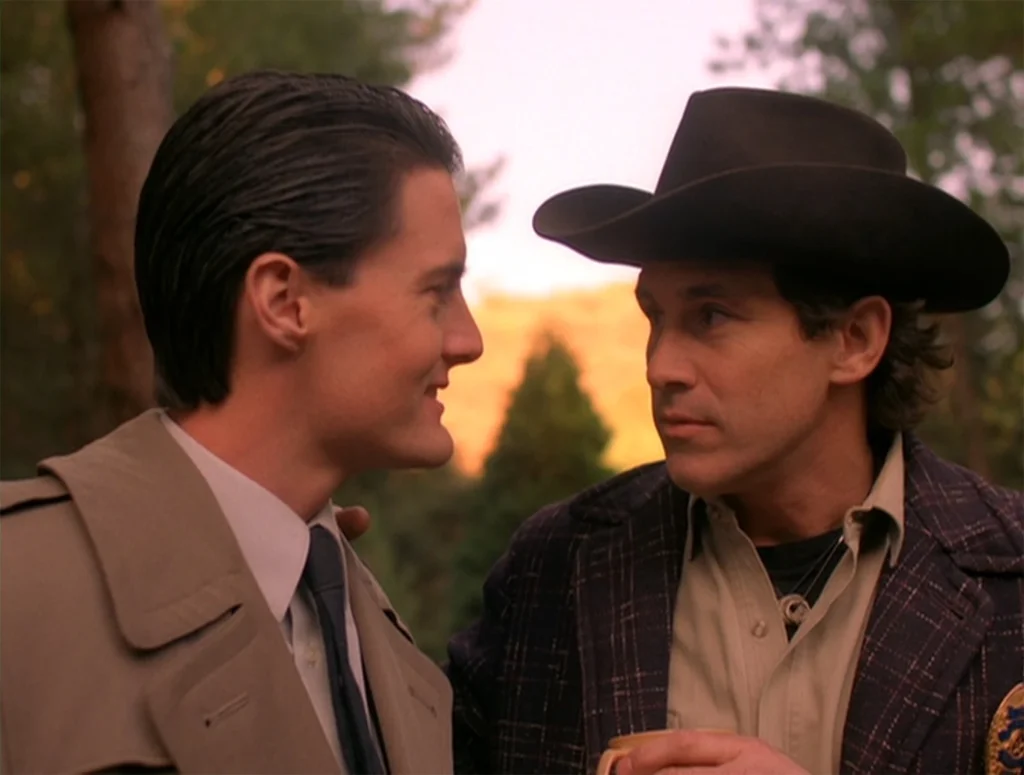
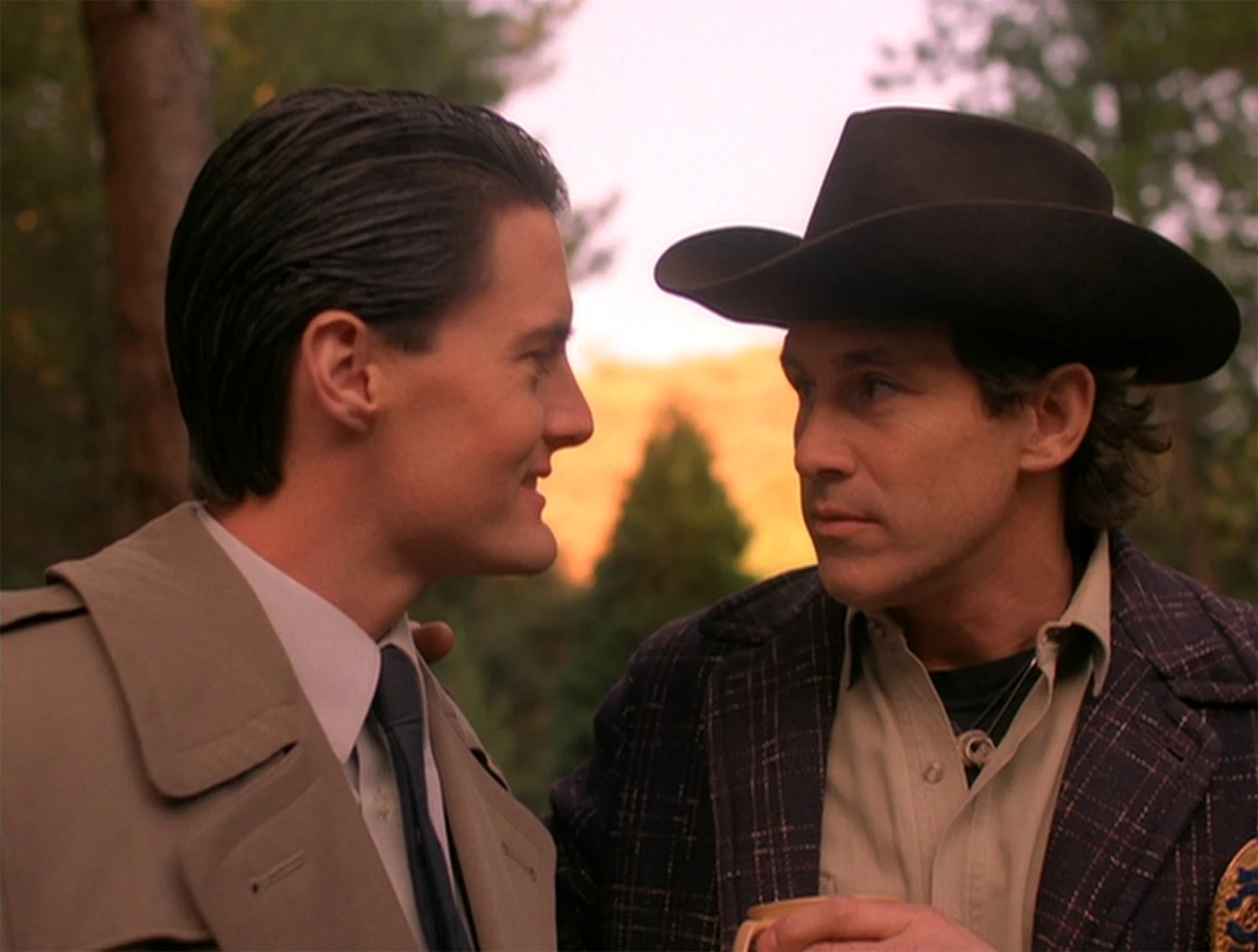
The hero image makes that warmth tangible. Cooper’s pale coat, Truman’s checked jacket and the softened foliage place two investigators within a welcoming palette. The clothes distinguish their affiliations without isolating them from one another. This is an observation of the published image. It does not establish the lighting setup or lens used to obtain it.
Building the town indoors
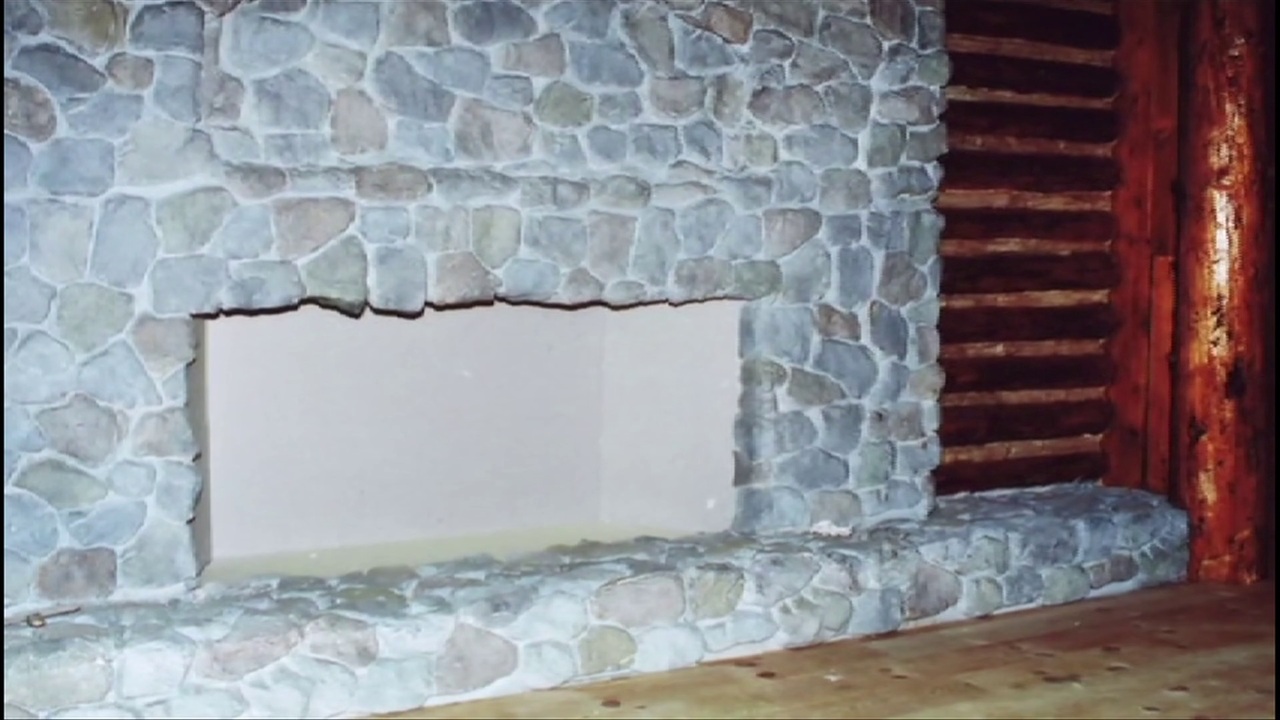
Richard Hoover’s account in Freshly Squeezed: Creating Season One makes the move from pilot to series tangible. Mark Frost describes renting a warehouse in the San Fernando Valley and turning it into stages for the interiors. Hoover explains the choice to use real pine and logs wherever possible. The material’s texture and presence mattered; recreating the same effect through painted imitation would have been a different and laborious task.
The documentary’s construction photographs show the Great Northern before it becomes a convincing inhabited room. Surfaces, windows and the fireplace are still visibly parts of a set. These images clarify a distinction hidden by the finished episodes: the town’s continuity depended on reconstructing selected interiors and finding Southern California exteriors that could sustain the impression of the Northwest. Frost names Malibou Lake and the Coldwater Canyon area among those resources.
Harley Peyton recalls offices and sets gathered in the same building. The account links the series’ imaginative world to a working environment in which writers and production staff could move among its rooms. Familiarity on screen was supported by repeated daily use behind it.
Source: Secrets from Another Place: Creating Twin Peaks, “Freshly Squeezed: Creating Season One,” 1:59–4:50, in Twin Peaks: From Z to A.
What the room allows the camera to do
A transcription of Byers’s commentary for the first season’s dream episode offers useful practical detail: lighting from the floor, difficult space at the One Eyed Jacks location, and location work shared between episodes. His recollections of film dailies explain why judging a warm filtered image required more than a rough video copy. The transcription and its illustrations have been inspected; the complete original commentary recording has not. Commentary transcription: interiors, location work and dailies
Our inference is that the show’s visual coherence was a repeated production task. The director of photography had to make different rooms and schedules belong to the same world. A recurring set makes an emotion recognisable, but it also changes what camera movement, actor placement and light are possible. The contrast between a practical location and a constructed room deserves documentation rather than romantic generalisation.
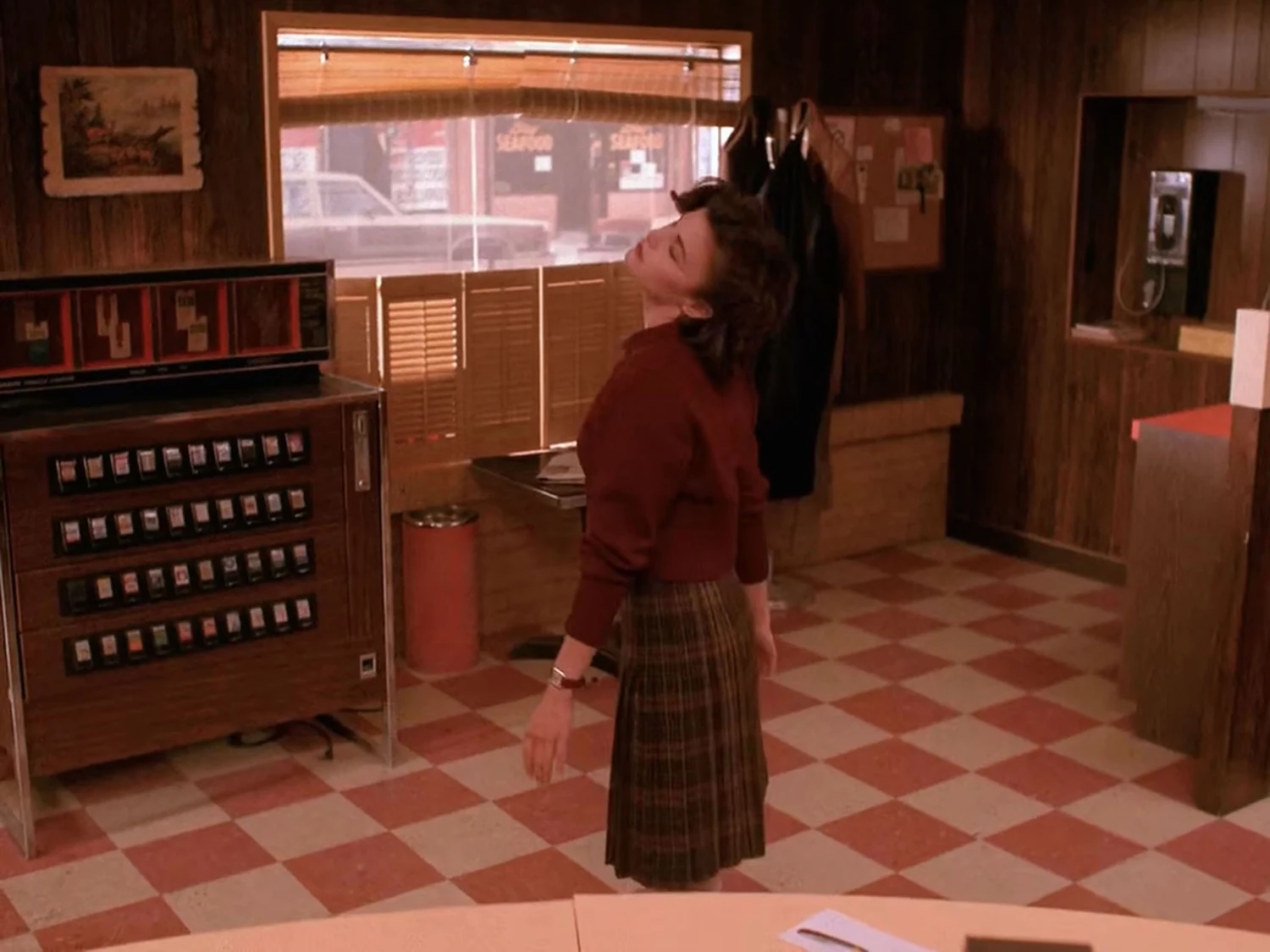
Audrey and the diner: looking beyond the famous pose
In the reproduced frame, Audrey occupies a room full of ordinary communications and pleasures: jukebox, payphone, window, counter and floor pattern. Her turned body interrupts the room’s rectilinear organisation. The red top connects her to the warm surroundings while the skirt and pose give her a separate rhythm. These visible relationships are more useful than treating the still only as an icon to recognise.
Dance also gives the spectator another way of understanding a character. Investigation usually asks what someone knows; performance asks how someone inhabits a space. That is our interpretive reason for placing this image beside the ensemble study. The specific wardrobe maker, garment continuity and physical jukebox remain object-level research questions. A costume department award does not answer them.
Music that makes the town feel continuous
Lori Eschler’s account of the original series describes music assembled from Angelo Badalamenti’s material, with changes of speed, direction and combination available to the music editor. The score’s recurring presence was therefore also editorial work. A theme on a soundtrack album and a passage as used in an episode are different research objects. Eschler on the original series’ music editing
Musical recurrence allows the town to feel emotionally connected even when its characters are separated. A familiar cue can make affection and suspicion coexist; it need not certify that an apparently tender moment is safe. Repetition is especially powerful in a serial because the listener brings earlier uses into a later scene.
The strange speech associated with Cooper’s dream belongs to performance and recording as well as mythology. Byers tentatively recalls the first-season Red Room passage as pilot material, distinguishing it from the later return to the set. His uncertainty matters: the recollection is a lead for a production comparison, not a verified shooting record. Commentary’s closing Red Room discussion
A complete sound study will identify the edition and audio track before assigning precise cue boundaries or comparing dialogue treatments. For now, the questions are productive listening routes: when does the music continue across a change of location; when does room tone take over; and when does a voice stop functioning like ordinary conversation?
The season, episode by episode
Paramount+ counts the pilot as S1E1; older disc and research references often call it the pilot or Episode 0, followed by regular episodes 1–7. Both locators appear here. Titles follow the distributor’s current listing. Distributor episode index
- S1E01 · Pilot / Episode 0
Pilot
A discovery becomes shared knowledge. Follow the movement from a private loss into school, work and official investigation; each setting gives grief a different public form.
- S1E02 · Overall episode 1
Traces to Nowhere
The investigation becomes a continuing practice. Notice how local knowledge and the visiting agent’s questions have to coexist before either can be useful.
- S1E03 · Overall episode 2
Zen, or the Skill to Catch a Killer
The woods and the dream propose different ways of knowing. Ask what happens when a method appears convincing before its relationship to evidence is clear.
- S1E04 · Overall episode 3
Rest in Pain
The funeral gathers people whose versions of Laura cannot simply be reconciled. Public mourning becomes a test of the town’s ability to recognise its own divisions.
- S1E05 · Overall episode 4
The One-Armed Man
Attention moves between persons, testimony and clues. Consider when a conspicuous detail helps an investigation and when it encourages premature certainty.
- S1E06 · Overall episode 5
Cooper’s Dreams
The search widens into the woods. Places outside familiar institutions alter who can speak with authority and what the investigators can safely assume.
- S1E07 · Overall episode 6
Realization Time
Separate inquiries begin to converge. Compare the risks taken by those acting officially with the risks taken by people trying to act alone.
- S1E08 · Overall episode 7
The Last Evening
The season suspends several consequences rather than delivering one clean finish. Track which relationships have changed even though the central question remains unanswered.
Margaret Lanterman
Margaret’s introductions: another way of listening
Margaret’s addresses invite the viewer to reconsider the story’s images, witnesses and dreams. They speak from outside the episodes’ original dramatic scenes; reading them alongside those scenes reveals connections without turning them into a single explanation.
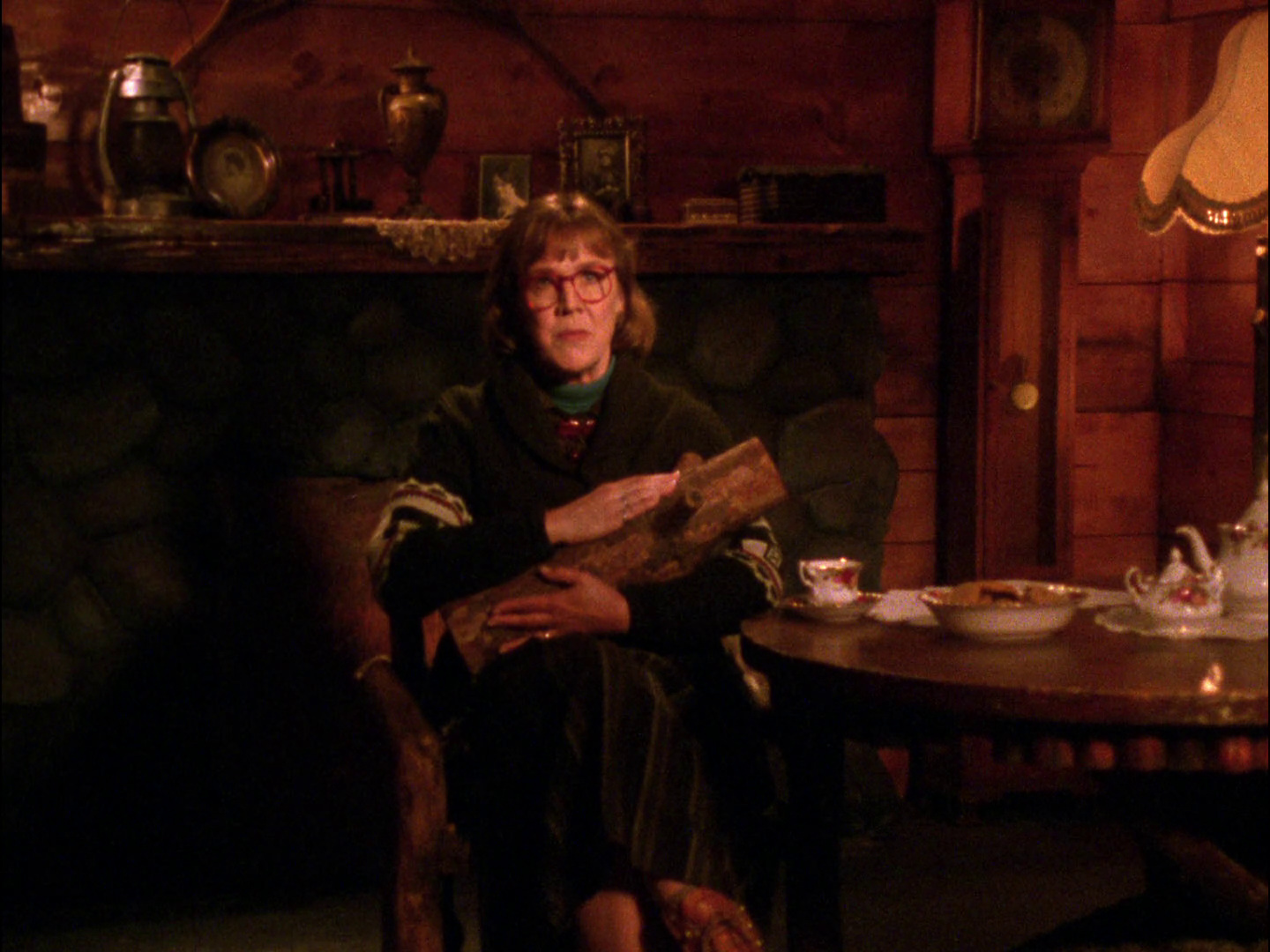
Margaret as an interpreter
The pilot introduction moves from the many kinds of stories in the town to Laura as the person through whom they connect. The introduction for regular Episode 1 asks the viewer to take the apparently absurd seriously, particularly the log and the reasons behind human behaviour. The next introduction describes ideas as constructive or destructive and points to dreams as a way they arrive. Together they guide attention without supplying a definitive explanation.
Read these separately presented introductions alongside the pilot’s movement through the town, the problem of witnesses in Episode 1, and Cooper’s dream in Episode 2. Their retrospective framing should not be confused with dialogue spoken inside the original episode scenes.
The short recaps and preview
The “Previously on” pieces select earlier dialogue and images to orient a returning viewer, while the short “Next on” preview advertises a coming confrontation. These are miniature acts of editing: they rank clues and relationships differently from an episode experienced at its own pace. They are useful companions to the scene studies, rather than additional episodes.
Versions and interpretation
An ending and an introduction do different things
The international pilot supplies a different concluding passage, whereas Margaret’s later introductions address the viewer from outside the original action. One alters the dramatic construction; the other invites a way of looking. The pilot comparison follows the alternate ending, while the introduction study considers Margaret’s separate interpretive voice.
Addressing the viewer
Introductions, recaps and previews
From Laura’s funeral to the first-season finale, Margaret’s introductions explore tears, mirrors, listening, appearances and the recognition of evil. Recaps and previews do a different kind of work: they select which relationships and dangers a returning viewer should carry into the next episode.
Episode 3 — tears, recollection and anticipation
Log Lady introduction · about 1 minute 4 seconds. Margaret moves between truth, ignorance, beauty and the human capacity for tears. Beside Rest in Pain, that address draws attention to the different ways people witness and express grief. It does not prescribe a single correct reaction to the funeral.
Recap · about 1 minute 3 seconds. Albert’s arrival and the approaching burial sit beside Jacoby, Leo’s demands, the Briggs household, the ledger and Leland’s dance. Cooper’s claim to know the killer provides the final promise that the new episode immediately complicates.
Preview · about 19 seconds. A compact selection points towards the recognised face, questioning and the next episode’s personal encounters. Its brevity makes recognition and confrontation more prominent than the slower work linking them.
Episode 4 — a mirror that refuses certainty
Log Lady introduction · about 45 seconds. Margaret’s questions about a mirror and its image lead towards dream, smoke and conflict. Sarah’s drawing and Audrey and Donna’s bathroom mirrors offer productive comparisons: looking can create a lead without providing a complete explanation.
Recap · about 1 minute 3 seconds. The search for the one-armed man, Maddy’s arrival, the Bookhouse investigation and the Renault brothers are brought forward. These choices establish a route from an elusive person towards a material network of drugs and witnesses.
Preview · about 19 seconds. The magazine lead, Jacoby’s account of Laura and testimony about a scream anticipate the next episode’s sharply different ways of describing her life and death.
Episode 5 — readiness to hear an answer
Log Lady introduction · about 42 seconds. Margaret asks whether a person is ready for an answer and associates anger with destructive fire. The episode’s visit to her home gives listening a practical order: entering, sitting and accepting hospitality precede testimony.
Recap · about 1 minute 2 seconds. The competing ledgers, Maddy, Audrey’s plan, the log’s witness, Leo’s shirt and Hank’s release are selected. Separate household stories become a set of questions that the episode can develop together.
Preview · about 19 seconds. Blackie, the apparent voice of Laura and Leo’s threat advertise the movement towards One Eyed Jack’s and the impersonation plot. The short form promises encounters without supplying their full context.
Episode 6 — beauty and the concealed self
Log Lady introduction · about 49 seconds. Margaret contrasts outward beauty with the life beneath it. That distinction is especially suggestive beside the episode’s performances: Audrey presents herself to Blackie while Maddy prepares to become someone else’s image of Laura.
Recap · about 1 minute 4 seconds. Audrey gains access to the perfume counter, Hank resumes work, Maddy finds a tape, the investigators follow the cabin lead and the mill scheme advances. The selection ends with danger in the Johnson home and Audrey’s appeal to Cooper.
Preview · about 19 seconds. Cooper’s approach to Jacques and the calls for Shelly point into the finale. Dialogue is used as an invitation into situations whose consequences remain withheld.
Episode 7 — recognition at the edge of the season
Log Lady introduction · about 45 seconds. Margaret considers how evil can be recognised, then turns to life’s rhythm and abrupt noises. Read after the finale, the address has an especially strong relation to the episode’s interruptions and final attack. It does not name the attacker.
Recap · about 1 minute 16 seconds. Waldo, the hidden recording, the mill arrangement, insurance, Nadine’s disappointment, One Eyed Jack’s and the false return of Laura are assembled before the final evening. The extended recap gathers the lines of action that the finale will set in motion together.
How the surrounding voices change an episode
The five Log Lady addresses invite a kind of attention that the recaps and previews do not. The funeral introduction moves from ignorance to tears and the question of whether sadness ends. The next address makes the mirror a question rather than a reliable answer. Before the cabin visit, Margaret considers when a listener is ready to receive information; before the two impersonations, she turns to beauty and the hidden self. The finale’s address finally brings recognition into an explicit comparison with musical rhythm and three sharp sounds. These are interpretive companions, not additional events in the characters’ day.
Read the introductions alongside the episode dialogue and the differences become productive. Margaret’s statement about readiness to hear is enacted in her insistence on hospitality before testimony. Her questions about appearances accompany people deliberately constructing plausible identities. Her final rhythmic image anticipates interruption without naming its agent. The addresses offer connections while withholding the kind of answer a police report would need.
What a recap promotes—and a preview removes
The recap before Episode 3 ends on Cooper’s claim to know the killer. That retained sentence promises certainty which his waking recollection cannot deliver. Before Episode 4, the recollection of Maddy’s arrival includes the television daughter and the call to Leland, preserving the episode’s juxtaposition of fictional and domestic voices. Before Episode 5, the shirt and Hank’s release carry different forms of apparent resolution into another day of uncertainty.
The Episode 6 recap ends by returning to the Johnson household’s danger and Audrey’s plea to remain in Cooper’s room. The finale’s longer recap gathers Waldo, the mill arrangements, the insurance policy, Nadine’s disappointment and the approach to One Eyed Jack’s. Selection makes these parallel stories available at the moment their consequences converge.
The four previews use isolated lines as promises of encounters: recognition and Shelly’s request for instruction; the magazine, Jacoby and Margaret’s testimony; Blackie and an apparent call from Laura; then Cooper’s approach to Jacques and the danger around Shelly. Removing a line from its conversation can change what a viewer expects from it. Most pointedly, the apparent voice of Laura becomes a lure for the audience before the episode shows how that lure is made.
Follow the individual voice studies: grief and competing voices · reports and misunderstandings · noise, music and testimony · recording and impersonation · false callers and the final interruption.
A public event with an unfinished ending
The ABC premiere on 8 April 1990 turned this unusual world into a shared television event. Richard Zoglin’s contemporary TIME piece is useful as an early response to its difference, not a retrospective explanation of its entire legacy. Only the available excerpt was inspected in this research record. Broadcast history · Zoglin’s April 1990 response
Our reading of the season’s form is that an ending full of suspended consequences changes the spectator’s work. The viewer has learned a network of people and places but has not obtained ownership of the story through a solution. In a weekly broadcast setting, that lack of resolution also becomes a social interval: there is time to discuss, speculate and disagree before the next instalment.
The distinction between the pilot’s versions makes this more than a theoretical issue. The 2014 Entire Mystery announcement lists both U.S. and international versions. An edition containing both preserves different narrative offers; it does not make the alternate ending a later ordinary episode. 2014 release inventory
Patricia Norris’s costume design and the series’ editing were recognised by the Television Academy in 1990. That institutional record directs attention to the craft behind the apparent spontaneity. It does not establish which technician created any individual object or which cut appears on every release. Academy awards record
Continue to Season 2 for the costs of solving the original case, the enlarged ensemble and the transformation of Cooper’s investigative confidence.
Explore further
Follow the sources below, explore the museum collection, or continue through the Reading Room. New archival discoveries and contributions enrich the record of Lynch’s work.
Sources and further reading
Participant testimony, distributor records and criticism do different jobs. The notes identify what was inspected and what remains a lead. Original readings above belong to Lyncharium, not to the quoted participants. Checked 16 October 2026.
- Twin Peaks at 35: an oral history ↗Jane Wollman Rusoff, Television Academy, 16 October 2025; originally published as A Damn Fine Show. Published oral history read. Participant memories are retrospective. Its Wild at Heart/second-season chronology is not adopted here.
- Twin Peaks — Television Academy awards record ↗Television Academy, awards database inspected. 1990 costume/editing wins and 2018 Part 8 editing nominees checked. An award entry is not a full episode credit roll.
- Andreas Halskov interviews Frank Byers ↗Published interview read: stock, colour, wide lenses, second-season premiere and finale. Publication date not established.
- Frank Byers: Episode 1.002 commentary, transcribed and illustrated ↗Dugpa, Twin Peaks Blog, 18 December 2024. Written transcription and selected images inspected, not the complete DVD audio. Episode 1.002 is S1E3 under pilot-inclusive numbering. Byers’s pilot-footage memory is explicitly tentative.
- Art of the Cut with Twin Peaks editor DuWayne Dunham ↗Steve Hullfish, ProVideo Coalition, 23 October 2017. Interview read on original-series work, editing, cards and chapter length. Source of Suzanne Tenner’s Laura Dern photograph. Recalled scene durations were not treated as measured timings.
- Andreas Halskov interviews Ron García ↗Published pilot and feature passages read. Motivated light, filters and Patricia Norris’s colour design distinguished from later interpretation. The transcript contains a speaker-label error; no quote under that label is attributed as direct Lynch testimony. Publication date not established.
- Amy Dawes interviews Lesli Linka Glatter ↗DGA Quarterly, Spring 2015. Twin Peaks directing passages read. Her animal-head anecdote differs in circumstances from García’s recollection; no single reconciled production history is asserted.
- The Sheryl Lee interview: complete and unedited ↗Andy Burns; interview conducted 24 February 2014, republished 24 February 2015. Published transcript read. Lee recalls casting, Maddy, direction and using Jennifer Lynch’s diary book.
- The Entire Mystery: contemporary release-announcement reprint ↗CBS/Paramount press release dated 15 May 2014, reproduced by Travis Leamons at Inside Pulse that day. Contents and disc breakdown read.
- Twin Peaks: Season 1 episode listing ↗Paramount+. Eight-entry distributor listing inspected; pilot is S1E1. Catalogue titles are not original on-screen title cards.
- Backwards through the backwoods ↗Sam Davies, Sight and Sound, 10 June 2025. Written interview with Lori Eschler and Dean Hurley read. The page headline swaps their surnames; the body identifies them correctly. Complete episode tracks were not auditioned.
- Like Nothing on Earth ↗Richard Zoglin, TIME, 9 April 1990. Contemporary enthusiasm, not an audience survey.
- From Z to A — 2019 announcement preserved at Twin Peaks Blog ↗CBS Home Entertainment release dated 21 August 2019, reproduced by Steven Miller on 22 August. Announcement and supplement descriptions read.
Screen and soundtrack sources
The episode and introduction studies use Twin Peaks: From Z to A. Its English presentations include DTS-HD Master Audio 7.1 and original stereo, with English SDH subtitles. The introductions, recaps and previews are separately authored pieces; they are not commentary over the episodes.
Another doorway
Continue exploring
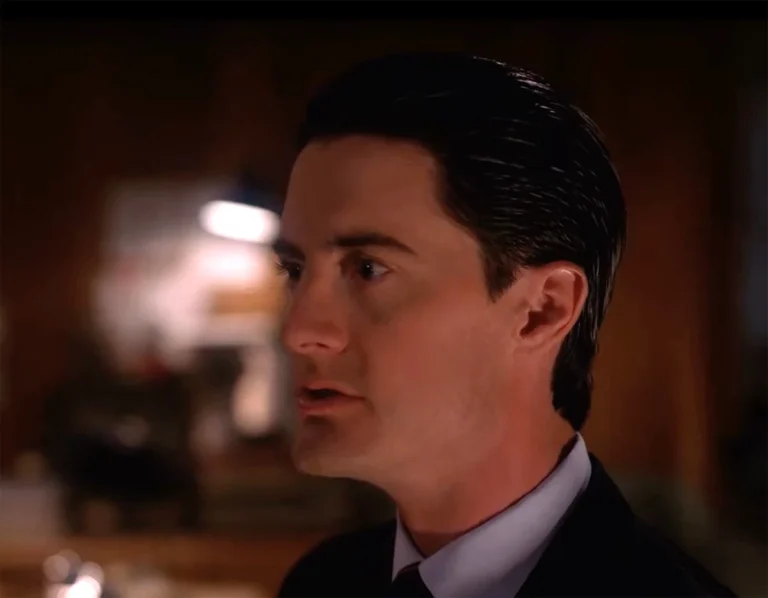
Television
Twin Peaks: Season 2
A detailed Twin Peaks Season 2 dossier: all 22 episodes, the killer’s revelation, ensemble, production history, performance, finale and research sources.
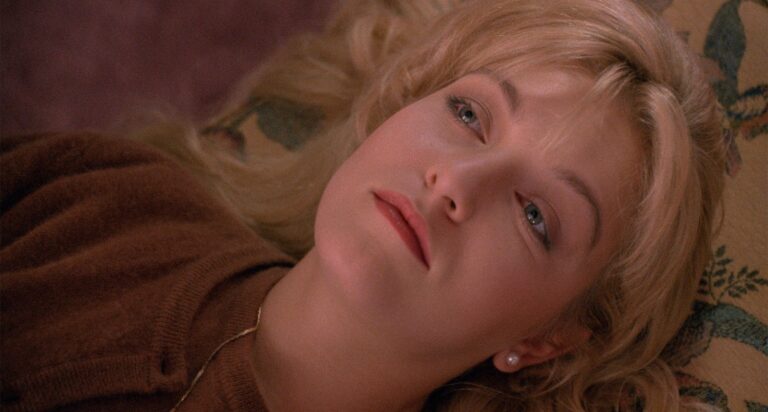
Films
Twin Peaks: Fire Walk with Me
A sourced guide to Twin Peaks: Fire Walk with Me: Laura Palmer, Sheryl Lee’s performance, image and sound, The Missing Pieces and the film’s changing reception.
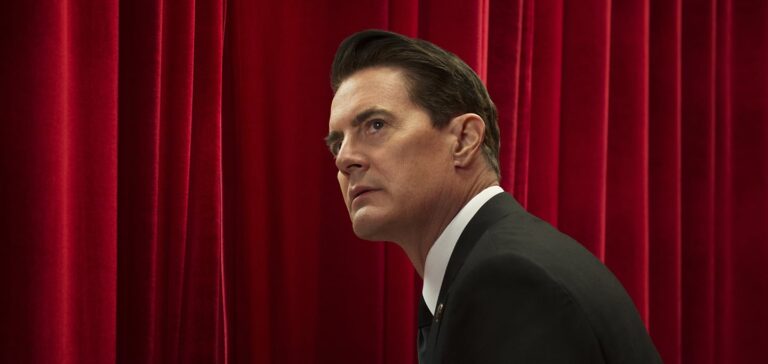
Television
Twin Peaks: The Return
Explore all 18 parts of Twin Peaks: The Return through performance, Part 8, effects, sound, editing, the ending and documented production sources.
Image credits and sources accompany each linked guide.